
Exclusive
What Trump Said About the U.S. Economy at Davos — and What the Data Reveals

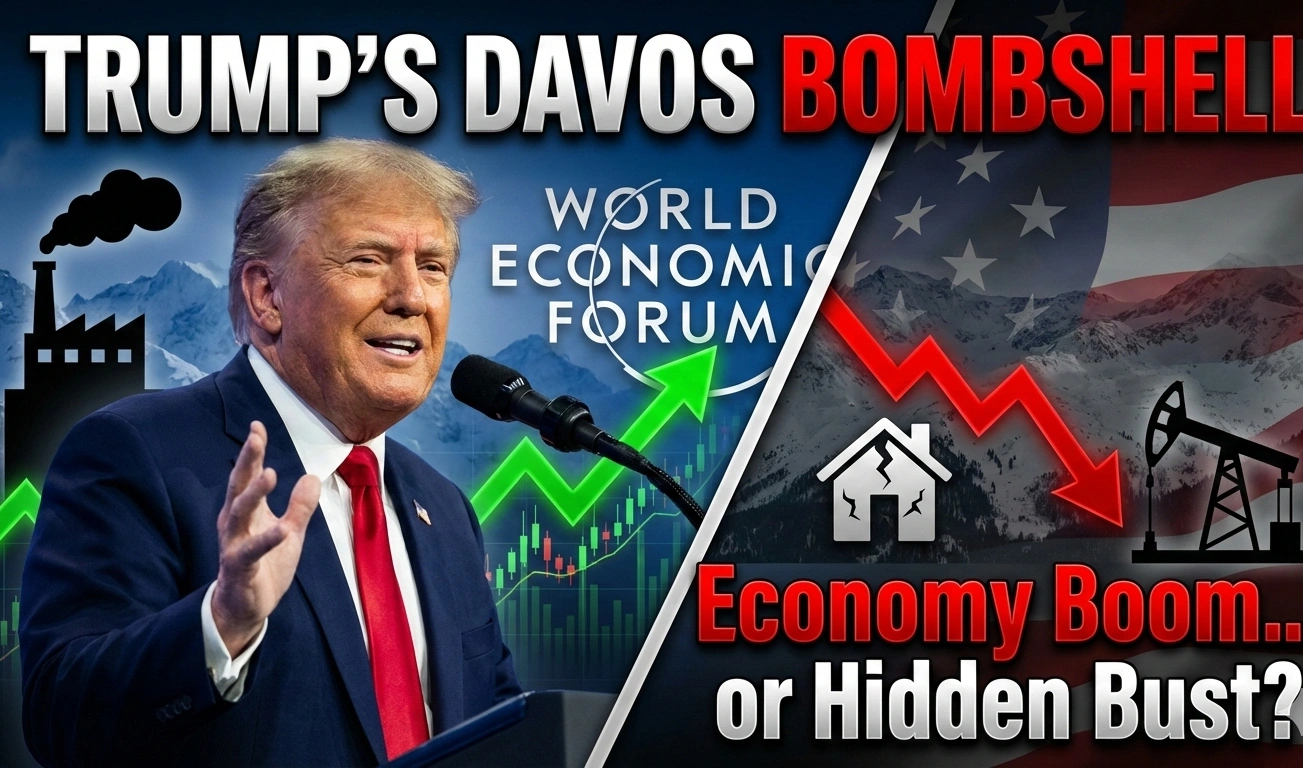
The alpine air in Davos was brisk on January 23, 2026, but the atmosphere inside the Congress Centre was even icier. President Donald Trump, addressing the World Economic Forum via video link for the second time in his current term, delivered a characteristically bold assessment of the American economy—one that painted a portrait of roaring industrial revival, plummeting energy costs, and imminent housing affordability.
His tone was triumphant, his claims sweeping. Yet in the ornate hall where global elites gathered, the reaction was notably muted. Polite applause punctuated pauses, but skeptical glances were exchanged among finance ministers and CEOs who’ve been parsing the actual trajectory of U.S. economic indicators since Trump’s so-called “Liberation Day” tariffs took effect last April.
Trump’s Davos economy speech in 2026 was vintage political theater—part victory lap, part sales pitch to international investors. He touted a manufacturing renaissance driven by his tariff regime, pledged to make America a “nation of owners, not renters,” and criticized European energy policy while boasting of American dominance at the pump. These proclamations resonated with his domestic base watching from home, but they landed awkwardly among an audience acutely aware of contradictory data emerging from U.S. federal agencies, independent research institutions, and global markets.
This disconnect between rhetoric and reality isn’t merely academic. As the world’s largest economy navigates an era of protectionist trade policy, elevated interest rates, and geopolitical volatility, understanding what Trump actually said at Davos—and how it compares to verifiable economic data—matters profoundly for investors, policymakers, and citizens alike. What follows is a rigorous examination of the president’s key claims, measured against the latest available evidence from the Bureau of Labor Statistics, Federal Reserve databases, energy markets, and housing sector analytics.
Key Highlights From Trump’s Davos 2026 Address
President Trump’s virtual address touched on several core economic themes that have defined his second term. Here are the most significant quotes and policy assertions from his speech:
- On tariffs and manufacturing: “We’ve unleashed the greatest factory boom in American history. Companies are pouring back into our country because they know tariffs mean business stays home. The Liberation Day tariffs are working exactly as planned.”
- On housing affordability: “We’re going to make America a nation of owners again, not renters. Homeownership is the American Dream, and my administration is cutting through red tape and bringing down costs so every family can achieve it.”
- On energy dominance: “American energy is the cheapest in the world. While Europe pays through the nose for inefficient green policies, Americans are filling up their tanks for less than they have in years. We’re producing more oil and gas than ever before.”
- On trade negotiations: “Countries that have ripped us off for decades are finally coming to the table with fair deals. We’re not backing down. America First means America wins.”
- On global competitiveness: “Investment is flooding into the United States. The world knows we’re the safest, strongest economy on the planet, and that’s not changing under my watch.”
These talking points were delivered with Trump’s characteristic confidence, designed to project strength and economic competence to both domestic and international audiences. But each claim invites scrutiny against measurable outcomes.

Tariffs and Trade Policy: Manufacturing Boom or Industrial Backfire?
Perhaps no aspect of Trump’s economic agenda has been more contentious than his aggressive use of tariffs. The “Liberation Day” tariffs announced on April 2, 2025, imposed sweeping levies on imports from China, the European Union, and other major trading partners—ostensibly to protect American manufacturing and force better trade terms. At Davos, Trump framed this policy as an unqualified success, claiming it sparked a “factory boom” that’s bringing industrial jobs flooding back to American shores.
The data tells a markedly different story. According to the Bureau of Labor Statistics, U.S. manufacturing employment has declined in seven of the nine months following the April 2025 tariff implementation. The sector shed approximately 43,000 jobs between April and December 2025, with particularly steep losses in auto parts manufacturing, electronics assembly, and metals fabrication—industries heavily dependent on integrated global supply chains that tariffs disrupted.
More revealing still is the trajectory of factory construction spending, a leading indicator of long-term industrial investment confidence. Federal Reserve Economic Data (FRED) from the St. Louis Fed tracks this metric closely through its TLMFGCONS series, which measures total manufacturing construction spending in millions of dollars. This data shows factory construction spending peaked in mid-2024 at approximately $225 billion annually, then began a steady decline through October 2025 (the most recent data available), falling to roughly $198 billion—a drop of about 12% that coincides almost precisely with the tariff rollout and subsequent supply chain reconfiguration costs.
The disconnect between Trump’s triumphalist rhetoric and these government statistics isn’t easily explained away. Economists at the Peterson Institute for International Economics have noted that while some reshoring announcements made headlines in 2025, many represented planned investments predating the tariffs, while others were subsequently canceled or scaled back as companies confronted the reality of higher input costs and retaliatory measures from trading partners.
The European Union’s counter-tariffs on American agricultural exports, for instance, have devastated Midwest soybean farmers—a politically sensitive constituency that Trump carried heavily in 2024. China’s pivot toward Brazilian and Argentine suppliers for industrial commodities has cost U.S. producers an estimated $18 billion in lost export revenue since mid-2025, according to the U.S. Department of Agriculture.
What Trump didn’t mention at Davos were these unintended consequences: rising input costs for American manufacturers who depend on imported components, retaliatory tariffs hammering export-oriented sectors, and investment hesitation as companies await clarity on whether tariff rates represent permanent policy or negotiating theater. The National Association of Manufacturers—hardly a liberal advocacy group—issued a cautious statement in December 2025 noting that while some tariff protections benefited specific industries, the overall impact had been “mixed at best” with supply chain disruptions offsetting gains.
Financial markets have reflected this ambiguity. The S&P Manufacturing PMI has hovered around the 50-point threshold separating expansion from contraction for most of late 2025, suggesting an industrial sector treading water rather than surging forward. For context, the manufacturing PMI averaged 52.8 in 2023 and 51.6 in 2024—both higher than the current reading, despite those years preceding Trump’s “factory boom” tariffs.
Housing Affordability: Bold Promises Meet Stubborn Market Realities
Trump’s pledge to transform America into “a nation of owners, not renters” resonated emotionally at Davos, tapping into a deep anxiety about housing affordability that transcends partisan divisions. The president pointed to regulatory rollbacks his administration has pursued, including attempts to streamline federal environmental reviews for residential development and pressure on local zoning boards to permit higher-density construction.
Yet housing affordability in January 2026 remains stubbornly elusive for most American households. The median existing home price stands at approximately $412,000 according to the National Association of Realtors—up 4.8% from January 2025 and nearly 47% higher than pre-pandemic levels in early 2020. Meanwhile, mortgage rates, while down slightly from their 2023 peaks, remain elevated at around 6.7% for a 30-year fixed-rate loan as of mid-January 2026, according to Freddie Mac’s Primary Mortgage Market Survey.
This combination—high prices plus high borrowing costs—has crushed affordability for first-time buyers. The monthly payment on that median-priced home with a standard 20% down payment now exceeds $2,200, compared to roughly $1,400 in early 2020. Real wage growth, while positive in some sectors, hasn’t kept pace. The result: homeownership rates have actually ticked downward slightly since Trump took office in January 2025, from 65.7% to 65.4% as of Q4 2025, per Census Bureau data.
The core challenge Trump’s rhetoric glosses over is supply. The United States has underbuilt housing for more than a decade relative to household formation, creating a structural deficit economists estimate at 3-4 million units. Regulatory streamlining—while potentially helpful at the margins—cannot quickly overcome labor shortages in construction (a sector that lost workers during the pandemic and hasn’t fully recovered), elevated materials costs (partly driven by tariffs on imported lumber and steel), and local political resistance to density that federal policy struggles to override.
Trump’s housing proposals have focused heavily on demand-side interventions—tax credits for first-time buyers, pressure on the Federal Reserve to lower interest rates—while offering less concrete action on supply constraints. The Federal Reserve, notably, has maintained its benchmark interest rate in the 4.25-4.50% range through early 2026, citing persistent inflation concerns partly related to tariff-driven price increases, effectively limiting how much mortgage rates can fall in the near term.
At Davos, Trump criticized rental markets and institutional investors purchasing single-family homes, rhetoric that polls well but doesn’t address why those investors find the market attractive in the first place: insufficient supply creates pricing power. Without a credible, large-scale plan to accelerate homebuilding—particularly affordable starter homes—the homeownership dream Trump invoked remains out of reach for millions.
Energy Dominance: Low Pump Prices and the European Contrast
On energy, Trump’s Davos messaging was characteristically combative. He contrasted what he described as America’s energy abundance and low consumer prices with Europe’s expensive, unreliable renewable transition—a critique designed to validate his administration’s “drill, baby, drill” philosophy and continued support for fossil fuel production.
Here, Trump’s claims align more closely with observable reality—though not quite as cleanly as his speech suggested. The average price of regular gasoline in the United States in mid-January 2026 sits at approximately $3.18 per gallon, according to AAA data. This represents a meaningful decline from the $3.85 average a year prior and is well below the peak of nearly $5.00 reached in summer 2022. American consumers are indeed paying less at the pump than most European counterparts, where taxes and carbon pricing keep fuel costs significantly higher.
U.S. crude oil production has remained robust, averaging about 13.2 million barrels per day in late 2025—near record levels—according to the Energy Information Administration. Natural gas production similarly continues at historic highs, supporting both domestic consumption and liquefied natural gas (LNG) exports that have made the United States a major global supplier, particularly to Europe following the disruption of Russian pipeline gas.
However, Trump’s portrayal omits crucial context. First, much of America’s oil and gas production boom predates his current term, accelerating during the 2010s shale revolution under both Obama and first-term Trump policies. Current production levels largely reflect long-cycle investments made years ago, plus market dynamics (higher global prices incentivizing drilling) rather than specific Trump administration actions since January 2025.
Second, while pump prices have fallen, this owes considerably to global crude oil market conditions—including OPEC+ production discipline weakening, demand growth in China slowing, and mild winter weather in the Northern Hemisphere reducing heating fuel consumption. The president’s energy policies, which primarily involve expanding federal leasing for drilling and rolling back emissions regulations, contribute at the margins but don’t singularly determine prices set in global markets.
Third, Trump’s critique of European energy policy ignores the rationale driving it: long-term energy security and climate mitigation. European leaders at Davos—while diplomatically refraining from direct rebuttals—have argued consistently that initial transition costs will yield strategic independence from volatile fossil fuel suppliers and position Europe competitively in clean technology manufacturing. Whether that bet pays off remains uncertain, but dismissing it as mere inefficiency oversimplifies a complex strategic calculation.
The energy picture Trump painted is thus partially accurate—Americans benefit from abundant domestic resources and relatively low prices—but his framing omits market complexities and overstates his administration’s causal role in outcomes substantially shaped by factors beyond presidential control.
Broader Implications for the U.S. and Global Economy in 2026
Stepping back from individual claims, Trump’s Davos appearance reflected a fundamental tension in his economic approach: confidence-building narratives aimed at sustaining business and consumer sentiment versus tangible policy outcomes that frequently disappoint the rhetoric’s promises.
From a global investor perspective, the United States retains substantial advantages—deep capital markets, technological leadership in AI and biotech, rule of law, and demographic dynamism relative to aging competitors like Japan and much of Europe. These structural strengths mean capital continues flowing into dollar-denominated assets despite policy uncertainties. U.S. equity markets have performed reasonably well through early 2026, with the S&P 500 up modestly year-to-date, suggesting investors see growth continuing even if not at the torrid pace Trump advertises.
Yet risks are accumulating. The tariff regime has introduced unpredictability into supply chains and raised costs that companies are increasingly passing to consumers, contributing to inflation persistence that constrains Federal Reserve flexibility. Manufacturing weakness, if sustained, could ripple into broader labor markets. Housing unaffordability threatens to become a generational crisis, with implications for wealth accumulation and social mobility. Trade partners are diversifying away from dollar dependence and U.S. supply chains where possible—a slow-moving but significant shift.
Economists surveyed by the Financial Times in early January projected U.S. GDP growth of 2.1% for 2026—solid but unspectacular, and down from 2.5% in 2025. Inflation is expected to remain around 2.8-3.0%, above the Fed’s 2% target, partly due to tariff effects. Unemployment, currently at 4.1%, is forecast to edge up slightly as labor demand softens. This is hardly a crisis scenario, but neither is it the “greatest economy ever” Trump routinely invokes.
The Davos audience—sophisticated actors who allocate capital based on probabilities, not slogans—likely digested Trump’s speech with professional detachment. They understand political leaders must project optimism. But they also track hard data, and that data suggests an economy of contradictions: resilient fundamentals shadowed by self-inflicted policy wounds, rhetorical confidence masking sectoral stress, and a president whose economic promises consistently outpace deliverable results.
Conclusion: Parsing Rhetoric From Reality in an Election Season
Trump’s Davos economy speech in 2026 was quintessential political communication—designed to shape perception, rally supporters, and project American strength to global elites. For those inclined to support the president, it offered reassurance that his policies are working. For skeptics, it provided fresh evidence of a widening gap between political messaging and economic fundamentals.
The reality, as data demonstrates, is more nuanced than either Trump’s boosters or critics typically acknowledge. Manufacturing isn’t booming, but neither has it collapsed. Housing affordability remains a serious challenge, yet homeownership rates haven’t cratered. Energy production is strong, though not uniquely attributable to current policies. Tariffs have created winners and losers, with aggregate effects tilting negative but not catastrophic.
What matters most for Americans trying to navigate this landscape—whether as workers, investors, or voters—is maintaining clear-eyed assessment grounded in verifiable information. Presidential speeches at global forums like Davos will always blend aspiration with salesmanship. The antidote is rigorous engagement with data from non-partisan sources: the Bureau of Labor Statistics for employment, the Federal Reserve for construction and monetary policy, the Census Bureau for housing, and the Energy Information Administration for production and prices.
As 2026 unfolds and another election cycle looms, these numbers—not political rhetoric—will determine whether Trump’s economic legacy is ultimately judged as successful stewardship or overpromised underdelivery. The Davos speech offered a preview of the narrative he’ll run on. The data provides the standard against which that narrative must be measured.
Discover more from The Economy
Subscribe to get the latest posts sent to your email.


Every decade or so, a headline announces that the petrodollar is dying. Every decade, the dollar proves those headlines wrong. The reason is simple, and it is buried inside a category error that has misled analysts, alarmed investors, and distorted foreign policy debates for fifty years: the petrodollar, as most people understand it, does not exist.
Here is what the data actually show. According to the Federal Reserve’s 2025 International Dollar Report, the US dollar still accounts for 58 percent of disclosed global foreign exchange reserves, roughly 88 percent of all foreign exchange transactions, and approximately 50 percent of international SWIFT payments — a share that has increased slightly in recent years. The dollar’s throne looks nothing like what the doomsday narrative describes. Understanding why requires dismantling a myth that has been half a century in the making.
What People Actually Mean by “Petrodollar”
A 1974 Diplomatic Arrangement — Not a Treaty
The petrodollar story begins, as most origin myths do, with a grain of truth. In the wake of the 1973 oil embargo, US Treasury Secretary William Simon and his deputy Gerry Parsky flew to Riyadh. The deal they assembled was elegant in its symmetry: Saudi Arabia would price oil in dollars and reinvest surplus earnings — “petrodollars” — into US Treasury securities. In exchange, Washington provided security guarantees and weapons. The arrangement was, as one State Department cable noted, a geopolitical masterstroke. But it was never a formal treaty, never legally binding across OPEC, and never the singular mechanism underwriting global dollar supremacy.
The Recycling Mechanism That Became a Myth
“Petrodollar recycling” — the idea that oil revenues flow from Riyadh back to Wall Street, endlessly funding US deficits — became doctrine in investment banks and think tanks alike. The problem is that the underlying arithmetic has quietly collapsed. Brad Setser at the Council on Foreign Relations documented the erosion with characteristic precision in early 2026: Saudi Arabia ran fiscal deficits in both 2024 and 2025. The Kingdom was a net drain on global dollar liquidity, not a supplier of it. Aramco and the Public Investment Fund were issuing international bonds. Riyadh was borrowing to fund its Vision 2030 ambitions, not recycling surplus petrodollars into Treasuries. “The glory days of the petrodollar,” Setser wrote, “are over.” What was never quite a system has, in its most literal form, ceased to function.
Why the Phrase Is Economically Misleading
Invoicing ≠ Reserve Architecture
The core error in petrodollar thinking is conflating trade invoicing with reserve currency architecture. These are not the same thing, and treating them as synonymous produces dangerous conclusions.
A country that buys oil priced in dollars does not need to hold dollars indefinitely. It needs dollars transiently — long enough to settle the transaction. If that country holds euros, it enters the FX market for milliseconds, converts, pays, and moves on. No accumulation required. The dollar’s commanding role as a reserve currency — held by central banks as a long-term store of sovereign wealth — is driven by entirely different forces: the depth and liquidity of US Treasury markets, the breadth of dollar-denominated derivative and lending markets, the dollar’s role as a global collateral asset, and the crisis-absorption capacity of the Federal Reserve through its network of swap lines.
An IMF working paper published in September 2025, drawing on data from 132 countries spanning 1990 to 2023, found precisely this: global dollar invoicing shares have remained broadly stable even as geopolitical fragmentation has accelerated, and there is “no robust evidence consistent with effective policy initiatives to reduce dollar reliance in oil exports.” Even countries geopolitically hostile to Washington continue to invoice in dollars because the network effects — embedded in contracts, hedging infrastructure, derivatives chains, and supply agreements — are not dismantled by political will alone.
The Network Effects That Actually Sustain Dollar Dominance
Harvard economist Gita Gopinath’s Dominant Currency Paradigm offers the cleaner explanation. Roughly 54 percent of global exports are invoiced in dollars, even though the United States accounts for a far smaller share of world trade. This is not the result of gunboat diplomacy or secret agreements. It is the result of network effects so deeply embedded that switching costs are prohibitive. Importers and exporters alike manage risk against a dollar baseline. Commodity markets from copper to cotton are priced in dollars. The derivative markets hedging those exposures are dollar-denominated. Changing the invoicing currency of oil does not collapse this architecture; it barely scratches it.
Dollar Shares Across Key Global Functions (2024–2025)
| Function | Dollar Share | Source |
|---|---|---|
| Global FX reserves | 56–58% | IMF COFER, Q2 2025 |
| FX transaction volume | 88% | BIS Triennial Survey 2022 |
| International SWIFT payments | ~50% (excl. intra-euro) | Federal Reserve, 2025 |
| Global export invoicing | ~54% | IMF/Gopinath, 2025 |
| Chinese firm trade invoicing (RMB) | ~25% (from 2024 data) | IMF Working Paper 2025 |
Sources: Federal Reserve; IMF COFER
Recent Developments That Expose the Myth
Saudi Deficits, Not Surpluses
The collapse of the petrodollar recycling mechanism is not speculative — it is fiscal arithmetic. With Brent crude averaging just under $70 per barrel through 2025, and Saudi Arabia’s balance-of-payments breakeven requiring roughly $90 per barrel on seven million barrels per day of exports, the Kingdom cannot generate the surpluses that the petrodollar story requires. The Gulf Cooperation Council surplus — once the engine of dollar recycling — had shrunk to roughly $200 billion in 2025 across Kuwait, UAE, Qatar, and Norway combined, with Saudi Arabia contributing a deficit of approximately $33 billion. The geopolitical story has not changed; the economic plumbing has. This is the real death of the petrodollar — not Saudi Arabia accepting yuan for oil, but Saudi Arabia having no surplus dollars to recycle at all.
The Yuan’s Modest Rise and Structural Limits
China has made genuine inroads. Yuan-settled oil trades with Russia have expanded. France’s TotalEnergies completed a modest LNG transaction with China priced in yuan in early 2024. China’s Cross-Border Interbank Payment System (CIPS) now handles approximately 30 percent of China’s cross-border trade settlements. And yet: the renminbi accounts for just 2 percent of global foreign exchange reserves and under 1 percent of global trade invoicing outside China’s direct trading partners. Capital controls, limited financial market depth, and the absence of a deep, liquid sovereign bond market comparable to US Treasuries create structural ceilings the yuan cannot penetrate through political ambition alone.
BRICS Digital Settlement: Signal or Noise?
The BRICS 2025 Johannesburg summit confirmed active prototyping of a commodity-backed digital settlement instrument. Technical working groups are simulating blockchain-based multi-currency settlements. This is real, and it signals genuine geopolitical momentum. But it also illustrates exactly why “reserve currency transitions take decades” — as the IMF has repeatedly stated. Creating a settlement instrument is the first step in a sequence that ends, much later, with reserve accumulation, financial depth, and crisis absorption. The dollar completed that sequence over 80 years, backed by two World Wars, Bretton Woods, and an incomparably liquid Treasury market. No announcement from Johannesburg accelerates that timeline meaningfully.
Policy and Market Implications
What Investors Are Getting Wrong
The perpetual “death of the petrodollar” trade — short dollars, long gold, long yuan assets — has failed repeatedly for the same structural reason: it mistakes political signaling for financial architecture replacement. The dollar’s share of global reserves has declined from 71 percent in 1999 to approximately 56 percent today, a real and meaningful shift. But that shift has not flowed to the yuan (at 2 percent, it barely registers). It has flowed to non-traditional reserve currencies: Canadian and Australian dollars, the Swiss franc, and — critically — gold. Central banks purchased a combined 2,082 tonnes of gold in 2023 and 2024, the fastest accumulation pace since World War I. This is diversification within a dollar-dominated system, not flight from it.
What Policymakers Should Actually Watch
The genuine vulnerability is not oil invoicing — it is US fiscal credibility and the weaponization of dollar infrastructure. The use of sanctions against Russia in 2022 demonstrated that dollar-denominated financial networks can be deployed as geopolitical weapons. That demonstration has accelerated the search for alternatives among countries that fear finding themselves on the wrong side of US foreign policy. This is the real mechanism of dollar erosion: not oil trades in yuan, but the slow construction of parallel payment rails — Russia’s SPFS, CIPS, and bilateral swap agreements — that reduce exposure to SWIFT cutoffs.
What Comes Next — Scenarios and Recommendations
The dollar will not collapse. Reserve currency transitions historically require financial architecture migration across decades, not policy press releases. But three distinct scenarios deserve attention from policymakers and strategists alike.
Scenario A — Status Quo Drift: Dollar dominance persists at 55–60 percent of reserves through 2035, with slow, non-disruptive diversification into non-traditional currencies and gold. Most likely outcome.
Scenario B — Accelerated Fragmentation: A major US fiscal shock (debt ceiling crisis, sovereign downgrade) or expanded sanctions regime triggers faster reallocation. Reserve share falls below 50 percent by 2032. Tail risk, but not negligible.
Scenario C — Bipolar Settlement Architecture: BRICS digital settlement becomes operational and widely adopted among the Global South, creating a parallel but interoperable system alongside SWIFT. Dollar share stable in Western bloc; declining in BRICS+ corridor. Emerging over 10–15 years.
For policymakers in Washington, the lesson is counterintuitive: the greatest threat to dollar dominance is not Saudi Arabia pricing oil in yuan. It is overusing the dollar’s weaponized infrastructure to the point that adversaries and neutrals alike invest in exits. For investors, the lesson is simpler: stop betting against the dollar’s architecture because its mythology is fraying. The myth was never what held it up.
Conclusion
The petrodollar was always more story than system — a convenient narrative that explained dollar hegemony through a single, dramatic bilateral agreement rather than through the far more prosaic reality of network effects, market depth, and institutional inertia. That narrative had consequences: it produced decades of misguided alarmism every time an oil deal was struck in yuan, and it distracted policymakers from the real vulnerabilities in dollar dominance. The dollar’s reign is long, its architecture is deep, and its nearest competitors remain structurally unready. The question is not whether the petrodollar is dying. It was never quite alive. The question is whether the United States will protect the actual foundations of monetary power — fiscal credibility, open capital markets, and restraint in financial weaponization — before those foundations quietly erode.
Discover more from The Economy
Subscribe to get the latest posts sent to your email.
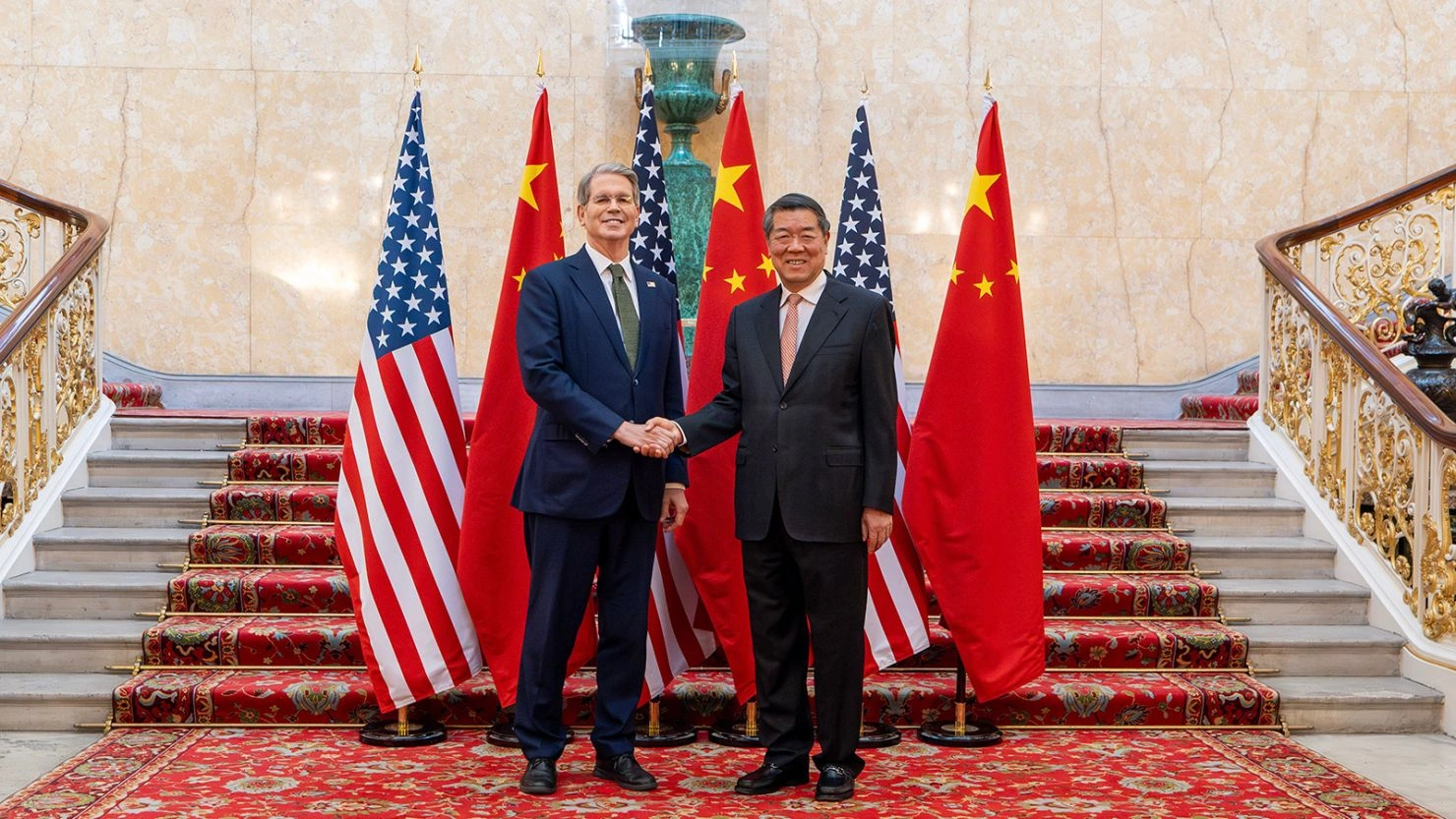
Bessent and He Lifeng meet at OECD Paris to review the Busan trade truce before Trump’s Beijing summit. Rare earths, Hormuz oil shock, and Section 301 cloud the path ahead.
The 16th arrondissement of Paris is not a place that announces itself. Discreet, residential, its wide avenues lined with haussmann facades, it is the kind of neighbourhood where power moves quietly. On Sunday morning, as French voters elsewhere in the city queued outside polling stations for the first round of local elections, a motorcade slipped through those unassuming streets toward the headquarters of the Organisation for Economic Co-operation and Development. Inside, the world’s two largest economies were attempting something rare in 2026: a structured, professional conversation.
Talks began at 10:05 a.m. local time, with Vice-Premier He Lifeng accompanied by Li Chenggang, China’s foremost international trade negotiator, while Treasury Secretary Scott Bessent arrived flanked by US Trade Representative Jamieson Greer. South China Morning Post Unlike previous encounters in European capitals, the delegations were received not by a host-country official but by OECD Secretary-General Mathias Cormann South China Morning Post — a small detail that spoke volumes. France was absorbed in its own democratic ritual. The world’s most consequential bilateral relationship was, once again, largely on its own.
The Stakes in Paris: More Than a Warm-Up Act
It would be tempting to dismiss the Paris talks as logistical scaffolding for a grander event — namely, President Donald Trump’s planned visit to Beijing at the end of March for a face-to-face with President Xi Jinping. That reading would be a mistake. The discussions are expected to cover US tariff adjustments, Chinese exports of rare earth minerals and magnets, American high-tech export controls, and Chinese purchases of US agricultural commodities CNBC — a cluster of issues that, taken together, constitute the structural skeleton of the bilateral relationship.
Analysts cautioned that with limited preparation time and Washington’s strategic focus consumed by the US-Israeli military campaign against Iran, the prospects for any significant breakthrough — either in Paris or at the Beijing summit — remain constrained. Investing.com As Scott Kennedy, a China economics specialist at the Center for Strategic and International Studies, put it with characteristic precision: “Both sides, I think, have a minimum goal of having a meeting which sort of keeps things together and avoids a rupture and re-escalation of tensions.” Yahoo!
That minimum — preserving the architecture of the relationship, not remodelling it — may, in the current environment, be ambitious enough.
Busan’s Ledger: What Has Been Delivered, and What Has Not
The two delegations were expected to review progress against the commitments enshrined in the October 2025 trade truce brokered by Trump and Xi on the sidelines of the APEC summit in Busan, South Korea. Yahoo! On certain metrics, the scorecard is encouraging. Washington officials, including Bessent himself, have confirmed that China has broadly honoured its agricultural obligations under the deal Business Standard — a meaningful signal at a moment when diplomatic goodwill is scarce.
The soybean numbers are notable. China committed to purchasing 12 million metric tonnes of US soybeans in the 2025 marketing year, with an escalation to 25 million tonnes in 2026 — a procurement schedule that begins with the autumn harvest. Yahoo! For Midwestern farmers and the commodity desks that serve them, these are not abstractions; they are the difference between a profitable season and a foreclosure notice.
But the picture darkens considerably when attention shifts to critical materials. US aerospace manufacturers and semiconductor companies are experiencing acute shortages of rare earth elements, including yttrium — a mineral indispensable in the heat-resistant coatings that protect jet engine components — and China, which controls an estimated 60 percent of global rare earth production, has not yet extended full export access to these sectors. CNBC According to William Chou, a senior fellow at the Hudson Institute, “US priorities will likely be about agricultural purchases by China and greater access to Chinese rare earths in the short term” Business Standard at the Paris talks — a formulation that implies urgency without optimism.
The supply chain implications are already registering. Defence contractors reliant on rare-earth permanent magnets for guidance systems, electric motors in next-generation aircraft, and precision sensors are operating on diminished buffers. The Paris talks, if they yield anything concrete, may need to yield this above all.
A New Irritant: Section 301 Returns
Against this backdrop of incremental compliance and unresolved bottlenecks, the US side has introduced a fresh complication. Treasury Secretary Bessent and USTR Greer are bringing to Paris a new Section 301 trade investigation targeting China and 15 other major trading partners CNBC — a revival of the legal mechanism previously used to justify sweeping tariffs during the first Trump administration. The signal it sends is deliberately mixed: Washington is simultaneously seeking to consolidate the Busan framework and reserving the right to escalate it.
For Chinese negotiators, the juxtaposition is not lost. Beijing has staked considerable domestic political credibility on the proposition that engagement with Washington produces tangible results. A Section 301 investigation, even if procedurally nascent, raises the spectre of a new tariff architecture layered atop the existing one — and complicates the case for continued compliance within China’s own policy bureaucracy.
The Hormuz Variable: When Geopolitics Enters the Room
No diplomatic meeting in March 2026 can be quarantined from the wider strategic environment, and the Paris talks are no exception. The ongoing US-Israeli military campaign against Iran has introduced a variable of potentially severe economic consequence: the partial closure of the Strait of Hormuz, the narrow waterway through which approximately a fifth of the world’s oil passes.
China sources roughly 45 percent of its imported oil through the Strait, making any disruption there a direct threat to its industrial output and energy security. Business Standard After US forces struck Iran’s Kharg Island oil loading facility and Tehran signalled retaliatory intent, President Trump called on other nations to assist in protecting maritime passage through the Strait. CNBC Bessent, for his part, issued a 30-day sanctions waiver to permit the sale of Russian oil currently stranded on tankers at sea CNBC — a pragmatic, if politically contorted, attempt to soften the energy-price spike.
For the Paris talks, the Hormuz dimension introduces a paradox. China has an acute economic interest in stabilising global oil flows and might, in principle, be receptive to coordinating with the United States on maritime security. Yet Beijing’s deep reluctance to be seen as endorsing or facilitating US-led military operations in the Middle East constrains how far it can go. The corridor between shared interest and political optics is narrow.
What Trump Wants in Beijing — and What Xi Can Deliver
With Trump’s Beijing visit now functioning as the near-term endpoint of this diplomatic process, the outlines of a summit package are beginning to take shape. The US president is expected to seek major new Chinese commitments on Boeing aircraft orders and expanded purchases of American liquefied natural gas Yahoo! — both commercially significant and symbolically resonant for domestic audiences. Boeing’s recovery from years of regulatory and reputational turbulence has made its order book a quasi-barometer of US industrial confidence; LNG exports represent a strategic diversification of American energy diplomacy.
For Xi, the calculus involves threading a needle between delivering enough to make the summit worthwhile and conceding so much that it invites criticism at home from nationalist constituencies already sceptical of engagement. China’s state media has consistently characterised the Paris talks as a potential “stabilising anchor” for an increasingly uncertain global economy Republic World — language carefully chosen to frame engagement as prudent statecraft rather than capitulation.
The OECD itself, whose headquarters serves as neutral ground for today’s meeting, cut its global growth forecast earlier this year amid trade fragmentation fears — underscoring that the bilateral relationship between Washington and Beijing carries systemic weight far beyond its two principals. A credible summit, even one short of transformative, would send a signal to investment desks and central banks from Frankfurt to Singapore that the world’s two largest economies retain the institutional capacity to manage their rivalry.
The Road to Beijing, and Beyond
What happens in the 16th arrondissement today will not resolve the structural tensions that define the US-China relationship in this decade. The rare-earth bottleneck is systemic, not administrative. The Section 301 investigation reflects a bipartisan American political consensus that China’s industrial subsidies represent an existential competitive threat. And the Iran war has introduced a geopolitical variable that neither side fully controls.
But the Paris talks serve a purpose that transcends their immediate agenda. They demonstrate, to a watching world, that diplomacy between great powers remains possible even as military operations unfold and supply chains fracture. They keep open the channels through which, eventually, more durable arrangements might be negotiated — whether at a Beijing summit, at the G20 in Johannesburg later this year, or in another European capital where motorcades slip, unannounced, through quiet streets.
The minimum goal, as CSIS’s Kennedy observed, is avoiding rupture. In the spring of 2026, with the Strait of Hormuz partially closed and yttrium shipments stalled, that minimum has acquired the weight of ambition.
Discover more from The Economy
Subscribe to get the latest posts sent to your email.

On a Friday afternoon in early March, Boeing’s stock did something it hadn’t done in months: it surged. Shares of the aerospace giant jumped as much as 4 percent — the best performance on the Dow Jones Industrial Average that day — after Bloomberg reported that the company is closing in on one of the largest aircraft sales in its 109-year history. The prize: a 500-aircraft order for 737 Max jets from China, to be unveiled when President Donald Trump makes his first state visit to Beijing since 2017 — scheduled for March 31 to April 2.
If confirmed, the deal would represent nothing less than Boeing’s formal re-entry into the world’s second-largest aviation market after years of diplomatic cold-shouldering, safety-related groundings, and trade-war turbulence. It would also cement a pattern that has quietly defined Trump’s second term: the systematic use of America’s largest exporter as a diplomatic sweetener in geopolitical negotiations.
The Numbers Behind the Boeing 737 Max China Deal
Let’s be precise about what is reportedly on the table. According to people familiar with the negotiations cited by Bloomberg, the headline figure is 500 Boeing 737 Max jets — narrowbody, single-aisle workhorses that form the backbone of Chinese domestic aviation. Separately, the two sides are in advanced discussions over a widebody package of approximately 100 Boeing 787 Dreamliners and 777X jets, though that portion of the deal is expected to be announced at a later date and would not feature in the Trump-Xi summit communiqué.
At current list prices — the 737 Max 8 carries a sticker price of roughly $101 million per aircraft — the narrowbody package alone would approach $50 billion in nominal terms before the standard deep discounts that large airline orders attract. Factor in the widebody tranche, and the full package could eventually represent the single largest bilateral aviation deal ever struck between the United States and China.
Boeing itself declined to comment. China’s Ministry of Commerce did not respond to requests outside regular hours. The White House offered no immediate statement. But the market spoke clearly enough.
A Decade of Order Drought — and Why China Needs Boeing Now
To appreciate the magnitude of this potential agreement, consider the context. China once made up roughly 25 percent of Boeing’s order book. Today, Boeing holds only 133 confirmed orders from Chinese airlines — approximately 2 percent of its total book. Investing.com That collapse in Chinese demand was not accidental. It was the deliberate consequence of a cascade of crises: the global grounding of the 737 Max following two fatal crashes in 2018 and 2019, the trade tensions of Trump’s first term, and the pandemic-era freeze on civil aviation procurement.
Yet Chinese airlines have been quietly suffocating under constrained fleet capacity. Aviation analysts and industry sources say China needs at least 1,000 imported planes to maintain growth and replace older aircraft. WKZO The country’s carriers — Air China, China Eastern, China Southern — are operating aging fleets while passenger demand has rebounded sharply. The arithmetic of Chinese aviation is unforgiving: a country of 1.4 billion people, a rapidly expanding middle class, and a domestic network that still relies heavily on Western-certified jet technology cannot simply wait indefinitely for political stars to align.
Beijing has also been hedging. China is simultaneously in talks for another 500-jet order with Airbus that would be in addition to any Boeing deal — negotiations that have been in on-off discussions since at least 2024. WKZO But Airbus has its own capacity constraints and delivery backlogs. The reality is that both European and American planemakers are needed to feed China’s aviation appetite, which gives Boeing considerable strategic leverage — if it can navigate the politics.
Trump’s Boeing Diplomacy: A Playbook Refined
There is a recognizable pattern here, and it is worth naming explicitly. Trump has used Boeing as a tool to sweeten accords with other governments Yahoo Finance, and the China deal fits squarely within that framework. Earlier in his second term, large Boeing orders from Gulf carriers and Southeast Asian airlines followed Trump diplomatic visits — deals that generated political headlines and tangible employment commitments in American manufacturing states.
The Beijing summit, however, would be the most significant deployment of this strategy yet. US-China trade tensions have been acute in early 2026. Trump threatened to impose export controls on Boeing plane parts in Washington’s response to Chinese export limits on rare earth minerals. Yahoo Finance During earlier trade clashes, Beijing ordered Chinese airlines to temporarily stop taking deliveries of new Boeing jets — before resuming later that spring. WKZO
That on-off pattern illustrates the extraordinary vulnerability of commercial aviation to geopolitical temperature. Unlike soybeans or semiconductors, a Boeing 737 Max is not a fungible commodity. It requires years of certified maintenance infrastructure, pilot training, and regulatory framework built around American aviation standards. Both sides know this, which is precisely why aircraft orders have become such potent bargaining chips.
The planned summit structure — Trump in Beijing from March 31 to April 2, followed by Xi visiting Washington later in the year — also suggests a two-stage negotiation architecture. The 737 Max order would serve as a confidence-building gesture at the first meeting; the widebody 787 and 777X tranche would follow as trust is consolidated.
Boeing’s Recovery Trajectory: Why Timing Matters
For Boeing CEO Kelly Ortberg, the timing of a China breakthrough could scarcely be more critical. Boeing’s total company backlog grew to a record $682 billion in 2025, primarily reflecting 1,173 commercial aircraft net orders for the year, with all three segments at record levels. Boeing Yet the Chinese market has remained conspicuously absent from that recovery story.
Boeing has achieved FAA approval to increase 737 Max production to 42 jets per month, a significant step toward restoring manufacturing capacity, and the company plans to raise 787 Dreamliner output to 10 aircraft per month during 2026. Investing.com In short, for the first time in several years, Boeing actually has the industrial capacity to absorb a massive new order. Management has targeted approximately 500 737 deliveries in 2026 and 787 deliveries of roughly 90–100 aircraft, while targeting positive free cash flow of $1–3 billion for the year. TipRanks
A confirmed China order of this scale would not merely boost the backlog — it would validate the entire recovery narrative. It would signal to Wall Street that the 737 Max safety rebound is complete, that Chinese regulators have definitively recertified the aircraft, and that geopolitical risk has sufficiently receded to justify multi-year procurement commitments. As Reuters reported, Boeing’s share price rose 3.7 percent on the news — but analysts caution that several sticking points remain unresolved, and a deal is not yet assured.
Aviation Ripple Effects: What a China Mega-Deal Means for Global Travelers
The significance of a Boeing 737 Max China order in 2026 extends well beyond corporate balance sheets. Chinese carriers operating newer, more fuel-efficient 737 Max jets would dramatically expand route networks — both domestically and internationally. The 737 Max 10, capable of flying roughly 3,300 nautical miles at maximum range, opens trans-regional routes that older Chinese narrowbody fleets cannot economically serve.
For the global travel industry — and for the Expedia-era traveler booking multi-stop itineraries across Asia — this translates into more competitive airfares, denser flight schedules out of Chinese hub airports, and expanded connectivity between Chinese secondary cities and international destinations. Tourism economists estimate that each percentage point increase in seat capacity on a major international corridor correlates with a 0.6 to 0.8 percent increase in inbound tourist arrivals. A Chinese aviation expansion of this magnitude, fuelled by 500 new-generation jets, would register meaningfully in global travel demand forecasts through the late 2020s.
The geopolitical calculus cuts the other way too. Should talks collapse — perhaps due to escalation over Taiwan, renewed rare-earth export controls, or a postponement of the Trump visit, which Bloomberg noted could occur if the ongoing US-Iran situation deteriorates — Boeing’s China exposure remains an open wound rather than a healed scar.
Historical Context: The Ghosts of Boeing-China Deals Past
This would not be the first time a US presidential visit to China generated a headline Boeing order. In 2015, during Barack Obama’s final engagement with Xi Jinping, Chinese carriers placed orders for over 300 Boeing jets — a deal that at the time was celebrated as a pillar of the bilateral commercial relationship. It took less than four years for that relationship to unravel under the dual pressures of the MAX crisis and Trump’s first-term tariffs.
The lesson is not that such deals are illusory. It is that they are fragile by design — deeply dependent on the political weather. A Boeing 500-plane order tied to Trump’s Beijing summit is, in that sense, simultaneously a genuine commercial transaction and a diplomatic performance. Its durability will depend less on what is signed in Beijing in April than on what is negotiated, month by month, in the trade relationship that follows.
Forward Outlook: Promise, Risk, and the Long Game
Boeing’s aircraft stand to feature prominently in whatever trade framework emerges from the Trump-Xi summit. But seasoned observers of US-China commercial aviation will note that a similar mega-deal euphoria surrounded Airbus last year — and ultimately failed to materialize. Given the fraught geopolitical backdrop, Boeing’s order bonanza is not assured, and two people familiar with the talks have specifically cautioned that deal completion remains uncertain. Yahoo Finance
What is certain is this: the structural demand is real, the production capacity is finally in place, and the political incentive on both sides has rarely been stronger. For Boeing, recapturing even a fraction of what was once a market that constituted a quarter of its order book would represent a transformation of its strategic position. For China’s airlines, new Boeing jets mean competitive fleets, lower operating costs, and the capacity to serve a travelling public that has never stopped wanting to fly.
The planes, as ever, are ready. The question is whether the politics will let them take off.
Discover more from The Economy
Subscribe to get the latest posts sent to your email.

Luxury Wellness: The Monetization and Expansion of Boutique Low-Impact Training

Leveraging Viral AI & Climate Hashtags for Brand Growth on X

The Medicaid Churn: Front-End Revenue Cycle Risks for Enterprise Hospitals

The 2026 Crypto Regulatory Shift: What It Means for Institutional Investors

AI-Powered Training: The Next Multi-Billion Dollar Ecosystem in Fitness

BRICS Summit 2026: Economic Implications of the India-China Diplomatic Thaw

Emerging Market Debt: The Ripple Effect of China’s Sovereign Refinancing Role

Dropping Oil & Surging Gold: Navigating Safe-Haven Investments in Q3

2026 AI Stock Frenzy: How to Position Your Portfolio

The AI Disruption in Financial Risk Management: Moving Beyond Record Banking Profits

The Rise of Green Aviation: Balancing High Fuel Prices with Sustainable Infrastructure

US-China Relations in Q3 2026: Trade Tariffs and Supply Chain Risks

Emerging Markets Rebound: Top Stock Strategies for the Gulf and South Asia

Tackling the 2026 Global Food Crisis: Policy Shifts and Market Speculation

China Politburo July 2026: Stimulus Signals Explained

Russia Fuel Shortages 2026: Inside a Cracking War Economy

Top 15 Financial Stocks for Investment in PSX

State Farm’s $5B Dividend 2026: Who Qualifies & Payout Dates

Pakistan Passed Its Third IMF Review

SpaceX Stock Lockup Expiration Explained: Why $123B in Shares Could Hit the Market

Pakistan IMF Program 2026: Inside the Push Toward an Interest-Free Economy

Russia Oil Revenue 2026: How Sanctions on Rosneft and Lukoil Are Draining the War Chest

Andy Burnham, UK Gilts and Mortgages: July 2026 Explainer

Gold Price 2026: Why Bullion Has Fallen 25% From Its January Record High

Pakistan’s 2026 Monsoon Floods Threaten Fragile Economic Recovery as Inflation Nears 9%

Russia Oil Revenue 2026: The Iran War Windfall and What a Hormuz Deal Means for Moscow

Canada US Trade War 2026: Inside Carney’s Push to Cut Ties With Trump’s Tariffs

Russia’s Budget Deficit Blew Past Its Full-Year Target in Three Months
-

 Markets & Finance8 months ago
Top 15 Stocks for Investment in 2026 in PSX: Your Complete Guide to Pakistan’s Best Investment Opportunities
-

 Analysis6 months ago
Johor’s Investment Boom: The Hidden Costs Behind Malaysia’s Most Ambitious Economic Surge
-

 Analysis6 months ago
Top 10 Stocks for Investment in PSX for Quick Returns in 2026
-

 Analysis7 months ago
Brazil’s Rare Earth Race: US, EU, and China Compete for Critical Minerals as Tensions Rise
-

 Banks7 months ago
Best Investments in Pakistan 2026: Top 10 Low-Price Shares and Long-Term Picks for the PSX
-

 Investment8 months ago
Top 10 Mutual Fund Managers in Pakistan for Investment in 2026: A Comprehensive Guide for Optimal Returns
-

 Global Economy8 months ago
15 Most Lucrative Sectors for Investment in Pakistan: A 2025 Data-Driven Analysis
-

 Global Economy8 months ago
Pakistan’s Export Goldmine: 10 Game-Changing Markets Where Pakistani Businesses Are Winning Big in 2025