
Banks
Big Bonuses for South Korea’s Chip Workers Put Central Bank on Inflation Alert


South Korea’s central bank is keeping a close watch on the labor market after major semiconductor companies handed out substantial bonuses to chip workers, a development that risks adding to domestic inflationary pressure even as the country’s export-driven chip sector rides a wave of strong global demand. CNBC reported on the dynamic this week as part of its broader coverage of how the AI-driven chip boom is rippling through Asian economies.
A Sector Riding High
South Korea’s semiconductor industry, anchored by giants such as Samsung Electronics and SK Hynix, has been a major beneficiary of the global AI infrastructure buildout, with surging demand for memory chips and advanced logic components used in data centers worldwide. That strength has translated into outsized profitability — and, in turn, generous compensation for employees, with large bonus payouts highlighted by CNBC as a notable feature of this earnings cycle.
Why It Matters for Inflation
While strong corporate performance and rising worker pay might typically be welcomed, South Korea’s central bank is treating the trend as a potential inflation risk. Higher wages in a key export sector can flow through to broader consumer spending and wage expectations across the economy, complicating the central bank’s efforts to manage price stability — particularly at a moment when many of the region’s monetary authorities are already navigating elevated energy costs tied to the Iran conflict.
Part of a Broader Asian Monetary Policy Story
The South Korean situation fits into a wider pattern across Asia-Pacific central banks, several of which have been managing monetary policy amid a combination of energy cost pressures and rising AI-related capital and labor costs. Bank Indonesia’s recent rate hike cycle reflects similar concerns about imported inflation, while regional central banks broadly are weighing how to balance support for booming technology export sectors against the risk of overheating domestic price pressures.
What to Watch Next
Investors and policymakers will be watching whether the South Korean central bank moves to tighten policy further in response to wage-driven inflation risk, or whether it opts to look through the bonus-related pay bump as a one-off event tied to an unusually strong earnings cycle in the chip sector. The decision carries implications not just for South Korea’s currency and bond markets, but for how other Asian economies riding the AI supercycle calibrate their own policy responses to similar wage and profit windfalls.
Discover more from The Economy
Subscribe to get the latest posts sent to your email.


Opinion
Federal Reserve Defies White House Pressure: Inside Trump’s Demand for Sub-1% Interest Rates After Historic 2026 Rate Hike

The Eccles Building in Washington, D.C., home to the Federal Reserve Board of Governors.
Executive Summary
- The Decision: The Federal Open Market Committee (FOMC) voted 12–0 to raise the benchmark federal funds rate by 25 basis points to a target range of 3.75%–4.00%—marking the central bank’s first rate increase in over three years.
- The Presidential Rebuttal: President Donald Trump posted a sharp criticism on Truth Social, declaring that U.S. borrowing costs should be “1%, or less,” asserting that America’s credit standing warrants the lowest interest rates in the world.
- The Fed’s Stance: Federal Reserve Chair Kevin Warsh defended the policy tightening as a “sober, serious, responsible decision,” pointing to stubborn inflation driven by elevated geopolitical energy shocks and structural supply-side pressures.
- Market Projection: The updated FOMC “dot plot” reveals that 16 out of 18 policymakers anticipate at least one additional rate increase before the end of 2026.
1. The Rate Hike: Why the FOMC Acted
In a move that surprised some dovish market participants, the Federal Open Market Committee unanimously voted to raise the target range for the federal funds rate by 25 basis points to 3.75%–4.00%. According to official reporting from Livemint Monetary Coverage, this decision represents the first upward adjustment in borrowing costs since mid-2023.
President Donald Trump has repeatedly called for aggressive monetary easing to stimulate domestic capital investment.
Speaking at a post-meeting press conference, Fed Chair Kevin Warsh emphasized that persistent inflationary pressures leave central bankers with little room to ease monetary policy. Recent Bureau of Labor Statistics readings showed underlying consumer price inflation hovering consistently above the Fed’s 2% annual target.
“The plain fact is that inflation is too high and has been for too long. Summer inflation readings do not tell me that underlying trends have improved sufficiently to pause our stabilization efforts.”
— Kevin Warsh, Chair of the Federal Reserve Board
Economic headwinds contributing to sticky inflation include:
- Geopolitical Energy Shocks: High global crude oil and liquefied natural gas (LNG) prices linked to Middle Eastern conflict zones.
- Tariff Impacts: Import duties continuing to feed into intermediate manufacturing costs.
- Capital Spending Inflows: Heavy corporate investment in artificial intelligence infrastructure maintaining high credit demand across domestic capital markets.
2. Trump’s Escalating Criticism & The “1% or Less” Target
Within hours of the Fed’s announcement, President Trump issued a strongly worded response on social media, criticizing the FOMC’s policy direction and renewing his demand for radical rate reductions as reported by Economic Times.
Key Quotations from President Trump
- On Rates: “Interest Rates in the United States should be 1%, or less, because we are the Best Credit in the World — BY FAR.”
- On Speed: “LOWER THE INTEREST RATES FOR THE UNITED STATES OF AMERICA, AND FAST!”
- On Trade Deficits: “The word ‘Deficit’ is nothing more than a fancy word for LOSS. We are ‘carrying’ almost every country in the World, and that cannot go on any longer.”
Trump linked monetary policy directly to international trade balances, arguing that higher U.S. interest rates place domestic manufacturers at a competitive disadvantage against foreign trading partners with lower cost-of-capital environments.
3. White House Growth Mandate vs. Federal Reserve Inflation Control
The debate over the ideal path for interest rates reflects fundamentally different perspectives on macroeconomic priorities:
| Dimension | White House Economic Stance | Federal Reserve Policy Framework |
| Primary Goal | Maximize GDP expansion & capital investment | Maintain price stability (2% inflation target) & employment |
| Target Rate Range | 1.00% or lower (Aggressive Easing) | 3.75% – 4.00% (Restrictive / Neutral) |
| Inflation Assessment | Supply-side deregulation & tariffs offset price risks | Sticky Core CPI requires tight borrowing conditions |
| View on Trade Deficits | High rates strengthen dollar, worsening trade deficit | Trade balances are driven by savings-investment balances, not policy rates |
| Rate Outlook (2026) | Immediate multi-percentage-point cuts | Dot plot signals 1 additional 25 bps hike |
Institutional policy research published by the Center for American Progress underscores that central bank independence is crucial for maintaining long-term bond market stability and preventing inflation expectations from becoming unanchored.
4. Market Reaction & Consumer Economic Impact
Financial markets responded with elevated volatility following the policy decision and subsequent presidential statements, as detailed in market summaries by TradingView Financial Markets.
Consumer Borrowing Costs
- Mortgage Rates: The 30-year fixed mortgage rate remains anchored above 6.5%–7.0%, dampening residential housing turnover.
- Credit Cards & Consumer Loans: Average commercial credit card APRs remain near multi-decade highs above 21%, increasing debt service obligations for revolving balance holders.
- Savings Yields: High-yield savings accounts (HYSAs) and short-term U.S. Treasury bills continue offering cash holders yields between 3.5% and 4.0%.
Institutional Analysis on Rate Easing
In a comprehensive macroeconomic review, researchers at the Washington Center for Equitable Growth note that cutting the federal funds rate down to 1% in an economy operating near full employment would risk re-igniting double-digit wage-price spirals last seen in the late 1970s. Economists stress that rate cuts of that magnitude are historically reserved for deep recessions or systemic financial crises.
5. Looking Ahead: What to Watch at the Next FOMC Meeting
As the central bank approaches its upcoming policy gathering, three indicators will determine whether Chair Warsh and the FOMC proceed with another rate increase:
- Monthly Consumer Price Index (CPI) & PCE Deflator: Any persistent month-over-month increases above 0.3% in core indexes will lock in another 25 bps hike.
- Labor Market Tightness: Unemployment claims and non-farm payroll growth will reveal whether elevated borrowing costs are successfully cooling labor demand.
- Treasury Yield Dynamics: The spread between short-term 2-year Treasury notes and 10-year Treasury bonds will signal bond market expectations regarding future rate policy and economic growth.
Discover more from The Economy
Subscribe to get the latest posts sent to your email.
Interest Rate Policy
How Rising Interest Rates Impact Gig Economy Apps: DoorDash, Uber, and Urban Services
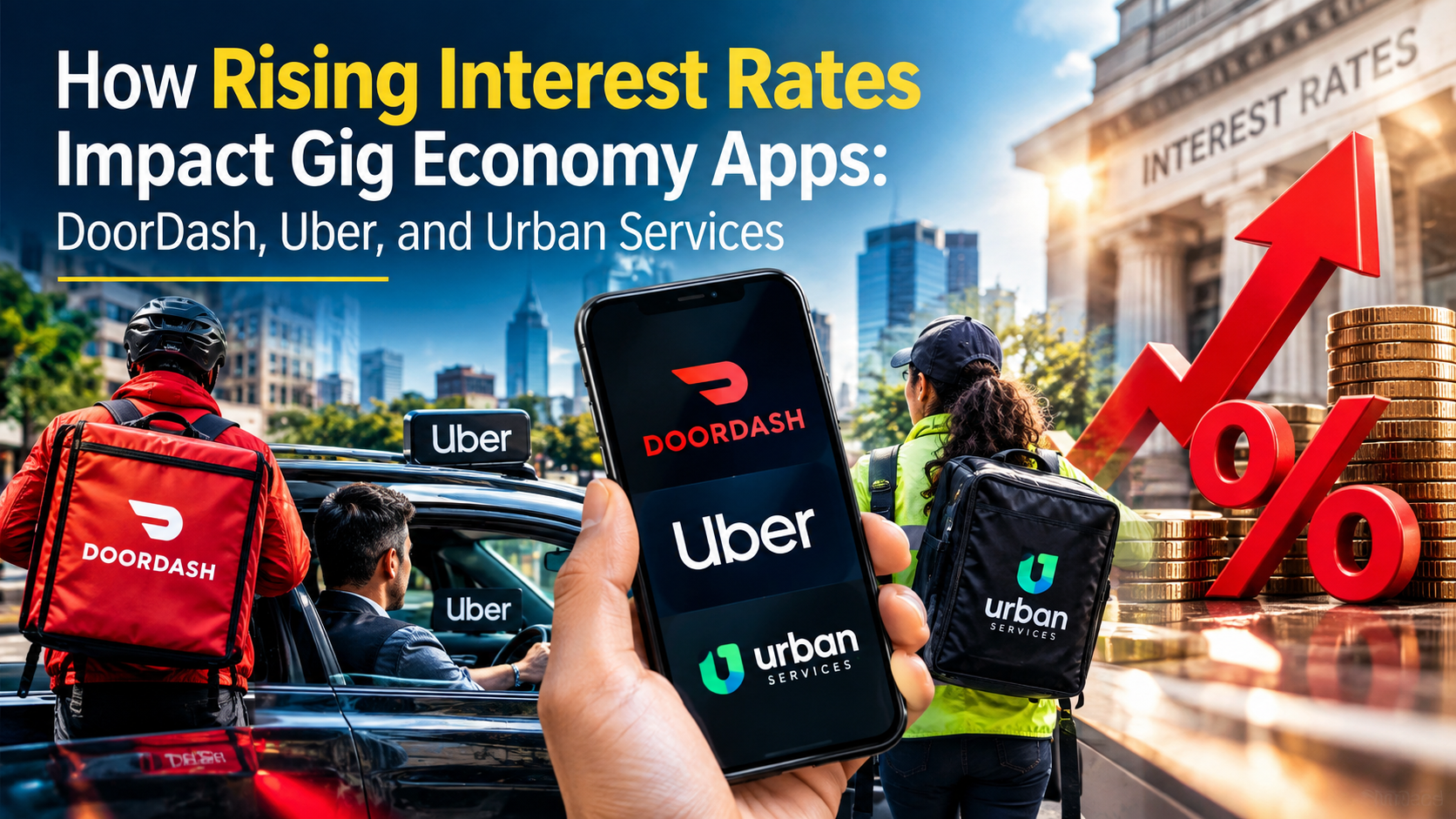
The Fed hiked to 3.75%-4% with gas above $4. See how rates, fuel and consumer spending transmit into DoorDash unit economics and gig platform margins.The standard model says rising rates hurt gig platforms because they are long-duration growth assets and because discretionary spending contracts. Both halves of that model are currently being contradicted by the data.
Executive Summary / Key Takeaways
- The Federal Reserve raised rates to 3.75%–4.00% on 16 September 2026, with 16 of 18 FOMC participants projecting at least one more hike this year.
- The transmission into gig platforms runs through three channels, and only one is the discount rate: consumer discretionary spending, courier input costs, and the cost of capital for long-duration investment.
- DoorDash guided take rate to decline in Q4 2026 on seasonal Dasher cost increases, an insurance step-up and higher winter delivery complexity — margin compression that is structural, not cyclical.
- The company absorbed a gross cost of over $50 million for a Dasher gas relief programme in Q2 2026, a direct macro-to-margin transfer with national pump prices above $4 a gallon.
- The counterintuitive finding: DashPass subscriptions grew more in twelve months than the prior twenty-four combined, suggesting convenience platforms may function as household cost-management tools rather than pure discretionary spend.
The Fed raised its target range by a quarter point to 3.75%–4.00% on 16 September 2026, describing economic activity as expanding at a solid pace with domestic spending resilient, productivity growth strong and capital investment robust, while noting that inflation remains elevated. Sixteen of eighteen participants expect at least one further increase before year-end.
Yet on the day of the hike, the Dow fell more than 600 points while the Nasdaq finished close to flat, with the damage concentrated in cyclicals, transport and energy-exposed names — J.B. Hunt Transport fell 12.64% on an earnings warning citing rising operating costs — according to market coverage. The rate-sensitive damage landed on physical logistics, not on technology platforms.
For gig economy analysis, that is the tell. The binding constraint in 2026 is not the discount rate. It is the cost of moving things.
2. Core Analysis: Three Transmission Channels
2.1 Channel one — courier input costs
This is the dominant channel and the most direct.
DoorDash anticipated the gross cost of its Dasher gas relief programme at over $50 million for Q2 2026, expecting to fund it at least partly by adjusting investment elsewhere, per its Q1 disclosure. That is a macro variable landing straight on the income statement: the national average for regular gasoline was $4.329 a gallon on 15 September 2026, against $3.14 a year earlier.
The seasonal effect compounds it. Management guided take rate to remain flattish in Q3 before declining in Q4 due to seasonal increases in Dasher costs, an insurance step-up and higher delivery complexity during winter months, per the earnings call summary.
Translated for investors: courier supply is price-elastic, weather-sensitive and fuel-cost-exposed, and the platform absorbs the gap rather than fully passing it to consumers. Rising rates do not cause this. Rising energy prices do — and the same energy shock is what drove the Fed to hike, which is why the two appear correlated.
2.2 Channel two — consumer discretionary spending
Here the data contradicts the thesis.
In Q2 2026, DoorDash grew total orders 27% year-on-year to 970 million, Marketplace GOV 36% to $33.1 billion and revenue 36% to $4.45 billion — 17%, 23% and 24% respectively excluding the Deliveroo acquisition, per company results. US paid DashPass members increased more in the twelve months through Q2 2026 than in the previous twenty-four months combined.
Subscription penetration accelerating during a period of elevated food and fuel inflation is not the behaviour of a discretionary category under pressure. Management’s stated logic is that membership reduces transactional friction through affordability, driving retention and engagement. The plausible reading is that for a meaningful cohort, a delivery subscription functions as a cost-management instrument — a fixed fee that caps variable delivery expense — rather than as a luxury.
2.3 Channel three — cost of capital for long-duration bets
| Metric | Q2 2026 | Signal |
|---|---|---|
| Adjusted EBITDA | $914m (+40%) | Core profitability strong |
| GAAP net income | $200m (-30%) | Legal and regulatory expense drag |
| Operating cash flow | $944m (from $504m) | Self-funding capacity improving |
| 2026 stock comp | $1.2–1.3bn | Dilution cost of talent retention |
| 2026 D&A | $1.1–1.2bn | Including ~$450m acquired intangibles |
With operating cash flow at $944 million in a single quarter, DoorDash is largely self-funding its autonomy, AI and infrastructure investment. Higher rates raise the opportunity cost of that spending but do not gate it. The platforms that higher rates genuinely constrain are the sub-scale, cash-burning ones — and the rate environment therefore accelerates consolidation toward the profitable incumbents rather than damaging them.
3. Structural Drivers and Competitor Gaps
The correlation most analyses get backwards. Fed funds and gig platform margins are correlated in 2026, but not causally in the direction usually assumed. Both are downstream of the same energy shock: elevated crude drove gasoline up 27.4% year-on-year in the August CPI, which drove headline inflation, which drove the Fed to hike, and independently drove courier fuel costs up. Modelling gig margins as a function of the policy rate will produce a fitted relationship with no predictive validity once energy normalises.
Autonomy is a rate-environment bet. DoorDash Dot is expected to reach high single-digit penetration in test markets by year-end, scaling from Phoenix. If seasonal courier cost inflation is the recurring drag on Q4 take rate, autonomous capacity attacks that line directly. Higher-for-longer rates raise the hurdle rate on that investment while simultaneously increasing its payoff — which is why the company is accelerating rather than deferring it.
The regulatory tail risk is larger than the rate risk. DoorDash’s filing names an unresolved California Employment Development Department audit over payroll-tax liabilities tied to Dasher classification, with an amount accrued and resolution uncertain, per the 10-Q. GAAP net income fell 30% partly on higher legal and regulatory expenses. A classification ruling would reprice unit economics sector-wide in a way no plausible rate path would.
Consolidation is the visible second-order effect. DoorDash completed its Deliveroo acquisition in October 2025 for $3.72 billion. In a higher-rate environment, platforms with positive operating cash flow acquire those without it. The gig sector’s competitive structure in 2027 will be shaped more by that dynamic than by demand.
4. Key Implications for Stakeholders
Tech equity investors. Strip the acquisition before modelling — 24% organic revenue growth against 36% headline is the number the multiple should reflect. Then treat Q4 take rate against guidance as the cleanest available test of whether courier cost inflation is cyclical or permanent.
Consumer analysts. Subscription growth during an inflation squeeze is the most interesting datapoint in the sector. If delivery membership is behaving as a household hedge rather than a luxury, the standard discretionary-spending framework misclassifies the entire category.
Gig workers. Fuel relief programmes are discretionary platform spending, funded by reallocating investment elsewhere. They are not contractual, and they are most likely to be trimmed precisely when platform margins compress — which is Q4.
Policy analysts. The combination of an energy shock, a tightening cycle and an unresolved worker-classification case creates unusual conditions for gig regulation. Rising courier costs strengthen the platforms’ argument for flexibility and the workers’ argument for guaranteed earnings simultaneously.
5. Frequently Asked Questions
Q1: Do higher interest rates hurt gig economy apps?
Less directly than assumed. The larger 2026 pressure is energy costs feeding into courier pay — DoorDash spent over $50 million gross on Dasher gas relief in one quarter — while its core profitability and subscription growth both accelerated despite tightening.
Q2: Why is DoorDash’s take rate expected to fall in Q4?
Management cited seasonal increases in Dasher costs, an insurance step-up and higher delivery complexity during winter months. Courier supply is weather- and price-sensitive, and the platform absorbs the cost gap rather than fully passing it to consumers.
Q3: Is consumer spending on delivery falling with rates?
Not on current data. DoorDash grew orders 27% year-on-year to 970 million in Q2 2026, and US paid DashPass members grew more in twelve months than in the prior twenty-four combined.
Q4: What is the biggest risk to gig platform economics right now?
The unresolved California worker-classification audit, which carries payroll-tax implications that would affect the entire sector’s cost structure — a larger exposure than any plausible interest-rate path.
Discover more from The Economy
Subscribe to get the latest posts sent to your email.
Stagfaltion
Stagflation vs. Soft Landing: How Central Bank Rates Are Reshaping European and Asian Economies
Fed hiked, ECB hiked, BoE held 6-3, BoJ next. Inside the most divergent central bank week since 2022 and what it signals for stagflation risk.
Executive Summary / Key Takeaways
- Four major central banks moved within eight days: the ECB raised its deposit rate to 2.5% on 10 September, the Fed hiked to 3.75%–4.00% on 16 September, the Bank of England held at 3.75% on a 6-3 vote on 17 September, and the Bank of Japan is expected to move on 18 September.
- UK inflation has hit a five-month high of 3.1%, with the BoE warning it is likely to rise further over coming quarters.
- The Bank of England also announced an unexpected plan to sell £146 billion of UK government bonds directly to the Treasury to complete quantitative tightening.
- This is a supply-shock tightening cycle, not a demand-driven one — which is precisely what makes the stagflation question live.
- The soft-landing case rests on strong productivity and AI-driven capital investment; the stagflation case rests on energy prices that have not normalised.
1. Introduction & Immediate Context
Central banks almost never tighten into an energy shock. Doing so risks amplifying the output loss while doing little to address the price source. Over eight days in September 2026, three of the world’s four largest monetary authorities did exactly that — and the fourth is expected to follow.
The sequencing matters. The ECB raised its main rates by a quarter point at its 10 September meeting, lifting the deposit rate from 2.25% to 2.5%, and said inflationary pressures arising from the conflict in the Middle East would contribute to inflation remaining above its 2% target for an extended period, according to the House of Commons Library. That followed a June increase of the same size. The Fed moved on 16 September. The Bank of England broke the pattern on 17 September by holding.
For CFOs and macro investors the question is no longer whether policy is restrictive. It is whether restriction is being applied to the right problem.
2. Core Market / Strategic Analysis
2.1 The September policy grid
| Central Bank | Decision | Policy Rate | Vote / Signal | Source |
|---|---|---|---|---|
| Federal Reserve (16 Sep) | +25 bps | 3.75%–4.00% | Unanimous 12-0; 16 of 18 see another hike | Federal Reserve |
| ECB (10 Sep) | +25 bps | 2.50% deposit rate | Second hike since June 2026 | Commons Library |
| Bank of England (17 Sep) | Hold | 3.75% | 6-3, three voting for 4.00% | Euronews |
| Bank of Japan (18 Sep) | Expected +25 bps | 1.00% → 1.25% expected | Hike priced near certainty | FXStreet |
2.2 Why the Bank of England blinked — and why three members did not
The MPC voted six to three to leave borrowing costs unchanged, with the dissenting trio pushing for a quarter-point increase to 4%, Euronews reported. The energy shock from the Iran war has pushed UK inflation to a five-month high of 3.1%. The Committee said inflation is likely to rise further over coming quarters, pointing to crude and refined energy prices that have climbed again since its last meeting and remain more volatile and higher than pre-conflict levels.
That is a central bank telling markets it expects to miss its target by a widening margin — and choosing not to act. Bank Rate has stood at 3.75% since December 2025 following six consecutive quarter-point cuts, and the July meeting produced the same hawkish 6-3 split.
The balance-sheet news was the genuine surprise. Alongside the rate decision the Bank announced an unexpected plan to sell £146 billion of UK government bonds directly to the Treasury, Invezz reported. The proposal is intended to help complete quantitative tightening and could ease some pressure on the gilt market, though it requires the chancellor’s approval. The MPC is already reducing its asset purchase programme from a peak of £895 billion to £489 billion as of 9 September 2026.
Read together, the two decisions are coherent: hold the price of money steady, but remove duration risk from the market through a different channel.
2.3 Asia’s mirror-image problem
Japan’s position inverts everyone else’s. Its ultra-low rates financed trillions of dollars in global investment for more than a decade, making the yen one of the world’s cheapest funding currencies — an advantage that may be entering a new phase as the BoJ tightens again, FXStreet noted.
The carry-trade unwind is not a Japanese story. It is a global liquidity story, and it has already shown up in the US long end: the 10-year Treasury yield briefly crossed 5% in mid-September, driven by a combination of surging oil prices, a hotter-than-expected August CPI, heavy bond issuance and a possible unwinding of the yen carry trade as Japanese rates rise.
3. Structural Drivers and Competitor Gaps
The stagflation-versus-soft-landing frame is usually argued with sentiment. The honest version requires separating two questions.
Question one: is the inflation demand-driven? Largely not. The ECB, BoE and Fed all attribute the current impulse to energy. The IMF’s July update expects global inflation to pause its steady decline. Tightening against a supply shock compresses demand without addressing supply, which is the textbook path to a growth-inflation squeeze.
Question two: is the supply side strong enough to absorb it? Here the evidence cuts the other way. The Fed’s own statement describes productivity growth as strong and capital investment as robust, with domestic spending resilient. The IMF notes that accelerated demand-driven momentum in the global technology cycle, driven by AI advances and adoption, is partly offsetting the war’s effects.
That is the crux. A genuine stagflation requires weak supply-side growth alongside high inflation. What the data currently show is high inflation alongside unusually strong productivity and investment — an unusual and unstable combination, but not classic stagflation.
Three markers will resolve it:
- Whether energy prices normalise. Oil trading solidly above $100 per barrel around the Fed decision, per Yahoo Finance, keeps the shock live. The World Bank’s 2027 recovery scenario assumes it fades.
- Whether second-round effects appear in wages. The BoE explicitly flagged the risk of higher energy prices transmitting into household costs, wages and broader inflation.
- Whether the AI capex cycle holds. Both the IMF and the World Bank treat broader AI adoption as the principal upside risk to growth. If technology investment slows, the offset disappears and the stagflation case strengthens sharply.
4. Key Implications for Stakeholders
Corporate CFOs in Europe. Euro-area policy is still the loosest of the major blocs at a 2.5% deposit rate, but the ECB has now hiked twice since June and expects above-target inflation for an extended period. Refinancing windows are narrowing; the argument for terming out debt in Q4 2026 rather than waiting for 2027 is stronger than it was in June.
UK-exposed borrowers. A held Bank Rate does not mean held borrowing costs. With the MPC expecting inflation to rise further and three members already voting to hike, the November meeting is genuinely live. The £146 billion gilt transfer, if approved, is the variable to watch for long-end pricing.
Asian exporters. Yen weakness following the Fed’s decision improved the earnings outlook for Japan’s export-focused industries — but a BoJ hike cuts the other way. Currency hedging assumptions built on a persistently cheap yen need revisiting.
Multi-asset allocators. Divergence itself is the tradeable feature. The Fed is tightening into strength, the ECB into weakness, the BoE is paralysed by a split committee, and the BoJ is normalising from a near-zero base. Relative-value positioning in rates is more attractive than directional duration.
5. Frequently Asked Questions
Q1: Is the global economy heading into stagflation in 2026?
Not on current data. Inflation is elevated and energy-driven, but productivity growth and capital investment remain strong, which classic stagflation requires to be weak. The risk rises materially if the AI-led investment cycle slows while energy prices stay high.
Q2: Why did the Bank of England hold while the Fed and ECB hiked?
The MPC voted 6-3 to hold at 3.75% despite inflation hitting a five-month high of 3.1%, judging that the energy-driven inflation impulse did not yet warrant tightening. Three members dissented in favour of a quarter-point rise to 4%.
Q3: What is the ECB’s current interest rate?
The ECB raised its deposit rate to 2.5% on 10 September 2026, its second quarter-point increase since June. Its next scheduled policy meeting concludes on 29 October.
Q4: How does the Bank of Japan’s decision affect global markets?
A BoJ hike raises the cost of yen funding, which has underpinned global carry trades for over a decade. The unwind has already contributed to higher long-dated yields in the US and Europe.
Discover more from The Economy
Subscribe to get the latest posts sent to your email.

How Crypto Transformed the Trump Fortune: A $1.4 Billion Financial Breakdown

Global Pension Systems Ranked: The World’s Best and Worst Retirement Frameworks

Global Supply Chain Vulnerabilities: From Eurasian Trade Corridors to Food Consumer Recalls

Why 5% U.S. Treasury Yields Signal a Global Market Regime Shift.

Federal Reserve Defies White House Pressure: Inside Trump’s Demand for Sub-1% Interest Rates After Historic 2026 Rate Hike

How Rising Interest Rates Impact Gig Economy Apps: DoorDash, Uber, and Urban Services

GasBuddy Market Insights: How Crude Price Shifts Impact Local Fuel Cost Averages

DoorDash Driver Payouts, Fee Structures, and Market Competition Analysis

OPINION:Breaking the 3.5% Growth Trap: How Pakistan Can Build a High-Productivity Export Economy

Global Equity Market Divergence: US Tech vs. European Dividend Stocks vs. Asian Growth

Asian Markets Analysis: Navigating Volatility in China, Japan, and Singapore Stocks

Stagflation vs. Soft Landing: How Central Bank Rates Are Reshaping European and Asian Economies

IMF & World Bank Global Economic Outlook: Growth Forecasts Across Europe and Asia

Fed Rate Hike Projections vs. Trump’s Interest Rate Policy: What Global Markets Expect Next

State Farm’s $5B Dividend 2026: Who Qualifies & Payout Dates

US-China Relations in Q3 2026: Trade Tariffs and Supply Chain Risks

SpaceX Starship Flight 14: First Orbital Attempt & Starlink V3 Launch Explained

Top 30 Stocks for Investment in PSX for Massive ROI in 2026

The 2026 Crypto Regulatory Shift: What It Means for Institutional Investors

AI Chip Stocks 2026: The Best Semiconductor Investments Beyond Marvell

AI-Powered Training: The Next Multi-Billion Dollar Ecosystem in Fitness

Tween Back-to-School Trends 2026: What’s Driving the $85B Season

Oil Prices Break $100 in 2026: Middle East Conflict & Energy Markets

10-Year Treasury Yield Hits 4.80%: What It Means for Rates & Portfolios

Shein Clothes Quality & Safety in 2026: What Lab Tests Show

Fidelity Investments Review 2026: SPAXX Yields & Zero-Fee Funds

MRVL Earnings 2026: Why Marvell Sank Despite Beating Estimates

China’s US$10.8 Billion Trade Shortcut: Why the Pinglu Canal Matters
-

 Markets & Finance9 months ago
Top 15 Stocks for Investment in 2026 in PSX: Your Complete Guide to Pakistan’s Best Investment Opportunities
-

 Analysis7 months ago
Johor’s Investment Boom: The Hidden Costs Behind Malaysia’s Most Ambitious Economic Surge
-

 Analysis7 months ago
Top 10 Stocks for Investment in PSX for Quick Returns in 2026
-

 Analysis7 months ago
Brazil’s Rare Earth Race: US, EU, and China Compete for Critical Minerals as Tensions Rise
-

 Banks8 months ago
Best Investments in Pakistan 2026: Top 10 Low-Price Shares and Long-Term Picks for the PSX
-

 Investment8 months ago
Top 10 Mutual Fund Managers in Pakistan for Investment in 2026: A Comprehensive Guide for Optimal Returns
-

 Global Economy9 months ago
15 Most Lucrative Sectors for Investment in Pakistan: A 2025 Data-Driven Analysis
-

 Global Economy9 months ago
Pakistan’s Export Goldmine: 10 Game-Changing Markets Where Pakistani Businesses Are Winning Big in 2025