
Tech Companies
Zelda: Ocarina of Time Switch 2 Remake — Release Date & Everything Confirmed

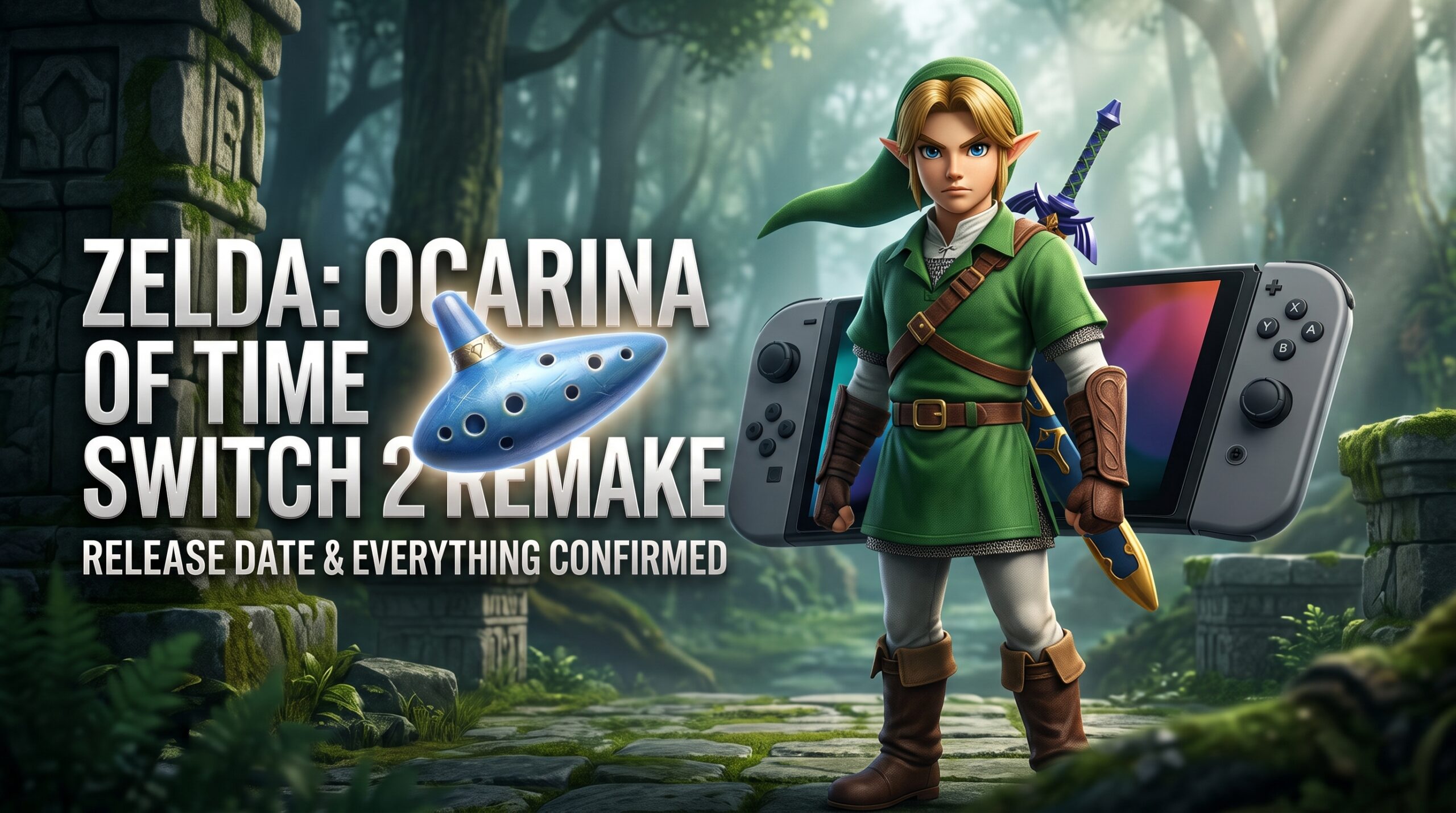
Nintendo answered a year’s worth of speculation in a single 30-minute stream. The Legend of Zelda 40th Anniversary Direct, which aired September 8, 2026, confirmed The Legend of Zelda: Ocarina of Time is coming to Nintendo Switch 2 on November 5, 2026 — alongside a dedicated hardware bundle, a live-action film title reveal, and a global orchestral concert tour, making it the largest coordinated cross-media expansion in the franchise’s four-decade history.
The Ocarina of Time Remake: Confirmed Details
| Detail | Confirmation |
|---|---|
| Release Date | November 5, 2026 |
| Platform | Nintendo Switch 2 (exclusive) |
| Original Announcement | Nintendo Direct, June 9, 2026 |
| Full Gameplay Reveal | Zelda 40th Anniversary Direct, September 8, 2026 |
| Developer Lead | Series producer Eiji Aonuma |
| Voice Acting | Full voice acting added to cutscenes (new) |
| Traversal Changes | Auto-jump removed; jump now on dedicated button press |
| Switch 2-Specific Feature | Built-in microphone lets players hum ocarina melodies as an alternative to button-press input |
| Companion App | Zelda Notes app supported from launch, with progress tracking, hint images, a virtual ocarina, and a 2,000+ question daily trivia pool |
This marks the second remake of the original 1998 Nintendo 64 title, following 2011’s Ocarina of Time 3D for Nintendo 3DS. Unlike that prior remaster, which largely preserved the original’s structure with visual polish, early hands-on impressions from the September Direct describe this as a fuller reimagining — a complete engine uplift while preserving the vast majority of the original’s content, dungeon design, and story beats, including the notoriously divisive Water Temple.
The Hardware Tie-In
Nintendo paired the software reveal with dedicated hardware:
- Nintendo Switch 2 – The Legend of Zelda 40th Anniversary Edition, a limited-edition console launching October 29, 2026 — one week ahead of the game itself — featuring a golden Triforce pattern on the dock and light-blue Joy-Con 2 artwork. Notably, the bundle does not include a copy of the Ocarina of Time remake itself.
- Matching 40th Anniversary Pro Controllers and a Carry Case/Screen Protector set, sold separately.
- Two new Amiibo figures — Young Link and Young Zelda — timed to the game’s launch.
Beyond the Game: A Franchise-Wide Anniversary Push
The Direct’s nine segments extended well beyond the Switch 2 remake, reflecting what industry coverage has characterized as Nintendo’s most ambitious simultaneous multi-vertical Zelda push to date:
- A live-action Zelda film received its official title — simply The Legend of Zelda — along with a confirmed logo, revealed by franchise creator Shigeru Miyamoto. The film is set to hit theaters April 30, 2027.
- A global orchestral concert tour, confirmed by longtime series composer Koji Kondo.
- A wave of anniversary merchandise, spanning LEGO sets and activations at the Nintendo Museum.
Competitive Timing: Zelda vs. GTA 6
Fans and industry observers immediately flagged the release-date proximity to Rockstar’s Grand Theft Auto VI, which launches November 19, 2026 — meaning Ocarina of Time’s remake arrives roughly two weeks earlier, giving Nintendo a head start in a holiday season that will otherwise be dominated by GTA 6 coverage. Reaction to the scheduling has been broadly framed as a deliberate move to capture dedicated playtime before the industry’s most anticipated release of the year absorbs the news cycle and consumer attention.
What Wasn’t Announced
Despite persistent fan speculation and prior insider leaks (including from established leaker NateTheHate, who had earlier predicted a “second half of 2026, approaching the holidays” release window that proved accurate), the Direct did not include:
- Any confirmation of Twilight Princess HD or Wind Waker HD ports/remasters to Switch 2 — a gap several fans and outlets specifically noted as a disappointment given ongoing speculation these Wii U-era remasters would finally escape their platform limbo.
- Pricing information for the Ocarina of Time remake was not part of the official presentation, though it had reportedly leaked via the Australian eShop ahead of the Direct.
Community and Industry Sentiment
Early hands-on and stream-reaction sentiment has been largely positive, with particular praise for the fidelity of the remake to the original’s content and character designs (young and adult Link, young Zelda, Ganondorf, Sheik, and the Great Fairies were all shown in the cinematic trailer), tempered by some concern over performance in the gameplay demo shown — caveated by outlets as likely reflecting a non-final build rather than a shipping-quality issue. The ocarina-humming microphone feature has drawn particular attention as a genuinely novel interaction mechanic rather than a simple visual/technical upgrade.
Nintendo used its Zelda 40th Anniversary Direct to convert a year of accurate leaks into a concrete release date: Ocarina of Time’s Switch 2 remake arrives November 5, 2026, backed by a dedicated console bundle, full voice acting, a novel ocarina-humming input method, and a franchise-wide expansion into film and live orchestral touring. The timing — two weeks ahead of GTA 6 — positions it as Nintendo’s clearest bid to anchor the 2026 holiday software conversation before the industry’s biggest release of the year takes over.
Discover more from The Economy
Subscribe to get the latest posts sent to your email.


Jeff Bezos has floated a future in which artificial intelligence makes workers productive enough that some people might choose a three-day workweek while still supporting their families. The Amazon founder made the point during an October 7, 2026 interview with Fox News. He did not announce that Amazon is adopting a three-day schedule or that AI guarantees shorter hours for everyone. The underlying distinction is crucial: Bezos was describing a possible long-term economic outcome, not a new employment policy. Fox News’s account of the interview and Fast Company’s focused coverage make that clear.
Key takeaways:
- Bezos linked the possibility of fewer working days to future gains in AI-driven productivity.
- He suggested greater output could make single-income households or shorter working schedules financially feasible for some families.
- There is no evidence in the cited interview of a universal three-day-workweek plan at Amazon.
- Research shows AI can save time on some tasks, but broad effects on compensation and employment remain unsettled.
What did Jeff Bezos say?
In the Fox interview, Bezos discussed an optimistic vision of technological progress. His argument was that powerful AI tools could raise economic output enough to expand people’s choices. If a person can generate greater value in less time—and share financially in that improvement—working fewer days could become an option rather than a forced reduction in income.
That scenario is different from predicting every office will close on Thursdays and Fridays. It is also different from a government-mandated reduction in work hours. Fast Company reported Bezos’s additional concern that firms might face labor shortages if people respond to higher productivity by choosing more leisure time.
The prediction has attracted attention because it reverses the most alarming version of the AI-and-jobs debate. Instead of imagining machines replacing so many workers that employment vanishes, Bezos emphasized the possibility of prosperity, shorter hours and tighter labor supply.
Why the productivity argument matters
Labor productivity is commonly measured as output per hour worked. That is the U.S. Bureau of Labor Statistics’ definition. A software developer completing work that used to require ten hours in six may produce more per hour. A customer-service team handling routine requests faster may serve more customers without increasing headcount at the same rate.
But greater task efficiency does not automatically mean that an employee receives proportionally higher wages or fewer shifts. Businesses choose how to allocate productivity gains among pricing, investment, expansion, profits, compensation and staffing. Workers’ bargaining power, competition, management priorities and public policy can all shape the outcome.
A simple illustration—not a forecast
Imagine an employee currently produces 40 units of useful output during a 40-hour week. Productivity is one unit per hour. If technology raises the rate to 1.67 units an hour, a 24-hour week could, arithmetically, produce approximately 40 units.
That calculation only shows a technical possibility. It assumes the tasks can be reorganized, demand stays sufficiently steady, management accepts the schedule, and pay arrangements remain favorable. Healthcare, aviation, emergency services, logistics and many other occupations require coverage across specific hours; AI cannot simply eliminate the need for people to be present.
The important question is not whether an AI tool sometimes saves time. It is whether the gain is widespread, reliable and shared in a way that makes shorter schedules financially sustainable.
What does current research show about AI and jobs?
The evidence is more restrained than the boldest predictions. A June 2026 International Labour Organization review found evidence of real but uneven productivity gains. It also concluded that large-scale job displacement had remained limited in the material reviewed, while warning about inequality, weakened entry-level pathways and shifting job quality.
Separately, Yale’s Budget Lab tracker, updated September 15, 2026, reported no clear economy-wide labor-market disruption attributable to AI in the indicators it examined. Its researchers cautioned that the findings could change as technology adoption and data evolve.
These results do not prove Bezos wrong. They show that the conditions for a large-scale three-day week have not yet been demonstrated by broad labor data. Firms are experimenting with AI, but productivity effects differ among tasks, occupations and organizations.
Task savings are not the same as job transformation
An AI assistant might draft a first version of a memo quickly, but a professional still needs to check accuracy, speak with clients, make decisions and accept responsibility. A factory might improve planning efficiency while remaining constrained by physical machinery. A hospital might automate paperwork yet still need the same number of nurses for bedside care.
This distinction between automating tasks and replacing whole jobs is essential. Headlines suggesting a direct line from better chatbots to a nationwide three-day week skip multiple economic steps.
Could workers keep the same pay while working less?
They could in some workplaces, but that would require an employer decision, collective agreement, regulatory change or a labor-market environment supportive of higher effective hourly compensation. An employee moving from five eight-hour days to three eight-hour days would cut weekly hours from 40 to 24—a 40% reduction in hours. Keeping weekly pay unchanged would require compensation per hour to increase by about 67%, before considering other changes in productivity or operating costs.
That is a much larger adjustment than ordinary schedule flexibility. The arithmetic does not make it impossible; it makes the necessary improvement explicit. By contrast, a four-day, 32-hour schedule requires a 20% reduction in hours, a different benchmark entirely.
Any employer trial must ask whether output, service quality, employee retention and customer coverage are maintained. Studies of particular programs may be promising, but results do not transfer uniformly to every industry.
What about Amazon employees?
There is no verified connection between Bezos’s prediction and an official companywide Amazon three-day-workweek policy. Bezos is Amazon’s founder and executive chair, but his personal economic forecast should not be presented as a company announcement.
Amazon operates a mixture of offices, warehouses, cloud-computing facilities, transportation networks and other businesses. Working-hour patterns depend on the role and contract. A broad change in hours would require formal employee communications and operational planning, not merely comments in a television interview.
Readers searching “Is Amazon switching to three days?” should therefore receive an unambiguous answer: not on the basis of this interview.
Could AI create a labor shortage instead of mass unemployment?
Bezos’s labor-shortage concern is plausible as a scenario, but it is not an established forecast. If incomes rose while more workers elected to reduce hours, businesses might face greater competition for labor. Yet other forces could push the opposite way: some jobs could be automated, employers could reduce hiring, or new industries might absorb displaced workers.
The net result will depend on adoption speed, which tasks AI performs reliably, the cost of computing and energy, economic growth and how governments and companies manage the transition. Reuters’ October 2026 discussion of AI at work also emphasized that AI is changing tasks within jobs, with younger and experienced workers potentially affected differently.
Frequently asked questions
Did Jeff Bezos predict a three-day workweek?
Yes. He discussed it as a possible consequence of greater AI productivity during an October 7, 2026 Fox News interview. It was not a commitment to a timetable.
Is Amazon moving to a three-day workweek?
No companywide shift was announced in the interview. Any claimed policy should be verified against Amazon’s official employment communications.
Would a three-day workweek mean three eight-hour days?
Not necessarily. A three-day schedule could mean 24 hours, longer shifts or another arrangement. Bezos did not establish a universal definition or wage agreement.
Will AI eliminate the need to work?
There is no evidence supporting that as an inevitable outcome. The ILO’s 2026 review describes heterogeneous gains and risks rather than the disappearance of work.
Could AI make one-income households more common?
It could in theory if household purchasing power rises materially, but wages, housing costs, childcare, benefits and employment security also matter. The claim remains a scenario, not a confirmed demographic trend.
When could three-day workweeks become common?
No defensible national timetable can be inferred from the cited interview. Some employers may experiment sooner than others.
The bigger economic question
The provocative part of Bezos’s vision is not whether software can perform individual tasks faster. It is whether future productivity gains become broadly shared prosperity. If workers capture enough benefit, shorter schedules may become more feasible. If gains are concentrated in profits or paired with job insecurity, fewer working hours could instead mean lower household income. Those are fundamentally different futures, and the evidence today does not settle which will dominate.
Discover more from The Economy
Subscribe to get the latest posts sent to your email.
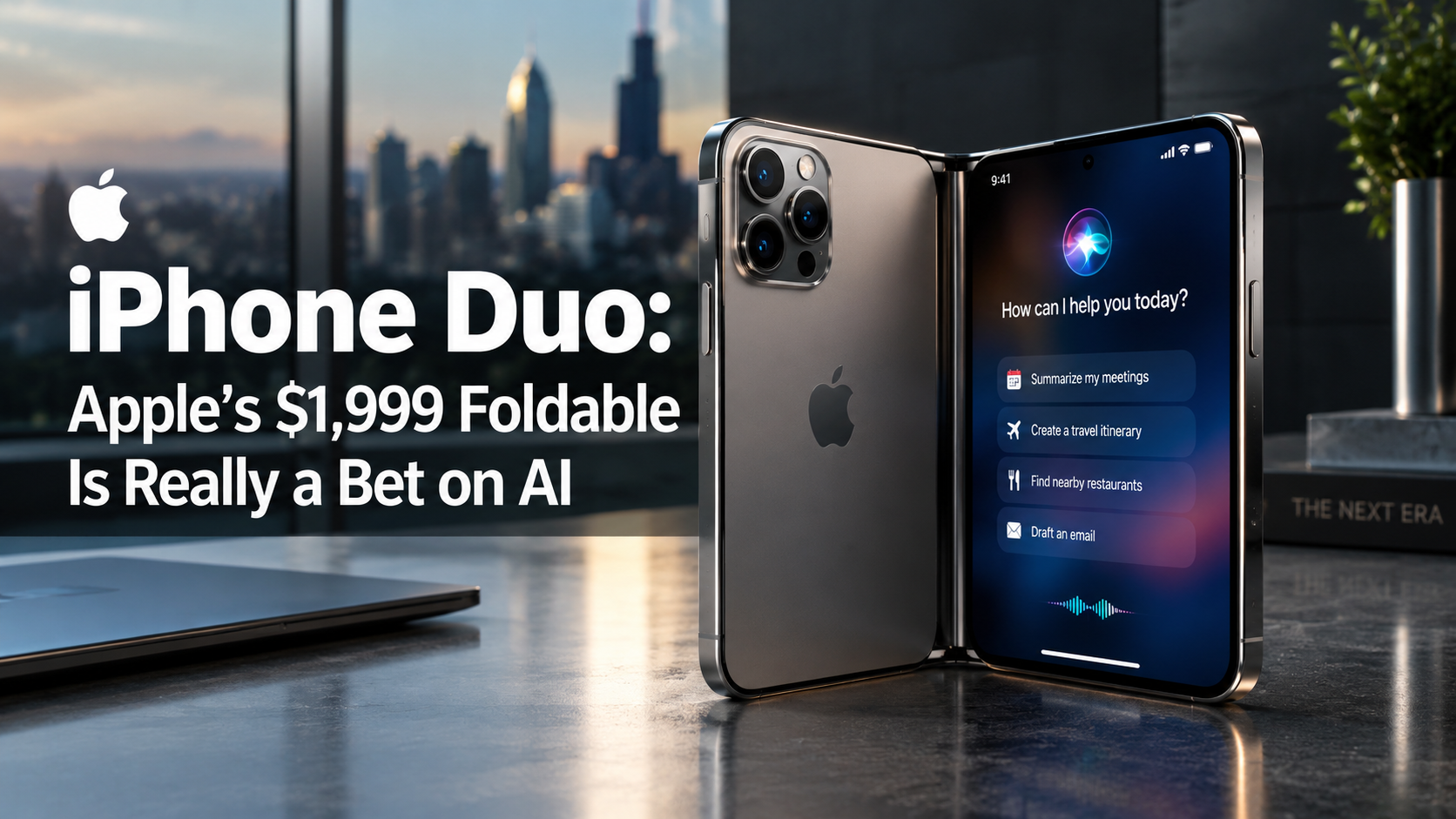
Apple waited seven years to build a foldable. When the company finally showed one, the pitch wasn’t the hinge. It was the screen real estate, and what Apple’s rebuilt AI assistant can do with it.
On September 9, Apple unveiled the iPhone Duo at its Cupertino headquarters, with a starting price of $1,999 and an October 23 release date. It was also the first Apple launch event run by new CEO John Ternus, who took over from Tim Cook on September 1. hawaiitribune-herald
Here’s what the Duo is, what it costs, and why it matters beyond the spec sheet.
Key Takeaways
- Price and date: The iPhone Duo starts at $1,999 and arrives October 23. That makes it the most expensive iPhone Apple has sold. hawaiitribune-heraldazfamily
- Screen: It opens to a 7.6-inch display, about 80% larger than the iPhone 18 Pro’s. wrdw
- Form factor: Folded, the front screen is roughly passport-sized. Opened, it runs two apps side by side. hawaiitribune-herald
- AI is the headline: Apple pitches the iPhone as a “personal intelligent hub,” and Siri AI is the software that is supposed to prove it.
- Market impact: Foldables are under 2% of global smartphone shipments, but IDC expects Apple to capture about a third of foldable demand. citizen
- Financing: Apple Upgrade, a new leasing program, lets buyers pay over one or two years. citizen
What Is the iPhone Duo?
The iPhone Duo is Apple’s first foldable phone. It folds like a book into a compact, passport-sized device and opens into a tablet-style screen. CNN reports Apple claims it is the thinnest iPhone ever when unfolded. keyt
Apple’s pitch was aimed squarely at existing foldables. Ternus said, “Others have created foldables that just feel like two phones awkwardly stuck together.” The Duo’s answer is a larger working canvas that still fits a pocket, with iOS 27 built around multitasking on that canvas. hawaiitribune-herald
Apple also put the Duo in its AP-reported lineup alongside the iPhone 18 Pro and 18 Pro Max, not above them as a separate product line. That framing matters. Apple wants the Duo read as a new iPhone shape, not a niche experiment.
iPhone Duo Specs and Price at a Glance
| Feature | iPhone Duo | Notes |
|---|---|---|
| Starting price | $1,999 | Most expensive iPhone to date |
| Release date | October 23, 2026 | Per Apple’s announcement |
| Main display | 7.6 inches (open) | About 80% larger than iPhone 18 Pro |
| Cover display | Passport-sized | Per CNN |
| Frame and hinge | Grade 5 titanium, 3D-printed hinge cover | Per Technology Magazine’s spec rundown |
| Chip | A20 Pro | Handles on-device AI and Apple Intelligence tasks |
| Pencil support | Yes | A first for iPhone |
| Multitasking | Two apps or two windows of one site | Split-screen on the large display New iPhone lineup includes a foldable version called Duo +7 |
Camera, battery and storage specifics are on Apple’s product page. I’d verify those directly before quoting them in a buying guide.
iPhone Duo vs iPhone 18 Pro: Which One Fits You?
The iPhone 18 Pro starts at $1,199 and the 18 Pro Max at $1,299. The Duo costs $700 to $800 more than either. irishexaminer
| iPhone 18 Pro | iPhone 18 Pro Max | iPhone Duo | |
|---|---|---|---|
| Starting price | $1,199 | $1,299 | $1,999 |
| Form | Slab | Large slab | Foldable |
| Best for | Everyday power users | Battery and camera-first buyers | Multitaskers, readers, Pencil users |
| AI features | Full Apple Intelligence | Full Apple Intelligence | Full Apple Intelligence, larger canvas |
Here’s the honest framing. Apple Intelligence and Siri AI run on the iPhone 15 Pro and 16 series or newer. The AI itself isn’t a reason to pay for the Duo. The screen is. If you mostly text, shoot photos and scroll, an 18 Pro does the same AI work for far less. propakistani
Why the Duo Is an AI Story
Look at how Apple framed the launch. Ternus emphasized Apple’s AI work and called the iPhone the ideal “personal intelligent hub.” The foldable is the hardware argument for that idea: more room to show an assistant’s output, research, and your apps at once. hawaiitribune-herald
The software side is Siri AI. It is Apple’s redesigned assistant, built on the latest generation of Apple Intelligence, and it rolls out initially in English. Two limits are worth knowing. Siri AI is not initially available on iPhones in the European Union, and Apple Intelligence features remain unavailable in China while regulatory work continues. French, Japanese, Korean, Portuguese and Spanish arrive in October. Apple Confirms iOS 27 Release Date for Eligible iPhones +2
Why does this matter commercially? Large screens make AI more useful. Compare two documents, keep a chat open beside a web page, mark up a PDF with the Pencil. Those are tasks where a 6-inch slab feels cramped and a 7.6-inch canvas doesn’t. If Siri AI delivers, the Duo becomes the best showcase for it. If Siri AI stumbles, a $1,999 phone becomes a hard sell.
How the Duo Could Reshape the Foldable Market
The numbers explain why the industry is watching. Counterpoint Research says nearly 20 million foldables shipped last year, under 2% of all smartphones. That’s a rounding error for a company that sells hundreds of millions of iPhones. hawaiitribune-herald
Two analyst views frame the opportunity:
- Demand: IDC expects Apple to take roughly a third of foldable demand and says the entry could shift competition in both China and global markets. citizen
- Strategy: Forrester’s Dipanjan Chatterjee called it classic Apple: let others work out the kinks, then enter and shape the category. wrdw
Samsung, Motorola, Google and Huawei have sold foldables for years. CNN notes Apple’s entry could push the category beyond early adopters. The likely effect is a bigger overall foldable market, with Android makers forced to compete on price and software polish against Apple’s ecosystem pull. keyt
The Supply Chain Angle
Foldables are hard to manufacture at volume, and the Duo’s reported component list shows who benefits. TSMC fabricates the A20 Pro, and Foxconn handles the complex assembly, including the titanium and 3D-printed hinge parts. Expect hinge suppliers, display makers and assembly partners to be central to Apple’s earnings commentary this quarter. technologymagazine
What the $1,999 Price Really Means
Apple clearly knows that number is steep. That’s why Apple Upgrade matters. The monthly leasing program spreads the cost over one or two years. Leasing turns a $1,999 sticker into a manageable monthly figure and keeps buyers inside Apple’s upgrade cycle. citizen
Accessories add to the total. The iPhone Duo Case is $79 and the Duo Folio with Kickstand is $129, both orderable October 16. A buyer who wants the Folio is looking at about $2,128 before tax. blakecrosley
Should You Buy the iPhone Duo?
Buy it if:
- You work on documents, spreadsheets or research on your phone and want a real second pane
- You want Apple Pencil on an iPhone
- You’re upgrading from an older foldable and want to stay in iOS
- Your employer or business can absorb the cost
Wait or skip if:
- You want the lowest-risk choice. First-generation hardware, especially hinges, deserves a few months of real-world reviews
- You live in the EU or China and want Siri AI on day one
- Your use is mostly calls, messaging and photos, where an 18 Pro does the job for $800 less
What to Watch Before October 23
- Hands-on reviews: Hinge durability and crease visibility will decide the first-wave verdict.
- Siri AI quality: Early beta impressions will shape whether the Duo is seen as an AI device or a pricey gadget.
- App support: Developers need to adapt layouts for the larger screen. Fox News’ iOS 27 rundown shows how much of Apple’s software push centers on Apple Intelligence.
- Android response: Expect Samsung and Google to counter with pricing and promotions.
The Bottom Line
The iPhone Duo isn’t Apple copying foldables. It’s Apple using a foldable to make its AI case on a screen big enough to matter. At $1,999 it will stay a premium product, but its real influence is on the category: bigger market, higher expectations, more pressure on rivals.
If you’re deciding, wait for hands-on reviews and Siri AI’s first weeks in the wild. If Apple delivers on both, the Duo could be the phone that finally makes foldables mainstream.
Discover more from The Economy
Subscribe to get the latest posts sent to your email.
Tech Companies
Beyond Petrochemicals: How Indonesia’s Chandra Asri is Constructing an Integrated ASEAN Mobility Powerhouse

Indonesia’s largest petrochemical and infrastructure conglomerate, PT Chandra Asri Pacific Tbk, is executing a transformative strategic pivot. Controlled by Indonesian billionaire Prajogo Pangestu’s Barito Pacific Group, the Jakarta-listed giant is aggressively expanding beyond its traditional industrial manufacturing roots to establish a dominant, multi-tiered energy, retail, and mobility platform centered in Singapore.
By connecting upstream refining, retail fuel distribution, and automotive retail across Singapore and Malaysia, Chandra Asri is building a vertically integrated ecosystem designed to hedge against volatile commodity chemical cycles while capturing high-margin growth across Southeast Asia’s changing transportation landscape.
Executive Summary & Strategic Takeaways
- The Mobility Pivot: Through its subsidiary CCHPL Holdings, Chandra Asri signed a conditional agreement to purchase the Singapore and Malaysia automotive operations of Jardine Cycle & Carriage (C&C) for approximately S$265 million (US$207 million).
- The Full-Value Chain Strategy: The C&C acquisition complements two prior megadeals in Singapore: the acquisition of Shell’s Energy and Chemicals Park on Pulau Bukom/Jurong Island via Aster Chemicals (a joint venture with Glencore) and the purchase of ExxonMobil’s network of 60 Esso service stations.
- Accretive Valuation: Financial analysts estimate that the combined mobility and retail assets (Esso + C&C) will generate an additional US$150 million to US$200 million in annual profit, acquired at an attractive multiple of ~4.3x to 8.6x P/E.
- Macro Hedge: The move insulates Chandra Asri from regional petrochemical margin compression driven by global overcapacity, creating predictable, cash-flow-generative consumer touchpoints.
The Macro Logic: Moving Downstream Amid Petrochemical Headwinds
The Asian petrochemical sector has faced margin pressure in recent years due to expanding regional refining capacity and shifting global demand dynamics. For commodity producers relying strictly on olefins and polyolefins, earnings volatility remains a central challenge.
Chandra Asri’s strategy addresses this risk by transforming from a regional industrial supplier into a consumer-facing energy and mobility platform.
┌────────────────────────────────────────────────────────────────────────┐
│                        THE INTEGRATED VALUE CHAIN                      │
├──────────────────────────┬──────────────────────────┬──────────────────┤
│    UPSTREAM REFINING     │     RETAIL ENERGY        │ CONSUMER MOBILITY│
│ (Bukom & Jurong Island)  │   (60 Esso Stations)     │ (Cycle & Carriage)│
├──────────────────────────┼──────────────────────────┼──────────────────┤
│ • 237k bpd Crude Refinery│ • Retail Fuel Sales      │ • 13+ Auto Brands│
│ • 1.1M MT/yr Cracker     │ • EV Fast-Charging Hubs  │ • EV Bus Dist.   │
│ • Downstream Monomers    │ • Convenience Retail     │ • Leasing & Fleet│
└──────────────────────────┴──────────────────────────┴──────────────────┘
By owning each link in this chain, Chandra Asri achieves three core strategic objectives:
- Guaranteed Downstream Offtake: Upstream refinery products from Pulau Bukom can be directly processed, distributed, and commercialized through controlled retail fuel networks and fleet platforms.
- EV & Energy Transition Readiness: Acquiring C&C provides immediate exposure to electric vehicle (EV) distribution (such as commercial EV bus maker Zhongtong), while the Esso network offers prime real estate for rapid deployment of EV charging infrastructure across Singapore.
- Cross-Selling & Data Synergies: Capturing consumer touchpoints across fuel retail, vehicle sales, commercial fleet leasing, and after-sales service unlocks long-term customer lifetime value.
The Tripartite M&A Playbook: Building the Platform
Chandra Asri’s expansion in Singapore relies on three complementary acquisitions structured over the last two years:
| Strategic Pillar | Target Asset / Deal | Strategic & Operational Significance | Source & Financing Details |
| 1. Upstream Refining & Chemicals | Shell Energy & Chemicals Park (SECP) (Pulau Bukom & Jurong Island) | Adds 237,000 bpd crude refining capacity and a 1.1 million metric ton annual capacity ethylene cracker via Aster Chemicals & Energy (JV with Glencore). | Barito Pacific Official Corporate Announcement |
| 2. Retail Energy & Distribution | ExxonMobil Esso Network (~60 Service Stations in Singapore) | Converts wholesale fuel refining into direct retail cash flow. Serves as physical hubs for future electrification and retail services. | Backed by $750M Private Credit Package from KKR |
| 3. Automotive & Mobility Platform | Cycle & Carriage (C&C) (Singapore & Malaysia Operations) | Captures ~12% of Singapore’s passenger car market across 13+ brands (including Mercedes-Benz, Kia, Mitsubishi) plus after-sales and leasing. | Agreement with Jardine C&C |
Financial Analysis: Valuation, Capital Structure & Profit Earnings
Despite a challenging cyclical environment that saw Chandra Asri’s H1 net profit contract due to high base-year accounting gains from prior acquisitions, the company’s financial foundation remains solid, supported by US$3.9 billion in total liquidity and over US$1 billion committed to strategic investments.
Deal Metrics & Accretion
Market analysts from Stockbit highlight that the acquisition of C&C represents an exceptionally cost-effective entry into steady consumer cash flows:
- Implied Valuation Multiples: At a purchase price of US$207 million against C&C’s 2025 net profit contribution of US$48 million, the implied transaction multiple sits at roughly 4.3x Price-to-Earnings (P/E). Even under conservative 2026 annualized estimates (~US$24 million profit), the multiple stays under 8.6x P/E.
- Earning Injections: The combined retail fuel (Esso) and automotive dealership (C&C) platforms are projected to contribute an immediate US$150 million to US$200 million in recurring annual net profit.
- Sovereign & Private Debt Backing: Institutional confidence is reflected in Chandra Asri’s ability to secure bespoke private credit financing, including a US$750 million facility arranged by KKR, alongside co-investments and credit lines from institutions like the Indonesia Investment Authority (INA) and Allianz Global Investors.
The Regional Trend: Indonesian Conglomerates Going Global
Chandra Asri’s expansion into Singapore is part of a broader shift among top-tier Indonesian industrial groups seeking regional scale and diversification.
Driven by maturing domestic balance sheets and the need to internationalize capital, groups like Bumi Resources (expanding into Australian copper/gold) and Djarum Group (acquiring North American paper assets via Singapore investment vehicles) are deploying capital internationally.
Singapore serves as the central springboard for this ambition. By establishing core assets within Singapore’s global financial, shipping, and energy architecture, Indonesian leaders like Chandra Asri gain:
- Direct access to international debt and equity capital markets.
- Reduced cost of capital through global credit syndicates.
- Operational headquarters to manage cross-border ASEAN energy flows between Indonesia, Singapore, Malaysia, and beyond.
Conclusion & Future Outlook
Chandra Asri’s transition from a domestic Indonesian petrochemical producer to a regional ASEAN mobility and energy leader represents a textbook case of strategic corporate evolution. By combining world-class refining assets on Pulau Bukom, 60 strategic Esso fuel stations, and the commercial auto distribution networks of Cycle & Carriage, Chandra Asri has built a resilient platform capable of riding out commodity downturns while capitalizing on Southeast Asia’s transition toward clean mobility.
Discover more from The Economy
Subscribe to get the latest posts sent to your email.

The Global South: Debt, Climate Finance and Investment in 2026

Energy Security Is the New Economic Security

Can Global Tourism Survive Geopolitical Shocks?

Global Maritime Hegemony: How China Secured Over 81% of All New Shipbuilding Orders

The Coming Battle Over AI, Jobs and Wages

Why Developing Economies Face a Sharper Inflation Problem

The New Geography of Trade: Are Supply Chains Coming Home?

Is AI Saving Global Growth or Creating the Next Bubble?

Global Banking Trends 2026: Digital Banks, AI and Compliance

Gold vs US Dollar vs Bitcoin in 2026: Inflation Hedge Compared

How Global Interest Rates Affect Savings, Loans and Investments

How to Invest During High Inflation: A Global Guide

Best Global Stocks to Watch in 2026: Four Sectors to Research

Pakistan’s 2027 Growth Strategy: Exports, AI, Energy and Jobs

Crude Oil & Petroleum Market Analysis: OPEC+ Decisions and Price Forecasts

World’s Largest Economies: Ranking the Top Global Powers

Silver Price Today: Why the Xi-Trump AI Standoff Is Fueling a Safe-Haven Rally

Top US Convenience Store Chains: Store Counts, EV Charging, and Sales Trends

Algorithmic Dogfights: Why the U.S. and China Must Establish Rules of Engagement for Autonomous Air Power

Who Is Shivon Zilis? The Neuralink Executive at the Center of the Musk–OpenAI Trial

Corporate America Faces a New Debt Test as US Borrowing Costs Surge

Business Insurance: What Coverage You Actually Need and What It Costs in 2026

Global Economic Outlook 2026: 7 Forces Reshaping Markets, Trade and Business

Social Security Extra $90 Deposit: Who Qualifies for the October 2026 Medicare Rebate?

MAS Allocates S$1.45 Billion to Five Asset Managers in Third EQDP Batch: Total Deployment Reaches S$5.4 Billion

Gold Falls 3.7% as Yields Surge: Is Gold Still a Safe Haven in 2026?

Stock Market Today: Dow, S&P 500, and Nasdaq Retreat as Treasury Yields

US 10-Year Yield Hits 5.24%: What the Historic Bond Market Sell off Means for Mortgages and Investors
-

 Markets & Finance10 months ago
Top 15 Stocks for Investment in 2026 in PSX: Your Complete Guide to Pakistan’s Best Investment Opportunities
-

 Analysis8 months ago
Johor’s Investment Boom: The Hidden Costs Behind Malaysia’s Most Ambitious Economic Surge
-

 Analysis8 months ago
Top 10 Stocks for Investment in PSX for Quick Returns in 2026
-

 Banks9 months ago
Best Investments in Pakistan 2026: Top 10 Low-Price Shares and Long-Term Picks for the PSX
-

 Analysis9 months ago
Brazil’s Rare Earth Race: US, EU, and China Compete for Critical Minerals as Tensions Rise
-

 Investment10 months ago
Top 10 Mutual Fund Managers in Pakistan for Investment in 2026: A Comprehensive Guide for Optimal Returns
-

 Global Economy10 months ago
15 Most Lucrative Sectors for Investment in Pakistan: A 2025 Data-Driven Analysis
-

 Global Economy10 months ago
Pakistan’s Export Goldmine: 10 Game-Changing Markets Where Pakistani Businesses Are Winning Big in 2025