
Pakistan Economy
Pakistan Economy 2026: Why GDP Growth Isn’t Reaching Ordinary Households

By the official scorecard, Pakistan’s economy had a good year. The Pakistan Economic Survey 2025-26 reports real GDP growth of 3.7%, easing inflation, improved foreign exchange reserves, and a primary fiscal surplus, according to reporting in Pakistan Today. The Asian Development Bank’s July 2026 outlook confirms the trajectory, projecting 3.7% growth for both 2026 and 2027, with inflation forecast at 7.2% for the year, per the ADB’s Pakistan country page.
Yet the same data that shows recovery also shows why it hasn’t reached most households — and understanding that gap matters more for policymakers, investors, and ordinary Pakistanis than the headline growth number itself.
Where the growth is actually coming from
The composition of Pakistan’s 3.7% GDP growth reveals a sharply uneven expansion. Large-scale manufacturing grew 6.1% in FY2025-26 — nearly double the headline rate — while agriculture, which remains the primary income source for tens of millions of Pakistanis, expanded by just 2.9%, according to the Pakistan Economic Survey figures reported by Pakistan Today. That gap is not a rounding error: agriculture still accounts for roughly 23% of GDP and employs over a third of the national labour force, based on the sector breakdown in Pakistan’s economic profile.
In effect, the recovery has been concentrated in industrial and formal-sector output — the parts of the economy captured most cleanly in GDP statistics — while the rural, agriculture-dependent majority has seen far more modest gains, if any.
The stabilization is real — but so is the poverty backdrop
It would be inaccurate to characterize the improvement as illusory. Pakistan’s headline inflation figures, foreign exchange reserve position, and fiscal balance have all genuinely improved from the acute crisis years of 2022-2024, when the country faced a severe balance-of-payments crunch driven by excessive external borrowing, the 2022 floods, and a global energy price shock, according to background compiled in Wikipedia’s account of the Pakistani economic crisis. By June 2025, Pakistan had reportedly led emerging markets in sovereign credit risk improvement, and April 2025 inflation briefly hit a historic low.
But stabilization from crisis is a different achievement than broad-based prosperity. Pakistan’s population below the poverty line stood at nearly 45%, with close to 16% in extreme poverty as of the latest figures cited in its national economic profile — context that helps explain why 3.7% aggregate growth, concentrated in manufacturing, does not translate into a broadly felt recovery. Unemployment remains close to 7%.
What this means for policy and for markets
For investors and multilateral lenders, the read-through is that Pakistan’s macro stabilization — inflation control, reserve accumulation, fiscal discipline — is on track and consistent with the trajectory the IMF has projected under its ongoing programme, with the Fund’s own data showing 2026 real GDP growth near 3.6% and consumer price inflation around 7.2%, according to the IMF’s Pakistan country page. That is the story that tends to dominate sovereign bond pricing and credit-rating commentary.
For domestic policymakers, the harder problem is structural: converting industrial-sector growth into broad income gains requires addressing agricultural productivity, rural credit access, and job creation in sectors beyond large-scale manufacturing — none of which move as quickly as a GDP print. Sindh’s cotton output, for instance, posted a 67% surge by end-July that offset declines in Punjab linked to monsoon disruption, illustrating how volatile and regionally uneven agricultural performance remains even within a single growing season, per Dawn’s business desk.
Key takeaways
- Pakistan’s FY2025-26 GDP grew 3.7%, but large-scale manufacturing (+6.1%) far outpaced agriculture (+2.9%), the sector employing the largest share of the workforce.
- Inflation, reserves, and the fiscal balance have genuinely improved from the 2022-2024 crisis years.
- Nearly 45% of the population remains below the poverty line, meaning macro stabilization has not yet closed Pakistan’s underlying poverty gap.
- The IMF and ADB both project ~3.6-3.7% growth continuing into 2026-2027, with inflation forecast around 7.2%.
- Regional agricultural performance remains volatile — Sindh’s cotton crop surged even as Punjab’s declined amid monsoon disruption.
FAQ
Is Pakistan’s economy actually recovering in 2026? Yes, by macro indicators — GDP grew 3.7% in FY2025-26, inflation has eased, and reserves have improved. But the growth is concentrated in large-scale manufacturing rather than agriculture, which employs more Pakistanis.
Why don’t ordinary Pakistanis feel the recovery? Because growth has been uneven: agriculture, the main income source for over a third of the workforce, grew only 2.9%, versus 6.1% for large-scale manufacturing, and poverty remains near 45% of the population.
What is Pakistan’s GDP growth forecast for 2027? The Asian Development Bank projects 3.7% growth for both 2026 and 2027, broadly matching IMF projections of around 3.6%.
Discover more from The Economy
Subscribe to get the latest posts sent to your email.


Opinion
OPINION:Breaking the 3.5% Growth Trap: How Pakistan Can Build a High-Productivity Export Economy
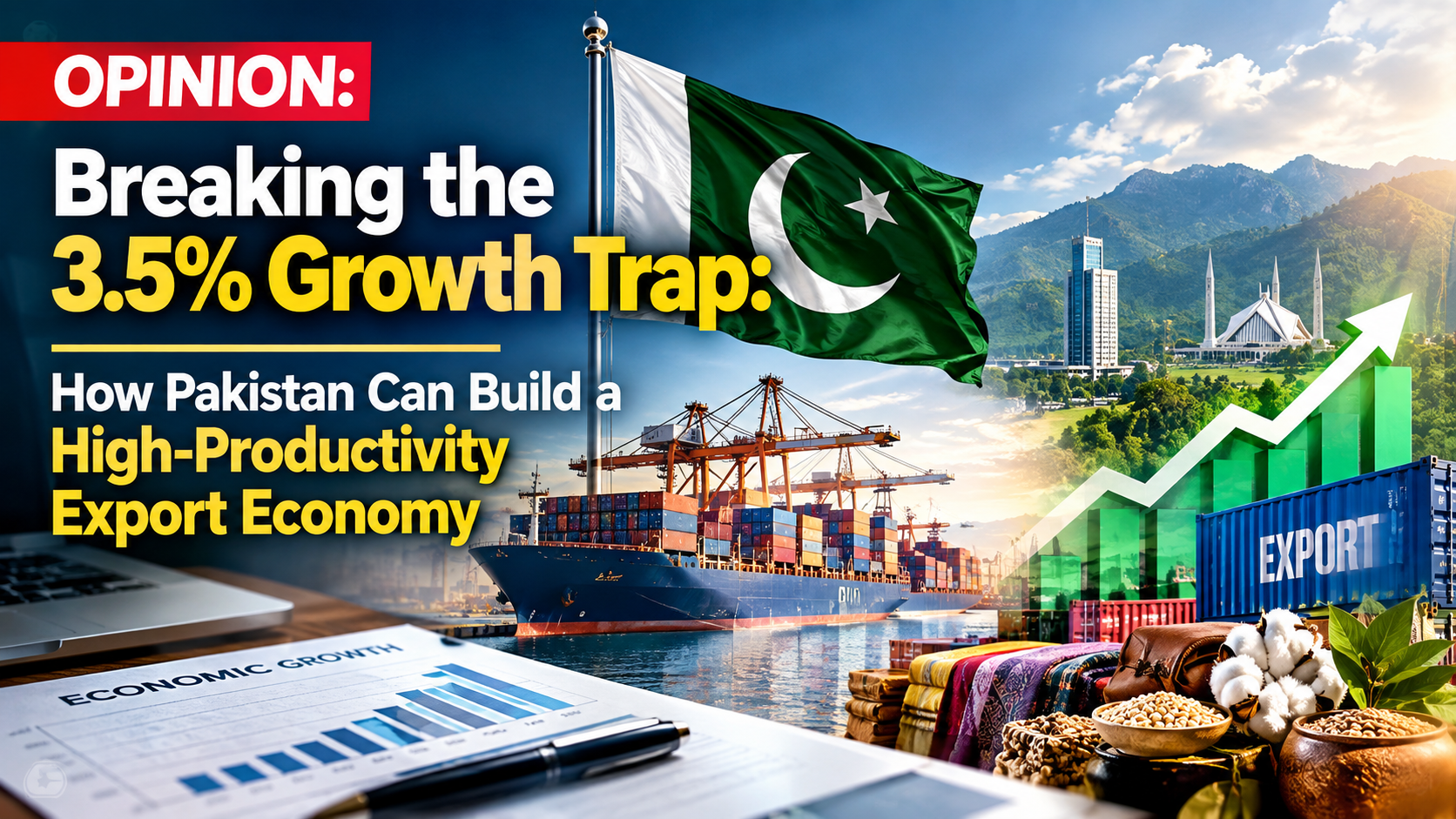
Over the last two centuries, global economic transformations have repeatedly demonstrated that escaping poverty requires moving labor from low-productivity agriculture to high-value industrial and technological sectors. While Western nations achieved this transition over centuries, East Asian economies—Japan, South Korea, Taiwan, and China—compressed the process into a few decades by sustaining growth rates near or above 8% per year.
Pakistan remains caught in a boom-and-bust stabilization cycle. While short-term fiscal adjustments under international programs stabilize reserves, real GDP growth continues to hover around 3.5%—a rate barely sufficient to match population growth and capital depreciation. Escaping this trap requires addressing the fundamental structural bottlenecks that constrain national productivity.
1. The Growth Divergence: Boom-and-Bust vs. Export-Led Industrialization
Pakistan’s growth model historically relies on domestic consumption driven by foreign remittances, debt-financed public spending, and import surges. Whenever domestic growth approaches 5%, import demand exhausts foreign exchange reserves, forcing monetary tightening, currency devaluation, and emergency fiscal consolidation.
In contrast, East Asian developmental models aligned domestic credit and state support directly with export discipline:
- State-Directed Capital Allocation: South Korea and Japan provided cheap credit, tax concessions, and infrastructure support exclusively to firms that achieved strict international export targets.
- Protection Tied to Performance: Domestic industrial protection was temporary and conditional on gaining global market share, preventing permanent reliance on state subsidies.
- High Savings and Investment: East Asian economies consistently maintained gross fixed capital formation above 30% of GDP, whereas Pakistan’s investment-to-GDP ratio routinely hovers below 15%.
2. The Three Structural Bottlenecks Holding Back Growth
I. The Economic Complexity Deficit
According to data from the Harvard Growth Lab’s Atlas of Economic Complexity, Pakistan ranks 89th globally in economic complexity. Its export basket remains concentrated in low-complexity goods—primarily basic textiles and raw agricultural commodities—which face volatile global prices and low income elasticity. Without expanding into medium- and high-tech manufacturing (such as electronics, auto components, and specialty chemicals), export revenues cannot cover the capital goods imports needed for sustained growth.
                     PAKISTAN'S STRUCTURAL GROWTH BARRIER

   +-------------------------------------------------------------------+
   |                 Low Industrial & Export Complexity                |
   |              (Textiles & Agriculture Dominate ~70%)               |
   +---------------------------------+---------------------------------+
                                     |
                                     v
   +-------------------------------------------------------------------+
   |                 Rapid Consumption-Driven Growth                   |
   |                     (Reaches ~4.5% - 5.0% GDP)                    |
   +---------------------------------+---------------------------------+
                                     |
                                     v
   +-------------------------------------------------------------------+
   |               Import Surge & Trade Deficit Spikes                 |
   |             (Foreign Exchange Reserves Depleted)                  |
   +---------------------------------+---------------------------------+
                                     |
                                     v
   +-------------------------------------------------------------------+
   |              Stabilization & Demand Contraction                  |
   |           (Higher Rates, Import Restrictions, Slow Growth)        |
   +-------------------------------------------------------------------+
II. Fiscal Crowding-Out and Energy Sector Inefficiencies
Data from the State Bank of Pakistan shows that public sector borrowing consumes the vast majority of commercial bank credit. This debt crowding-out deprives private enterprises of affordable long-term capital for industrial upgrades. Furthermore, structural power tariffs—driven by unaddressed circular debt, capacity payments, and transmission losses—render local manufacturers uncompetitive against regional peers in Vietnam, Bangladesh, and India.
“Escaping the 3.5% growth trap requires shifting resources from rent-seeking sectors into productive, export-oriented manufacturing.”
III. Human Capital & Agricultural Productivity Deficits
Recent economic analyses published in the World Bank Pakistan Development Update emphasize that low agricultural yield per hectare keeps a large share of the labor force tied to low-productivity farming. Stagnant agricultural yields limit raw material supply for processing industries and force the country to import essential food commodities during demand spikes.
3. A Four-Pillar Framework for Sustainable 7%+ Growth
To move beyond perpetual debt-fueled stabilization and achieve sustained double-digit growth, economic policy must focus on four structural imperatives:
| Reform Pillar | Strategic Action | Targeted Outcome |
| 1. Export Diversification | Transition subsidies from low-value textiles to high-complexity sectors (engineering, IT, specialty chemicals). Tie tax incentives to global market share gains. | Higher export complexity and reduced trade deficits. |
| 2. Energy & Fiscal Restructuring | Privatize mismanaged power distribution companies (DISCOs), eliminate cross-subsidies, and broaden the direct tax base to broaden credit for the private sector. | Lower industrial energy costs and increased private sector credit. |
| 3. Agricultural Modernization | Adopt high-yield seed technologies, corporate farming frameworks, and efficient drip irrigation systems to boost yield per acre. | Higher farm incomes, food security, and agricultural export surpluses. |
| 4. Institutional & Investment Reform | Create long-term policy predictability through legislative guarantees for foreign and domestic direct investment, structured via international standards like the International Monetary Fund (IMF) reform frameworks. | Increased Foreign Direct Investment (FDI) and gross capital formation. |
The Path Forward
Macroeconomic stabilization is a necessary condition for survival, but it is not a growth strategy. Without shifting resources from rent-seeking sectors into productive, export-oriented manufacturing, Pakistan will remain caught in its historical boom-and-bust cycle. Sustained, inclusive growth requires aligning state policy with market-driven export incentives, reforming the energy and tax structures, and modernizing the country’s economic foundation.
Discover more from The Economy
Subscribe to get the latest posts sent to your email.
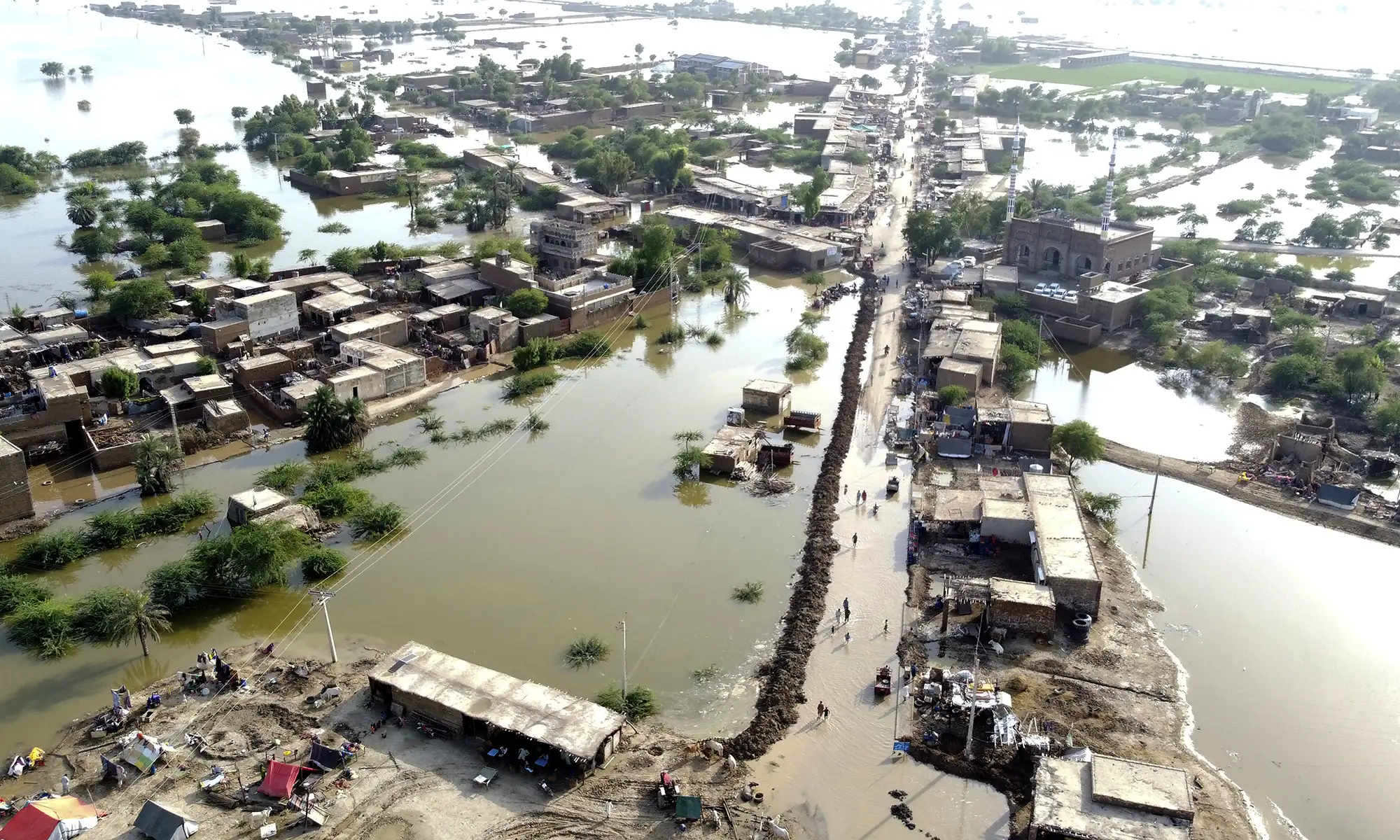
As Pakistan’s 2026 monsoon season continues to claim lives across Punjab, Khyber Pakhtunkhwa, Sindh and Balochistan, a harder question is coming into focus in Islamabad: whether the country’s fiscal priorities match the scale of the climate risk it now faces year after year — even as defence spending, driven by tensions with India, continues to climb.
The Human Toll Keeps Rising
Pakistan’s death toll from rain-related incidents since June 26 had climbed to 126 as of early August, according to the National Disaster Management Authority’s latest situation report, with Punjab and Khyber Pakhtunkhwa provinces bearing the heaviest losses at 47 and 55 deaths respectively. The NDMA has continued to warn of fresh flooding risk across Sindh, Punjab, KP and Balochistan as additional rain spells move through the country.
The federal Emergency Response Committee, chaired by Planning Minister Ahsan Iqbal, has stressed the importance of close coordination among stakeholders to ensure a timely and effective response to the unfolding emergency, while NDMA teams continue coordinating relief operations with national and international humanitarian partners.
A Pattern Pakistan Has Seen Before
This year’s floods carry unmistakable echoes of 2022, when record monsoon rains and glacial melt killed more than 1,700 people, affected over 33 million, and caused an estimated $30 billion in economic losses — one of Pakistan’s worst natural disasters on record. While this year’s death toll has so far been far lower, the pattern of institutional response has drawn sharp criticism from Pakistani commentators. A Business Recorder editorial argued that every monsoon exposes the same shortcomings — inadequately maintained drainage systems, encroachments blocking natural waterways, and construction proceeding in flood-prone areas with little regard for long-term risk, with administrative coordination typically strengthening only during the emergency itself rather than before it.
Compounding the risk, the World Meteorological Organization’s July 31 update flagged El Niño’s effect on rising temperatures and drought conditions in the coming months — suggesting Pakistan’s climate volatility is unlikely to ease even once this monsoon season passes.
The Fiscal Trade-off
What distinguishes this year’s flooding from a purely humanitarian story is the fiscal backdrop against which it is unfolding. Despite mounting climate risk, Pakistan raised defence spending by 20% for the 2025-2026 fiscal year, citing ongoing tensions with India, while cutting its overall federal budget by 6.9%, according to analysis of the country’s competing budget priorities.
The scale of the mismatch is stark when set against Pakistan’s long-term climate financing needs. The World Bank estimates Pakistan will require $348 billion by 2030 to address climate impacts, split between $152 billion for adaptation and resilience strategies and $196 billion toward reducing carbon emissions across the economy — a figure that dwarfs the country’s current fiscal capacity even before accounting for the defence-spending increase.
Agriculture Bears the Brunt
The economic exposure runs deep given Pakistan’s reliance on farming. Agriculture accounts for roughly 24% of Pakistan’s GDP and employs half of its labour force, meaning flood damage to Punjab’s farmland — a critical agricultural hub — carries outsized consequences for both rural livelihoods and the broader economy’s growth trajectory, coming just as the country posted its fastest GDP growth in four years for FY26.
Unlike the catastrophic 2022 floods, this year’s disaster has affected an even broader geographic swathe of the country, including areas of Punjab that were less severely hit three years ago — a reminder that flood risk is spreading rather than concentrating in historically vulnerable regions.
Why This Matters for Investors and Policymakers
For a country whose fiscal credibility with the IMF and international creditors already rests on a delicate balance of reform commitments, the collision between climate adaptation needs and defence spending pressures adds a new variable to Pakistan’s macroeconomic outlook. Every flood season that passes without meaningfully upgraded drainage infrastructure or flood-plain zoning enforcement effectively defers costs rather than avoiding them — costs that show up later as emergency relief spending, agricultural output losses, or renewed pressure on the current account through disrupted export crops like cotton.
Key Takeaways
- Pakistan’s 2026 monsoon death toll has climbed to at least 126 since June 26, with Punjab and Khyber Pakhtunkhwa hardest hit.
- The government raised defence spending 20% for FY26 citing India tensions, while cutting the overall federal budget by 6.9%.
- The World Bank estimates Pakistan needs $348 billion by 2030 for climate adaptation and emissions reduction — far exceeding current fiscal capacity.
- Agriculture, which accounts for 24% of GDP and employs half the labour force, remains acutely exposed to repeated flood damage.
- Commentators warn that recurring institutional shortcomings — poor drainage maintenance and flood-plain construction — are deferring rather than reducing long-term costs.
Frequently Asked Questions
How many people have died in Pakistan’s 2026 monsoon floods? Pakistan’s death toll from rain-related incidents since June 26, 2026 had reached at least 126 as of early August, according to the National Disaster Management Authority.
How much does Pakistan need for climate adaptation? The World Bank estimates Pakistan will require $348 billion by 2030, including $152 billion for adaptation and resilience and $196 billion for reducing emissions across the economy.
Why has Pakistan increased defence spending despite flood risks? Pakistan raised defence spending by 20% for FY26, citing ongoing tensions with India, while simultaneously cutting its overall federal budget by 6.9%, creating a fiscal trade-off with climate adaptation needs.
Discover more from The Economy
Subscribe to get the latest posts sent to your email.

Pakistan closed out July 2026 with two of its strongest economic signals in years — even as the underlying trade picture tells a more cautious story. Workers’ remittances hit $3.6 billion in July, up 13% year-on-year, the State Bank of Pakistan confirmed on Monday, August 10 (The Nation). Meanwhile, the benchmark KSE-100 index has delivered one of its strongest runs in the region.
Remittances: A Record Year, Confirmed
July’s $3.6 billion inflow marked a 4.5% increase over June, continuing a pattern that has defined Pakistan’s external accounts throughout FY2026. According to the Ministry of Finance’s monthly economic outlook, cited by the Express Tribune, workers’ remittances rose to $41.6 billion for the full FY2025-26, up 8.6% from $38.3 billion the previous year (Express Tribune). Saudi Arabia and the UAE remain the dominant sources, together accounting for close to half of total inflows, according to earlier-year tracking from Pakistan & Gulf Economist, alongside notably strong growth from the UK and EU corridors.
The KSE-100’s Extraordinary Run
Pakistan’s stock market has been the standout story of FY2026. The benchmark KSE-100 index surged 27.6% year-on-year to 176,042 points by July 29, 2026, with market capitalisation rising 19.4% in rupee terms and 21.6% in dollar terms, according to the Ministry of Finance’s own reporting (Express Tribune). That kind of rally, sustained over a full fiscal year, places Pakistan’s equity market among the best performers globally for the period — a striking outcome for an economy still working through an active IMF program.
The Trade Picture Is Less Flattering
The same Ministry of Finance report is candid about where the pressure points remain. Exports declined to $30.8 billion for FY2025-26, down from $32.3 billion the prior year, while imports rose sharply to $64.5 billion from $59.1 billion. Foreign direct investment fell to $1.64 billion from $2.48 billion, and portfolio investment remained negative for the year.
Despite that widening trade gap, Pakistan’s current account deficit was contained to just $139 million for the full fiscal year — a remarkably narrow figure that the finance ministry credits directly to record remittance inflows. Foreign exchange reserves reached $22.7 billion by mid-July 2026, and the rupee actually appreciated slightly to Rs277.80 against the dollar, compared with Rs283.05 a year earlier. Inflation averaged 7.1% across FY2026, staying within the government’s target band despite elevated global oil prices.
The IMF Backdrop
Pakistan’s macroeconomic stabilization continues under the IMF’s Extended Fund Facility. The Fund’s most recent review found fiscal performance “strong,” with a primary surplus of 1.6% of GDP expected for FY26, in line with program targets, while gross reserves climbed to $16 billion by end-2025 from $14.5 billion six months earlier (IMF). A separate 28-month Resilience and Sustainability Facility arrangement, approved in May 2025, continues supporting Pakistan’s climate and disaster-resilience reforms.
The Risk the Ministry Itself Flagged
Pakistan’s own finance ministry has been unusually direct about the fragility beneath these headline numbers, warning that renewed escalation between the United States and Iran could trigger volatility in global energy prices, trade flows, and financial markets — risks that could disrupt Pakistan’s improving trajectory given the country’s continued exposure to Gulf labor markets and energy import costs (Express Tribune).
The Bottom Line
Pakistan’s FY2026 story is genuinely two-sided: a stock market and remittance base performing better than almost anyone forecast a year ago, financing a current account that has stayed remarkably close to balance — set against an export sector that continues to shrink and a foreign direct investment picture that remains stubbornly weak. Whether the KSE-100 rally and remittance strength can persist long enough for structural export reform to catch up remains the defining question for Pakistan’s economy heading into FY2027.
How much did Pakistan’s remittances grow in July 2026?
Pakistan’s remittances reached $3.6 billion in July 2026, up 13% year-on-year, while the KSE-100 stock index surged 27.6% year-on-year to 176,042 points by late July.
Discover more from The Economy
Subscribe to get the latest posts sent to your email.

VIX Index Explained: How to Trade Wall Street’s Fear Gauge Today

Commercial vs Residential Real Estate: Which Wins in 2026?

Presidential Stock Market Performance: How Trump’s Second Term Compares to History

2026 Real Estate Market News: Are We Heading for a Correction?

Bitcoin Price Forecast 2026–2027: Will the 4-Year Cycle Hold?

Fidelity Crypto vs. Traditional Brokerages: A Guide for Modern Investors

The 2026 Global Smartphone Market: AI Integration and Competitor Analysis

SpaceX IPO: How Aerospace Is Reshaping Tech Startup News

Fidelity Investments Review: Maximizing Returns in a Volatile Stock Market

How Crypto Transformed the Trump Fortune: A $1.4 Billion Financial Breakdown

Global Pension Systems Ranked: The World’s Best and Worst Retirement Frameworks

Global Supply Chain Vulnerabilities: From Eurasian Trade Corridors to Food Consumer Recalls

Why 5% U.S. Treasury Yields Signal a Global Market Regime Shift.

Federal Reserve Defies White House Pressure: Inside Trump’s Demand for Sub-1% Interest Rates After Historic 2026 Rate Hike

State Farm’s $5B Dividend 2026: Who Qualifies & Payout Dates

US-China Relations in Q3 2026: Trade Tariffs and Supply Chain Risks

Top 30 Stocks for Investment in PSX for Massive ROI in 2026

SpaceX Starship Flight 14: First Orbital Attempt & Starlink V3 Launch Explained

The 2026 Crypto Regulatory Shift: What It Means for Institutional Investors

AI Chip Stocks 2026: The Best Semiconductor Investments Beyond Marvell

Tween Back-to-School Trends 2026: What’s Driving the $85B Season

AI-Powered Training: The Next Multi-Billion Dollar Ecosystem in Fitness

Oil Prices Break $100 in 2026: Middle East Conflict & Energy Markets

10-Year Treasury Yield Hits 4.80%: What It Means for Rates & Portfolios

Fidelity Investments Review 2026: SPAXX Yields & Zero-Fee Funds

Shein Clothes Quality & Safety in 2026: What Lab Tests Show

BRICS+ Cross-Border Payments 2026: Interoperability Explained

MRVL Earnings 2026: Why Marvell Sank Despite Beating Estimates
-

 Markets & Finance9 months ago
Top 15 Stocks for Investment in 2026 in PSX: Your Complete Guide to Pakistan’s Best Investment Opportunities
-

 Analysis7 months ago
Johor’s Investment Boom: The Hidden Costs Behind Malaysia’s Most Ambitious Economic Surge
-

 Analysis7 months ago
Top 10 Stocks for Investment in PSX for Quick Returns in 2026
-

 Analysis8 months ago
Brazil’s Rare Earth Race: US, EU, and China Compete for Critical Minerals as Tensions Rise
-

 Banks8 months ago
Best Investments in Pakistan 2026: Top 10 Low-Price Shares and Long-Term Picks for the PSX
-

 Investment8 months ago
Top 10 Mutual Fund Managers in Pakistan for Investment in 2026: A Comprehensive Guide for Optimal Returns
-

 Global Economy9 months ago
15 Most Lucrative Sectors for Investment in Pakistan: A 2025 Data-Driven Analysis
-

 Global Economy9 months ago
Pakistan’s Export Goldmine: 10 Game-Changing Markets Where Pakistani Businesses Are Winning Big in 2025