
Business
Alphabet’s $500 Billion Reckoning: Wall Street Is Losing Patience With the AI Boom


Why investors punished Google while largely sparing Microsoft—and what the historic sell-off reveals about the economics of artificial intelligence.
Wall Street has spent years rewarding technology companies for promising an artificial intelligence revolution. On October 29, it sent one of the revolution’s largest financiers a brutally different message: innovation may be impressive, but investors still expect a return on their money.
In a single trading session, approximately $500 billion evaporated from Alphabet’s stock market valuation. Shares in Google’s parent company plunged 12.6 percent, their worst one-day performance since the company’s public listing in 2004.
The extraordinary sell-off came after a quarter that, by many conventional measures, should have been cause for celebration. Alphabet reported revenue of $127.6 billion, a 25 percent increase from a year earlier. Its cloud division more than doubled its revenue. Operating income rose 30 percent.
Yet investors responded not with applause but with alarm.
The explanation lies in a troubling contradiction at the heart of the AI economy. The industry’s technological ambitions are accelerating faster than its capacity to translate those ambitions into cash.
What happened to Alphabet was not simply an earnings disappointment. It was a warning that the financial rules governing Silicon Valley’s AI investment boom may be changing.
And the contrasting treatment of Microsoft, which reported results on the same evening, offers an illuminating explanation.
The $500 Billion Warning
Alphabet’s financial results, released on October 28, exposed an uncomfortable imbalance.
The company generated $42.3 billion in operating cash flow during the third quarter. But it spent $51.4 billion on capital expenditure, primarily technical infrastructure. That left negative free cash flow of approximately $9.1 billion.
The previous quarter had produced a free-cash-flow deficit of $5.9 billion.
Two consecutive quarters in which capital investment exceeded internally generated operating cash represent a significant change in the financial profile of a business long celebrated for converting digital advertising into enormous amounts of cash.
The numbers are particularly striking because Alphabet’s investment programme shows little sign of slowing.
Management maintained its capital-expenditure forecast of $195 billion to $205 billion for 2026 and warned that spending would rise significantly again in 2027.
For investors, this raises a question that no amount of enthusiasm about large language models can easily answer: How much investment will be required before the financial rewards become commensurate with the costs?
The market was not reacting merely to the size of the expenditure. It was reacting to the possibility that infrastructure commitments could continue rising faster than the cash available to finance them.
There is, however, an essential distinction.
Alphabet is not a financially distressed company. According to its third-quarter regulatory filing, it held approximately $265 billion in cash, cash equivalents and marketable securities at the end of September, although that total included substantial equity holdings, including restricted SpaceX shares.
Its free cash flow over the preceding 12 months remained positive at $19.7 billion.
Moreover, an approximately $8.7 billion loss on equity securities—largely associated with SpaceX—depressed reported earnings without representing an equivalent quarterly operating cash outflow.
These distinctions matter. A temporary cash-flow deficit is not proof of impending insolvency, just as a large accounting profit is not proof that every investment creates economic value.
Alphabet has the resources to continue financing its ambitions. What investors are questioning is the price shareholders must pay for those ambitions, and the returns they will ultimately receive.
The market’s message is therefore more subtle than a rejection of AI: extraordinary financial capacity no longer guarantees unlimited investor patience.
Why Microsoft Escaped the Same Punishment
Microsoft’s earnings announcement provided a revealing contrast.
The company reported quarterly revenue of $92.3 billion, up 19 percent, while Azure revenue grew 48 percent.
It generated approximately $58 billion in operating cash flow and recorded $18.6 billion in positive free cash flow, despite capital expenditures of $45.2 billion.
Microsoft’s share price finished October 29 almost unchanged, declining approximately 0.2 percent.
That relative resilience was not because Microsoft had abandoned infrastructure spending. Nor was its investment programme fundamentally modest.
The company was continuing to commit extraordinary sums to data centres, processors and cloud infrastructure. Management projected approximately $170 billion in capital expenditures for calendar 2026, with some capacity deliveries delayed.
The distinction was that Microsoft’s operating cash generation continued to cover its cash capital investment, providing a financial cushion that Alphabet lacked during the latest quarter.
Microsoft also presented investors with a more immediately visible commercial connection between infrastructure and revenue.
Azure sells computing capacity directly to business customers. Microsoft can monetize AI through cloud consumption, enterprise software, development platforms and productivity subscriptions.
The relationship between customer demand, computational capacity and revenue is not perfectly transparent, but it is relatively straightforward.
When a business buys additional Azure computing capacity, Microsoft can demonstrate the associated revenue. That does not guarantee attractive returns on capital, but it offers investors a clearer path toward measuring them.
Alphabet faces a more complicated challenge.
Its infrastructure must support cloud customers, AI-model development and a vast collection of consumer services. Much of the expenditure is directed toward transforming products that users already access, including Search.
In those businesses, greater AI usage does not automatically produce a corresponding increase in revenue.
Nevertheless, the argument that Microsoft can finance its AI expansion entirely from internally generated cash also requires qualification.
On October 29, Microsoft priced a $25 billion offering of senior unsecured notes, with proceeds available for general corporate purposes, potentially including capital expenditure.
Even one of the industry’s strongest cash generators has chosen to supplement its financial resources through capital markets.
The real distinction is therefore not between companies that borrow and those that do not.
It is between companies whose investors remain confident in the relationship between investment, operating cash generation and future returns—and those for which that relationship has become harder to forecast.
Google’s Most Dangerous AI Problem Is Its Greatest Business
The more consequential challenge may lie beneath Alphabet’s capital expenditure.
Google’s search engine remains one of the most profitable commercial platforms ever created. For decades, its advertising model has depended on a remarkably efficient transaction: users express an intention, advertisers compete for their attention, and Google collects revenue.
Artificial intelligence threatens to alter that relationship.
Alphabet reported that Google Search and other advertising revenue grew 12 percent to approximately $63.4 billion in the third quarter, down from 17 percent growth in the preceding quarter.
The slowdown was not solely attributable to AI. Company executives pointed to currency effects and changing advertising patterns in specific industries, with foreign exchange identified as the largest factor.
But they also acknowledged that lower monetization in Google’s AI Mode was contributing to the deceleration.
This is the economic dilemma at the centre of Google’s transformation.
Traditional search presents users with advertisements alongside links to external websites. AI-powered search increasingly attempts to answer questions within Google’s own interface.
These experiences can be more useful, more conversational and more engaging. But the established commercial architecture does not transfer automatically.
A user who receives a comprehensive AI-generated answer may have less reason to click on conventional search results. Advertisers may need different formats to reach that user. Google must discover how to generate sufficient revenue from those interactions without compromising their usefulness.
Chief Executive Sundar Pichai has said AI investments are helping produce the fastest year-over-year growth in search queries in five years.
He has also reported that queries in AI Mode are, on average, three times longer than traditional searches.
Longer queries do not necessarily mean three times the computational cost. But they illustrate how significantly the product is changing.
The crucial question is whether this increased engagement can become sufficiently profitable engagement.
If Google’s new AI services attract greater usage but generate less advertising revenue per interaction, the company faces a double challenge: increasing infrastructure costs alongside uncertainty about monetization.
That possibility makes Alphabet’s situation different from a conventional infrastructure investment cycle.
Google is not merely building a new business. It is spending heavily to reinvent an existing one, partly to defend it against technologies that could undermine its established advantages.
And that creates a difficult strategic calculation.
Moving too slowly risks allowing competitors to redefine how consumers discover information. Moving too quickly could weaken the economics of the search business that finances Google’s technological ambitions.
For Alphabet, therefore, the cost of AI is not limited to servers, chips and electricity.
It also includes the possibility of disrupting one of the world’s most successful advertising models before an equally profitable successor is firmly established.
The Case Against Wall Street’s Verdict
There is a powerful counterargument to the market’s reaction.
Alphabet’s latest earnings contained evidence that its AI investments are already producing substantial commercial results.
Google Cloud revenue increased 103 percent to $30.7 billion, while the division’s operating income climbed from approximately $3.6 billion to $11.1 billion.
These are not the financial results of a business experiencing a collapse in AI demand.
They suggest that Alphabet is gaining meaningful commercial traction.
Importantly, the company said sales of its tensor processing unit systems made a significant contribution to Cloud’s expansion. Such hardware sales are not economically identical to recurring cloud-service revenue, and investors should distinguish between them when evaluating future growth.
Even so, the improvement in operating income is difficult to dismiss.
Alphabet has also built substantial expertise across semiconductor design, AI models, cloud infrastructure and consumer distribution.
Its ability to combine these capabilities may ultimately create advantages that narrower competitors struggle to replicate.
And large infrastructure investments frequently require cash long before their economic benefits become visible.
Data centres may take years to build and operate at full capacity. Customers may increase their spending gradually as applications move beyond experimentation into widespread deployment.
Judging a multiyear investment programme solely by two quarters of negative free cash flow would be shortsighted.
Indeed, if Alphabet’s investments strengthen its cloud business, improve the economics of inference and preserve Google’s position in search, the present spending surge could ultimately appear justified.
The difficulty is that investors must evaluate these possibilities before the returns become fully measurable.
That is what makes the debate so consequential.
The question is not whether Alphabet possesses valuable technology or whether demand for AI infrastructure exists. Its latest cloud results provide compelling evidence of both.
The question is whether today’s investment will earn sufficient returns to justify the company’s valuation after allowing for operating costs, depreciation, financing requirements and technological obsolescence.
That is a substantially higher standard than simply demonstrating rapid revenue growth.
The AI Boom Has Entered Its Financing Era
Alphabet’s experience is part of a much broader transformation in the economics of America’s largest technology companies.
The industry’s leading platforms are committing sums once associated with national infrastructure programmes.
Meta expects capital expenditures of $135 billion to $145 billion in 2026. It also reported negative free cash flow of approximately $2.1 billion in the third quarter.
Amazon’s October 29 results revealed a $42.4 billion free-cash-flow outflow over the preceding 12 months, despite AWS revenue growing 39 percent in the third quarter. Amazon maintained plans for approximately $220 billion in cash capital expenditures in 2026.
The enormous scale of these commitments suggests that AI is moving from a software-led innovation cycle into something closer to an industrial investment cycle.
Building the infrastructure requires land, electricity, cooling systems, semiconductors, financing and years of planning.
It also introduces risks unfamiliar to investors accustomed to the exceptional profitability of asset-light internet businesses.
An AI accelerator purchased today may become less economically competitive as newer processors arrive. Data-centre capacity must attract customers at prices sufficient to recover its cost. Electricity and cooling requirements can place lasting pressure on operating margins.
Accounting profits may remain strong while cash is tied up in new infrastructure.
Nor is the industry insulated from the cost of capital.
When borrowing becomes more expensive, when investors demand higher returns or when economic uncertainty affects enterprise spending, projects that once appeared compelling can become less attractive.
This does not mean an AI investment bubble must inevitably burst. Technological revolutions can deliver extraordinary productivity gains and create profitable businesses.
But history offers no guarantee that every company financing a technological revolution will capture a proportionate share of its economic benefits.
Railways transformed trade. Telecommunications transformed communication. The internet transformed commerce.
In each case, society’s long-term gains and the financial returns available to particular investors were not always the same thing.
Artificial intelligence may prove no different.
The Next Test Is Not Revenue Growth. It Is Return on Capital.
Investors should now demand more useful answers from technology companies than ever-larger announcements of capital expenditure.
How much additional revenue is generated by each dollar invested in computing infrastructure?
How quickly does new capacity reach commercially productive utilization?
Are businesses earning attractive margins after accounting for depreciation, energy, financing and maintenance?
And perhaps most importantly for Alphabet, can AI-powered search eventually produce revenue per user interaction comparable to—or better than—the traditional model it is replacing?
These questions matter more than headline declarations about model capabilities or user engagement.
Alphabet’s forthcoming fourth-quarter results, including further guidance on 2027 capital expenditure, will provide another opportunity to assess whether spending is beginning to stabilize relative to cash generation.
Microsoft will face similar scrutiny, especially as delayed GPU capacity becomes available and its own financing requirements increase.
The market’s relative tolerance toward Microsoft should not be mistaken for permanent immunity.
If AI revenue growth disappoints, or if capital requirements continue escalating faster than cash flow, even the strongest balance sheets will be tested.
There is another possibility, of course.
If AI adoption accelerates, infrastructure becomes more efficient and companies successfully develop profitable products, today’s expenditure could support years of earnings growth.
That outcome remains plausible.
But the burden of proof is shifting from technological promise to financial performance.
The End of Silicon Valley’s Blank Cheque
Alphabet’s historic sell-off may ultimately be remembered not as the moment Wall Street abandoned artificial intelligence, but as the moment it began taking the technology’s economics seriously.
The company did not lose roughly $500 billion in market value because its engineers had failed to build compelling AI products. It lost that value because investors became less confident about how much future cash shareholders would receive from the investments required to commercialize them.
Microsoft’s comparative resilience demonstrates the importance of that distinction. Investors were more willing to tolerate enormous capital commitments when supported by strong operating cash flow and clearer monetization prospects.
But Microsoft is not exempt from the same arithmetic, and Alphabet is far from defeated by it.
The real reckoning lies ahead.
Silicon Valley has successfully convinced the world that artificial intelligence will reshape how businesses operate and how people live.
Now it must prove that the economics of building that future will reward those paying for it.
For years, the defining question of the AI boom was who could build the most powerful technology. The defining question now is who can turn that technology into sustainable cash returns.
That is not the end of the AI revolution.
It may be the beginning of its financial maturity.
Discover more from The Economy
Subscribe to get the latest posts sent to your email.


Aviation
Zhuhai Airshow 2026: How China’s Stealth Jets, Drones and Missiles Are Redrawing Global Air Power
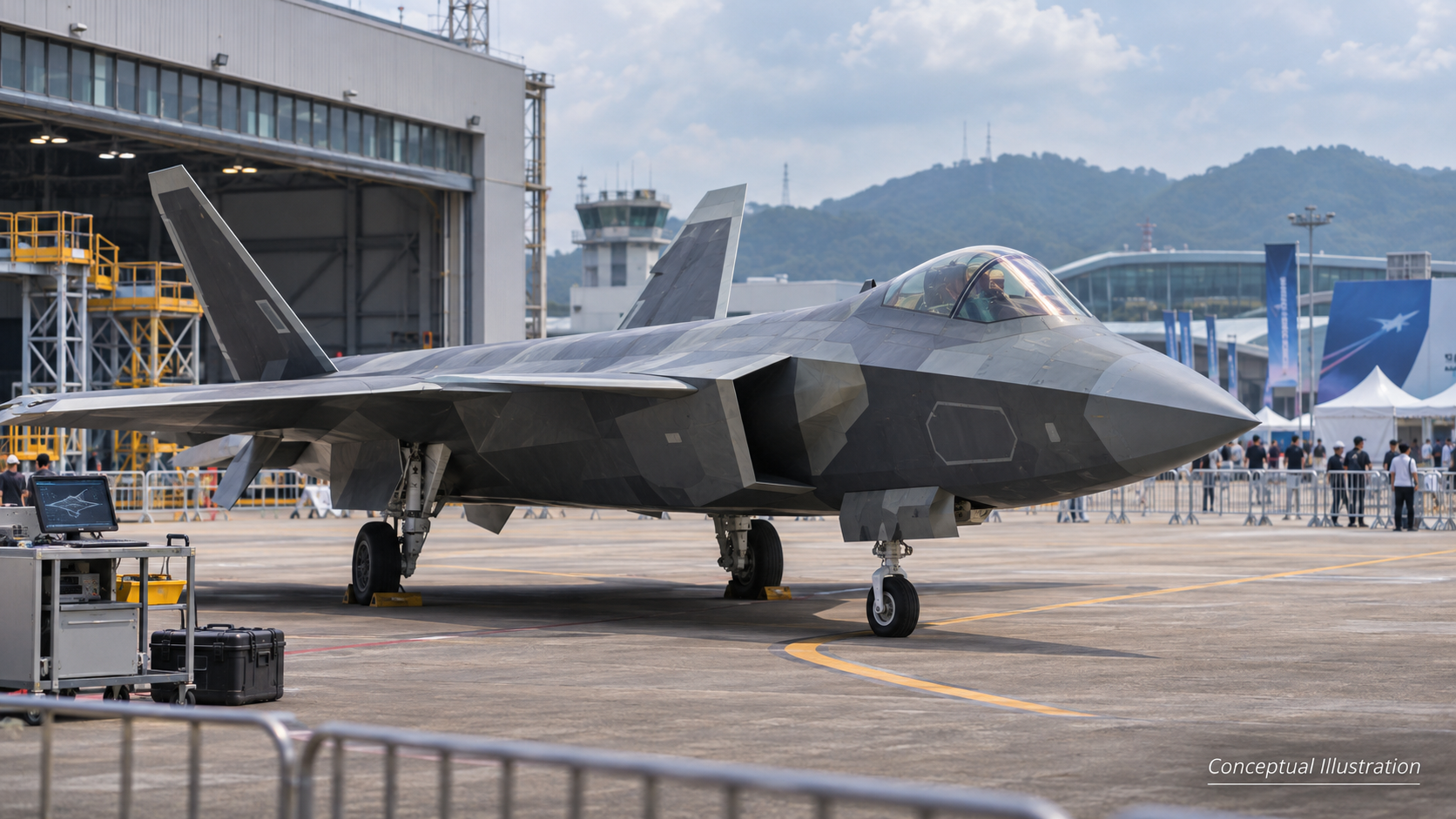
Thirty years after Russian fighters impressed crowds at China’s inaugural airshow, Zhuhai has become a window into an ambitious aerospace transformation. The deeper story is not just the aircraft Beijing can display, but whether its factories, pilots, sensors and supply chains can deliver sustained military advantage.
In brief: The 16th China International Aviation and Aerospace Exhibition is scheduled for December 7–13, 2026, in Zhuhai, Guangdong. Marking 30 years since the first show in 1996, it will highlight China’s growing capability in stealth fighters, unmanned systems, advanced missiles and naval aviation. Independent analysts nevertheless distinguish public displays from operational readiness, especially in areas such as aircraft engines, drone autonomy and large-scale combat integration. The dates and organisers’ programme were confirmed at an October 13 press conference.
The day Russian jets defined China’s ambitions
In November 1996, the first Zhuhai airshow revealed an uncomfortable fact about Chinese military aviation: the most impressive combat aircraft on view were not Chinese. Russian Su-27 fighters demonstrated the manoeuvrability and technological sophistication that Beijing still hoped to develop domestically. China presented its J-8IIM, an adaptation of an older fighter using Russian avionics and armaments, but the broader gap between aspiration and industrial capability remained striking. That contrast anchors the retrospective published by the South China Morning Post.
Thirty years later, the story has changed. China can manufacture operational stealth fighters, long-range combat aircraft, advanced radar platforms and specialised electronic-warfare aircraft. It has also become a significant exporter of military hardware. Yet the most important question is no longer whether China can build impressive aircraft. It is whether the country can integrate those aircraft, their weapons and their human operators into a durable combat system capable of challenging the United States and its partners.
That distinction—between possessing a platform and mastering a system—should shape any serious assessment of Zhuhai in 2026.
Three decades of aviation development: the milestones
| Year | Zhuhai milestone | Why it mattered |
|---|---|---|
| 1996 | Inaugural exhibition; Russian Su-27s attract attention alongside the Chinese J-8IIM | Highlighted the technology gap and dependence on imported know-how |
| 2008 | J-10 fighter makes a prominent public showing | Signalled progress in indigenous modern fighter development |
| 2014 | Y-20 heavy transport appears at Zhuhai | Demonstrated advances in large-aircraft design and military airlift |
| 2016 | J-20 stealth fighter’s first public flight demonstration | Established an indigenous low-observable combat-aircraft programme |
| 2021 | Postponed 2020 edition takes place; China displays a broader set of advanced systems | Illustrated the maturing, diversified aerospace ecosystem |
| 2024 | J-35A public debut; J-20, missiles, electronic warfare and drones featured | Demonstrated a shift from individual fighter projects toward more varied capabilities |
| 2026 | Planned 30th-anniversary exhibition, with a dedicated naval equipment area | Moves the exhibition further toward integrated cross-domain military technology |
The Chinese Ministry of National Defense’s aviation history documents the J-20’s 2016 public debut and Y-20’s 2014 appearance; Reuters reported the J-20 flypast in 2016 and the J-35A’s 2024 debut. Dates refer to public appearances, not necessarily first flights, serial production or entry into military service.
J-20: the clearest evidence that China has moved beyond imitation
China’s Chengdu J-20 is not merely an aircraft concept displayed at trade fairs. It is an operational stealth fighter being delivered in increasing numbers. The International Institute for Strategic Studies (IISS) assessed in its 2026 Military Balance commentary that more than 300 J-20s had been delivered. This is an expert estimate rather than a publicly audited production figure.
A separate January 2026 analysis by the Royal United Services Institute (RUSI) assessed approximately 300 J-20s in service by mid-2025, compared with around 50 in 2020. RUSI estimated that annual production of upgraded J-20 variants could be approaching 120 aircraft by late 2025. It projected that, if the trend continued, the force might reach roughly 1,000 J-20 variants by 2030. That 2030 number is a projection, not an existing fleet or a guaranteed outcome.
Why does scale matter? A small number of stealth aircraft may offer prestige and limited specialised capability. Hundreds can potentially sustain training, maintenance rotations and persistent air operations—provided spare parts, engines, munitions, bases and qualified crews keep pace. Fleet size alone does not prove superiority over US aircraft, but it changes how opponents must plan.
J-35A: a second stealth family, not simply another J-20
The smaller Shenyang J-35A made its public airshow debut in November 2024. Janes identified the J-35A as a land-based aircraft and examined the distinct naval variant being developed for carrier operations. Aircraft with similar designations should not be assumed to have identical operating roles.
The IISS reported that an initial batch of J-35A aircraft entered service during 2025, while RUSI described J-35 production as being in an early phase. These assessments indicate progress, not proof of large-scale operational maturity. Public information still does not permit definitive comparisons between the J-35A and America’s F-35 in stealth performance, sensor fusion or combat reliability.
What about the so-called J-36 and J-50?
Unusual Chinese tailless aircraft designs observed in 2025 have frequently been labelled the J-36 and J-50/J-XDS by outside observers. Those labels should not be treated as definitive official programme names. RUSI describes the aircraft as developmental demonstrators, not frontline fighters. Their appearance suggests experimentation with future long-range, low-observable aircraft, but it cannot establish when—or whether—either design will enter service.
The real transformation: China is building an air-combat network
Fighter aircraft attract cameras. The less photogenic equipment—radars, long-range missiles, early-warning aircraft, datalinks and electronic-warfare platforms—may be more consequential.
Modern aerial warfare depends on the ability to detect a target, distribute reliable information, launch a weapon and update targeting data while the enemy attempts to disrupt the chain. Military analysts call this a kill chain. A sophisticated stealth fighter loses much of its potential if it lacks timely intelligence, reliable communications or supporting tankers and radar aircraft.
China has invested across that system. RUSI notes expanding KJ-500 airborne early-warning capacity, specialised J-16D and naval J-15 electronic-warfare variants, and modern long-range air-to-air missiles such as the PL-15 and PL-17. Its analysis also points to increasingly demanding training and a larger pool of modern combat aircraft. These developments suggest China is not merely copying Western aircraft designs; it is developing ways to conduct complex air operations with multiple supporting platforms.
At Zhuhai in 2024, visitors saw a wider ecosystem of military technology, including the CH-7 uncrewed aircraft, HQ-19 missile defence system and the electronic-warfare J-15. Reuters’ reporting highlighted both their military potential and the limitations of public technical information.
The implication for a Taiwan contingency or wider Indo-Pacific crisis is serious: US and allied planners may face not one exceptional Chinese fighter, but a layered network of aircraft, surface-to-air missiles and surveillance assets. That still does not establish that China would win an air campaign. Geography, combat experience, logistics, base vulnerability, electronic warfare and political decisions could all change the outcome. CSIS research on Chinese military activity in 2025 provides additional context about rising operational tempo around Taiwan and elsewhere in the region.
The drone revolution: plenty of ambition, less public proof
Uncrewed systems are an important part of the Zhuhai story. Platforms on display range from reconnaissance aircraft to proposed collaborative combat drones that might operate alongside crewed fighters. The attraction is understandable: such systems could extend surveillance, complicate enemy defences or assume missions too dangerous for pilots.
But a model described as ‘AI-enabled’ is not the same thing as a fully autonomous aircraft ready for combat. The US Department of Defense’s 2025 report on Chinese military developments noted that some drone and artificial-intelligence capabilities promoted at Zhuhai were aspirational, while other real-world functions still relied heavily on human inputs and pre-programmed missions.
This is a crucial distinction for readers. The meaningful tests are not how futuristic a drone looks, but whether it can operate reliably in contested airspace, communicate under electronic attack, distinguish targets appropriately and fit into existing command structures. Most of those performance characteristics cannot be verified from a public exhibition.
Engines, manufacturing and training: where the technological race is still being decided
China’s expansion has been substantial, but several constraints remain important.
Aircraft engines. Historically, Chinese fighter programmes depended on imported Russian engines while domestic propulsion matured. US defence officials acknowledged China’s progress in transitioning the J-20 toward indigenous engines. The 2025 Pentagon report nevertheless cautioned that advanced engine development continues to encounter technological barriers. Claims about particular engines’ thrust, lifespan and fleetwide installation should therefore be treated carefully unless independently substantiated.
Industrial consistency. Prototypes demonstrate what engineers can design; serial production shows what factories can repeat to specification. Maintaining hundreds of modern fighters demands precision manufacturing, materials expertise and predictable component supply. Public estimates of output are informative, but exact fleet readiness rates remain uncertain.
Personnel and logistics. Training pilots for advanced air combat requires realistic exercises, secure communications, maintainers and spare engines. RUSI considers the complexity of Chinese air-force training to have increased, but China still has much less publicly documented recent experience of large-scale high-end air warfare than the United States. Operational experience is not identical to combat readiness, and neither side’s actual performance can be established in advance.
Why China’s commercial aviation industry belongs in the story
Military aircraft are only one side of China’s aerospace ambitions. State-owned COMAC wants to establish a serious passenger-aircraft manufacturing industry. Its C919 made its first commercial flight in May 2023, according to COMAC’s official product history. The aircraft competes for the single-aisle market dominated by the Boeing 737 and Airbus A320 families.
The 2024 Zhuhai exhibition gave COMAC a platform to promote the C919, the regional C909 and plans for the larger C929. Reuters documented orders and programme announcements, although announced orders do not necessarily mean deliveries or export certification have occurred.
Commercial aircraft also expose the limits of domestic supply-chain autonomy. The C919 uses LEAP-1C engines supplied through CFM International, a GE Aerospace–Safran venture. Reuters reported in January 2026 that European regulators had conducted validation test flights, an important step in the certification process—not certification itself. The C919’s certification and production trajectory must therefore be distinguished from China’s progress on military fighters.
Why does it matter? Aerospace leadership requires an industrial system: manufacturing workers, materials specialists, software engineers, precision suppliers, maintenance networks and regulators. Civil and military aviation can share parts of that workforce and research base, but success in one does not automatically guarantee independence or competitiveness in the other.
Military exports: China’s global reach has grown, but it is uneven
Zhuhai is an international marketplace as well as a showcase. Buyers do not merely shop for an aircraft; they may be committing to decades of training, weapons, spares and technical support. That makes aerospace exports an instrument of geopolitical influence.
The Stockholm International Peace Research Institute’s March 2026 report ranked China as the world’s fifth-largest supplier of major arms in 2021–2025, with 5.6% of global exports. The United States remained first with 42%. China is therefore a major exporter but not a peer of the US by global share. SIPRI’s figures measure the volume of major weapons transfers using its indicator system; they are not sales revenue or profit.
Pakistan is especially important. SIPRI found that 61% of China’s major-arms exports in 2021–2025 went to Pakistan. Separately, 80% of Pakistan’s major-arms imports came from China during the same period. These are different denominators, and the distinction matters.
The China–Pakistan relationship extends beyond aircraft sales to co-production and weapons integration, notably the JF-17 programme. The operational relevance of Chinese systems drew much wider international attention during the May 2025 India–Pakistan fighting. Reuters reported, citing US officials, that Pakistani J-10 fighters were involved in shooting down Indian aircraft, including a Rafale according to one official. The full sequence, respective contributions of sensors and missiles, and wider tactical conclusions are not fully publicly verifiable. A single engagement should not be treated as proof that any fighter is universally superior to another.
Pakistan’s possible acquisition of the J-35 family has also attracted attention, but an announced intention, early agreement and physical aircraft delivery are separate milestones. As of this article’s date, claims about specific delivery numbers and an operational Pakistani J-35 fleet should not be presented as established fact.
For Pakistan, the question is larger than one possible purchase. Deep reliance on Chinese weapons can improve compatibility between aircraft, munitions and air defence, but it can also concentrate financial, technical and geopolitical dependence on a single supplier. Procurement decisions must weigh training, maintenance capacity, spare-parts resilience and affordability alongside advertised performance.
Zhuhai Airshow 2026: what is confirmed, and what is still unknown?
The show’s organisers and Chinese military media have confirmed the following announced plans for the next exhibition, not post-event outcomes:
| 2026 exhibition detail | Status as of 31 October 2026 |
|---|---|
| Dates | December 7–13, 2026 |
| Venue | Zhuhai, Guangdong province, China |
| Anniversary | 30 years since the 1996 inaugural show |
| Exhibitors | More than 1,100 expected, from nearly 50 countries and regions |
| Displays | More than 3,000 announced exhibits, roughly one-tenth billed as debuts |
| Aircraft | More than 170 announced for the principal zone |
| Naval component | A dedicated display area, including a static display of in-service ships at Gaolan Port |
| Aircraft and systems to watch | New PLA Air Force equipment, uncrewed platforms, reconnaissance and support systems; final identities and performance remain subject to confirmation |
Source: Official October 13, 2026 Airshow China briefing. These numbers are organiser forecasts and should be updated after the exhibition opens.
The new naval component is particularly revealing. It suggests that the exhibition’s purpose is broadening from flight demonstrations toward a more complete presentation of China’s ability to combine air, maritime and unmanned operations.
What should observers look for in December? Not just a surprising aircraft silhouette. They should examine whether previously displayed systems have advanced into production, whether actual aircraft and weapons are shown rather than models, what can be verified about engine development, and whether overseas customers announce binding contracts instead of preliminary expressions of interest.
Has China caught the United States in military aviation?
A simple yes-or-no answer is misleading.
China has undeniably narrowed major gaps in modern fighter production, radars, electronic warfare, long-range air-to-air missiles and supporting surveillance systems. IISS and RUSI assessments show that its progress is no longer confined to experimental demonstrations. In a conflict close to China’s mainland, geography and layered missile defences could substantially complicate US operations.
Yet catching up in a particular technology is not the same thing as achieving overall military parity. The United States retains major strengths in alliance networks, combat experience, overseas basing, long-range support, established stealth-fleet operations and global power projection. Different air forces are also designed around different geographies and missions. A comparison that excludes those factors is incomplete.
The better question is whether China has become strong enough to make the outcome of a regional conflict dangerously uncertain. On that question, recent RUSI analysis offers a consequential warning: traditional assumptions of uncontested Western air superiority in parts of the Indo-Pacific are increasingly difficult to sustain.
This is not a forecast of war or a declaration of Chinese supremacy. It is an argument for evaluating operational systems rather than judging fighter aircraft by airshow performances.
What the next decade will reveal
Zhuhai began as a window through which Chinese engineers and aviation enthusiasts could see technologies already mastered elsewhere. Three decades later, it has become a platform through which Beijing shows foreign audiences what its own aerospace sector can do.
The transformation is real. China now fields stealth fighters in meaningful numbers, develops specialised electronic-warfare and carrier-aircraft capabilities, builds long-range missiles and is pushing into commercial airliners. The strategic consequences extend from the Taiwan Strait to defence markets in South Asia and beyond.
But the next stage of the story will not be decided by applause beneath the Zhuhai flight path. It will be decided by operational readiness, industrial resilience, training, credible technology assessments and the political choices of governments trying to manage the risks of an increasingly competitive aerospace world.
The airshow tells us what China wants the world to see. The harder task is determining what those machines can actually do.
Frequently asked questions
When is Zhuhai Airshow 2026?
The 16th China International Aviation and Aerospace Exhibition is scheduled for December 7–13, 2026, in Zhuhai, Guangdong province, according to the official exhibition briefing.
What is China’s most advanced operational fighter?
The J-20 is China’s established operational stealth fighter with an independently estimated fleet exceeding 300 delivered aircraft. The newer J-35A has begun entering service on a smaller scale, while aircraft commonly nicknamed J-36 and J-50 remain developmental designs. See the IISS assessment.
Is China’s J-35A better than the American F-35?
Public information is insufficient to make a definitive operational comparison. The two aircraft share some broad low-observable design objectives, but their real sensor performance, signature management, maintainability and combat effectiveness are not transparently measurable from public displays. Janes’ technical review details what could be observed at Zhuhai.
How many J-20 fighters does China have?
The IISS said in 2026 that over 300 had been delivered. Exact numbers in service, ready for immediate deployment or undergoing maintenance are not independently public.
Why is the Zhuhai airshow important to Pakistan?
Pakistan buys a large share of its major defence equipment from China, and Chinese aircraft and air-to-air missiles are central to its modern air-force development. SIPRI estimates that China supplied 80% of Pakistan’s major-arms imports in 2021–2025.
Does an airshow debut mean an aircraft is operational?
No. A public appearance may feature a concept model, prototype, test aircraft or already deployed weapon. Operational service must be established separately through corroborated evidence of military induction, training, support infrastructure and sustained use.
Discover more from The Economy
Subscribe to get the latest posts sent to your email.

Players looking for new Xbox games in the week of October 26–30, 2026 have a wide release calendar covering mystery adventures, independent puzzle games, remasters, management titles and horror releases. Microsoft published its Next Week on Xbox schedule on October 23, with titles spread across Xbox Series X|S, older hardware, PC and subscription services depending on the game. For anyone deciding what to download or buy, the essential distinction is that a listed release date does not itself guarantee availability on every Xbox device or inclusion in Game Pass.
A second official announcement, the October 20 Game Pass update, identifies specific subscription additions and tiers. Read the two announcements together: one is a marketplace release overview, the other a service entitlement list. The information below was checked October 26, before most listed releases took place, and should therefore be treated as scheduled rather than retroactively described as already launched.
Selected releases and Game Pass additions this week
| Date (2026) | Title | What is verified | Game Pass status from official announcement |
|---|---|---|---|
| October 26 | Scramble Knights Online (Game Preview) | Online fantasy adventure scheduled | Game Pass Ultimate and PC Game Pass |
| October 27 | The Séance of Blake Manor | Supernatural detective mystery | Ultimate, Premium and PC Game Pass |
| October 27 | Dog Man: Bark in Action | Comic-inspired action game | Not established by this table as Game Pass |
| October 28 | Primal Planet | Dinosaur-era survival/metroidvania | Not established by this table as Game Pass |
| October 28 | SULFUR | First-person action/roguelike | Not established by this table as Game Pass |
| October 29 | Mouthwashing | Psychological horror game | Ultimate, Premium and PC Game Pass |
| October 29 | Final Fantasy VII Remake Intergrade | Major RPG addition to the subscription catalog | Ultimate, Premium and PC Game Pass |
| October 29 | Terrible Lizards | Horror parkour experience | Ultimate and PC Game Pass |
| October 29 | The Wolf Among Us Remastered | Remastered narrative mystery | Do not infer inclusion without a service listing |
| October 30 | Queen’s Domain | Retro-inspired fantasy action RPG | Do not infer inclusion without a service listing |
Dates and descriptions above originate from the Xbox Wire weekly release article and the Game Pass wave-two announcement. Their wording matters. “Not established” is not the same as “never joining Game Pass”; it simply prevents a claim that the source does not support. Microsoft warns that dates are subject to change, and regional storefronts can display different availability.
The Séance of Blake Manor: the detective pick
Of the week’s smaller-profile releases, The Séance of Blake Manor has a clearly described premise and an explicit Game Pass listing. According to the publisher-focused Xbox Wire feature, the game sends players to 1897 Ireland to investigate a disappearance in a remote manor. The emphasis is on interviewing characters, comparing evidence and drawing conclusions rather than completing a conventional shooting campaign.
The game is scheduled for October 27 on Xbox Series X|S and Xbox on PC, and the service announcement includes it in applicable Game Pass tiers and cloud access categories. That combination makes it a comparatively low-friction choice for a subscriber who enjoys investigative stories, provided the title is available in their region and subscription tier.
The genre label deserves attention. Someone looking for constant combat may be disappointed by a deduction-heavy investigation. Someone who likes taking notes, examining contradictions and advancing a mystery through dialogue is much more likely to enjoy the design. The useful search question is not merely “when does it release?” but whether the actual game loop suits the player.
Mouthwashing and the horror-heavy October slate
Mouthwashing, listed for October 29 on Xbox, is a psychological horror narrative about a space-freighter crew in crisis. Xbox Wire identifies its publisher as CRITICAL REFLEX, and the October 20 Game Pass update includes it in specified subscription tiers. The release timing aligns with the late-October appetite for horror, but thematic suitability matters more than a seasonal label.
The game’s subject matter is bleak. A buyer should not assume that every game released before Halloween is a family-friendly haunted-house experience. Read storefront content warnings and ratings for the exact regional edition. For households sharing a console, checking age guidance and accessibility settings ahead of time is as important as checking a price.
Other Xbox Wire entries this week include Remothered: Red Nun’s Legacy, with its survival-horror setting, and The Night of the Exorcism, listed for October 30. These titles may appeal to different segments of the horror audience: cinematic investigative play on one hand, decision-based supernatural narrative on the other. Being on the same calendar does not mean they share platform features, subscription arrangements or the same maturity rating.
Final Fantasy VII Remake Intergrade: release versus subscription addition
A headline that says “new Xbox games” can include products that are not brand-new works worldwide. Final Fantasy VII Remake Intergrade is one of the important October 29 Game Pass additions identified in Microsoft’s service announcement. Its arrival on a particular service or platform should not be confused with the original first release of the underlying game.
For subscribers, the immediate question is entitlement. The company lists Game Pass Ultimate, Premium and PC Game Pass, together with cloud, console and PC categories in its October announcement. Someone on another tier should check their library directly rather than taking the bare phrase “included in Game Pass” as a blanket promise.
The distinction also matters for purchase decisions. A subscriber who expects to retain a game permanently after a title leaves the catalog may misunderstand how subscription rights work. If you want continuing access regardless of rotation, investigate a separate license purchase and its platform terms. Xbox’s subscription listing is not, by itself, a promise of permanent ownership.
Smaller releases worth checking by genre
The week’s list is unusually broad. Primal Planet mixes prehistoric survival with exploration and platform progression. Fallen City Brawl invokes the side-scrolling arcade brawler tradition. House Builder 2 focuses on construction simulation, while Candy Shop Simulator takes a more relaxed shop-management approach. Croc 2 Kingdom of the Gobbos revisits an established platforming character. These are descriptions of scheduled product offerings drawn from Microsoft’s weekly overview, not firsthand game reviews.
That range makes a genre-first buying strategy sensible. A player who enjoys careful planning may prefer simulation to a reflex-based title. A player seeking short sessions may consider puzzle-oriented releases. Parents selecting games for children should inspect age ratings and platform compatibility, not rely on cute artwork or a familiar literary property.
Independent releases are sometimes sold under separate versions for Xbox Series X|S, Xbox One and PC. Confirm the version you are viewing before purchasing a key or making a wishlist decision. Similarly, a game preview is explicitly a development-stage offering rather than a guarantee that every planned feature is finished or that all progress will carry over unchanged.
What do Smart Delivery and Xbox Play Anywhere mean?
Xbox Wire sometimes adds product labels next to a title, such as Smart Delivery and Xbox Play Anywhere. These are not synonyms for Game Pass. Smart Delivery is associated with obtaining the appropriate supported Xbox console version of eligible titles, while Xbox Play Anywhere indicates eligible digital ownership across Xbox and Windows PC under program terms. Whether a title is included depends on its specific listing.
A game might carry Xbox Play Anywhere labeling but not be available through your Game Pass tier. Conversely, a Game Pass catalog title does not automatically grant a permanent Play Anywhere purchase. The differences are technical and commercial, so verify what the storefront shows for your account, region and device before paying.
Players using cloud streaming should check it separately. Cloud availability is not guaranteed merely because a product is playable on Windows PC or Xbox Series X|S. Streaming may also require a compatible subscription, region, network connection and supported device. These limitations matter for travelers and people playing on lower-powered hardware.
How to verify a game before you buy it
Start with the publisher or official Xbox storefront entry for the exact product. Look for the release date, platform list, edition details, region, age rating and the purchase or subscription button visible in your account. Then compare the game’s inclusion against the current Game Pass announcement, paying attention to tier names. If a release is advertised as “coming soon,” it may not yet be downloadable on the day you read the article.
Do not assume that a price shown in a U.S. article is universal. Currency, taxes, exchange conditions and local discounts may differ. Some markets receive titles later or have different age-classification requirements. Review download size, storage space and performance options before committing to a large installation, particularly if the household uses metered internet.
A sensible personal shortlist contains perhaps three games: one high-confidence purchase or subscription download, one smaller experimental title and one alternative for a different mood. This is more actionable than copying an entire storefront calendar into a “best games” list. The purpose of a release guide is to help readers make better choices, not merely to produce the longest table.
What about the claim of 50 new Xbox games?
That is a separate fact-checking question. A weekly release list should not be rewritten as proof that Microsoft announced exactly 50 games through a particular showcase, nor should a year-round catalog be described as 50 titles launching this week. Xbox Wire’s October 26–30 roundup is a specific dated schedule that also warns of possible changes. If an online claim says “fifty new releases,” ask whether it refers to a showcase, preorders, Game Pass additions or a broader editorial list.
Titles sometimes appear in more than one category. A game may be both a new console release and a Game Pass addition; counting it twice inflates the headline. Remasters and editions also complicate totals. Readers deserve clearly defined counting rules before being given a dramatic number.
Quick questions
What is new on Xbox on October 27, 2026?
Microsoft’s list includes The Séance of Blake Manor, Dog Man: Bark in Action and several other releases. Confirm the exact platform and region in each game’s storefront entry.
Is The Séance of Blake Manor on Game Pass?
Yes, it is listed for October 27 in Ultimate, Premium and PC Game Pass through Microsoft’s October 20 announcement, subject to applicable regional availability.
Is Final Fantasy VII Remake Intergrade included in Game Pass?
Microsoft lists its service addition on October 29 for specified tiers. It is not automatically included with every subscription plan.
Are every week’s releases available on Xbox One?
No such blanket claim is justified. The weekly lineup spans Xbox Series X|S, Xbox One and PC, but eligibility varies by title and edition. Read the individual product listing.
Can the release dates change?
Yes. Microsoft explicitly says its weekly dates are subject to change. Check again before purchasing or scheduling a launch-day download.
The useful way to read the October calendar
The most important releases for you depend on genre fit, supported hardware and access rights. The official schedule tells you what is planned; the separate Game Pass update clarifies subscription inclusion. Together they offer a much stronger basis for planning than a generic “50 brand-new games” claim or an undated list copied from social media.
Discover more from The Economy
Subscribe to get the latest posts sent to your email.

The global economic growth is becoming more uneven, capital is increasingly sensitive to financing costs, and investors must distinguish a convincing story from an investable price. This guide focuses on research methods and risks rather than predictions of guaranteed returns. The IMF October 2026 outlook projects 3.1% global growth and 4.7% inflation for 2026, while the IMF financial-stability assessment warns that market resilience coexists with important vulnerabilities.
Key takeaways
- Match each investment decision to its time horizon, currency and ability to withstand losses.
- Separate observable earnings or contractual cash flows from optimistic forecasts.
- Compare diversification, fees, taxes, liquidity and regulatory restrictions before committing capital.
- Track primary institutional evidence and update assumptions when conditions change.
- Readers in Pakistan should consider rupee exposure and availability of regulated investment channels.
Why this matters now
The central question behind gold vs dollar vs bitcoin 2026 is not merely what may happen next. It is which economic mechanisms could change cash flow, purchasing power or risk. The Bank for International Settlements’ 2026 review describes an economy supported by technological investment but constrained by geopolitical and fiscal pressures. A robust financial plan must therefore survive both a favourable and an adverse scenario.
Three assets, three different economic functions
Gold is a scarce physical asset without a contractual cash flow. The dollar is a currency used for transactions, reserve holdings and dollar liabilities; holding dollars is not the same as owning an inflation-protected investment. Bitcoin is a highly volatile digital asset whose long-run response to inflation cannot be assumed stable. The comparison depends on which inflation and which home currency the investor faces. See the primary institutional research.
For practical analysis, separate the baseline, the upside case and the downside case. Document the specific development that would change your assessment. Assess timing: a promising long-term theme may still be inappropriate for cash needed within twelve months.
Why gold has attracted investment demand
The World Gold Council reported resilient investment demand during 2026 and a recovery in central-bank purchasing in the second quarter. That is evidence of demand, not a promise of rising prices. Gold can fall when real interest rates rise, the dollar strengthens or investors liquidate positions. Storage, spreads and insurance matter for physical buyers. See the primary institutional research.
For practical analysis, separate the baseline, the upside case and the downside case. Document the specific development that would change your assessment. Assess timing: a promising long-term theme may still be inappropriate for cash needed within twelve months.
The dollar: liquidity versus purchasing power
Foreign-currency balances may reduce exposure to a depreciation of the investor’s home currency, but US inflation still erodes dollar purchasing power. Cash in a bank has different legal protection and returns from banknotes held privately. A Pakistani household paying future US-dollar tuition has a genuine dollar liability; a household buying groceries in rupees has different currency matching needs.
For practical analysis, separate the baseline, the upside case and the downside case. Document the specific development that would change your assessment. Assess timing: a promising long-term theme may still be inappropriate for cash needed within twelve months.
Bitcoin: upside narratives and drawdown risk
Bitcoin supply rules do not make its market price stable. Liquidity conditions, leverage, custody arrangements, regulatory changes and speculative activity can dominate short-run returns. Investor.gov warns that crypto assets involve substantial loss and fraud risks. Treat any allocation as a speculative risk decision, not a guaranteed inflation hedge. See the primary institutional research.
For practical analysis, separate the baseline, the upside case and the downside case. Document the specific development that would change your assessment. Assess timing: a promising long-term theme may still be inappropriate for cash needed within twelve months.
How to compare hedges in rupees
Measure the purchase price and exit value after exchange rates, fees and taxes. Consider the needed holding period and worst plausible drawdown. Diversification is more credible than trying to select one universally superior asset. The right benchmark is the real purchasing power of the specific future expense, not whichever asset had the best recent performance. See the primary institutional research.
For practical analysis, separate the baseline, the upside case and the downside case. Document the specific development that would change your assessment. Assess timing: a promising long-term theme may still be inappropriate for cash needed within twelve months.
Comparison and decision framework
| Question | Stronger evidence | Warning sign |
|---|---|---|
| What drives returns? | Audited cash flows, clear contract or transparent index | Undefined or projected returns |
| What can go wrong? | Explicit scenario and downside analysis | Claims of guaranteed gains |
| Is it affordable to hold? | Low transparent fees and adequate liquidity | Leverage, costly spreads or lockups |
| Is access legitimate? | Appropriate licensing and clear legal rights | Unverified brokers or custody |
| Is the exposure diversified? | Multiple independent sources of return | One company, sector or currency |
What it means for Pakistani savers and investors
A Pakistani reader faces both international investment risk and local purchasing-power risk. For example, a foreign asset can rise in US-dollar terms while the rupee conversion and transaction costs alter the realized local outcome. The opposite can also occur. Record the starting exchange rate, applicable taxes, custody charges and capital-transfer restrictions, and confirm current requirements with the State Bank of Pakistan and the relevant securities regulator. Overseas access should not be assumed universally available.
An emergency reserve, expensive consumer debt and near-term family obligations deserve attention before any speculative allocation. A portfolio that cannot meet a sudden cash requirement may force sales at the worst moment. The objective is not to remove risk—impossible in markets—but to choose risks that fit the investor’s actual liabilities.
Risks, limitations and uncertainty
Institutional forecasts are conditional and can change after policy decisions, commodity shocks, conflict escalation or unexpectedly weak earnings. Historic correlations are not binding promises about future asset performance. The analysis does not provide live stock prices, current investment product quotes, real-time exchange rates or individualized tax advice. Prices, regulations and product eligibility should be checked on the transaction date.
Frequently asked questions
Is this a guaranteed investment opportunity?
No. Every financial asset or strategy involves uncertainty. The existence of a popular investment theme is not evidence that an individual security is fairly priced.
What should beginners examine first?
Understand the product, the financial loss you could tolerate, fees and liquidity. Verify the provider and decide whether the money may be needed soon.
How do interest rates affect the analysis?
They influence financing costs, discount rates, exchange rates and demand. The effect differs by sector, maturity and business balance sheet.
Can Pakistani residents invest in foreign markets?
Access depends on current foreign-exchange, banking, brokerage, securities and tax rules, and on the investor’s individual circumstances. Check current regulations and regulated providers rather than assuming access.
How often should this analysis be refreshed?
Review institutional economic releases monthly and re-evaluate immediately after material earnings, regulatory or policy changes. Avoid reacting mechanically to every daily market movement.
Is diversification enough to prevent losses?
No. Diversification may reduce company-specific risk but cannot eliminate broad market, currency, inflation or systemic risks.
Conclusion
Sound financial decisions begin with verifiable evidence, reasonable valuation, awareness of uncertainty and a plan that survives adverse outcomes. Readers should compare multiple independent sources and avoid letting a compelling headline substitute for due diligence.
Discover more from The Economy
Subscribe to get the latest posts sent to your email.

China’s 175 Trillion AI Tokens Reveal a Bigger Shift: The AI Boom

The Philippines’ Stagflation Trap: Higher Interest Rates

Alphabet’s $500 Billion Reckoning: Wall Street Is Losing Patience With the AI Boom

4 Reasons Why China’s Trade Concessions to Europe Will Not Solve the Crisis

The AI Revolution Needs Atomic Power. Southeast Asia Is Ready to Build It.

Zhuhai Airshow 2026: How China’s Stealth Jets, Drones and Missiles Are Redrawing Global Air Power

The $8 Billion Runway: China’s Strategic Bet on Guangzhou and the Future of Aviation

The Sandbox Imperium: Why Beijing’s Digital Yuan Needs Hong Kong

Gold at the $4,000 Line: Possible December Fed Hike

Oil at $100+: Hormuz, a Qatari Peace Draft and the Iran Deadline

The Fed’s 10-2 Hold: Why Two Dissenters Wanted a Rate Hike

SBP Raises Policy Rate to 12%: What It Means for Your Loans, Savings and Business

IMF’s $1.2bn Staff-Level Deal: What Pakistan Promised on Surplus

Decoding the DBS–BCA Merger Rumour: Market Volatility, Strategic Realities

Crude Oil & Petroleum Market Analysis: OPEC+ Decisions and Price Forecasts

Top US Convenience Store Chains: Store Counts, EV Charging, and Sales Trends

Social Security Extra $90 Deposit: Who Qualifies for the October 2026 Medicare Rebate?

Who Is Shivon Zilis? The Neuralink Executive at the Center of the Musk–OpenAI Trial

Gold Price Outlook 2026: The Forces Behind the Forecasts—and What Could Reverse Them

Algorithmic Dogfights: Why the U.S. and China Must Establish Rules of Engagement for Autonomous Air Power

Corporate America Faces a New Debt Test as US Borrowing Costs Surge

Global Economic Outlook 2026: 7 Forces Reshaping Markets, Trade and Business

Stock Market Crash in 2026? Warning Signs, Scenarios and a Calm Investor Checklist

Geopolitics and Your Portfolio: How International Affairs Move Global Markets

Anthropic Bans Sustained Abuse of Claude AI Under New Usage Policy Effective November 12, 2026

Stock Market Today: Dow, S&P 500, and Nasdaq Retreat as Treasury Yields

US–Iran Conflict in October 2026: Hormuz, Oil Prices and Diplomacy

Why Did I Get $90 From Social Security? 8 Reasons Behind an Unexpected SSA Payment
-

 Markets & Finance10 months ago
Top 15 Stocks for Investment in 2026 in PSX: Your Complete Guide to Pakistan’s Best Investment Opportunities
-

 Analysis8 months ago
Johor’s Investment Boom: The Hidden Costs Behind Malaysia’s Most Ambitious Economic Surge
-

 Analysis9 months ago
Top 10 Stocks for Investment in PSX for Quick Returns in 2026
-

 Banks10 months ago
Best Investments in Pakistan 2026: Top 10 Low-Price Shares and Long-Term Picks for the PSX
-

 Analysis9 months ago
Brazil’s Rare Earth Race: US, EU, and China Compete for Critical Minerals as Tensions Rise
-

 Investment10 months ago
Top 10 Mutual Fund Managers in Pakistan for Investment in 2026: A Comprehensive Guide for Optimal Returns
-

 Global Economy10 months ago
15 Most Lucrative Sectors for Investment in Pakistan: A 2025 Data-Driven Analysis
-

 Global Economy10 months ago
Pakistan’s Export Goldmine: 10 Game-Changing Markets Where Pakistani Businesses Are Winning Big in 2025