
Stagfaltion
The Philippines’ Stagflation Trap: Higher Interest Rates

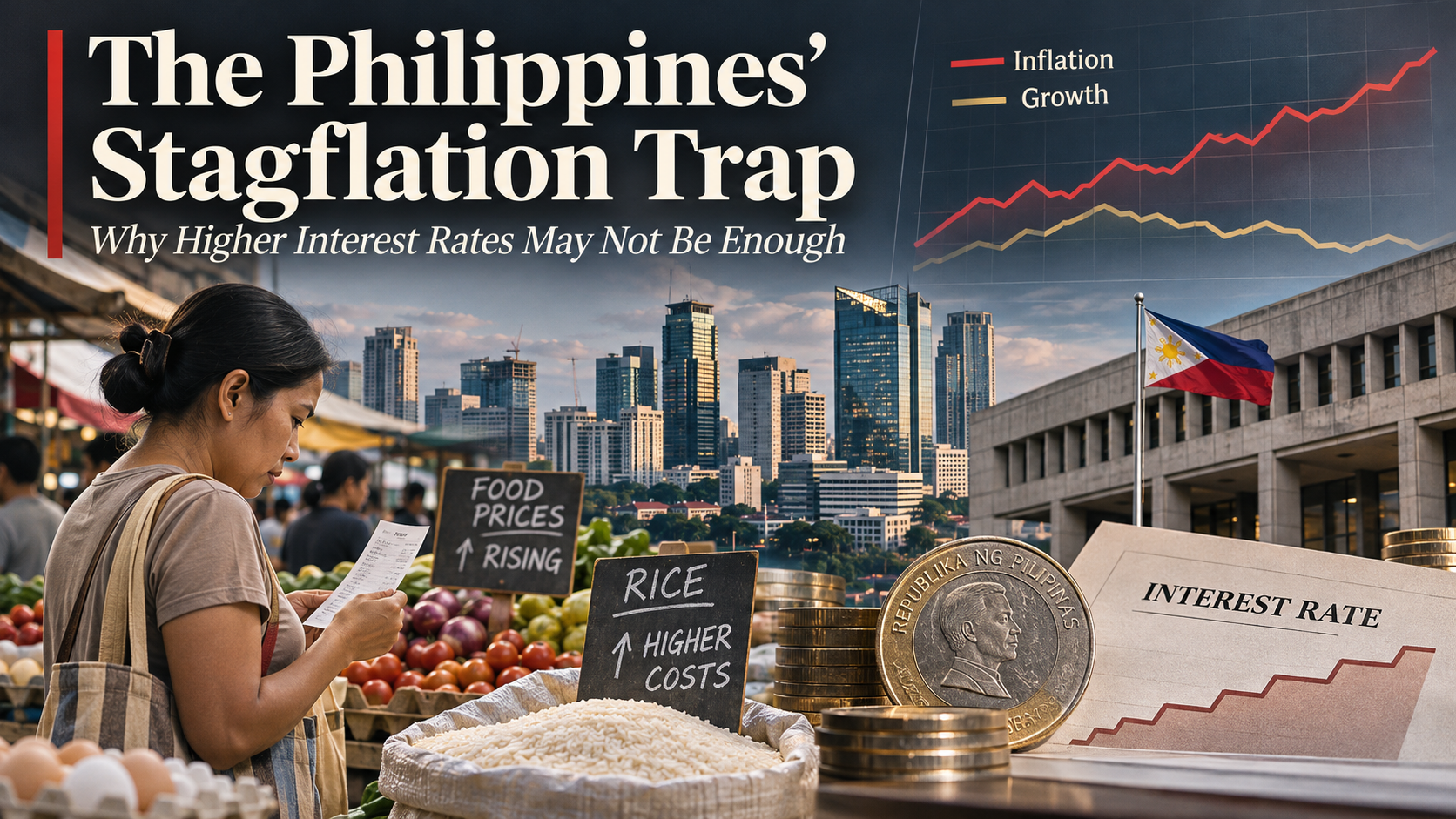
Prices are surging, economic growth is faltering and the peso is under pressure. But the deeper danger for the Philippines is a collision of imported energy inflation, disrupted investment and weakening purchasing power that monetary policy cannot resolve on its own.
A central bank can make borrowing more expensive. It cannot produce more rice, restart a delayed public project or bring down the world price of oil. That is the uncomfortable reality confronting the Philippines as 2026 draws to a close.
In September, annual consumer-price inflation reached 7.2%, according to the Philippine Statistics Authority (PSA). In the second quarter, annual economic growth slowed to 2.3%, while investment contracted and household spending lost momentum. Then, on October 22, the Bangko Sentral ng Pilipinas (BSP) raised its benchmark interest rate by 50 basis points to 5.5%, surprising economists who had expected a smaller move.
That combination has revived a word dreaded by economic policymakers: stagflation. The label deserves scrutiny. The more important question is whether officials can break an increasingly destructive feedback loop: higher import costs push up inflation; falling purchasing power slows demand; stalled projects weaken investment; and higher interest rates, though intended to stabilize prices, threaten to prolong the slowdown.
The Philippines is not yet an economy in outright contraction. It is, however, an economy with diminishing room for policy mistakes.
The Philippine economy in six numbers
| Indicator | Latest confirmed reading | What it means |
|---|---|---|
| Headline inflation | 7.2%, September 2026 | Prices rising well beyond the BSP’s 2%–4% tolerance band |
| Core inflation | 4.7%, September 2026 | Price pressure extends beyond the most volatile items |
| Real GDP growth | 2.3% year over year, Q2 2026 | Expansion has slowed sharply |
| Household consumption growth | 2.8% year over year, Q2 2026 | Consumers are spending more in real terms, but growth has weakened |
| Gross capital formation | −9.2% year over year, Q2 2026 | Investment is contracting |
| BSP benchmark rate | 5.5%, October 22, 2026 | Policymakers are tightening as growth weakens |
Sources: PSA inflation report; PSA national accounts; Reuters on the BSP decision. The GDP and inflation figures cover different reporting periods; no third-quarter GDP or October inflation result had been released by November 2.
Is this stagflation—or an unusually painful slowdown?
Stagflation typically describes persistently high inflation combined with stagnant or very weak output and an impaired labor market. It is not a designation triggered mechanically whenever the inflation rate exceeds economic growth. Nor does a single weak quarter establish a long-lasting regime.
The Philippine evidence is troubling but mixed. Output remained positive in Q2, with services growing 4.5%, agriculture 2.7% and industry contracting 2.4%, PSA figures show. Unemployment fell from 6.0% in July to 5.3% in August. Yet it was higher than the 3.9% recorded a year earlier, and 5.9 million employed people wanted more work or longer hours, according to the August labor-force survey.
The sensible verdict is stagflation risk, not a settled verdict of prolonged stagnation. What will settle the argument is not the terminology but the next sequence of inflation, employment and growth data. A sustained period of weak expansion accompanied by entrenched price pressure would make the diagnosis harder to resist.
There is also a geographic blind spot in the phrase “Manila’s stagflation.” The problem is national, and September inflation was actually 5.4% in the National Capital Region versus 7.6% elsewhere, according to the PSA. The cost-of-living shock is often more severe beyond the capital.
The first shock: An oil-import bill made worse by a weak peso
The Philippines cannot insulate domestic prices from the global energy market. The prolonged Middle East conflict has raised oil costs, while depreciation increases the peso price of dollar-denominated imports. Energy is not confined to petrol stations: it influences freight charges, food distribution, electricity and the costs of operating businesses.
The peso’s slide has magnified the shock. On October 22, Reuters reported that the currency had weakened by nearly 10% since the outbreak of the war, despite the central bank’s rate increases. Markets can reward higher interest rates, but they also respond to oil prices, external financing requirements and doubts about growth.
There is a crucial distinction here: a weak currency can raise imported inflation, but a rate increase does not guarantee currency appreciation. Higher yields may attract capital or discourage its exit; they do not erase a country’s need to import oil.
The International Monetary Fund’s September assessment projected a 2026 current-account deficit of 4.8% of GDP, reflecting, among other factors, a larger oil-import bill. That external gap makes the exchange-rate dimension harder to ignore. It does not, by itself, predict a currency crisis, but it shows why inflation and financing conditions must be considered together.
The second shock: Rice, weather and an unequal inflation burden
Energy is only part of the story. The PSA’s September inflation report shows that rice prices were 20.3% higher than a year earlier, vegetable prices rose 10.7%, transport inflation reached 14.6%, and housing, utilities and related costs increased 8.4%. These are not marginal categories for a typical household; they shape everyday budgets.
The strain is particularly acute for poorer Filipinos. The PSA’s separate price index for the bottom 30% of income households showed 9.0% inflation in September, compared with 7.2% for the country as a whole. That is an inflation gap of 1.8 percentage points, not a claim that every household’s spending or income changed by precisely those percentages.
For families whose budgets are already concentrated on food, transport and utilities, the adjustment often means sacrificing discretionary consumption or postponing essential purchases. Inflation can thus weaken economic growth without a formal recession: the economy continues expanding, while many households feel poorer.
The outlook is vulnerable to weather. The Financial Times reported on BSP preparations for a potentially severe El Niño, while the Asian Development Bank’s September 2026 outlook warned that a strong El Niño could reduce harvests and complicate energy supplies across the region. The appropriate policy response is not merely to suppress demand. It is also to improve food logistics, strengthen climate resilience, target support to vulnerable households and remove avoidable supply bottlenecks.
The third shock: An investment slump that money alone cannot repair
Perhaps the most revealing statistic is not inflation but investment. Philippine gross capital formation dropped 9.2% in Q2, while construction contracted 14.8%, according to the PSA.
The composition matters. General-government construction plunged 32.4%, while construction by financial and non-financial corporations rose 3.8%. That is not evidence of uniformly collapsing private construction activity. It points instead to a particularly severe public-sector implementation problem alongside broader weakness in capital spending and equipment investment.
The governance story is central. Bloomberg Opinion examined the damaging effect of the graft scandal on confidence, while Reuters reported in August that it had curbed infrastructure spending and investor sentiment. The IMF separately identified stricter public-project reviews, lower public construction and weaker confidence as growth headwinds.
Reviewing questionable projects is necessary. Allowing an indefinite bottleneck to paralyze legitimate projects is not. The economic task is to distinguish wasteful expenditure from productive investment, disclose the findings, improve procurement controls and restart projects that pass independent scrutiny.
This is where conventional macroeconomic prescriptions become inadequate. A central bank may adjust the cost of capital. It cannot quickly restore confidence in the public investment pipeline. And while the state can increase ordinary spending, such spending does not automatically replace the productivity gains from functioning transport, drainage, power or logistics infrastructure.
The fourth shock: Households are still spending—but losing momentum
The claim that Philippine households have simply stopped spending obscures an important distinction. Real household consumption rose 2.8% year over year in Q2. It had risen 3.0% in Q1, according to Reuters. The problem is deceleration, not a recorded nationwide decline in real consumption.
But that distinction offers little comfort to a family dealing with rapidly rising rice and transport costs. The labor market makes the squeeze harder to measure with one headline number. August unemployment improved month on month, while remaining above its year-earlier level; underemployment still affected 11.9% of employed workers, PSA data show.
Weak consumer demand and higher financing costs can reinforce one another. Smaller businesses delay expansion. Households postpone purchases that require credit. Investors demand a larger return to compensate for uncertainty. These behaviors can gradually weaken hiring and tax collections, even when the economy has not formally entered recession.
The danger is that inflation becomes self-defeating: it initially pushes up the cost of living and eventually undermines the very spending that could sustain domestic growth.
What the BSP’s 5.5% rate really means
The BSP’s October 22 increase was its fourth consecutive hike and its biggest move in the current tightening cycle, also covered by The Wall Street Journal. All 27 economists in a Reuters survey had expected a smaller, 25-basis-point increase. The central bank’s concern was that one-off energy and food shocks could spread to wages, services, contracts and inflation expectations.
That concern is legitimate. If households and firms conclude that rapid price increases will persist, today’s imported inflation can become tomorrow’s domestically generated inflation. In that situation, failing to act can eventually require an even more damaging tightening cycle.
Yet there is a limit to what interest rates can accomplish. Higher rates suppress some forms of demand and can help stabilize expectations or the currency. They do not expand rice supplies or deliver cheaper global oil. They also do not distinguish between an unproductive speculative project and a productive business needing working capital.
It may be tempting to compare the 5.5% policy rate with September’s 7.2% inflation rate and declare monetary policy too loose. That simple subtraction mixes a current nominal policy rate with backward-looking inflation. The economically meaningful real interest rate depends on expected future inflation and on the borrowing rates actually faced by households and firms. The BSP’s credibility must therefore be judged by the path of inflation expectations, credit conditions and subsequent price data—not by one arithmetic comparison.
The bank has good reason to be cautious. In the October decision, it raised its 2027 average inflation projection to 6.0% from 5.4%. This was a worsening outlook, not evidence that 2027 inflation had already reached 6%.
The 2027 forecast: A rebound is possible, not guaranteed
Despite the current weakness, major forecasters have not written off a recovery. The Asian Development Bank’s September projection put Philippine growth at 3.3% for 2026 and 5.1% for 2027. The IMF’s September mission projected 3.4% and 5.1%, respectively.
These projections tell a nuanced story: a rebound remains plausible if energy pressures ease, domestic projects resume and confidence improves. But the numbers were prepared before all subsequent data and monetary decisions became known. They are conditional forecasts, not promises.
Inflation expectations illustrate the uncertainty. The ADB projected 4.4% average inflation in 2027, and the IMF projected 4.1% in their respective September assessments. By October 22, the BSP’s updated projection for 2027 was 6.0%, according to Reuters. These forecasts differ in timing, information sets and assumptions; they should not be treated as directly comparable assessments made on the same day.
Nor should the Philippines’ problems be confused with those of all Southeast Asia. The ADB expects developing Southeast Asia to expand 4.7% in 2026, compared with its 3.3% country projection for the Philippines. That gap suggests domestic policy execution matters alongside the shared energy shock.
Three paths from here
An improving scenario: Oil and shipping pressures ease, the peso stabilizes, rice supplies normalize and vetted public projects restart. Inflation expectations improve, allowing the BSP eventually to stop tightening. Investment and consumption recover gradually.
A prolonged squeeze: Energy costs remain elevated, the peso struggles and public construction resumes only slowly. Inflation stays above target while growth remains weak. Rates stay higher for longer, leaving households and small businesses exposed.
A more severe stagflation scenario: Further energy or weather shocks coincide with deteriorating labor conditions, renewed currency pressure and persistent capital-spending delays. Policymakers face increasingly costly choices between stabilizing prices and supporting activity.
These are qualitative scenarios, not probability-weighted forecasts. Their purpose is to distinguish the conditions that would change the outlook rather than invent precise growth or inflation numbers.
What policymakers should do instead of relying on rates alone
The BSP should remain committed to price stability, but a credible anti-stagflation strategy requires a coordinated response.
First, protect monetary credibility without pretending every price increase is demand-driven. The central bank should explain which elements of inflation are broadening, how expectations are evolving and what evidence would justify another hike or a pause. Transparency matters as much as surprise.
Second, repair the public-investment pipeline. Review projects rigorously, publish clear procurement and audit findings, and resume demonstrably viable work. The IMF has urged improvements in project appraisal, procurement and public financial management. Restoring trustworthy capital spending can strengthen both short-term activity and longer-term productive capacity.
Third, protect vulnerable households through targeted, time-limited measures. Assistance linked to food or transport costs is more defensible than universal price caps or subsidies that are costly, poorly targeted and difficult to unwind. The ADB has warned about the fiscal expense of broad energy subsidies across the region.
Fourth, improve the supply side. Rice distribution, storage, ports, farm resilience, transport efficiency and reliable electricity deserve attention because they reduce the economy’s exposure to recurring supply shocks. Better logistics can support growth without automatically adding the same inflation pressure as a broad demand stimulus.
Fifth, preserve fiscal credibility. The IMF projected a Philippine fiscal deficit of 5.4% of GDP in 2026. That constrains the scope for indiscriminate spending. Better-targeted relief and stronger project execution are more credible than unfunded, permanent giveaways.
Finally, measure the recovery through households and investment, not just headline GDP. A genuine improvement should bring lower food inflation, narrower pressure on low-income households, stronger real consumption, a pickup in legitimate construction and better employment opportunities.
The next dates that could change the verdict
The immediate debate will soon encounter fresh evidence. According to the PSA’s 2026 release calendar, October consumer-price data are scheduled for November 5, September labor-market data for November 6, and third-quarter GDP for November 9. The next BSP monetary-policy meeting is scheduled for December 17.
Those releases will help answer three questions. Is inflation still spreading beyond volatile commodities? Is the labor market absorbing the slowdown or beginning to fracture? And is public construction recovering fast enough to lift the economy without another burst of inflation?
The worst mistake would be to treat the word stagflation as the story’s conclusion. It should be its warning.
The Philippines does not need officials to win an argument over economic terminology. It needs prices to stop outrunning paychecks, credible public projects to move again and businesses to believe that long-term investment will be rewarded. Interest rates are one part of that response. They cannot substitute for the rest.
“The Philippines’ real economic test is not whether it can raise rates. It is whether it can restore supply, investment and trust before weak growth becomes entrenched.”
Frequently asked questions
Is the Philippines in stagflation in 2026?
It faces a serious stagflation risk, with inflation at 7.2% in September and Q2 real GDP growth at 2.3%. But output was still rising, and the labor market shows mixed signals. A definitive diagnosis requires evidence that weak growth and elevated inflation persist together.
Why did the Bangko Sentral ng Pilipinas raise interest rates in October 2026?
On October 22, the BSP raised its benchmark rate by 50 basis points to 5.5%, seeking to limit the spread of inflation into broader prices and expectations. The increase was larger than economists surveyed by Reuters expected.
Why are prices rising while economic growth is slowing?
Imported energy costs, a weaker peso, higher rice prices, weather disruptions and slower investment are affecting supply and household purchasing power at the same time. This combination can lift prices even as domestic demand weakens.
What is the Philippine economic growth outlook for 2027?
Both the IMF and ADB projected 5.1% growth in 2027 in assessments released in September 2026. That forecast depends on an improvement in investment, external price pressures and domestic confidence; it is not a guaranteed outcome.
When will the next Philippine economic figures be released?
The PSA calendar schedules October 2026 inflation for November 5, September employment figures for November 6, and Q3 GDP for November 9. Those figures were not available as confirmed results on November 2, 2026.
Discover more from The Economy
Subscribe to get the latest posts sent to your email.


Stagfaltion
Stagflation vs. Soft Landing: How Central Bank Rates Are Reshaping European and Asian Economies

Fed hiked, ECB hiked, BoE held 6-3, BoJ next. Inside the most divergent central bank week since 2022 and what it signals for stagflation risk.
Executive Summary / Key Takeaways
- Four major central banks moved within eight days: the ECB raised its deposit rate to 2.5% on 10 September, the Fed hiked to 3.75%–4.00% on 16 September, the Bank of England held at 3.75% on a 6-3 vote on 17 September, and the Bank of Japan is expected to move on 18 September.
- UK inflation has hit a five-month high of 3.1%, with the BoE warning it is likely to rise further over coming quarters.
- The Bank of England also announced an unexpected plan to sell £146 billion of UK government bonds directly to the Treasury to complete quantitative tightening.
- This is a supply-shock tightening cycle, not a demand-driven one — which is precisely what makes the stagflation question live.
- The soft-landing case rests on strong productivity and AI-driven capital investment; the stagflation case rests on energy prices that have not normalised.
1. Introduction & Immediate Context
Central banks almost never tighten into an energy shock. Doing so risks amplifying the output loss while doing little to address the price source. Over eight days in September 2026, three of the world’s four largest monetary authorities did exactly that — and the fourth is expected to follow.
The sequencing matters. The ECB raised its main rates by a quarter point at its 10 September meeting, lifting the deposit rate from 2.25% to 2.5%, and said inflationary pressures arising from the conflict in the Middle East would contribute to inflation remaining above its 2% target for an extended period, according to the House of Commons Library. That followed a June increase of the same size. The Fed moved on 16 September. The Bank of England broke the pattern on 17 September by holding.
For CFOs and macro investors the question is no longer whether policy is restrictive. It is whether restriction is being applied to the right problem.
2. Core Market / Strategic Analysis
2.1 The September policy grid
| Central Bank | Decision | Policy Rate | Vote / Signal | Source |
|---|---|---|---|---|
| Federal Reserve (16 Sep) | +25 bps | 3.75%–4.00% | Unanimous 12-0; 16 of 18 see another hike | Federal Reserve |
| ECB (10 Sep) | +25 bps | 2.50% deposit rate | Second hike since June 2026 | Commons Library |
| Bank of England (17 Sep) | Hold | 3.75% | 6-3, three voting for 4.00% | Euronews |
| Bank of Japan (18 Sep) | Expected +25 bps | 1.00% → 1.25% expected | Hike priced near certainty | FXStreet |
2.2 Why the Bank of England blinked — and why three members did not
The MPC voted six to three to leave borrowing costs unchanged, with the dissenting trio pushing for a quarter-point increase to 4%, Euronews reported. The energy shock from the Iran war has pushed UK inflation to a five-month high of 3.1%. The Committee said inflation is likely to rise further over coming quarters, pointing to crude and refined energy prices that have climbed again since its last meeting and remain more volatile and higher than pre-conflict levels.
That is a central bank telling markets it expects to miss its target by a widening margin — and choosing not to act. Bank Rate has stood at 3.75% since December 2025 following six consecutive quarter-point cuts, and the July meeting produced the same hawkish 6-3 split.
The balance-sheet news was the genuine surprise. Alongside the rate decision the Bank announced an unexpected plan to sell £146 billion of UK government bonds directly to the Treasury, Invezz reported. The proposal is intended to help complete quantitative tightening and could ease some pressure on the gilt market, though it requires the chancellor’s approval. The MPC is already reducing its asset purchase programme from a peak of £895 billion to £489 billion as of 9 September 2026.
Read together, the two decisions are coherent: hold the price of money steady, but remove duration risk from the market through a different channel.
2.3 Asia’s mirror-image problem
Japan’s position inverts everyone else’s. Its ultra-low rates financed trillions of dollars in global investment for more than a decade, making the yen one of the world’s cheapest funding currencies — an advantage that may be entering a new phase as the BoJ tightens again, FXStreet noted.
The carry-trade unwind is not a Japanese story. It is a global liquidity story, and it has already shown up in the US long end: the 10-year Treasury yield briefly crossed 5% in mid-September, driven by a combination of surging oil prices, a hotter-than-expected August CPI, heavy bond issuance and a possible unwinding of the yen carry trade as Japanese rates rise.
3. Structural Drivers and Competitor Gaps
The stagflation-versus-soft-landing frame is usually argued with sentiment. The honest version requires separating two questions.
Question one: is the inflation demand-driven? Largely not. The ECB, BoE and Fed all attribute the current impulse to energy. The IMF’s July update expects global inflation to pause its steady decline. Tightening against a supply shock compresses demand without addressing supply, which is the textbook path to a growth-inflation squeeze.
Question two: is the supply side strong enough to absorb it? Here the evidence cuts the other way. The Fed’s own statement describes productivity growth as strong and capital investment as robust, with domestic spending resilient. The IMF notes that accelerated demand-driven momentum in the global technology cycle, driven by AI advances and adoption, is partly offsetting the war’s effects.
That is the crux. A genuine stagflation requires weak supply-side growth alongside high inflation. What the data currently show is high inflation alongside unusually strong productivity and investment — an unusual and unstable combination, but not classic stagflation.
Three markers will resolve it:
- Whether energy prices normalise. Oil trading solidly above $100 per barrel around the Fed decision, per Yahoo Finance, keeps the shock live. The World Bank’s 2027 recovery scenario assumes it fades.
- Whether second-round effects appear in wages. The BoE explicitly flagged the risk of higher energy prices transmitting into household costs, wages and broader inflation.
- Whether the AI capex cycle holds. Both the IMF and the World Bank treat broader AI adoption as the principal upside risk to growth. If technology investment slows, the offset disappears and the stagflation case strengthens sharply.
4. Key Implications for Stakeholders
Corporate CFOs in Europe. Euro-area policy is still the loosest of the major blocs at a 2.5% deposit rate, but the ECB has now hiked twice since June and expects above-target inflation for an extended period. Refinancing windows are narrowing; the argument for terming out debt in Q4 2026 rather than waiting for 2027 is stronger than it was in June.
UK-exposed borrowers. A held Bank Rate does not mean held borrowing costs. With the MPC expecting inflation to rise further and three members already voting to hike, the November meeting is genuinely live. The £146 billion gilt transfer, if approved, is the variable to watch for long-end pricing.
Asian exporters. Yen weakness following the Fed’s decision improved the earnings outlook for Japan’s export-focused industries — but a BoJ hike cuts the other way. Currency hedging assumptions built on a persistently cheap yen need revisiting.
Multi-asset allocators. Divergence itself is the tradeable feature. The Fed is tightening into strength, the ECB into weakness, the BoE is paralysed by a split committee, and the BoJ is normalising from a near-zero base. Relative-value positioning in rates is more attractive than directional duration.
5. Frequently Asked Questions
Q1: Is the global economy heading into stagflation in 2026?
Not on current data. Inflation is elevated and energy-driven, but productivity growth and capital investment remain strong, which classic stagflation requires to be weak. The risk rises materially if the AI-led investment cycle slows while energy prices stay high.
Q2: Why did the Bank of England hold while the Fed and ECB hiked?
The MPC voted 6-3 to hold at 3.75% despite inflation hitting a five-month high of 3.1%, judging that the energy-driven inflation impulse did not yet warrant tightening. Three members dissented in favour of a quarter-point rise to 4%.
Q3: What is the ECB’s current interest rate?
The ECB raised its deposit rate to 2.5% on 10 September 2026, its second quarter-point increase since June. Its next scheduled policy meeting concludes on 29 October.
Q4: How does the Bank of Japan’s decision affect global markets?
A BoJ hike raises the cost of yen funding, which has underpinned global carry trades for over a decade. The unwind has already contributed to higher long-dated yields in the US and Europe.
Discover more from The Economy
Subscribe to get the latest posts sent to your email.

China’s 175 Trillion AI Tokens Reveal a Bigger Shift: The AI Boom

The Philippines’ Stagflation Trap: Higher Interest Rates

Alphabet’s $500 Billion Reckoning: Wall Street Is Losing Patience With the AI Boom

4 Reasons Why China’s Trade Concessions to Europe Will Not Solve the Crisis

The AI Revolution Needs Atomic Power. Southeast Asia Is Ready to Build It.

Zhuhai Airshow 2026: How China’s Stealth Jets, Drones and Missiles Are Redrawing Global Air Power

The $8 Billion Runway: China’s Strategic Bet on Guangzhou and the Future of Aviation

The Sandbox Imperium: Why Beijing’s Digital Yuan Needs Hong Kong

Gold at the $4,000 Line: Possible December Fed Hike

Oil at $100+: Hormuz, a Qatari Peace Draft and the Iran Deadline

The Fed’s 10-2 Hold: Why Two Dissenters Wanted a Rate Hike

SBP Raises Policy Rate to 12%: What It Means for Your Loans, Savings and Business

IMF’s $1.2bn Staff-Level Deal: What Pakistan Promised on Surplus

Decoding the DBS–BCA Merger Rumour: Market Volatility, Strategic Realities

Crude Oil & Petroleum Market Analysis: OPEC+ Decisions and Price Forecasts

Top US Convenience Store Chains: Store Counts, EV Charging, and Sales Trends

Social Security Extra $90 Deposit: Who Qualifies for the October 2026 Medicare Rebate?

Who Is Shivon Zilis? The Neuralink Executive at the Center of the Musk–OpenAI Trial

Gold Price Outlook 2026: The Forces Behind the Forecasts—and What Could Reverse Them

Algorithmic Dogfights: Why the U.S. and China Must Establish Rules of Engagement for Autonomous Air Power

Corporate America Faces a New Debt Test as US Borrowing Costs Surge

Global Economic Outlook 2026: 7 Forces Reshaping Markets, Trade and Business

Stock Market Crash in 2026? Warning Signs, Scenarios and a Calm Investor Checklist

Geopolitics and Your Portfolio: How International Affairs Move Global Markets

Anthropic Bans Sustained Abuse of Claude AI Under New Usage Policy Effective November 12, 2026

Stock Market Today: Dow, S&P 500, and Nasdaq Retreat as Treasury Yields

US–Iran Conflict in October 2026: Hormuz, Oil Prices and Diplomacy

Why Did I Get $90 From Social Security? 8 Reasons Behind an Unexpected SSA Payment
-

 Markets & Finance10 months ago
Top 15 Stocks for Investment in 2026 in PSX: Your Complete Guide to Pakistan’s Best Investment Opportunities
-

 Analysis8 months ago
Johor’s Investment Boom: The Hidden Costs Behind Malaysia’s Most Ambitious Economic Surge
-

 Analysis9 months ago
Top 10 Stocks for Investment in PSX for Quick Returns in 2026
-

 Banks10 months ago
Best Investments in Pakistan 2026: Top 10 Low-Price Shares and Long-Term Picks for the PSX
-

 Analysis9 months ago
Brazil’s Rare Earth Race: US, EU, and China Compete for Critical Minerals as Tensions Rise
-

 Investment10 months ago
Top 10 Mutual Fund Managers in Pakistan for Investment in 2026: A Comprehensive Guide for Optimal Returns
-

 Global Economy10 months ago
15 Most Lucrative Sectors for Investment in Pakistan: A 2025 Data-Driven Analysis
-

 Global Economy10 months ago
Pakistan’s Export Goldmine: 10 Game-Changing Markets Where Pakistani Businesses Are Winning Big in 2025