
Social Security
Why Did I Get $90 From Social Security? 8 Reasons Behind an Unexpected SSA Payment


Key Takeaways
- A surprise $90 deposit is usually an adjustment, not a gift. The most common causes are back pay, a benefit-rate change, a Medicare premium correction or a recalculation after you worked.
- Check your records before you spend it. Your my Social Security account and any mailed notice should explain the payment. Letters often trail the deposit by days.
- Overpayments are real, and they are recoverable. If SSA decides it paid you too much, it can withhold 50% of your monthly benefit, or 10% of an SSI payment, after giving you notice.
- 2026 has more moving parts than usual. A 2.8% cost-of-living adjustment, a higher Medicare Part B premium and ongoing Social Security Fairness Act recalculations all touch payment amounts.
- Never send money back to a caller or texter. Real SSA problems arrive by letter or inside your online account, not through gift-card demands.
You open your banking app and there it is: a deposit labeled something like “SSA TREAS 310,” and it is $90 you didn’t expect. It isn’t your normal payment day. It isn’t your normal amount.
Your first feeling is probably a mix of hope and dread. Is the government sending you extra money? Or is this the opening move in a clawback?
The honest answer is that only the Social Security Administration can tell you what happened to your record. But the list of likely explanations is short, and you can narrow it down in about ten minutes. This guide walks through the payment calendar, eight common causes, what an overpayment looks like, and the exact steps to confirm what you received.
First, Was It Really Off Schedule?
Before you chase a mystery, confirm that the date is actually unusual. SSA pays on a fixed pattern, laid out in its 2026 benefit payment schedule.
| Your situation | When Social Security pays |
|---|---|
| Birthday on the 1st through 10th | Second Wednesday of the month |
| Birthday on the 11th through 20th | Third Wednesday of the month |
| Birthday on the 21st through 31st | Fourth Wednesday of the month |
| Started benefits before May 1997, or receive both Social Security and SSI | The 3rd of the month |
| SSI payments | The 1st of the month |
In October 2026, for example, the Wednesday groups are paid on the 14th, 21st and 28th. If a $90 deposit landed outside your slot, you can rule out a simple timing quirk. If it landed inside your slot, check whether your regular payment changed instead.
Eight Reasons You Might Have Received $90
1. Retroactive benefit adjustment (back pay)
This is the classic one. SSA recalculates a benefit and discovers you were underpaid for earlier months. Rather than waiting for your next regular deposit, it often pays the difference immediately.
Here is a purely hypothetical example. If your monthly benefit was corrected upward by $45, and the change applies to the previous two months, you would see a catch-up deposit of $90.
2. The 2026 cost-of-living adjustment
Benefits rose 2.8% in January 2026, which SSA put at about $56 more per month for the average retired worker. On the average benefit of roughly $1,920, a 2.8% increase is around $54 a month. A $90 gap could reflect a larger-than-average benefit, a delayed processing of the raise, or a COLA plus another adjustment stacked together.
3. A Medicare Part B premium change
Most beneficiaries over 65 have their Part B premium deducted before the deposit hits. The standard premium is $202.90 in 2026, up $17.90 from last year, with a $283 annual deductible. If your premium was corrected or your income-related surcharge was adjusted, the difference can surface as a small one-time payment or as a changed deduction. Both are worth checking.
4. Social Security Fairness Act recalculations
The Social Security Fairness Act repealed the Windfall Elimination Provision and Government Pension Offset, which had reduced benefits for many people with public pensions. SSA published a dedicated page on the law. If you or a spouse worked in government jobs outside Social Security, a late recalculation can still generate adjustments.
5. A recomputation after you kept working
If you continued working after you started benefits, SSA can review your earnings and raise your benefit. The increase may come with a small back payment covering the months it should have applied.
6. Family or survivor benefit changes
Benefits paid to spouses, children or survivors are linked to the worker’s record. When one person’s status changes, the others’ amounts can shift, and SSA may true up the difference.
7. An SSI or state supplement change
If you receive Supplemental Security Income, small amounts can move because of changes in income, living arrangements or a state supplement. SSI payments also follow their own calendar, so the timing can look odd.
8. A refund of previously withheld money
If SSA withheld too much earlier, for an overpayment recovery or a premium, it may refund the excess. A refund usually comes with a notice explaining the math.
What If It’s an Overpayment?
Sometimes the answer is less pleasant. An overpayment happens when SSA pays more than the law allows. It can follow unreported work, a change in marital status or living situation, or a simple processing error.
Here is how the process works, according to SSA’s overpayment page:
- You get a notice explaining the amount and the reason.
- SSA waits at least 30 days before it begins collecting.
- After that, it withholds 50% of your benefit or 10% of an SSI payment each month until the debt is repaid, unless you arrange something different.
You have options. According to SSA’s overpayment fact sheet, you should contact SSA within 60 days if you want to appeal. If you agree you were overpaid but it wasn’t your fault and repayment would be a hardship, you can request a waiver using Form SSA-632-BK. For smaller overpayments of $1,000 or less, a waiver request may be possible by phone. NerdWallet’s guide to Social Security overpayments walks through the appeal-versus-waiver choice in plain English.
| If your notice says… | Your likely move |
|---|---|
| You were not overpaid, or the amount is wrong | Appeal within 60 days |
| You were overpaid, but it wasn’t your fault and you can’t afford repayment | Request a waiver |
| You were overpaid and agree | Ask for a repayment plan you can afford |
How to Find Out What Happened in Ten Minutes
You don’t need to guess. Work through these steps in order.
- Log in to your my Social Security account. Type the address into your browser yourself rather than clicking a link in a message. Look at your benefit amount, payment history and any notices.
- Check your mail and messages. Explanations are typically mailed, and the letter can arrive days after the electronic deposit.
- Compare this month’s regular payment to last month’s. A changed monthly amount points to a rate adjustment, a Medicare deduction change or a recomputation.
- Call SSA at 1-800-772-1213 if nothing explains it. Have your Social Security number ready, and be prepared for a wait.
- Keep a record. Screenshot the deposit and save any letter. You’ll want it at tax time and if SSA later asks questions.
A Word on Scams
Unexpected money can also be bait. Scammers impersonate agency employees, create urgency and push you toward payment methods that can’t be reversed.
The pattern is consistent. SSA’s inspector general says the agency will never demand payment by gift card, wire transfer or cash, and the CFPB’s five ways to recognize a Social Security scam lists the same red flags. The inspector general’s fraud advisory adds that agency texts asking you to call a number about a problem should be treated as suspicious.
Rule of thumb: if someone contacts you about the $90 and asks you to send money anywhere, stop. Verify through your online account or the official phone number instead.
What to Do With the $90 in the Meantime
Treat it like a pending item. Leave it in your account until you know the cause, especially if there is any chance it’s an overpayment. If it turns out to be back pay, it is part of your benefits for tax reporting, so keep your annual SSA-1099 handy and ask a tax professional how it applies to your situation.
Asked & Answered
Can Social Security take back a $90 deposit?
Yes, if SSA determines it was an overpayment. The agency must send a notice first, waits at least 30 days before collecting, and gives you appeal and waiver rights.
How long until I get an explanation letter?
Often a few days to about two weeks after the deposit. If your online account shows no new notice and nothing arrives by mail, call SSA.
Does a one-time $90 mean my monthly benefit changed?
Not necessarily. A one-time amount can be back pay. But compare your next regular payment to the previous one, because a recalculation can do both: pay the past difference and change the future amount.
What if I got $90 but my regular payment went down?
That pattern deserves a prompt call. It could reflect a Medicare premium change, a withholding for an overpayment, or an error. Ask SSA to walk you through each line.
Will the next COLA change my deposits again?
Probably. Cost-of-living adjustments are announced in the fall and take effect with January benefits. Your Part B premium for 2027 will also be set, and it comes out of the same check.
Discover more from The Economy
Subscribe to get the latest posts sent to your email.


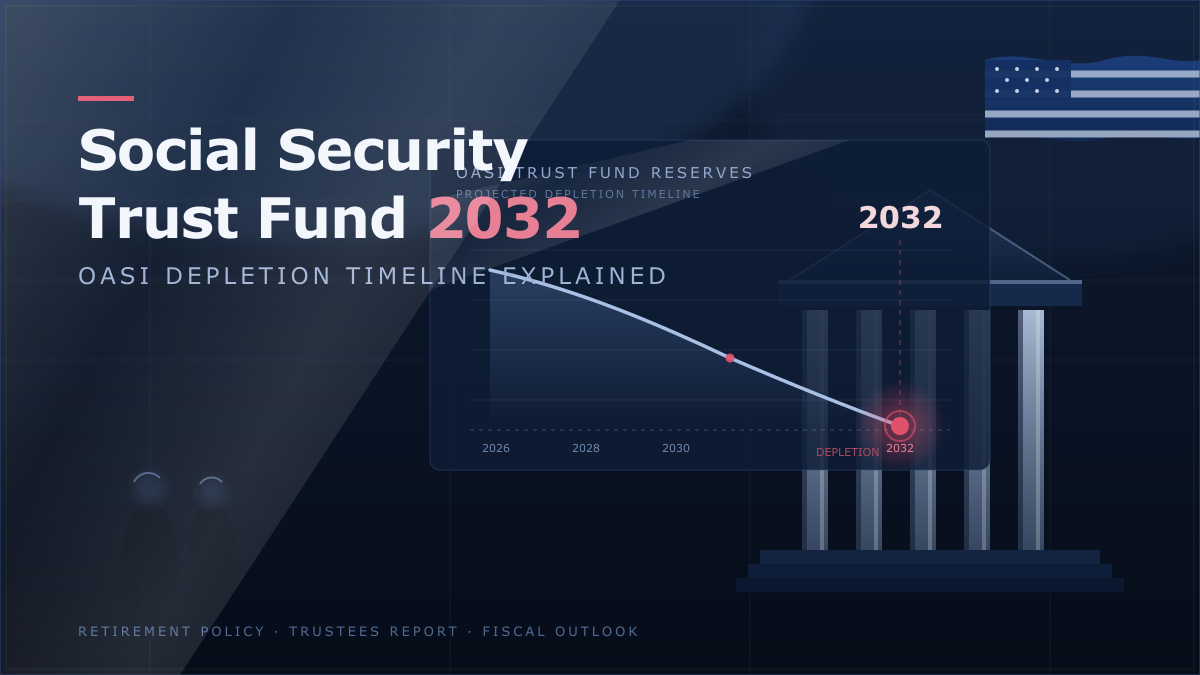
The 2026 Social Security Trustees Report moved the projected depletion date for the Old-Age and Survivors Insurance (OASI) trust fund to the fourth quarter of 2032 — one quarter earlier than the prior year’s estimate, and the fund’s worst reading in over a decade. With a 2027 Cost-of-Living Adjustment (COLA) now projected in the 3.2%–3.6% range, the same inflation dynamic that raises retirees’ monthly checks is simultaneously narrowing the runway policymakers have to act.
The 2026 Trustees Report, in Numbers
- OASI depletion: Q4 2032, at which point the fund could pay only 78% of scheduled benefits — an automatic 22% across-the-board cut with no congressional action required.
- Combined OASI/DI depletion: Q3 2034, if Congress permits fund-combining (which requires new legislation), covering 83% of benefits at that point.
- Disability Insurance (DI) fund remains solvent through the full 75-year projection window on its own.
- Combined trust fund reserves fell $160 billion in 2025 to $2.56 trillion.
- The 75-year actuarial deficit widened to 4.42% of taxable payroll, up from 3.82% in the prior year’s report — a meaningfully worse trajectory in a single annual cycle.
- The OASI trust fund ratio (reserves as a share of annual program cost) is projected to collapse from 153.0% today to 38.6% in 2032, and 0% in 2033.
Separately, the Congressional Budget Office’s March 2026 update pulled the OASI depletion date forward to 2032 as well — a year earlier than its own 2025 estimate — citing weaker payroll tax revenue inflows tied to slowing real GDP growth (1.4% in Q4 2025) and a softening labor market (unemployment near 4.4% as of February 2026).
Why a Bigger COLA Makes the Math Worse
The COLA mechanism and the trust fund’s solvency are mechanically linked, and not in the direction that helps retirees long-term:
- COLAs increase the “cost” side of the ledger immediately, raising the total dollar amount SSA must pay out to roughly 71 million beneficiaries the moment a new adjustment takes effect.
- Payroll tax revenue — the “income” side — only rises with wage growth, which does not move in lockstep with the CPI-W-driven COLA formula. When inflation outpaces wage growth, as has occurred intermittently through the 2023–2026 stretch of 8.7%, 3.2%, 2.5%, and 2.8% COLAs, the trust fund absorbs a larger annual drawdown.
- The trust fund has run a cash-flow deficit since 2010 and a total-cost-exceeds-total-income deficit since 2021 — meaning every COLA cycle since then has added incremental strain rather than working from a position of surplus.
- Penn Wharton Budget Model’s dynamic scoring reaches the same 2032 OASI depletion date and projects payable benefits falling from 83% at depletion to as low as 64% of scheduled benefits by 2100 absent reform — illustrating that 2032 is a waypoint, not an endpoint, in a longer structural decline.
What Depletion Actually Means (and Doesn’t)
A common misconception is that trust fund depletion means Social Security “runs out of money” entirely. It does not: payroll taxes continue flowing in every pay period regardless of trust fund balance, because Social Security is fundamentally a pay-as-you-go transfer program. What depletion means concretely:
- SSA would be legally permitted to pay benefits only up to the level covered by concurrent payroll tax revenue — no more.
- At the projected 2032 depletion point, that translates to a roughly 22–23% across-the-board benefit cut, applied automatically and without new legislation, to every OASI beneficiary simultaneously.
- Unlike prior near-misses (Social Security came within months of insolvency in the early 1980s before the Greenspan Commission reforms), there is currently no comparable bipartisan reform package moving through Congress, and prediction markets closed 2025 pricing the odds of Social Security-related tax relief passing in reconciliation at essentially zero.
Legislative Scenarios on the Table
Congress has a narrow, well-documented menu of policy levers, each with distinct distributional consequences:
| Lever | Mechanism | Political Difficulty |
|---|---|---|
| Raise the payroll tax rate | Currently 12.4% split between employer/employee | High — direct tax increase on all workers |
| Lift or eliminate the taxable maximum (“wage cap”) | Currently applies FICA only up to a capped wage level | Moderate — targets higher earners, popular in polling |
| Reduce future benefit growth | Adjust the benefit formula for new claimants | High — politically framed as a “cut” |
| Raise the full retirement age further | Already rising to 67 for 1960+ births under 1983 law | High — disproportionately affects lower-income/manual-labor workers |
| Combine OASI and DI reserves | Extends combined depletion to 2034 from OASI’s 2032 | Requires new legislation; buys limited time |
CRFB and other nonpartisan scorekeepers have been explicit that every point of extra COLA “imposes high costs for a retirement fund that is only six years away from insolvency,” framing the 2027 COLA debate not just as a budgeting question for retirees but as an input into how quickly the 2032 deadline arrives.
Forward-Looking Implications for Stakeholders
- Current retirees and near-retirees (within 6–10 years of the 2032 deadline) face the highest exposure to an unmitigated benefit cut, since they have the least time to adjust savings or claiming strategy before depletion.
- Workers under 45 have a longer runway to absorb likely reform outcomes — whether through payroll tax increases, wage-cap adjustments, or benefit formula changes — but also bear the compounding uncertainty of not knowing which lever(s) Congress will ultimately pull.
- Financial advisors and retirement planners increasingly model a “haircut scenario” — assuming benefits are reduced by roughly 20–23% from the mid-2030s onward — as a base case for clients within a decade of the depletion window, rather than treating full scheduled benefits as a safe planning assumption.
- Markets and fiscal analysts will watch whether any reconciliation-adjacent legislative vehicle in 2027–2028 attempts even a partial fix (e.g., a targeted wage-cap increase) given the narrowing window before the automatic-cut mechanism activates.
Bottom Line
The OASI trust fund’s Q4 2032 depletion date is now six years away, one quarter sooner than last year’s estimate, and moving in the wrong direction across nearly every metric the trustees track — reserve balance, trust fund ratio, and the 75-year actuarial deficit. A larger-than-average 2027 COLA, while providing real near-term relief to retirees, adds to the cost side of a program that has run structural deficits since 2021, tightening rather than loosening the window Congress has to act before an automatic ~22% benefit cut becomes law by default.
Discover more from The Economy
Subscribe to get the latest posts sent to your email.

Nearly 71 million Social Security beneficiaries are heading toward the smallest annual raise in three years — but one that would still rank as the largest since 2023. With the Social Security Administration set to announce the official 2027 Cost-of-Living Adjustment (COLA) on October 14, 2026, advocacy groups and independent analysts have converged on a range that puts retirees’ planning in a tighter band than markets expected as recently as April.
Where the 2027 COLA Estimate Stands Today
As of early September 2026, the most-cited projections cluster as follows:
| Source | 2027 COLA Estimate | Monthly Increase (Avg. Retiree) |
|---|---|---|
| AARP | 3.5% | ~$73/month |
| The Senior Citizens League (TSCL) | 3.6% | ~$75/month |
| Committee for a Responsible Federal Budget (CRFB) | 3.2% | ~$67/month |
| Congressional Budget Office (CBO), earlier-cycle estimate | 3.1% | ~$65/month |
| Kiplinger (David Payne, oil-price-contingent) | 3.3%–3.5% | ~$69–73/month |
AARP’s estimate has itself been trending down — from an initial 3.6% forecast to 3.5% after the July Consumer Price Index (CPI) reading showed inflation cooling to 3.4% year-over-year, down from 3.5% in June. TSCL’s tracker moved in the same direction, slipping from 3.8% in the spring to 3.6% by August.
If the 3.5% figure holds, the average retired-worker benefit — roughly $2,086 per month as of July 2026 — would rise by about $73, pushing the typical check to roughly $2,159. Spousal benefits, averaging $987, would climb to approximately $1,023.
How the COLA Is Actually Calculated
Unlike a policy decision, the COLA is a formula-driven output. By statute, the Social Security Administration compares the average CPI-W (Consumer Price Index for Urban Wage Earners and Clerical Workers) across the third quarter (July, August, September) of the current year against the same period in the prior year. The percentage change — rounded to the nearest tenth of a percent — becomes the following January’s adjustment.
This means:
- Two of the three input months remain open. Only July’s CPI-W is finalized; August and September data will determine the final number.
- Oil and shelter costs are the swing factors. Kiplinger’s David Payne has flagged that a 30-day move in oil prices alone could shift the final COLA between 3.3% and 3.5%.
- The number is backward-looking. Because the adjustment reflects inflation that has already occurred, retirees frequently report that COLAs lag their actual cost pressures — a dynamic amplified after the volatile 2023–2026 stretch, where COLAs swung from 8.7% (2023) to 3.2% (2024) to 2.5% (2025) to 2.8% (2026).
What Changes Alongside the COLA in 2027
The headline benefit bump is only one piece of the 2027 Social Security picture. Several structural changes land at the same time:
- Full retirement age reaches 67 for anyone born in 1960 or later — the final step-up under the 1983 Social Security reforms.
- Earnings limits for early claimants adjust upward, tied to the same wage-index mechanics that drive the COLA.
- The taxable maximum wage base rises, meaning higher earners will pay Social Security payroll tax on a larger share of income in 2027.
- Medicare Part D parameters are already finalized for 2027 — the deductible is set at $700 and the out-of-pocket cap at $2,400 — both of which interact with the net COLA increase retirees actually feel, since Medicare premiums are typically deducted directly from Social Security checks.
Why a “Bigger” COLA Isn’t Necessarily Good News
The framing of 3.5% as the “largest COLA since 2023” obscures a harder truth that CRFB has been explicit about: every point of COLA accelerates pressure on the Old-Age and Survivors Insurance (OASI) trust fund, which trustees project could be depleted within the next six years. CRFB’s own analysis warns that if the trust fund is exhausted before Congress acts, beneficiaries would face an automatic, across-the-board benefit cut of roughly 22% — a scenario a higher-than-expected COLA only moves closer.
For retirees, that creates a paradox: a larger monthly check now, funded in part by a program running down its reserves faster, with unresolved legislative risk on the other side of the decade.
What Retirees Should Do Before the October 14 Announcement
- Avoid locking in fixed budgets around unofficial estimates. AARP, TSCL, and CRFB estimates have already moved once this summer and could move again with the August and September CPI-W releases (due mid-September and mid-October, respectively).
- Model your Medicare Part B premium alongside the COLA, since the Centers for Medicare & Medicaid Services (CMS) sets the standard Part B premium separately, and a higher premium can offset a meaningful share of the COLA increase — a phenomenon known as the “hold harmless” trade-off.
- Reassess claiming-age strategy. Delaying benefits past full retirement age still adds roughly 2/3 of 1% per month up to age 70, a guaranteed increase that dwarfs any single year’s COLA and is unaffected by inflation volatility.
- Watch the October 14 SSA announcement, followed by individualized benefit statements mailed and posted to my Social Security accounts in November, ahead of the new amounts taking effect with January 2027 payments.
Bottom Line
The 2027 COLA is very likely to land between 3.2% and 3.6%, with AARP’s 3.5% figure currently the most-quoted planning benchmark. It would mark the largest raise since 8.7% in 2023, but the dollar impact — roughly $73 to $75 a month for the average retiree — is modest against a backdrop of an OASI trust fund moving closer to its projected mid-2030s depletion date. The official number arrives October 14, 2026.
Discover more from The Economy
Subscribe to get the latest posts sent to your email.

Millions of retirees are watching one date on the calendar: October 14, 2026, when the Social Security Administration is expected to announce the official 2027 cost-of-living adjustment. Current independent estimates from The Senior Citizens League and AARP put the number around 3.6%, though some forecasters peg it closer to 3.4% based on cooling summer inflation data.
That would make it one of the largest COLAs in years — up from 2026’s 2.8% adjustment. For beneficiaries, a bigger check sounds like unambiguous good news. It isn’t. Here’s the part most coverage buries: a larger COLA accelerates the exact trust fund shortfall that could force automatic benefit cuts starting in 2032.
The October 14 Announcement: What’s Actually Being Calculated
The COLA isn’t a policy decision — it’s a formula. The Social Security Administration compares average CPI-W (Consumer Price Index for Urban Wage Earners and Clerical Workers) readings from July, August, and September against the prior year’s baseline. That means:
- The August 2026 CPI report, released September 11, is the next major data point that will move estimates.
- The final September CPI-W figure, released in the weeks before October 14, locks in the actual number.
- Analysts currently place the range between 3.2% and 3.6%, some media have nicknamed the elevated figure the “Trump Bump” given the inflationary pressures feeding into it.
Once confirmed, the percentage applies uniformly to all beneficiaries — but your specific new dollar amount won’t post to your my Social Security account until late November, with mailed notices following in mid-December.
The 2032 Depletion Clock Is Already Ticking
This is the story competitors routinely miss: the COLA calculation and the trust fund’s solvency are mechanically linked, and not in the direction most beneficiaries assume.
According to the 2026 Social Security Trustees Report, released June 9, 2026, the Old-Age and Survivors Insurance (OASI) trust fund is now projected to exhaust its reserves in the fourth quarter of 2032 — a full quarter earlier than the prior year’s projection. If Congress takes no action before depletion, incoming payroll tax revenue would cover only about 78% of scheduled benefits, triggering an automatic, across-the-board reduction.
Here’s the paradox at the center of this story:
- A larger COLA helps benefits keep pace with today’s cost of living — but it does not necessarily preserve real purchasing power once Medicare premium increases are netted out.
- A larger COLA also pulls more money out of the OASI trust fund faster than the trustees originally modeled, which is part of why the depletion date keeps moving closer rather than farther away.
- The Committee for a Responsible Federal Budget calculates the program’s 75-year actuarial deficit grew roughly 16% in a single year — from 3.82% to 4.42% of taxable payroll, equivalent to a present-value shortfall in the tens of trillions of dollars.
In plain terms: the same inflation driving up your monthly check is also shortening the runway before Congress is legally forced to act — or benefits get cut automatically.
As of early September 2026, independent forecasters including The Senior Citizens League and AARP estimate the 2027 Social Security cost-of-living adjustment at approximately 3.6%, though estimates range from 3.2% to 3.6% pending final CPI-W data. The Social Security Administration is scheduled to announce the official figure on October 14, 2026.
What a 3.6% COLA Actually Nets Out To
Before anyone books a bigger retirement budget around this number, run the math on what actually reaches your bank account:
- The trustees project the 2027 Medicare Part B premium at roughly $209.50/month, a $6.60 increase — but private forecasters expect it could land closer to $216–$219.
- Because Part B premiums are typically deducted directly from Social Security checks, a meaningful slice of that “raise” — commonly estimated at $7 to $15 of the average $75 monthly increase — never actually reaches the beneficiary.
- SSI maximum payments and the earnings limit for early claimants who continue working are also adjusted using COLA-linked formulas, both worth checking against the official October 14 release.
Retirement Planning Implications: Beyond the Headline Number
For readers building or protecting a retirement income plan, the COLA headline is really a prompt to revisit three bigger questions:
1. How exposed is your retirement income to Social Security specifically? Beneficiaries who rely on Social Security for the majority of their monthly income have the least flexibility to absorb a future benefit reduction. This is a natural moment to stress-test a retirement budget against a hypothetical 22% across-the-board cut starting in 2033 — the scenario that follows if the 2032 depletion date arrives and Congress hasn’t acted.
2. Are you diversified against inflation risk specifically, not just market risk? Assets that have historically served as an inflation hedge — including Treasury Inflation-Protected Securities (TIPS), certain real assets, and diversified income-generating portfolios — deserve a fresh look any year the COLA outpaces historical averages. This is not a recommendation to buy any specific asset; it’s a prompt to have that conversation with a professional.
3. Is your withdrawal strategy built around Social Security timing? Every year Social Security’s long-term solvency picture gets more uncertain, the value of working with a fiduciary financial advisor to model claiming-age strategies — including delayed claiming to age 70 for a higher guaranteed benefit — goes up, not down. A fiduciary is legally obligated to act in your interest, which matters when the products being discussed involve retirement wealth preservation strategies with real fees attached.
What Competitors Are Missing
Most coverage of the 2027 COLA either (a) simply reports the estimated percentage, or (b) simply reports the 2032 depletion date — treating them as two unrelated stories. The financial reality is that they are the same story: every upward COLA revision this cycle has come paired with an earlier depletion projection in the trustees’ own modeling. Readers deserve to see that connection made explicit, along with the practical Medicare Part B offset math that determines what a “3.6% raise” is actually worth in take-home terms.
Key Dates to Watch
- September 11, 2026 — August CPI report, next major COLA estimate revision
- October 14, 2026, 8:30 a.m. ET — Official 2027 COLA announcement
- Late November 2026 — Individual dollar amounts post to my Social Security accounts
- Mid-December 2026 — Mailed COLA notices for non-digital beneficiaries
- Q4 2032 — Projected OASI trust fund depletion date, absent congressional action
Discover more from The Economy
Subscribe to get the latest posts sent to your email.

Planet Labs and Goldman: How Satellite Geospatial Data Is Reshaping Wall Street

Red Dye Diesel in 2026: Tax Exemptions, Regulations, and the Real Agricultural Impact

Student Loans in 2026: Forgiveness Updates, Consolidation, and Repayment Strategies

Why Did I Get $90 From Social Security? 8 Reasons Behind an Unexpected SSA Payment

Corporate America Faces a New Debt Test as US Borrowing Costs Surge

Goldman vs. Citi: Which Banking Giant Leads Modern Global Finance in 2026?

Beyond Hanoi & HCMC: How Northern Industrial Clusters Are Driving Vietnam’s 10% Growth Surge

Analytical Review of The Economist’s “What is the Right Tax System for the 21st Century?”

Southeast Asia’s LNG Dilemma: Navigating Price Volatility, Infrastructure Gaps, and Energy Security

Who Is Shivon Zilis? The Neuralink Executive at the Center of the Musk–OpenAI Trial

ChatGPT Traffic Rebounds in 2026: Why OpenAI’s AI Giant Is Winning Users Back

U.S.-Ireland Trade Dynamics: Trump’s Investment Push

Energy Crisis Action: G7 Agrees to Release 100 Million Barrels of Diesel and Crude

Johor Bahru-Singapore RTS Link Passenger Service Delayed to February 2027: Economic and Cross-Border Implications

Oil Prices Break $100 in 2026: Middle East Conflict & Energy Markets

IMF & World Bank 2026 Global Economic Outlook: Growth, Inflation, Debt

Middle East War Economics 2026: Oil Prices & Energy Markets

China Stocks Today: Are Big Economies in Asia Nearing a Market Bottom?

High-CPM Finance Niches 2026: Publisher Monetization Blueprint

Global Pension Systems Ranked: The World’s Best and Worst Retirement Frameworks

Enterprise AI Platforms Disrupting B2B SaaS in 2026: Full Analysis

Social Security Trust Fund 2032: OASI Depletion Timeline Explained

Elon Musk’s Next Moves: Disrupting the 2026 Global Economy

Crypto Daily Outlook: Bitcoin, Altcoins, and the Future of Decentralized Finance

GasBuddy Market Insights: How Crude Price Shifts Impact Local Fuel Cost Averages

World Bank & IMF Reports 2026: Why the “3% Growth” Consensus Is Actually a Debate

PSX Forecast 2026: KSE-100, IMF Reviews & Geopolitics

Global Equity Market Divergence: US Tech vs. European Dividend Stocks vs. Asian Growth
-

 Markets & Finance9 months ago
Top 15 Stocks for Investment in 2026 in PSX: Your Complete Guide to Pakistan’s Best Investment Opportunities
-

 Analysis8 months ago
Johor’s Investment Boom: The Hidden Costs Behind Malaysia’s Most Ambitious Economic Surge
-

 Analysis8 months ago
Top 10 Stocks for Investment in PSX for Quick Returns in 2026
-

 Banks9 months ago
Best Investments in Pakistan 2026: Top 10 Low-Price Shares and Long-Term Picks for the PSX
-

 Analysis8 months ago
Brazil’s Rare Earth Race: US, EU, and China Compete for Critical Minerals as Tensions Rise
-

 Investment9 months ago
Top 10 Mutual Fund Managers in Pakistan for Investment in 2026: A Comprehensive Guide for Optimal Returns
-

 Global Economy9 months ago
15 Most Lucrative Sectors for Investment in Pakistan: A 2025 Data-Driven Analysis
-

 Global Economy9 months ago
Pakistan’s Export Goldmine: 10 Game-Changing Markets Where Pakistani Businesses Are Winning Big in 2025