
Oil Markets
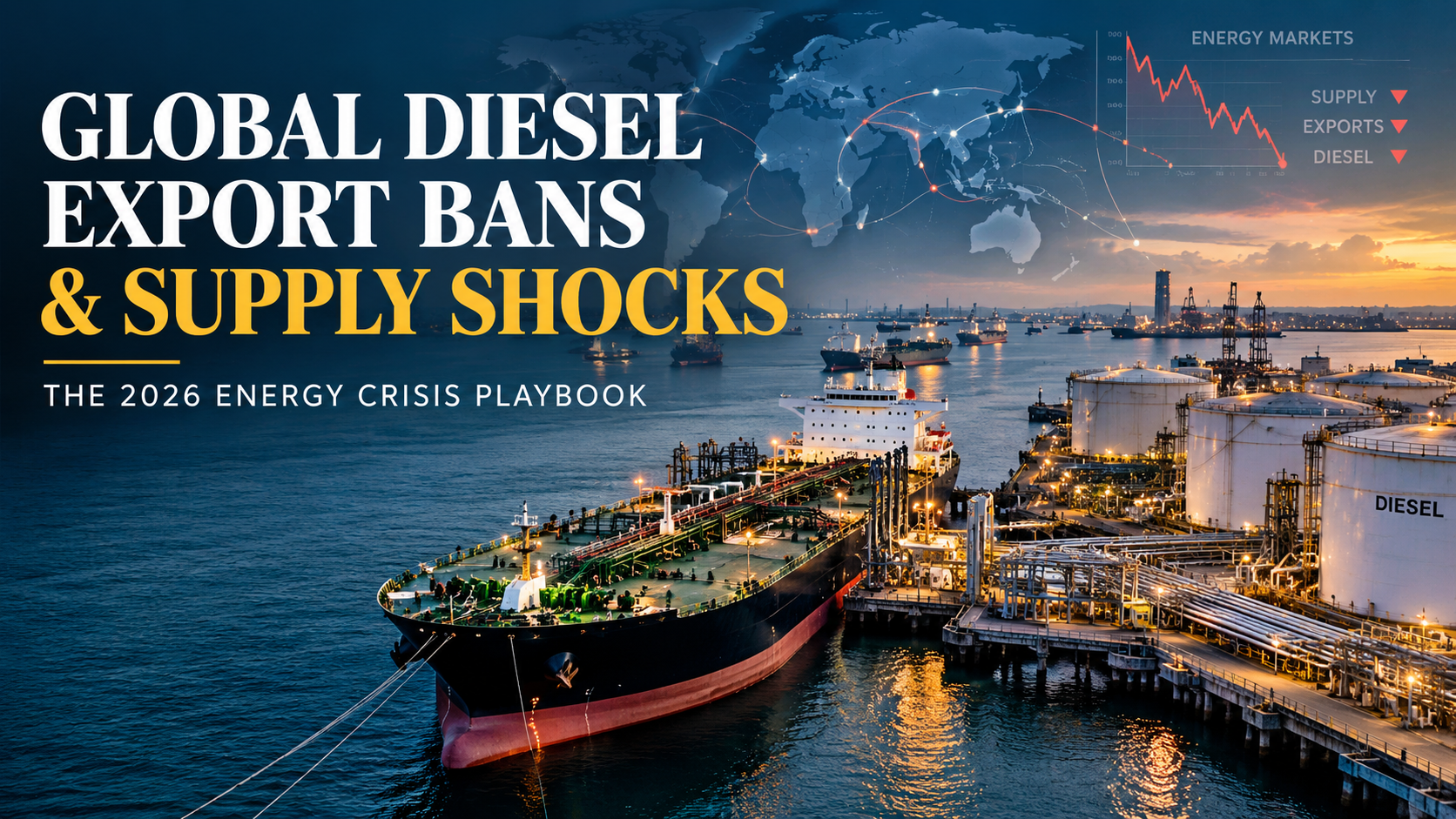
Global Diesel Export Bans & Supply Shocks: The 2026 Energy Crisis Playbook

Key Takeaways
- Supply Crunch: Discussions regarding potential US diesel export bans have amplified global energy deficits as refiners struggle to meet middle distillate demand.
- Maritime Transit Bottlenecks: Escalating geopolitical tensions surrounding the Strait of Hormuz have constrained crude oil transport and raised marine shipping insurance premiums.
- Refining Spread Explosion: The diesel “crack spread”—the profit margin refiners earn converting crude into diesel—has expanded to near-record highs.
- Logistics Inflation: Transportation, trucking, and agricultural industries face immediate operational cost surges, directly impacting downstream consumer prices.
The Middle Distillate Deficit: Why Diesel Rules the Global Economy
While headlines frequently focus on crude oil benchmark prices, diesel and gasoil (middle distillates) serve as the actual blood stream of global commerce. Industrial manufacturing, commercial trucking, maritime shipping, and agricultural machinery rely almost entirely on diesel fuel engines.
Supply chain research from McKinsey & Company demonstrates that middle distillate shortages exert a far more immediate inflationary impact on logistics costs than gas station petrol fluctuations.$$\text{Refining Crack Spread} = \text{Refined Diesel Market Price} – \text{Raw Crude Oil Cost}$$
When refiners face crude supply constraints due to Middle Eastern transit blockades, the price of refined diesel decouples from standard crude benchmarks, causing the crack spread to widen dramatically.
               Global Supply Chain Diesel Price Impact Loop

  [Strait of Hormuz Disruptions] + [Proposed US Export Bans]
                              |
                              v
             [Middle Distillate Inventory Depletion]
                              |
                              v
             [Diesel Crack Spread Expands Past $45/bbl]
                              |
                              v
  [Freight Surcharges Rise] ---> [Consumer Goods Inflation Spikes]
Geopolitical Chokepoints: The Strait of Hormuz Crisis
The vulnerabilities in global energy supply chains are heavily concentrated around key maritime bottlenecks. The Strait of Hormuz, through which roughly 20% of global petroleum liquids flow daily, is experiencing severe transit risk reductions.
As reported by commodity analysts at S&P Global, marine insurance underwriters have raised war-risk premiums for oil tankers transiting the Persian Gulf by over 300%, forcing major shipping lines to reroute vessels around the Cape of Good Hope.
Global Supply Chain Transmission Factors:
- Increased Transit Duration: Rerouting tankers adds 10 to 14 days to voyage times between Gulf suppliers and European/North American refineries.
- Capital Lockup: Millions of barrels of middle distillate fuel remain trapped in floating transit for longer durations, compounding domestic regional deficits.
- Refinery Configuration Mismatches: Heavy complex refiners in North America and Asia face challenges adjusting secondary unit inputs when crude slates shift abruptly.
Commercial Impact Metrics across Key Industrial Sectors
Real-time commodity data verified by Reuters outlines how the supply crunch is impacting critical economic sectors.
Sector-by-Sector Impact Analysis
| Industry Sector | Cost Exposure Level | Primary Risk Mechanism | Projected Consumer Price Impact |
| Commercial Trucking | Extreme | Immediate fuel surcharge add-ons | $+4.5\% – 7.2\%$ on retail goods |
| Agricultural Farming | High | Planting & harvesting equipment fuel costs | Elevated food commodity futures |
| Maritime Shipping | High | Very Low Sulfur Fuel Oil (VLSFO) spikes | Surcharges per TEU container |
| Aviation & Travel | Critical | Jet fuel refining competition | $+25\% – 30\%$ on long-haul airfares |
Corporate Playbook: Mitigating Energy Supply Disruptions
To navigate the ongoing energy market volatility, supply chain directors and corporate risk executives are implementing defensive hedging models:
- Fuel Hedging Derivatives: Securing long-term diesel swap contracts and call options to cap maximum operational fuel expenditures.
- Dual-Fuel Logistics Fleets: Accelerating the deployment of compressed natural gas (CNG) and electric commercial fleets for last-mile delivery operations.
- Strategic Fuel Reserve Buffers: Expanding local on-site fuel storage reserves from 14-day supply minimums to 45-day operational safety buffers.
Frequently Asked Questions (FAQ)
What happens if the US implements a total diesel export ban?
If the US restricts diesel exports, domestic fuel inventories within the United States would rise, lowering domestic prices temporarily. However, global fuel markets—especially in Europe and Latin America—would face immediate severe deficits, driving international prices and global supply chain costs dramatically higher.
Why is diesel price inflation more dangerous for the economy than gasoline price spikes?
Gasoline primarily impacts consumer personal travel. Diesel powers commercial transportation, including freight trucks, delivery vans, cargo ships, trains, and agricultural tractors. When diesel prices rise, the cost to transport every consumer product rises, driving broad inflation.
How does the Strait of Hormuz impact global refined fuel supply?
The Strait of Hormuz is the world’s most critical energy maritime chokepoint. A significant portion of global crude oil exports pass through it to reach global refineries. Any transit blockades reduce raw crude supplies to refiners, directly shrinking global diesel and jet fuel production.
Discover more from The Economy
Subscribe to get the latest posts sent to your email.


Markets & Finance
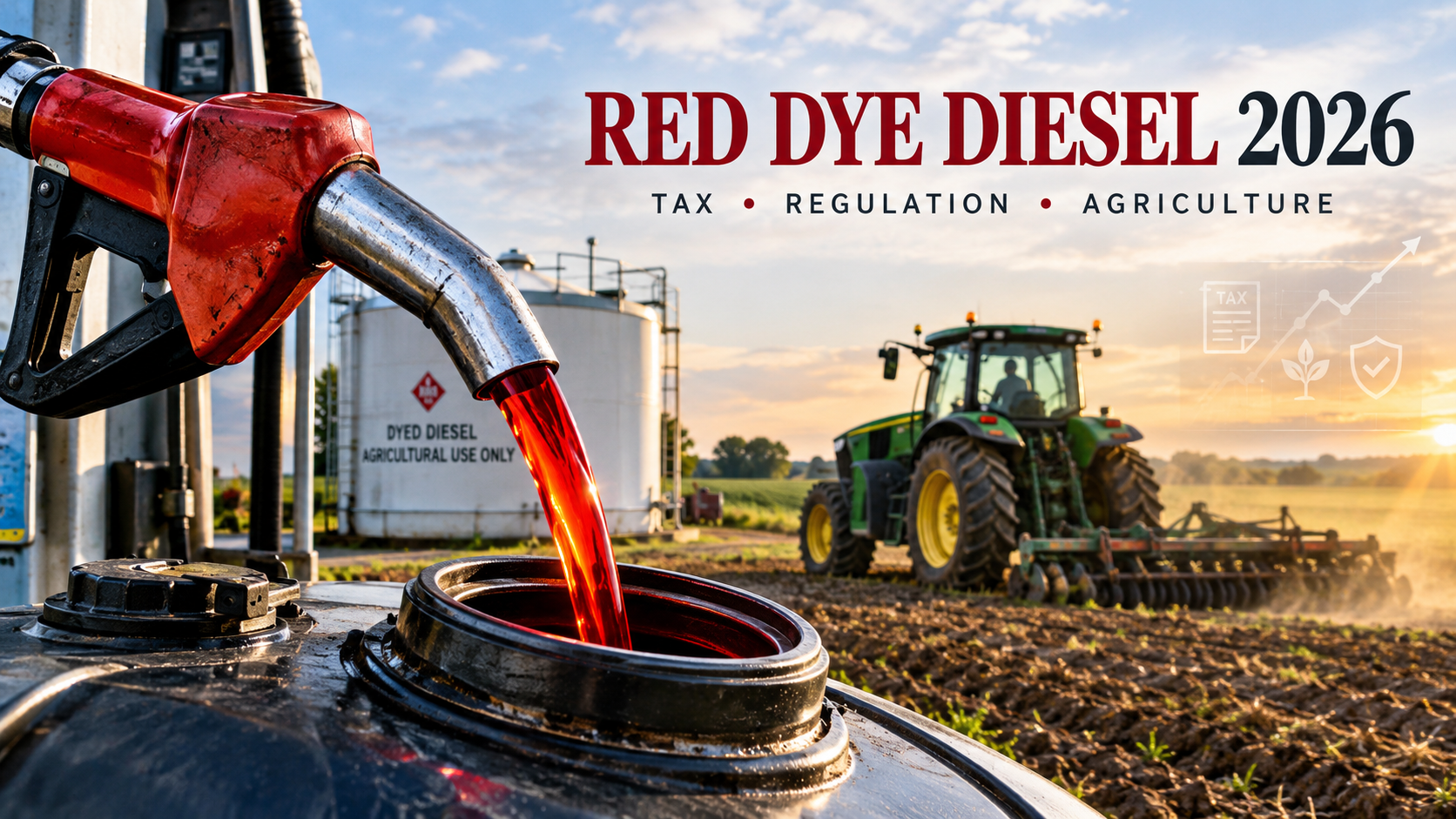
Red Dye Diesel in 2026: Tax Exemptions, Regulations, and the Real Agricultural Impact
Key Takeaways
- Red dye diesel is a tax marker, not a different fuel. The dye flags diesel on which the federal highway excise tax of 24.4 cents per gallon was not collected, because it is sold for exempt uses such as farming, home heating and local government, according to the IRS.
- Using it on the road is expensive. The federal penalty is the greater of $1,000 or $10 per gallon, per IRS Publication 510. That is roughly 41 times the tax a driver would be dodging.
- 2026 is an unusual year. U.S. on-highway diesel averaged $6.382 a gallon in the week of September 28, after a record $6.529 the week before and about $2.63 above a year earlier.
- States are loosening enforcement for harvest. North Carolina, Alabama and Arkansas have each acted, while the American Farm Bureau has asked Washington to waive federal penalties.
- Relief is local. State waivers do not erase federal exposure, and crossing a state line can put a driver back on the wrong side of the law.
If you have ever pulled up behind a tractor and noticed the fuel tank cap, or walked past a farm pump with a bright red nozzle, you’ve seen red dye diesel. It looks like a curiosity. It is actually one of the quietest, most important tax-enforcement tools in American agriculture.
This year it’s also a news story. Diesel hit record highs just as the fall harvest began, and the question of who can burn dyed fuel, where, and at what risk, has moved from a niche compliance topic to a governors’ agenda item.
Here is what red dye diesel is, how the tax logic works, what the penalties look like, and why 2026 has made it matter far beyond the farm gate.
What Red Dye Diesel Actually Is
Red dye diesel, often called dyed diesel, off-road diesel or farm diesel, is ordinary diesel with red dye added at the terminal. The chemistry is the same as clear diesel. The paperwork is not.
The dye exists to make tax evasion visible. Because fuel sold for exempt uses is not taxed, regulators needed a way to tell at a glance whether a tank holds taxed or untaxed fuel. Red does the job.
According to the IRS, dyed diesel is ordinarily untaxed because it’s sold for uses exempt from excise tax, such as to farmers for farming purposes, for home heating use and to local governments. The tax that normally applies to highway diesel is 24.4 cents per gallon at the federal level, and states add their own.
Dyed vs. Clear Diesel: The Comparison
| Feature | Dyed (red) diesel | Clear (undyed) diesel |
|---|---|---|
| Federal highway excise tax | Not collected for exempt uses | 24.4 cents per gallon |
| Typical allowed uses | Farm equipment, generators, heating, construction machinery off-road | On-road vehicles and general use |
| Pump price gap | Often 20 to 30 cents cheaper, per local reporting | Higher, because taxes are included |
| Highway use | Prohibited unless a specific exception or relief applies | Allowed |
| Penalty for misuse | Greater of $1,000 or $10 per gallon, plus the tax owed | Not applicable |
Notice what is missing from that table: a quality difference. Red diesel is not “dirtier” or “weaker.” The distinction is legal, not mechanical.
The Penalty Math Nobody Wants to Learn the Hard Way
The incentive to cheat looks small on paper. At 24.4 cents a gallon, filling a 100-gallon tank with dyed fuel saves about $24. But the penalty under federal law is the greater of $1,000 or $10 per gallon, as laid out in Publication 510.
Run the numbers on a bigger tank:
- 100 gallons: about $24.40 of tax avoided, versus a $1,000 minimum penalty.
- 300 gallons: about $73.20 avoided, versus $3,000.
- Per gallon: 24.4 cents against $10, a ratio of roughly 41 to 1.
On top of the federal exposure, states layer their own penalties. Arkansas, for example, noted in a recent order that improper use can bring additional tax and a $10-per-gallon penalty calculated on the full capacity of a vehicle’s tanks. Mixing dyed and undyed fuel can also trigger charges.
Why 2026 Changed the Conversation
For years, the dyed-diesel debate was a footnote. This fall it became a headline, because the price of diesel moved the economics of farming.
The price shock
The U.S. Energy Information Administration’s weekly survey put national on-highway diesel at $6.382 in the week of September 28, 2026, including taxes. That followed a record $6.529 the previous week, and it was $2.628 higher than a year earlier. California averaged about $8.18.
The driver is the war involving Iran and the disruption around the Strait of Hormuz, which has pushed up crude and distillate prices globally. Off-road diesel is cheaper at the pump because it escapes road taxes, but, as Axios reported, its price moves in tandem with the on-highway fuel.
The farm-level damage
Fuel is a modest share of farm costs in a normal year. This isn’t a normal year.
| Indicator | 2026 figure | Source |
|---|---|---|
| Fuel as a share of corn, soybean and wheat production expenses | Around 3% to 5% | Farm Bureau, via Axios |
| Estimated extra diesel cost across four southern row crops | About $247 million | Auburn University analysis |
| Farm diesel price, week ending September 18 | $5.42 per gallon | Alabama Extension |
| Fuel cost increase per acre, corn / soybeans | $11 / $7 | Purdue’s Michael Langemeier, via Farm Progress and Bloomberg |
Farmers also can’t easily pass costs along. The Farm Bureau’s John Newton has described the squeeze in simple terms: growers buy at retail and sell at wholesale. Add higher fertilizer bills from the same conflict, and many operations are working with thin margins.
States Step In: Relief for Harvest
When harvest season collides with record fuel prices, state governments have a lever they can pull quickly: temporarily relaxing enforcement of the highway-use ban on dyed fuel.
- Alabama: Governor Kay Ivey directed a 120-day halt to enforcement of off-road diesel use on state highways.
- North Carolina: Governor Josh Stein asked the Department of Revenue to waive the state penalty through December 31, 2026. The state’s notice says the relief applies to farming and agricultural highway use, and users must still pay the state excise tax of 41 cents per gallon.
- Arkansas: An executive order suspended specified taxes and penalties for qualifying farm and logging vehicles.
Rep. Don Davis (NC-01) said at least ten governors had suspended or relaxed these penalties, and he urged the IRS to grant federal relief using its existing authority.
What federal relief would look like
The IRS has done this before. In 2021, after a fuel-supply disruption, it waived the dyed-fuel penalty for highway use in a set of states for two weeks, on the condition that the operator or seller paid the 24.4-cent tax. As of the Farm Bureau’s October 1 letter, the group was asking the White House to suspend the federal highway diesel tax and waive penalties for emergency use. We found no federal waiver announced at the time of writing, so check the IRS newsroom before you rely on one.
How to Stay Compliant This Harvest
- Know your state’s rule and its end date. State relief is not federal relief, and it usually expires.
- Pay any required tax. Waivers frequently require the state or federal excise tax to be paid.
- Don’t cross state lines on the assumption you’re covered. North Carolina’s own notice warns that vehicles running dyed fuel outside the state may face federal and other-state penalties.
- Flush tanks afterward. Dye remnants can linger, and regulators advise clearing them before relief ends.
- Keep records. Receipts, farm use logs and dates protect you in a dispute.
- Consider the refund route. Buyers of clear diesel used off-highway can often claim a credit on their federal return using the fuel-tax credit form, so ask your tax preparer.
Red Diesel Outside the U.S.
The same concept exists elsewhere, with different politics. In the United Kingdom, rebated “red” diesel entitlement was sharply narrowed in April 2022. Agriculture, horticulture, forestry and fish farming kept their entitlement, while most construction users lost it. GOV.UK’s Excise Notice 75 guidance sets out the permitted uses. The lesson travels: a cheap, tax-advantaged fuel survives only as long as the rules defining its use are credible.
Asked & Answered
Is it illegal to use red dye diesel in a pickup truck on the road?
Generally yes, in the United States. Dyed diesel is intended for off-road, tax-exempt uses. Highway use can trigger the greater of a $1,000 or $10-per-gallon federal penalty, plus any tax owed, unless a specific exception or temporary relief applies.
How do authorities know I used dyed fuel?
Inspectors can check a vehicle’s fuel supply for the dye, and the red color is visible in a sample. That is the entire reason the dye exists.
Will the IRS waive dyed diesel penalties in 2026?
It has done so in past supply disruptions, and farm groups and state officials are asking for relief now. At the time of writing, we found no announced federal waiver, so check the IRS newsroom for the latest.
Does state relief protect me from federal penalties?
No. State waivers apply only to state penalties. Federal law remains in force unless the IRS issues its own relief, and other states may enforce their rules if you cross a border.
Why is red diesel cheaper than regular diesel?
Because road-use taxes aren’t collected on it. The fuel is the same, but without the 24.4-cent federal tax and typical state taxes, the pump price is lower.
Discover more from The Economy
Subscribe to get the latest posts sent to your email.
Markets & Finance
Southeast Asia’s LNG Dilemma: Navigating Price Volatility, Infrastructure Gaps, and Energy Security

Southeast Asia’s accelerating industrial growth and rapid depletion of domestic gas fields have transformed the region into a critical frontier for global Liquefied Natural Gas (LNG) demand. However, this transition exposes emerging Asian economies to severe spot-market price volatility, geopolitical supply chain disruptions, and critical regasification infrastructure deficits. Balancing near-term power stability with long-term decarbonization pledges requires a strategic recalibration of LNG procurement, terminal development, and regional pipeline connectivity.
The Macro Demand Shift: Depleting Reserves & Domestic Shortfalls
For decades, countries like Thailand, Malaysia, and Indonesia relied on domestic natural gas to power grid expansion and industrial development. Today, maturing legacy fields are experiencing steep natural decline rates. According to analysis from the International Energy Agency (IEA), Southeast Asia’s net energy trade deficit is projected to widen significantly as indigenous production drops below domestic demand thresholds.
To prevent acute power shortages, regional utilities are turning to imported LNG as a bridge fuel to phase out coal-fired generation. Yet, substituting domestic piped gas with imported LNG exposes power markets directly to international supply-demand shocks:
- Supply Chokepoint Vulnerabilities: Maritime trade routes remain highly sensitive to geopolitical tensions, particularly across critical transit corridors like the Strait of Hormuz and the Malacca Strait, as reported by Reuters.
- Fiscal Exposure: Price spikes directly impact state-subsidized utility markets, straining national budgets in price-sensitive developing economies such as Vietnam and the Philippines.
- Contractual Mismatches: Many regional buyers remain over-indexed on short-term spot markets rather than long-term Sale and Purchase Agreements (SPAs), leaving them vulnerable to market squeezes during peak winter heating cycles in North Asia and Europe.
Infrastructure Bottlenecks Across the ASEAN Energy Landscape
Importing LNG requires capital-intensive midstream infrastructure—including onshore regasification terminals, Floating Storage Regasification Units (FSRUs), break-bulk distribution facilities, and high-pressure transmission pipelines. Infrastructure deployment across the region remains fragmented:
1. Archipelagic Geography & Storage Limits
The island geography of the Philippines and Indonesia severely complicates central grid distribution. Small-scale LNG distribution requires specialized shallow-draft carriers and modular FSRUs, which carry higher capital expenditure per unit of energy delivered compared to centralized world-scale onshore terminals.
2. Grid Interconnection & Pipeline Gaps
While the proposed Trans-ASEAN Gas Pipeline (TAGP) aims to interlink regional gas grids, progress remains stymied by regulatory mismatches, cross-border tariff disputes, and physical infrastructure deficits. Without interconnectivity, surplus regasification capacity in one nation cannot cushion supply deficits in another.
3. Terminal Offtake Financing Hurdles
Financial institutions evaluating midstream gas projects require bankable, long-term power purchase agreements (PPAs). Uncertainty surrounding electricity tariff reform and currency fluctuation delays Final Investment Decisions (FIDs) for major regasification projects, according to market intelligence from S&P Global Energy.
Country-by-Country LNG Infrastructure & Import Trajectory
The operational realities, regasification capacities, and procurement strategies differ substantially across key Southeast Asian markets:
| Country | Key Demand Drivers | Active/Planned Regas Capacity | Primary Procurement Strategy | Major Infrastructure Challenge |
| Singapore | 95% gas-fired power generation; industrial bunkering hub | ~10 MTPA (SLNG expansion underway) | Long-term SPAs + Portfolio Hedging | Land constraints for large-scale onshore storage expansion |
| Thailand | Depleting Gulf of Thailand gas fields; power generation | ~19 MTPA (Map Ta Phut Phase 1 & 2) | Mixed long-term contracts & spot purchases | High exposure to spot JKM price spikes during summer cooling peaks |
| Vietnam | Transitioning from coal; industrial power demand | ~1–3 MTPA (Thi Vai terminal live; Son My planned) | High spot-market dependency | Absence of cost-reflective retail power tariffs for gas-to-power projects |
| Philippines | Depletion of Malampaya gas field | ~5 MTPA (Batangas FSRUs operational) | Short-to-medium term contracts | Archipelagic gas transport; lack of cross-island pipeline links |
| Malaysia | Regional LNG exporter transitioning to domestic importer in Peninsular West | ~7.3 MTPA (Pengerang & Melaka terminals) | Internal portfolio balancing via Petronas | Internal geographical demand split between Sabah/Sarawak and Peninsular Malaysia |
Strategic Framework: De-Risking Southeast Asia’s Gas Transition
To mitigate price volatility and bridge infrastructure deficits, regional energy planners and corporate buyers must adopt a multi-tiered procurement and structural framework:
+-----------------------------------------------------------------------------------+
|                        REGIONAL LNG RISK MITIGATION FRAMEWORK                     |
+------------------------------------+----------------------------------------------+
| 1. Contract Portfolio Optimization | Balance 70-80% Long-Term SPAs with Spot JKM  |
+------------------------------------+----------------------------------------------+
| 2. Midstream Agility               | Deploy Modular FSRUs to shorten FID timelines |
+------------------------------------+----------------------------------------------+
| 3. Regional Pricing Benchmarks    | Develop an ASEAN Gas Index to decouple oil   |
+------------------------------------+----------------------------------------------+
| 4. Hybrid Grid Integration         | Pair Gas-to-Power with Solar/Energy Storage  |
+------------------------------------+----------------------------------------------+
1. Rebalancing Contract Portfolios
Energy buyers must shift away from pure spot exposure. Securing long-term SPAs indexed to Henry Hub or Brent crude provides price stability, while retaining a 15–20% spot allotment maintains operational flexibility. Market outlooks published by Shell Global emphasize that long-term contracting remains the primary shield against geopolitical price shocks.
2. Accelerated Deployment of Modular Infrastructure
FSRU technology offers a significantly shorter lead time (18–24 months) compared to onshore terminals (4–5 years). Developing nations can leverage leased FSRUs to initiate import capabilities while onshore pipeline networks are built out.
3. Constructing an ASEAN LNG Pricing Hub
Establishing localized regional trading hubs (such as Singapore’s SLNG expansion) enables the creation of an ASEAN-specific price benchmark. This reduces over-reliance on the North Asian Japan Korea Marker (JKM) and better reflects local market dynamics, a strategy actively analyzed by the U.S. Department of Energy.
4. Co-Optimization with Renewable Energy
Gas-to-power infrastructure should not be viewed in isolation. Gas turbines must be deployed as flexible, quick-start balancing units alongside expanding solar and wind capacity, ensuring system reliability without locking utilities into unmanageable fossil fuel import bills.
Outlook: The Balancing Act Ahead
Southeast Asia’s demand for LNG is structural and unavoidable over the coming decade. However, transforming LNG from a volatile financial burden into a secure transition fuel requires disciplined infrastructure planning, tariff reforms, and sophisticated procurement strategies. Without regional coordination and strategic long-term contracting, ASEAN power markets remain exposed to global market dynamics beyond their control.
Discover more from The Economy
Subscribe to get the latest posts sent to your email.
Markets & Finance
Energy Crisis Action: G7 Agrees to Release 100 Million Barrels of Diesel and Crude
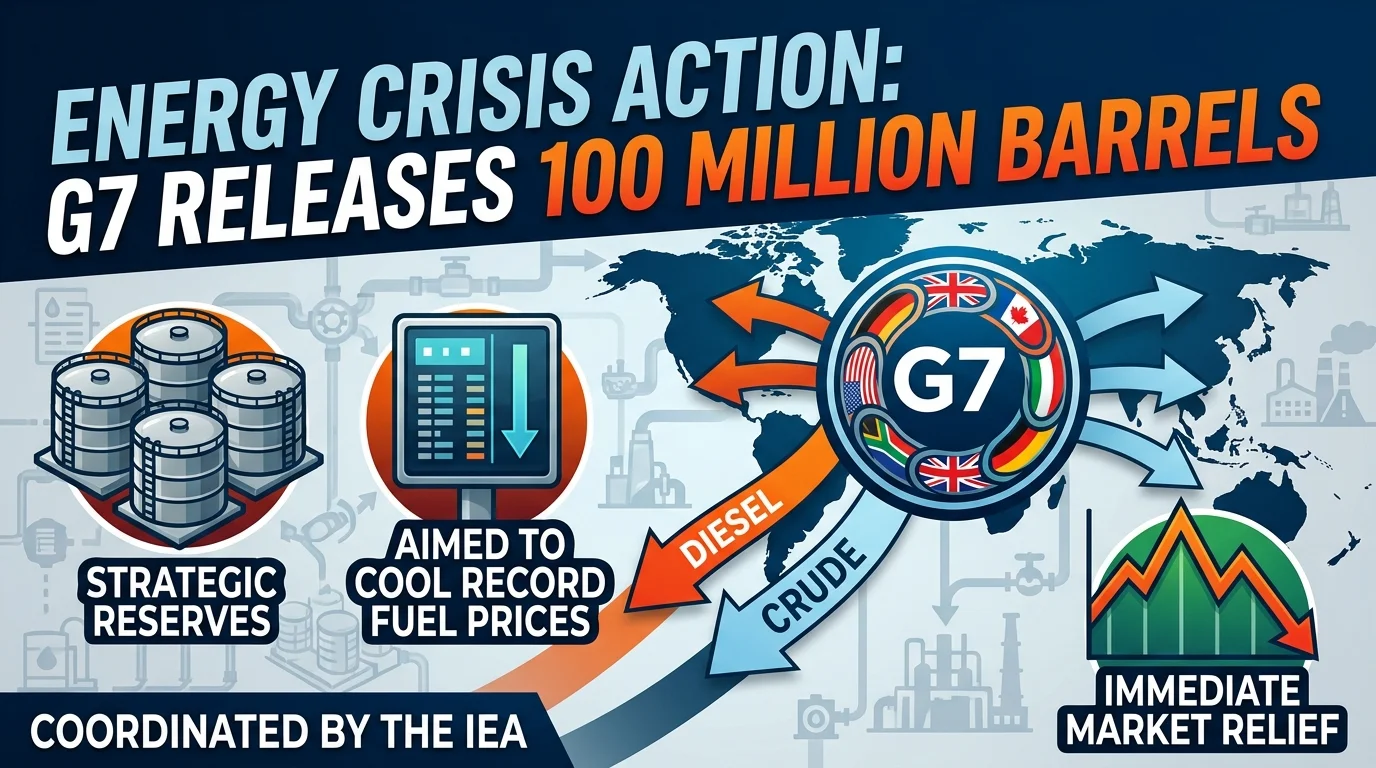
Executive Summary:The G7 nations have committed to releasing 100 million barrels of diesel and crude oil from strategic reserves over the next four months.
- Coordinated by the IEA, the emergency release aims to cool record-high fuel prices driven by geopolitical conflicts in Iran and damaged refinery infrastructure.
- A massive, front-loaded release of diesel is scheduled to hit the market within 20 days.
- Strategic diplomatic agreements successfully averted a US fuel export ban, ensuring a continued flow of energy to heavily dependent European markets.
The G7’s Historic Market Intervention
In a coordinated maneuver to stabilize deeply volatile global energy markets, the Group of Seven (G7) nations—comprising the US, France, Italy, Germany, Japan, Britain, and Canada—have agreed to release 100 million barrels of diesel and crude oil from their strategic stockpiles. The initiative, orchestrated in tandem with the International Energy Agency (IEA), will unfold incrementally over the next four months to act as a vital buffer against soaring global energy costs.
While 100 million barrels roughly equates to a single day of total global oil demand, the structural focus of this release sets it apart. The G7’s immediate priority is refined middle distillates. A “substantial” portion of the release, designated specifically as diesel, will flood the markets within the next 20 days, acting as a rapid-response measure to acute commercial fuel shortages.
Geopolitical Catalysts: Refinery Disruptions and the Middle East
The primary catalyst for this unprecedented market intervention is a severe, global refining bottleneck. Diesel and related fuels account for roughly 28% of global oil demand, according to historical IEA market data. Right now, the capacity to meet that demand is crippled.
Military strikes linked to the escalating war in Iran, combined with the ongoing degradation of energy infrastructure in Russia, have severely damaged critical regional refineries. The global market is not strictly suffering from a lack of unrefined crude; rather, it lacks the operational capacity to convert that crude into the refined fuels required to power supply chains, commercial logistics, and everyday vehicles.
Averting a Transatlantic Trade Crisis: The US Export Ban
The G7 agreement arrives at a politically fraught moment in the United States. With retail diesel prices recently skyrocketing to nearly $6.50 per gallon, US President Donald Trump faced intense domestic pressure to lower fuel costs ahead of the November midterm elections. Initial reports indicated the administration was preparing to impose a strict ban on American diesel exports to artificially lower domestic pump prices.
This proposed protectionist policy drew fierce opposition from domestic oil producers and sparked panic among European allies. Such a restriction would have been devastating for a European energy grid that pivoted heavily to American fuel imports following the 2022 bans on Russian energy. Current logistics indicate that Europe imports approximately 1.5 million barrels of fuel daily, with a full third originating from the United States, according to market tracking by S&P Global Commodity Insights.
Macron’s Diplomatic Push and Europe’s Reliance
French President Emmanuel Macron, the current chair of the G7, played a pivotal role in brokering the stockpile release and walking the US administration back from the export ban. Following a virtual summit of world leaders, Macron confirmed that the US had committed to abandoning the export restrictions, replacing the threat with a unified, multi-nation supply release.
Trump corroborated the shift in strategy via social media, highlighting that European nations had agreed to release a “massive amount of their heavily stocked diesel oil” to help balance the global market.
Analysts note that this unified action marks a significant shift in European strategy. Energy experts at Rapidan Energy Group pointed out that European nations generally prefer to hoard domestic supplies during prolonged geopolitical disruptions to protect against long-term shortages. However, the severity of the current pricing crisis—and the looming threat of losing US imports—forced a coordinated hand.
Immediate Market Reaction and Future Outlook
The immediate market response to the G7 announcement has delivered relief for commercial and retail consumers. US diesel futures plummeted by 8% in early trading immediately following the news, a trend closely monitored by Reuters energy coverage. While retail prices at the pump traditionally lag behind wholesale futures, energy economists anticipate a tangible drop for consumers within the month.
Despite the optimism, the global supply chain remains fragile. With China—another major global diesel supplier—recently reinstating restrictive fuel export quotas, the burden on Western stockpiles remains heavy. Analysts at Washington-based Clearview advised that while sweeping export bans are now highly unlikely, targeted destination constraints cannot be entirely ruled out as the northern hemisphere approaches peak winter demand.
Discover more from The Economy
Subscribe to get the latest posts sent to your email.

Algorithmic Dogfights: Why the U.S. and China Must Establish Rules of Engagement for Autonomous Air Power

Stock Market Today: Dow, S&P 500, and Nasdaq Retreat as Treasury Yields

Global Economic Outlook 2026: 7 Forces Reshaping Markets, Trade and Business

Geopolitics and Your Portfolio: How International Affairs Move Global Markets

Conservative Party Conference 2026: What Badenoch’s Tax and Deregulation Pitch Means for the UK Economy

Planet Labs and Goldman: How Satellite Geospatial Data Is Reshaping Wall Street

Red Dye Diesel in 2026: Tax Exemptions, Regulations, and the Real Agricultural Impact

Student Loans in 2026: Forgiveness Updates, Consolidation, and Repayment Strategies

Why Did I Get $90 From Social Security? 8 Reasons Behind an Unexpected SSA Payment

Corporate America Faces a New Debt Test as US Borrowing Costs Surge

Goldman vs. Citi: Which Banking Giant Leads Modern Global Finance in 2026?

Beyond Hanoi & HCMC: How Northern Industrial Clusters Are Driving Vietnam’s 10% Growth Surge

Analytical Review of The Economist’s “What is the Right Tax System for the 21st Century?”

Southeast Asia’s LNG Dilemma: Navigating Price Volatility, Infrastructure Gaps, and Energy Security

Oil Prices Break $100 in 2026: Middle East Conflict & Energy Markets

IMF & World Bank 2026 Global Economic Outlook: Growth, Inflation, Debt

Middle East War Economics 2026: Oil Prices & Energy Markets

High-CPM Finance Niches 2026: Publisher Monetization Blueprint

China Stocks Today: Are Big Economies in Asia Nearing a Market Bottom?

Global Pension Systems Ranked: The World’s Best and Worst Retirement Frameworks

Enterprise AI Platforms Disrupting B2B SaaS in 2026: Full Analysis

Elon Musk’s Next Moves: Disrupting the 2026 Global Economy

Social Security Trust Fund 2032: OASI Depletion Timeline Explained

Crypto Daily Outlook: Bitcoin, Altcoins, and the Future of Decentralized Finance

World’s Largest Economies: Ranking the Top Global Powers

GasBuddy Market Insights: How Crude Price Shifts Impact Local Fuel Cost Averages

World Bank & IMF Reports 2026: Why the “3% Growth” Consensus Is Actually a Debate

PSX Forecast 2026: KSE-100, IMF Reviews & Geopolitics
-

 Markets & Finance9 months ago
Top 15 Stocks for Investment in 2026 in PSX: Your Complete Guide to Pakistan’s Best Investment Opportunities
-

 Analysis8 months ago
Johor’s Investment Boom: The Hidden Costs Behind Malaysia’s Most Ambitious Economic Surge
-

 Analysis8 months ago
Top 10 Stocks for Investment in PSX for Quick Returns in 2026
-

 Banks9 months ago
Best Investments in Pakistan 2026: Top 10 Low-Price Shares and Long-Term Picks for the PSX
-

 Analysis8 months ago
Brazil’s Rare Earth Race: US, EU, and China Compete for Critical Minerals as Tensions Rise
-

 Investment9 months ago
Top 10 Mutual Fund Managers in Pakistan for Investment in 2026: A Comprehensive Guide for Optimal Returns
-

 Global Economy9 months ago
15 Most Lucrative Sectors for Investment in Pakistan: A 2025 Data-Driven Analysis
-

 Global Economy9 months ago
Pakistan’s Export Goldmine: 10 Game-Changing Markets Where Pakistani Businesses Are Winning Big in 2025