
KSE-100
KSE-100 Index 2026: Is Pakistan’s Stock-Market Recovery Sustainable?

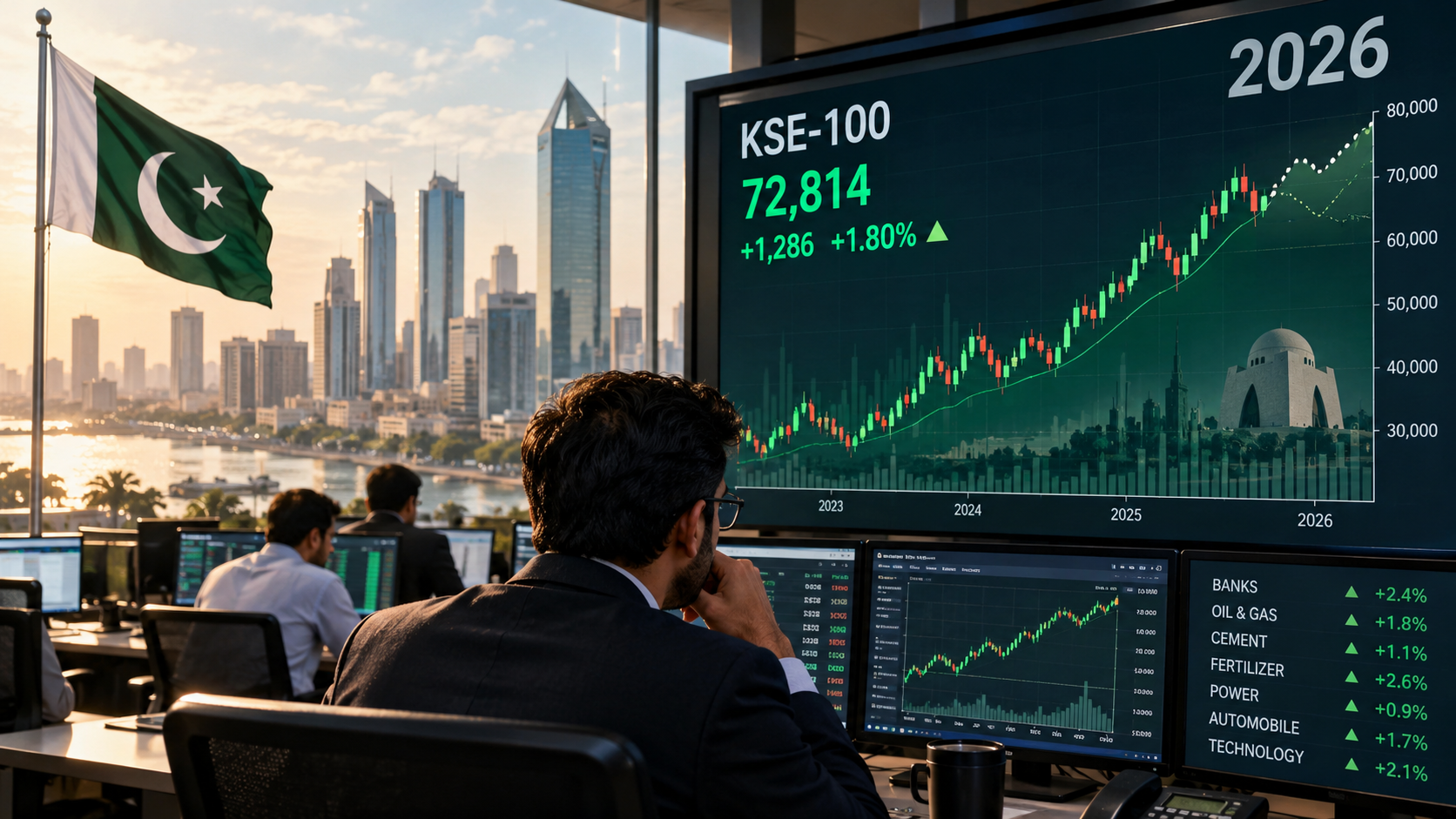
Is the KSE-100 rally sustainable in 2026? Compare valuations, interest rates and earnings to make better investing decisions. Read the latest analysis.
Key Takeaways
- The Pakistan Stock Exchange data portal displayed the KSE-100 at 166,419.71 on 16 October 2026, below its displayed 52-week high of 191,032.73; see the exchange data.
- The State Bank had a 11.5% policy rate after its September 2026 meeting; interest rates affect both equity valuations and competing deposit returns.
- A high index level says little about value without corporate profits, dividends, debt and index concentration.
- A dividend, capital gain and inflation-adjusted return are different concepts; investors should calculate all three where applicable.
Investors love a round number on a screen. But an index nearing or exceeding a previous landmark is not automatically a bargain. The KSE-100 index 2026 stood at 166,419.71 on 16 October, according to the Pakistan Stock Exchange data portal, below a displayed 52-week high above 191,000. That is a useful reminder that even a market with strong long-term hopes can experience substantial corrections.
The question is whether company earnings and cash flows justify prices. Lower interest rates can help share valuations, while higher oil costs, energy arrears or political volatility can quickly damage them. This guide gives ordinary Pakistani investors a framework for separating a durable business improvement from an expensive narrative.
Where does the KSE-100 index 2026 stand?
The PSX data portal showed the KSE-100 closing at 166,419.71 on Friday, 16 October 2026, a modest gain on that day. It also displayed a 52-week high of 191,032.73 and a 52-week low of 144,119.44. Those are dated exchange readings, not a current live quote after the cutoff.
| Exchange measure | Value | Context |
|---|---|---|
| KSE-100 close | 166,419.71 | 16 October 2026 |
| Displayed 52-week high | 191,032.73 | PSX portal as of same date |
| Displayed 52-week low | 144,119.44 | PSX portal as of same date |
| Distance below displayed high | About 12.9% | Author calculation |
The distance from the high is an arithmetic comparison, not a prediction of the next move. Index levels are also weighted toward larger companies. A few heavily weighted banks, energy names or other blue chips can push the headline up while many smaller shares go nowhere.
Check the index construction
Read the latest PSX methodology and company disclosures before relying on a chart. Corporate actions, dividends and index revisions matter. A price-return series and total-return series can tell different stories because cash distributions can be a material part of investment results.
Why do interest rates move stock valuations?
A share price represents investors’ willingness to pay today for uncertain future profits. When government securities and deposits offer attractive yields, an investor demands stronger expected returns before taking the additional risk of equities. When interest rates fall, that comparison can become more favourable to stocks. It is a tendency, not an iron rule.
The State Bank’s September 2026 rate information showed a policy rate of 11.5%. Banks with government securities exposure may benefit or suffer from rate changes in different ways, while businesses financed through floating-rate borrowing may receive relief with a lag.
The October IMF assessment called for continued monetary discipline amid renewed energy and inflation risks. A trader betting on aggressive rate cuts should examine whether inflation makes that assumption unrealistic. A simple market narrative is often less reliable than the joint movement of policy rates, bond yields and corporate earnings.
What do company valuations tell you that an index cannot?
Start with price-to-earnings, dividend yield, debt and free cash flow. A company trading at Rs200 per share and earning Rs20 annually has an implied price-to-earnings ratio of 10, assuming the earnings figure and share count are correctly defined. That is not a buy signal by itself: earnings may be temporary or expected to collapse.
| Metric | Illustrative calculation | What to ask |
|---|---|---|
| P/E ratio | Rs200 price ÷ Rs20 EPS = 10× | Are earnings repeatable? |
| Dividend yield | Rs12 dividend ÷ Rs200 = 6% | Can cash flow support it? |
| Debt burden | Compare interest and operating cash flow | Can it refinance safely? |
| Margin trend | Net profit ÷ sales | Is pricing power improving? |
The example is fictional. Readers should use current audited or reviewed company statements for actual investments. A firm can look cheap on reported earnings while consuming cash and building debt. An exporter may report higher rupee profits partly because of currency conversion rather than higher production.
Investors also need governance checks. Examine related-party transactions, auditor qualifications, overdue receivables and dividend history. Those details often reveal more than repeated claims that Pakistan’s market is ‘under-owned’.
Which sectors are most exposed to macroeconomic shocks?
Banks, fertilisers, energy companies, cement producers and exporters react differently to inflation and interest rates. A bank can earn spreads on loans and securities but face credit risk if clients struggle. A cement producer can benefit from construction activity while being hurt by expensive fuel. Exporters receive foreign currency but may buy imported inputs.
The PBS trade statistics for September 2026 showed a cumulative $10.768 billion goods deficit in July–September, highlighting continued import sensitivity. A renewed oil-price shock could feed fuel costs and inflation, change rate expectations, and weaken consumption at home.
A sensible sector view asks which costs move immediately and which earnings respond later. For example, a company selling a regulated product may not be able to pass fuel increases to customers quickly. A debt-heavy firm with short-term loans may feel higher rates before a peer financed mostly by equity.
Broad market enthusiasm often hides these very different risk profiles. The portfolio challenge is to hold businesses whose risks are understandable rather than buy every share that recently rose.
Worked example: how can a 12% gain fail to beat inflation?
Imagine an investor buys Rs100,000 of shares and sells a year later for Rs112,000, before dealing costs, dividends or tax. Nominal capital gain is 12%. If the relevant consumer basket rises 10.3%, the exact real gain is (1.12 ÷ 1.103) − 1, or approximately 1.54%. The inflation assumption uses the PBS September 2026 year-on-year reading for illustration, not a forecast for the investor’s holding period.
Suppose commissions and taxes absorb another Rs2,000 of the proceeds. The real result is smaller. A dividend can improve the picture, but it may be subject to different taxation and does not make capital losses disappear.
This is why comparing a nominal index chart with an inflation chart is useful but not enough. The investor’s purchase date, security selection, cash flows, costs and taxes determine the realised outcome.
What would make a rally durable?
For a sustainable improvement, listed firms need growing earnings from better demand and productivity, not only lower discount rates. Government finances must remain credible enough to avoid squeezing private credit. Energy costs should not repeatedly create unplanned losses for industrial companies. And the market needs reliable disclosure so investors can price risk rationally.
The World Bank’s FY2026–35 Pakistan framework stresses productive investment and the business environment. Those reforms could create a broader base of profitable listed and unlisted firms over time. The Finance Ministry’s FY26 debt review shows why debt and interest costs remain material macro constraints.
A prudent investor avoids the idea that index records prove future returns. Build an asset allocation based on emergency savings, investment horizon, diversification and the possibility of a 20% or larger drawdown. A market that recovers sharply can still be too risky for money needed next month.
What This Means for You
First-time investor: Learn the difference between a broker account, a CDC holding and an index fund before transferring large sums. Start with money you can leave invested and do not borrow to chase a market move.
Dividend investor: Compare dividend yield with earnings quality, tax treatment and sustainability. An unusually high yield can signal a falling share price or uncertain payout.
Retiree: Match cash needs with liquid and lower-risk assets. Equity exposure should reflect the ability to tolerate loss, not a neighbour’s reported gains.
Business owner: Follow stock valuations as a window into financing conditions, but base expansion decisions on demand and project cash flow rather than index excitement.
What to Watch Next
- 26 October 2026: The State Bank monetary-policy decision and any revision to its inflation assessment; verify any schedule change with the SBP.
- Early November 2026, exact release date to be confirmed: Pakistan Bureau of Statistics October inflation and merchandise-trade releases.
- Late October–November 2026, date not yet confirmed: Any IMF Executive Board announcement on the October staff-level agreement; staff agreement is not Board approval.
- Throughout FY2026–27: Updated SBP monthly balance-of-payments and remittance statistics; compare cumulative results rather than one month alone.
Frequently Asked Questions
What was the KSE-100 index level on 16 October 2026?
The Pakistan Stock Exchange data portal displayed a KSE-100 close of 166,419.71 on 16 October 2026. The same display showed a 52-week range from 144,119.44 to 191,032.73. Prices change each trading session, so use the exchange for a later quote.
Is Pakistan’s stock market at a record high in October 2026?
Not on the 16 October data cited here. The KSE-100 was below its displayed 52-week high. Headlines about records must specify the date, index and whether the discussion refers to price, total return or a past milestone.
Is the KSE-100 a good investment in 2026?
There is no universal answer. The index offers exposure to listed Pakistani companies but also carries volatility, governance, currency and sector-concentration risk. Assess earnings, valuation, dividends and your investment horizon. Do not interpret recent index gains as a guarantee of future returns.
How do interest rates affect the Pakistan Stock Exchange?
Higher rates make deposits and bonds more competitive against shares and may raise corporate borrowing costs. Lower rates can help valuations and firms financed with debt. The actual result varies by sector and depends on inflation, credit quality and profits.
What is the difference between KSE-100 and a total-return index?
A price index mainly captures price movements under its calculation rules, whereas a total-return approach also accounts for reinvested cash distributions. Before comparing a stock portfolio with an index, check how the benchmark handles dividends and corporate actions.
The Bottom Line
The KSE-100’s level is a headline. The investment case is the price paid for repeatable profits after adjusting for risk. That distinction matters most when enthusiasm is high and markets have already shown they can fall sharply.
Discover more from The Economy
Subscribe to get the latest posts sent to your email.


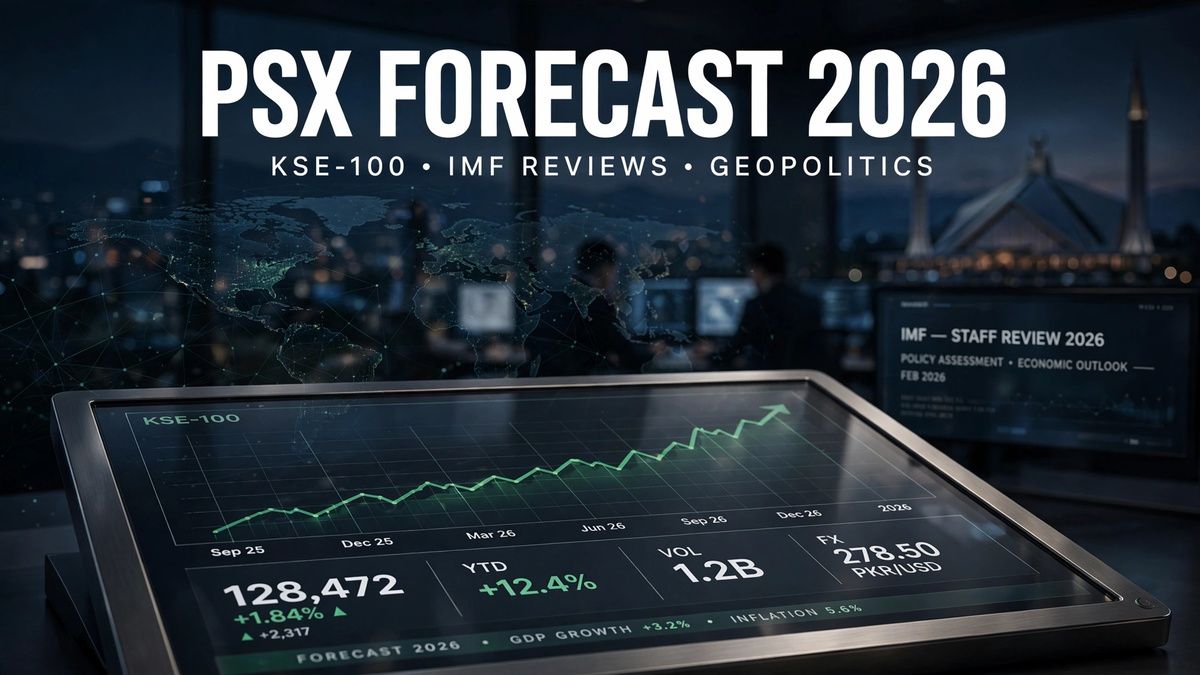
The KSE-100 Index just delivered its third consecutive year as the best-performing major asset class available to Pakistani investors — a 44% rupee-terms gain in FY2026 that outpaced gold, real estate, and fixed income. Yet the same index spent the back half of that fiscal year lurching between rallies triggered by IMF tranche approvals and sell-offs triggered by missile strikes 2,000 kilometers away. For domestic and expat investors weighing exposure to Pakistan’s frontier equity market, the story of 2026 is a tug-of-war between genuine macroeconomic reform and a regional war that keeps interrupting it.
FY26 in Numbers: A Historic Rally, Delivered in Two Very Different Halves
The KSE-100 closed FY2026 (ended June 30) at 180,302 points, a 44% gain in rupee terms and 46% in U.S. dollar terms, according to year-end reports from AKD Research and Topline Securities cited by Profit Pakistan Today. Stack that on top of FY24 and FY25, and the index has delivered a cumulative 335% return in rupee terms — 347% in dollar terms — over three straight years, driven by policy continuity, macroeconomic stabilization, record trading volumes, and Pakistan’s return to international debt markets.
But the FY26 rally was not a straight line. As Business Recorder reported, the first half of FY26 (July–December 2025) delivered a 39% gain, driven by improving economic indicators despite flood-related disruptions. The second half turned sharply volatile: the index touched an intra-period high of 189,167 on January 23, 2026, before the outbreak of the Middle East war in late February triggered a sustained bout of selling that erased much of the gain before a partial recovery into fiscal year-end.
KSE-100 FY26 timeline:
| Period | Level/Move | Driver |
|---|---|---|
| H1 FY26 (Jul–Dec 2025) | +39% | Macro stability, IMF program progress |
| Jan 23, 2026 | Intra-period high: 189,167 | Pre-war peak |
| Feb 28, 2026 | War begins | Middle East conflict onset |
| April 2026 | +14,251 points (+9.6%) to 162,994 | US–Iran ceasefire optimism (short-lived) |
| May 2026 | IMF approves $1.2bn tranche (May 8) | Sentiment recovery |
| June 30, 2026 (FY26 close) | 180,302 | Full-year: +44% |
| September 2026 | ~170,000–171,000 range | Renewed oil shock, Houthi attacks on Saudi facilities |
The IMF Program: Pakistan’s Structural Anchor
Unlike prior boom-bust cycles on the PSX, the FY26 rally has an institutional anchor: Pakistan’s ongoing IMF Extended Fund Facility (EFF) and Resilience and Sustainability Facility (RSF) programs. Pakistan cleared its second and third EFF/RSF reviews in December 2025 and May 2026 respectively, unlocking total disbursements of roughly $4.8 billion, according to Profit Pakistan Today’s FY26 wrap-up.
The next test is imminent. An IMF staff mission was expected to arrive in Pakistan around September 23, 2026, to conduct the fourth EFF review and third RSF review, covering the $7 billion EFF and $1.4 billion RSF programs, according to the Express Tribune. For FY27, the IMF has set an underlying primary balance target of 2% of GDP and an FBR tax revenue target of Rs15.3 trillion — both of which will be closely watched by the market as proxies for continued program compliance.
Pakistan’s external buffers have also strengthened materially. Total liquid foreign exchange reserves rose 5.3% week-on-week to $23.7 billion as of early September 2026, with State Bank of Pakistan reserves at $18.3 billion, pushing import cover up to 2.74 months from 2.56 months, per Tribune reporting. Remittances have been an unsung support: workers’ remittances hit a record $4.3 billion in May 2026, helping the rupee and easing external-account pressure even as the trade balance absorbed a higher energy import bill.
Geopolitics: The Recurring Interruption
Every rally attempt on the PSX in 2026 has been vulnerable to the same external shock: Middle East oil-price spikes. AKD Research’s own commentary has been explicit that “a constructive resolution to ongoing geopolitical tensions remains the key near-term catalyst for direction, with any easing in oil prices expected to trigger a recovery,” as noted in Profit Pakistan Today’s May 2026 outlook.
That pattern has persisted into September. As of the most recent trading sessions, Houthi assaults on Saudi energy facilities pushed crude oil prices higher, weighing directly on investor sentiment on the PSX, according to the Express Tribune’s latest market wrap. A six-member Gulf Cooperation Council bloc was reported to be considering direct talks with Iranian officials over the future of the Strait of Hormuz — a diplomatic track that, if successful, would be the single biggest near-term catalyst for a PSX re-rating, given how tightly correlated the index has become to global crude benchmarks.
Valuation and 2026 Targets
Despite the rally, brokerages continue to argue Pakistani equities remain undervalued relative to history. The KSE-100 was trading at a price-to-earnings ratio of roughly 6.9x as of April 2026, against a longer-run historical average closer to 8.0x, according to AKD Research commentary cited by Profit Pakistan Today.
Brokerage KSE-100 targets for December 2026:
| Brokerage | Target Level | Implied Framing |
|---|---|---|
| Topline Securities | 203,000 | Base case, ~13% total return from mid-2026 levels |
| AKD Research | 263,800 | Bull case, contingent on sustained reform and oil relief |
| Trading Economics (conservative model) | 155,000–156,000 | Short-term stability scenario |
Sector-level positioning matters as much as the index target. Banking (UBL, HBL, Meezan Bank), oil and gas exploration (OGDC, PPL), fertilizers, and cement have been flagged repeatedly by local brokerages as the highest-upside sectors heading into FY27, benefiting respectively from a still-elevated (though easing) policy rate, higher global energy prices, and continued infrastructure and construction demand.
Final Verdict
The KSE-100’s FY26 performance confirms that Pakistan’s macro reform story — anchored in a credible, disbursing IMF program, strengthening FX reserves, and record remittance inflows — is real and durable. But 2026 has also demonstrated that the index’s near-term direction is now a leveraged bet on Middle East de-escalation as much as on domestic policy execution. For frontier-market investors, the base case remains constructive: single-digit trailing P/E multiples, an IMF anchor into FY27, and a currency backed by improving reserves argue for continued exposure. The tactical risk to monitor closely is the September 23 IMF mission outcome and any material escalation around the Strait of Hormuz, either of which could swing the index by double-digit percentages within weeks.
Discover more from The Economy
Subscribe to get the latest posts sent to your email.

Pakistan IMF Programme 2026: Why Bailouts Keep Returning

Agri-Tech Pakistan 2026: Where Farming Innovation Could Actually Pay

Pakistan Tax Net: Why Agriculture, Retail and Property Are So Hard to Tax

KSE-100 Index 2026: Is Pakistan’s Stock-Market Recovery Sustainable?

Pakistan IT Exports 2026: What Would It Take to Reach $10 Billion?

Pakistan AI Policy 2025: Can It Raise Productivity and Create Jobs?

Pakistan Remittances 2026: How Overseas Workers Support the Economy

Can Pakistan Reach $34 Billion in Exports? The Real Barriers and Fastest Fixes

Why Pakistan’s Inflation Is Still Near 10% Despite Economic Stabilisation

Holiday Airfare 2026: Why Flights Cost More & Fares

California Prop 40 Explained: The 2026 Billionaire Wealth Tax Ballot Measure

US–Iran Conflict in October 2026: Hormuz, Oil Prices and Diplomacy

AIIB in 2026: Can Green Infrastructure Deliver Measurable Growth?

IMF and World Bank Outlook 2026: Growth, Debt and the Missing Investment

World’s Largest Economies: Ranking the Top Global Powers

Crude Oil & Petroleum Market Analysis: OPEC+ Decisions and Price Forecasts

Pakistan Economy 2026: Inside the SBP’s Balancing Act

Asian Stock Markets 2026: Japan, China, Pakistan & More

Silver Price Today: Why the Xi-Trump AI Standoff Is Fueling a Safe-Haven Rally

Oil Prices 2026: Inside the Hormuz Crisis That Won’t End

SpaceX IPO 2026: History’s Biggest Stock Debut?

Algorithmic Dogfights: Why the U.S. and China Must Establish Rules of Engagement for Autonomous Air Power

IMF Reports 2026: What the Latest Data Means for the Global Economy

Top US Convenience Store Chains: Store Counts, EV Charging, and Sales Trends

Business Insurance: What Coverage You Actually Need and What It Costs in 2026

Who Is Shivon Zilis? The Neuralink Executive at the Center of the Musk–OpenAI Trial

Corporate America Faces a New Debt Test as US Borrowing Costs Surge

Is AI a Stock Bubble in 2026? What the Data Shows
-

 Markets & Finance10 months ago
Top 15 Stocks for Investment in 2026 in PSX: Your Complete Guide to Pakistan’s Best Investment Opportunities
-

 Analysis8 months ago
Johor’s Investment Boom: The Hidden Costs Behind Malaysia’s Most Ambitious Economic Surge
-

 Analysis8 months ago
Top 10 Stocks for Investment in PSX for Quick Returns in 2026
-

 Banks9 months ago
Best Investments in Pakistan 2026: Top 10 Low-Price Shares and Long-Term Picks for the PSX
-

 Analysis9 months ago
Brazil’s Rare Earth Race: US, EU, and China Compete for Critical Minerals as Tensions Rise
-

 Investment9 months ago
Top 10 Mutual Fund Managers in Pakistan for Investment in 2026: A Comprehensive Guide for Optimal Returns
-

 Global Economy10 months ago
15 Most Lucrative Sectors for Investment in Pakistan: A 2025 Data-Driven Analysis
-

 Global Economy10 months ago
Pakistan’s Export Goldmine: 10 Game-Changing Markets Where Pakistani Businesses Are Winning Big in 2025