
Banks
Open Banking Trends 2026: What Consumers Should Know


Open banking lets you share your bank account data with apps and services, such as budgeting tools and lenders, that you choose to use. In the United States, the framework is less settled than in Europe or the UK. The CFPB finalized its Section 1033 rule in October 2024, but a federal court has enjoined its enforcement, and the agency is rewriting the rule, including whether banks may charge fees for data access. The result is a patchwork in which market standards and state proposals are doing much of the work.
Key Takeaways
- The CFPB finalized its Section 1033 open banking rule in October 2024, but it is not in force, according to the Open Banking Tracker’s status update.
- The CFPB sent a proposed revision to the White House’s regulatory review office (OIRA) in August 2026, per Consumer Finance Monitor.
- A key open question is whether banks can charge fees for data access. The 2024 rule barred most such fees.
- New York has introduced open banking bills in committee, so state rules could diverge from federal ones.
- Industry practice is moving toward the FDX standard and away from screen scraping, according to the status tracker.
What Open Banking Means for You
Open banking refers to the ability to move your financial data securely between institutions and apps. A budgeting app might read your transactions to categorize spending. A lender might check your income and balances before approving a loan. In the best cases, the data sharing is read-only, consent-based, and easy to revoke.
Two components matter. Data access lets an app read your account information with your permission. Payment initiation lets an authorized app move money on your behalf. Most consumer use cases today involve data access.
Where the Rule Stands
Section 1033 of the Dodd-Frank Act gives consumers the right to access their financial data and to direct it to third parties. The CFPB’s implementing rule, the Personal Financial Data Rights rule, was published in the Federal Register in January 2025. Its compliance dates were phased, starting in 2026 for the largest data providers.
Those dates no longer bind in practice. A federal court in Kentucky enjoined the CFPB from enforcing the rule, according to an ABA Banking Journal report cited in the tracker, and the agency has reopened the rule for substantial revision. The April 2026 compliance deadline passed without becoming an enforcement trigger.
The CFPB’s revised proposal, sent to OIRA in August 2026, is expected to narrow or reshape several provisions. Analysts have flagged changes to who counts as a consumer or representative, limits on secondary data use, and whether data providers may charge fees.
Timing is uncertain. One analysis expected a revised rule in the Federal Register around the fourth quarter of 2026, with comments closing in early 2027. That projection is not confirmed, so check the Federal Register before relying on it.
The Fee Question
The fee question matters most for consumers because it shapes who pays for data sharing. The 2024 rule barred data providers from charging consumers or authorized third parties for access. Banks argued that this was one-sided and prevented them from recovering the cost of building and securing the infrastructure. Fintechs and consumer advocates argued that free access is a core consumer right.
If the revised rule allows fees, the most likely effect is higher costs for fintech apps that rely on bank data, which could be passed to consumers through subscription fees or reduced free features. If fees remain barred, the cost burden stays with banks.
State Action
While federal rules are in flux, states are acting. New York Assembly Bill 10640 and its Senate companion, S9483, were introduced in March 2026 and remain in committee. These bills focus on open banking data and could create state-level obligations that differ from federal requirements.
Consumers in states that pass such laws may gain protections the federal framework lacks. Companies operating nationally may face a patchwork of requirements, which could slow product development.
Market Standards Are Doing Real Work
Even without a binding federal rule, many institutions are building connections. The FDX standard, a U.S. data-sharing specification, has become a common reference point. Building on FDX reduces reliance on screen scraping, a method where an app logs in to your bank on your behalf using your credentials.
Screen scraping is less secure because the app holds your login details. Connections through standardized APIs typically let you grant and revoke access through your bank’s interface without sharing your password.
Protect Your Financial Data
Whether or not a rule is in force, these steps reduce risk:
- Review connected apps. Check your bank’s app connection list at least once a year and remove any service you no longer use.
- Prefer API connections over credential sharing. If an app asks for your bank username and password directly, look for an alternative connection method.
- Read data-use terms. Confirm whether the app sells or shares your data with third parties, and whether it uses your data for purposes beyond the service you requested.
- Limit permissions. Choose read-only access when payment initiation is not needed.
- Revoke access after use. If you stop using an app, revoke its access instead of leaving the connection active.
- Monitor statements. Watch for unexpected transactions, which can signal a compromised connection.
What to Watch Next
- The CFPB’s revised Section 1033 proposal and its Federal Register publication
- Whether the revised rule permits data-access fees, and at what level
- Progress of New York’s open banking bills and any similar state efforts
- Court rulings on the enjoined rule, which could affect timing and scope
Frequently Asked Questions
Is open banking legal in the U.S.?
Yes, sharing financial data with consented third parties is common. The question is which rules govern it. The CFPB’s Section 1033 rule is enjoined and under revision.
Is the CFPB open banking rule in effect?
No. As of mid-2026, a federal court has enjoined the CFPB from enforcing the rule, and the agency is rewriting it.
Can my bank charge me for sharing my data?
The 2024 rule generally barred fees. That provision is under reconsideration, so future rules could allow certain charges.
Is screen scraping dangerous?
It can be less secure, because the app stores or uses your login credentials. API-based connections are generally safer.
How do I revoke an app’s access to my bank data?
Most banks show connected apps in their online or mobile banking settings. You can usually revoke access there, and you may also be able to contact the app provider to delete your data.
What happens if a state passes its own open banking law?
State rules could add protections or obligations. Check your state’s legislature for pending bills if you live in New York or another state considering similar legislation.
Conclusion: Control What You Share
U.S. open banking is moving toward a clearer framework, but the final rules are not settled. Consumers can benefit from easier access to their financial data and better-tailored financial tools, provided they manage their connections carefully. Review your connected apps, prefer secure API connections, and follow the CFPB’s proposed rule as it moves toward publication.
Discover more from The Economy
Subscribe to get the latest posts sent to your email.


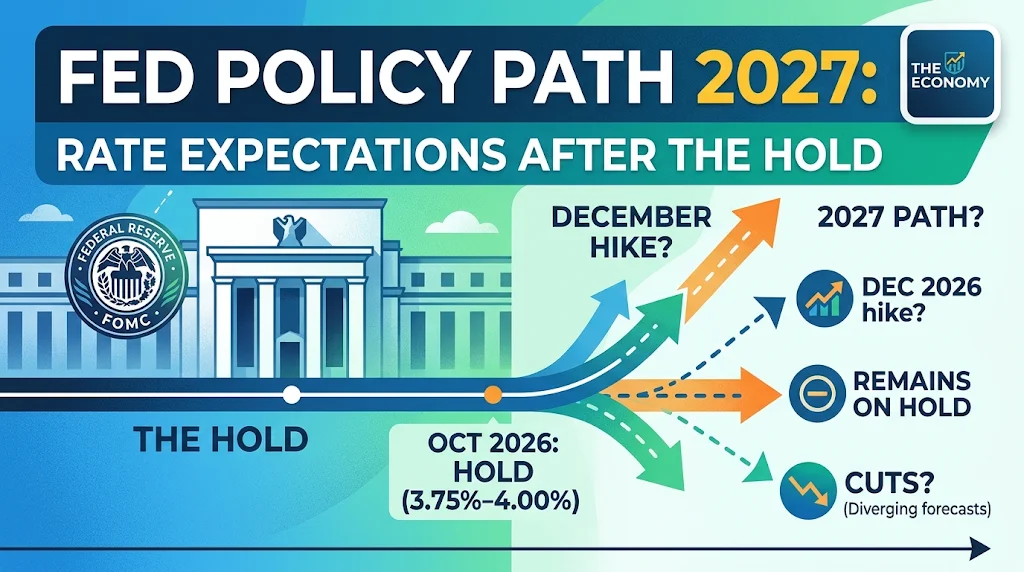
The Federal Reserve kept its policy rate unchanged in late October 2026, with two officials dissenting in favor of a hike, and the next move is now debated between a December increase and a longer hold into 2027. The federal funds target range was 3.75% to 4.00% after the October meeting, according to J.P. Morgan’s summary of the decision. The 2027 path depends on whether inflation eases enough for cuts to resume or stays high enough to keep tightening on the table.
Key Takeaways
- The Fed held rates in October 2026 despite elevated inflation, with two dissents favoring a quarter-point increase, per Charles Schwab’s meeting summary.
- Several major forecasters expect a December 2026 hike, including J.P. Morgan’s economists, who said the statement signaled a “hawkish bias.”
- Rabobank now expects the Fed to remain on hold through 2027, with one cut per year in 2028 to 2030.
- Goldman Sachs’s June forecast pushed its final two cuts of the cycle to June and December 2027, though its view predates the autumn hawkish turn.
- The Fed will hold eight meetings in 2027, but one will be devoted to strategy with no rate vote, which reduces scheduled chances to adjust policy.
Where Policy Stands Now
The Fed cut rates three times in late 2025, bringing the target range to 3.50% to 3.75% by December, according to a JPMorgan Asset Management review. The range sat at 3.75% to 4.00% at the October 2026 meeting, which means the committee moved toward restriction in 2026 rather than continuing to ease.
Two developments define the current debate. First, inflation has remained above target, with energy prices and tariffs cited by analysts as contributors. Second, Kevin Warsh now chairs the Fed, and his first meetings have been closely watched for signals about strategy. Schwab reported that Governor Lisa Cook and Cleveland Fed President Beth Hammack were among those opposing the hold, though reports differ on the exact dissent details, so verify against the official FOMC statement before publication.
Editors should note that the December 2025 Summary of Economic Projections, published by the New York Fed, is now out of date. It projected a median federal funds rate of 3.4% for 2026 and 3.1% for 2027. Those projections have been overtaken by the 2026 rate decisions and should be cited only as historical context.
The Case for a December Hike
The hawkish case rests on inflation and the committee’s language. J.P. Morgan’s economists interpreted the October statement as keeping December “a live option” for a hike, and they continue to expect one. Schwab reported that some forecasters, including Shah of Saxo, expected an increase in December and another in early 2027.
The argument for tightening is straightforward: if inflation expectations drift upward, the Fed risks losing credibility unless it acts. Oil price spikes linked to Middle East conflict and tariff pass-through have been cited as reasons that price pressures may persist.
Signals that would raise the odds of a hike:
- Core inflation readings that stay above target for consecutive months
- Strong payroll growth that tightens labor markets further
- Rising longer-term inflation expectations in Fed surveys
- Hawkish language in speeches by voting members before the December meeting
The Case for a Longer Hold
Rabobank’s updated view is that the Fed will stop short of further tightening and wait for data. Its analysts argue that the committee will likely stop at a higher neutral rate than its own projections suggest, but they do not expect a December move. After the hold, they see one cut annually from 2028 through 2030.
The hold case also rests on fiscal timing. Continuum Economics has argued that fiscal easing, including tax rebates scheduled to take effect in the first quarter of 2027, would give the Fed reason to wait and observe the effect before adjusting policy.
Signals that would support a hold:
- Inflation trending down toward target without a recession
- Softer hiring data, particularly in payroll and jobless claims
- Stable inflation expectations in consumer and market surveys
- Lower energy prices reducing headline inflation
Forecasts Are Diverging
The range of views is wide, which is itself a finding. Goldman Sachs, in June 2026, pushed its expected cuts into mid-2027. Rabobank now sees no cuts through 2027. J.P. Morgan sees a hike first. Markets have at times priced more hikes than economists, as Goldman noted in its analysis that market pricing sat above its own forecasts.
For readers, the practical takeaway is that rate expectations are uncertain in both directions. A single forecast should not be treated as a plan.
What the 2027 Meeting Calendar Changes
Warsh announced that one of the eight 2027 FOMC meetings will be devoted to “broad monetary policy strategy” without a rate decision or post-meeting statement. Fewer decision points could make the Fed slower to react to sudden shocks, though it could also reduce the risk of abrupt policy swings.
Investors should check the Fed’s official calendar and confirm which meetings include a rate vote, since the strategy meeting will not produce a rate announcement.
What This Means for Borrowers and Savers
For borrowers, the key variable is the longer end of the curve. Mortgage and corporate borrowing costs track Treasury yields more closely than the fed funds rate. A hold at restrictive levels keeps variable-rate debt expensive, while a December hike would add further pressure.
For savers, higher policy rates support yields on short-term deposits and Treasury bills. If the Fed holds through 2027, savings products may remain competitive, though yields could decline if cuts arrive later.
Practical steps:
- Review variable-rate debt and consider the cost of a 25-basis-point increase.
- Ladder short-term deposits or Treasury bills to reduce reinvestment risk.
- Avoid locking in long-term rates based on a single forecast.
Frequently Asked Questions
What is the current federal funds rate?
The target range was 3.75% to 4.00% after the October 2026 meeting, according to J.P. Morgan’s summary. Check the Federal Reserve’s website for the latest decision.
Will the Fed raise rates in December 2026?
Possibly. J.P. Morgan expects a hike, while Rabobank has added one to its forecast before resuming a hold. Markets and analysts disagree, and the outcome will depend on incoming inflation and jobs data.
When will the Fed cut rates again?
Forecasts vary. Rabobank sees no cuts through 2027. Goldman Sachs’s June forecast expected cuts in mid-2027, though that view predates the autumn hawkish turn.
Who is the Fed chair?
Kevin Warsh chairs the Federal Reserve as of late 2026, according to reports of the October meeting.
How many Fed meetings will have rate decisions in 2027?
Seven of the eight scheduled 2027 meetings are expected to include rate decisions. One is designated for strategy discussions without a rate vote.
How should homeowners prepare for a longer hold?
Consider the cost of variable-rate debt, compare refinancing options, and plan for mortgage rates that track longer-term Treasury yields more closely than the policy rate.
Conclusion: Plan for Both Outcomes
The 2027 rate path is genuinely uncertain. A December hike, a longer hold, or an eventual return to cuts are all plausible given current forecasts. The best guide is incoming data on inflation and jobs, along with the Fed’s own statements. Readers should treat forecasts as scenarios to prepare for rather than predictions to bet on.
Discover more from The Economy
Subscribe to get the latest posts sent to your email.
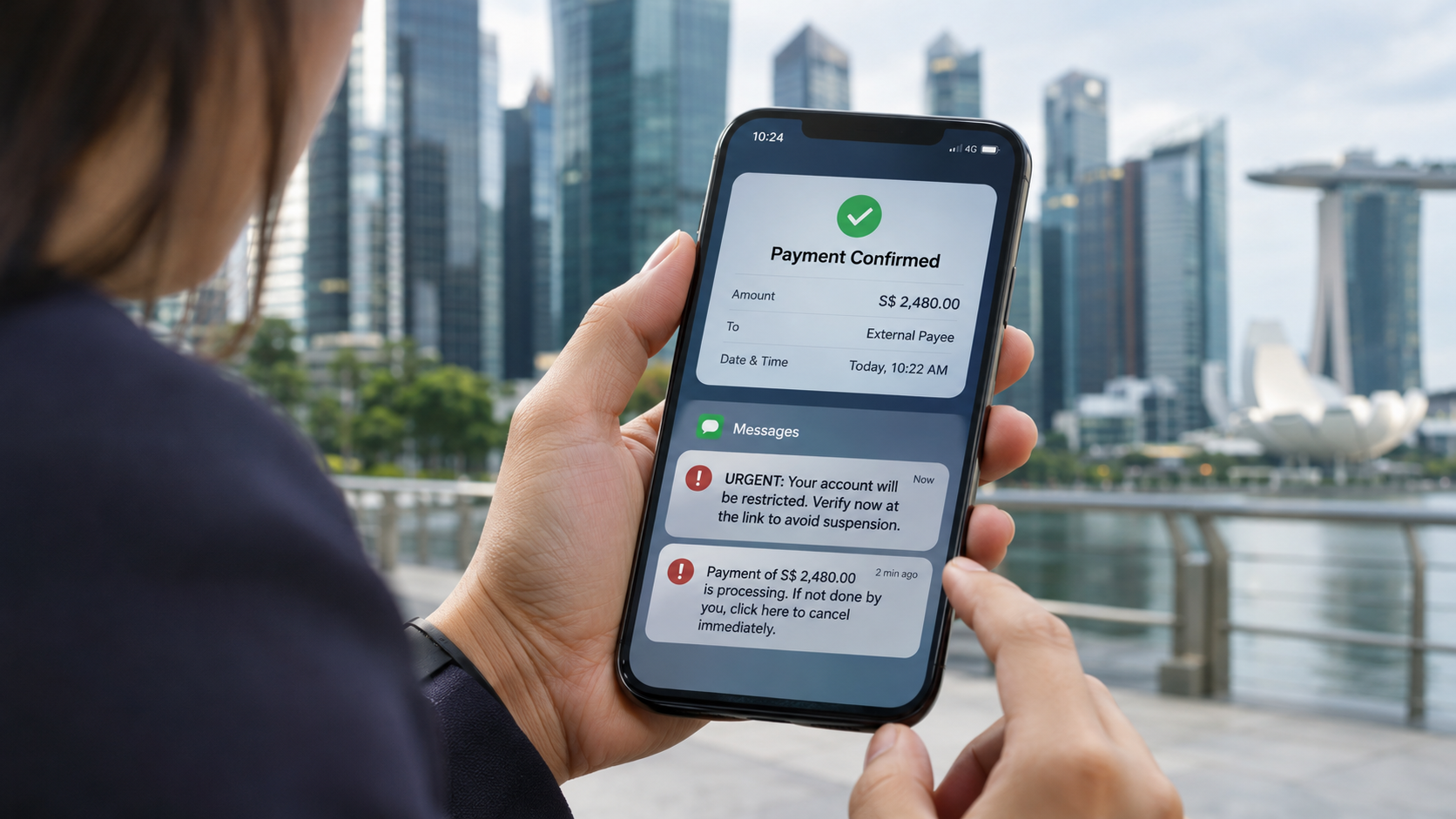
Scam losses are declining, but the economics of deception remain brutal. Singapore now needs a clearer answer to a question that digital finance has made unavoidable: when a payment is legitimate in form but fraudulent in purpose, who should bear the consequences?
A payment can be correctly authenticated, voluntarily approved and catastrophically mistaken. That is the uncomfortable reality behind a large share of modern financial fraud. Someone posing as an official convinces a frightened customer to transfer savings. A supposed investment adviser cultivates trust in a messaging group. A business receives an altered invoice from an apparently familiar supplier. In each case, the transaction may look authorized within the banking system even though the decision was engineered by a criminal.
Singapore has made measurable progress against scams, but the remaining scale is staggering. In the first half of 2026, Singapore Police Force figures reported by CNA recorded 16,821 cases and approximately S$410.6 million in losses. Reported cases were down 14.4% and losses down 17.9% year on year. This is progress, not victory.
The most revealing statistic is that about 80.8% of reported scams involved victims making transfers themselves, according to the same police account. This should change how the country frames the problem. The key vulnerability is often not a broken password but a manipulated person, persuaded to use a secure financial system in an insecure way. A defense based solely on telling customers to be more careful cannot be enough.
The answer is not an unconditional promise that banks refund every bad decision. It is a more intelligent division of responsibility that gives each participant a reason to stop fraud at the point where it has the greatest capacity to act.
The scale of the problem demands precision, not panic
Loss figures alone do not reveal the severity of individual harm or how much frozen money actually reaches victims. It matters.
The police’s half-year figures showed that investment scams caused roughly S$169.8 million in losses, making them the largest category by dollar amount. Government-official impersonation scams cost about S$90.8 million. Business email compromise losses rose to S$57.3 million, substantially higher than a year earlier, while e-commerce scams were the most common category by case count.
A serious strategy cannot treat these offences as interchangeable. An investment scam may unfold over weeks of persuasion. A compromised invoice might exploit a business’s payment workflow and supplier verification failures. A phishing attack may seek account credentials and allow an unauthorised account takeover. Prevention that works for one can miss another entirely.
The police also reported more than S$97.7 million in losses recovered or frozen through anti-scam efforts in the first half, and at least S$127.1 million in potential losses prevented. Those figures should not be added together and called money returned to victims. The recovered amount described funds secured in accounts or wallets, rather than automatically refunded, while prevention estimates refer to money that might otherwise have been transferred.
An important sign of progress appeared in a joint police-bank operation from July to August. Working with DBS, OCBC, UOB, Standard Chartered Singapore and GXS, authorities reported disrupting more than 400 ongoing scam attempts and averting over S$46 million in potential losses. The achievement shows what rapid intelligence-sharing can do. It also shows that the most useful intervention is often the one made before the transaction becomes irreversible.
The false boundary between ‘authorised’ and ‘fraudulent’
Banking law and payment systems need to determine whether a transaction was authorised. Customers need to determine whether the person asking them to pay is legitimate. Criminals exploit the gap between those two judgments. A person can authorise an instruction without understanding that the alleged identity, emergency or investment opportunity is fictitious.
From the bank’s operational perspective, the payment may have passed the required checks. From the customer’s perspective, the decision was based on deception. From a regulator’s perspective, the central challenge is to reduce the number of fraudulent transfers without imposing excessive friction on normal commerce. None of these perspectives is automatically complete.
The distinction matters because Singapore’s Shared Responsibility Framework, established by the Monetary Authority of Singapore and the Infocomm Media Development Authority, addresses a defined set of phishing scams and corresponding duties of financial institutions and telecommunications operators. It should not be represented as a universal, automatic reimbursement scheme for every investment scam, impersonation loss or unauthorised payment.
The MAS policy overview describes a duty-based approach to accountability, with expected payments when covered entities breach applicable duties. Outside its scope, other avenues of complaint, discretionary remediation and dispute resolution may still matter. A framework with boundaries can be useful, but misunderstanding those boundaries is dangerous for consumers.
Singapore therefore faces a policy question larger than the framework itself: should the treatment of authorised-but-fraudulent payments increasingly depend on whether an institution could reasonably have recognised and interrupted suspicious behaviour? If so, how can authorities define that standard without creating either limitless liability or a system so rigid that ordinary customers cannot transact?
The bank has information the consumer does not
A bank can observe transaction histories, unusual beneficiary patterns, sudden transfers, device activity and other signals that a customer usually cannot see. It may be able to identify a suspicious movement of funds across its network or cooperate with law enforcement more quickly than an individual victim. That informational advantage creates an obligation to invest seriously in monitoring and response.
In a November 4, 2026 parliamentary reply, the MAS chairman described safeguards including real-time fraud surveillance, transaction alerts and tools allowing customers to lock cards or contact emergency hotlines. These are meaningful measures, but their existence is not the same as proof that they catch every relevant pattern. The right questions are whether the alerts are timely, intelligible and effective, and whether a customer can obtain rapid assistance when something seems wrong.
Some transfers are anomalous for obvious reasons: an account suddenly sends large sums to unfamiliar recipients, or successive transactions rapidly drain savings. Other payments look routine until an external clue emerges—a fake commercial identity, a coerced beneficiary or an organised scam network. Banks should be judged against what their systems could reasonably know, not against an impossible expectation of omniscience.
There is a practical argument for narrowly designed delays on high-risk transactions. A pause can give a frightened customer time to speak with a trusted person, question the caller’s identity or contact the real institution using a verified channel. Delays can impede legitimate payments, so intervention must target demonstrable risk.
The strongest protection may be intelligently placed friction rather than universal friction. A system that quietly processes ordinary transactions while interrupting unusual, high-risk ones could protect both safety and convenience better than a blanket regime. Proving that requires measurement—false positives, prevented losses and customer outcomes—not slogans about innovation.
Platforms and communications networks are not innocent bystanders.
Many scams begin far from a bank. A fraudulent advertisement appears on a platform. A fake mentor builds credibility in a messaging group. A message impersonates a government office. An email thread is altered just before a supplier payment. By the time money reaches the banking system, crucial deception may already have happened elsewhere.
The mid-year police account highlighted investment-scam techniques involving impersonation and online chat communities. That makes digital platforms significant points of prevention. Verification of advertisers, rapid removal of impersonating accounts, better evidence preservation and effective escalation channels can affect whether the fraud is ever attempted successfully.
The challenge is to assign duties according to practical influence. Telecommunications providers can filter certain harmful communications. Platforms can moderate fraudulent ads and impersonation networks. Banks can assess money flows. Police can coordinate investigations and freeze illicit proceeds. Consumers still need reasonable opportunities to identify deception. A strategy that names only the victim at the end of the chain ignores the institutions able to intervene earlier.
Singapore’s September 2026 anti-scam legislative changes expanded tools for cooperation with service providers, including specified information-sharing and restrictions on accounts linked to scams. Such powers may reduce criminal opportunities, but they also need oversight. If a legitimate account is disabled in error, the disruption can be acute, particularly for someone who relies on it for wages or essential purchases.
It is possible to believe simultaneously that the state needs better anti-scam powers and that ordinary people need effective remedies when those powers are misapplied. A financial system worthy of trust should be able to hold both positions.
The overlooked issue of financial exclusion
Scam prevention increasingly intersects with the right to a basic bank account. Risk controls that are excellent at denying access can be poor at distinguishing malicious users from people caught in confusing or suspicious circumstances. For customers excluded from the payment system, a dispute over account access can quickly become a dispute over food, rent and employment.
In a November 3 parliamentary reply, the MAS chairman explained the availability of limited-purpose bank accounts for many Singapore citizens and permanent residents whose standard accounts are closed or denied, subject to exceptions. The principle is sound: severe restrictions should not automatically remove every avenue for essential lawful payment activity.
The implementation deserves scrutiny. Customers need understandable reasons to the extent legally possible, a realistic review process and accessible support. Regulators should study both the effectiveness of account restrictions against scams and the incidence of unjustified exclusion. If a protective system creates invisible hardship, it can erode trust even as it prevents crime.
A modern society increasingly treats digital payments as essential infrastructure. That raises the standard of fairness for institutions that control access. Banks should not be forced to take unlimited financial-crime risks, but neither should consumers be left without a credible path to resolve mistakes.
Artificial intelligence changes the economics of deception
The threat from AI is not merely a dramatic deepfake video. It is the ability to generate convincing messages at scale, tailor an impersonation to a specific victim, translate naturally across languages and maintain a persistent fictional identity. Criminals can lower the cost of experimentation while increasing the realism of some approaches.
In remarks accompanying the MAS 2025/2026 annual report, the regulator discussed more personalised AI-assisted scams and the need for banks to improve fraud-detection models. It also disclosed that roughly S$47 billion was protected under the Money Lock function as of May 2026. The function illustrates an important concept: the freedom to move money instantly is not always the same as the freedom to preserve it safely.
But there is also risk in overconfident automated decision-making. A model that labels a lawful transaction suspicious can trap customers in opaque procedures. A model that fails to recognise a new scam variant can provide false comfort. Human review, explainable escalation processes and testing against real outcomes should accompany claims of AI-driven protection.
The relevant innovation is not an impressive detection dashboard. It is a measurable reduction in losses and harm without intolerable collateral damage to legitimate financial life.
A fair counterargument: unlimited reimbursement would make matters worse
Those sceptical of expanded bank responsibility have a legitimate concern. If customers believe every authorised transfer will be reimbursed, some may take fewer precautions, while criminals devise new ways to abuse the guarantee. Banks may respond by charging more, rejecting more transactions or withdrawing services from customers they perceive as risky. A poorly designed liability regime could hurt the very households it intends to protect.
Such incentives must be taken seriously. Responsibility should be calibrated to what an institution could reasonably prevent and whether it fulfilled defined duties. Customers must retain agency, and payment systems must remain usable. A uniform compensation rule would be blunt; it could make ordinary financial activity less accessible without solving the underlying deception.
Yet the opposite extreme—treating every customer-approved transfer as solely the customer’s problem—would also produce bad incentives. A bank might invest less than socially optimal amounts in detection if most of the losses fall on households. A platform might profit from advertising while leaving expensive cleanup to police and banks. An effective framework makes prevention worthwhile for the parties best placed to prevent harm.
What a better Singapore model would measure
Singapore should report consistent statistics on preventable losses, intervention success, complaint outcomes and false-positive restrictions, alongside headline scam losses. It should distinguish money frozen from money repaid and publish clear explanations of how different scam types fit within different compensation regimes. Greater transparency would help the public understand actual protections rather than rely on vague assurances.
Banks and platforms should be encouraged to test interventions jointly, including targeted payment pauses, beneficiary warnings, suspicious-ad takedowns and rapid information-sharing. Police and regulators should assess which interventions prevent the most harm per unit of cost or inconvenience. Firms should have incentives to fix recurring weaknesses, while consumers should have practical routes to appeal and recovery.
At the same time, legal protections must respect privacy, proportionality and due process. Fighting financial crime does not justify indefinite, unexplained restrictions on innocent users. The system should protect both personal savings and access to the infrastructure of everyday life.
For policymakers, the central test is whether responsibility follows capacity. If one party controls a risky communication channel, another holds the money and a third maintains investigative powers, each should carry obligations aligned with the harm it can realistically prevent. Responsibility shared in this manner does not dissolve accountability; it makes it operational.
Trust is the ultimate financial infrastructure
Singapore’s falling scam totals are an achievement. But hundreds of millions in losses during six months remain a profound challenge for an economy built on trust, efficient transactions and sophisticated financial institutions. A victim who authorised a payment while being expertly deceived may bear part of the responsibility. That does not justify ignoring the systems that enabled the deception and the transfer.
The goal should not be to guarantee a world without financial crime, which no jurisdiction can promise. It should be to build a system in which fraud is harder to initiate, easier to interrupt, less devastating when it occurs and subject to remedies that ordinary people can understand.
Digital finance has reduced the friction of sending money. The next phase of progress must reduce the friction of keeping it safe. Singapore’s institutions have the skills and coordination capacity to do that. Whether they allocate the costs of prevention fairly will determine how much of the public’s trust they retain.
Singapore’s scam losses declined in the first half of 2026, but still reached S$410.6 million. Many victims authorised transfers themselves under deception, exposing a gap between technical payment security and real-world protection. An effective response should assign clear, proportionate duties to banks, platforms, telecommunications operators and regulators while preserving consumers’ access to essential financial services.
Singapore’s scam losses are falling, yet victims still lose hundreds of millions. The unresolved question is who should act—and who should pay—when fraud succeeds through a valid payment.
Discover more from The Economy
Subscribe to get the latest posts sent to your email.

As shares in DBS, OCBC and UOB come under pressure despite resilient underlying businesses, Singapore must ask a question that goes beyond how much its banks can earn: Can its financial institutions continue to honour the public’s trust amid mounting pressures from costs, technological transformation and financial security?
A bank can possess substantial capital, stable deposits and impressive profits, yet still lose the patience of some investors. That is precisely the situation unfolding in Singapore’s financial markets in the autumn of 2026.
Shares in DBS Group, Oversea-Chinese Banking Corporation (OCBC) and United Overseas Bank (UOB) faced sustained pressure from October into early November. Market discussions shifted from dividend returns towards net interest margins, trading income and valuation risks.
Yet the underlying businesses remained remarkably resilient.
According to data compiled by the Singapore Exchange on November 6, the three major banks generated a combined S$8.302 billion in net interest income during the third quarter, marking the 16th consecutive quarter in which their combined net interest income exceeded S$8 billion.
These figures are not contradictory.
A financially sound bank is not necessarily a stock whose price must continually rise. Equally, a declining share valuation does not automatically indicate a systemic threat to deposit safety.
But if the discussion remains confined to how far bank shares have fallen and whether investors should buy them, Singapore risks overlooking a far more consequential public-policy question:
How can its banking industry restore the balance between profitability, customer protection, technological innovation and financial inclusion?
A November 6 report by Lianhe Zaobao highlighted the divergence in the three banks’ third-quarter performances. OCBC exceeded market expectations, while DBS and UOB fell short of some forecasts.
The important task is not to identify a single explanation for every movement in their share prices. It is to distinguish sustainable earnings from exceptional returns, determine which sources of income can be replicated, and understand who ultimately bears the costs of an increasingly complex financial system.
The First Test: Bank Profits Are More Than a Single Number
Net profit is the figure investors notice most readily. Yet its underlying composition often receives considerably less attention.
Interest income, wealth-management fees, insurance earnings, investment gains and trading revenue all contribute to a bank’s financial statements. Their predictability and resilience, however, differ substantially.
Interest earned from long-term lending depends on funding costs and customer demand. Trading income may change rapidly with market conditions. Insurance earnings can be influenced by investment valuations and other exceptional factors.
According to the Singapore Exchange’s third-quarter summary, the three banks recorded approximately 2 per cent quarter-on-quarter growth in net interest income, while non-interest income declined 18.5 per cent.
Looking only at the first figure might suggest that banks continue to perform strongly. Looking exclusively at the second could create the impression that their businesses have suddenly deteriorated.
Neither interpretation is sufficient.
A sound assessment must consider the revenue mix, one-off items and the durability of long-term customer relationships.
DBS reported third-quarter net profit of S$2.81 billion, a 5 per cent decline from a year earlier. At the same time, its wealth-management assets rose to S$544 billion, while its non-performing loan ratio improved to 0.9 per cent.
OCBC reported third-quarter net profit of S$2.04 billion, an increase of 3 per cent year on year. Its net profit for the first nine months of 2026 reached S$6.24 billion.
Meanwhile, UOB’s financial disclosures showed third-quarter net profit of S$1.25 billion, a net interest margin of 1.68 per cent and a non-performing loan ratio of 1.5 per cent.
These figures support two conclusions that can coexist.
Singapore’s banks retain substantial operational strengths. But investors also have legitimate reasons to reassess the pace of future earnings growth.
Treating an exceptionally profitable quarter as a permanent benchmark can inflate the expectations embedded in share prices. Conversely, dismissing a bank’s long-term value because trading income weakened in a single quarter reflects an equally short-term perspective.
The Second Test: Higher Interest Rates Do Not Necessarily Mean Higher Bank Profits
The proposition that higher interest rates automatically produce greater bank profits is one of the financial market’s most persistent oversimplifications.
Banks can certainly earn more from loans and other interest-bearing assets when rates rise. But they must also pay interest to depositors while managing funding maturities, competition, hedging arrangements and borrowers’ repayment capacity.
When deposit costs increase faster than lending yields, net interest margins can narrow rather than widen.
An October analysis by The Business Times had already drawn attention to this changing reality. Earlier market optimism about rising rates may have underestimated the pressure of funding costs.
Bank management cannot rely exclusively on the broader interest-rate environment to establish a sustainable competitive advantage. It must demonstrate disciplined asset-liability management and lending practices capable of withstanding an economic slowdown.
Singapore’s monetary framework introduces an additional distinction.
In its October 2026 monetary policy statement, the Monetary Authority of Singapore maintained the prevailing appreciation path of the Singapore dollar nominal effective exchange rate policy band.
Unlike central banks that primarily conduct monetary policy by announcing domestic policy interest-rate targets, Singapore manages monetary conditions chiefly through its exchange rate.
Consequently, changes in interest rates in the United States, Australia and Singapore should not be interpreted as identical policy signals.
For households, interest-rate movements affect far more than bank dividends. They influence mortgage repayments, savings returns and everyday cash flow.
For small and medium-sized enterprises, borrowing costs can determine whether an investment project is financially viable.
If banks continually raise lending charges to defend short-term profitability, they risk damaging valuable long-term customer relationships.
If they relax credit standards excessively in pursuit of market share, the eventual risks may prove even greater.
The challenge is therefore not simply to maximise interest income, but to preserve a lending model that remains profitable, competitive and responsible throughout the economic cycle.
The Third Test: Can the Wealth-Management Boom Deliver Lasting Value?
Singapore’s position as an international wealth-management centre provides its domestic banks with a considerable structural advantage.
Affluent families, cross-border businesses and institutional investors frequently require services involving multiple currencies, payments, financing and asset allocation.
Relationships of this kind are strategically more valuable than the sale of any single banking product.
Nevertheless, growth in assets under management does not guarantee an equivalent increase in fee income every quarter.
Customers may increase their deposits while reducing investment transactions. Wealth-management divisions may continue attracting fresh assets even as difficult market conditions temporarily slow revenue growth.
Financial institutions must also absorb the costs of regulatory compliance, cybersecurity, anti-money-laundering controls and assessments of investment product suitability.
A business model’s profitability will be overstated if analysts calculate the revenue generated by clients without accounting for the resources required to protect them.
Singapore Exchange data indicated that some wealth-management and fee-related measures at the three major banks reached record levels, even as overall non-interest income declined significantly.
This distinction matters.
The development of an international financial centre is a long-term undertaking. Its progress will not necessarily be reflected in uninterrupted quarterly earnings growth.
The most valuable banks are not merely those capable of attracting new customers. They are institutions that convince those customers their assets, privacy and financial rights will be treated with seriousness and care.
That confidence cannot be manufactured through marketing campaigns or quarterly earnings announcements. It must be demonstrated through conduct, transparency and resilience.
The Fourth Test: Digital Convenience Must Not Transfer Every Risk to Customers
Competition among modern banks is no longer determined primarily by branch networks and lending rates.
Mobile applications, instant transfers, identity verification, artificial intelligence-assisted services and automated risk monitoring are transforming financial activity.
These technologies improve efficiency. But they also create opportunities for criminals to exploit transaction speed, consumer anxiety and information asymmetries.
According to figures released by the Singapore Police Force for the first half of 2026, Singapore recorded 16,821 scam cases involving approximately S$410.6 million in losses.
Both the number of cases and the amount lost declined compared with the corresponding period a year earlier.
That improvement should be recognised as evidence of progress in combating scams. Nevertheless, the remaining financial damage is substantial.
Particularly significant is the finding that more than 80 per cent of reported cases involved victims who were deceived into initiating the transfers themselves.
A scam does not necessarily require criminals to break into a bank account or defeat an institution’s security infrastructure.
Fraudsters can instead manipulate human behaviour, persuading customers to authorise transactions voluntarily.
This creates a difficult policy dilemma.
Financial institutions have a responsibility to protect their customers, but banks cannot indiscriminately block every legitimate payment.
Excessively restrictive controls can disrupt ordinary transactions, entrepreneurial activity and access to essential financial services, particularly for vulnerable groups.
Yet allowing high-risk transactions to proceed without meaningful safeguards can expose victims to the loss of a lifetime’s savings within moments.
The Monetary Authority of Singapore’s guidance on combating scams explains the Shared Responsibility Framework, which applies to certain phishing scams and establishes obligations for relevant financial institutions and telecommunications companies.
An important distinction must be maintained: the framework has a defined scope. It does not provide automatic compensation for every scam-related loss.
Presenting the policy as a blanket promise that banks must reimburse anyone who has been deceived would create dangerously misleading expectations.
The real challenge is to design a system in which preventive responsibility is shared appropriately, legitimate transactions remain accessible, and customers understand both their protections and their obligations.
The Fifth Test: Fighting Financial Crime Must Not Create Financial Exclusion
As banks strengthen customer screening and transaction monitoring, another risk is emerging.
Some individuals may find their accounts restricted or closed, leaving them unable to conduct ordinary financial activities.
Accounts linked to suspicious transactions may require investigation. But prudent financial supervision must also address false positives, transparency and effective avenues for redress.
In a written parliamentary reply dated November 3, the Monetary Authority of Singapore explained that local banks could offer basic banking accounts with restricted functionality to certain Singapore citizens and permanent residents who had been denied account opening or had their accounts closed, subject to limited exceptional circumstances.
The arrangement attempts to reconcile two legitimate objectives: combating financial crime and preserving access to essential payment services.
This approach deserves recognition, but it also requires continuing scrutiny.
The inclusiveness of a financial centre should not be measured solely by its ability to provide sophisticated products to high-net-worth individuals.
It must also be judged by whether ordinary people can obtain safe, reasonable and accessible banking services, together with meaningful opportunities to appeal decisions affecting their accounts.
Every anti-scam measure should be assessed against the principle of proportionality.
Is the restriction necessary? Could a less intrusive alternative achieve the same objective? When mistakes occur, who is responsible for correcting them?
Anti-scam legislation passed in Singapore in 2026 expanded the powers available to relevant authorities and institutions in specified circumstances.
The effectiveness of such measures should not be evaluated merely by counting the number of accounts restricted.
A more meaningful assessment would consider how much financial loss was prevented, how many legitimate customers were adversely affected, and whether appeals and remedies work in practice.
Financial security should not become a justification for excluding people from the very system intended to protect them.
The Sixth Test: Will Artificial Intelligence Make Banks Safer—or Scams More Convincing?
Artificial intelligence can help banks identify suspicious behaviour. It can also enable criminals to produce increasingly convincing messages, images and impersonations.
The net effect of the technology does not depend on which side adopts the language of AI first.
It depends on the practical quality of data, model monitoring, human review and collaboration across institutions.
In remarks delivered during the Monetary Authority of Singapore’s annual report media conference in July 2026, the authority emphasised the need for banks to strengthen scam-detection capabilities and assess the effectiveness of artificial intelligence in relevant systems.
The report also disclosed that approximately S$47 billion was protected by Money Lock as of May 2026.
Such measures demonstrate an important principle: some friction in financial technology can serve the public interest.
An additional few minutes of verification before a high-risk transfer may be more valuable than an entirely frictionless payment experience.
A joint operation involving the Singapore Police Force and five partner banks between July and August 2026 used automated information processing to disrupt more than 400 scam attempts and prevent over S$46 million in potential losses.
The distinction between potential losses and recovered money is critical.
Preventing a transaction from resulting in a loss is not the same as recovering funds that have already been stolen.
Similarly, freezing suspicious assets does not necessarily mean those funds have been returned to their rightful owners.
Credible financial reporting must distinguish among losses prevented, funds frozen and money actually recovered.
These are different measures of success, and confusing them can distort public understanding of the effectiveness of anti-fraud initiatives.
The Counterargument: Making Banks Responsible for Too Much Can Also Harm Consumers
Criticising banks for insufficient customer protection does not mean every risk associated with financial fraud should be transferred to them.
In many transactions, banks possess only part of the relevant information.
Interactions between customers and third-party platforms often occur entirely outside the banking system.
If regulators required banks to provide full compensation for every payment voluntarily authorised by a customer, institutions might respond by increasing fees, tightening transaction restrictions or reducing services to customers considered high-risk.
These concerns are not merely theoretical.
In a November 4 parliamentary reply concerning safeguards against authorised fraudulent payments, the Monetary Authority of Singapore outlined existing bank protections, including real-time detection, transaction alerts and emergency account-freezing tools.
It also indicated that safeguards would remain under review.
Prudent regulation should reward effective prevention rather than focus exclusively on assigning liability after losses occur.
Yet this counterargument must not become an excuse for financial institutions to disclaim all responsibility.
Banks control payment infrastructure, possess extensive risk-related data and benefit commercially from the scale and efficiency of instant transactions.
It is therefore reasonable to expect them to strengthen their defences continuously under standards that are proportionate, transparent and appropriately targeted.
Such responsibility forms part of the broader social contract between financial institutions and the societies they serve.
Looking Ahead to 2027: Three Scenarios That Could Shape the Industry’s Reputation
Singapore’s banking industry faces three possible trajectories, each carrying different implications for profitability, resilience and public confidence.
Scenario One: Resilient Modernisation
In the first scenario, lending and deposit businesses continue to expand, wealth management develops steadily, and banks gradually improve system security and customer experience.
Profit growth may normalise rather than accelerate dramatically.
Nevertheless, consistent service and effective customer protection could strengthen long-term trust.
This would be the trajectory most consistent with Singapore’s enduring interests as an international financial centre.
Scenario Two: Profits Above All Else
Under the second scenario, intense competition and shareholder pressure encourage financial institutions to place disproportionate emphasis on short-term cost control.
Investment in technological infrastructure, customer protection and employee training receives insufficient attention.
Near-term returns may appear attractive.
But a single serious technological failure or crisis of confidence could erase the benefits of years of operational and financial progress.
Scenario Three: Excessive Defensiveness
The third scenario involves an increasingly restrictive environment in which regulation and internal risk controls create additional barriers to ordinary banking activity.
Scam losses may decline, but false positives, complicated procedures and financial exclusion become more widespread.
Consumers may gain protection against losing their money while simultaneously losing the convenience and freedom to use it.
Such an outcome would hardly represent an ideal financial system.
Future banking policy should therefore examine more than capital adequacy ratios, non-performing loans and earnings growth.
It should also consider scam-related losses, complaint resolution, equitable access to financial services, responses to technological failures and the social costs of anti-fraud restrictions.
Not all these indicators can be reduced to a single financial measure.
Together, however, they reveal something more fundamental: the true quality of a financial system.
Conclusion: Trust Is a Bank’s Most Valuable Capital
Bank share prices rise and fall. Interest rates change. Wealth-management booms inevitably experience cycles.
Singapore cannot guarantee that every investor will always be satisfied. Nor should preventing adjustments in market valuations become an objective of financial policy.
What the country can preserve over the long term is something more consequential: prudent supervision, fair rules and public confidence in the financial system.
The challenges confronting banks today extend far beyond the income statement.
Customers need payment services that are secure without becoming unnecessarily restrictive.
Businesses need continued access to reasonable financing.
Investors require risks they can understand and assess.
Regulators must protect the integrity and stability of the financial system.
If any one of these priorities is neglected over an extended period, the strength of the others may gradually erode.
Singapore’s most important competitive advantage in banking is therefore not the number of financial records its three largest banks can break each quarter.
It is whether those institutions can continue demonstrating that they deserve the public’s confidence amid market volatility, technological disruption and financial crime.
Profit is the outcome of banking activity. Trust is the foundation that allows the financial system to exist.
Frequently Asked Questions
Which are Singapore’s three largest local banking groups?
DBS Group, Oversea-Chinese Banking Corporation (OCBC) and United Overseas Bank (UOB).
Does a decline in bank share prices indicate a crisis in deposit safety?
Not necessarily. Share valuations must be assessed separately from banks’ operational performance, capital strength and overall financial condition.
Are banks required to compensate customers for every scam-related loss?
No. Singapore’s Shared Responsibility Framework covers specific qualifying scams and applies according to defined responsibilities and eligibility requirements.
Discover more from The Economy
Subscribe to get the latest posts sent to your email.

Open Banking Trends 2026: What Consumers Should Know

Nvidia After the Selloff: What to Watch Before Earnings

Black Friday 2026 Early Deals: A Data-Driven Shopping Guide

Fed Policy Path 2027: Rate Expectations After the Hold

Asia’s Economic Resilience in 2026: The Strategic Blueprint for Sustaining the Global Growth Engine

Credit Scoring Changes 2026: What Mortgage Buyers Need to Know

10-Year Treasury Yield Outlook for 2027 After the Democratic Sweep

Is the AI Infrastructure Boom Sustainable? A Reality Check

Disability Insurance Demand in 2026: Who’s Buying and Why

What the 2026 Midterms Mean for Treasury Yields and Bond Markets

Payroll Outlook After the Midterms: 2027 Tax Changes, Compliance Risks and AI Trends

Lisa Su: AMD Is Now a “Data Center First Company” – 2027 Outlook

Reasons for Falling US Gas Prices in November 2026: A Seasonal Shift

SoftBank’s $3.7 Billion Turbine Loss: What the AI Power Bet Reveals

Dow Jones Today: Dow Slips 237 Points After the Worst Day Since April 2025

US–Iran Conflict in October 2026: Hormuz, Oil Prices and Diplomacy

Pakistan IMF Programme 2026: Why Bailouts Keep Returning

SSI November 2026 Payment: Why Benefits Arrive October 30

2027 Federal Tax Brackets: New IRS Rates and Standard Deductions Explained

Singapore Stock Market Outlook 2027: The STI’s Bank-and-Yield Test

IMF Global Outlook 2027: The Recovery Is Real, but the Divide Is Growing

World Bank Debt Report 2026: The $9.4 Trillion Burden Behind the Recovery

Stock Market Crash 2026? What the November Rout Actually Tells Us

KSE-100 Index 2026: Is Pakistan’s Stock-Market Recovery Sustainable?

Germany–France ‘Made in Europe’ Deal Could Reshape China’s EV Ambitions

Global Markets Today: The AI Sell-Off Has Become a Test of Liquidity

Zhuhai Airshow 2026: How China’s Stealth Jets, Drones and Missiles Are Redrawing Global Air Power

Democrats Won Congress. Can They Fix the U.S. Economy
-

 Markets & Finance10 months ago
Top 15 Stocks for Investment in 2026 in PSX: Your Complete Guide to Pakistan’s Best Investment Opportunities
-

 Analysis9 months ago
Johor’s Investment Boom: The Hidden Costs Behind Malaysia’s Most Ambitious Economic Surge
-

 Analysis9 months ago
Top 10 Stocks for Investment in PSX for Quick Returns in 2026
-

 Banks10 months ago
Best Investments in Pakistan 2026: Top 10 Low-Price Shares and Long-Term Picks for the PSX
-

 Analysis9 months ago
Brazil’s Rare Earth Race: US, EU, and China Compete for Critical Minerals as Tensions Rise
-

 Investment10 months ago
Top 10 Mutual Fund Managers in Pakistan for Investment in 2026: A Comprehensive Guide for Optimal Returns
-

 Global Economy11 months ago
15 Most Lucrative Sectors for Investment in Pakistan: A 2025 Data-Driven Analysis
-

 Global Economy11 months ago
Pakistan’s Export Goldmine: 10 Game-Changing Markets Where Pakistani Businesses Are Winning Big in 2025