
FED
Fed Policy Path 2027: Rate Expectations After the Hold

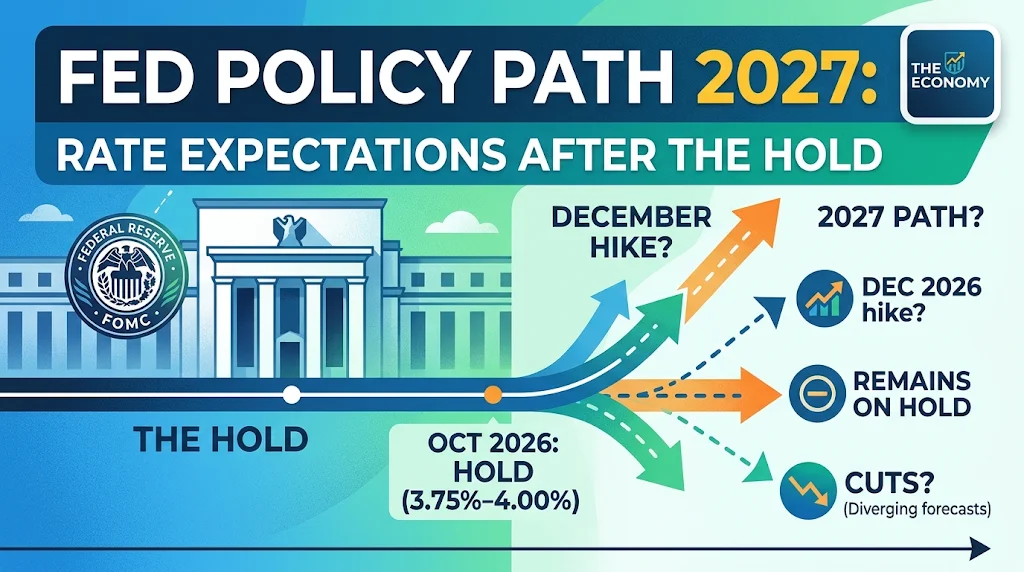
The Federal Reserve kept its policy rate unchanged in late October 2026, with two officials dissenting in favor of a hike, and the next move is now debated between a December increase and a longer hold into 2027. The federal funds target range was 3.75% to 4.00% after the October meeting, according to J.P. Morgan’s summary of the decision. The 2027 path depends on whether inflation eases enough for cuts to resume or stays high enough to keep tightening on the table.
Key Takeaways
- The Fed held rates in October 2026 despite elevated inflation, with two dissents favoring a quarter-point increase, per Charles Schwab’s meeting summary.
- Several major forecasters expect a December 2026 hike, including J.P. Morgan’s economists, who said the statement signaled a “hawkish bias.”
- Rabobank now expects the Fed to remain on hold through 2027, with one cut per year in 2028 to 2030.
- Goldman Sachs’s June forecast pushed its final two cuts of the cycle to June and December 2027, though its view predates the autumn hawkish turn.
- The Fed will hold eight meetings in 2027, but one will be devoted to strategy with no rate vote, which reduces scheduled chances to adjust policy.
Where Policy Stands Now
The Fed cut rates three times in late 2025, bringing the target range to 3.50% to 3.75% by December, according to a JPMorgan Asset Management review. The range sat at 3.75% to 4.00% at the October 2026 meeting, which means the committee moved toward restriction in 2026 rather than continuing to ease.
Two developments define the current debate. First, inflation has remained above target, with energy prices and tariffs cited by analysts as contributors. Second, Kevin Warsh now chairs the Fed, and his first meetings have been closely watched for signals about strategy. Schwab reported that Governor Lisa Cook and Cleveland Fed President Beth Hammack were among those opposing the hold, though reports differ on the exact dissent details, so verify against the official FOMC statement before publication.
Editors should note that the December 2025 Summary of Economic Projections, published by the New York Fed, is now out of date. It projected a median federal funds rate of 3.4% for 2026 and 3.1% for 2027. Those projections have been overtaken by the 2026 rate decisions and should be cited only as historical context.
The Case for a December Hike
The hawkish case rests on inflation and the committee’s language. J.P. Morgan’s economists interpreted the October statement as keeping December “a live option” for a hike, and they continue to expect one. Schwab reported that some forecasters, including Shah of Saxo, expected an increase in December and another in early 2027.
The argument for tightening is straightforward: if inflation expectations drift upward, the Fed risks losing credibility unless it acts. Oil price spikes linked to Middle East conflict and tariff pass-through have been cited as reasons that price pressures may persist.
Signals that would raise the odds of a hike:
- Core inflation readings that stay above target for consecutive months
- Strong payroll growth that tightens labor markets further
- Rising longer-term inflation expectations in Fed surveys
- Hawkish language in speeches by voting members before the December meeting
The Case for a Longer Hold
Rabobank’s updated view is that the Fed will stop short of further tightening and wait for data. Its analysts argue that the committee will likely stop at a higher neutral rate than its own projections suggest, but they do not expect a December move. After the hold, they see one cut annually from 2028 through 2030.
The hold case also rests on fiscal timing. Continuum Economics has argued that fiscal easing, including tax rebates scheduled to take effect in the first quarter of 2027, would give the Fed reason to wait and observe the effect before adjusting policy.
Signals that would support a hold:
- Inflation trending down toward target without a recession
- Softer hiring data, particularly in payroll and jobless claims
- Stable inflation expectations in consumer and market surveys
- Lower energy prices reducing headline inflation
Forecasts Are Diverging
The range of views is wide, which is itself a finding. Goldman Sachs, in June 2026, pushed its expected cuts into mid-2027. Rabobank now sees no cuts through 2027. J.P. Morgan sees a hike first. Markets have at times priced more hikes than economists, as Goldman noted in its analysis that market pricing sat above its own forecasts.
For readers, the practical takeaway is that rate expectations are uncertain in both directions. A single forecast should not be treated as a plan.
What the 2027 Meeting Calendar Changes
Warsh announced that one of the eight 2027 FOMC meetings will be devoted to “broad monetary policy strategy” without a rate decision or post-meeting statement. Fewer decision points could make the Fed slower to react to sudden shocks, though it could also reduce the risk of abrupt policy swings.
Investors should check the Fed’s official calendar and confirm which meetings include a rate vote, since the strategy meeting will not produce a rate announcement.
What This Means for Borrowers and Savers
For borrowers, the key variable is the longer end of the curve. Mortgage and corporate borrowing costs track Treasury yields more closely than the fed funds rate. A hold at restrictive levels keeps variable-rate debt expensive, while a December hike would add further pressure.
For savers, higher policy rates support yields on short-term deposits and Treasury bills. If the Fed holds through 2027, savings products may remain competitive, though yields could decline if cuts arrive later.
Practical steps:
- Review variable-rate debt and consider the cost of a 25-basis-point increase.
- Ladder short-term deposits or Treasury bills to reduce reinvestment risk.
- Avoid locking in long-term rates based on a single forecast.
Frequently Asked Questions
What is the current federal funds rate?
The target range was 3.75% to 4.00% after the October 2026 meeting, according to J.P. Morgan’s summary. Check the Federal Reserve’s website for the latest decision.
Will the Fed raise rates in December 2026?
Possibly. J.P. Morgan expects a hike, while Rabobank has added one to its forecast before resuming a hold. Markets and analysts disagree, and the outcome will depend on incoming inflation and jobs data.
When will the Fed cut rates again?
Forecasts vary. Rabobank sees no cuts through 2027. Goldman Sachs’s June forecast expected cuts in mid-2027, though that view predates the autumn hawkish turn.
Who is the Fed chair?
Kevin Warsh chairs the Federal Reserve as of late 2026, according to reports of the October meeting.
How many Fed meetings will have rate decisions in 2027?
Seven of the eight scheduled 2027 meetings are expected to include rate decisions. One is designated for strategy discussions without a rate vote.
How should homeowners prepare for a longer hold?
Consider the cost of variable-rate debt, compare refinancing options, and plan for mortgage rates that track longer-term Treasury yields more closely than the policy rate.
Conclusion: Plan for Both Outcomes
The 2027 rate path is genuinely uncertain. A December hike, a longer hold, or an eventual return to cuts are all plausible given current forecasts. The best guide is incoming data on inflation and jobs, along with the Fed’s own statements. Readers should treat forecasts as scenarios to prepare for rather than predictions to bet on.
Discover more from The Economy
Subscribe to get the latest posts sent to your email.


The IRS has published its 2027 inflation adjustments. Here are the brackets, deductions and the crucial difference between marginal and effective tax rates.
The IRS has published its 2027 inflation adjustments. Here are the brackets, deductions and crucial difference between marginal and effective tax rates. This analysis draws on primary documents and contemporaneous reports available on November 6, 2026; subsequent market movements or policy announcements may change the outlook.
The Internal Revenue Service announced tax-year 2027 inflation adjustments on November 5, 2026. Most of these changes affect income earned during 2027 and tax returns generally filed in 2028—not the 2026 return filed in 2027. The top marginal individual rate remains 37%. The standard deduction rises to $16,600 for single filers, $33,200 for married couples filing jointly and $24,925 for heads of household.
A tax bracket is a rate applied to a layer of taxable income, not to every dollar someone earns. Confusing marginal and effective rates is among the most common errors in public explanations of U.S. federal income taxes.
The 2027 rates for single filers
For single taxpayers the IRS schedule applies a 10% rate up to $12,800 of taxable income; 12% above $12,800 through $52,025; 22% above $52,025 through $109,125; 24% above $109,125 through $208,325; 32% above $208,325 through $264,550; 35% above $264,550 through $661,375; and 37% above $661,375. These are taxable-income thresholds, not gross salary levels.
The determination of taxable income can involve the standard deduction or itemized deductions, as well as other adjustments and credits. An employer’s paycheck withholding is not the same as final federal income-tax liability.
A worked marginal-rate example
Consider an illustrative single filer with $80,000 of taxable income in 2027, after deductions and adjustments. The first $12,800 is taxed at 10%, generating $1,280. The next $39,225—from $12,800 to $52,025—is taxed at 12%, generating $4,707. The remaining $27,975—from $52,025 to $80,000—is taxed at 22%, generating $6,154.50. Total regular federal income tax before credits or other applicable adjustments would be $12,141.50 under this simplified bracket-only example.
The marginal rate is 22%, but the example’s effective rate on taxable income is approximately 15.18%. Effective tax as a share of gross income would be different. These calculations exclude special taxes, credits, alternative minimum tax issues and state taxes.
Other changes that matter
The IRS announcement lists a 2027 maximum child tax credit of $2,300, with up to $1,800 refundable subject to eligibility. The annual gift exclusion rises to $20,000, and the basic estate-tax exclusion increases to $15.48 million. These figures have different functions; an exclusion is not the same as a refundable credit.
The IRS also increased various limits associated with the earned income tax credit, medical savings arrangements and employer-sponsored benefits. Readers should consult the relevant official provisions, because maximum amounts can be subject to income phaseouts and eligibility rules.
Why inflation indexing is not a tax cut for everyone
Indexing tax brackets helps prevent nominal wage increases from pushing income into higher marginal brackets purely because of inflation. But individual outcomes vary with earnings, deductions, household changes and credits. A taxpayer whose nominal wages rise faster than indexed thresholds can still owe more; a taxpayer with changing family circumstances may face a different result.
Do not use tax brackets alone to estimate withholding changes or an expected refund. Tax software and professional advisers incorporate the broader return, including employment income, dependents, capital gains and relevant state provisions. This article offers general information, not personalised tax advice.
What a closer look at the source record shows
The available record supports a useful separation between confirmed developments and interpretation. The first column below identifies the type of evidence; the second explains the analytical use, not an independently measured market statistic.
| Research focus | How it informs this story |
|---|---|
| Confirmed evidence | IRS official 2027 adjustments |
| Interpretive opportunity | Full thresholds and worked example |
| Secondary question | Correct tax-year distinction |
| Next verification | Check any later legislation, correction or filing instructions before tax advice or publication. |
The research priority is relevance rather than sheer citation volume. Repeated references to the same press release do not represent independent confirmation, and authoritative data can support a narrower claim than an ambitious headline suggests. Wherever a numerical fact is used, the source date and stated coverage should travel with it.
How to interpret the evidence without overclaiming
A bracket is applied in layers. Progressive rates apply to successive ranges of taxable income. The highest applicable marginal rate is not applied to a taxpayer’s entire income. In this article’s subject—2027 tax brackets—that distinction prevents superficially precise figures from becoming misleading conclusions. A credible account should explain exactly which evidence supports each inference and what would change the analysis.
Timing and filing status matter. A taxpayer’s filing category, deductions and the distinction between earning year and filing year can change the calculation materially. Check any later legislation, correction or filing instructions before tax advice or publication. These checks are important because individual data points can be correct while the story assembled from them is incomplete.
Three specific tests make the coverage stronger:
- Full thresholds and worked example. Ask what the underlying observation actually measures, which population or companies it covers, and how recent it is. A relevant primary document outweighs a popular unsourced claim.
- Correct tax-year distinction. Compare plausible explanations and resist attributing every market or policy movement to one event. When an observed change has several possible causes, explain which are supported and which remain hypotheses.
- Marginal versus effective rate. Describe what new fact would falsify the prevailing interpretation. Reporting that cannot be revised in the face of new evidence is advocacy, not analysis.
How three taxpayers could experience the same 2027 brackets differently
A single filer who takes the standard deduction. The $16,600 standard deduction reduces income considered for the regular federal income-tax calculation, subject to applicable rules. A worker’s gross salary is not automatically equal to taxable income. A promotion that raises taxable income into a higher bracket would normally expose only the additional portion to that higher marginal rate.
A married couple filing jointly. The joint standard deduction is $33,200, and the bracket thresholds differ from those for single filers. Combining two incomes affects the applicable brackets, but child-related credits, itemised deductions, investment income and other household facts can change the final bill. The official IRS schedule is the starting point, not a personalised return.
A household with credits or irregular income. A freelancer with large quarterly variations, a family eligible for dependent-related benefits or an investor realising capital gains cannot calculate final tax from the ordinary wage-income brackets alone. Tax liability can be affected by estimated payments, special capital-gain rates and credit phaseouts. The correct tax year also matters: the 2027 schedule generally belongs on returns filed in 2028.
A practical research checklist
A reader evaluating this issue should first open the primary sources linked in the article and check their publication dates. Next, identify the specific claim being tested, its units and its geographic or institutional scope. Then compare that evidence with at least one independent account, asking whether the sources are reporting the same underlying data or repeating one another. Finally, distinguish a dated observation from a prediction and note the developments that would demand an update.
For a working editorial desk, this sequence is equally important. A clearly dated article can remain valuable after prices or politics change if its explanations endure and its volatile numbers are identified as snapshots. An article that quietly presents yesterday’s quote as today’s fact, by contrast, loses credibility even when the broader argument is sensible.
Questions readers are asking
When are 2027 tax brackets used?
They apply to tax year 2027, with returns generally filed in 2028.
What is the 2027 standard deduction for a single filer?
$16,600, according to the IRS announcement.
Does moving into the 22% bracket tax all income at 22%?
No. Only the taxable income within that bracket is taxed at 22% under the progressive schedule.
What is the top federal individual rate in 2027?
The top marginal rate remains 37%, with IRS-published thresholds depending on filing status.
The judgement
The IRS has published its 2027 inflation adjustments. Here are the brackets, deductions and crucial difference between marginal and effective tax rates. The most responsible conclusion is conditional: Check any later legislation, correction or filing instructions before tax advice or publication. The argument should evolve when new source material is published, rather than being defended simply because it made a compelling headline on November 6. For readers, the value is a clearer distinction among what has already happened, what remains uncertain and what developments would actually change the decision.
Discover more from The Economy
Subscribe to get the latest posts sent to your email.

Spot gold traded around $4,020 to $4,035 an ounce on Thursday 29 October, down roughly 1% on the day, and moved briefly close to $3,983 later, according to Kitco’s live quote. Reuters reported bullion on track for a second straight monthly decline. The metal remains roughly 27-28% below its 2026 record of about $5,600, set in late January.
In Pakistan, one local market report put gold at about Rs423,436 per tola on 26 October. Tola prices also depend on the dollar-rupee rate and local premiums, so check the day’s rate.
Why Gold Is Under Pressure
A hawkish Fed hold. The Fed held rates at 3.75%-4.00% on 28 October, but Governor Lisa Cook and Cleveland Fed President Beth Hammack voted for a hike. On Thursday, Reuters reported markets pricing about a 90% chance of a December hike on the CME FedWatch tool.
Strong US data. Q3 GDP grew 3.4% and core PCE inflation rose to 2.5%, per Kitco, reinforcing the case for restrictive policy. The 10-year yield stayed near 5%.
Why this matters for gold. Gold pays no interest, so higher yields raise the opportunity cost of holding it, and a firmer dollar makes it costlier for non-US buyers. TDS strategist Bart Melek called the Fed’s stance a hawkish pause and expects gold to stay vulnerable in a $3,900-$4,250 range; Sucden Financial warned of a possible fall to $3,900.
Spot gold fell to about $4,020-4,035 an ounce on 29 October 2026 as strong US growth (3.4% in Q3) and higher core inflation kept a December Fed rate hike in play. Higher rates raise the opportunity cost of holding gold, which pays no interest.
What Could Push Gold Back Up
- A softer Fed: TDS expects the Fed to eventually turn toward its employment mandate, which could lift gold, though not immediately.
- Geopolitical shocks: Reuters quoted an analyst noting markets are wary of another spike in tensions after the 3 November US midterms.
- Oil, a double-edged factor: an oil spike raises inflation fears and hawkish expectations, which hurts gold in the short run. The same analyst said gold could post a fresh yearly low if oil revisits $120 and above.
Technical Levels Traders Watch
Kitco’s technical commentary points to $4,000 as a pivot, with downside objectives near $4,024 on a break lower and $3,986 beyond, and resistance in the $4,084-$4,146 zone. Treat these as trader reference points, not predictions.
What It Means for Pakistani Buyers
- Dollar-rupee matters as much as the gold price. If the rupee weakens, local gold can stay firm even when dollar gold falls.
- Time horizon. Analysts quoted expect volatility in a range over the coming weeks; long-term holders and short-term traders face different risks.
- Compare with alternatives. With the SBP policy rate at 12%, yield-bearing assets compete with gold for savings.
- Mind premiums and purity. Jewellery carries making charges; bars and coins track the spot price more closely.
Gold is stuck between a hawkish Fed and geopolitical risk. The $4,000 level has become the focus, and the next US inflation data and Iran’s response on the Qatari deal are the nearest catalysts.
Discover more from The Economy
Subscribe to get the latest posts sent to your email.

The Federal Open Market Committee left its target range unchanged at 3.75%-4.00% on Wednesday 28 October, according to Admiral Markets’ FOMC summary. The vote was 10-2. The two dissenters, Governor Lisa Cook and Cleveland Fed President Beth Hammack, wanted to raise rates by 25 basis points. A committee that is split towards tightening rather than easing is a notable shift in tone.
The statement pointed to strong economic growth and elevated inflation. Chair Kevin Warsh said the committee held to gather more information, and he floated cutting the number of rate decisions from eight to six a year, per Trading Economics.
Why the Dissents Matter More Than the Hold
A hold was expected. The significance is the direction of dissent. Two voters wanting a hike signals that part of the committee sees inflation risks, aggravated by energy prices from the Middle East conflict, as large enough to justify tightening now. FXStreet and MUFG Research both framed the outcome as a hold with a hawkish edge, with the committee not explicitly committing to further hikes but not ruling them out.
MUFG’s read is that a December hike remains live, with more of another move priced by March. On Thursday, Reuters reported the CME FedWatch tool showing roughly a 90% chance of a December hike. That pricing, rather than the unchanged rate, is what moved currencies and precious metals around the decision.
The Inflation Problem Is an Energy Problem
The Fed’s challenge is that the inflation pressure is not purely domestic demand. Brent oil has climbed to around $115, a six-month high, as attacks on tankers and Saudi infrastructure keep supply worries alive, and Iran is weighing a Qatari draft deal that could ease or inflame the market depending on the answer. Central banks cannot lower oil prices with interest rates, but they can stop an energy shock from becoming embedded in wages and expectations, which is the argument the hawkish dissenters appear to be making.
Market Reaction
Crude oil barely moved on the decision, according to FXStreet, as traders waited on Iran’s response to the Qatari proposal. Gold slid toward $4,000 an ounce on Thursday after US Q3 growth printed at 3.4% and core PCE at 2.5%, per Kitco, with the 10-year yield near 5%.
What It Means Beyond the US
- Emerging markets: a Fed leaning hawkish tightens global financial conditions and raises the bar for easing elsewhere. Pakistan’s central bank raised its policy rate to 12% two days before the Fed meeting for domestic inflation reasons, but a firmer dollar adds pressure to the rupee.
- Gulf central banks: several Gulf central banks held rates after the decision, since their currencies are pegged to the dollar.
- Asia-Pacific: officials such as RBNZ’s governor have said another hike is plausible if inflation does not ease.
What to Watch Before December
- Inflation data: the next PCE and CPI prints will decide whether the dissenters gain allies.
- Oil: Iran’s reply on the Qatari draft, due by the end of the week, is the biggest swing factor. A deal would remove part of the hawks’ case; a breakdown would strengthen it.
- Chair Warsh’s messaging: his comments on the balance between AI-driven productivity and inflation risk.
- Labour market data ahead of the December meeting.
The Fed held, but the committee is no longer debating how fast to cut. It is debating whether to hike. Unless oil retreats, the December meeting is genuinely open.
Discover more from The Economy
Subscribe to get the latest posts sent to your email.

Open Banking Trends 2026: What Consumers Should Know

Nvidia After the Selloff: What to Watch Before Earnings

Black Friday 2026 Early Deals: A Data-Driven Shopping Guide

Fed Policy Path 2027: Rate Expectations After the Hold

Asia’s Economic Resilience in 2026: The Strategic Blueprint for Sustaining the Global Growth Engine

Credit Scoring Changes 2026: What Mortgage Buyers Need to Know

10-Year Treasury Yield Outlook for 2027 After the Democratic Sweep

Is the AI Infrastructure Boom Sustainable? A Reality Check

Disability Insurance Demand in 2026: Who’s Buying and Why

What the 2026 Midterms Mean for Treasury Yields and Bond Markets

Payroll Outlook After the Midterms: 2027 Tax Changes, Compliance Risks and AI Trends

Lisa Su: AMD Is Now a “Data Center First Company” – 2027 Outlook

Reasons for Falling US Gas Prices in November 2026: A Seasonal Shift

SoftBank’s $3.7 Billion Turbine Loss: What the AI Power Bet Reveals

Dow Jones Today: Dow Slips 237 Points After the Worst Day Since April 2025

US–Iran Conflict in October 2026: Hormuz, Oil Prices and Diplomacy

Pakistan IMF Programme 2026: Why Bailouts Keep Returning

SSI November 2026 Payment: Why Benefits Arrive October 30

2027 Federal Tax Brackets: New IRS Rates and Standard Deductions Explained

Singapore Stock Market Outlook 2027: The STI’s Bank-and-Yield Test

IMF Global Outlook 2027: The Recovery Is Real, but the Divide Is Growing

World Bank Debt Report 2026: The $9.4 Trillion Burden Behind the Recovery

Stock Market Crash 2026? What the November Rout Actually Tells Us

KSE-100 Index 2026: Is Pakistan’s Stock-Market Recovery Sustainable?

Germany–France ‘Made in Europe’ Deal Could Reshape China’s EV Ambitions

Global Markets Today: The AI Sell-Off Has Become a Test of Liquidity

Zhuhai Airshow 2026: How China’s Stealth Jets, Drones and Missiles Are Redrawing Global Air Power

Singapore’s Bank Sell-Off Is Really a Test of What Stability Is Worth
-

 Markets & Finance10 months ago
Top 15 Stocks for Investment in 2026 in PSX: Your Complete Guide to Pakistan’s Best Investment Opportunities
-

 Analysis9 months ago
Johor’s Investment Boom: The Hidden Costs Behind Malaysia’s Most Ambitious Economic Surge
-

 Analysis9 months ago
Top 10 Stocks for Investment in PSX for Quick Returns in 2026
-

 Banks10 months ago
Best Investments in Pakistan 2026: Top 10 Low-Price Shares and Long-Term Picks for the PSX
-

 Analysis9 months ago
Brazil’s Rare Earth Race: US, EU, and China Compete for Critical Minerals as Tensions Rise
-

 Investment10 months ago
Top 10 Mutual Fund Managers in Pakistan for Investment in 2026: A Comprehensive Guide for Optimal Returns
-

 Global Economy11 months ago
15 Most Lucrative Sectors for Investment in Pakistan: A 2025 Data-Driven Analysis
-

 Global Economy11 months ago
Pakistan’s Export Goldmine: 10 Game-Changing Markets Where Pakistani Businesses Are Winning Big in 2025