
China Economy
China’s US$10.8 Billion Trade Shortcut: Why the Pinglu Canal Matters

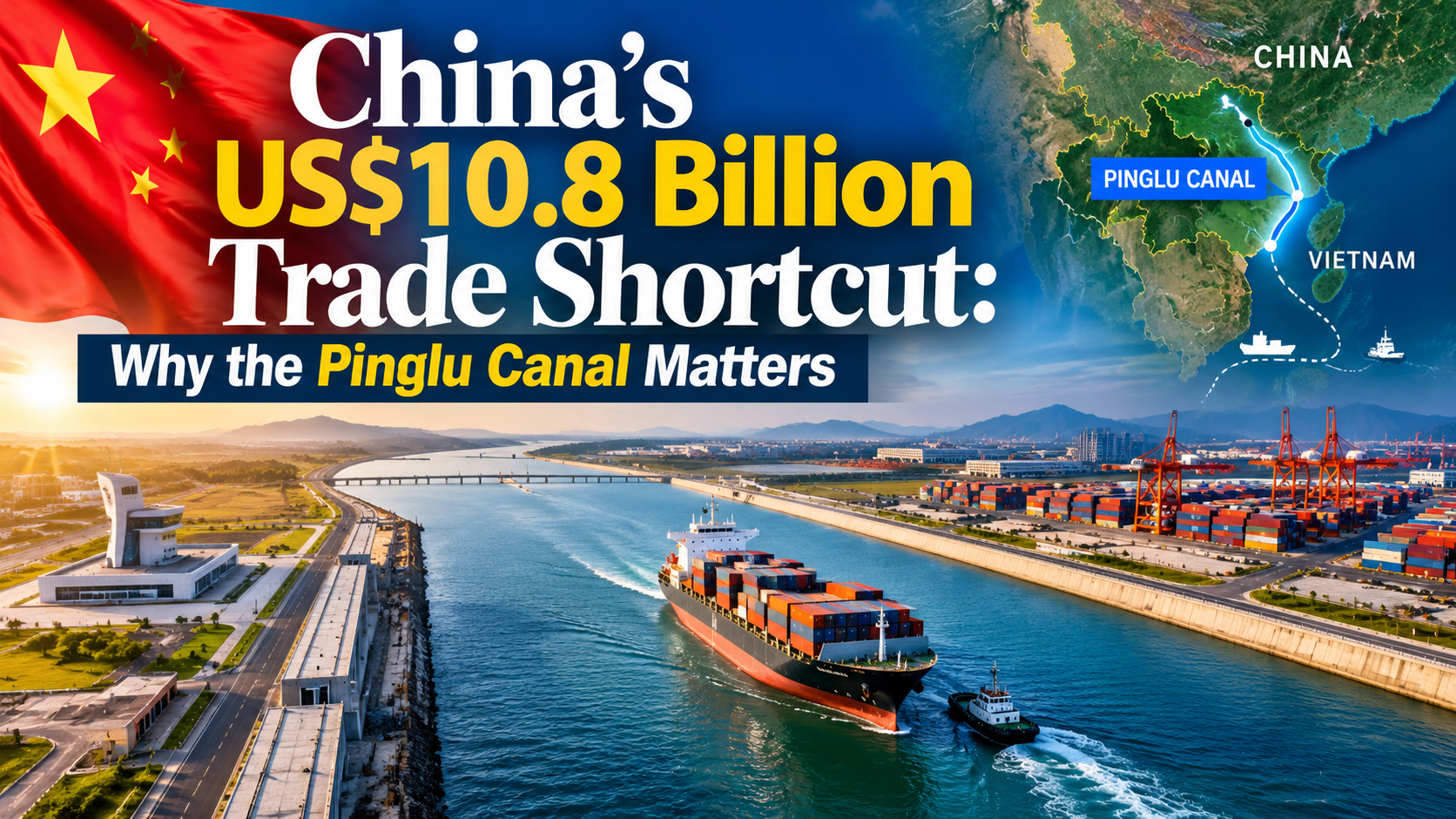
The delivery of the Pinglu 001 command and management vessel in early September 2026 signals that China’s US$10.8 billion inland waterway project is ready for commercial operations. With final vessel trials concluded and completion acceptance achieved in late August, the 134.2-kilometre Pinglu Canal is preparing to open. For logistics planners and manufacturers across Southeast Asia, this development fundamentally shifts the geography of regional trade. Rather than routing goods east through Guangzhou, inland Chinese factories can now send cargo directly south to the Beibu Gulf, shaving more than 560 kilometres off the maritime journey to ASEAN markets.
| Metric | Details |
| Project | Pinglu Canal |
| Location | Guangxi, China |
| Length | 134.2 km |
| Investment | ~US$10.8 billion (72.7 billion yuan) |
| Vessel capacity | Up to 5,000 tonnes |
| Destination | Beibu Gulf (via Qinzhou) |
| Expected opening | September 2026 |
| Strategic corridor | New International Land-Sea Trade Corridor |
| Main trade relevance | China-ASEAN connectivity |
What Is the Pinglu Canal?
The Pinglu Canal is China’s first major river-to-sea canal constructed since the founding of the People’s Republic. The waterway begins at the Xijin reservoir on the Yu River in Hengzhou (near Nanning, the capital of Guangxi) and cuts southward to meet the lower Qinjiang River in Qinzhou. This connection physically links Guangxi’s expansive inland river system directly to the Beibu Gulf.
Historically, cargo navigating the rivers of southwestern China had to float eastward down the Pearl River system to reach ocean-going ports in Guangdong province. The canal breaks this geographic constraint by blasting a direct southern corridor through the mountains, connecting inland manufacturing hubs directly to the deep-water facilities of Qinzhou Port and the open sea.
Why the First Command Vessel Matters
The arrival of the Pinglu 001 command vessel is the clearest indicator that the infrastructure phase has transitioned into the operational management phase. A canal handling 5,000-tonne vessels requires sophisticated maritime traffic control, lock synchronization, and emergency response capabilities. The delivery of this vessel proves that the bureaucratic and operational frameworks—not just the concrete locks and excavated channels—are ready to handle live commercial traffic. It acts as the final administrative sign-off before the floodgates open to scheduled freight lines in September 2026.
China’s US$10.8 Billion Bet on Faster Trade
At approximately 72.7 billion yuan (US$10.8 billion), the canal represents a massive capital injection into regional logistics. The economics of the project hinge on aggregate transport savings. Official estimates project that the canal will save regions along the route more than 5.2 billion yuan (US$720 million) annually in transportation costs.
These savings stem from reduced fuel consumption, faster turnaround times, and lower transshipment fees. For a manufacturer in Sichuan or Chongqing exporting electronics to Thailand, the cost of moving containers by river directly to the Beibu Gulf is substantially lower than rail-to-port or road-to-port alternatives. This infrastructure multiplier effect is expected to make western China’s exports more price-competitive in international markets.
The 560-Kilometre Shortcut: What Actually Changes?
The defining metric of the Pinglu Canal is the elimination of approximately 560 kilometres of inland transit.
Before
Factory → Inland river transport (eastward) → Pearl River Delta/Guangzhou ports → Ocean freight → ASEAN
After
Factory → Pinglu Canal (southward) → Beibu Gulf/Qinzhou Port → Ocean freight → ASEAN
This does not replace road or rail logistics, which remain vital for time-sensitive cargo. Instead, it offers a high-volume, low-cost multimodal alternative for bulk goods, raw materials, and heavy containerized freight that cannot bear the premium pricing of rail transport.
Why ASEAN Is at the Center of the Story
The canal’s strategic value is inherently tied to the Association of Southeast Asian Nations (ASEAN). ASEAN is China’s largest trading partner, and the trade volume is heavily skewed toward intermediate goods—components manufactured in China that are assembled in Southeast Asia.
Economies like Vietnam, Malaysia, Singapore, Thailand, and Indonesia require a constant, cheap flow of Chinese industrial inputs to feed their own export engines. By lowering the logistics friction between China’s industrial hinterland and these ASEAN markets, the canal effectively shrinks the economic distance between factories in Nanning and assembly lines in Hanoi, Rayong, or Penang.
Vietnam Could Be One of the Biggest Beneficiaries
Due to its geographic proximity to Guangxi and the Beibu Gulf, Vietnam is positioned to absorb the immediate effects of the canal. The cross-border supply chain between southern China and northern Vietnam is highly integrated, particularly in electronics, machinery, and textiles.
While the canal does not cross into Vietnam, it allows barges carrying intermediate goods from deep inside China to reach Qinzhou Port faster. From Qinzhou, short-sea shipping routes to Haiphong or Ho Chi Minh City can operate with greater frequency and lower baseline costs. This maritime bridge complements the heavily congested overland border crossings at Friendship Pass.
What It Means for China’s Inland Factories
For small and medium enterprises (SMEs) and large manufacturers in western China, the canal offers a margin buffer. Machinery producers, auto parts suppliers, and agricultural exporters often operate on razor-thin margins where logistics dictate profitability.
Access to a cheaper, higher-capacity water route allows inland factories to scale up production without being bottlenecked by rail quotas or high trucking costs. It essentially grants coastal shipping advantages to landlocked industrial parks.
The Beibu Gulf Port Becomes More Important
The Pinglu Canal is useless without a maritime outlet, which makes Qinzhou and the broader Beibu Gulf Port complex an integrated part of this logistics ecosystem. Over the past five years, Qinzhou has expanded its automated container terminals and warehousing facilities to handle the anticipated surge in river-to-sea cargo.
Cargo barges arriving via the canal will transship their containers onto ocean-going vessels at Qinzhou. Consequently, the Beibu Gulf is expected to see a sharp rise in vessel calls, attracting more international shipping lines and cementing its status as a primary hub for China-ASEAN trade, rather than a secondary feeder port.
The New International Land-Sea Trade Corridor
The canal is the physical backbone of the New International Land-Sea Trade Corridor (ILSTC). The ILSTC is a logistics network designed to connect western China to the global maritime network via Guangxi, rather than routing everything through the distant eastern seaboard.
The corridor utilizes a mix of rail, road, and now river transport. By adding a 5,000-tonne capacity waterway to the corridor, Guangxi solidifies its strategic mandate as the transit nexus for all western Chinese trade heading south to Southeast Asia and beyond.
Could Pinglu Canal Reshape China-ASEAN Supply Chains?
The opening of the waterway has the potential to alter regional inventory management and sourcing. If logistics costs drop and delivery reliability increases, ASEAN-based manufacturers may opt to source bulkier, heavier intermediate goods from western China rather than coastal China.
Furthermore, industrial investment could shift inland. If a company can achieve similar export costs from Nanning as it can from Shenzhen, the lower land and labor costs in Guangxi become highly attractive, potentially drawing manufacturing away from the saturated eastern provinces.
What the Canal Does NOT Solve
Despite its massive scale, the Pinglu Canal is not a cure-all for supply chain volatility. The waterway is restricted to vessels of approximately 5,000 tonnes. Ocean-going mega-ships carrying 20,000 TEUs cannot navigate it; all cargo must still be transshipped at the Beibu Gulf.
Furthermore, river transport is inherently slower than rail or road. Time-sensitive electronics or perishable goods will likely remain on trains and trucks. The canal is also susceptible to weather conditions, seasonal water levels, and potential lock congestion if vessel traffic exceeds design capacity.
Environmental and Social Questions
Constructing a 134-kilometre canal requires moving roughly 339 million cubic meters of earth. The ecological disruption to the regional river systems, wetlands, and local agriculture is substantial. To mitigate this, engineers incorporated ecological corridors, wildlife crossings, and water-saving lock technologies—such as the Madao hub, which recycles water to reduce consumption by 63%. Long-term environmental monitoring will be required to assess the actual impact on the Beibu Gulf’s marine ecosystems as freshwater and industrial traffic mix with the marine environment.
The Bigger Geoeconomic Picture
Geoeconomically, the canal is a tool for domestic rebalancing and regional integration. By enriching its western provinces, China addresses domestic economic inequality while binding ASEAN closer to its industrial orbit. It is a physical manifestation of supply-chain diversification, ensuring that China maintains multiple high-capacity trade routes that bypass potential bottlenecks in the South China Sea or the congested Pearl River Delta.
What Happens After the September 2026 Opening?
Short term
Expect initial operational adjustments as barges, lock operators, and port authorities sync their schedules. First commercial vessels will test the efficiency of transshipment at Qinzhou.
Medium term
Logistics companies will likely introduce dedicated river-to-sea freight products, bundling inland factory pickup with ASEAN delivery. Total cargo volumes will scale up over 2027 and 2028.
Long term
Sustained lower freight rates could trigger industrial relocation, with heavy manufacturing clustering around the canal’s inland hubs to exploit the cheap waterborne route to Southeast Asia.
| Factor | Before Pinglu Canal | Potential Post-Opening Effect |
| Inland-to-sea distance | Longer route (east) | Shorter route (south) |
| Logistics costs | Higher | Potentially lower |
| Access to Beibu Gulf | Rail/Road dependent | Direct high-capacity water |
| ASEAN connectivity | Existing but indirect | Stronger maritime bridge |
| Guangxi industrial competitiveness | Secondary | Potential major boost |
The Pinglu Canal is far more than a civil engineering triumph. It is a deliberate restructuring of China’s trade geography. By spending US$10.8 billion to carve a 560-kilometre shortcut to the sea, China is effectively moving its inland factories closer to Southeast Asia. While transshipment and vessel size limits remain, the sheer volume of cheap, waterborne freight that can now flow directly into the Beibu Gulf ensures that the Pinglu Canal will become a critical artery in the global supply chain.
FAQ
1. What is the Pinglu Canal?
The Pinglu Canal is a 134.2-kilometre inland waterway in Guangxi, China, designed to connect the inland river system directly to the Beibu Gulf, bypassing longer eastern routes.
2. When will the Pinglu Canal open?
Following the completion of vessel trials and project acceptance in August 2026, the canal is scheduled to open for commercial navigation in September 2026.
3. How much did the Pinglu Canal cost?
The project required a total investment of approximately 72.7 billion yuan, which translates to roughly US$10.8 billion.
4. How long is the Pinglu Canal?
The canal stretches 134.2 kilometres from the Xijin reservoir in Hengzhou down to the Beibu Gulf via Qinzhou.
5. Which countries will benefit from the Pinglu Canal?
While China benefits domestically, ASEAN nations—particularly Vietnam, Malaysia, Thailand, Singapore, and Indonesia—will benefit from faster and potentially cheaper access to Chinese industrial goods.
6. How will the canal affect China-Vietnam trade?
By lowering the cost of moving intermediate goods to the Beibu Gulf, the canal facilitates cheaper short-sea shipping to northern Vietnam, complementing existing cross-border supply chains.
7. Why is Guangxi important for ASEAN trade?
Guangxi borders Vietnam and the Beibu Gulf, making it China’s primary gateway to Southeast Asia for both overland and maritime logistics.
8. What is the New International Land-Sea Trade Corridor?
It is a strategic trade and logistics network connecting western China to global markets via southern ports, heavily utilizing rail, road, and river transport.
9. How much cargo can Pinglu Canal vessels carry?
The canal is designed to accommodate inland river vessels with capacities of up to approximately 5,000 tonnes.
10. Will the Pinglu Canal reduce shipping costs?
Yes, official estimates suggest the 560-kilometre shortcut will save regions along the route up to 5.2 billion yuan annually in transport costs.
Sources
- Xinhua: Pinglu Canal enters final preparations for September opening
- People’s Daily: Major Chinese river-to-sea canal passes completion acceptance
- Global Times: Pinglu Canal: How China’s ‘canal project of the century’ reshapes trade
- Wikipedia: Pinglu Canal Specifications & History
Discover more from The Economy
Subscribe to get the latest posts sent to your email.


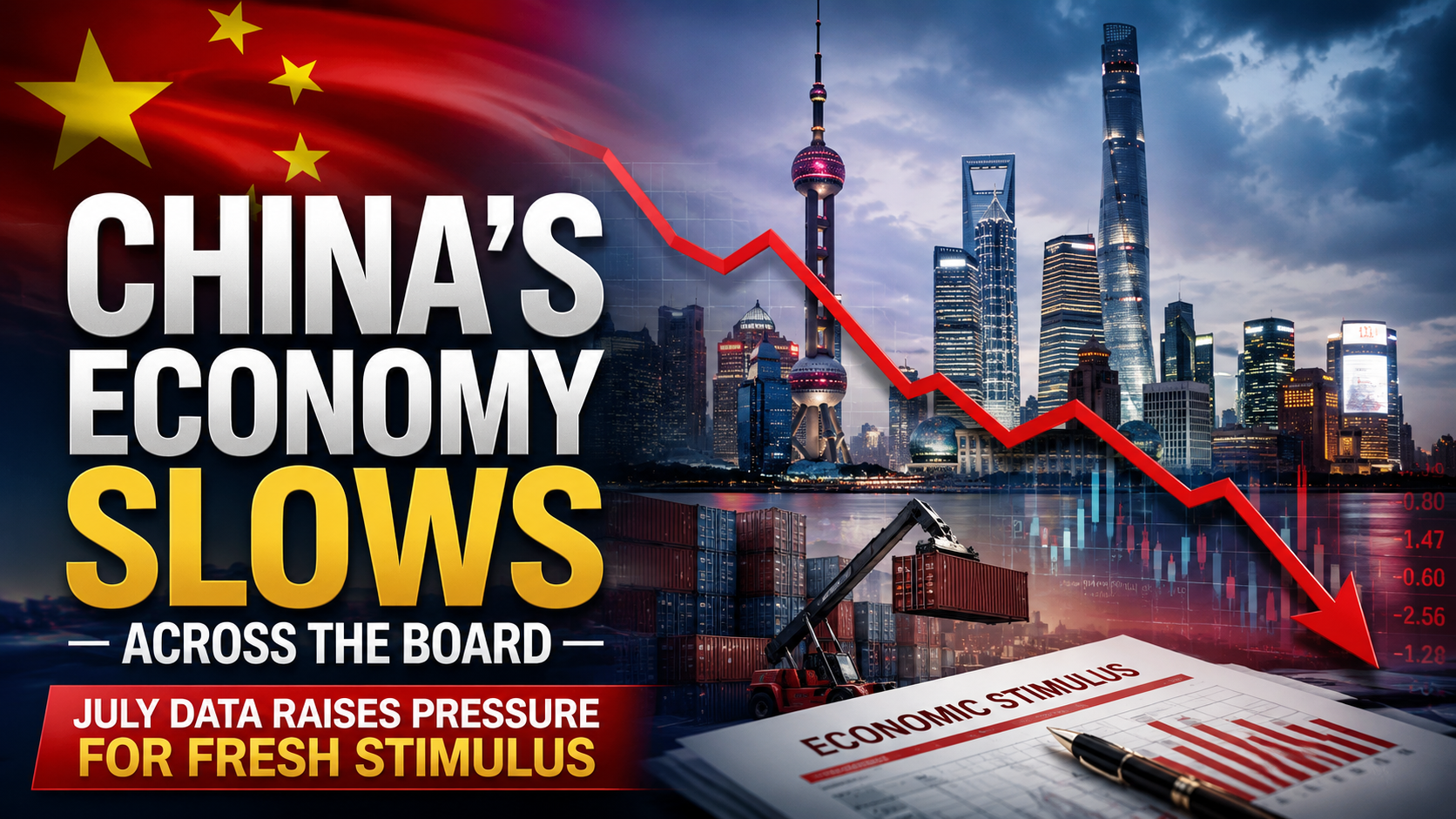
China’s economy opened the second half of 2026 on weaker footing than markets had hoped, with July data released Monday showing industrial output, retail sales, and fixed-asset investment all undershooting forecasts simultaneously — a broad-based miss that intensifies pressure on Beijing to deliver further policy support.
The Numbers Behind the Slowdown
Industrial production rose 4.5% year-on-year in July, missing the 4.8% consensus estimate and slowing from June’s 5.3% pace — the first deceleration in three months. Retail sales fared even worse: consumption grew just 0.6% year-on-year, well below the 1.5% forecast in a Bloomberg survey and down from 1% growth in June. In yuan terms, total retail sales of consumer goods reached 3,902.2 billion yuan (roughly $578.7 billion), up just 0.06% on a month-on-month basis — effectively flat.
Investment told a similarly downbeat story. China’s urban fixed-asset investment, spanning real estate and infrastructure, contracted 6.7% in the year to end-July, worse than the roughly 6% decline economists had expected. The labour market showed strain too, with the urban unemployment rate ticking up to 5.2% in July from 5% in June. Manufacturing sentiment reinforced the picture: July’s Purchasing Managers’ Index fell to 49.2%, back below the 50-point expansion threshold.
Why It’s Happening
China’s National Bureau of Statistics pointed to a combination of external and domestic pressures behind the soft patch. Spokesman Fu Linghui told reporters that international geopolitical conflicts persisted through July and the global energy market was marked by significant instability, a reference to the same Iran-linked oil volatility that has been rattling markets from London to Washington. Authorities also cited extreme weather conditions in parts of the country during the month as a contributing drag on activity.
Beijing is targeting national growth of 4.5%–5.0% for 2026 — already the lowest official goal in decades — and the economy fell short of that pace in the second quarter even before July’s figures. The property downturn remains the most stubborn drag: new home prices extended their decline in July, continuing a slump that has weighed on household wealth and, by extension, consumer confidence for well over two years.
The AI Export Lifeline
Not every part of the economy is struggling. Investment in high-tech industries grew a solid 5.0% year-on-year, with information services up 19.2%, aerospace vehicle and equipment manufacturing up 12.3%, and electronic and communication equipment manufacturing up 7.1%. More broadly, industrial production and exports tied to the global AI investment boom have helped cushion weak consumption and private investment, though July’s data suggest that offsetting support “may be thinning” as the headline numbers show broader weakness breaking through.
Trade data released earlier this month told a more encouraging story on the export side, with exports and imports both climbing on the back of overseas demand for AI-related technology products — a dynamic that has also shown up as a tailwind in Malaysia’s and Singapore’s most recent growth prints, both of which have leaned heavily on AI-hardware and data-centre exports this year.
What Comes Next: The Stimulus Question
The scale and timing of the data release itself became a story in its own right. China’s statistics bureau shifted Monday’s briefing to 3 p.m. local time — a break from its usual 10 a.m. slot and a move that coincided with the close of China’s stock market, fuelling speculation among analysts about whether officials were managing market reaction as much as reporting data.
With growth undershooting Beijing’s already-modest target, investors are now watching for a policy response. The People’s Bank of China and fiscal authorities have levers available — from further rate cuts to expanded consumer trade-in subsidies and infrastructure spending — but have so far proceeded cautiously given concerns about debt sustainability and the limited effectiveness of prior stimulus rounds in reviving the property sector specifically.
Key Takeaways
- Industrial output (4.5%), retail sales (0.6%) and fixed-asset investment (-6.7%) all missed forecasts in July, marking a broad-based slowdown.
- Urban unemployment rose to 5.2% and the manufacturing PMI slipped back below the 50 expansion threshold.
- Officials cited Middle East-linked energy market instability and extreme domestic weather as contributing factors.
- AI-related high-tech investment and exports remain a bright spot, growing 5% and helping offset weaker consumption.
- Markets are now watching for fresh stimulus signals after China fell short of its already-reduced 2026 growth target in the first half.
Frequently Asked Questions
Why did China’s July economic data disappoint? Industrial output, retail sales and fixed-asset investment all grew more slowly than forecast, with officials citing global energy market instability and extreme weather, on top of a prolonged property-sector downturn.
What is China’s 2026 GDP growth target? Beijing is targeting growth of 4.5%–5.0% for 2026, its lowest official target in decades, and the economy fell short of that range in the second quarter.
Is any part of China’s economy still growing strongly? Yes — high-tech investment and exports linked to global AI infrastructure demand grew solidly in July, helping offset weakness in consumption and property investment.
Discover more from The Economy
Subscribe to get the latest posts sent to your email.
China Economy
China’s Economy Has a Structural Problem: Factories Are Winning, Households Are Losing
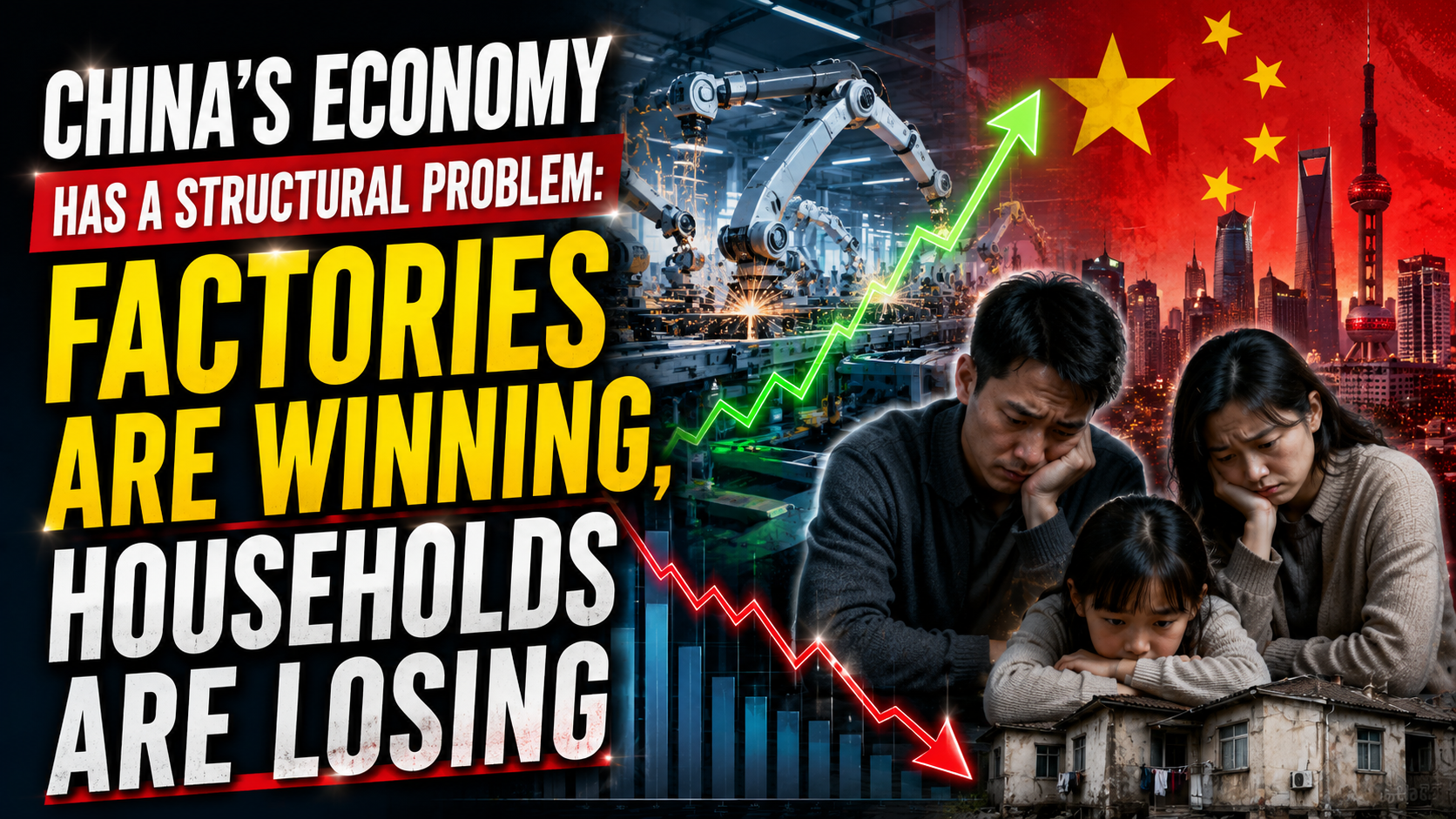
China’s headline growth numbers still look respectable at first glance. GDP expanded 4.3% year-on-year in the June quarter, down from 5.0% in the first quarter, bringing first-half growth to 4.7% (GoMarkets). But the composition beneath that headline is where the real story sits — and it points to a widening structural imbalance rather than a routine slowdown.
The production-consumption gap, in numbers
Industrial output rose 5.4% across the first half of 2026, anchored by a 5.3% annual gain in June concentrated in manufacturing and high-tech sectors (GoMarkets). Consumer activity, by contrast, remained deeply subdued: retail sales grew just 1.0% year-on-year in June and only 1.3% over the full six-month period (GoMarkets). That is roughly a four-to-one gap between how fast China is producing and how fast its own citizens are spending — a divergence with few precedents in the country’s post-2000 growth history.
Property remains the drag beneath the drag
Capital allocation data confirms the imbalance runs deeper than a temporary consumer pullback. Fixed-asset investment fell 5.7% across the first half of 2026, real estate development investment dropped a sharp 18.0%, and housing starts contracted alongside falling property sales (GoMarkets). For an economy in which real estate has historically been a primary household wealth store, an 18% investment contraction in the sector helps explain why consumer confidence — and therefore retail spending — has not recovered in line with industrial output.
Why manufacturing strength isn’t translating to household income
The pattern suggests China’s growth model is increasingly supply-driven rather than demand-driven: factories and high-tech manufacturing continue to expand production, largely for export markets, while the domestic income and confidence channels that would normally translate industrial strength into consumer spending remain broken. This is precisely the imbalance Beijing’s policymakers have spent years pledging to correct through “dual circulation” and consumption-boosting initiatives, with limited visible success by mid-2026.
The regional and global read-through
China’s uneven recovery profile is now one of three defining Asia-Pacific storylines for August 2026, alongside the Bank of Japan’s monetary normalisation and the Reserve Bank of Australia’s rate decision — and these narratives are increasingly intersecting rather than running independently, given how China’s demand weakness affects commodity exporters and regional supply chains alike (GoMarkets). China’s continued dominance within BRICS, and its willingness to use the platform to advance national economic interests, adds a geopolitical dimension to what is fundamentally a domestic demand problem (Inquirer).
What would actually close the gap
Closing a four-to-one production-to-consumption gap requires more than incremental stimulus — it requires either a sustained property-sector stabilisation that restores household wealth confidence, or a direct transfer-based approach to boosting disposable income that bypasses the property channel altogether. Absent one of those two shifts, China’s 2026 growth figures will likely keep looking healthier in aggregate than they feel to the households generating the underlying production.
Discover more from The Economy
Subscribe to get the latest posts sent to your email.
China’s economy in 2026 is best understood not as a single growth trajectory but as two divergent ones running in parallel. Citi Research’s 2026 outlook describes this explicitly as a “K-shaped” pattern that is becoming entrenched — one branch defined by booming AI-linked exports and equity markets, the other by a deepening property downturn that shows no clear sign of bottoming, according to Citi’s China Economics 2026 Outlook.
The upside branch: exports and AI are filling the demand gap
External demand has stepped in where domestic consumption has fallen short. High-tech exports are expanding, net exports are now contributing 1.4 percentage points to overall GDP growth, and China’s trade surplus is approaching $1.2 trillion, per Citi’s analysis. In equity markets, AI-related sectors have rallied sharply through 2026, even as “old economy” names — Baijiu, property, coal — have underperformed, illustrating just how concentrated the current growth engine has become.
Citi’s base case anticipates continued measured policy support: roughly RMB 1 trillion in additional fiscal stimulus, a 20 basis-point rate cut, and a 50 basis-point cut to the reserve requirement ratio, with the bank maintaining its 2026 GDP growth forecast at 4.7%.
The downside branch: a property sector still contracting
Housing investment may continue to contract by as much as 13% in 2026, with supply curbs remaining the primary tool policymakers are using to rebalance an oversupplied sector, according to Citi’s outlook. This is not a new phenomenon — it reflects a structural break from China’s prior debt-driven, real-estate-centric growth model — but the persistence of the contraction into a third consecutive year underscores how difficult the rebalancing has proven.
The overcapacity problem underneath the export strength
A separate analysis from the Brussels-based think tank Bruegel offers a less flattering read on the same export data: China’s growth model continues to rely on expanding industrial capacity and exporting to the world rather than lifting domestic consumption, and this has driven a marked increase in China’s global share of manufactured exports — raising international concern about overcapacity, according to Bruegel’s analysis. Capacity utilisation has declined even as exports have grown, pointing to a genuine mismatch between what Chinese factories can produce and what the domestic market can absorb. Producer and export prices have fallen in most months since the start of 2025 as a result — a form of exported deflation that has drawn criticism, and occasional retaliatory trade measures, from the US and EU.
Why the policy response has been narrow rather than broad-based
Despite years of external pressure to shift toward domestic-consumption-led growth, Chinese leaders have largely refrained from adopting broad stimulus measures, instead relying on narrower tools — tax incentives for technology and research, VAT export rebates, and “cash for clunkers”-style trade-in financing for EVs and appliances — partly to avoid adding further to already-elevated debt levels, according to the Congressional Research Service. At the Central Economic Work Conference in late 2025, leaders set a 2026 “proactive” fiscal policy aimed at boosting investment in key industries while maintaining austerity on local government debt — a combination that keeps the K-shaped divergence largely intact rather than resolving it.
Key takeaways
- Citi describes China’s 2026 growth pattern as increasingly “K-shaped”: AI-linked exports and equities surging, property and old-economy sectors declining.
- China’s trade surplus is approaching $1.2 trillion, with net exports contributing 1.4 percentage points to GDP growth.
- Housing investment may contract as much as 13% in 2026.
- Citi maintains a 4.7% GDP growth forecast for 2026, expecting roughly RMB 1 trillion in additional fiscal stimulus.
- Export strength partly reflects overcapacity rather than pure competitiveness, with falling producer and export prices since early 2025.
FAQ
What does “K-shaped” mean for China’s economy? It describes a growth pattern where some sectors (AI, high-tech exports) are expanding strongly while others (property, “old economy” industries) continue to contract — rather than the economy moving uniformly in one direction.
How large is China’s trade surplus in 2026? Approaching $1.2 trillion, according to Citi Research.
Is China’s property sector recovering in 2026? No — housing investment is projected to contract by as much as 13% in 2026, continuing a multi-year downturn.
Discover more from The Economy
Subscribe to get the latest posts sent to your email.

BRICS+ Cross-Border Payments 2026: Interoperability Explained

AI Voice Phishing 2026: How Vishing Is Forcing Banks to Adapt

China’s US$10.8 Billion Trade Shortcut: Why the Pinglu Canal Matters

World’s Top 10 Economies to Watch and Their Strengths

Social Security COLA 2027: Why the 3.6% Increase Could Trigger 2032 Benefit Cuts

Blue Origin New Glenn Explosion 2026: The Multibillion-Dollar Setback Shaking Aerospace Stocks

Top 5 AI ETFs and Stocks to Buy Before Anthropic Goes Public

The Largest IPO in History: How Anthropic Could Surpass SpaceX

What Morgan Stanley & Goldman Sachs’ Roles Mean for Anthropic Investors

Top 30 Stocks for Investment in PSX for Massive ROI in 2026

OpenAI vs. Anthropic IPO: Which AI Giant Will Dominate Wall Street?

Anthropic’s $2 Trillion Valuation Breakdown: Is the Claude Creator Overvalued?

Rerun or Sequel? Naomi Klein, Astra Taylor, and the High-Tech Economics of ‘End Times Fascism’

United Airlines’ 10 New 2027 Routes: Full List, Cities & Launch Dates

State Farm’s $5B Dividend 2026: Who Qualifies & Payout Dates

Top 15 Financial Stocks for Investment in PSX

US-China Relations in Q3 2026: Trade Tariffs and Supply Chain Risks

Gold’s Wild 2026: From a Record $5,600 Peak to a 24% Crash and Back Toward $4,500

Oil Surges as Strait of Hormuz Traffic Collapses Again

Gold Price 2026: Why Bullion Has Fallen 25% From Its January Record High

The Rocket That Won’t Quit: Inside SpaceX’s Falcon 9 Launch Machine

Russia Oil Revenue 2026: The Iran War Windfall and What a Hormuz Deal Means for Moscow

July Jobs Shock: Why the Fed’s September Rate Decision Just Flipped (2026 Analysis)

Bank of England Set to Hold Rates Through Year-End, Reuters Poll Shows

The 2026 Crypto Regulatory Shift: What It Means for Institutional Investors

Retail Earnings Week: What Home Depot, Target & Walmart Reveal

SpaceX Starship Flight 14: First Orbital Attempt & Starlink V3 Launch Explained

Airfare Prices 2026: Why Flights Are Up 26.5% and What Could Finally Bring Fares Down
-

 Markets & Finance8 months ago
Top 15 Stocks for Investment in 2026 in PSX: Your Complete Guide to Pakistan’s Best Investment Opportunities
-

 Analysis7 months ago
Johor’s Investment Boom: The Hidden Costs Behind Malaysia’s Most Ambitious Economic Surge
-

 Analysis7 months ago
Top 10 Stocks for Investment in PSX for Quick Returns in 2026
-

 Analysis7 months ago
Brazil’s Rare Earth Race: US, EU, and China Compete for Critical Minerals as Tensions Rise
-

 Banks8 months ago
Best Investments in Pakistan 2026: Top 10 Low-Price Shares and Long-Term Picks for the PSX
-

 Investment8 months ago
Top 10 Mutual Fund Managers in Pakistan for Investment in 2026: A Comprehensive Guide for Optimal Returns
-

 Global Economy8 months ago
15 Most Lucrative Sectors for Investment in Pakistan: A 2025 Data-Driven Analysis
-

 Global Economy8 months ago
Pakistan’s Export Goldmine: 10 Game-Changing Markets Where Pakistani Businesses Are Winning Big in 2025