
Supply Chain
Global Supply Chain Vulnerabilities: From Eurasian Trade Corridors to Food Consumer Recalls

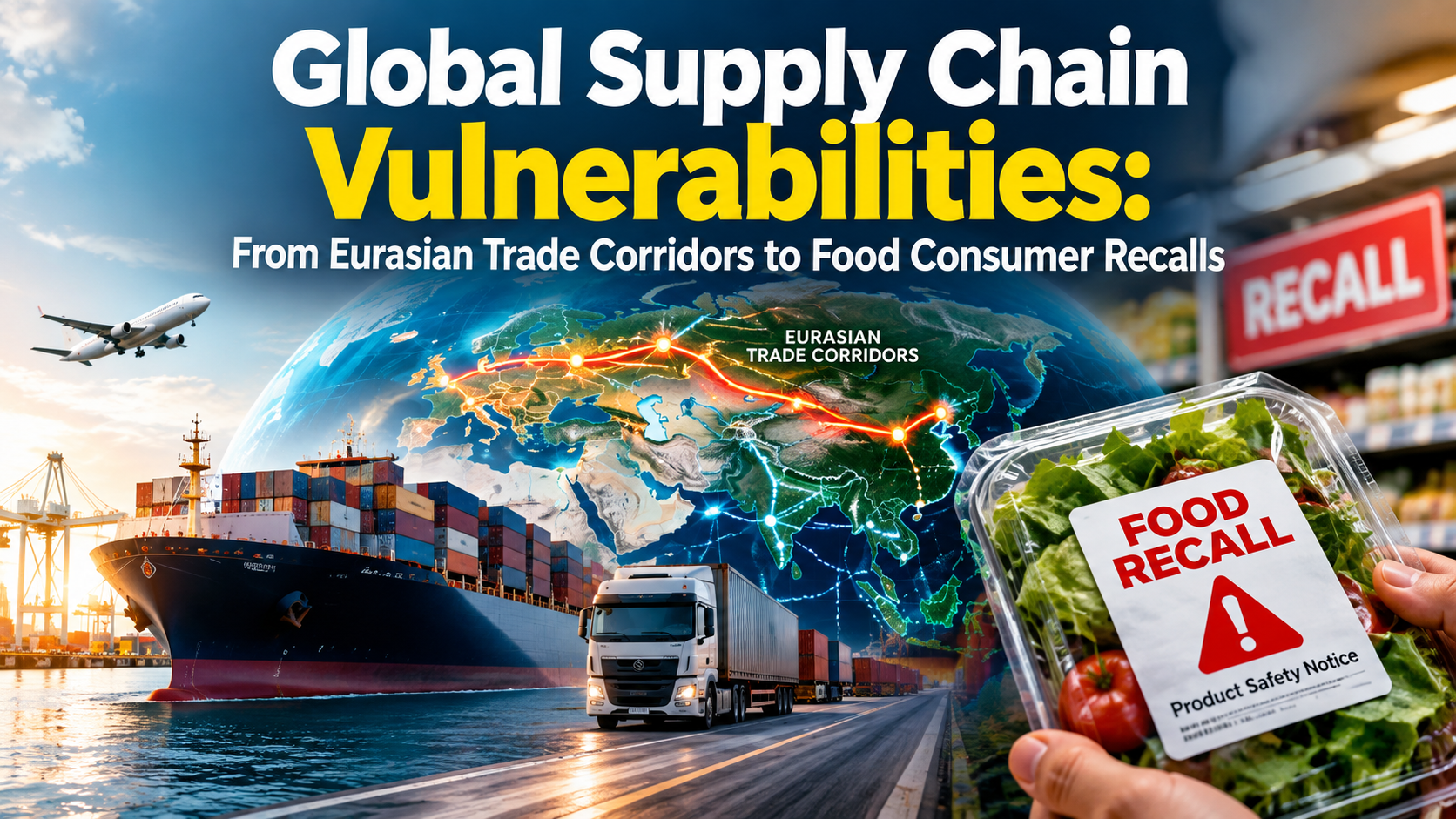
Hormuz closed, Red Sea contested, schedule reliability below 60%. How chokepoint failure and quality-control failure share the same root cause.Two supply chain failures occurred within days of each other in September 2026, at opposite ends of the scale. One shut a pipeline carrying a meaningful share of the world’s crude. The other put small stones in a pint of frozen dessert. They are more closely related than they appear.
Executive Summary / Key Takeaways
- Maritime disruption in 2026 is no longer episodic. The Red Sea remains contested, Suez throughput sits well below pre-2023 levels, and schedule reliability is still below 60% on most east-west lanes.
- The Strait of Hormuz carries roughly 20% of global oil shipments and has been effectively closed to routine commercial traffic for extended periods of 2026.
- Around 130 container ships — roughly 1.5% of global capacity — became trapped in the Persian Gulf, with BIMCO estimating 3% of global container volume cut off from normal routing.
- Cape of Good Hope rerouting adds 10 to 14 days to Asia-Europe transit, with war risk surcharges of $1,500 to $4,000 per container on affected corridors.
- The unifying insight: the September 2026 So Delicious recall — the second for an identical contaminant in under a year — and the chokepoint crisis are both failures of visibility into upstream inputs, not failures of execution downstream.
Maritime disruption in 2026 is no longer a one-off shock — it is the operating condition, according to freight sector analysis. The Red Sea remains contested, Suez Canal throughput is still well below pre-2023 levels, the Strait of Hormuz sits one escalation away from a fresh oil spike, and most Asia-to-Europe vessels are still routing around the Cape of Good Hope. The operative question for shippers is not whether disruption is happening but which chokepoint is moving this week and how long the next reroute will hold.
Meanwhile, Danone USA recalled So Delicious Dairy Free Salted Caramel Cluster pints on 15 September over potential small stones and hard objects in the cashew inclusions — the identical stated cause as a December 2025 recall of the same product, per the FDA notice.
Both are input-visibility failures.
2. Core Analysis: The Chokepoint Map
2.1 Disruption by corridor
| Chokepoint | Status 2026 | Operational impact | Source |
|---|---|---|---|
| Strait of Hormuz | Effectively closed to routine commercial traffic for extended periods | ~20% of global oil shipments; single largest tail risk | GoFreight |
| Red Sea / Bab el-Mandeb | Contested; limited resumption with naval escort | 10–14 days added Asia-Europe; 25–30% FAK premium | GoFreight |
| Suez Canal | Throughput well below pre-2023 | Most Asia-Europe traffic diverted to Cape | GoFreight |
| Saudi East-West pipeline | Shut 11 September 2026 | Removed the principal Hormuz bypass | Trading Economics |
| Cape of Good Hope | Primary Asia-Europe artery | Capacity tightness, container imbalance, blank sailings | Carra Globe |
| Middle Corridor / TRIPP | Under construction, Azerbaijan section due end-2026 | Overland redundancy option | Caspian News |
2.2 The cost structure of rerouting
BIMCO reported that transit disruption had disconnected Persian Gulf ports from normal global container services, cutting off 3% of global volume from its normal routes, with approximately 130 container ships — about 1.5% of global capacity — trapped inside the Gulf, per Maritime News. Outside those vessels, supply growth remained relatively unaffected, but the demand shock and higher oil prices created additional operating costs for liner operators.
Direct cost effects have been substantial. War risk surcharges imposed by major carriers add between $1,500 and $4,000 per container on affected corridors, with emergency fuel surcharges applied across most east-west lanes as carriers absorb higher costs from routing around Africa, according to freight forwarding analysis. Shanghai-to-Jebel Ali container rates quadrupled from under $2,000 to above $8,000 per container since the start of the conflict, per Freightos.
Notably, Freightos assessed that while the Hormuz closure is a serious regional disruption for Gulf-bound containers, it has not become the systemic shock the Red Sea crisis represented — with the main check on rate increases being the overcapacity that was expected to define 2026 before the war began.
2.3 Beyond oil: the commodity exposure
The disruption extends well past energy. The Gulf region supplies approximately 45% of global sulfur and a third of the world’s helium, while over 30% of global urea — a key fertiliser component — is exported through the Strait, per logistics sector analysis. The Persian Gulf accounts for roughly 30–35% of global urea exports and 20–30% of global ammonia exports, inputs critical to food production, and UNCTAD issued a formal warning in March 2026 of heightened risks to energy, fertiliser supply and vulnerable economies, highlighting that developing nations with high debt burdens and constrained fiscal space are particularly exposed, per SeaVantage.
That is the link to the World Bank’s downgrade of its MENA, Afghanistan and Pakistan regional forecast to 1.6% for 2026 from 3.6% in January.
3. Structural Drivers and Competitor Gaps
The connection nobody draws is the one worth drawing.
Both failures are upstream visibility failures. Small stones in cashew inclusions is a raw-material sorting problem, not a manufacturing problem. Tree nuts are harvested from the ground or from drying floors, and stones are specifically what optical sorting and density separation exist to catch — difficult for downstream detection because their density can approximate the nut’s. A recurrence of the identical contaminant within nine months implies the corrective action after December 2025 did not reach the root cause, most plausibly at supplier or sorting-specification level. A Canadian Food Inspection Agency recall of a related cashew-base product over plastic-like and gravel-like fragments indicates supply-chain rather than single-facility scope.
In both the maritime and the food case, the operator has good visibility into its own operations and poor visibility into the tier below.
Redundancy is now a capital expenditure, not a contingency plan. Knock-on effects — capacity tightness, container imbalances, longer working-capital cycles, more blank sailings — are structural rather than transitional, and procurement should be planned around the new normal rather than a return to 2019 conditions. The same logic applies to food inputs: dual-sourcing a cashew supplier costs money in normal conditions and is only obviously worth it after a recall.
Overland corridors are the structural beneficiary. Azerbaijan aims to complete its section of the expanded Middle Corridor by the end of 2026, with TRIPP construction through Armenian territory expected to begin in the second half of 2026. Kazakhstan has been reinforcing the Azerbaijan-Georgia segment at ministerial level. Every additional month of maritime unreliability strengthens the commercial case for Trans-Caspian routing, which is why the corridor has attracted capital irrespective of the underlying diplomatic weather.
The multi-modal shift is already visible. Sea-air combined freight and China-Europe rail options are being consulted where ocean freight becomes unreliable or expensive, with the trade-off being cost against reliability for high-value goods.
4. Key Implications for Stakeholders
Supply chain executives. Schedule reliability below 60% on most east-west lanes is the number to plan against. That is not a delay problem; it is a forecasting problem, and it argues for safety stock and buffer inventory over just-in-time regardless of carrying cost.
Food and CPG operators. Audit tier-two suppliers on physical-contaminant controls specifically, not just on allergen and microbiological programmes. Repeat recalls for identical causes attract regulatory scrutiny of the corrective-action plan filed after the first event.
Policy analysts. The fertiliser exposure is the most under-covered risk in the chokepoint story. Urea and ammonia disruption transmits to food prices with a growing-season lag, which means the agricultural impact of 2026’s disruption may not appear in price data until 2027.
Frontier-market economies. UNCTAD’s warning identifies the specific vulnerability: high debt, constrained fiscal space, and simultaneous exposure to elevated freight and food costs. For net energy and fertiliser importers, this is a compounding rather than an additive shock.
Logistics buyers. Confirm current routing positions with freight and compliance partners before committing, because the picture changes within days. Dated figures in any published analysis, including this one, are a record of how the crisis developed rather than a live feed.
5. Frequently Asked Questions
Q1: What is the current state of global shipping disruption?
The Red Sea remains contested, Suez throughput sits well below pre-2023 levels, and the Strait of Hormuz has been effectively closed to routine commercial traffic for extended periods of 2026. Schedule reliability is below 60% on most east-west lanes.
Q2: How much does Cape of Good Hope rerouting cost?
It adds 10 to 14 days to Asia-Europe transit with a 25–30% premium on FAK rates, plus war risk surcharges of $1,500 to $4,000 per container and emergency fuel surcharges across most east-west lanes.
Q3: What caused the So Delicious recall?
Potential presence of foreign materials such as small stones and hard objects within the cashew inclusions — the identical stated cause as the December 2025 recall of the same product, pointing to an upstream raw-material sorting issue rather than a plant-level failure.
Q4: Can overland routes replace maritime shipping?
Not at volume. The Middle Corridor and TRIPP add genuine redundancy for Asia-Europe cargo, and Azerbaijan aims to complete its section by end-2026, but overland capacity remains a fraction of ocean freight. It is a resilience option, not a substitute.
Discover more from The Economy
Subscribe to get the latest posts sent to your email.

Global Supply Chain Vulnerabilities: From Eurasian Trade Corridors to Food Consumer Recalls

Why 5% U.S. Treasury Yields Signal a Global Market Regime Shift.

Federal Reserve Defies White House Pressure: Inside Trump’s Demand for Sub-1% Interest Rates After Historic 2026 Rate Hike

How Rising Interest Rates Impact Gig Economy Apps: DoorDash, Uber, and Urban Services

GasBuddy Market Insights: How Crude Price Shifts Impact Local Fuel Cost Averages

DoorDash Driver Payouts, Fee Structures, and Market Competition Analysis

OPINION:Breaking the 3.5% Growth Trap: How Pakistan Can Build a High-Productivity Export Economy

Global Equity Market Divergence: US Tech vs. European Dividend Stocks vs. Asian Growth

Asian Markets Analysis: Navigating Volatility in China, Japan, and Singapore Stocks

Stagflation vs. Soft Landing: How Central Bank Rates Are Reshaping European and Asian Economies

IMF & World Bank Global Economic Outlook: Growth Forecasts Across Europe and Asia

Fed Rate Hike Projections vs. Trump’s Interest Rate Policy: What Global Markets Expect Next

Singapore Stocks: The Ultimate Safe Haven for Markets and Finance in 2026?

Marie Gluesenkamp Perez: How a Former Shop Owner’s Moderate Politics Are Shaping Tech and Economy Bills

State Farm’s $5B Dividend 2026: Who Qualifies & Payout Dates

US-China Relations in Q3 2026: Trade Tariffs and Supply Chain Risks

SpaceX Starship Flight 14: First Orbital Attempt & Starlink V3 Launch Explained

Top 30 Stocks for Investment in PSX for Massive ROI in 2026

The 2026 Crypto Regulatory Shift: What It Means for Institutional Investors

AI Chip Stocks 2026: The Best Semiconductor Investments Beyond Marvell

AI-Powered Training: The Next Multi-Billion Dollar Ecosystem in Fitness

Tween Back-to-School Trends 2026: What’s Driving the $85B Season

10-Year Treasury Yield Hits 4.80%: What It Means for Rates & Portfolios

Shein Clothes Quality & Safety in 2026: What Lab Tests Show

Oil Prices Break $100 in 2026: Middle East Conflict & Energy Markets

MRVL Earnings 2026: Why Marvell Sank Despite Beating Estimates

Fidelity Investments Review 2026: SPAXX Yields & Zero-Fee Funds

China’s US$10.8 Billion Trade Shortcut: Why the Pinglu Canal Matters
-

 Markets & Finance8 months ago
Top 15 Stocks for Investment in 2026 in PSX: Your Complete Guide to Pakistan’s Best Investment Opportunities
-

 Analysis7 months ago
Johor’s Investment Boom: The Hidden Costs Behind Malaysia’s Most Ambitious Economic Surge
-

 Analysis7 months ago
Top 10 Stocks for Investment in PSX for Quick Returns in 2026
-

 Analysis7 months ago
Brazil’s Rare Earth Race: US, EU, and China Compete for Critical Minerals as Tensions Rise
-

 Banks8 months ago
Best Investments in Pakistan 2026: Top 10 Low-Price Shares and Long-Term Picks for the PSX
-

 Investment8 months ago
Top 10 Mutual Fund Managers in Pakistan for Investment in 2026: A Comprehensive Guide for Optimal Returns
-

 Global Economy9 months ago
15 Most Lucrative Sectors for Investment in Pakistan: A 2025 Data-Driven Analysis
-

 Global Economy9 months ago
Pakistan’s Export Goldmine: 10 Game-Changing Markets Where Pakistani Businesses Are Winning Big in 2025