
US Economy
$166B Tariff Refund Tapering Fast: Is Your Business Missing Out?


In a major pivot for federal balance sheets, the historic $166 billion tariff refund process is rapidly approaching its finish line. According to the latest data released by the Treasury Department, the U.S. government has just taken in more tariff revenue than it issued in refunds for the first time in months.
With recent payouts dropping to just $10.5 billion, the massive wealth transfer—triggered by the Supreme Court’s landmark February 2026 decision invalidating the sweeping 2025 IEEPA tariffs—is officially tapering off.
As the dust settles on one of the largest corporate refunds in U.S. history, who actually walked away with the windfall, and what happens to the businesses that haven’t yet filed?
The Treasury’s Turning Point
For the past four months, U.S. Customs and Border Protection (CBP) has been pushing billions out the door through its CAPE (Consolidated Administration and Processing of Entries) digital portal. The early months were a veritable gold rush for importers; Phase 1 alone saw nearly $95 billion queued up for immediate disbursement.
However, Friday’s Treasury statement marks a critical inflection point. The scales have tipped back in the government’s favor. The tapering of the $166 billion refund pool indicates that the vast majority of the 330,000 eligible importers have already successfully processed their claims, or are stuck indefinitely in a complex reconciliation pipeline.
Where Did the Money Go?
While businesses rejoiced at the 6-3 Supreme Court ruling, everyday consumers largely missed out on the victory.
Because tariffs function as taxes on imports, the initial burden was passed downstream to shoppers in the form of higher retail prices throughout 2025. Yet, as the refunds were disbursed to the “importers of record”—typically wholesalers, major retailers, and customs brokers—very few companies opted to slash prices at the checkout.
Instead, many businesses used the CAPE refunds to patch margin gaps, pad their bottom lines, or offset the costs of new, legally sound duties that were subsequently put in place. Outside of a few corporate pledges from companies like Costco and FedEx to pass on savings, the $166 billion largely acted as a corporate balance sheet stabilizer rather than a catalyst for consumer relief.
The Clock is Ticking for Holdouts
If you are an importer of record who has not yet navigated the CAPE portal, the window is slamming shut.
- The Complexity Trap: The filing process remains unforgiving. Early data showed that nearly 4 in 10 initial filings faced rejection due to formatting errors, and accepted files cannot be easily amended.
- Phase 3 Realities: As the process shifts to handling older, finally liquidated entries, the government is heavily prioritizing companies that have actively engaged the system or filed protective lawsuits.
The Bottom Line
The tapering of the Treasury’s refund payouts confirms that the largest wave of the $166 billion tariff reversal is behind us. Moving forward, businesses must pivot from anticipating refund checks to navigating the current, restructured trade landscape. For the stragglers, the message is clear: act immediately, or leave your share of the remaining billions on the table permanently.
Discover more from The Economy
Subscribe to get the latest posts sent to your email.



Key Takeaways
- A surprise $90 deposit is usually an adjustment, not a gift. The most common causes are back pay, a benefit-rate change, a Medicare premium correction or a recalculation after you worked.
- Check your records before you spend it. Your my Social Security account and any mailed notice should explain the payment. Letters often trail the deposit by days.
- Overpayments are real, and they are recoverable. If SSA decides it paid you too much, it can withhold 50% of your monthly benefit, or 10% of an SSI payment, after giving you notice.
- 2026 has more moving parts than usual. A 2.8% cost-of-living adjustment, a higher Medicare Part B premium and ongoing Social Security Fairness Act recalculations all touch payment amounts.
- Never send money back to a caller or texter. Real SSA problems arrive by letter or inside your online account, not through gift-card demands.
You open your banking app and there it is: a deposit labeled something like “SSA TREAS 310,” and it is $90 you didn’t expect. It isn’t your normal payment day. It isn’t your normal amount.
Your first feeling is probably a mix of hope and dread. Is the government sending you extra money? Or is this the opening move in a clawback?
The honest answer is that only the Social Security Administration can tell you what happened to your record. But the list of likely explanations is short, and you can narrow it down in about ten minutes. This guide walks through the payment calendar, eight common causes, what an overpayment looks like, and the exact steps to confirm what you received.
First, Was It Really Off Schedule?
Before you chase a mystery, confirm that the date is actually unusual. SSA pays on a fixed pattern, laid out in its 2026 benefit payment schedule.
| Your situation | When Social Security pays |
|---|---|
| Birthday on the 1st through 10th | Second Wednesday of the month |
| Birthday on the 11th through 20th | Third Wednesday of the month |
| Birthday on the 21st through 31st | Fourth Wednesday of the month |
| Started benefits before May 1997, or receive both Social Security and SSI | The 3rd of the month |
| SSI payments | The 1st of the month |
In October 2026, for example, the Wednesday groups are paid on the 14th, 21st and 28th. If a $90 deposit landed outside your slot, you can rule out a simple timing quirk. If it landed inside your slot, check whether your regular payment changed instead.
Eight Reasons You Might Have Received $90
1. Retroactive benefit adjustment (back pay)
This is the classic one. SSA recalculates a benefit and discovers you were underpaid for earlier months. Rather than waiting for your next regular deposit, it often pays the difference immediately.
Here is a purely hypothetical example. If your monthly benefit was corrected upward by $45, and the change applies to the previous two months, you would see a catch-up deposit of $90.
2. The 2026 cost-of-living adjustment
Benefits rose 2.8% in January 2026, which SSA put at about $56 more per month for the average retired worker. On the average benefit of roughly $1,920, a 2.8% increase is around $54 a month. A $90 gap could reflect a larger-than-average benefit, a delayed processing of the raise, or a COLA plus another adjustment stacked together.
3. A Medicare Part B premium change
Most beneficiaries over 65 have their Part B premium deducted before the deposit hits. The standard premium is $202.90 in 2026, up $17.90 from last year, with a $283 annual deductible. If your premium was corrected or your income-related surcharge was adjusted, the difference can surface as a small one-time payment or as a changed deduction. Both are worth checking.
4. Social Security Fairness Act recalculations
The Social Security Fairness Act repealed the Windfall Elimination Provision and Government Pension Offset, which had reduced benefits for many people with public pensions. SSA published a dedicated page on the law. If you or a spouse worked in government jobs outside Social Security, a late recalculation can still generate adjustments.
5. A recomputation after you kept working
If you continued working after you started benefits, SSA can review your earnings and raise your benefit. The increase may come with a small back payment covering the months it should have applied.
6. Family or survivor benefit changes
Benefits paid to spouses, children or survivors are linked to the worker’s record. When one person’s status changes, the others’ amounts can shift, and SSA may true up the difference.
7. An SSI or state supplement change
If you receive Supplemental Security Income, small amounts can move because of changes in income, living arrangements or a state supplement. SSI payments also follow their own calendar, so the timing can look odd.
8. A refund of previously withheld money
If SSA withheld too much earlier, for an overpayment recovery or a premium, it may refund the excess. A refund usually comes with a notice explaining the math.
What If It’s an Overpayment?
Sometimes the answer is less pleasant. An overpayment happens when SSA pays more than the law allows. It can follow unreported work, a change in marital status or living situation, or a simple processing error.
Here is how the process works, according to SSA’s overpayment page:
- You get a notice explaining the amount and the reason.
- SSA waits at least 30 days before it begins collecting.
- After that, it withholds 50% of your benefit or 10% of an SSI payment each month until the debt is repaid, unless you arrange something different.
You have options. According to SSA’s overpayment fact sheet, you should contact SSA within 60 days if you want to appeal. If you agree you were overpaid but it wasn’t your fault and repayment would be a hardship, you can request a waiver using Form SSA-632-BK. For smaller overpayments of $1,000 or less, a waiver request may be possible by phone. NerdWallet’s guide to Social Security overpayments walks through the appeal-versus-waiver choice in plain English.
| If your notice says… | Your likely move |
|---|---|
| You were not overpaid, or the amount is wrong | Appeal within 60 days |
| You were overpaid, but it wasn’t your fault and you can’t afford repayment | Request a waiver |
| You were overpaid and agree | Ask for a repayment plan you can afford |
How to Find Out What Happened in Ten Minutes
You don’t need to guess. Work through these steps in order.
- Log in to your my Social Security account. Type the address into your browser yourself rather than clicking a link in a message. Look at your benefit amount, payment history and any notices.
- Check your mail and messages. Explanations are typically mailed, and the letter can arrive days after the electronic deposit.
- Compare this month’s regular payment to last month’s. A changed monthly amount points to a rate adjustment, a Medicare deduction change or a recomputation.
- Call SSA at 1-800-772-1213 if nothing explains it. Have your Social Security number ready, and be prepared for a wait.
- Keep a record. Screenshot the deposit and save any letter. You’ll want it at tax time and if SSA later asks questions.
A Word on Scams
Unexpected money can also be bait. Scammers impersonate agency employees, create urgency and push you toward payment methods that can’t be reversed.
The pattern is consistent. SSA’s inspector general says the agency will never demand payment by gift card, wire transfer or cash, and the CFPB’s five ways to recognize a Social Security scam lists the same red flags. The inspector general’s fraud advisory adds that agency texts asking you to call a number about a problem should be treated as suspicious.
Rule of thumb: if someone contacts you about the $90 and asks you to send money anywhere, stop. Verify through your online account or the official phone number instead.
What to Do With the $90 in the Meantime
Treat it like a pending item. Leave it in your account until you know the cause, especially if there is any chance it’s an overpayment. If it turns out to be back pay, it is part of your benefits for tax reporting, so keep your annual SSA-1099 handy and ask a tax professional how it applies to your situation.
Asked & Answered
Can Social Security take back a $90 deposit?
Yes, if SSA determines it was an overpayment. The agency must send a notice first, waits at least 30 days before collecting, and gives you appeal and waiver rights.
How long until I get an explanation letter?
Often a few days to about two weeks after the deposit. If your online account shows no new notice and nothing arrives by mail, call SSA.
Does a one-time $90 mean my monthly benefit changed?
Not necessarily. A one-time amount can be back pay. But compare your next regular payment to the previous one, because a recalculation can do both: pay the past difference and change the future amount.
What if I got $90 but my regular payment went down?
That pattern deserves a prompt call. It could reflect a Medicare premium change, a withholding for an overpayment, or an error. Ask SSA to walk you through each line.
Will the next COLA change my deposits again?
Probably. Cost-of-living adjustments are announced in the fall and take effect with January benefits. Your Part B premium for 2027 will also be set, and it comes out of the same check.
Discover more from The Economy
Subscribe to get the latest posts sent to your email.
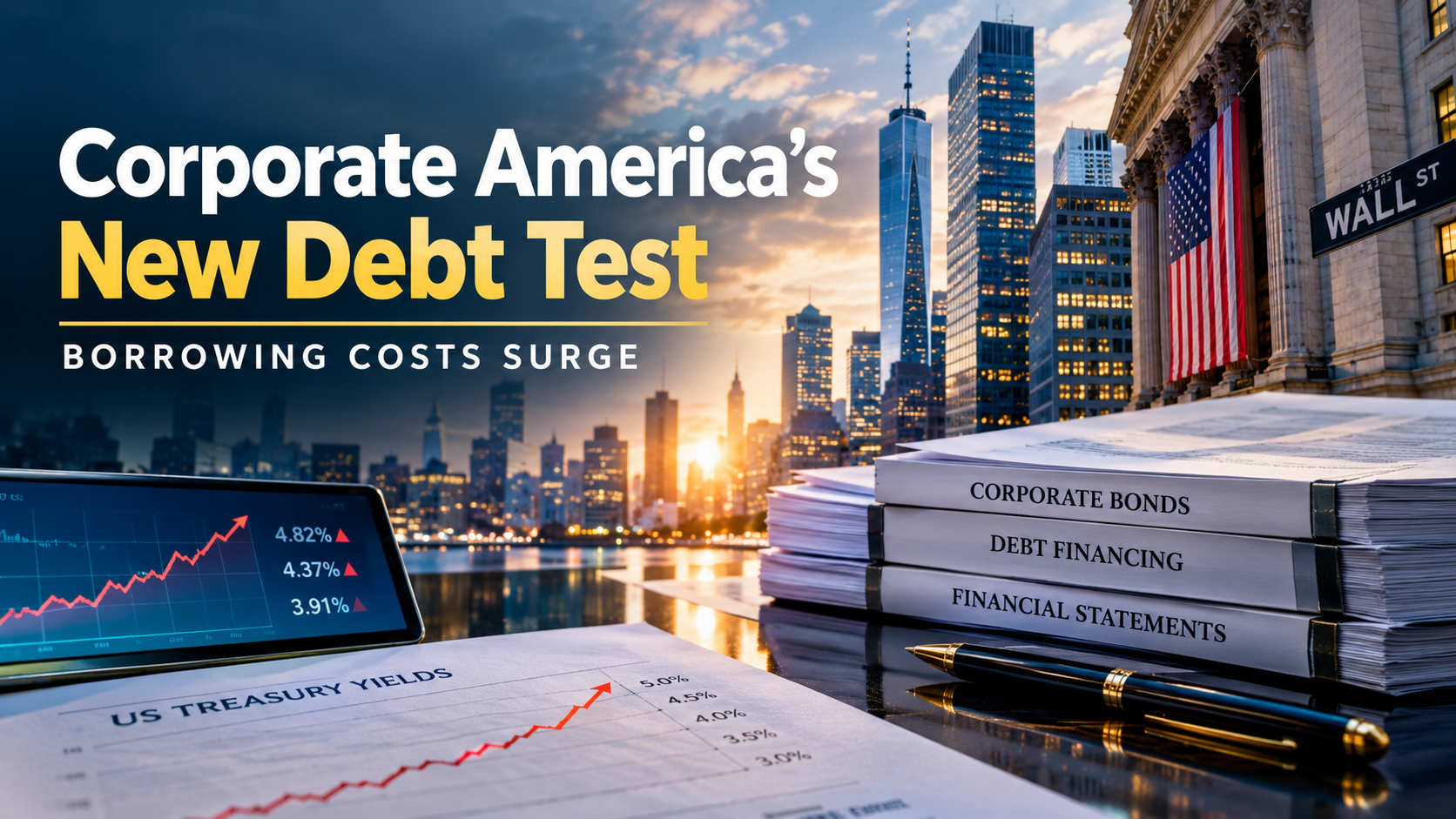
US Treasury yields have climbed to multi-year highs, pushing corporate financing costs higher and creating a growing refinancing challenge for American companies. The immediate pressure is concentrated among weaker borrowers, but a prolonged high-rate environment could eventually affect investment, mergers, buybacks and economic growth across corporate America.
The US bond market has entered a more difficult phase for corporate borrowers.
A sharp rise in Treasury yields is increasingly feeding into the cost of corporate debt, forcing companies to reconsider when and how they borrow. The impact is most severe for highly leveraged and lower-rated businesses, but even investment-grade companies are facing a more expensive capital market than they enjoyed during the ultra-low-rate era of the early 2020s.
The issue is no longer simply whether the Federal Reserve raises or cuts short-term interest rates. The bigger question for corporate America is how long long-term borrowing costs remain elevated.
That distinction matters because companies refinancing debt today are replacing old financing obtained at substantially lower rates with new debt priced in a very different market.
The Treasury market is setting a tougher price for corporate debt
The starting point is the US government bond market.
The 10-year Treasury yield has climbed to levels not seen in more than two decades, increasing the baseline rate against which much of the corporate bond market is priced. Recent market reporting has put the 10-year yield above 5%, with investors demanding greater compensation for holding long-duration government debt.
The Federal Reserve has warned that higher interest rates can increase debt-servicing costs for businesses with substantial leverage and upcoming refinancing requirements. The central bank has also noted that the corporate sector entered 2026 with relatively strong investment-grade credit quality, meaning the current environment should not automatically be interpreted as an economy-wide credit crisis.
That distinction is crucial.
The problem is increasingly concentrated in companies that have some combination of high leverage, weak cash flow, floating-rate liabilities or large amounts of debt coming due.
Federal Reserve financial-stability analysis supports the view that corporate credit vulnerabilities remain uneven rather than universal.
Why refinancing is becoming the central risk
Many companies borrowed heavily when interest rates were exceptionally low.
As those bonds mature, companies must either repay the debt from existing cash, refinance it at prevailing rates, sell assets, raise equity or reduce spending.
The refinancing arithmetic can be painful.
Suppose a company borrowed $10 billion at an average interest rate of 3%. Its annual interest bill would be approximately $300 million.
If that debt has to be refinanced at 6%, the annual interest expense rises to approximately $600 million.
The company has not borrowed another dollar, yet its annual financing burden has doubled.
That is why refinancing can become a hidden earnings shock.
Reuters estimates that approximately $4.3 trillion of US non-financial corporate bonds will mature between 2027 and 2031. Annual maturities are expected to rise from roughly $572 billion in 2027 to approximately $1.03 trillion in 2030.
This creates what investors increasingly describe as a corporate refinancing wall.
The weakest companies are feeling the pressure first
The deterioration is not evenly distributed.
Companies with investment-grade balance sheets can generally access capital markets more easily and often have diversified sources of funding.
Highly leveraged companies have fewer options.
According to the Financial Times, borrowing costs for companies rated CCC or lower have risen to approximately 17%, while their risk premium has reached about 12 percentage points.
That level of financing can fundamentally change corporate decision-making.
A project that looked profitable when money cost 5% may no longer make economic sense when financing costs move substantially higher.
This can lead companies to postpone:
- acquisitions;
- share buybacks;
- expansion projects;
- capital expenditure;
- hiring;
- new factories;
- technology investments;
- refinancing transactions.
The consequences can therefore spread beyond bond investors into the real economy.
Corporate America is not facing one uniform debt crisis
One of the most important nuances missing from many discussions about higher borrowing costs is that corporate America is highly divided.
At one end are highly profitable technology companies and other large investment-grade borrowers with enormous cash flows and strong access to capital markets.
At the other are highly leveraged companies whose earnings leave relatively little room to absorb a major increase in interest expense.
The Federal Reserve’s 2026 Financial Stability Report found that investment-grade corporate credit quality remained robust, although some riskier firms, particularly those dependent on private credit, were experiencing greater debt-servicing challenges.
That suggests the current environment is better described as a credit-selection problem than a generalized corporate solvency crisis.
The longer yields remain elevated, however, the greater the probability that today’s refinancing pressure becomes tomorrow’s default problem.
The corporate bond market is already sending signals
Market pricing provides an important window into this transition.
FRED data show Moody’s seasoned Baa corporate bond yield at approximately 6.73% on October 1, 2026. The Baa spread over the 10-year Treasury was about 1.49 percentage points at the beginning of October.
This distinction is important.
Corporate borrowing costs consist broadly of two components:
Treasury yield + corporate credit spread = corporate borrowing yield
The Treasury component compensates investors for the time value of money and government interest-rate risk.
The credit spread compensates investors for taking corporate credit risk.
When both rise simultaneously, companies experience a much more powerful increase in financing costs.
So far, much of the pressure has come from the Treasury side, although credit spreads for weaker borrowers have also widened substantially.
Paramount’s enormous financing illustrates the new reality
The Paramount Skydance transaction provides a particularly useful case study.
Paramount disclosed plans for tens of billions of dollars of debt financing connected with its acquisition of Warner Bros. Discovery. Its SEC filings show that the transaction involved substantial debt commitments, including a large bridge financing facility that was expected to be replaced or reduced through permanent financing.
The transaction demonstrates a broader challenge facing corporate finance teams.
When financing costs are uncertain, companies increasingly have to think about:
How much should we borrow?
For how long?
At what fixed rate?
How much floating-rate exposure should we accept?
Should we refinance now or wait?
Can the acquisition generate enough additional cash flow to justify the higher financing expense?
Those questions become especially important for highly leveraged mergers and acquisitions.
Why companies are shortening maturities
One logical response to high long-term interest rates is to avoid locking in today’s expensive financing for decades.
Companies may therefore prefer shorter maturities.
The strategy has an obvious advantage: if rates fall later, the company can refinance at a lower cost.
But it also creates another risk.
Shorter maturities mean more refinancing requirements in the future.
If interest rates remain high, companies could find themselves repeatedly refinancing debt at elevated rates.
That creates a difficult trade-off between paying more today for long-term certainty and accepting refinancing risk in exchange for shorter-term flexibility.
AI is creating an important exception
One of the most interesting features of the current credit market is the enormous borrowing associated with artificial intelligence infrastructure.
Technology companies are spending unprecedented amounts on data centres, chips, networking infrastructure and electricity capacity.
The Financial Times has reported estimates that hyperscalers could borrow around $1 trillion through 2030 to support AI infrastructure expansion.
For these companies, the calculation is different.
If management believes that failing to invest in AI infrastructure would result in losing a strategic position, higher financing costs may be treated as the price of maintaining competitive advantage.
This creates a strange two-speed corporate credit market.
AI-related investment can remain aggressive while other companies cut capital spending.
That divergence could become one of the defining characteristics of the next phase of the US corporate bond market.
The refinancing wall could become an earnings problem
The most important transmission mechanism is straightforward:
Higher Treasury yields → higher corporate borrowing costs → higher interest expense → lower free cash flow → reduced investment or weaker credit quality.
For companies with strong margins, the increase may be manageable.
For companies operating with thin margins, it can be decisive.
Consider a company generating $1 billion in annual operating cash flow and paying $300 million in interest.
If refinancing raises annual interest expense to $500 million, the company’s interest burden consumes a much larger share of its cash flow.
Management then has fewer resources available for investment, acquisitions, dividends and buybacks.
If revenues simultaneously weaken, the problem becomes more serious.
Could this trigger a wave of corporate defaults?
Not necessarily.
The Federal Reserve’s earlier 2026 assessment showed that corporate bond issuance remained strong and investment-grade credit quality was generally solid.
That provides an important cushion.
Large corporations have also had years to prepare for higher rates by extending maturities and locking in fixed-rate financing.
But the risk is asymmetric.
A stable economy can allow heavily indebted companies to refinance successfully.
A combination of high interest rates, slowing economic growth and falling corporate profits would be much more dangerous.
That is when refinancing pressure can turn into covenant breaches, distressed exchanges, restructurings and defaults.
The Federal Reserve has explicitly warned that higher rates can amplify vulnerabilities associated with leverage and upcoming refinancing needs.
What investors should watch next
Investors should focus on five indicators rather than Treasury yields alone.
1. The 10-year Treasury yield
A sustained move above current levels would increase the baseline cost of corporate financing.
2. High-yield credit spreads
A sharp widening would indicate that investors are demanding substantially greater compensation for corporate credit risk.
3. Corporate refinancing volumes
If companies begin delaying bond issuance, it could signal that borrowers consider market pricing too expensive.
4. Interest coverage ratios
Companies with declining earnings and rising interest expense are particularly vulnerable.
5. Default and distressed-debt indicators
A sustained increase in defaults would suggest that the refinancing problem is becoming a solvency problem.
The bigger issue is the cost of capital
The most important consequence of the bond sell-off may not be a sudden wave of bankruptcies.
It may be a gradual repricing of corporate decision-making.
For more than a decade, exceptionally low interest rates encouraged companies to borrow cheaply, refinance frequently, acquire competitors and return capital to shareholders.
That model becomes less attractive when the cost of capital rises substantially.
The result could be a more disciplined corporate environment in which companies demand higher returns from acquisitions and capital projects.
That may ultimately be healthy.
But the transition could be painful for companies that built their business models around cheap debt.
A new test for corporate America
The US economy has already demonstrated considerable resilience in the face of higher rates.
The question now is whether that resilience extends to a corporate sector facing a large refinancing cycle.
The numbers suggest that the pressure will build gradually rather than arrive as a single shock.
The immediate danger is concentrated among highly leveraged and lower-rated companies. Investment-grade borrowers remain considerably better positioned.
But the refinancing calendar means the issue cannot simply be dismissed.
With roughly $4.3 trillion of non-financial corporate bonds coming due between 2027 and 2031, the cost of money over the next several years will matter enormously.
If Treasury yields eventually decline, many companies could refinance more comfortably.
If yields remain elevated while earnings weaken, the pressure could move steadily up the credit spectrum.
That makes the current bond-market sell-off more than a story about government debt.
It is becoming a test of how much corporate America can adapt to a world in which capital is no longer cheap.
Bottom line
The US corporate sector is not yet facing a systemic debt crisis. The stronger borrowers retain substantial market access, while investment-grade credit quality remains relatively resilient.
But the refinancing cycle is creating a growing divide between companies that can absorb higher interest costs and those that cannot.
The crucial variable is therefore not simply whether the Federal Reserve raises or lowers its policy rate.
It is whether long-term borrowing costs remain high long enough for the refinancing wall to become an earnings and solvency problem.
For investors, the next phase of the credit cycle will be about separating companies that can grow their cash flows faster than their financing costs from those whose balance sheets were built for the era of cheap money.
Discover more from The Economy
Subscribe to get the latest posts sent to your email.

When Washington doubles down on reshoring corporate capital, export-reliant trade partners typically prepare for impact. However, Ireland’s Prime Minister Micheál Martin is turning trade pressure into bilateral leverage—using U.S. “America First” incentives to sharpen Irish competitiveness while securing high-profile tariff rollbacks for staple Irish exports.
Following a landmark pledge from President Donald Trump to eliminate the 10% U.S. duty on Irish whiskey, Irish diplomats have locked their sights on the next major trade concession: Kerrygold butter, a commodity generating over $1 billion in annual U.S. retail sales.
The Bilateral Investment Balance Sheet
Contrary to popular belief that transatlantic trade flows primarily benefiting European exporters, the economic relationship between the U.S. and Ireland operates as a two-way investment engine. Official data from the U.S. Bureau of Economic Analysis ranks Ireland among the top five foreign direct investment (FDI) contributors to the U.S. economy.
| Economic Metric | U.S. Capital in Ireland | Irish Investment in the U.S. |
| Total Investment Position | ~$460+ Billion | ~$390+ Billion |
| Employment Footprint | ~210,000 Irish workers | ~200,000 U.S. workers |
| Key Industries | Pharmaceuticals, Tech, MedTech | Agrifood, Health Sciences, Tech Services |
| Enterprise Presence | ~950 U.S. Multinationals | ~800 Irish Companies |
Data supported by Enterprise Ireland demonstrates that Irish-owned firms expanded their U.S. payrolls significantly across regional manufacturing and tech hubs, creating a dual-dependency that insulates Dublin from hostile tariff measures.
From Doonbeg to Distilleries: The Whiskey Breakthrough
The political momentum behind recent tariff exemptions crystallized during President Trump’s visit to his Doonbeg golf resort in County Clare, Ireland. Following direct representations by Taoiseach Micheál Martin and Irish golfer Shane Lowry, the administration committed to stripping away duties on Irish spirits.
As reported by Global Banking & Finance, the announcement removed a 10% import tariff that had been applied to EU spirits, returning Irish whiskey exports toward a zero-for-zero trade parity.
“He’s certainly had success in terms of the investments that companies are making in the U.S.,” stated Micheál Martin. “In a way, it makes us more competitive. We’ve analyzed it and said, ‘OK, that’s a new challenge. How do we double down, make ourselves more competitive, and stay agile?'”
Kerrygold in the Crosshairs: The Next $1 Billion Trade Target
With spirits secured, Ireland’s diplomatic and commercial apparatus is pivoting toward agricultural exports—specifically dairy products managed by Irish dairy cooperative Ornua.
- Market Scale: Kerrygold stands as the second-largest butter brand by value in the United States, crossing the $1 billion retail sales threshold in 2025.
- Economic Stake: Food and drink exports form the backbone of Ireland’s rural economy. Agricultural tariffs directly impact primary producers across all 26 counties.
- Regulatory Leverage: As Ireland leads discussions during its presidency of the Council of the European Union, reducing regulatory friction and bureaucracy for U.S. technology imports serves as potential bargaining leverage for agricultural parity.
EU Bureaucracy vs. Transatlantic Competitiveness
A central theme in ongoing U.S.-EU discussions is European regulation. American MNEs routinely cite European red tape as a primary barrier to capital deployment.
According to official briefings from the European Commission, the EU and U.S. have been working on reciprocal tariff reductions across industrial goods, aerospace, and generic pharmaceuticals while streamlining sanitary certification processes. Ireland is using its influence within the EU Council to prioritize deregulation, aligning European business practices more closely with U.S. capital efficiency.
By framing American domestic investment pushes not as a threat, but as a benchmark for national agility, Ireland maintains its position as the premier European bridgehead for U.S. multinationals while methodically clearing tariff hurdles for its own flagship exports.
Discover more from The Economy
Subscribe to get the latest posts sent to your email.

Algorithmic Dogfights: Why the U.S. and China Must Establish Rules of Engagement for Autonomous Air Power

Stock Market Today: Dow, S&P 500, and Nasdaq Retreat as Treasury Yields

Global Economic Outlook 2026: 7 Forces Reshaping Markets, Trade and Business

Geopolitics and Your Portfolio: How International Affairs Move Global Markets

Conservative Party Conference 2026: What Badenoch’s Tax and Deregulation Pitch Means for the UK Economy

Planet Labs and Goldman: How Satellite Geospatial Data Is Reshaping Wall Street

Red Dye Diesel in 2026: Tax Exemptions, Regulations, and the Real Agricultural Impact

Student Loans in 2026: Forgiveness Updates, Consolidation, and Repayment Strategies

Why Did I Get $90 From Social Security? 8 Reasons Behind an Unexpected SSA Payment

Corporate America Faces a New Debt Test as US Borrowing Costs Surge

Goldman vs. Citi: Which Banking Giant Leads Modern Global Finance in 2026?

Beyond Hanoi & HCMC: How Northern Industrial Clusters Are Driving Vietnam’s 10% Growth Surge

Analytical Review of The Economist’s “What is the Right Tax System for the 21st Century?”

Southeast Asia’s LNG Dilemma: Navigating Price Volatility, Infrastructure Gaps, and Energy Security

Oil Prices Break $100 in 2026: Middle East Conflict & Energy Markets

IMF & World Bank 2026 Global Economic Outlook: Growth, Inflation, Debt

Middle East War Economics 2026: Oil Prices & Energy Markets

High-CPM Finance Niches 2026: Publisher Monetization Blueprint

China Stocks Today: Are Big Economies in Asia Nearing a Market Bottom?

Global Pension Systems Ranked: The World’s Best and Worst Retirement Frameworks

Enterprise AI Platforms Disrupting B2B SaaS in 2026: Full Analysis

Elon Musk’s Next Moves: Disrupting the 2026 Global Economy

Social Security Trust Fund 2032: OASI Depletion Timeline Explained

Crypto Daily Outlook: Bitcoin, Altcoins, and the Future of Decentralized Finance

World’s Largest Economies: Ranking the Top Global Powers

GasBuddy Market Insights: How Crude Price Shifts Impact Local Fuel Cost Averages

World Bank & IMF Reports 2026: Why the “3% Growth” Consensus Is Actually a Debate

PSX Forecast 2026: KSE-100, IMF Reviews & Geopolitics
-

 Markets & Finance9 months ago
Top 15 Stocks for Investment in 2026 in PSX: Your Complete Guide to Pakistan’s Best Investment Opportunities
-

 Analysis8 months ago
Johor’s Investment Boom: The Hidden Costs Behind Malaysia’s Most Ambitious Economic Surge
-

 Analysis8 months ago
Top 10 Stocks for Investment in PSX for Quick Returns in 2026
-

 Banks9 months ago
Best Investments in Pakistan 2026: Top 10 Low-Price Shares and Long-Term Picks for the PSX
-

 Analysis8 months ago
Brazil’s Rare Earth Race: US, EU, and China Compete for Critical Minerals as Tensions Rise
-

 Investment9 months ago
Top 10 Mutual Fund Managers in Pakistan for Investment in 2026: A Comprehensive Guide for Optimal Returns
-

 Global Economy9 months ago
15 Most Lucrative Sectors for Investment in Pakistan: A 2025 Data-Driven Analysis
-

 Global Economy9 months ago
Pakistan’s Export Goldmine: 10 Game-Changing Markets Where Pakistani Businesses Are Winning Big in 2025