
US Economy
US-Iran War Economic Impact 2026: Hormuz Shock, Stagflation Risk, and the Global Recession Threat

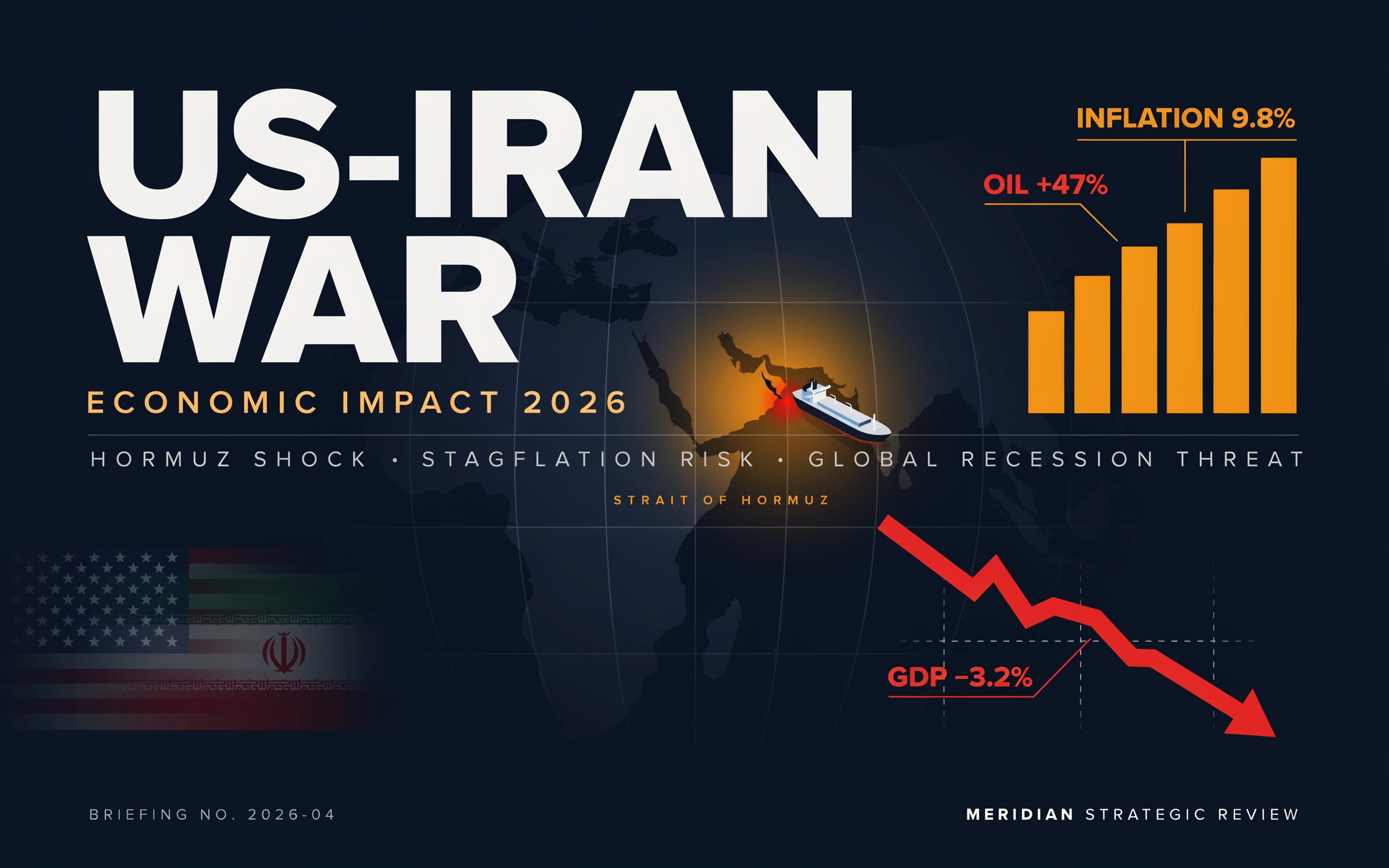
The US-Israel war on Iran closed the Strait of Hormuz to 20% of world oil trade. The IMF warns of global recession. Europe faces stagflation. Asia scrambles for alternatives. Here is the full economic map.US and Israeli forces launched strikes on Iran. Within days, the Strait of Hormuz — the narrow maritime chokepoint through which roughly 20% of the world’s oil and LNG passes — was effectively closed to commercial tanker traffic. The International Energy Agency characterised the resulting supply disruption as the largest in the history of the global oil market. The comparison to the 1970s oil crisis was not hyperbole. It was the framework within which global policymakers, central bankers, and finance ministries began operating.
The consequences cascaded across every dimension of the global economy — trade, inflation, currency markets, sovereign debt, and monetary policy — with a speed that caught financial markets unprepared.
The Energy Shock: Prices, Shortages, and the LNG Emergency
Brent crude rose more than 50% from its pre-war level within two months of the conflict’s outbreak, briefly touching $101.89 per barrel by late March. US diesel prices — a real-economy barometer — surged from $3.75 to $5.37 per gallon within weeks, imposing immediate cost pressures on agriculture, logistics, and construction. The national US average gasoline price crossed $3.98, up a dollar in under a month.

But the LNG shock proved equally severe. On March 18, Iran struck Qatar’s Ras Laffan Industrial City, causing a 17% reduction in Qatar’s LNG production capacity — damage that engineers estimated would require three to five years to repair. Asian LNG spot prices rose more than 140% in the aftermath. In 2024, about 84% of the crude oil and 83% of the LNG passing through the Strait was bound for Asia — with China, India, Japan, and South Korea accounting for nearly 70% of those shipments.
The IMF’s Three Scenarios
The IMF cut its 2026 global growth forecast to 3.1% — down 0.2 percentage points from January — but stressed that even this lower number assumes the most optimistic scenario: a short-lived conflict with oil averaging $82 a barrel across the year. The IMF’s own oil price assumption had been $62 at the start of 2026. With prices hovering near $100, the Fund’s intermediate scenario projects global growth falling to 2.5%. In its worst-case scenario — supply disruptions extending into 2027 — global growth falls to approximately 2%, which the IMF characterised as a “close call for a global recession.” Growth has only fallen below 2% four times since 1980.
The regional devastation in the Middle East and Central Asia is more acute: the IMF projects growth for the region at just 1.9% for 2026, a two-percentage-point downgrade, with several economies — Iran, Qatar, Iraq, Kuwait, and Bahrain — projected to contract outright.
Europe on the Brink of Stagflation
The European economic position is among the most precarious. The ECB postponed planned rate cuts on March 19, raising its 2026 inflation forecast while cutting GDP growth projections. Oxford University’s economics department modelled the UK and the Eurozone as at risk of contraction. The Ifo Institute assessed Germany and the Netherlands as carrying high recession risk. The OECD flagged the UK as the worst-hit major economy globally.
Chemical and steel manufacturers in the UK and EU imposed production surcharges of up to 30% to offset surging electricity and feedstock costs, with warnings of permanent deindustrialisation in some energy-intensive sectors if the disruption persisted through the summer refill season.
Asia: Scrambling for Alternative Supply
The strategic exposure of Asia-Pacific economies was acute. As of February 2026, 94.2% of Japan’s crude oil imports came from the Middle East. Japan released 80 million barrels from strategic reserves — equivalent to 15 days of domestic demand — from mid-March. Indonesia, an oil producer but importer of a third of its supply, activated emergency rationing measures. Pakistan, Bangladesh, and Vietnam were identified among the worst-hit economies in the developing world. Bangladesh faced recession-like conditions.
Myanmar restricted private vehicle use to alternate days. Nepal’s state oil corporation announced it would fill only half of consumers’ empty cylinders to lengthen petroleum stockpiles.
The Recession Debate: Euphoria or Denial?
Perhaps the most striking market development was the decoupling between equity performance and the underlying economic reality. The S&P 500 touched a new all-time intraday high of 7,230.12 on May 1, 2026 — despite an oil price that had risen more than 50% since February 28. Energy Aspects founder Amrita Sen described markets as displaying “extremely misplaced euphoria,” warning of “sleepwalking into potentially a pretty big recession.”
Goldman Sachs raised its US recession probability over the next twelve months to 30%. EY-Parthenon placed it at 40%. Their shared concern: that rising energy costs function as a sustained tax on consumer spending — which accounts for roughly two-thirds of US output — while simultaneously eroding corporate margins and dampening business investment.
The global economy in mid-2026 was navigating the rare and uncomfortable territory between geopolitical catastrophe and market complacency. The peace agreement signed between the US and Iran in late June offers a fragile off-ramp. But the structural lessons — about energy security, geopolitical risk pricing, and the fragility of global supply chains — will outlast the ceasefire by decades.
Discover more from The Economy
Subscribe to get the latest posts sent to your email.



The global economic growth is becoming more uneven, capital is increasingly sensitive to financing costs, and investors must distinguish a convincing story from an investable price. This guide focuses on research methods and risks rather than predictions of guaranteed returns. The IMF October 2026 outlook projects 3.1% global growth and 4.7% inflation for 2026, while the IMF financial-stability assessment warns that market resilience coexists with important vulnerabilities.
Key takeaways
- Match each investment decision to its time horizon, currency and ability to withstand losses.
- Separate observable earnings or contractual cash flows from optimistic forecasts.
- Compare diversification, fees, taxes, liquidity and regulatory restrictions before committing capital.
- Track primary institutional evidence and update assumptions when conditions change.
- Readers in Pakistan should consider rupee exposure and availability of regulated investment channels.
Why this matters now
The central question behind gold vs dollar vs bitcoin 2026 is not merely what may happen next. It is which economic mechanisms could change cash flow, purchasing power or risk. The Bank for International Settlements’ 2026 review describes an economy supported by technological investment but constrained by geopolitical and fiscal pressures. A robust financial plan must therefore survive both a favourable and an adverse scenario.
Three assets, three different economic functions
Gold is a scarce physical asset without a contractual cash flow. The dollar is a currency used for transactions, reserve holdings and dollar liabilities; holding dollars is not the same as owning an inflation-protected investment. Bitcoin is a highly volatile digital asset whose long-run response to inflation cannot be assumed stable. The comparison depends on which inflation and which home currency the investor faces. See the primary institutional research.
For practical analysis, separate the baseline, the upside case and the downside case. Document the specific development that would change your assessment. Assess timing: a promising long-term theme may still be inappropriate for cash needed within twelve months.
Why gold has attracted investment demand
The World Gold Council reported resilient investment demand during 2026 and a recovery in central-bank purchasing in the second quarter. That is evidence of demand, not a promise of rising prices. Gold can fall when real interest rates rise, the dollar strengthens or investors liquidate positions. Storage, spreads and insurance matter for physical buyers. See the primary institutional research.
For practical analysis, separate the baseline, the upside case and the downside case. Document the specific development that would change your assessment. Assess timing: a promising long-term theme may still be inappropriate for cash needed within twelve months.
The dollar: liquidity versus purchasing power
Foreign-currency balances may reduce exposure to a depreciation of the investor’s home currency, but US inflation still erodes dollar purchasing power. Cash in a bank has different legal protection and returns from banknotes held privately. A Pakistani household paying future US-dollar tuition has a genuine dollar liability; a household buying groceries in rupees has different currency matching needs.
For practical analysis, separate the baseline, the upside case and the downside case. Document the specific development that would change your assessment. Assess timing: a promising long-term theme may still be inappropriate for cash needed within twelve months.
Bitcoin: upside narratives and drawdown risk
Bitcoin supply rules do not make its market price stable. Liquidity conditions, leverage, custody arrangements, regulatory changes and speculative activity can dominate short-run returns. Investor.gov warns that crypto assets involve substantial loss and fraud risks. Treat any allocation as a speculative risk decision, not a guaranteed inflation hedge. See the primary institutional research.
For practical analysis, separate the baseline, the upside case and the downside case. Document the specific development that would change your assessment. Assess timing: a promising long-term theme may still be inappropriate for cash needed within twelve months.
How to compare hedges in rupees
Measure the purchase price and exit value after exchange rates, fees and taxes. Consider the needed holding period and worst plausible drawdown. Diversification is more credible than trying to select one universally superior asset. The right benchmark is the real purchasing power of the specific future expense, not whichever asset had the best recent performance. See the primary institutional research.
For practical analysis, separate the baseline, the upside case and the downside case. Document the specific development that would change your assessment. Assess timing: a promising long-term theme may still be inappropriate for cash needed within twelve months.
Comparison and decision framework
| Question | Stronger evidence | Warning sign |
|---|---|---|
| What drives returns? | Audited cash flows, clear contract or transparent index | Undefined or projected returns |
| What can go wrong? | Explicit scenario and downside analysis | Claims of guaranteed gains |
| Is it affordable to hold? | Low transparent fees and adequate liquidity | Leverage, costly spreads or lockups |
| Is access legitimate? | Appropriate licensing and clear legal rights | Unverified brokers or custody |
| Is the exposure diversified? | Multiple independent sources of return | One company, sector or currency |
What it means for Pakistani savers and investors
A Pakistani reader faces both international investment risk and local purchasing-power risk. For example, a foreign asset can rise in US-dollar terms while the rupee conversion and transaction costs alter the realized local outcome. The opposite can also occur. Record the starting exchange rate, applicable taxes, custody charges and capital-transfer restrictions, and confirm current requirements with the State Bank of Pakistan and the relevant securities regulator. Overseas access should not be assumed universally available.
An emergency reserve, expensive consumer debt and near-term family obligations deserve attention before any speculative allocation. A portfolio that cannot meet a sudden cash requirement may force sales at the worst moment. The objective is not to remove risk—impossible in markets—but to choose risks that fit the investor’s actual liabilities.
Risks, limitations and uncertainty
Institutional forecasts are conditional and can change after policy decisions, commodity shocks, conflict escalation or unexpectedly weak earnings. Historic correlations are not binding promises about future asset performance. The analysis does not provide live stock prices, current investment product quotes, real-time exchange rates or individualized tax advice. Prices, regulations and product eligibility should be checked on the transaction date.
Frequently asked questions
Is this a guaranteed investment opportunity?
No. Every financial asset or strategy involves uncertainty. The existence of a popular investment theme is not evidence that an individual security is fairly priced.
What should beginners examine first?
Understand the product, the financial loss you could tolerate, fees and liquidity. Verify the provider and decide whether the money may be needed soon.
How do interest rates affect the analysis?
They influence financing costs, discount rates, exchange rates and demand. The effect differs by sector, maturity and business balance sheet.
Can Pakistani residents invest in foreign markets?
Access depends on current foreign-exchange, banking, brokerage, securities and tax rules, and on the investor’s individual circumstances. Check current regulations and regulated providers rather than assuming access.
How often should this analysis be refreshed?
Review institutional economic releases monthly and re-evaluate immediately after material earnings, regulatory or policy changes. Avoid reacting mechanically to every daily market movement.
Is diversification enough to prevent losses?
No. Diversification may reduce company-specific risk but cannot eliminate broad market, currency, inflation or systemic risks.
Conclusion
Sound financial decisions begin with verifiable evidence, reasonable valuation, awareness of uncertainty and a plan that survives adverse outcomes. Readers should compare multiple independent sources and avoid letting a compelling headline substitute for due diligence.
Discover more from The Economy
Subscribe to get the latest posts sent to your email.

A federal emergency power order affecting the PJM electricity region has triggered searches about a “13-state power-grid emergency.” The Department of Energy’s 202(c) order, issued October 12 and effective October 13–16, gives PJM additional authority to dispatch specified generation resources to support reliability.
The essential answer
A federal emergency power order affecting the PJM electricity region has triggered searches about a “13-state power-grid emergency.” The Department of Energy’s 202(c) order, issued October 12 and effective October 13–16, gives PJM additional authority to dispatch specified generation resources to support reliability. Crucially, the presence of an emergency order does not establish that all homes across 13 states have lost power, nor does it imply every jurisdiction faces the same immediate conditions. Readers need to understand the grid operator, the legal authority, the dates and what reliable local outage information actually shows. For primary-source background, consult DOE 2026 emergency orders; PJM Interconnection; US Energy Information Administration. In a fast-moving topic, publication time and information cutoff matter: subsequent events may require updating the figures or legal status, not merely changing the date in the footer.
What the Department of Energy ordered
The DOE lists Order No. 202-26-50 as issued October 12, effective October 13 through October 16, pursuant to section 202(c) of the Federal Power Act. It authorizes PJM to direct specified generating units to operate as needed for reliability, and backup resources under defined emergency conditions. These are operational instructions within a regional system—not a declaration that each customer is experiencing a blackout. The precise order language, affected facilities and reporting requirements should be read in the DOE order listing. Avoid confusing the issue date with its effective date.
What PJM does and how regional power flows work
PJM is a regional transmission organization coordinating wholesale electricity and high-voltage transmission across a multistate footprint. Electricity crosses state borders within interconnected systems, so a regional reliability challenge is not neatly contained by state boundaries. PJM can respond using dispatch instructions, imports, reserves and demand-side measures. The actions differ from the local distribution utility’s job of restoring a downed neighborhood power line. A headline that counts states in the operator’s footprint is a geographic description, not a census of customers without electricity.
Reliability orders versus rolling blackouts
Power-system terminology is precise. A reliability alert or emergency order may be preventive, designed to preserve margin before a more serious shortage. A formal energy emergency alert is not equivalent to every utility carrying out customer disconnections. Rolling blackouts occur only under particular operational conditions and should be verified through utilities and grid-operator statements. A local outage can also be caused by storms, equipment damage or a vehicle striking a pole, unrelated to the PJM-wide instruction. Reporters should state what has actually happened and avoid sensationalizing a contingency measure.
The reasons emergency flexibility can matter
Unexpected generating-unit outages, unusually high demand, constrained fuel supply and transmission limits can put pressure on available reserves. Dispatching a resource that normally would not be run can make a difference during a narrow period. However, that flexibility may carry extra cost, emissions or operating constraints, making the legal basis and duration important. It is not a permanent answer to every electricity system challenge. Long-run reliability requires sufficient generation, transmission investment, maintenance, fuel planning and realistic forecasts of demand from data centers, industries and households.
What residents and businesses should actually do
Check your own utility’s outage dashboard for local conditions, and subscribe to official emergency alerts rather than forwarding unsourced statewide warnings. Households relying on powered medical equipment should follow prearranged contingency instructions from care providers and local emergency authorities. Businesses can review backup-power readiness, facility cooling requirements and safe shutdown procedures. Do not run portable generators indoors or near open windows because of carbon-monoxide risk. Most importantly, make decisions based on local alerts and utility notices—not the existence of a regional legal order alone.
Worked example: how to interpret a difficult headline
A Pennsylvania resident sees a headline referring to 13 states but finds no outage at home. A separate community may experience a distribution fault after a storm. Both situations can coexist with the PJM order, because the federal dispatch authorization, regional resource balance and local service status are three different things. The correct reporting should describe these layers rather than merging them into one dramatic claim. This is a deliberately illustrative comparison unless explicit documented numbers are identified. It should not be mistaken for a real person’s financial circumstances, an unverified event, or a guaranteed forecast. Its purpose is to show how a reader can apply the underlying principle and identify which information still needs to be checked.
Three concepts that are often confused
| Concept | What it actually establishes |
|---|---|
| DOE emergency order | Federal reliability authority with stated dates and conditions. |
| PJM alert or dispatch | Regional operational decision about resources. |
| Local outage report | Utility information about affected customers and restoration. |
These distinctions are more than technical niceties. They change the answer to the reader’s question. An estimate does not carry the same evidentiary weight as a final rule; an announcement does not have the same practical consequence as a completed transaction; and a provisional interpretation should not be presented as a confirmed event. Wherever a live source supplies a new fact, the editor should check whether the old text still describes the right stage of the process.
A reader’s verification workflow
Start by recording the precise claim and the date it was allegedly true. Open the primary announcement or filing rather than a social-media screenshot. Ask whether the source has an incentive to present only the most favorable interpretation, and corroborate material facts with reputable independent reporting where available. For numerical claims, note the denominator, timeframe and whether the number is a stock, a flow, a forecast or a realized result. For legal claims, note the court, agency, stage of proceedings and exact published document.
Next, separate information useful for immediate decisions from context that merely explains the headline. A person may need to act on a deadline even when the long-run political debate remains unresolved. Someone evaluating a security may need financing details, while a customer comparing technology products needs a tested specification and local warranty terms. The same headline can matter for different reasons; the article should therefore provide an actionable answer without implying that every reader faces the same circumstances.
Indicators and developments worth monitoring
- Expiration or extension of DOE Order 202-26-50.
- PJM-issued operational and emergency-alert statements.
- Utility outage maps and local emergency notices.
- Any official review of costs or environmental conditions.
Avoid treating these signals as a checklist that mechanically predicts the future. Some are leading indications and others are lagging measurements. A change becomes significant only after its magnitude, source and comparison period are understood. If two reputable sources disagree, explain the source of the difference—definitions, timing, jurisdiction, measurement or uncertainty—instead of selecting whichever number makes the strongest headline. That practice strengthens both reader trust and the article’s usefulness in search features that surface isolated paragraphs.
The specific information advantage of this article
The emotional headline suggests widespread darkness; the official document authorizes regional operating flexibility. Explaining the relationship between federal emergency power, PJM dispatch and the local utility outage map prevents a materially misleading inference about households across the region.
Frequently asked questions
Are 13 states completely without power?
The federal order does not establish that; check utility outage reports for actual affected customers. For individual decisions, consult the primary institution or product provider, and use the exact relevant date.
What is PJM?
A regional electricity transmission and wholesale-market operator serving a multistate region. For individual decisions, consult the primary institution or product provider, and use the exact relevant date.
When does the order run?
The DOE lists October 13–16, 2026, as the effective period. For individual decisions, consult the primary institution or product provider, and use the exact relevant date.
Where should I check my address?
Your electricity utility and local emergency management office provide the most relevant service and safety updates. For individual decisions, consult the primary institution or product provider, and use the exact relevant date.
Bottom line
A federal emergency power order affecting the PJM electricity region has triggered searches about a “13-state power-grid emergency.” The Department of Energy’s 202(c) order, issued October 12 and effective October 13–16, gives PJM additional authority to dispatch specified generation resources to support reliability. Crucially, the presence of an emergency order does not establish that all homes across 13 states have lost power, nor does it imply every jurisdiction faces the same immediate conditions. Readers need to understand the grid operator, the legal authority, the dates and what reliable local outage information actually shows. The best next step is to identify which of the monitored developments could change this answer and use a current, authenticated record before acting. Clear distinctions between confirmed facts, estimates, proposals and contested claims are more valuable than dramatic certainty.
Discover more from The Economy
Subscribe to get the latest posts sent to your email.

As Washington bets on technological breakthroughs and Beijing turns artificial intelligence into industrial power, Pakistan faces a more urgent challenge: ensuring that the next technological revolution strengthens its economy, institutions and citizens rather than deepening their dependence.
The future of artificial intelligence may be decided as much on factory floors as inside research laboratories. Yet the world remains preoccupied with a deceptively simple question: will China overtake the United States in the race for AI supremacy?
It is an attractive question because it promises a familiar answer. One nation wins, another loses, and the balance of global power shifts accordingly. History, however, rarely unfolds so conveniently. Technological revolutions do not produce a single victor. They produce competing centres of power, new dependencies and unexpected opportunities for countries willing to recognise them.
For Pakistan, this distinction matters enormously.
A farmer struggling with falling agricultural yields has little reason to celebrate whether an American or Chinese model leads an international benchmark. A textile manufacturer facing high production costs needs technology that improves efficiency. A public hospital short of specialists needs more reliable diagnostic support, not another announcement about becoming a regional AI hub.
The real question is not who will invent the most intelligent machine. It is who will turn intelligence into prosperity — and who will be left paying for technologies designed elsewhere.
Two superpowers, different advantages
America continues to enjoy formidable advantages in AI research, capital markets, advanced computing and the commercial development of frontier models. China, meanwhile, possesses industrial scale, integrated supply chains and an increasingly sophisticated manufacturing ecosystem capable of bringing technological improvements into practical use.
The numbers reveal the contrast.
According to Stanford University’s 2026 AI Index, American private investment in artificial intelligence reached approximately $285.9 billion in 2025, compared with $12.4 billion in China. The figures are striking, although they do not capture the entirety of Chinese government-directed investment.
The same report shows that the performance gap between leading American and Chinese AI models has narrowed considerably. The two countries have repeatedly challenged each other’s position at the technological frontier.
This suggests that American financial dominance no longer guarantees an equally commanding technological advantage.
China, however, is competing on another front.
In 2025, Chinese factories installed approximately 354,000 industrial robots, accounting for 59 per cent of global installations, according to figures reported by Dawn from the International Federation of Robotics.
The United States installed substantially fewer.
These figures demonstrate the scale of China’s manufacturing automation. They do not mean that every installed robot possesses advanced artificial intelligence, or that China has already mastered general-purpose robotics.
That distinction is important.
An industrial robot repeating a programmed welding operation is not equivalent to a machine capable of independently navigating an unfamiliar environment, recognising unexpected problems and adapting safely without human intervention.
Indeed, a detailed Reuters investigation into China’s humanoid robotics industry found that many impressive demonstrations remain far removed from commercially viable autonomous factory work.
China’s industrial advantage is therefore substantial but not conclusive.
Its deeper strength lies in something less spectacular: the ability to manufacture components, improve them through repeated production, reduce costs and distribute the resulting technologies across industries.
America may remain stronger at developing some of the world’s most capable models. China may prove exceptionally effective at making increasingly capable systems affordable and useful.
Neither achievement guarantees overall victory.
The limits of technological nationalism
Much of the discussion surrounding AI resembles an updated version of the Cold War space race. Political leaders invoke national prestige, strategic supremacy and the danger of falling behind.
But artificial intelligence differs from a contest to place the first human on the moon.
There is no final destination. There is no agreed finishing line. A breakthrough in model performance can quickly lose its commercial advantage if competitors develop cheaper alternatives or if businesses find that the technology is too expensive to deploy.
The economics may ultimately matter more than the publicity.
Consider the semiconductor industry.
American companies occupy strategically important positions in AI chip design, software and computing platforms. China has responded to export restrictions by accelerating efforts to build domestic alternatives.
The results are beginning to appear. An October 13 Reuters report citing IDC figures found that Nvidia held 34 per cent of China’s data-centre AI accelerator market in the first half of 2026, while Huawei had reached 28 per cent.
This does not establish technological equivalence between the two companies’ most advanced products. It does show how restrictions intended to protect a technological advantage can simultaneously encourage competitors to develop substitutes.
China faces serious obstacles involving advanced semiconductor manufacturing, specialised equipment and access to leading-edge computing resources.
America confronts vulnerabilities of its own, including dependence on international chip fabrication, enormous infrastructure costs and uncertainty over whether anticipated commercial returns will justify extraordinary investment.
The global AI economy is not dividing neatly into two self-sufficient technological empires.
It remains interconnected, even as governments attempt to redraw its boundaries.
Electricity may matter as much as algorithms
Another neglected dimension of AI competition is energy.
Training and operating sophisticated AI systems requires substantial computing infrastructure. Data centres need dependable electricity, cooling systems, transmission networks and capital.
The International Energy Agency projects that worldwide data-centre electricity consumption could approximately double to 945 terawatt-hours by 2030 under its base-case scenario.
That is a forecast, not a certainty. Improvements in chip efficiency, model design and computing practices could alter the trajectory.
Nevertheless, the direction is unmistakable: intelligence is becoming increasingly dependent on physical infrastructure.
China’s investments in electricity generation, renewable energy manufacturing and industrial supply chains provide significant advantages.
America, meanwhile, combines deep capital markets with major investments in data centres and energy infrastructure, although electricity supply constraints and grid expansion delays remain concerns.
The lesson is not that one country possesses an unbeatable advantage. It is that the AI revolution will reward governments capable of coordinating technology, energy, investment and infrastructure.
For Pakistan, where electricity reliability and industrial competitiveness remain longstanding concerns, this should be a warning against misplaced priorities.
A country struggling to deliver affordable power to existing industries cannot assume that building fashionable AI infrastructure will automatically generate economic development.
Indeed, the World Bank’s approval of $375.9 million for Pakistan’s grid stability programme in July 2026 illustrates the continuing importance of basic infrastructure.
Reliable electricity is not separate from digital transformation. It is one of its essential foundations.
The winner may not be the greatest beneficiary
There is another problem with viewing AI as a contest between Washington and Beijing: it confuses technological leadership with public welfare.
A country can lead in artificial intelligence while large sections of its population experience economic insecurity, stagnant wages or declining opportunities.
An impressive national AI industry does not automatically produce better schools, more equitable healthcare or greater economic mobility.
The opposite is also possible. Businesses may enjoy efficiency gains while workers bear the costs of technological disruption.
The enormous spending commitments associated with AI also deserve scrutiny.
As Reuters has reported, the current investment boom has intensified questions about whether productivity improvements and commercial revenues will eventually justify the scale of expenditure.
History offers reasons for both optimism and caution.
Electricity, computers and the internet transformed economies, but the benefits were neither immediate nor evenly distributed. Productivity gains required complementary investments, organisational changes, human skills and functioning institutions.
AI is unlikely to escape these realities.
Nor should societies overlook the human labour behind supposedly autonomous machines.
Training advanced robotic systems frequently involves people performing repetitive tasks, collecting data and correcting machine errors. The apparent intelligence of the final product may conceal an extensive workforce whose economic contribution receives comparatively little attention.
This raises questions about worker protection, compensation and the distribution of benefits from automation.
Technological progress should not be measured exclusively by the amount of human labour a machine can replace.
It should also be measured by whether people gain better opportunities, greater security and improved living standards.
The emerging battle over technological dependence
AI competition is increasingly becoming a struggle over the systems other countries will adopt.
Washington’s AI Action Plan promotes the international export of integrated American technology packages, including computing hardware, models, applications and standards.
China is pursuing its own international technological influence through infrastructure, manufacturing, increasingly competitive models and industrial partnerships.
For developing countries, this competition presents both opportunities and dangers.
Affordable AI tools can reduce barriers to innovation. Open-weight models can allow smaller firms and universities to adapt technologies without financing the development of enormously expensive frontier systems.
But accessibility is not the same as independence.
A system may be inexpensive to adopt and costly to abandon. Businesses can become dependent on foreign computing platforms, proprietary software, remote infrastructure and licensing arrangements.
National institutions may surrender control over sensitive data without fully understanding the implications.
The danger for Pakistan is not simply choosing American technology over Chinese technology, or vice versa.
It is allowing technology procurement decisions to create dependencies that limit future national choices.
Technological sovereignty does not require Pakistan to manufacture every advanced chip or build a rival to every frontier model. It requires the ability to choose, evaluate, adapt and, when necessary, replace the systems on which its economy and public services depend.
That means encouraging interoperability, competitive procurement, cybersecurity, local technical expertise and meaningful data protection.
Such safeguards should apply regardless of whether the technology originates in Silicon Valley, Shenzhen or Islamabad.
Pakistan’s unfinished AI agenda
Pakistan is not starting entirely from zero.
The federal government approved its National Artificial Intelligence Policy in July 2025, outlining ambitions in skills development, innovation, infrastructure and responsible technology adoption.
In February 2026, the government also announced plans to invest $1 billion in AI by 2030, alongside scholarships and training programmes intended to improve national capabilities.
These announcements suggest that policymakers recognise AI’s importance.
Recognition, however, is not implementation.
A Dawn investigation published in February 2026 reported delays in implementing the national AI policy, including difficulties establishing governance structures and coordinating with provincial authorities.
Subsequent initiatives indicate policy activity, but activity alone is an inadequate measure of progress.
Pakistan’s problem has rarely been a shortage of ambitious announcements.
It has been the persistent distance between official promises and institutional delivery.
The country should therefore resist the temptation to pursue AI prestige projects disconnected from economic realities.
Building a national computing facility may be worthwhile if researchers, universities and businesses can use it effectively. It becomes an expensive symbol if the necessary electricity, technical expertise, governance and sustainable financing are absent.
Similarly, training large numbers of people in basic AI terminology is not equivalent to creating a competitive workforce.
Skills programmes must be connected to employers, technical standards and demonstrable improvements in productivity.
Otherwise, Pakistan risks producing another generation of certificates without corresponding economic opportunities.
From national ambition to measurable results
A credible national AI strategy should begin with Pakistan’s most urgent economic and social needs.
Agriculture offers one opportunity. Better weather analysis, pest identification, irrigation planning and market information could help farmers make more informed decisions. Such systems would need reliable local data, affordable access and independent evaluation.
Manufacturing offers another. Pakistan’s textile exporters face demanding international competition. AI-assisted quality inspection, predictive maintenance and production planning could help some firms reduce losses and improve competitiveness.
Education requires an equally practical approach.
AI can support teachers, develop supplementary learning materials and provide assistance in regional languages. But an unreliable automated tutor is not a substitute for trained teachers, functioning schools and sound educational standards.
Healthcare presents similar possibilities and risks. AI-assisted administrative systems, screening tools and clinical support could improve service delivery, provided qualified professionals retain responsibility for consequential decisions.
These are not arguments for indiscriminate automation.
They are arguments for carefully designed experiments with measurable outcomes.
The government should begin with a limited number of publicly evaluated projects across agriculture, education, healthcare, manufacturing and public administration.
Each project should establish its baseline costs, expected benefits, privacy protections and measurable results before receiving substantial public funding.
An independent assessment should then determine whether the technology actually improves services.
Did patients receive faster care? Did farmers reduce avoidable losses? Did schools demonstrate better learning outcomes? Did exporters achieve measurable productivity gains?
Projects that succeed should be expanded. Those that fail should be modified or discontinued.
This approach may attract fewer headlines than announcing an AI revolution, but it would provide a more credible foundation for one.
The missing foundation: citizens and institutions
Pakistan cannot build a successful AI economy while ignoring the inequalities that already restrict participation in its digital economy.
In June 2026, the World Bank approved $70 million for Punjab’s Connected Punjab Programme, designed to improve broadband connectivity, digital public services and participation by underserved communities.
The initiative illustrates a broader principle: meaningful digital transformation requires infrastructure that citizens can actually access.
Investment in AI must therefore accompany improvements in basic education, digital literacy, affordable connectivity and technical training.
Pakistan also needs systems that work beyond English-speaking urban professionals.
Tools designed for Urdu and regional languages could widen access to information and public services. But they must be tested carefully, particularly where errors could affect healthcare, legal rights or financial decisions.
There is also a question of accountability.
An algorithm used by a private company to recommend products does not raise the same public-interest concerns as one used by a government department to determine access to welfare, monitor citizens or make decisions affecting individual rights.
Public institutions should disclose consequential uses of AI, provide meaningful human review and establish procedures through which citizens can challenge harmful automated decisions.
Without those protections, technological efficiency can become a convenient justification for unaccountable power.
The quality of a country’s institutions will determine whether AI strengthens public services or merely digitises existing dysfunction.
A different measure of national success
The United States may continue producing some of the world’s most advanced AI models. China may expand its commanding position in industrial automation and develop increasingly competitive alternatives across the technology supply chain.
Their rivalry will shape global economics, trade and security for years to come.
The country that truly benefits from AI will not necessarily be the one that creates the smartest machine. It will be the one that makes its people more capable, its institutions more accountable and its economy more productive.
But the future need not belong exclusively to whichever country leads the next benchmark or unveils the next generation of machines.
Other countries will exercise influence through the choices they make as users, regulators, innovators and economic partners.
Pakistan should seek productive partnerships with both established technology powers and other countries, without confusing geopolitical allegiance with a development strategy.
It should purchase technology where appropriate, build domestic expertise where necessary and protect public interests consistently.
Above all, it must reject the mistaken belief that access to advanced technology is itself evidence of progress.
A country is not transformed by possessing artificial intelligence. It is transformed by acquiring the institutional capacity to use that intelligence wisely.
For Pakistan, the defining challenge is therefore not to predict whether America or China will win.
It is to prevent another technological revolution from exposing familiar national weaknesses while allowing others to capture most of the gains.
Pakistan’s future in artificial intelligence will be decided less by the technological achievements of Washington or Beijing than by the quality of decisions made in Islamabad, the provinces, universities and workplaces across the country.
We may need to import advanced intelligence for years to come. What we cannot afford to outsource is our judgment about how it should serve us.
Discover more from The Economy
Subscribe to get the latest posts sent to your email.

Global Banking Trends 2026: Digital Banks, AI and Compliance

Gold vs US Dollar vs Bitcoin in 2026: Inflation Hedge Compared

How Global Interest Rates Affect Savings, Loans and Investments

How to Invest During High Inflation: A Global Guide

Best Global Stocks to Watch in 2026: Four Sectors to Research

Pakistan’s 2027 Growth Strategy: Exports, AI, Energy and Jobs

Pakistan Economy FY2027: IMF Reform, Debt and Recovery Outlook

Global Interest Rates 2027: Risks for Pakistan’s Rupee and Debt

Energy Shock 2026–2027: Oil, Gas and Pakistan’s Economy

World Trade 2027: Tariffs, Supply Chains and Pakistan Exports

AI Investment Boom 2026–2027: Can Pakistan Capture the Upside?

Global Economy 2026–2027: What Slower Growth Means for Pakistan

Why Global Inflation Is Rising Again in 2026, and What It Means for Pakistan

Raast Pakistan 2026: Digital Payments, Fintech

Crude Oil & Petroleum Market Analysis: OPEC+ Decisions and Price Forecasts

World’s Largest Economies: Ranking the Top Global Powers

Pakistan Economy 2026: Inside the SBP’s Balancing Act

Silver Price Today: Why the Xi-Trump AI Standoff Is Fueling a Safe-Haven Rally

Oil Prices 2026: Inside the Hormuz Crisis That Won’t End

SpaceX IPO 2026: History’s Biggest Stock Debut?

Top US Convenience Store Chains: Store Counts, EV Charging, and Sales Trends

Algorithmic Dogfights: Why the U.S. and China Must Establish Rules of Engagement for Autonomous Air Power

Who Is Shivon Zilis? The Neuralink Executive at the Center of the Musk–OpenAI Trial

Global Economic Outlook 2026: 7 Forces Reshaping Markets, Trade and Business

Business Insurance: What Coverage You Actually Need and What It Costs in 2026

Corporate America Faces a New Debt Test as US Borrowing Costs Surge

Is AI a Stock Bubble in 2026? What the Data Shows

Social Security Extra $90 Deposit: Who Qualifies for the October 2026 Medicare Rebate?
-

 Markets & Finance10 months ago
Top 15 Stocks for Investment in 2026 in PSX: Your Complete Guide to Pakistan’s Best Investment Opportunities
-

 Analysis8 months ago
Johor’s Investment Boom: The Hidden Costs Behind Malaysia’s Most Ambitious Economic Surge
-

 Analysis8 months ago
Top 10 Stocks for Investment in PSX for Quick Returns in 2026
-

 Banks9 months ago
Best Investments in Pakistan 2026: Top 10 Low-Price Shares and Long-Term Picks for the PSX
-

 Analysis9 months ago
Brazil’s Rare Earth Race: US, EU, and China Compete for Critical Minerals as Tensions Rise
-

 Investment9 months ago
Top 10 Mutual Fund Managers in Pakistan for Investment in 2026: A Comprehensive Guide for Optimal Returns
-

 Global Economy10 months ago
15 Most Lucrative Sectors for Investment in Pakistan: A 2025 Data-Driven Analysis
-

 Global Economy10 months ago
Pakistan’s Export Goldmine: 10 Game-Changing Markets Where Pakistani Businesses Are Winning Big in 2025