
IPO
SpaceX IPO 2026: Inside the $2 Trillion Valuation That Remade Wall Street

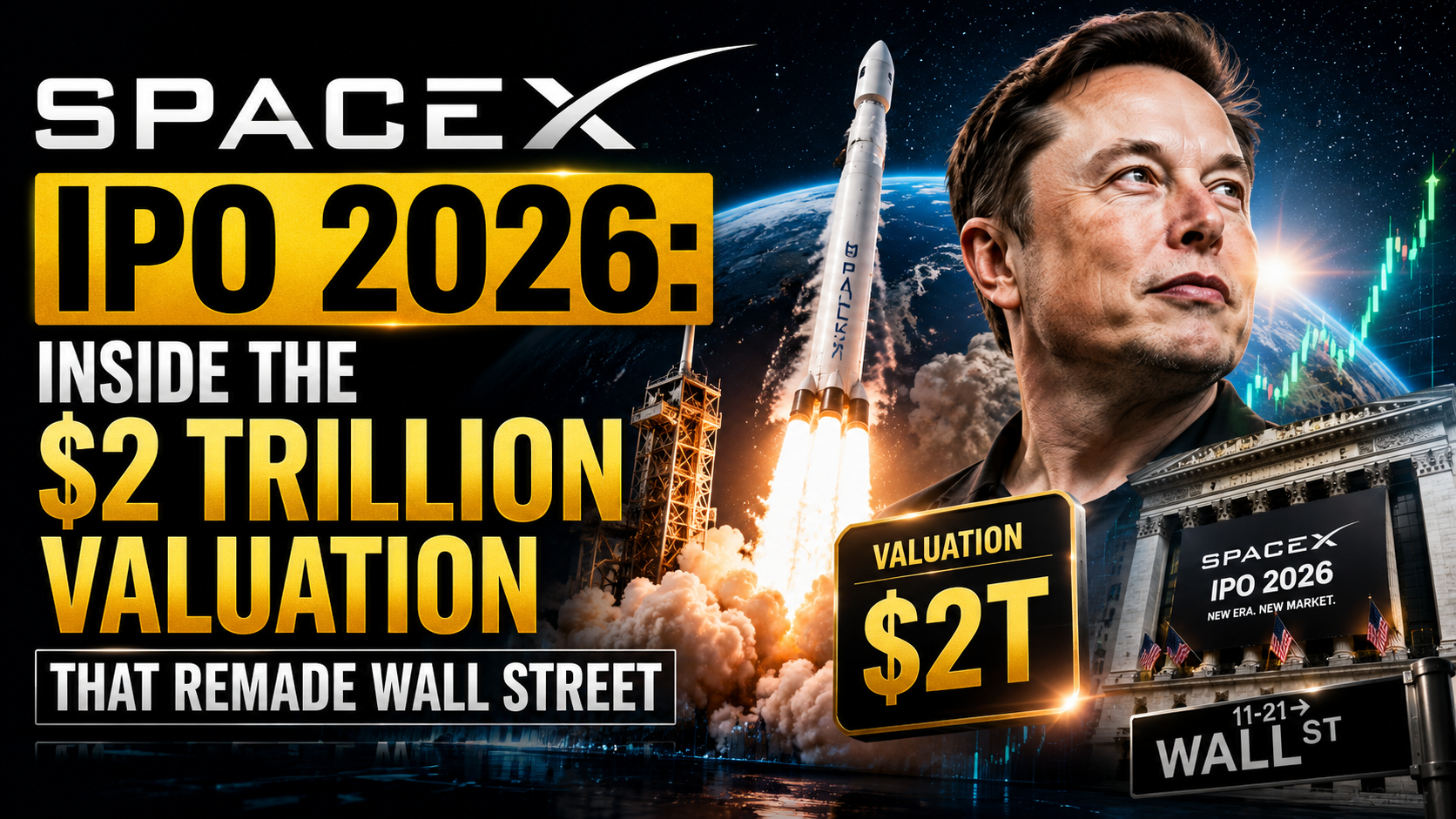
SpaceX’s June 2026 IPO became the largest in history. We examine the bull case, the overvaluation warnings, Musk’s voting control, and what SPCX’s Nasdaq-100 fast-track means for markets.When the Nasdaq opening bell rang at SpaceX’s Starbase headquarters in Texas on June 12, 2026, Elon Musk did not just take a rocket company public. He rewrote the rules of what a market capitalisation could mean in the age of artificial intelligence. Within hours, SpaceX had closed at $160.95 per share, implying a market capitalisation of roughly $2.1 trillion — making it the sixth most valuable publicly traded company in the United States and minting Musk as the world’s first dollar trillionaire.
The event was, by any measure, the largest initial public offering in financial history, surpassing Saudi Aramco’s 2019 debut. SpaceX priced at $135 per share, raising $75 billion for the company’s long-term ambitions — including building data centres in space — with underwriters holding an option to purchase an additional 83 million shares. Goldman Sachs led the bookrunning syndicate, flanked by Morgan Stanley, Bank of America, Citigroup, and JPMorgan Chase.
Yet beneath the spectacle lies one of the most contested valuation debates modern finance has seen.
The xAI Wildcard: Merger, Compute, and the Grok Economy
The deal’s complexity owes much to SpaceX’s February 2026 acquisition of Musk’s artificial intelligence company xAI, in a transaction that valued the combined entity at $1.25 trillion. That merger folded xAI’s Grok chatbot and the Colossus supercomputer — currently the world’s largest AI training cluster at one million GPUs — into the space company’s balance sheet.
The commercial logic is not trivial. Google signed a cloud computing agreement in June 2026 to pay $920 million per month for capacity from Colossus, covering approximately 110,000 Nvidia GPUs needed to power Google’s Gemini models. Anthropic has signed a similar arrangement. These contracts transform SpaceX from a pure-play launch-and-satellite business into a vertically integrated AI infrastructure company — one with orbital compute capacity as its long-term differentiator.
Starlink, the only clearly profitable division at IPO, reported quarterly revenue of $3.26 billion, with subscribers projected to grow from 10 million to nearly 17 million during 2026. That commercial foundation gave bulls a credible anchor for the listing price.
The Bear Case: Morningstar’s $780 Billion Counter-Narrative
Not everyone celebrated. Morningstar analysts valued SpaceX at $780 billion — roughly 48% below the IPO price — warning that the company had been “significantly overvalued.” The firm found xAI’s economic moat “indeterminate” and cited SpaceX’s net loss of $4.28 billion in its most recent quarter as evidence that the profitability story remained aspirational.
The valuation multiple was staggering by conventional metrics. At $1.75 trillion, SpaceX carried a price-to-sales ratio of 67 times — three times Nvidia’s rating based on its prior financial year. Dan Coatsworth of AJ Bell described the implied valuation as richer than “a plate of dauphinoise potatoes.” Ross Gerber of Gerber Kawasaki, an existing shareholder, called the IPO price “alarming,” noting that SpaceX had been valued at just $400 billion thirteen months earlier.
The counter-argument from supporters: that earlier valuation was wrong, not the current one. The xAI contracts with Google and Anthropic, they argue, validate a new category of orbital compute revenue that no prior financial model had priced in.
Governance, Voting Control, and the Musk Premium
Perhaps the most structurally consequential aspect of the IPO is its governance architecture. Musk controls 42% of SpaceX’s economic interest but holds 82% of the voting power through a dual-class share structure — Class A shares for public investors, Class B shares conferring superior voting rights to Musk. Tesla, where Musk also serves as CEO, holds 18.99 million SpaceX shares valued at $2.56 billion at the IPO price. The two companies have shared personnel, pooled resources, and hold licensing agreements — raising persistent speculation about an eventual merger that Musk has privately discussed with colleagues.
Public investors, in effect, are purchasing participation in Musk’s judgment without meaningful ability to constrain it.
The Nasdaq-100 Fast-Track: A Rules Revolution
Institutional mechanics amplified the IPO’s market impact. Nasdaq changed its index eligibility rules specifically to accommodate SpaceX, allowing inclusion in the Nasdaq-100 just 15 trading days post-IPO rather than the standard minimum of three to twelve months. SpaceX joined the index effective July 7, 2026. FTSE Russell simultaneously added SPCX to its U.S. equity indexes during its semi-annual reconstitution.
The consequence: passive funds tracking these benchmarks — collectively managing tens of trillions of dollars — were required to purchase SPCX shares, creating structural buying pressure independent of fundamental views. Critics warned that only 5% of SpaceX shares were initially available to the public, meaning this mandatory passive demand would exert enormous price influence over a thin float.
What the SpaceX IPO Means for the Global Capital Markets Landscape
The implications extend far beyond one company’s listing. SpaceX’s debut signals that AI infrastructure — whether terrestrial or orbital — commands valuation multiples previously reserved for pure software businesses with near-zero marginal costs. It also signals that the era of founder-controlled dual-class structures has reached its logical apex: a company generating multi-billion-dollar quarterly losses, led by a CEO simultaneously running multiple trillion-dollar enterprises, has become the sixth most valuable public equity on earth.
For investors, the critical question is whether the Grok-Google-Anthropic compute contracts represent genuine recurring revenue or one-time promotional arrangements. For regulators, the governance structure raises the question of whether index providers, by fast-tracking inclusion, have effectively subsidised a valuation that independent analysts find unjustifiable. For the broader market, SPCX is now a systemic variable — its trajectory will move the Nasdaq-100.
Discover more from The Economy
Subscribe to get the latest posts sent to your email.



Records in the IPO market rarely last long during a boom cycle — and 2026 is proving that in dramatic fashion. SpaceX’s June debut set an all-time high for IPO size, raising roughly $75 billion at a valuation near $1.8 trillion. Just months later, Anthropic is reportedly positioning for a listing that could push past that mark entirely, with investors discussing a valuation of $2 trillion or more. Here’s how the two offerings actually compare, and what it would take for Anthropic to claim the record.
Key Takeaways
- SpaceX’s June 12, 2026 IPO priced at $135 per share, raising approximately $75 billion and closing its first day near a $2.1 trillion market cap.
- Anthropic’s reported target valuation of ~$2 trillion would rival or exceed SpaceX’s opening print, and comfortably exceed SpaceX’s settled valuation of roughly $1.5–1.84 trillion.
- U.S. IPOs had raised $160.6 billion through August 19, 2026 — closing in on the 2021 full-year record of $195.2 billion, with months still to go.
- Both companies share a structural quirk that amplifies price moves: an unusually low free float at listing.
- Anthropic’s IPO is reportedly targeted for September or October 2026, which would put the two largest offerings in history within roughly four months of each other.
Setting the Bar: What SpaceX Actually Did
SpaceX’s IPO on June 12, 2026 was, by nearly every measure, historic. The company priced shares at $135, raising approximately $75 billion in the offering — the largest capital raise ever completed in a single IPO. Its market capitalization closed the first trading day near $2.1 trillion before settling into a range closer to $1.5 trillion by late July, and has since stabilized around $140 per share, implying a market cap of roughly $1.84 trillion.
That settling pattern — a dramatic first-day pop followed by a pullback — is common in low-float IPOs, where a small percentage of total shares outstanding are actually available to trade. Early price discovery in these situations tends to overshoot before institutional and retail flows normalize the price closer to fundamental value.
The Anthropic Comparison, Side by Side
| Metric | SpaceX (June 2026) | Anthropic (Reported Target) |
|---|---|---|
| IPO date | June 12, 2026 | September–October 2026 (expected) |
| Offer price | $135/share | Not yet set |
| Capital raised | ~$75 billion | Not yet disclosed |
| First-day peak valuation | ~$2.1 trillion | Unknown |
| Settled valuation | ~$1.5–1.84 trillion | Target: ~$2 trillion |
| Lead underwriters | Morgan Stanley, Goldman Sachs, JPMorgan | Morgan Stanley, Goldman Sachs, JPMorgan (reported) |
| Revenue backing | Aerospace/launch contracts | AI/software, ~$65B run rate |
| Free float at listing | Low | Reportedly low (single-digit %) |
The most important distinction: SpaceX’s valuation is anchored in aerospace infrastructure, satellite internet (Starlink), and government/commercial launch contracts — a capital-intensive but tangible-asset-heavy business. Anthropic’s valuation, by contrast, rests almost entirely on software revenue growth and AI model licensing — an asset-light but computationally expensive business model with a much steeper, more recent growth curve.
Why Anthropic Could Actually Take the Record
- A steeper growth trajectory. Anthropic’s revenue run rate grew roughly sevenfold in about seven months (from $9B to $65B). Few companies of any kind — let alone one preparing a public listing — have shown that rate of acceleration this close to an IPO.
- Two-year forward pricing. Bankers are reportedly using a 2028 revenue projection of $190–200 billion to justify the $2 trillion figure, implying a roughly 10x forward multiple — a framework that gives more room to argue for a higher headline valuation than a purely trailing-revenue approach would.
- A hot IPO market overall. With $160.6 billion already raised across U.S. IPOs through mid-August 2026, nearing the full-year 2021 record of $195.2 billion, market conditions are unusually supportive of large, ambitious offerings.
- Underwriter reuse and confidence. The same lead banks that priced SpaceX’s record deal are reportedly leading Anthropic’s — suggesting they believe the market can support back-to-back trillion-dollar-plus tech listings within the same year.
Why It Might Not Happen
- The $2 trillion figure is unconfirmed. It comes from investors and bankers circling the deal, not from Anthropic’s own guidance. SpaceX’s final valuation, by contrast, was a completed, priced transaction.
- A run rate isn’t revenue. Anthropic’s $65 billion figure is an extrapolation from a short, recent period. If growth decelerates even modestly before pricing, the valuation math could compress.
- Post-listing performance matters more than headline valuation. SpaceX’s first-day peak of ~$2.1 trillion wasn’t sustained — it settled meaningfully lower within weeks. Anthropic could technically “beat” SpaceX’s opening valuation and still underperform it on a settled, weeks-later basis.
- Market conditions can shift quickly. A cooling in the broader 2026 IPO boom between now and Anthropic’s expected September–October window could compress achievable pricing.
What “Largest IPO Ever” Actually Measures
It’s worth being precise about what record is actually being discussed, because there are at least three distinct measures:
- Capital raised — the actual dollar amount sold to investors (SpaceX: ~$75 billion)
- Valuation at pricing — the implied market cap based on the offer price (SpaceX: ~$1.8 trillion)
- First-day peak market cap — the highest valuation reached during initial trading (SpaceX: ~$2.1 trillion)
Anthropic could plausibly set a record on one of these measures without setting a record on all three — for instance, achieving a higher headline valuation target while raising less absolute capital than SpaceX did, depending on how many shares the company decides to sell in the offering.
FAQ
Is Anthropic definitely going to have the largest IPO in history? Not confirmed. Investors and bankers are reportedly targeting a valuation around $2 trillion, which would exceed SpaceX’s settled valuation and rival its first-day peak, but no final valuation, share price, or capital raise amount has been set.
How much did SpaceX raise in its IPO? SpaceX raised approximately $75 billion in its June 12, 2026 IPO, pricing shares at $135 and reaching a first-day market cap near $2.1 trillion.
Why do both SpaceX and Anthropic have such volatile early trading potential? Both companies reportedly have a low free float — a small percentage of total shares available for public trading at listing — which tends to amplify price swings in both directions during early trading.
Could Anthropic’s IPO underperform SpaceX’s despite a higher target valuation? Yes. A higher headline target valuation doesn’t guarantee stronger post-listing performance. SpaceX itself saw its valuation compress from a $2.1 trillion first-day peak to roughly $1.5 trillion within weeks before stabilizing.
Discover more from The Economy
Subscribe to get the latest posts sent to your email.
When a company chooses its underwriters, it’s telling the market something before a single share trades. Anthropic’s reported selection of Morgan Stanley and Goldman Sachs — alongside JPMorgan — as lead banks on its expected IPO is being read by Wall Street as a signal of confidence in the company’s ability to command a valuation near $2 trillion. Here’s what these roles actually mean, mechanically and strategically, for anyone considering an investment.
Key Takeaways
- Morgan Stanley reportedly holds the “pole position” for the coveted lead-left spot on Anthropic’s IPO, according to sources cited by the Financial Times.
- Goldman Sachs is running “neck-and-neck” with Morgan Stanley for a top-tier underwriting role.
- JPMorgan, Citigroup, and Barclays are expected to round out the broader syndicate.
- These same three lead banks — Morgan Stanley, Goldman Sachs, and JPMorgan — anchored the SpaceX IPO in June 2026, the current record-holder for largest offering.
- The banks previously provided Anthropic with debt financing, including work toward a reported $15 billion pre-IPO credit facility.
- Underwriter selection influences pricing strategy, institutional allocation, and after-market stabilization — all of which affect retail investors indirectly.
What “Lead-Left” Actually Means
In IPO terminology, the lead-left bank is the underwriter listed first (traditionally on the left side) on the cover of the prospectus — a position that comes with outsized responsibility and outsized reward. The lead-left bank typically:
- Runs the bookbuilding process, collecting and aggregating institutional investor orders
- Sets the final offer price in coordination with the issuer’s board
- Takes the largest underwriting fee allocation among the syndicate
- Leads after-market stabilization activities, including exercising the “greenshoe” over-allotment option if the stock trades up
- Serves as the primary point of contact between the company and public market investors during the roadshow
If Morgan Stanley secures this role for Anthropic, as reporting suggests is likely, it puts the bank in the driver’s seat for what could be the largest IPO ever completed — surpassing even its own recent work, alongside Goldman Sachs and JPMorgan, on the SpaceX offering.
Why Two (or Three) Top-Tier Banks Matters for Investors
A syndicate anchored by Morgan Stanley and Goldman Sachs — both perennially ranked among the top global equity underwriters — sends a specific signal: institutional demand is expected to be deep enough to require serious distribution muscle. For investors, this translates into a few practical implications:
- Broader institutional reach. These banks’ wealth management and institutional sales networks span pension funds, sovereign wealth funds, and large asset managers globally, which typically supports stronger initial demand and a more orderly aftermarket.
- More rigorous pricing discipline. Top-tier lead underwriters have reputational incentive to avoid a “busted IPO” — a listing that trades below its offer price shortly after debut — because it damages their standing for future mandates.
- Deeper aftermarket support. Lead banks typically commit capital to stabilize the stock in early trading through the over-allotment mechanism, which can reduce (though not eliminate) early volatility.
The Debt-Equity Connection: Why the $15 Billion Credit Facility Matters Here
It’s not a coincidence that the banks reportedly structuring Anthropic’s equity offering previously provided the company with debt financing. Morgan Stanley, Goldman Sachs, and JPMorgan are also reportedly involved in finalizing a $15 billion pre-IPO credit facility for Anthropic — capital that gives the company balance sheet flexibility to fund continued compute infrastructure buildout independent of the equity raise itself.
This dual relationship — debt financier and equity underwriter — is common for large-cap tech IPOs and gives the lead banks unusually deep visibility into Anthropic’s financials heading into the roadshow. For investors, that can be read two ways:
- Bullish read: The banks have extensive due diligence exposure and are still willing to lead a ~$2 trillion offering.
- Cautious read: The banks have a strong financial incentive (underwriting fees plus debt relationship preservation) to see the deal price successfully, which doesn’t guarantee the valuation is fundamentally sound.
Historical Precedent: The SpaceX Playbook
Morgan Stanley, Goldman Sachs, and JPMorgan ran the book on SpaceX’s IPO in June 2026, which priced at $135 per share and raised approximately $75 billion at a valuation near $1.8 trillion — the current record for largest IPO in history. That stock has since traded in a range from a first-day peak near $2.1 trillion market cap down to roughly $1.5 trillion by late July, before stabilizing.
The reuse of essentially the same underwriting trio for Anthropic suggests the banks are applying lessons learned from the SpaceX process — particularly around managing a low free-float listing, which both companies share as a structural feature.
| Deal Element | SpaceX (June 2026) | Anthropic (Expected) |
|---|---|---|
| Lead underwriters | Morgan Stanley, Goldman Sachs, JPMorgan | Morgan Stanley, Goldman Sachs, JPMorgan (reported) |
| IPO valuation | ~$1.8 trillion | ~$2 trillion (target, unconfirmed) |
| Capital raised | ~$75 billion | Not yet disclosed |
| Post-IPO price action | Peaked ~$2.1T, settled ~$1.5T | Unknown |
| Free float | Low | Reportedly low (~4% range in some estimates) |
Risks the Underwriter Roster Doesn’t Solve
Even the strongest underwriting syndicate can’t eliminate fundamental risk. Investors should keep in mind:
- A low float amplifies volatility regardless of which bank is managing the book — SpaceX’s post-IPO price swing from $2.1T to $1.5T illustrates this even with top-tier underwriters involved.
- Underwriter confidence is not a valuation guarantee. Banks earn substantial fees regardless of long-term stock performance; their willingness to lead the deal reflects market appetite and relationship value, not a certification of fair value.
- Multiple additional banks joining the syndicate (Citigroup, Barclays) spreads risk but also dilutes any single bank’s accountability for pricing outcomes.
FAQ
What does it mean that Morgan Stanley is the “lead-left” bank on Anthropic’s IPO? It means Morgan Stanley would run the bookbuilding process, help set the final offer price, and lead after-market stabilization — the most influential and highest-fee role in the underwriting syndicate.
Does Goldman Sachs having a top role change the IPO outlook?
Having two top-tier global banks (Morgan Stanley and Goldman Sachs) sharing lead roles typically signals strong expected institutional demand and broader distribution capacity, though it doesn’t guarantee post-IPO stock performance.
Are Morgan Stanley and Goldman Sachs also lending Anthropic money?
Yes — reporting indicates these banks previously provided debt financing to Anthropic and are involved in structuring a reported $15 billion pre-IPO credit facility alongside their equity underwriting roles.
Did the same banks handle the SpaceX IPO?
Yes. Morgan Stanley, Goldman Sachs, and JPMorgan anchored the SpaceX IPO in June 2026, which currently holds the record for the largest offering in history.
Discover more from The Economy
Subscribe to get the latest posts sent to your email.
Anthropic is preparing for a possible October 2026 IPO with Morgan Stanley, Goldman Sachs and JPMorgan as lead underwriters, targeting a valuation close to or above $1 trillion — up from a $965 billion private valuation set in a May 2026 funding round. The listing would put Anthropic ahead of rival OpenAI, which has pushed its own IPO target from late 2026 into 2027.
Beyond the valuation headline
Most coverage of the Anthropic IPO has focused on a single number — the trillion-dollar valuation threshold. The more useful story for investors and market-watchers is the sequencing: why Anthropic is moving first, what its revenue trajectory actually looks like against that valuation, and what risks sit underneath the number that don’t show up in the headline.
Where things stand
Bankers working on Anthropic’s offering began scheduling meetings with prospective institutional investors in mid-July, according to reporting that cited people familiar with the process — a concrete signal that the company’s move toward a public listing, possible as early as October 2026, is advancing beyond speculation (CNBC via StartupHub; CNBC).
The valuation anchor is a $65 billion Series H funding round closed in May 2026, which pushed Anthropic’s post-money valuation to roughly $965 billion — surpassing OpenAI’s $852 billion valuation for the first time (CNBC; IG UK). Investment bankers and analysts widely expect the company to debut above the $1 trillion mark, assuming market conditions cooperate (IG UK).
Secondary-market pricing offers an early read on investor appetite: platforms tracking pre-IPO share transfers have shown an implied valuation range between roughly $1.05 trillion and $1.15 trillion, with one forecasting firm projecting a median first-day market capitalisation around $1.10 trillion — a 14% premium over the last private funding round (BitMEX).
The race against OpenAI
Timing is a deliberate part of the strategy. OpenAI also filed confidentially for an IPO but has since pushed its target from fall 2026 into 2027, giving Anthropic a window to list first (TheStreet). Being first matters for two structural reasons market analysts point to: the first mover sets the valuation benchmark the rest of the sector gets measured against, and it locks in institutional capital before broader AI-market sentiment has a chance to shift (TheStreet).
Prediction markets appear to be pricing that race directly: platform Kalshi has shown roughly a 72% probability of Anthropic listing before OpenAI, according to reporting (TheStreet).
The revenue math underneath the number
The valuation is aggressive relative to revenue by conventional software standards, though analysts describe it as within the range frontier AI companies have been commanding. Reported figures put Anthropic’s annualized revenue run-rate at roughly $47 billion as of May 2026, against the $965 billion private valuation — an implied multiple of around 20 times revenue (Luminix).
What stands out in the growth trajectory cited by analysts is its pace: the annualized run-rate reportedly moved from roughly $9 billion at the end of 2025 to $14 billion in February, $30 billion in April, and $47 billion by May — a rate of increase some analysts have described as effectively doubling every six weeks at points during that stretch (Luminix).
The consumer-versus-enterprise question
One structural risk analysts flag: Anthropic’s business is heavily weighted toward enterprise and API customers rather than consumer brand recognition. Estimates cited in investor analysis put ChatGPT’s share of consumer AI traffic at 53-68%, against roughly 2-6% for Claude (Luminix). That makes the IPO pitch to retail investors — who tend to reward consumer familiarity — different in kind from the enterprise-stickiness argument likely to anchor the institutional roadshow.
The SpaceX precedent looming over the deal
Anthropic’s timing follows closely behind SpaceX’s Nasdaq debut on June 12, 2026, which raised approximately $75 billion at a $1.77 trillion valuation under ticker SPCX. SpaceX shares have since fallen below their $135 IPO price — a data point IPO advisers and institutional buyers are reportedly weighing carefully as they assess how much premium markets will actually pay for a loss-making frontier technology company at IPO (StartupHub).
What’s confirmed versus speculative
It’s worth separating fact from forecast here. Confirmed: the confidential S-1 filing, the underwriter roster (Morgan Stanley, Goldman Sachs, JPMorgan), the $965 billion May funding round, and the ongoing investor meetings. Not yet confirmed: the actual offering price range, the exact IPO date, and the final valuation — none of which will be public until the S-1 is unsealed, expected in the lead-up to any autumn listing.
Anthropic has also taken an unusual defensive step ahead of the listing, warning multiple secondary-market platforms — including Forge, Hiive and Sydecar — that unauthorised transfers of its private shares are void and will not be recognised on the company’s books, a signal of how closely it is trying to control pre-IPO trading and pricing signals ahead of an official debut (IG UK).
The bottom line
For the nine markets covered in this analysis, the Anthropic listing is less a Silicon Valley story than a global capital-markets event: a trillion-dollar-plus debut would be among the largest IPOs in history, competing directly with OpenAI for the same pool of institutional capital and setting the valuation benchmark every subsequent AI listing — in the US, Singapore, the UK or elsewhere — will be measured against.
Discover more from The Economy
Subscribe to get the latest posts sent to your email.

Stock Market Crash 2026? How the Trump $5,000 Dividend Impacts Global Inflation

Tax-to-GDP Ratio Explained: Global Benchmarks, Fiscal Sovereignty & 2026 Insights

Trade Deficit & Terms of Trade Explained: Global Impact, Real-World Examples, and 2026 Insights

Supply vs Demand Shocks Explained: Market Equilibrium, Inflation Risks & Policy Responses in 2026

Microeconomics vs. Macroeconomics Explained: Key Differences, Interdependence & Global Impact

Devaluation vs Depreciation: Clear Differences, Causes, and Economic Impact

Purchasing Power Parity (PPP) Explained: Global Rankings, Living Standards & Why Nominal Exchange Rates Mislead in 2026

Remittances 2026: Global Trends, Household Resilience & Economic Lifeline for Developing Nations

Stagflation Explained: Causes, Global Impact & 2026 Economic Outlook

Understanding Foreign Exchange Reserves: Key Purposes and Global Impact

The Business of Gaming and Tech: How Global Economies Are Driven by Digital Consumerism

Crypto Daily Outlook: Bitcoin, Altcoins, and the Future of Decentralized Finance

Anthony Scaramucci’s Crypto Prediction: Why MicroStrategy’s Move Is Bitcoin’s “iPhone Moment”

Best Dividend Stocks 2026: European & Asian Blue Chips

State Farm’s $5B Dividend 2026: Who Qualifies & Payout Dates

US-China Relations in Q3 2026: Trade Tariffs and Supply Chain Risks

Gold’s Wild 2026: From a Record $5,600 Peak to a 24% Crash and Back Toward $4,500

Oil Surges as Strait of Hormuz Traffic Collapses Again

The Rocket That Won’t Quit: Inside SpaceX’s Falcon 9 Launch Machine

Bank of England Set to Hold Rates Through Year-End, Reuters Poll Shows

SpaceX Starship Flight 14: First Orbital Attempt & Starlink V3 Launch Explained

The 2026 Crypto Regulatory Shift: What It Means for Institutional Investors

AI Chip Stocks 2026: The Best Semiconductor Investments Beyond Marvell

Top 30 Stocks for Investment in PSX for Massive ROI in 2026

Retail Earnings Week: What Home Depot, Target & Walmart Reveal

AI-Powered Training: The Next Multi-Billion Dollar Ecosystem in Fitness

Russia’s Black Sea Oil Exports Fall for a Fifth Straight Week

Tween Back-to-School Trends 2026: What’s Driving the $85B Season
-

 Markets & Finance8 months ago
Top 15 Stocks for Investment in 2026 in PSX: Your Complete Guide to Pakistan’s Best Investment Opportunities
-

 Analysis7 months ago
Johor’s Investment Boom: The Hidden Costs Behind Malaysia’s Most Ambitious Economic Surge
-

 Analysis7 months ago
Top 10 Stocks for Investment in PSX for Quick Returns in 2026
-

 Analysis7 months ago
Brazil’s Rare Earth Race: US, EU, and China Compete for Critical Minerals as Tensions Rise
-

 Banks8 months ago
Best Investments in Pakistan 2026: Top 10 Low-Price Shares and Long-Term Picks for the PSX
-

 Investment8 months ago
Top 10 Mutual Fund Managers in Pakistan for Investment in 2026: A Comprehensive Guide for Optimal Returns
-

 Global Economy9 months ago
15 Most Lucrative Sectors for Investment in Pakistan: A 2025 Data-Driven Analysis
-

 Global Economy9 months ago
Pakistan’s Export Goldmine: 10 Game-Changing Markets Where Pakistani Businesses Are Winning Big in 2025