
Analysis
Google $135M Android Settlement: Who Qualifies and What to Do Now

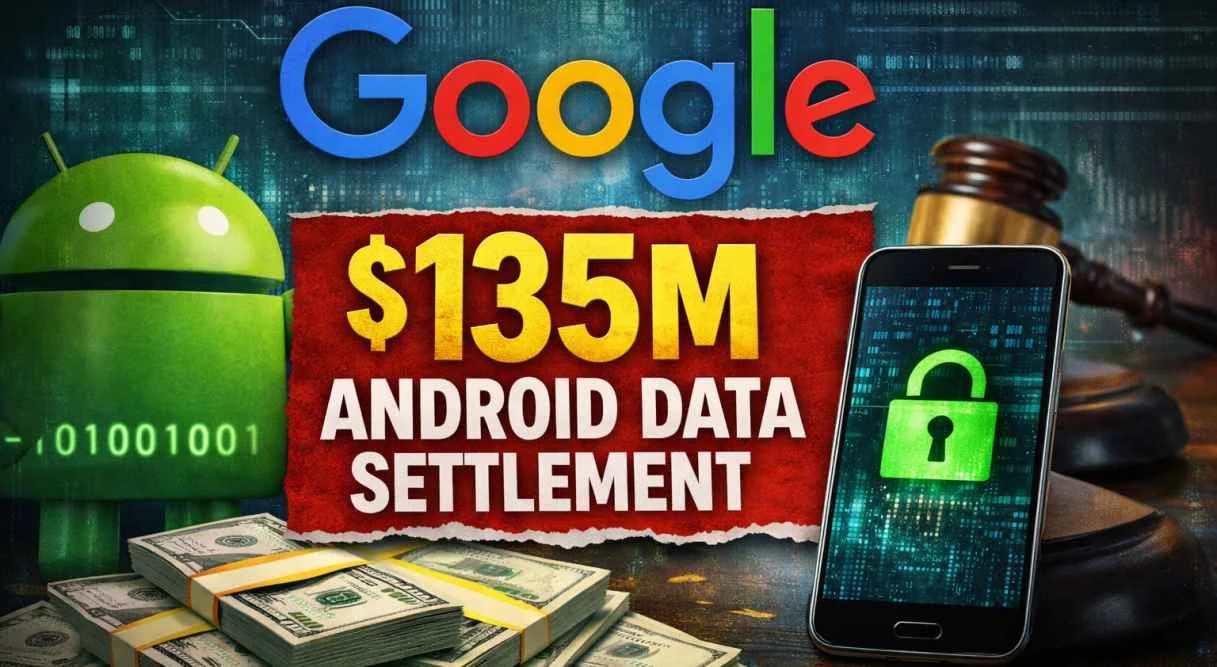
The opt-out deadline is tomorrow. If you’ve carried an Android phone on a carrier plan since late 2017, you may already be enrolled in a $135 million class action settlement against Google — and you have until May 29, 2026 to decide what to do about it.
Most people won’t act. That’s precisely what makes this moment worth understanding.
The case, Taylor et al. v. Google LLC (Case No. 5:20-cv-07956-VKD), was filed in the U.S. District Court for the Northern District of California. It alleges that Google quietly programmed Android devices to beam user data back to its servers over cellular networks — without user knowledge, without user consent, and at users’ own cellular data expense — even when those devices were completely idle and connected to Wi-Fi. An estimated 100 million Americans meet the eligibility threshold. The math on what each person actually receives is, to put it charitably, sobering.
But the real story here isn’t the dollar amount on anyone’s Venmo notification.
The Core Case: What Google Is Accused of Doing
The Google Android settlement draws its legal force from a theory of “conversion” — a civil claim that occurs when one party appropriates another’s property without permission. In this context, the plaintiffs argued that cellular data, which users pay for by the gigabyte, is property. Google was accused of “designing the Android operating system to collect vast amounts of information about its users,” effectively forcing those users to “subsidize its surveillance by secretly programming Android devices to constantly transmit user information to Google in real time.” Yahoo!
The complaint went further. The suit stated that these transfers consumed users’ cellular data and occurred in the background, “without any notice to the user, including when the devices are in a completely idle state.” Closing an app, disabling location sharing, locking the screen — none of it stopped the data flow, the plaintiffs alleged. NBC Chicago
Google denied any wrongdoing. It still does. But rather than risk a jury trial — which was set for August 5, 2026 if the settlement collapsed — the company agreed in January 2026 to pay $135 million into a non-reversionary fund. Judge Virginia K. DeMarchi granted preliminary approval on March 5, 2026, with the final approval hearing scheduled for June 23, 2026. Openclassactions
To qualify, you must be a U.S. resident who used an Android device with a carrier data plan at any point since November 12, 2017. California residents are excluded — they were already compensated in a parallel state court action. That earlier case, Csupo v. Google LLC, settled in July 2025 for $314.6 million and covered approximately 14 million California Android users. TimeClassAction.org
No claim form is required. Payments are automatic, delivered via Zelle, PayPal, Venmo, ACH transfer, or virtual Mastercard — but you must select a payment method before the May 29 deadline or risk not receiving anything at all. Theclassactionlawsuit
How Much Will You Actually Get — and Why the Number Is Small
Here is the question everyone is asking, and it deserves a direct answer.
What is the estimated payout from the Google Android settlement? After deducting attorney fees, administrative costs, and service awards to the three named plaintiffs, the net fund available to class members is approximately $85 million. Divided across 100 million eligible claimants, that works out to roughly $1.01 to $1.48 per person. If fewer people successfully receive payment, leftover funds would be redistributed — up to a cap of $100 per person.
That figure — slightly more than a dollar — sounds like a punchline. It isn’t, quite.
Plaintiffs’ counsel, Bartlit Beck LLP and Korein Tillery LLC, indicated they may seek up to $39,825,000 in fees — roughly 29.5% of the gross fund — plus $750,000 in costs and service awards of up to $25,000 each for the three named plaintiffs, Joseph Taylor, Mick Cleary, and Jennifer Nelson. Openclassactions
That fee structure is standard in class action practice. Attorneys work entirely on contingency; they collect nothing if the case fails. Yet it means that nearly 30 cents of every dollar Google pays goes to the lawyers, not the users whose data was allegedly taken. It’s a structure that critics of the class action system have long targeted — and one that rarely changes, because the incentives for the parties at the table don’t demand it.
Still, size of individual payment is the wrong metric. The question worth asking is what changes in Google’s behaviour. As part of the settlement, Google is required to update its Play Terms of Service, Help Centre, and Android setup screens to disclose the data transfers and ask users to consent — and to disable a related setting on Android devices. Whether those disclosures arrive in plain language or in the fine-print tradition that has defined tech industry privacy notices for two decades remains to be seen. Theclassactionlawsuit
Implications: What This Settlement Signals About Big Tech’s Privacy Reckoning
The $135 million figure is large enough to generate headlines and small enough that it won’t alter Google’s quarterly earnings by a rounding error. Alphabet posted revenues of over $350 billion in 2024. This settlement represents roughly 0.04% of that. For Google, it is less a punishment than a cost of doing business.
Yet the cumulative picture is different. In a separate case, Rodriguez v. Google LLC, a jury delivered a $425 million verdict against Google for saving consumer data from third-party apps after users had explicitly asked the company not to track them — with plaintiffs arguing the opt-out function was, in effect, fake. Simultaneously, Google agreed to a $68 million settlement over the Google Assistant’s “false accepts” — instances where the voice assistant activated and recorded conversations without the user saying the designated trigger phrase, accumulating nearly seven years of legal proceedings before Google chose to settle. HuntonFindLaw
Last October, Texas Attorney General Ken Paxton finalised a $1.375 billion settlement with Google over violations of Texans’ privacy rights — the largest data privacy enforcement action ever brought by a single state. Office of the Attorney General
What emerges from this pattern isn’t a company making isolated mistakes. It’s a portrait of a business model that was built — from advertising infrastructure to operating system design — around data accumulation, and that is now facing the compounding legal consequences of that architecture across multiple jurisdictions simultaneously.
The broader enforcement environment has shifted, too. Google’s $391.5 million location-tracking settlement involved forty state attorneys general acting in concert — a coordinated enforcement bloc that would have been unthinkable a decade ago. Facebook’s $725 million Cambridge Analytica class action, meanwhile, remains the largest single consumer data settlement on record, setting a ceiling that regulators and plaintiffs’ attorneys now routinely reference in demand letters. UniConsent
The message to the technology industry is unambiguous: the cost of non-disclosure is rising faster than the cost of disclosure.
The Case for Scepticism: Does Any of This Actually Change Anything?
There’s a legitimate counterargument, and it deserves honest treatment.
Critics of privacy class actions — including several legal scholars and a number of consumer advocacy groups — argue that mega-settlements of this kind function more as institutional theatre than genuine deterrence. The companies involved do not admit wrongdoing. They pay, they adjust a disclosure screen, and they return to normal operations. Individual class members receive, in this case, amounts that wouldn’t cover a cup of coffee. Meanwhile, the data collection infrastructure that gave rise to the lawsuit remains substantially intact.
Google has agreed, as part of this settlement, to changes in how it discloses data usage and gives users more control over background data collection. But the broader takeaway is still Big Tech writing big checks — and users left wondering whether anything really changes. WROK
There’s also a structural problem with the class action mechanism itself. When 100 million people are affected by the same conduct, their collective harm may be enormous — but the logistics of distributing $85 million across that population produces payments so small that most recipients will never notice them. The primary financial beneficiaries of the settlement, by any honest accounting, are the attorneys.
That is not an argument against class actions per se. Without them, the Taylor case almost certainly never reaches trial. Individual plaintiffs have neither the resources nor the incentive to sue a trillion-dollar company over $1.50 of cellular data. The mechanism exists precisely to aggregate claims that would otherwise go unpursued. The question is whether the current fee structure serves the public interest — or primarily serves a specialist bar that has learned to monetise mass grievance.
The Wider Picture, and What Comes Next
The Taylor settlement sits at an inflection point in the decades-long negotiation between consumers, technology companies, and the courts over the meaning of digital privacy.
The June 23 hearing before Judge DeMarchi will almost certainly result in final approval — settlements of this structure rarely fall apart at the final stage. Payments will follow in late 2026, once any appeals are resolved. Most eligible users will receive their dollar-and-change without ever knowing the case existed. A smaller number will have opted out by tomorrow’s deadline, preserving their right to pursue individual claims — a theoretically available option that, for most, is purely academic.
What matters more, in the long run, is the behavioural and regulatory pressure these cases generate over time. Not any single settlement, but the accumulated cost — legal, reputational, operational — of building products that treat user data as an inexhaustible, uncompensated resource. Google is a different company in 2026 than it was when the Taylor complaint was first filed in 2020. Some of that difference reflects genuine product evolution. Some of it reflects the fact that litigation is expensive and verdicts are unpredictable.
The next case is already filed somewhere.
Discover more from The Economy
Subscribe to get the latest posts sent to your email.



Key Takeaways
- Rolex’s secondary market rose approximately 7.9% year-over-year as of 2026 (per WatchCharts data) — trailing Patek Philippe (+16.2%) and Tudor (+11.4%) but still outperforming Audemars Piguet (+3.4%).
- Rolex raised U.S. retail prices 4–9% in January 2026 (steel models ~5.6%, gold models ~8.7%), narrowing the historical gap between retail and pre-owned pricing.
- Not every model appreciates: steel sports references (Submariner, GMT-Master II, Daytona) have held value far better than two-tone or widely available dress references like the standard Datejust.
- The Lady-Datejust posted the sharpest 2026 gain among tracked collections — up 22.73%, from roughly $9,269 to $11,376 — driven by demand for smaller, “everyday luxury” watches.
- Gold’s rise past $2,400/oz has directly lifted the investment case for Rolex’s precious-metal references (Day-Date, Sky-Dweller, Yacht-Master).
The Model-by-Model Picture
| Category | 2026 Trend |
|---|---|
| Lady-Datejust | +22.73% (strongest performer among tracked collections) |
| Steel sports models (Submariner, GMT-Master II) | Held value well; corrected from 2022 peak but stabilized above retail |
| Daytona | Corrected from highs above $50,000 to the mid-$30,000s; still among the most sought-after references |
| Two-tone/widely available Datejust | Flat to negative — “holds value” is an overstatement for this category |
| Gold references (Day-Date, Sky-Dweller) | Lifted by gold’s rise above $2,400/oz |
Why the “Rolex Always Appreciates” Myth Is Fading
The pandemic-era boom pushed some references — the Daytona above all — to speculative highs disconnected from historical norms. Since the March 2022 peak, steel sports models have compressed meaningfully, and dealers who bought inventory near the top have in some cases faced 20–40% markdowns on liquidation. The lesson for 2026 buyers: Rolex as a category is not a monolith. Value retention depends heavily on specific reference, condition, and whether the piece comes with box and papers (“full set”).
What’s Actually Driving 2026 Strength
- Retail price increases raise the floor. When a new Submariner retails at $10,050 (up from $9,500), a pre-owned example at $11,000–$12,000 suddenly represents a smaller premium — narrowing the gap without secondary prices actually moving.
- Supply discipline remains Rolex’s core lever. The brand has never confirmed production numbers, and secondary-market premiums remain entirely a function of Rolex’s own manufacturing decisions — a risk factor as much as a support.
- Certified Pre-Owned rollout. Rolex’s now fully rolled-out CPO program has changed how buyers transact in the used market, adding a layer of brand-verified legitimacy that supports pricing.
The Case for Rolex as a Portfolio Diversifier
Financial advisors increasingly frame luxury watches not as a replacement for equities or bonds, but as a tangible, historically low-correlation diversifier — one that carries its own risks (illiquidity, condition-dependent pricing, no yield) but has demonstrated multi-decade resilience for specific references.
Is Rolex a good investment in 2026?
It depends heavily on the specific reference. Steel sports models like the Submariner and Daytona have held or grown in value; two-tone and widely available dress models generally have not. Overall, Rolex’s secondary market rose about 7.9% year-over-year in 2026, trailing Patek Philippe but ahead of Audemars Piguet.
Discover more from The Economy
Subscribe to get the latest posts sent to your email.

Navigating Mortgage and Loan Refinancing in a High-Yield Environment
Global public debt crossing critical thresholds has kept central bank policies volatile, resulting in fluctuating US Treasury yields throughout 2026. For homeowners and commercial property holders burdened by previous high-interest borrowing cycles, finding optimal refinance windows has become a high-stakes financial puzzle. Stalled disinflation and stubborn employment numbers mean rate cuts are incremental, requiring borrowers to act with precision.
Timing your mortgage or commercial loan refinance in this environment requires a deep understanding of yield curve movements and lender risk appetites.
Decoding 2026 Refinance Dynamics
The 10-Year Treasury Yield Benchmark
Mortgage rates continue to track closely with the 10-year US Treasury yield. When macroeconomic anxiety spikes debt issuance, yields rise, tightening consumer borrowing capacity. Savvy borrowers monitor weekly Treasury auctions to lock in rates during brief dip windows.
Hybrid ARMs and Alternative Structures
With fixed rates remaining elevated, 7/1 and 10/1 adjustable-rate mortgages (ARMs) have surged in popularity. These products offer lower initial monthly payments, giving borrowers breathing room until central bank easing cycles fully materialize.
| Loan Product | Current Rate Range | Best For | Key Risk Factor |
| 30-Year Fixed Mortgage | 6.2% – 6.8% | Long-term predictability | Higher initial monthly outlay |
| 7/1 Hybrid ARM | 5.5% – 5.9% | Short-term ownership / flipping | Rate reset risk after year 7 |
| Commercial Refinance | 7.0% – 8.2% | Corporate asset restructuring | Strict DSCR lender covenants |
Actionable Steps for Successful Refinancing
To maximize your chances of securing favorable refinance terms in a volatile market, follow a disciplined preparation strategy.
Boost Your Credit Score Immediately: Lenders in 2026 are applying stringent credit tiering; a 20-point increase can drop your APR by a crucial quarter-point.
Shop Regional Credit Unions: Smaller financial institutions often offer portfolio loans with more flexible underwriting than major national banks.
Calculate the Break-Even Point: Ensure your total closing costs are recouped through monthly savings within 24 months of closing.
“Market Strategist View: Refinancing in 2026 is an exercise in opportunistic timing. Borrowers must maintain immaculate financial profiles ready to strike the moment Treasury yields dip.”
Mastering the complexities of today’s debt environment ensures you can successfully lower your debt service costs and protect your long-term financial stability.
Discover more from The Economy
Subscribe to get the latest posts sent to your email.

The days of pulling generic auto insurance quotes based purely on your zip code and age are officially over. In 2026, insurance comparison engines are powered entirely by generative AI and real-time telematics. These platforms digest thousands of live data points—ranging from your driving smoothness via connected vehicle sensors to real-time traffic congestion patterns—to generate hyper-personalized premiums instantly.
For consumers, this evolution represents both a massive opportunity for savings and a hidden trap for penalty pricing. Understanding how AI algorithms evaluate risk is essential for anyone looking to lower their monthly auto insurance premiums.
How AI Comparison Engines Evaluate Your Risk Profile
Behavioral Telematics and Connected Cars
Modern cars stream performance data directly to insurance aggregators. Generative AI models analyze braking sharpness, acceleration curves, cornering G-forces, and phone distraction metrics. Drivers who maintain smooth, defensive habits are rewarded with dynamic rate cuts of up to 40% compared to traditional rating tiers.
Predictive Traffic and Weather Modeling
AI tools now cross-reference your daily commute route with predictive weather and accident probability models. If your standard parking location or driving corridor has a statistically higher incidence of uninsured motorist claims, your quotes will reflect that hyper-local risk assessment.
| Comparison Factor | Traditional Rating Model | 2026 Generative AI Model | Impact on Premium |
| Mileage & Usage | Annual estimated odometer reading | GPS tracking & live trip duration | High (up to 35% savings) |
| Driving Behavior | MVR driving record & accidents | Real-time braking, speed, & G-force | Critical (determines tier) |
| Vehicle Tech | Make, model, and safety rating | ADAS calibration & repair cost data | Moderate |
Strategies to Lower Your AI-Driven Insurance Quote
To outsmart the algorithm and secure the lowest possible premium in 2026, drivers must proactively manage their digital footprint on insurance platforms.
Opt-In for Telematics Trial Periods: Many insurers offer immediate 15% discounts just for installing their driving app; let it track safe habits for 30 days to lock in permanent savings.
Scrub Unverified Public Records: Ensure your motor vehicle report is free of clerical errors that AI risk models misinterpret as reckless behavior.
Compare AI Aggregators: Use platforms that integrate multi-carrier API feeds rather than single-brand comparison sites to find the best risk-adjusted rate.
“Industry Note: AI-driven pricing rewards transparency and precision. Drivers who actively manage their telematics data consistently out-save those relying on legacy quote calculators.”
Embracing AI comparison tools allows savvy policyholders to customize coverage limits precisely to their driving habits, eliminating wasted premium spend while ensuring robust protection.
Discover more from The Economy
Subscribe to get the latest posts sent to your email.

What Is a Neocloud? How AI GPU Clouds Work and Compare

Lula Re-elected in 2026: What Changes for the Dollar, Brazilian Stocks, and Interest Rates?

Lula Wins Brazil’s 2026 Election: Five Economic Tests for 2027

SSI November 2026 Payment: Why Benefits Arrive October 30

Russia Sanctions Waiver: What Asian Oil Buyers Gain

Asia Markets Weekly: How Oil, US Yields and the Fed Reach Tokyo, Kuala Lumpur and Karachi

Gold Near $4,000: Buy, Hold or Wait? A Pakistan Tola Price Guide

US 10-Year Treasury Yield Near 5%: The Hidden Cost for Pakistani Investors

Fed Meeting on October 28: Hike or Hold—and Why Pakistan Investors Should Care

Can Pakistan Turn US–Iran Mediation Into an Economic Dividend?

Oil Above $100: How Higher Crude Prices Reach Pakistan’s Rupee, Petrol and Imports

SBP Interest Rate at 11.5%: What Will Decide Pakistan’s Next Policy Move?

The Global South: Debt, Climate Finance and Investment in 2026

Energy Security Is the New Economic Security

Crude Oil & Petroleum Market Analysis: OPEC+ Decisions and Price Forecasts

Top US Convenience Store Chains: Store Counts, EV Charging, and Sales Trends

Algorithmic Dogfights: Why the U.S. and China Must Establish Rules of Engagement for Autonomous Air Power

Who Is Shivon Zilis? The Neuralink Executive at the Center of the Musk–OpenAI Trial

Social Security Extra $90 Deposit: Who Qualifies for the October 2026 Medicare Rebate?

Global Economic Outlook 2026: 7 Forces Reshaping Markets, Trade and Business

Corporate America Faces a New Debt Test as US Borrowing Costs Surge

Gold Price Outlook 2026: The Forces Behind the Forecasts—and What Could Reverse Them

Gold Falls 3.7% as Yields Surge: Is Gold Still a Safe Haven in 2026?

Stock Market Today: Dow, S&P 500, and Nasdaq Retreat as Treasury Yields

Anthropic Bans Sustained Abuse of Claude AI Under New Usage Policy Effective November 12, 2026

MAS Allocates S$1.45 Billion to Five Asset Managers in Third EQDP Batch: Total Deployment Reaches S$5.4 Billion

US 10-Year Yield Hits 5.24%: What the Historic Bond Market Sell off Means for Mortgages and Investors

Geopolitics and Your Portfolio: How International Affairs Move Global Markets
-

 Markets & Finance10 months ago
Top 15 Stocks for Investment in 2026 in PSX: Your Complete Guide to Pakistan’s Best Investment Opportunities
-

 Analysis8 months ago
Johor’s Investment Boom: The Hidden Costs Behind Malaysia’s Most Ambitious Economic Surge
-

 Analysis8 months ago
Top 10 Stocks for Investment in PSX for Quick Returns in 2026
-

 Banks9 months ago
Best Investments in Pakistan 2026: Top 10 Low-Price Shares and Long-Term Picks for the PSX
-

 Analysis9 months ago
Brazil’s Rare Earth Race: US, EU, and China Compete for Critical Minerals as Tensions Rise
-

 Investment10 months ago
Top 10 Mutual Fund Managers in Pakistan for Investment in 2026: A Comprehensive Guide for Optimal Returns
-

 Global Economy10 months ago
15 Most Lucrative Sectors for Investment in Pakistan: A 2025 Data-Driven Analysis
-

 Global Economy10 months ago
Pakistan’s Export Goldmine: 10 Game-Changing Markets Where Pakistani Businesses Are Winning Big in 2025