
Analysis
Trump Nominates Kevin Warsh as Next Fed Chair: A Conventional Choice with Unconventional Implications

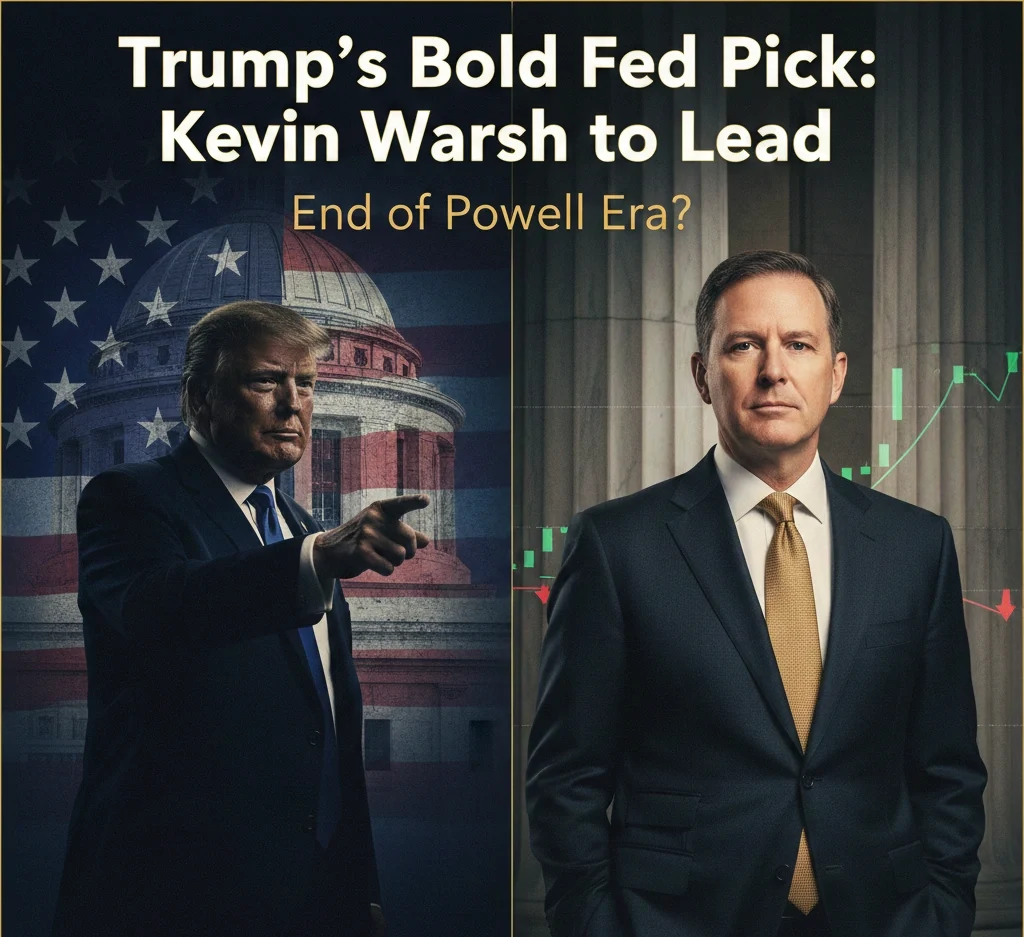
President Donald Trump announced Friday morning that he is nominating Kevin Warsh to succeed Jerome Powell as Federal Reserve Chair CNBC, bringing to a close a five-month search process that has been as much political theater as personnel decision. The choice represents a superficially conventional selection—Warsh is a former Fed governor with crisis-era credentials—yet it arrives at one of the most fraught moments in the central bank’s modern history, raising fundamental questions about monetary policy independence, interest rate trajectory, and the future of American economic governance.
“I have known Kevin for a long period of time, and have no doubt that he will go down as one of the GREAT Fed Chairmen, maybe the best,” CNBC Trump wrote on Truth Social. “On top of everything else, he is ‘central casting,’ and he will never let you down.” CNBC
The nomination of the 55-year-old economist, Wall Street veteran, and Stanford scholar marks a homecoming of sorts for someone who nearly secured the role eight years ago. Yet Warsh returns to a Federal Reserve under siege—facing a Justice Department criminal investigation of Powell, a Supreme Court case testing presidential power over Fed governors, and relentless political pressure from a president who has made aggressive rate cuts a centerpiece of his economic agenda.
Who Is Kevin Warsh?
Warsh’s biography reads like a textbook case study in American financial elite formation. Born in Albany, New York, in 1970, he earned his undergraduate degree in public policy from Stanford University and a law degree from Harvard before joining Morgan Stanley’s mergers and acquisitions department in 1995, where he rose to executive director.
His transition to public service came in 2002 when President George W. Bush appointed him Special Assistant for Economic Policy and Executive Secretary of the National Economic Council. Four years later, at just 35, Bush nominated him to the Federal Reserve Board of Governors, making him the youngest person ever to hold that position—a distinction that remains today.
Warsh’s tenure coincided with the eruption of the 2008 financial crisis, where he served as Chairman Ben Bernanke’s primary liaison to Wall Street Wikipedia and played a pivotal role in crisis management. Bernanke later wrote that Warsh, “with his many Wall Street and political contacts and his knowledge of practical finance,” was among his “most frequent companions on the endless conference calls through which we shaped our crisis-fighting strategy.” Wikipedia
During the September 2008 chaos, Warsh helped engineer the conversion of his former employer Morgan Stanley into a bank holding company, effectively saving the firm from collapse. His Wall Street pedigree and Republican credentials made him invaluable during a crisis that required swift, unconventional action.
Yet Warsh’s Fed tenure ended in controversy. By 2011, he had become increasingly concerned that quantitative easing would lead to inflation Britannica and publicly broke with Bernanke over the second round of bond purchases (QE2). His resignation that March, seven years before his term was set to expire, signaled a fundamental disagreement over the central bank’s post-crisis direction.
Since leaving the Fed, Warsh has served as a Distinguished Visiting Fellow at Stanford’s Hoover Institution, worked with billionaire investor Stanley Druckenmiller at Duquesne Family Office, and sat on the board of directors for UPS. He also conducted an influential independent review of the Bank of England’s monetary policy framework, whose recommendations were adopted by Parliament.
The Nomination Process: A Reality-Show Search
Trump’s search for Powell’s successor has been anything but conventional. Treasury Secretary Scott Bessent led a process that at one point considered eleven candidates spanning from former and current Fed officials to prominent economists and Wall Street pros CNBC. The field was eventually narrowed to four finalists: Warsh, current Fed Governor Christopher Waller, BlackRock fixed income executive Rick Rieder, and National Economic Council Director Kevin Hassett.
For months, Hassett appeared to be the front-runner—a veteran Republican economist with strong White House visibility. But Trump’s frequent media appearances praising “the two Kevins” kept Warsh in contention, and the president ultimately decided he couldn’t afford to lose Hassett from his current role. “A lot of people think that this is somebody that could have been there a few years ago,” Euronews Trump told reporters Thursday evening, fueling speculation that had already reached fever pitch.
Bloomberg reported Thursday night that Warsh had visited the White House, sending prediction markets into overdrive. By Friday morning, betting platforms showed Warsh’s odds exceeding 85%.
Market Reaction: Hawkish Credentials Meet Dovish Expectations
Financial markets responded to Warsh’s likely nomination with a complex mixture of relief and apprehension. Stocks fell with US Treasuries as the administration prepared the announcement, a choice viewed as more hawkish than other contenders. Gold slid 2.8% and the dollar gained Bloomberg on Thursday evening as speculation mounted.
The market’s ambivalence reflects Warsh’s inherent contradictions. His historical reputation is that of an inflation hawk who consistently warned of price pressures that never materialized during his 2006-2011 tenure. In September 2009, with unemployment at 9.5% and climbing, Warsh argued that the Fed should begin pulling back on its recovery efforts Wikipedia, warning of an “excessive surge in lending” that could fuel inflation. That inflation never appeared, leading critics like University of Oregon Professor Tim Duy to suggest Warsh prioritized Wall Street over Main Street.
Yet Warsh’s recent rhetoric has shifted markedly. In a Wall Street Journal op-ed last year, he argued that the Fed should “discard its forecast of stagflation” Yahoo! and acknowledged that artificial intelligence would be a “significant” disinflationary force boosting productivity. He has publicly supported lower interest rates—precisely what Trump demands.
This hawkish-to-dovish evolution has left analysts divided. “If the nominee is indeed Warsh, we could actually end up with a Fed that tilts hawkish at the margin,” MarketScreener said Sonu Varghese, global macro strategist at Carson Group. Yet Trump himself has insisted, “He thinks you have to lower interest rates” Yahoo!—his key litmus test for the role.
Commonwealth Bank strategist Kristina Clifton noted the dollar’s rise reflected expectations that Warsh “is a little bit less dovish than perhaps Kevin Hassett” and would “perhaps preserve a little bit more of the Fed’s independence than some of the other candidates would.” MarketScreener
The Independence Question: A Central Bank Under Siege
Warsh’s nomination arrives at a moment of unprecedented political pressure on the Federal Reserve. The Justice Department’s criminal investigation of Powell over testimony regarding the Fed’s $2.5 billion headquarters renovation—the first such probe of a sitting Fed chair—has shocked senators from both parties and raised alarms about central bank independence.
Powell argued the investigation was part of an attempt to intimidate the Fed for its interest rate decisions, undermining its independence. Euronews The probe has created a toxic confirmation environment, with Republican Senator Thom Tillis of North Carolina vowing to block any Fed nominee until the investigation is resolved. “I will oppose the confirmation of any nominee for the Fed—including the upcoming Fed Chair vacancy—until this legal matter is fully resolved,” CNBC Tillis declared.
Alaska Senator Lisa Murkowski has joined Tillis in opposition, potentially creating a mathematical problem for Warsh’s confirmation. With 53 Republicans in the Senate but at least two defections, passage is no longer assured—particularly given likely united Democratic opposition, intensified by Trump’s attempt to fire Fed Governor Lisa Cook.
Warsh himself has sent mixed signals on independence. In an April 2025 speech to the Group of Thirty and International Monetary Fund, he called Fed independence “important and worthy” NPR but argued the central bank had weakened its case by overreaching its mandate. “Our constitutional republic accepts an independent central bank only if it sticks closely to its congressionally-directed duty and successfully performs its tasks,” NPR he stated.
More provocatively, Warsh has accused the Fed under Powell of “using independence as a shield from accountability” and said members should “grow up” and “be tough” in the face of criticism. The Hill Such rhetoric suggests a willingness to challenge institutional norms—precisely what troubles defenders of Fed autonomy.
Monetary Policy Implications: Lower Rates, Smaller Balance Sheet
If confirmed, Warsh would inherit a Federal Reserve navigating treacherous terrain. The central bank has cut its benchmark rate by 1.75 percentage points since September 2024, bringing it to a range of 3.5% to 3.75%. Yet inflation remains a good deal from the Fed’s 2% target CNBC, while the labor market has cooled into what economists describe as a “no-fire, no-hire” equilibrium.
Trump wants rates far lower—he has called for rates as low as 1%, compared to the current 3.6% range. Markets, however, expect caution. Traders are pricing in at most two more cuts this year before the benchmark fed funds rate lands around 3% CNBC, which policymakers view as the long-run neutral rate.
Warsh’s distinctive policy combination—lower rates paired with aggressive balance sheet reduction—sets him apart from conventional dovishness. He believes AI-driven productivity gains are disinflationary, justifying aggressive rate cuts, while arguing the Fed’s balance sheet has subsidized Wall Street and should shrink significantly. Yahoo Finance
This approach could reshape the liquidity environment that has supported risk assets since 2008. The Fed’s balance sheet currently stands at roughly $6.5 trillion, down from $8.9 trillion in 2022. Warsh’s anti-quantitative easing stance suggests further reductions ahead, potentially pressuring equity valuations and cryptocurrencies that have historically risen alongside Fed balance sheet expansion.
Australian strategist Damien Boey captured market uncertainty: “The trade-off that he makes with lower rates is that he wants the Fed to have a smaller balance sheet. The markets are reacting as if thinking: ‘What would the world look like with a smaller Fed balance sheet?'” MarketScreener
Historical Context: Echoes of Volcker, Bernanke, and Powell
Warsh’s nomination invites comparison to previous Fed leadership transitions. Like Paul Volcker before Ronald Reagan appointed Alan Greenspan, Powell faces replacement by a president demanding different priorities. Yet unlike Volcker, who left voluntarily after taming inflation, Powell is being ousted while price pressures remain elevated and his term as governor extends until early 2028.
Powell could follow the unconventional path of staying on as a regular governor—a move that would allow him to serve as what some describe as “a bulwark against Trump’s efforts to compromise Fed independence.” CNBC Most Fed chairs have resigned their board positions upon losing the chairmanship, but Powell’s potential decision to remain would reflect the extraordinary circumstances of Trump’s pressure campaign.
Warsh’s relationship with his own mentor, Ben Bernanke, offers instructive precedent. Despite working closely during the crisis, Warsh ultimately broke with Bernanke over QE2, suggesting an independent streak. Yet his recent alignment with Trump’s preferences raises questions about whether he would resist presidential pressure more effectively than Powell has.
JPMorgan Chase CEO Jamie Dimon—rarely effusive about Fed nominees—reportedly said at a private December conference that Warsh would make “a great chair,” a rare endorsement carrying significant weight in financial circles.
Global Ramifications and the Dollar’s Future
Warsh’s potential Fed leadership extends beyond domestic implications. As a former Fed representative to the G-20 and emissary to Asian economies, he brings international credentials that could prove valuable as Trump pursues an aggressive tariff agenda.
“A Warsh appointment would not only play to the view that Fed independence will be protected, it would also play to the view that whilst some reforms should be expected, it’s not going to really dramatically change the Fed,” MarketScreener noted a strategist at Oversea-Chinese Banking Corp.
The dollar’s initial strength following Warsh speculation reflected confidence in his hawkish pedigree. Yet sustained dollar performance will depend on whether Warsh delivers the aggressive rate cuts Trump demands or maintains the data-dependent approach that has characterized modern Fed policy.
The Path Forward: Confirmation, Implementation, and Consequences
Warsh’s confirmation hearing will likely prove contentious. Senators will probe his evolution from inflation hawk to rate-cut advocate, question his ties to Trump through his father-in-law Ronald Lauder (a major Republican donor), and press him on Fed independence. The Tillis blockade adds procedural complexity, potentially delaying confirmation until the Powell investigation concludes—if it ever does.
Should Warsh clear the Senate, he would face immediate challenges. The Federal Open Market Committee consists of 12 members—seven governors and five rotating regional Fed bank presidents. Building consensus for Trump’s preferred policies among career central bankers skeptical of political interference will test Warsh’s leadership and diplomatic skills.
Moreover, Powell’s potential decision to remain as a governor would create an unusual dynamic: a displaced chair serving alongside his successor, potentially marshaling opposition to policies he views as imprudent. This scenario has no modern precedent and could produce public disagreements that undermine market confidence.
The broader economic backdrop compounds these challenges. Trump’s tariff policies are widely viewed as inflationary, creating tension between the president’s demand for lower rates and the Fed’s price stability mandate. Warsh’s argument that tariffs represent one-time price level adjustments—a view increasingly echoed by some Fed officials—could provide intellectual cover for rate cuts despite elevated inflation. Yet if price pressures persist, Warsh would face the uncomfortable choice between accommodating presidential preferences and fulfilling his statutory mandate.
Conclusion: Continuity, Disruption, or Something In Between?
Kevin Warsh’s nomination represents a paradox wrapped in conventional credentials. On paper, he is precisely the sort of figure markets should find reassuring: a former Fed governor with crisis management experience, academic standing, and bipartisan relationships. His selection over more unconventional candidates like Hassett or outsiders without central banking experience suggests Trump ultimately opted for establishment continuity.
Yet Warsh’s recent rhetoric, his willingness to challenge institutional norms, and his alignment with Trump’s policy preferences signal potential disruption ahead. The combination of lower rates and aggressive balance sheet reduction could reshape American monetary policy in ways that echo his earlier opposition to quantitative easing—only now with presidential blessing rather than opposition.
The ultimate test will be whether Warsh can reconcile his historical hawkishness with Trump’s dovish demands, maintain the Fed’s credibility amid unprecedented political pressure, and navigate economic conditions that may not cooperate with anyone’s preferred policy path. As Financial Times readers know, central banking is ultimately about expectations management—and Warsh inherits an institution whose independence, credibility, and policy framework are all under question.
Markets appear to be pricing in cautious optimism: a Chair who understands financial stability, respects institutional process, yet remains sympathetic to growth-oriented policies. Whether that optimism proves justified may depend less on Warsh’s intentions than on economic realities, political pressures, and the still-unresolved question of what Fed independence means in the Trump era.
The coming months will reveal whether this conventional choice produces unconventional outcomes—or whether the guardrails of institutional process, market discipline, and economic constraints ultimately force convergence toward the cautious, data-dependent approach that has characterized modern central banking. For investors, policymakers, and citizens alike, Warsh’s tenure—should he be confirmed—will offer a defining test of American economic governance at a moment when both inflation and political pressure remain uncomfortably elevated.
Discover more from The Economy
Subscribe to get the latest posts sent to your email.



Key Takeaways
- Rolex’s secondary market rose approximately 7.9% year-over-year as of 2026 (per WatchCharts data) — trailing Patek Philippe (+16.2%) and Tudor (+11.4%) but still outperforming Audemars Piguet (+3.4%).
- Rolex raised U.S. retail prices 4–9% in January 2026 (steel models ~5.6%, gold models ~8.7%), narrowing the historical gap between retail and pre-owned pricing.
- Not every model appreciates: steel sports references (Submariner, GMT-Master II, Daytona) have held value far better than two-tone or widely available dress references like the standard Datejust.
- The Lady-Datejust posted the sharpest 2026 gain among tracked collections — up 22.73%, from roughly $9,269 to $11,376 — driven by demand for smaller, “everyday luxury” watches.
- Gold’s rise past $2,400/oz has directly lifted the investment case for Rolex’s precious-metal references (Day-Date, Sky-Dweller, Yacht-Master).
The Model-by-Model Picture
| Category | 2026 Trend |
|---|---|
| Lady-Datejust | +22.73% (strongest performer among tracked collections) |
| Steel sports models (Submariner, GMT-Master II) | Held value well; corrected from 2022 peak but stabilized above retail |
| Daytona | Corrected from highs above $50,000 to the mid-$30,000s; still among the most sought-after references |
| Two-tone/widely available Datejust | Flat to negative — “holds value” is an overstatement for this category |
| Gold references (Day-Date, Sky-Dweller) | Lifted by gold’s rise above $2,400/oz |
Why the “Rolex Always Appreciates” Myth Is Fading
The pandemic-era boom pushed some references — the Daytona above all — to speculative highs disconnected from historical norms. Since the March 2022 peak, steel sports models have compressed meaningfully, and dealers who bought inventory near the top have in some cases faced 20–40% markdowns on liquidation. The lesson for 2026 buyers: Rolex as a category is not a monolith. Value retention depends heavily on specific reference, condition, and whether the piece comes with box and papers (“full set”).
What’s Actually Driving 2026 Strength
- Retail price increases raise the floor. When a new Submariner retails at $10,050 (up from $9,500), a pre-owned example at $11,000–$12,000 suddenly represents a smaller premium — narrowing the gap without secondary prices actually moving.
- Supply discipline remains Rolex’s core lever. The brand has never confirmed production numbers, and secondary-market premiums remain entirely a function of Rolex’s own manufacturing decisions — a risk factor as much as a support.
- Certified Pre-Owned rollout. Rolex’s now fully rolled-out CPO program has changed how buyers transact in the used market, adding a layer of brand-verified legitimacy that supports pricing.
The Case for Rolex as a Portfolio Diversifier
Financial advisors increasingly frame luxury watches not as a replacement for equities or bonds, but as a tangible, historically low-correlation diversifier — one that carries its own risks (illiquidity, condition-dependent pricing, no yield) but has demonstrated multi-decade resilience for specific references.
Is Rolex a good investment in 2026?
It depends heavily on the specific reference. Steel sports models like the Submariner and Daytona have held or grown in value; two-tone and widely available dress models generally have not. Overall, Rolex’s secondary market rose about 7.9% year-over-year in 2026, trailing Patek Philippe but ahead of Audemars Piguet.
Discover more from The Economy
Subscribe to get the latest posts sent to your email.

Navigating Mortgage and Loan Refinancing in a High-Yield Environment
Global public debt crossing critical thresholds has kept central bank policies volatile, resulting in fluctuating US Treasury yields throughout 2026. For homeowners and commercial property holders burdened by previous high-interest borrowing cycles, finding optimal refinance windows has become a high-stakes financial puzzle. Stalled disinflation and stubborn employment numbers mean rate cuts are incremental, requiring borrowers to act with precision.
Timing your mortgage or commercial loan refinance in this environment requires a deep understanding of yield curve movements and lender risk appetites.
Decoding 2026 Refinance Dynamics
The 10-Year Treasury Yield Benchmark
Mortgage rates continue to track closely with the 10-year US Treasury yield. When macroeconomic anxiety spikes debt issuance, yields rise, tightening consumer borrowing capacity. Savvy borrowers monitor weekly Treasury auctions to lock in rates during brief dip windows.
Hybrid ARMs and Alternative Structures
With fixed rates remaining elevated, 7/1 and 10/1 adjustable-rate mortgages (ARMs) have surged in popularity. These products offer lower initial monthly payments, giving borrowers breathing room until central bank easing cycles fully materialize.
| Loan Product | Current Rate Range | Best For | Key Risk Factor |
| 30-Year Fixed Mortgage | 6.2% – 6.8% | Long-term predictability | Higher initial monthly outlay |
| 7/1 Hybrid ARM | 5.5% – 5.9% | Short-term ownership / flipping | Rate reset risk after year 7 |
| Commercial Refinance | 7.0% – 8.2% | Corporate asset restructuring | Strict DSCR lender covenants |
Actionable Steps for Successful Refinancing
To maximize your chances of securing favorable refinance terms in a volatile market, follow a disciplined preparation strategy.
Boost Your Credit Score Immediately: Lenders in 2026 are applying stringent credit tiering; a 20-point increase can drop your APR by a crucial quarter-point.
Shop Regional Credit Unions: Smaller financial institutions often offer portfolio loans with more flexible underwriting than major national banks.
Calculate the Break-Even Point: Ensure your total closing costs are recouped through monthly savings within 24 months of closing.
“Market Strategist View: Refinancing in 2026 is an exercise in opportunistic timing. Borrowers must maintain immaculate financial profiles ready to strike the moment Treasury yields dip.”
Mastering the complexities of today’s debt environment ensures you can successfully lower your debt service costs and protect your long-term financial stability.
Discover more from The Economy
Subscribe to get the latest posts sent to your email.

The days of pulling generic auto insurance quotes based purely on your zip code and age are officially over. In 2026, insurance comparison engines are powered entirely by generative AI and real-time telematics. These platforms digest thousands of live data points—ranging from your driving smoothness via connected vehicle sensors to real-time traffic congestion patterns—to generate hyper-personalized premiums instantly.
For consumers, this evolution represents both a massive opportunity for savings and a hidden trap for penalty pricing. Understanding how AI algorithms evaluate risk is essential for anyone looking to lower their monthly auto insurance premiums.
How AI Comparison Engines Evaluate Your Risk Profile
Behavioral Telematics and Connected Cars
Modern cars stream performance data directly to insurance aggregators. Generative AI models analyze braking sharpness, acceleration curves, cornering G-forces, and phone distraction metrics. Drivers who maintain smooth, defensive habits are rewarded with dynamic rate cuts of up to 40% compared to traditional rating tiers.
Predictive Traffic and Weather Modeling
AI tools now cross-reference your daily commute route with predictive weather and accident probability models. If your standard parking location or driving corridor has a statistically higher incidence of uninsured motorist claims, your quotes will reflect that hyper-local risk assessment.
| Comparison Factor | Traditional Rating Model | 2026 Generative AI Model | Impact on Premium |
| Mileage & Usage | Annual estimated odometer reading | GPS tracking & live trip duration | High (up to 35% savings) |
| Driving Behavior | MVR driving record & accidents | Real-time braking, speed, & G-force | Critical (determines tier) |
| Vehicle Tech | Make, model, and safety rating | ADAS calibration & repair cost data | Moderate |
Strategies to Lower Your AI-Driven Insurance Quote
To outsmart the algorithm and secure the lowest possible premium in 2026, drivers must proactively manage their digital footprint on insurance platforms.
Opt-In for Telematics Trial Periods: Many insurers offer immediate 15% discounts just for installing their driving app; let it track safe habits for 30 days to lock in permanent savings.
Scrub Unverified Public Records: Ensure your motor vehicle report is free of clerical errors that AI risk models misinterpret as reckless behavior.
Compare AI Aggregators: Use platforms that integrate multi-carrier API feeds rather than single-brand comparison sites to find the best risk-adjusted rate.
“Industry Note: AI-driven pricing rewards transparency and precision. Drivers who actively manage their telematics data consistently out-save those relying on legacy quote calculators.”
Embracing AI comparison tools allows savvy policyholders to customize coverage limits precisely to their driving habits, eliminating wasted premium spend while ensuring robust protection.
Discover more from The Economy
Subscribe to get the latest posts sent to your email.

Solar Panel Installation Cost in 2026: Why the Math Changed Overnight

Business Insurance: What Coverage You Actually Need and What It Costs in 2026

Auto Insurance Quotes: How to Get the Lowest Rate Without Losing Coverage

Huntington Online Banking: Full Features, Fees, and How It Compares in 2026

Apply for a Bank Account Online: What You Need and How Long It Actually Takes

World’s Largest Economies: Ranking the Top Global Powers

Business Loan: A Complete 2026 Guide to Rates, Types, and Qualifying

Fast Invoice Factoring: How to Turn Unpaid Invoices Into Cash Within 24 Hours

Investment Banking Services: What They Cost and How to Choose the Right Firm in 2026

Structured Settlement Loan: What “Cash Now” Offers Actually Cost You

DUI Attorney: Why Your First Call After an Arrest Should Never Be to the Court

Personal Injury Lawyer: A Complete Guide to Filing Your Claim in 2026

Commercial Vehicle Accident Lawyer: Holding Companies Accountable Beyond the Driver

Inside the White House Feud: How Trump’s Allies Are Painting Anthropic’s Dario Amodei as the Face of ‘AI Doomerism’

Top 30 Stocks for Investment in PSX for Massive ROI in 2026

SpaceX Starship Flight 14: First Orbital Attempt & Starlink V3 Launch Explained

Oil Prices Break $100 in 2026: Middle East Conflict & Energy Markets

Fidelity Investments Review 2026: SPAXX Yields & Zero-Fee Funds

AI Chip Stocks 2026: The Best Semiconductor Investments Beyond Marvell

BRICS+ Cross-Border Payments 2026: Interoperability Explained

Tween Back-to-School Trends 2026: What’s Driving the $85B Season

10-Year Treasury Yield Hits 4.80%: What It Means for Rates & Portfolios

Shein Clothes Quality & Safety in 2026: What Lab Tests Show

China’s US$10.8 Billion Trade Shortcut: Why the Pinglu Canal Matters

MRVL Earnings 2026: Why Marvell Sank Despite Beating Estimates

IMF & World Bank 2026 Global Economic Outlook: Growth, Inflation, Debt

High-CPM Finance Niches 2026: Publisher Monetization Blueprint

Middle East War Economics 2026: Oil Prices & Energy Markets
-

 Markets & Finance9 months ago
Top 15 Stocks for Investment in 2026 in PSX: Your Complete Guide to Pakistan’s Best Investment Opportunities
-

 Analysis7 months ago
Johor’s Investment Boom: The Hidden Costs Behind Malaysia’s Most Ambitious Economic Surge
-

 Analysis7 months ago
Top 10 Stocks for Investment in PSX for Quick Returns in 2026
-

 Banks8 months ago
Best Investments in Pakistan 2026: Top 10 Low-Price Shares and Long-Term Picks for the PSX
-

 Analysis8 months ago
Brazil’s Rare Earth Race: US, EU, and China Compete for Critical Minerals as Tensions Rise
-

 Investment9 months ago
Top 10 Mutual Fund Managers in Pakistan for Investment in 2026: A Comprehensive Guide for Optimal Returns
-

 Global Economy9 months ago
15 Most Lucrative Sectors for Investment in Pakistan: A 2025 Data-Driven Analysis
-

 Global Economy9 months ago
Pakistan’s Export Goldmine: 10 Game-Changing Markets Where Pakistani Businesses Are Winning Big in 2025