
Analysis
‘Clear Leader’ in Southeast Asia: Analysts Overwhelmingly Bullish on Grab


Grab Holdings (NASDAQ: GRAB) delivered its strongest-ever first quarter on May 5, 2026 — yet the stock still trades near a 52-week low. That disconnect, analysts say, is precisely the opportunity.
There is a particular kind of market moment that veteran investors learn to recognize: a fundamentally strong business, beset by a sudden regulatory headline, trading at a price that reflects panic rather than analysis. Grab Holdings finds itself squarely in that position today.
On May 5, the Singapore-headquartered super-app posted first-quarter 2026 revenues of $955 million — up 24% year-over-year and comfortably ahead of the $914 million analysts had pencilled in. Adjusted EBITDA surged 46% to a record $154 million, marking the company’s 17th consecutive quarter of adjusted EBITDA growth. Profit for the period reached $120 million, versus a mere $10 million a year earlier — a twelvefold improvement. Monthly transacting users climbed 16% to 51.6 million, while on-demand gross merchandise value hit $6.1 billion, accelerating into what is traditionally the company’s softest seasonal quarter.
By nearly every operational metric, Grab is performing like a company that has permanently turned the corner. Yet the shares were trading at roughly $3.87 as of this writing — close to a 52-week low of $3.48, and some 40% below the analyst consensus price target of approximately $6.28 to $6.56. That gap, implying upside of 65% to 70% or more, has become one of the more striking mispricings in emerging-market technology.
The explanation lies in a single regulatory bombshell from Jakarta — and why Grab’s management, and an overwhelming majority of Wall Street analysts, believe the market has dramatically overstated its impact.
Q1 2026: A Profit Machine Firing on All Cylinders
Grab’s Q1 2026 results did not merely beat expectations. They illustrated a business model that is simultaneously deepening its moat and broadening its margin profile across three interdependent pillars: mobility, deliveries, and financial services.
Mobility — Grab’s original ride-hailing engine — remains the crown jewel of the group’s P&L. Revenue rose 19% year-over-year to $337 million, with segment adjusted EBITDA climbing 24% to $198 million, affirming the group’s dominant position in the regional ride-hailing market. Strong GMV expansion was underpinned by continued growth in mobility monthly transacting users and the early dividends of AI-driven marketplace efficiencies, including the company’s “Turbo” driving mode, which management says has already increased driver earnings by 23% — a metric that is as much about driver retention and supply-side resilience as it is about technology.
Deliveries contributed revenue of $510 million, up 23% year-over-year, driven by GMV expansion and an increasingly profitable advertising business layered atop its food delivery platform. Of particular note: GrabMart, the group’s grocery delivery vertical, now accounts for 10% of deliveries GMV and is growing at 1.7 times the rate of food delivery. Grocery users order with 1.8 times the frequency of food-only users — a powerful indication of the stickiness and upward value migration that the super-app model enables.
Financial Services was the quarter’s standout growth story. Revenue jumped 43% year-over-year to $107 million, propelled by a gross loan portfolio that more than doubled to $1.44 billion — with management reiterating a target of $2 billion by year-end. Loan disbursals surged 67% to exceed $1 billion in the quarter. The segment continues to operate at a loss — adjusted EBITDA of negative $17 million — but that loss narrowed sharply from negative $30 million a year earlier, and the company has firmly reiterated its target of fintech segment adjusted EBITDA breakeven in the second half of 2026.
The balance sheet, meanwhile, provides formidable strategic optionality. Grab ended the quarter with $6.9 billion in gross cash liquidity and $5.0 billion in net cash liquidity — a war chest that underpins its recently launched $400 million accelerated share repurchase program, part of a previously approved $500 million buyback mandate. “This is a reflection of our conviction in Grab’s long-term value at these dislocated prices,” CEO Anthony Tan told investors. It is difficult to argue with his framing.
Full-year 2026 guidance was reaffirmed at revenue of $4.04 billion to $4.10 billion (implying 20–22% growth) and adjusted EBITDA of $700 million to $720 million (implying 40–44% growth). Trailing twelve-month adjusted free cash flow reached $489 million — a metric that underscores the underlying quality of the business in ways that standard EBITDA reporting often obscures.
The Analyst Consensus: Overwhelmingly Bullish, Carefully Differentiated
The analytical community’s view on Grab is about as unified as it gets in a stock where regulatory uncertainty warrants genuine debate. 26 of 27 Wall Street analysts currently rate the stock a Buy, with a consensus price target of approximately $6.28 to $6.56, implying upside of 65% to nearly 70% from current levels.
The range of price targets, however, reflects divergent views on the severity and duration of the Indonesia commission cap headwind:
| Firm | Rating | Price Target |
|---|---|---|
| Evercore ISI (Mark Mahaney) | Buy | $8.00 |
| Barclays | Outperform/Buy | $7.00 |
| Jefferies | Buy | $6.70 |
| Morgan Stanley | Overweight | $6.40 |
| HSBC | Buy | $6.20 |
| BofA Securities | Buy | $6.20 |
| Mizuho | Outperform | $6.00 (lowered) |
| JPMorgan | Overweight | $5.90 (lowered) |
| Barclays (conservative) | Buy | $4.50 |
The spread between the most optimistic and most conservative targets — $8.00 to $4.50 — reflects less a disagreement about Grab’s fundamental trajectory and more a calibration exercise around Indonesia’s regulatory timeline, the macroeconomic oil price environment, and the pace of the fintech segment’s path to profitability.
InvestingPro’s screening flags a PEG ratio of just 0.18 for Grab — strikingly low for a company growing revenue at 20%+ and EBITDA at 40%+. Moody’s, for its part, recently upgraded Grab’s corporate family rating to Ba2 with a stable outlook, citing continued earnings growth and its leading Southeast Asian market position. The credit analysts, it appears, are ahead of the equity market.
Regulatory Headwinds: The Indonesia Commission Cap, Unpacked
The regulatory development that rattled markets — and shaved tens of millions off Grab’s market capitalization in late April — deserves careful examination, because the initial reaction almost certainly overstated the structural risk.
On May 1, Indonesian President Prabowo announced a regulation capping ride-hailing platform commissions for two-wheel motorcycle-taxi (ojol) drivers at 8%, down from the current range of 15–20%. The announcement was a genuine surprise — Grab had specifically stated during its February 2026 Q4 earnings call that no commission cap changes were being proposed. The regulation also mandates expanded social protections and insurance for gig workers across deliveries and ride-hailing, which Grab had partly anticipated through a Rp100 billion driver welfare program announced in January 2026.
The headline risk is real: Indonesia represents approximately 17–19% of Grab’s Mobility GMV and roughly 20% of consolidated adjusted EBITDA, making it a material market. However, the actual scope of the cap has been significantly narrower than initial reports suggested.
During the Q1 earnings call, COO Alex Hungate delivered the crucial clarification: the 8% cap applies specifically to ojol two-wheel drivers, and that segment represents less than 6% of Grab’s total Mobility GMV. Four-wheel vehicle drivers, who earn substantially above Indonesia’s minimum wage, are not subject to the regulation in the same way. “We are therefore reiterating our expectations for Mobility margins to stabilize within the historical range,” Hungate said.
Grab’s mitigation levers are meaningful: fare adjustments, renegotiated incentive structures, and a cooperative posture with regulators aimed at “shaping a balanced implementation” of the decree. The fuel crisis sweeping Southeast Asia — which prompted Grab to temporarily raise its Singapore fuel surcharge from S$0.50 to S$0.90 per trip — is also providing cover for consumer-facing pricing adjustments that partially offset commission compression.
The broader regulatory question for Grab is structural, not episodic: Southeast Asian governments are increasingly treating digital platform operators as quasi-utilities, scrutinizing commission structures, data practices, and competitive behavior. That is a headwind Grab must manage continuously — but it is also a headwind that, given Grab’s embedded position in daily consumer life, is unlikely to prove fatal.
Competitive Moat: Why Grab Remains the Clear Regional Leader
The case for Grab’s competitive durability rests on a simple but powerful set of facts: no other regional operator comes close to matching its geographic breadth, ecosystem depth, or the compounding flywheel of its super-app model.
Grab operates across eight countries in Southeast Asia, a region of 680 million people with a rapidly expanding middle class, deepening smartphone penetration, and chronic underbanking. Its closest regional rival, GoTo (Gojek/Tokopedia), is overwhelmingly concentrated in Indonesia — a massive market, to be sure, but a geographically constrained competitive position that limits GoTo’s total addressable market.
The market share data tells a compelling story:
- Ride-hailing across Southeast Asia: Grab commands approximately 70% market share regionally, compared to GoTo’s Indonesia-focused position.
- Indonesia specifically (by order volume): Grab holds 63% of ride-hailing to GoTo/Gojek’s 36%, a data point that significantly complicates the narrative of GoTo as a serious regional threat.
- Southeast Asia food delivery: Grab leads with approximately 55% market share (equating to roughly $9.4 billion in GMV), while Foodpanda holds 15.8% and Gojek just 10.5%. ShopeeFood (Sea Group) and Thailand’s LINEMAN have shown growth at 8.8% and 8.1% respectively, but remain sub-scale at the regional level.
GoTo’s first-ever positive net income, achieved in late 2025, is a genuine competitive development — and a sign that the regional digital economy is maturing. But structural concentration of operations in Indonesia, the absence of a meaningful regional payments or lending network comparable to Grab’s, and limited corporate M&A firepower relative to Grab’s $5 billion net cash pile leave GoTo structurally disadvantaged as a pan-regional challenger.
Foodpanda, owned by Germany’s Delivery Hero, has been losing market share steadily; Grab’s acquisition of Foodpanda’s Taiwan operations for $600 million — secured at a roughly 30% discount to the price Uber was said to have considered — marks Grab’s first geographic expansion beyond Southeast Asia. Jefferies analysts view the deal as enabling Grab to “replicate its Southeast Asian delivery success in Taiwan, driven by affordability, reliability, and technology.” The EBITDA contribution is not expected before 2028, but the strategic logic — entering a high-density, digitally sophisticated market at distressed-asset pricing — is characteristic of Grab’s disciplined capital deployment.
SeaMoney (Sea Group’s fintech arm) and GoPay (GoTo’s digital payments unit) are legitimate fintech competitors, particularly in Indonesia and Vietnam. But neither offers the three-way flywheel — ride, eat, pay — at Grab’s regional scale. Network effects compound asymmetrically: the more users Grab adds to GrabPay, the more attractive its merchant offers become; the more merchants join, the more reason users have to keep the app active; the more active users there are, the richer the data set for credit decisioning in GrabFin. That is a virtuous cycle that took Grab thirteen years to build, and it cannot be acquired or replicated in a single funding round.
Growth Drivers: Fintech, AI, and the Path to 2028
The medium-term investment thesis for Grab rests on three compounding growth drivers that are still in relatively early stages.
Financial Services: The Margin Frontier. GrabFin’s gross loan portfolio doubling to $1.44 billion in a single year — with a $2 billion year-end target and disbursals exceeding $1 billion in Q1 alone — reflects the under-penetration of formal credit across Southeast Asia. An estimated 70% of adults in the region remain underbanked or entirely unbanked. Grab’s GX Bank (Malaysia) and GXS Bank (Singapore) are accumulating deposits and lending infrastructure at speed; combined deposits stood at $1.6 billion at quarter-end. When fintech reaches adjusted EBITDA breakeven in H2 2026, it will transition from a drag on group margins to an accretive driver — representing the single most significant near-term re-rating catalyst for the stock.
AI-Driven Efficiencies: Compounding the Flywheel. Grab’s AI infrastructure investment — which pushed regional corporate costs to $114 million in Q1 (management says this will now stabilize) — is already generating operational returns. Turbo driving mode’s 23% improvement in driver earnings is the most tangible example. The company is deploying AI across demand forecasting, dynamic pricing, credit scoring, fraud detection, and hyper-personalized in-app recommendations. CEO Anthony Tan has spoken of “leaning deeply into AI to out-serve our users,” and while such language is now ubiquitous across technology earnings calls, Grab’s data advantage — billions of transactions across ride, delivery, payment, and credit — gives its AI investment a differentiated training set that smaller regional players simply cannot replicate.
Regional Ecosystem Expansion. Grab’s partners — drivers, merchants, and food vendors — earned more than $15 billion on the platform in 2025, up 19% year-over-year. This is not just a financial statistic; it is the foundation of a political economy. When regulators in Jakarta or Kuala Lumpur consider regulatory interventions, the two to three million gig workers whose livelihoods depend on Grab’s marketplace represent a constituency that moderates the most punitive policy impulses. It is a structural mitigant that is rarely modelled in sell-side EBITDA scenarios, but it is real.
Looking toward 2028, analysts at Jefferies project meaningful EBITDA contribution from the Taiwan foodpanda integration, fintech segment profitability at scale, and continued GMV expansion across the core mobility and deliveries businesses — all compounding against a base of deep market share leadership.
Risks: A Balanced View
No credible investment analysis is complete without a clear-eyed accounting of the risks. For Grab, they are as follows:
Regulatory contagion. The Indonesia commission cap could inspire similar moves by regulators in Malaysia, Vietnam, or the Philippines — particularly as government interest in platform worker protections intensifies across the region. A coordinated regulatory tightening across multiple markets would require a more fundamental reassessment of the profit trajectory.
Fuel and macroeconomic volatility. Elevated fuel prices compress driver earnings and create upward pressure on Grab’s partner incentives, which reached $650 million in Q1 2026 (on-demand incentives at 10.5% of GMV). In a prolonged fuel crisis, the cost of keeping supply healthy could erode margin gains elsewhere.
Credit quality in lending. The loan book’s rapid expansion — doubling in a year — is a potential source of portfolio quality risk if Southeast Asian macroeconomic conditions deteriorate. Management says credit quality remains within risk appetite, but this warrants close monitoring as the portfolio scales toward $2 billion.
GoTo consolidation. A potential Grab–GoTo merger, which remains speculative despite persistent market discussion, could face lengthy antitrust review. A combined entity would hold an extraordinary concentration of market power — potentially approaching 99% in some Indonesian segments — creating genuine regulatory risk and execution complexity.
Integration of Taiwan operations. The Foodpanda Taiwan acquisition introduces a new geography with different consumer behaviors, competitive dynamics (iFood, local players), and regulatory requirements. Integration costs will weigh on near-term profitability before EBITDA contribution materializes post-2028.
The Investment Thesis: Dislocated Quality in a Structurally Growing Market
Grab’s current market valuation presents a familiar paradox: a company delivering record profitability, 17 consecutive quarters of EBITDA growth, a $5 billion net cash position, and a $489 million trailing free cash flow run rate — trading at a price that implies the market is discounting nearly everything that has gone right and pricing in everything that could go wrong.
The Indonesia commission cap is a real headwind. But its actual scope — affecting less than 6% of Mobility GMV — has been clarified, management has reiterated its full-year margin guidance, and Grab’s response has been measured and regulatory-cooperative rather than adversarial.
The deeper story is one of structural positioning in a region undergoing rapid digital transformation. Southeast Asia’s internet economy is forecast to reach $600 billion in GMV by 2030. Grab, with its 51.6 million monthly transacting users, eight-country footprint, growing fintech platform, and AI-powered operational flywheel, is the closest thing the region has to an indispensable digital infrastructure provider.
With 26 of 27 analysts maintaining Buy ratings, a consensus price target implying 65–70% upside, a PEG ratio of just 0.18, a Moody’s Ba2 credit upgrade, and management buying back $400 million of its own stock at these prices, the signals are pointing in a consistent direction.
The market, as is its occasional habit, appears to be confusing a regulatory headwind with a structural impediment. Analysts who have followed Grab since its 2021 SPAC listing — and through its long, disciplined journey from billion-dollar losses to sustained profitability — are not making that mistake.
Conclusion: The Long Game in Southeast Asia
Thirteen years ago, Anthony Tan and Tan Hooi Ling launched a modest ride-hailing app in Malaysia, pitching it to taxi drivers who had grown skeptical of a market moving beneath their feet. Today, Grab is the economic backbone of daily life for more than 50 million users across Southeast Asia’s most dynamic cities — connecting people with transport, food, credit, insurance, and income in a single application.
The Indonesia commission cap is a genuine test of regulatory relationship management and cost structure resilience. It is not an existential threat to a company holding $5 billion in net cash, generating nearly half a billion dollars in annual free cash flow, and growing adjusted EBITDA at 46% in what it describes as its softest seasonal quarter.
In markets like Southeast Asia, where regulatory landscapes shift and macroeconomic conditions fluctuate with greater frequency than in developed markets, the defining advantage is not the absence of headwinds. It is the institutional capacity to absorb, adapt, and continue compounding. Grab, by every operational and financial measure available, has demonstrated that capacity. The analysts who have spent years studying the company’s ecosystem have taken note.
The market, it seems, is still catching up.
Discover more from The Economy
Subscribe to get the latest posts sent to your email.


Oil Markets
China’s Oil Shock Absorber: How Beijing Kept Crude Prices Half of What Analysts Predicted
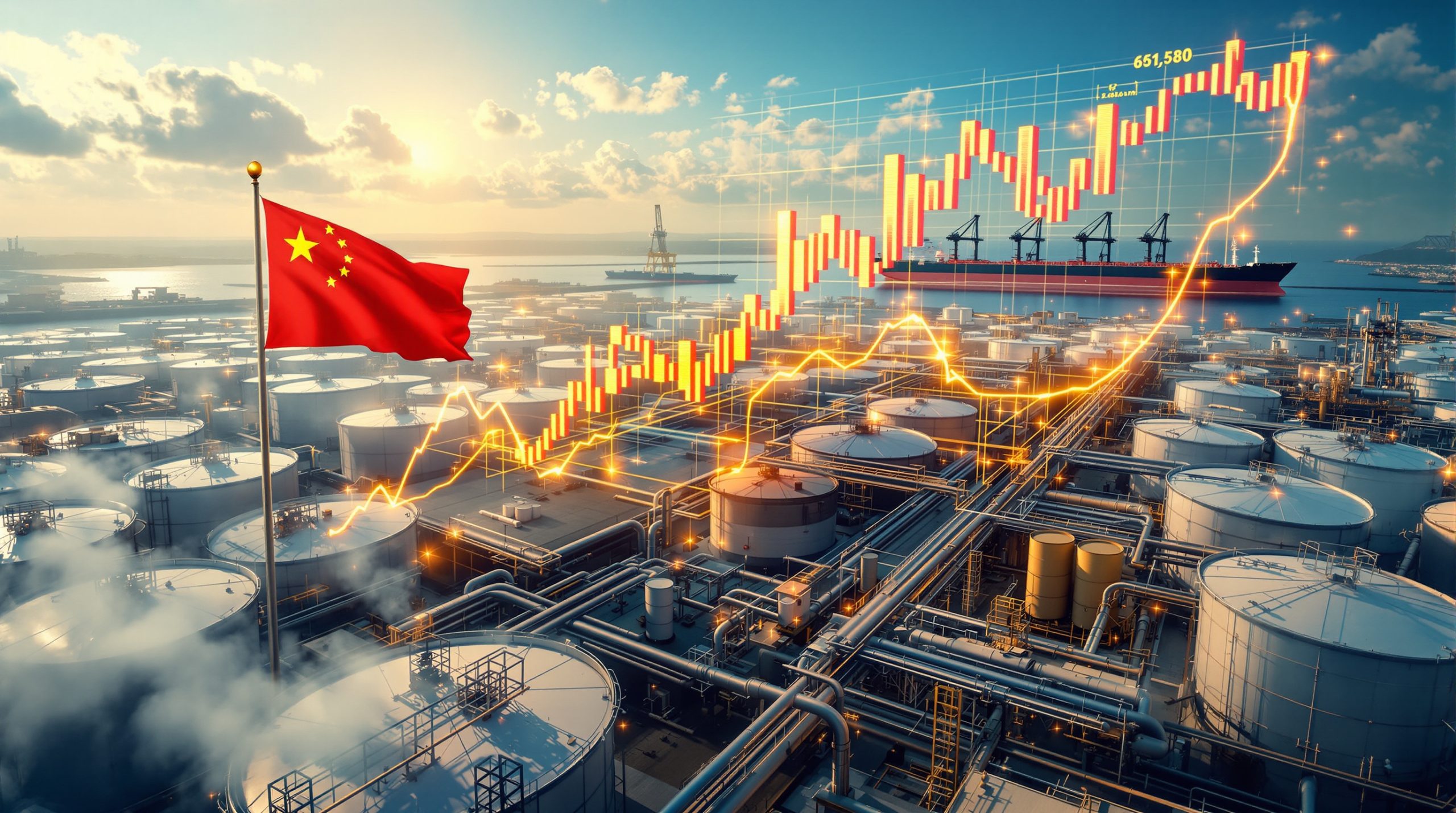
Analysts predicted oil above $200 during the Hormuz crisis. China’s intervention kept prices roughly half that. Fortune and Bloomberg explain how Beijing did it — and why the strategy has limits that markets have not fully priced in.
The $200 Oil That Never Arrived
When Iranian forces declared the Strait of Hormuz closed in early March 2026, the analytical consensus in energy markets shifted rapidly toward a catastrophic scenario. The Strait carries 27% of globally traded crude oil and petroleum products (Congressional Research Service, 2026). Iran had demonstrated both the capability and willingness to enforce that closure through attacks on shipping. A sustained blockade, analysts projected, could push Brent crude to $150, $175, or even above $200 per barrel — levels not seen since the 1970s oil shocks in real terms.
Brent reached approximately $113 at its peak in April. That is a severe price spike by any historical standard — a 100%-plus rise from January levels of around $56. But it is emphatically not $200. And the primary reason it is not $200, according to reporting from Fortune and Bloomberg, is China (Fortune, June 2026).
How Beijing managed to suppress oil prices to roughly half of what the most bearish forecasters projected — and why analysts warn that capability has limits — is one of the most consequential and under-analysed stories in global energy markets this year.
Key Takeaways
- Analyst consensus during the Hormuz closure was for Brent crude to potentially breach $200/barrel
- China’s strategic reserve releases, demand management, and alternative supply sourcing kept prices around $100–113 at their peak
- China receives approximately one-third of its total oil imports via the Strait of Hormuz
- Beijing is reportedly running out of its ability to continue suppressing oil price volatility through reserves alone
- The longer-term consequence may be a permanent reshaping of Asian energy supply chains away from Gulf dependence
China’s Structural Exposure and Its Response
China is not merely a passive participant in global oil markets. It is, by a significant margin, the world’s largest crude oil importer, and the Strait of Hormuz occupies a central role in its energy security architecture. Approximately one-third of China’s total oil imports — representing about 3–4 million barrels per day — transits the Strait of Hormuz (Wikipedia / 2026 Hormuz Crisis). The disruption of that supply was not an abstract geopolitical concern for Beijing; it was a direct threat to industrial production, electricity generation, and economic stability.
China’s response operated on multiple fronts simultaneously. The most immediate was the release of strategic petroleum reserves — a buffer that Beijing has been systematically expanding since the early 2000s precisely in anticipation of supply disruptions. China’s strategic reserve capacity, estimated at approximately one billion barrels by the time of the conflict, provided a multi-month cushion that allowed Chinese refineries to maintain throughput without paying spot prices at the elevated levels that would otherwise have cleared the market (Wikipedia / Hormuz Crisis).
Simultaneously, Beijing accelerated the diversification of its spot purchasing toward West African, Russian, and Central Asian supply — suppliers not exposed to the Strait bottleneck. Russia, whose pipeline export routes run overland through Central Asia and whose Pacific coast ports access Chinese markets without Middle East transit, saw a significant increase in contracted volumes. The rapid rerouting of demand is a function of commercial relationships that China’s National Petroleum Corporation and Sinopec have been cultivating for precisely this scenario for over a decade.
Demand Management: The Hidden Tool
Less visible but equally important was demand-side management. China’s centralised economic planning apparatus has tools that market economies simply do not possess. When spot crude prices spiked, Chinese industrial regulators directed state-owned enterprises in energy-intensive sectors — aluminum smelting, steel production, cement manufacturing — to reduce output or shift to pre-accumulated inventory rather than purchase at market prices.
This is not a price mechanism adjustment; it is a direct administrative intervention in the quantity of oil demanded. By reducing industrial throughput in sectors where the marginal cost of a production pause is relatively low, Beijing effectively shifted the demand curve downward during the period of peak supply disruption — suppressing the equilibrium price without directly intervening in international markets.
The geopolitical complexity of this strategy should not be overlooked. China’s demand management created cover for an implicit diplomatic position: Beijing was neither supporting the U.S.-led international effort to reopen the Strait nor openly backing Tehran’s closure. It was simply managing its own economic exposure — a position that Xi Jinping could maintain with public statements calling the Strait’s openness “in the common interest of regional countries and the international community” while privately doing whatever was necessary to insulate the Chinese economy from the worst consequences (Wikipedia / Hormuz Crisis).
Why the Strategy Has Limits
Fortune’s analysis is clear: China’s oil shock absorption cannot continue indefinitely, and cannot protect global markets much longer at current intensity (Fortune, June 2026).
The strategic petroleum reserve, however large, is a finite buffer. It is designed to cover weeks or a few months of disruption — not a sustained multi-year reorientation of global supply chains. Every barrel released from reserve must eventually be replaced, and replacement purchases at a time of market tightness push prices back up. If the Hormuz situation were to deteriorate again after a partial reopening, China’s reserve cushion would be materially depleted compared to its pre-crisis level.
The administrative demand management approach also carries economic costs that compound over time. Cutting aluminum or steel output during a supply shock is tolerable for weeks. Sustained output reductions damage trade relationships, create delivery failures on international contracts, and impose real economic costs on the downstream industries that depend on those materials. At some point, the cost of demand suppression exceeds the cost of simply paying higher oil prices.
The most durable consequence of the crisis is not what China did in the short term — it is what it is now doing structurally. Long-term supply agreements with non-Gulf producers, accelerated domestic refinery investment, expanded strategic reserve capacity, and intensified electric vehicle and renewable energy adoption are all being fast-tracked as direct lessons of the 2026 disruption. Those investments will reduce China’s Hormuz dependency over a five-to-ten-year horizon — permanently altering the geopolitical leverage that control of the Strait confers.
What This Means for Global Oil Prices
The two-sided implication for global energy markets is stark. In the near term, as the Hormuz deal is implemented and Chinese reserve releases wind down, the physical oil market will need to find a new equilibrium without Beijing’s suppressive effect. The natural clearing price — in the absence of further disruption — is likely in the $75–90 Brent range, reflecting OPEC-plus production discipline, recovering non-Gulf supply, and the partial demand destruction caused by the price spike.
In the medium term, China’s structural shift away from Gulf dependency represents a secular demand reduction for Hormuz-routed barrels. That reduction, distributed across a five-to-ten year transition, is manageable for Gulf producers who can reroute via pipeline (Saudi Arabia, UAE) but is structurally damaging for those who cannot (Iraq, Kuwait, Qatar).
For energy investors, the China oil story of 2026 offers a counterintuitive insight: the country that was most exposed to the supply disruption also proved to be the most effective damper on the price shock. That capability will not disappear — but it will not be unlimited either. The next disruption will test reserves and administrative levers that are now partially depleted, and the price response, when it comes, may be harder to contain.
Discover more from The Economy
Subscribe to get the latest posts sent to your email.
Analysis
U.S. Inflation at a Three-Year High: How the Iran War Turned an Economic Recovery Into a Stagflation Risk
U.S. inflation hit 4.2% in May 2026 — its highest since April 2023 — driven by an oil price surge linked to the U.S.-Iran conflict and the Strait of Hormuz closure. Here’s what it means for households, the Fed, and economic growth.
Key Takeaways
- U.S. CPI rose 4.2% year-on-year in May 2026, the highest reading since April 2023
- Core CPI (ex-food and energy) is more contained at 2.9%, limiting but not eliminating the Fed’s concern
- WTI crude rose from ~$57/barrel in January to a peak of $113 in April — nearly doubling in three months
- The Federal Reserve has revised its 2026 PCE inflation forecast up sharply, from 2.7% to 3.6%
- The risk of second-round inflationary effects — where energy costs embed into the broader price level — is Citigroup’s primary concern
From Recovery to Renewed Pressure
Entering 2026, the U.S. economic outlook appeared broadly constructive. Inflation had trended down from post-pandemic peaks; the Federal Reserve had delivered three successive quarter-point rate cuts in the final months of 2025; the labour market, while cooling, remained healthy; and consumer spending was proving more resilient than many forecasters expected.
Then, in late February 2026, the United States and Israel launched military operations against Iran, and the macroeconomic calculus changed almost overnight.
The Consumer Price Index rose 4.2% year-on-year in May 2026 — the highest annual reading since April 2023, and a dramatic reversal of the disinflationary trajectory that had defined 2024 and most of 2025 (CBS News, June 2026). The Federal Reserve revised its headline PCE inflation forecast for 2026 up from 2.7% to 3.6% at the June FOMC meeting — a 90-basis-point upward revision in a single quarter, the most aggressive single-meeting inflation reassessment in years (Fox Business, June 17, 2026).
The Oil Price Channel: From $57 to $113
The transmission mechanism is straightforward. Iran’s declaration that the Strait of Hormuz was “closed” on March 4, 2026 — through which approximately 27% of globally traded crude flows — created an immediate and severe supply shock. West Texas Intermediate crude futures rose from approximately $57 per barrel at the start of the year to a peak of $113 in April (U.S. Bank Asset Management, June 2026).
At the pump, the consequences were immediate. U.S. gasoline prices track crude oil prices closely, with a lag of several weeks. By the time WTI peaked in April, American consumers were paying materially more to fill their tanks, heat their homes, and power their businesses. Energy is both a direct component of the CPI and an indirect input cost for virtually every sector of the economy — transportation, manufacturing, agriculture, and retail alike.
The energy shock was the primary driver behind the May CPI reading. Core inflation — which strips out volatile food and energy prices and is the Fed’s preferred gauge of underlying price dynamics — came in at a more contained 2.9% (NPR, June 17, 2026). That 130-basis-point gap between headline and core is the central interpretive challenge facing policymakers: it suggests the inflation is mostly a supply shock rather than a demand-driven phenomenon — but that is cold comfort when households are paying 4.2% more for their consumption basket than they were a year ago.
The Second-Round Effect: The Slow Spread
The more dangerous scenario, from a monetary policy perspective, is not the initial energy price spike — it is what economists call second-round effects. These occur when energy cost increases flow into the prices of non-energy goods and services through transportation costs, higher manufacturing input costs, and wage demands that workers make in response to a higher cost of living.
Citigroup flagged this risk in a late-May research note, warning that the prolonged run-up in crude prices was already beginning to spill into broader inflation pressures, with second-round effects becoming visible in sectors where energy costs are a significant input — logistics, food processing, and industrial manufacturing in particular (CNBC, May 28, 2026). Once second-round effects are embedded in the wage-price dynamic, the supply-shock origin becomes irrelevant: the inflation is self-sustaining regardless of what happens to oil.
This mechanism is why the Federal Reserve — which under normal doctrine would look through a supply-driven energy shock — has moved to a hawkish posture despite the conflict being the source of price pressure. Nine of 18 FOMC members now project a rate hike before year-end 2026 (Fox Business). The committee has explicitly raised its inflation outlook and removed its easing-biased forward guidance. That is not the behaviour of a central bank confident it can look through an energy spike.
Labour Market Complexity
What makes this inflation episode particularly difficult to manage is the backdrop of a surprisingly resilient labour market. U.S. employers added an average of 188,000 jobs per month over the three months to May, and the unemployment rate has held steady at 4.3% for a full year — a remarkably stable number given the geopolitical disruption (CNBC, June 17, 2026).
In a conventional supply-shock inflation scenario, one would expect the real income compression caused by higher energy prices to dampen consumer spending and slow growth — effectively doing the Fed’s tightening work for it. That has not clearly happened yet. Consumer spending has remained resilient, supported by a tight labour market, lower income and corporate taxes enacted earlier in the Trump administration, and fiscal tailwinds from government spending programmes.
The combination of elevated inflation and a still-strong labour market is, in monetary policy terms, the worst of all worlds for a central bank trying to justify patience. It removes the “growth is already slowing” argument that would otherwise support a hold-and-wait posture. The hawks within the FOMC have a clean case: prices are too high, jobs are plenty, and there is no compelling reason to leave rates where they are.
How American Households Are Feeling It
Behind the statistics is a lived economic reality for American households. Inflation has now been running above the Fed’s 2% target for five consecutive years (Fox Business). The compounding effect of sustained above-target inflation on real purchasing power is substantial: a household that was earning $75,000 in 2021 needs approximately $89,000 in 2026 to maintain the same standard of living, even before accounting for the latest energy-driven spike.
The political consequences are significant. Inflation is historically the most potent economic grievance among voters. An inflation reading of 4.2% — after a period when the public narrative had shifted to “inflation is under control” — represents a reputational setback for the administration and a genuine hardship for lower- and middle-income households, who spend a disproportionate share of their income on energy and food.
SNAP benefit restrictions — under active congressional consideration — would compound the impact on the most vulnerable households. Food companies and grocery chains are watching the policy debate closely, as changes to SNAP purchasing rules could meaningfully alter demand patterns for staple goods (CNBC, June 20, 2026).
The Path Forward
The good news — and it is significant — is that the primary driver of the inflation surge is now partially reversing. Brent crude has retreated from its April peak of approximately $113 to approximately $78 by mid-June, as the U.S.-Iran peace framework reduces near-term supply disruption fears (Al Jazeera, June 17, 2026). If Brent settles in the $70–80 range and the Strait reopening is durable, the energy component of CPI should provide disinflationary relief in the June, July, and August prints.
The lagged second-round effects will take longer to unwind. Wage growth that has been pulled higher by workers’ cost-of-living concerns does not retreat immediately when pump prices fall. Transportation costs embedded in goods pricing take months to work out of supply chain contracts. Services inflation — already running hot before the conflict — has limited sensitivity to oil prices in either direction.
The base case, shared by most economists surveyed ahead of the June FOMC meeting, is that inflation moderates back toward 3% by year-end as energy effects dissipate — but that the Fed holds rates steady at best, and hikes once at worst. The stagflationary risk — where growth slows meaningfully while inflation remains above target — is not the central scenario but is no longer a tail risk.
Discover more from The Economy
Subscribe to get the latest posts sent to your email.
IPO
IPO Summer 2026: Anthropic, OpenAI, and the Race to Price Artificial Intelligence on Public Markets
With SpaceX now public, Anthropic has confidentially filed at a ~$965 billion valuation and OpenAI follows at $852 billion. We break down what their IPOs mean for public markets, AI competition, and investors.
Key Takeaways
- Anthropic confidentially filed its S-1 with the SEC on June 1, 2026; OpenAI followed on June 8
- Anthropic’s latest funding values it at approximately $965 billion; OpenAI targets a $852 billion debut valuation
- Anthropic’s annualised revenue run rate crossed $44–47 billion in May 2026, growing at roughly 10x per year
- Both Goldman Sachs and Morgan Stanley are bookrunning both deals, each expected to raise at least $60 billion
- Together with SpaceX, the three mega-IPOs could demand north of $200 billion from public markets in 2026
The Year Public Markets Had to Price AGI
SpaceX’s June 12 debut was historic. But in the longer narrative arc of 2026, it may prove to be the prelude. With Elon Musk’s rocket company now trading on the Nasdaq and raising $85.7 billion in the largest IPO in history, Wall Street’s attention has pivoted immediately to the next act: Anthropic and OpenAI, the two companies whose products are reshaping global knowledge work, coding, legal services, healthcare, and finance — and whose valuations are asking public markets to price something it has never priced before: the plausible path to artificial general intelligence.
The sequence is moving fast. Anthropic confidentially filed its S-1 with the SEC on June 1, 2026, the company confirmed in a blog post that day (Fortune, June 1, 2026). OpenAI followed exactly one week later, on June 8, announcing its own filing rather than allowing it to leak — a signal from Sam Altman’s team that they intend to control the IPO narrative (FutureSearch, June 2026). Both are bookrun by the same dual-bank syndicate: Goldman Sachs and Morgan Stanley, each expected to raise at least $60 billion (FutureSearch).
Anthropic: The Quiet Frontrunner
Twelve months ago, Anthropic was universally described as OpenAI’s challenger. Today, by several key metrics, it has pulled ahead. The company’s annualised revenue run rate crossed $44–47 billion in May 2026, compounding at approximately 10x per year — a growth rate that makes OpenAI’s roughly 3.4x annualised growth look almost conventional by comparison (IndMoney, June 2026; BitMEX).
Anthropic raised $30 billion in a Series G round in February 2026 at a $380 billion post-money valuation, before a $65 billion Series H-1 round in May pushed the private valuation to approximately $965 billion — eclipsing OpenAI’s valuation for the first time (Fortune, June 2026). The company is also on track to post its first-ever operating profit in Q2 2026, projecting approximately $559 million on $10.9 billion in quarterly revenue (IndMoney).
The enterprise thesis is central to Anthropic’s public market story. Approximately 80% of revenue comes from enterprise customers, and Anthropic’s share of the enterprise AI market surpassed OpenAI’s for the first time in April 2026, driven by Claude’s dominance in agentic coding workflows, legal research, and financial analysis (IG UK, June 2026). Anthropic has told investors its annualised run rate will surpass $50 billion by July, and has projected $70 billion in revenue with $17 billion in free cash flow by 2028 (IG UK).
The risks are real. A $5.6 billion net loss in 2024 and a 2028 cash-flow profitability target — rather than an immediate one — mean investors must take a long-dated view. The company is also embroiled in a legal dispute with the U.S. government after the Pentagon designated it a supply-chain risk, a designation Anthropic argues could jeopardise billions in revenue (Fortune). Additionally, a June 12 regulatory action suspending the “Claude Fable” model export has widened the tail risk on Anthropic’s IPO timeline, pushing the p10 downside date out to April 2028 in some analyst models (FutureSearch).
The consensus target date for Anthropic’s listing is December 2026, with a first-day market cap median of approximately $1.10 trillion — which would make it the first pure-enterprise AI safety company to trade publicly, and one of the most valuable companies ever to debut (FutureSearch).
OpenAI: Bigger by Brand, Smaller by Growth Rate
OpenAI carries extraordinary brand recognition — ChatGPT crossed 900 million weekly active users by early 2026 — and its revenue trajectory, while slower than Anthropic’s in percentage terms, is still formidable in absolute terms: revenues grew from approximately $2 billion annualised in 2023 to over $20 billion by end-2025 (IndMoney).
But the loss picture gives public investors pause. FutureSearch estimates OpenAI’s 2026 GAAP net loss at $25–26 billion against a widely cited $14 billion non-GAAP figure — a gap that reflects the difference between the story management is telling on the roadshow and the financial reality a public company must disclose in quarterly filings (FutureSearch). The 90-day post-IPO market cap estimate of $0.86 trillion — materially below the first-day median — reflects the prediction that institutional models, once they have time to fully digest the loss line, will price more conservatively than day-one narrative demand.
OpenAI’s $852 billion debut valuation target positions it slightly below Anthropic’s pre-IPO mark (Fortune, June 2026). The later it lists, the more revenue compounds under the number — meaning OpenAI has a structural incentive to maximise quality of disclosure ahead of its September target rather than rush to beat Anthropic to market.
The Capital Markets Challenge: Can the System Absorb It?
The scale of capital being demanded is genuinely unprecedented. SpaceX alone raised $85.7 billion. Anthropic and OpenAI are each expected to raise at least $60 billion. Total 2026 U.S. IPO proceeds could reach approximately $160 billion, according to Goldman Sachs projections — against a 2025 baseline of $45 billion (IndMoney).
The liquidity case is that there is an estimated $8 trillion sitting in U.S. money market funds. SpaceX’s $85.7 billion raise represents roughly 1% of that pool. Institutional investors who have spent years gaining AI exposure indirectly — via Nvidia for chips, Microsoft for its OpenAI stake, Alphabet for its Anthropic investment — now have the option of owning the underlying models directly. The pent-up demand for pure-play AI exposure is enormous.
The displacement risk is subtler but real. Money rotating into SpaceX, Anthropic, and OpenAI must come from somewhere — and that somewhere is likely existing Magnificent 7 positions or cash allocations that would otherwise flow into other sectors (IndMoney). The portfolio rebalancing triggered by three mega-listings could create meaningful headwinds for established large-cap tech stocks in the second half of 2026.
The Race to First-Mover Advantage
Anthropic’s decision to file first was strategically deliberate. By going to market ahead of OpenAI, the company avoids being overshadowed by its more famous rival and benefits from scarcity — institutional investors who buy Anthropic have less capital available for OpenAI when it comes. OpenAI, meanwhile, gains a tactical advantage from watching how the market prices audited frontier AI financials before committing to its own price.
It is worth noting, as IG UK observes, that both companies filed within days of each other despite being direct competitors — suggesting that both management teams made independent calculations that the post-SpaceX IPO window represents an optimal moment for AI listings, when investor appetite for frontier technology is at a verifiable high and the SpaceX roadshow has done the work of educating institutional allocators on how to think about pre-profitability, mission-driven, deeply moated technology businesses (IG UK).
2026: The Year That Changes Public Markets Forever
If SpaceX, Anthropic, and OpenAI all complete their listings before year-end, 2026 will be remembered as the year public markets were forced to price artificial general intelligence for the first time. Their combined target valuations of approximately $3.6 trillion equal the GDP of France — and they are not asking investors to value what they earn today, but what humanity becomes tomorrow (IndMoney).
That is a proposition without precedent in the history of capital markets. Whether public markets accept it enthusiastically, price it conservatively, or — as some veteran investors warn — create the conditions for a correction of historic proportions when the gap between narrative and quarterly earnings becomes undeniable, is the central investment question of 2026.
Discover more from The Economy
Subscribe to get the latest posts sent to your email.

Goldman Sachs: “The Circulatory System Is Not Working”

Why the U.S. Budget Airline Model Is Running Out of Runway

China’s Oil Shock Absorber: How Beijing Kept Crude Prices Half of What Analysts Predicted

CRH Nears Biggest-Ever Deal to Acquire Arcosa

U.S. Inflation at a Three-Year High: How the Iran War Turned an Economic Recovery Into a Stagflation Risk

IPO Summer 2026: Anthropic, OpenAI, and the Race to Price Artificial Intelligence on Public Markets

Strait of Hormuz Crisis 2026: How a Waterway War Broke Global Oil Markets

Kevin Warsh’s Fed Debut: Rate Hikes Now on the Table as U.S. Monetary Policy Enters a New Era

SpaceX IPO 2026: Inside the $85.7 Billion Listing That Made Elon Musk the World’s First Trillionaire

PSX KSE-100 Up 500+ Points: The Geopolitical Impact on Stocks

Did Anthropic Talk Its Way Into an AI Export Ban?

Big Bonuses for South Korea’s Chip Workers Put Central Bank on Inflation Alert

Easing Iran Tensions Push Mortgage Rates Lower — But a Potential Fed Hike Clouds the Outlook

Paramount’s $111 Billion Warner Bros. Discovery Merger Clears DOJ, But Faces New Hurdles

China Overhauls the World’s Biggest Surveillance Network with Advanced AI

SpaceX IPO: Inside the $2 Trillion Market Debut

KPMG Australia CEO Resigns After Whistleblower Claims Exposed Investigation Failures

PwC China Partner Payouts Cut Amid Evergrande Audit Fraud

Broadcom Market Value Loss: Revenue Forecast Disappoints

The Guardrails Are Down: How Meta and Google’s AI Models Fold Under Pressure

Pakistan Budget FY 2026-27: Relief, Prospects, and the Tightrope Walk

Benefitbay Raises $18M to Build the Plumbing for America’s ICHRA Shift

Nasdaq Tumbles 4% as Chip and Memory Stocks Sink: A $1.2 Trillion Wipeout

Here’s How Much It’ll Cost You to Be Part of SpaceX’s Record-Breaking $75 Billion IPO

Japanese Mid-Sized Firms Flock to Southeast Asia for Growth

Singapore Puts a Clock on Wealth: MAS Orders Banks to Halve Account-Opening Times

Smash Capital Leads $200M Funding for Allen Control Systems

Can Exxon Build the World’s Biggest Carbon Capture Business?
-

 Markets & Finance6 months ago
Top 15 Stocks for Investment in 2026 in PSX: Your Complete Guide to Pakistan’s Best Investment Opportunities
-

 Analysis4 months ago
Top 10 Stocks for Investment in PSX for Quick Returns in 2026
-

 Analysis5 months ago
Brazil’s Rare Earth Race: US, EU, and China Compete for Critical Minerals as Tensions Rise
-

 Analysis4 months ago
Johor’s Investment Boom: The Hidden Costs Behind Malaysia’s Most Ambitious Economic Surge
-

 Banks5 months ago
Best Investments in Pakistan 2026: Top 10 Low-Price Shares and Long-Term Picks for the PSX
-

 Investment5 months ago
Top 10 Mutual Fund Managers in Pakistan for Investment in 2026: A Comprehensive Guide for Optimal Returns
-

 Global Economy6 months ago
15 Most Lucrative Sectors for Investment in Pakistan: A 2025 Data-Driven Analysis
-

 Global Economy6 months ago
Pakistan’s Export Goldmine: 10 Game-Changing Markets Where Pakistani Businesses Are Winning Big in 2025