
Global Economy
Malaysia’s Economic Paradox: Strong Growth Masks Anwar’s Stalled Reform Agenda

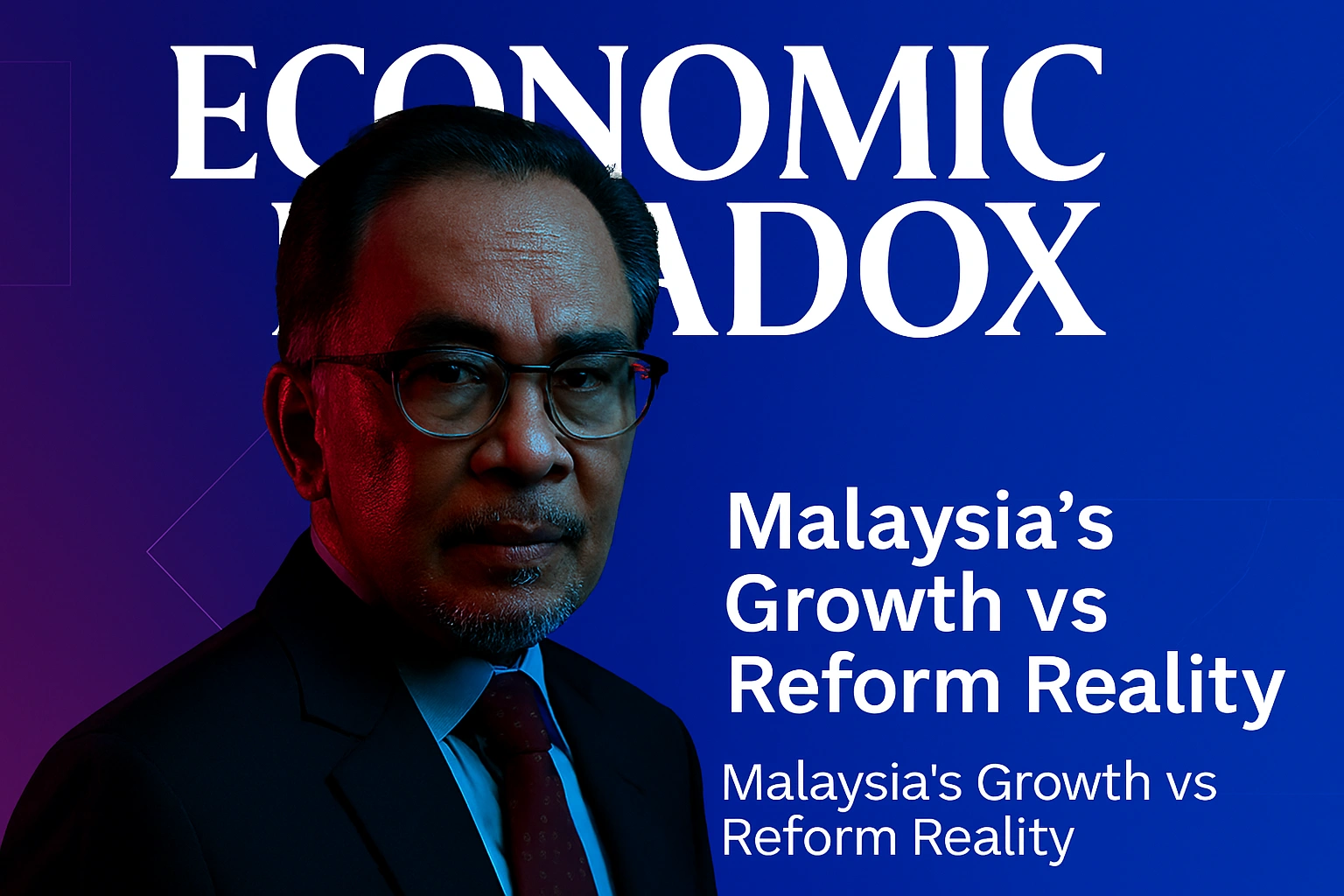
Three years into his premiership, Anwar Ibrahim’s Malaysia faces a critical divergence—robust GDP expansion is buying time for reforms that remain frustratingly incomplete
On a humid November afternoon in Kuala Lumpur, Finance Minister Datuk Seri Anwar Ibrahim stood before cameras to announce Malaysia’s third-quarter 2025 GDP growth: a robust 5.2 percent, placing the country on track to exceed government targets. Markets responded positively. International fund managers took note. Yet beneath the headline numbers lies a more complex narrative—one where impressive economic expansion has become both Anwar’s greatest achievement and his most dangerous temptation.
The divergence is stark and increasingly consequential. Malaysia’s economy has grown 5.1 percent in 2024 and is projected to maintain momentum through 2025, outpacing most regional peers and confounding skeptics who predicted political instability would derail the country’s economic trajectory. Meanwhile, the structural reforms that Anwar promised voters—subsidy rationalization, anti-corruption drives, institutional transformation—have advanced at a pace best described as cautious. For investors seeking policy predictability, policymakers watching regional competition intensify, and voters navigating cost-of-living pressures, this gap between growth and reform is reshaping how they judge Anwar’s stewardship three years into his tenure.
The Numbers Don’t Lie: Malaysia’s Impressive Growth Story
Malaysia’s economic performance since Anwar assumed office in November 2022 has been remarkably resilient. The country recorded 5.1 percent GDP growth in 2024, a significant acceleration from 3.6 percent in 2023, according to Bank Negara Malaysia. Through the first nine months of 2025, the economy expanded 4.7 percent year-on-year, with third-quarter growth hitting 5.2 percent—well above the government’s initial forecast range of 4.0 to 4.8 percent.
This trajectory stands out even within dynamic Southeast Asia. While Vietnam surged ahead with 8.22 percent third-quarter growth in 2025—its highest since 2011—Malaysia’s performance exceeded Indonesia’s 5.04 percent and substantially outpaced Thailand’s anemic 1.2 percent third-quarter expansion. The Philippines, grappling with domestic challenges, saw growth slow to its weakest pace since 2021. Against this backdrop, Malaysia has emerged as a regional bright spot, its economy now 12 percent larger than pre-pandemic levels, outperforming every Southeast Asian nation except Singapore.
What’s driving this momentum? The engines are multiple and mutually reinforcing. Manufacturing, particularly the electrical and electronics sector, expanded 4.1 percent in first-quarter 2025, buoyed by the global semiconductor upcycle and Malaysia’s deepening integration into supply chains diversifying away from China. The services sector, accounting for the largest share of economic activity, grew 5 percent, lifted by tourism recovery and robust domestic consumption. Construction surged an extraordinary 14.2 percent as infrastructure projects gained traction and data center investments materialized.
Malaysia’s employment growth reached 3.1 percent with 17.0 million people employed, while the unemployment rate held steady at 3 percent—the lowest in a decade. Private consumption, the economy’s anchor, expanded 5 percent in first-quarter 2025, supported by wage increases, including a new minimum wage of RM1,700 monthly implemented in February 2025, and civil servant salary adjustments.
Foreign investment tells a similarly encouraging story. Malaysia recorded RM51.5 billion in net foreign direct investment inflows in 2024, up substantially from RM38.6 billion the previous year, according to the Department of Statistics Malaysia. Total approved foreign investments for 2024 reached a staggering $85.8 billion, with the United States leading at $7.4 billion, followed by Germany and China. Tech giants Microsoft, Google, and ByteDance committed $2.2 billion, $2 billion, and $2.1 billion respectively to build data centers and AI infrastructure, betting on Malaysia’s competitive advantages in electricity costs, land availability, and strategic location.
The ringgit has been perhaps the most visible symbol of renewed confidence. After touching RM4.80 to the US dollar in early 2024, the currency staged a dramatic recovery, appreciating to around RM4.12 by late 2025—a gain of roughly 16.5 percent. This represented the ringgit’s best quarterly performance since 1973, driven by the Federal Reserve’s rate-cutting cycle, Bank Negara Malaysia’s intervention to encourage repatriation of overseas funds, and improved investor sentiment toward Malaysia’s economic management.
Malaysia’s stock market reflected this optimism. The FBM KLCI index surged 12.58 percent in 2024, its strongest performance in 14 years, with the capital market value hitting a record RM4.2 trillion. International fund managers, who had shunned Malaysian equities during years of political turbulence, began rotating back into the market, attracted by valuations and the reform narrative Anwar championed.
Yet for all these impressive figures, a critical question persists: Is this growth buying time for necessary reforms, or substituting for them?
The Reform Reality: Promises Outpacing Progress
When Anwar Ibrahim assumed the premiership, he inherited a reform agenda that had languished through years of political instability—three prime ministers in as many years before his appointment. His Madani Economy Framework, launched in July 2023, promised to address fiscal sustainability, institutional governance, and economic transformation. Three years on, the scorecard reveals progress measured in inches where feet were promised.
Subsidy Rationalization: Bold Talk, Cautious Steps
Fuel subsidies represent Malaysia’s most politically treacherous reform challenge. The blanket subsidy system cost the government approximately RM14.3 billion in 2023, disproportionately benefiting wealthy Malaysians and foreigners while straining public finances. Anwar repeatedly stressed the need for change, declaring that subsidies meant for the poor were enriching the rich.
The government removed diesel subsidies in June 2024, increasing prices by approximately 55 percent to RM3.35 per liter, saving an estimated RM4 billion annually. This was touted as a milestone—and it was. But it was also the easier reform, affecting primarily commercial users who could be partially compensated through targeted fleet card programs.
The harder test—RON95 petrol subsidy reform, which affects ordinary Malaysians directly—has been repeatedly delayed. Initially slated for late 2024, then early 2025, the government announced in July 2025 a temporary price ceiling of RM1.99 per liter alongside a RM2 billion one-off cash transfer, but without clear implementation timelines for structural reform. This approach suggests possible delays in subsidy rationalisation and rising subsidy costs that could cloud Malaysia’s medium-term fiscal path, according to analysts at Public Investment Bank.
The fiscal math is unforgiving. While the government narrowed its fiscal deficit to 4.1 percent of GDP in 2024, beating its 4.3 percent target, the government still bears approximately RM7 billion in fuel subsidies annually. Without comprehensive rationalization, Malaysia’s path to its medium-term deficit target of 3 percent by 2026 grows steeper, particularly as petroleum revenue declines with lower crude oil prices.
Anti-Corruption Drive: Rhetoric Versus Results
Anwar launched the National Anti-Corruption Strategy 2024-2028 in May 2024 with considerable fanfare, setting an ambitious goal for Malaysia to rank among the top 25 countries in Transparency International’s Corruption Perception Index within a decade. Malaysia ranked 57th globally with a score of 50 in the 2024 Corruption Perception Index, unchanged from the previous year—a sobering indication that words have yet to translate into measurable improvement.
The strategy encompasses worthy initiatives: introducing a Public Procurement Act, establishing a Political Financing Act, enhancing MACC reporting procedures, and creating incentives for whistleblowers. Yet implementation has been uneven. Civil society organizations have criticized the reappointment of MACC Chief Commissioner Azam Baki despite controversies, questioned procurement processes lacking transparency, and noted that 14 initiatives from the previous National Anti-Corruption Plan 2019-2023 remained incomplete.
More troubling, the monitoring mechanism remains largely intergovernmental, with limited explicit involvement from civil society despite rhetorical commitments to transparency. Completion of initiatives cannot be taken at face value as it does not consider actual impact, warned the C4 Center, a governance watchdog. Box-ticking exercises masquerading as reform undermine public confidence and investor perceptions of institutional quality.
Institutional and Economic Transformation: Blueprints Without Buildings
Anwar’s government has produced an impressive array of policy documents: the New Industrial Master Plan 2030, National Energy Transition Roadmap, National Semiconductor Strategy, and plans for a Johor-Singapore Special Economic Zone. These frameworks chart Malaysia’s aspirations to move up the value chain, attract high-quality investments, and transition to a knowledge economy.
Yet translating strategy documents into tangible outcomes requires bureaucratic capacity, policy consistency, and sustained political will—all areas where execution has lagged. Government-linked companies, which dominate key sectors, have seen incremental rather than transformational reform. The promised separation of Attorney General and Public Prosecutor roles—a critical institutional check against political interference—has been delayed despite commitments to implement before the next general election.
Labor market reforms aimed at boosting productivity remain tentative. Employee compensation as a percentage of GDP stood at just 33.1 percent in 2023, far short of the government’s 40 percent target by 2025. Low- and semi-skilled workers still comprise over two-thirds of Malaysia’s formal labor force, perpetuating a low-wage, low-productivity trap that reforms on paper have yet to break.
The pattern is consistent: announcements generate headlines, but implementation timelines stretch, details remain vague, and follow-through proves elusive. Political constraints within Anwar’s unity government coalition, which includes former rivals with divergent interests, complicate decisive action. The result is a reform agenda that looks impressive in PowerPoint presentations but delivers incremental progress measured against the scale of change Malaysia requires.
Three Audiences, Three Scorecards
The divergence between Malaysia’s economic growth and reform momentum creates distinct—and increasingly divergent—assessments among the three constituencies that matter most for Anwar’s political and economic future.
Investors: Watching, Waiting, and Weighing Alternatives
International investors have demonstrated cautious optimism tempered by persistent concerns. Foreign direct investment flows improved significantly in 2024, and equity inflows periodically surged, particularly into bond markets as foreign holdings of Malaysian government securities increased to RM298 billion in November 2025 from RM277 billion a year earlier. Tech sector commitments from Microsoft, Google, and ByteDance provided high-profile validation of Malaysia’s investment proposition.
Yet portfolio flows remain volatile, oscillating between net buying and selling based on global risk appetite rather than sustained conviction in Malaysia’s structural story. Equity markets have proven more fickle than bond markets, suggesting investors view currency stability and yield differentials as more compelling than Malaysia’s equity risk-return profile.
Fund managers in Singapore and Hong Kong consistently cite the same concerns in private conversations: reform implementation uncertainty, bureaucratic friction despite official pledges to reduce red tape, and competitive pressure from regional peers. Vietnam continues to attract manufacturing FDI with aggressive incentives and streamlined approvals. Thailand, despite political challenges, offers established supply chains and infrastructure. Indonesia’s massive domestic market exerts gravitational pull despite its own reform challenges.
Foreign investors scrutinize concrete implementation and stability of initiatives before making commitments, especially given Malaysia’s unity government remains relatively new, noted Sedek Ahmad, an analyst tracking Southeast Asian markets. Sustained progress and a stable governance framework are paramount for maintaining investor confidence, he emphasized.
Malaysia’s improved credit outlook and narrowing fiscal deficit provide comfort, but investors increasingly question whether growth momentum can be maintained without deeper structural reforms addressing productivity constraints, skills gaps, and institutional quality. The perception risk is subtle but consequential: if investors conclude that Malaysia’s leadership views strong GDP numbers as sufficient rather than as providing political capital for harder reforms, capital allocation decisions could shift unfavorably.
Policymakers: Coalition Constraints and Regional Competition
For Anwar’s government, the calculus is brutally complex. Leading a unity government that includes the United Malays National Organization (UMNO)—his former political nemesis—requires constant coalition management. Reform measures that might be economically rational face political obstacles from coalition partners representing constituencies that benefit from existing arrangements.
Subsidy reform exemplifies this dilemma. While economists universally advocate removing blanket subsidies as fiscally wasteful and regressive, the political optics of raising fuel prices for voters are treacherous, particularly with cost-of-living concerns prominent. The government’s stop-start approach to RON95 rationalization reflects this tension—acknowledging necessity while deferring politically painful implementation.
Regional competitive dynamics compound the pressure. Malaysia faces a classic middle-income trap challenge. Its per capita GDP of approximately $13,000 positions it between lower-cost competitors like Vietnam and Indonesia and high-income peers like Singapore. To maintain competitiveness against low-cost rivals requires productivity improvements and value chain advancement. To converge toward high-income status requires institutional quality and human capital development. Both demand reforms that the current political coalition structure makes difficult.
Vietnam, Thailand, and Malaysia have managed to capitalize on US-China trade tensions, attracting foreign direct investment associated with supply chain reconfigurations in medium- to high-tech sectors, according to Asian Development Bank analysis. But sustaining this advantage requires continued policy clarity and execution—precisely where Malaysia’s coalition constraints create vulnerability.
Policymakers are acutely aware that the window created by strong economic growth is finite. External risks loom large: a deeper-than-expected slowdown in China, Malaysia’s largest trading partner; escalating US-China technology competition that could disrupt electronics supply chains; and potential tariff policies from a second Trump administration that could reshape trade flows. Any of these shocks would narrow Malaysia’s fiscal and political space to pursue difficult reforms.
The tragedy is that strong growth creates the ideal conditions—economically and politically—to pursue structural transformation. Tax revenues are healthy, employment is robust, and public tolerance for short-term adjustment costs is higher when the broader economy is performing well. Yet the same strong growth that should enable bold reform also reduces the perceived urgency to act, creating a dangerous complacency trap.
Voters: Pocketbook Politics Trumps GDP Statistics
For Malaysia’s 33 million citizens, GDP growth rates and foreign investment figures feel abstract when measured against daily lived experience. Here, the divergence between macroeconomic performance and household economic reality grows most acute.
Malaysia’s average monthly disposable household income increased by 3.2 percent to RM7,584 in 2024, while the median rose by 5.1 percent to RM5,999, representing 82.8 percent of total gross household income, according to Department of Statistics Malaysia data. These numbers suggest improving purchasing power. Yet inflation-adjusted real gains tell a more sobering story.
Inflation has remained relatively benign at 1.3 to 1.5 percent through most of 2024 and 2025, but these headline figures mask the lived reality of specific cost pressures. Housing costs in major urban centers continue rising faster than general inflation. Education expenses, healthcare costs for those outside the public system, and food prices away from home—categories that matter most to middle-income households—have increased more rapidly than average incomes.
The Employees Provident Fund’s Belanjawanku 2024/25 budget benchmarks illustrate the squeeze. In the Klang Valley, a family with two children requires RM7,440 monthly to maintain a modest but decent standard of living—consuming approximately 75 percent of the state’s median household income. In Penang, the proportion exceeds typical household earnings entirely. For Malaysia’s M40 middle-income households, the gap between income growth and cost-of-living increases creates a mounting debt culture and financial stress.
The political implications are straightforward: voters judge government performance not by GDP growth rates but by whether their household finances are improving. When economic growth fails to translate into tangible wage increases and cost-of-living relief, approval ratings suffer regardless of macroeconomic statistics.
Polling data and by-election results suggest growing voter frustration. While Anwar’s coalition maintained control in key state elections, margins narrowed in urban and suburban constituencies where cost-of-living concerns predominate. The government’s approval ratings, while stable, have failed to translate economic growth into overwhelming political capital.
Youth unemployment, while numerically low, conceals underemployment and quality concerns. Graduate unemployment persists despite headline labor market strength, reflecting skills mismatches and the economy’s continued reliance on low-productivity sectors. For young Malaysians, the promise of economic transformation and high-value job creation remains aspirational rather than experiential.
The Time-Bought Gamble: Can Growth Sustain Without Deeper Reform?
Anwar’s core bet is that growth buys time for sequenced, gradual reform implementation that minimizes political disruption while building institutional capacity for structural change. This strategy has clear logic: attempting comprehensive reform simultaneously risks political backlash that could destabilize the unity government and reverse gains. Better, the thinking goes, to consolidate economic momentum, demonstrate competent governance, and pursue incremental reform as political capital accumulates.
The optimistic case rests on several pillars. Political stability since Anwar’s appointment represents a marked improvement after years of uncertainty. This stability has itself generated economic dividends through restored investor confidence and policy predictability. The fiscal deficit is declining, debt levels are stabilizing, and revenue measures are gradually taking effect. Reform blueprints are in place, awaiting execution as conditions permit. Major infrastructure projects are progressing, foreign investment commitments are materializing, and the semiconductor strategy is positioning Malaysia for the next technology cycle.
Proponents argue that attempting shock therapy reforms in Malaysia’s complex multi-ethnic political landscape could trigger backlash that undoes stability. The gradual approach, while frustrating to reform advocates, represents political realism in a democracy where coalition management is essential. Give Anwar’s government the full five-year term to implement its agenda, supporters contend, and judge outcomes then rather than demanding instant transformation.
The pessimistic case, however, carries compelling force. Malaysia has been promising structural reform for decades while sliding down competitiveness rankings relative to regional peers. Vietnam has surged from a low base through decisive policy execution. Thailand, despite political turbulence, maintains advantages in infrastructure and supply chain depth that Malaysia struggles to match. Singapore’s institutional quality and policy implementation speed remain aspirational benchmarks Malaysia cannot reach without fundamental change.
The danger is that strong growth becomes a substitute for reform rather than its enabler. Why endure political pain from subsidy cuts when GDP is expanding 5 percent? Why risk coalition fractures over institutional reforms when foreign investment is flowing? This logic is seductive precisely because it contains short-term truth—but creates long-term vulnerability.
Global economic conditions could deteriorate rapidly. A US recession, Chinese slowdown, or financial market disruption would slash Malaysia’s fiscal space and economic growth simultaneously. At that point, implementing painful reforms becomes economically more damaging and politically more difficult. The window that growth creates would slam shut, leaving Malaysia exposed with unfinished reform business.
Regional precedents offer cautionary lessons. Indonesia under Joko Widodo pursued impressive infrastructure development and selective reforms but left critical structural issues—labor market rigidities, bureaucratic inefficiency, corruption—largely untouched. The result was respectable but not transformative growth, leaving Indonesia stuck in middle-income status. Thailand’s political cycles have repeatedly interrupted reform momentum, creating sustained mediocrity rather than sustained excellence.
Malaysia risks following similar patterns: respectable performance that satisfies neither those demanding transformation nor those resisting change, while regional competitors execute more decisively. The question isn’t whether Malaysia can maintain 4-5 percent growth short-term—it clearly can given current tailwinds. The question is whether, five years hence, Malaysia’s economic structure, institutional quality, and competitiveness will have improved sufficiently to sustain long-term prosperity.
What Hangs in the Balance
The divergence between Malaysia’s economic growth and reform implementation is approaching a critical juncture. Anwar’s government faces decisions in the coming 18-24 months that will largely determine whether current momentum translates into sustained transformation or proves another false dawn in Malaysia’s long quest for high-income status.
Subsidy reform cannot be deferred indefinitely without undermining fiscal consolidation targets and perpetuating resource misallocation. The political cost of implementing RON95 rationalization will only increase as the next general election approaches. If the government lacks political will to act when GDP is growing 5 percent and unemployment is at decade lows, it certainly won’t find courage during economic headwinds.
Institutional reforms—separating prosecutorial and advisory functions, strengthening MACC independence, implementing political financing transparency—require legislative action and coalition consensus. The window for achieving this before the next general election is narrowing. Failure to deliver would validate critics’ charges that Anwar’s reform agenda was always more rhetoric than reality.
Labor market and productivity reforms demand sustained effort beyond policy announcements. Shifting Malaysia’s workforce composition toward higher skills, attracting knowledge-intensive industries, and improving public sector efficiency require years of consistent implementation. Starting this transformation now versus waiting another electoral cycle will determine whether Malaysia converges toward high-income status or stagnates.
For investors, the message must be clear: Malaysia’s fundamentals are strong, but structural competitiveness depends on reform execution, not just growth statistics. For policymakers, the uncomfortable truth is that political capital is finite—using growth-driven goodwill to pursue difficult reforms is precisely what distinguishes transformative from transactional leadership. For voters, the question is whether they reward governments for GDP growth or demand tangible improvement in household economic security.
Three years into Anwar Ibrahim’s tenure, Malaysia has achieved economic stabilization and respectable growth—accomplishments that should not be dismissed. But growth alone never transformed a nation. The test ahead is whether Malaysia’s leaders possess the political courage to pursue reforms that strong growth makes possible but political convenience makes tempting to defer. Time is buying opportunity, but opportunity has an expiration date. The divergence between growth and reform cannot persist indefinitely without consequences.
Malaysia’s moment of truth approaches. The question is no longer whether the economy can grow—it demonstrably can. The question is whether growth will catalyze the transformation Malaysia requires or simply paper over the structural cracks that deeper reforms must eventually address. That answer will define not just Anwar’s legacy, but Malaysia’s trajectory for the next generation.
[Statistics sourced from Bank Negara Malaysia, Department of Statistics Malaysia, Ministry of Finance Malaysia, Malaysian Investment Development Authority, World Bank, International Monetary Fund, Asian Development Bank, McKinsey Southeast Asia Quarterly Economic Review, and Transparency International, November-December 2025]
Discover more from The Economy
Subscribe to get the latest posts sent to your email.


The latest joint diagnostics from the IMF and World Bank reveal a bifurcated global economy. While developed economies attempt soft landings, emerging markets face severeliquidity squeezes. Sovereign debt restructuring mechanisms are failing to keep pace with US-dollar obligations, signaling suppressed infrastructure spending in developing nations.
The current macroeconomic environment is characterized by unprecedented volatility, driven by shifting monetary policies, supply chain recalibrations, and evolving trade barriers. As central banks navigate the delicate balance between curbing inflation and preventing deep recessions, emerging markets face asymmetric risks. Developing economies must rigorously manage their foreign exchange reserves while calibrating import duties and trade frameworks—often leveraging insights from national tariff commissions to protect domestic industries without stifling vital foreign direct investment. This delicate equilibrium directly impacts global liquidity, equity valuations, and sovereign debt yields. The restructuring of global supply chains, initially sparked by geopolitical friction, has now become a structural reality. Corporations are transitioning from ‘just-in-time’ manufacturing to ‘just-in-case’ inventory management, fundamentally altering capital expenditure cycles. Furthermore, the integration of advanced digital tracking and open-source intelligence is allowing multinational firms to better anticipate supply shocks, although the cost of implementing these technologies creates new barriers to entry for smaller enterprises. Ultimately, the intersection of foreign policy and economic strategy is tighter than ever, with trade tariffs and sanctions acting as primary instruments of geopolitical leverage.
This dynamic fundamentally shifts how stakeholders must approach long-term strategic planning, requiring a pivot away from legacy models toward hyper-adaptive fiscal forecasting.
2. Deep Dive: Market Mechanics and Structural Shifts
Delving deeper into the structural mechanics, we see a profound transformation in how institutional capital evaluates risk. Historically, geographic diversification offered a reliable hedge against localized downturns. Today, however, the rapid transmission of financial shocks across borders—facilitated by highly integrated banking networks and algorithmic trading—means that systemic risk is virtually ubiquitous. Asset managers are heavily scrutinizing cash flow durability, favoring sectors with inelastic demand characteristics. The regulatory environment is also tightening. Heightened scrutiny over data privacy, antitrust concerns in the technology sector, and rigorous ESG (Environmental, Social, and Governance) compliance mandates are forcing companies to overhaul their operational frameworks. These compliance costs are inevitably passed down to the consumer, fueling core inflationary pressures. Concurrently, the labor market is undergoing a structural shift. The automation of routine tasks, coupled with the rising premium on specialized technical and analytical skills, is widening the productivity gap between different segments of the workforce. For policymakers and corporate strategists alike, navigating this landscape requires a nuanced understanding of these intersecting vectors, moving beyond traditional econometric models to incorporate real-time, alternative data sources.
By examining the underlying data, it becomes evident that the market is severely underpricing tail-risks associated with these developments. Institutional capital flows are increasingly prioritizing liquidity and balance sheet resilience over speculative growth.
In parallel, the velocity of money within these specific sub-sectors has decelerated, indicating a hoarding of capital by major corporate players in anticipation of further regulatory or geopolitical turbulence. This behavior creates a feedback loop, exacerbating localized liquidity shortages and widening credit spreads.
3. Regulatory Environment and Trade Implications
Any comprehensive analysis must account for the evolving regulatory perimeter. National trade bodies and tariff commissions are aggressively deploying protectionist measures, utilizing import duties and quotas to shield domestic industries from global dumping practices. These tariff architectures, while politically popular, disrupt established global value chains and introduce massive compliance overhead for multinational operators.
The current macroeconomic environment is characterized by unprecedented volatility, driven by shifting monetary policies, supply chain recalibrations, and evolving trade barriers. As central banks navigate the delicate balance between curbing inflation and preventing deep recessions, emerging markets face asymmetric risks. Developing economies must rigorously manage their foreign exchange reserves while calibrating import duties and trade frameworks—often leveraging insights from national tariff commissions to protect domestic industries without stifling vital foreign direct investment. This delicate equilibrium directly impacts global liquidity, equity valuations, and sovereign debt yields. The restructuring of global supply chains, initially sparked by geopolitical friction, has now become a structural reality. Corporations are transitioning from ‘just-in-time’ manufacturing to ‘just-in-case’ inventory management, fundamentally altering capital expenditure cycles. Furthermore, the integration of advanced digital tracking and open-source intelligence is allowing multinational firms to better anticipate supply shocks, although the cost of implementing these technologies creates new barriers to entry for smaller enterprises. Ultimately, the intersection of foreign policy and economic strategy is tighter than ever, with trade tariffs and sanctions acting as primary instruments of geopolitical leverage.
Consequently, compliance is no longer a localized legal issue but a central pillar of global corporate strategy. Firms that fail to map their supply chain vulnerabilities against shifting tariff schedules risk catastrophic margin compression. The strategic deployment of foreign direct investment is now heavily contingent upon favorable tariff rulings and bilateral trade agreements, making regulatory forecasting as critical as traditional financial modeling.
4. Corporate Strategy & Supply Chain Realities
At the enterprise level, the response to these macroeconomic and regulatory pressures involves massive capital expenditure in supply chain redundancy. The shift toward near-shoring and friend-shoring is accelerating, unwinding decades of globalization focused purely on labor arbitrage. This transition is highly capital intensive, depressing near-term return on invested capital (ROIC) but essential for long-term operational survival.
Delving deeper into the structural mechanics, we see a profound transformation in how institutional capital evaluates risk. Historically, geographic diversification offered a reliable hedge against localized downturns. Today, however, the rapid transmission of financial shocks across borders—facilitated by highly integrated banking networks and algorithmic trading—means that systemic risk is virtually ubiquitous. Asset managers are heavily scrutinizing cash flow durability, favoring sectors with inelastic demand characteristics. The regulatory environment is also tightening. Heightened scrutiny over data privacy, antitrust concerns in the technology sector, and rigorous ESG (Environmental, Social, and Governance) compliance mandates are forcing companies to overhaul their operational frameworks. These compliance costs are inevitably passed down to the consumer, fueling core inflationary pressures. Concurrently, the labor market is undergoing a structural shift. The automation of routine tasks, coupled with the rising premium on specialized technical and analytical skills, is widening the productivity gap between different segments of the workforce. For policymakers and corporate strategists alike, navigating this landscape requires a nuanced understanding of these intersecting vectors, moving beyond traditional econometric models to incorporate real-time, alternative data sources.
Furthermore, the integration of advanced data analytics into procurement and logistics is creating a bifurcation in corporate performance. Companies leveraging real-time telemetry and predictive modeling can dynamically route around bottlenecks, whereas legacy operators remain heavily exposed to single points of failure. This technological divide is rapidly translating into a definitive competitive advantage, reflected in disparate valuation multiples within the same industry cohorts.
5. Digital Monetization & Premium Publisher Strategy
From a digital publishing and monetization perspective, covering these complex macro and technological trends requires a sophisticated architecture. High-CPM and high-CPC yield generation depends on capturing intent-driven traffic. Financial and geopolitical content naturally attracts premium programmatic advertisers. Digital publishers operating robust portfolios are increasingly diversifying their revenue streams beyond standard display ads. By integrating specialized publisher networks, such as Coin.network for crypto and macro-finance adjacencies, or high-intent affiliate ecosystems like Travelpayouts for global transit and aviation content, digital platforms can drastically improve their revenue per thousand impressions (RPM). Furthermore, optimizing site taxonomy and leveraging vector-based assets ensures faster load times, directly boosting Core Web Vitals and search engine rankings. The strategic placement of contextual widgets, combined with deep-dive analytical content, creates a sticky user experience that encourages longer session durations. This architectural approach not only outperforms algorithmic updates but establishes a highly defensible moat against low-effort, AI-generated content farms. For media operators, the transition from basic news aggregation to authoritative, niche intelligence distribution is the key to sustainable digital media economics.
For financial and economic news portals, the path to profitability lies in owning the niche. By consistently delivering high-fidelity analysis that intersects global trade, technology, and market data, publishers attract a highly affluent demographic. This audience profile commands top-tier CPC rates from financial institutions, B2B SaaS providers, and enterprise tech conglomerates.
Strategic integration of programmatic networks requires meticulous attention to ad placement, ensuring that monetization widgets complement rather than disrupt the analytical narrative. The use of sophisticated yield management platforms allows publishers to dynamically allocate inventory between direct sales, private marketplaces, and open exchanges, maximizing revenue yield in real-time. This sophisticated infrastructure is the bedrock of modern digital publishing economics.
6. Future Outlook and Risk Assessment
The current macroeconomic environment is characterized by unprecedented volatility, driven by shifting monetary policies, supply chain recalibrations, and evolving trade barriers. As central banks navigate the delicate balance between curbing inflation and preventing deep recessions, emerging markets face asymmetric risks. Developing economies must rigorously manage their foreign exchange reserves while calibrating import duties and trade frameworks—often leveraging insights from national tariff commissions to protect domestic industries without stifling vital foreign direct investment. This delicate equilibrium directly impacts global liquidity, equity valuations, and sovereign debt yields. The restructuring of global supply chains, initially sparked by geopolitical friction, has now become a structural reality. Corporations are transitioning from ‘just-in-time’ manufacturing to ‘just-in-case’ inventory management, fundamentally altering capital expenditure cycles. Furthermore, the integration of advanced digital tracking and open-source intelligence is allowing multinational firms to better anticipate supply shocks, although the cost of implementing these technologies creates new barriers to entry for smaller enterprises. Ultimately, the intersection of foreign policy and economic strategy is tighter than ever, with trade tariffs and sanctions acting as primary instruments of geopolitical leverage.
Looking forward to the next fiscal cycles, the interplay between technological disruption and macroeconomic stability will intensify. Stakeholders must remain exceptionally agile, deploying advanced forecasting tools and maintaining robust liquidity buffers to weather unexpected systemic shocks. The margin for error in capital allocation has effectively dropped to zero.
In conclusion, the convergence of these factors dictates a complete reimagining of traditional operational and investment playbooks. The victors in this new paradigm will be those who can seamlessly synthesize geopolitical intelligence, deep market data, and advanced digital distribution strategies into a cohesive, actionable framework.
Discover more from The Economy
Subscribe to get the latest posts sent to your email.

The gap between the best- and worst-monetized content on the same platform, with the same traffic, is not a rounding error — it’s a 10x to 40x multiplier. A finance or insurance page earning $50–$80 RPM from 1,000 visitors sits next to an entertainment page earning $2–$5 from the identical traffic volume. For publishers building in wealth management, macroeconomics, and adjacent financial verticals, understanding — and deliberately engineering for — that gap is the single highest-leverage decision in the monetization stack.
The 2026 CPM Landscape, By Channel
| Channel | Finance-Niche CPM/RPM (2026) | Comparison Baseline |
|---|---|---|
| Display/AdSense (insurance) | $40–$80 RPM (US traffic) | Entertainment: $1–$4 RPM |
| Display/AdSense (finance, broad) | High-tier, comparable band | Recipe/cooking: $2–$5 RPM |
| YouTube (finance/credit cards) | $20–$50 CPM, $10–$25 RPM | Gaming/entertainment: $1–$8 CPM |
| Newsletter — Finance/Investing | $80–$180 CPM (direct), $30–$65 CPM (programmatic) | General-interest newsletters: materially lower |
| Newsletter — Legal | $55–$130 CPM | — |
| Newsletter — B2B SaaS | $50–$120 CPM | — |
The pattern holds across every channel: finance, insurance, legal, and B2B/SaaS content consistently occupies the top CPM tier, while entertainment, gossip, and general lifestyle content sits at the bottom, regardless of which ad platform or format is measured.
Why Financial Content Commands This Premium
Three structural factors explain the gap, and understanding them is what allows a publisher to deliberately position content to capture it rather than stumbling into it:
- High customer lifetime value on the advertiser side. Financial services, software, and B2B companies can justify significantly higher acquisition costs per click or impression because each converted customer is worth thousands of dollars in lifetime revenue — a fundamentally different unit economics than a consumer-goods or entertainment advertiser is working with.
- Purchase-intent signals embedded in the content itself. A reader consuming an article on “best high-yield savings accounts” or “how to open a Roth IRA” is, by definition, closer to a purchase decision than a reader consuming general entertainment content — and programmatic ad systems price that intent signal directly into the CPM.
- Affluent, professionally-engaged demographics. Content targeting professionals, business decision-makers, and active investors delivers an audience composition advertisers will pay a structural premium to reach, independent of the specific article topic.
Sub-Niche Stratification: Not All Finance Content Is Equal
The highest-leverage insight for publishers already operating in finance is that the finance vertical itself is not monolithic — sub-niche selection produces meaningful CPM variance:
- Specificity beats breadth. “Best credit cards for travel rewards 2026” attracts materially more advertiser competition than “general money tips” — the more precisely a piece of content maps to a specific purchase decision, the more advertisers bid to appear against it.
- Audience precision beats audience size. A newsletter serving 3,000 active options traders can command a higher CPM than a general personal-finance newsletter with 30,000 subscribers, because options-trading advertisers (brokerages, trading platforms, specialized data services) will pay a premium for a small, precisely-qualified audience over a large, diffuse one.
- High-value sub-niches within finance include independent registered investment advisors, high-net-worth investors, cryptocurrency traders, options traders, and real estate investors — each representing a distinct advertiser pool with its own premium pricing dynamics.
The Format and Length Lever
Content format materially affects realized CPM independent of topic:
- Longer-form content (8+ minutes on video; substantial word count on text) enables more ad placements per unit of content — on YouTube specifically, videos over 8–10 minutes qualify for mid-roll placements, and a 10-minute video can carry 3–4 mid-roll ad breaks versus a single pre-roll on shorter content.
- Short-form content dramatically underperforms in finance specifically. YouTube Shorts RPM in the finance niche runs 50–100x lower than long-form content — meaning a content strategy overly weighted toward short-form for audience-building purposes can actively suppress realized revenue if not balanced against long-form monetization content.
- This dynamic favors exactly the kind of deep, analytical, long-form content this publication produces — a genuine structural advantage for publishers investing in comprehensive rather than surface-level financial content.
Seasonal Timing: Q4 Concentration
Advertiser spending in financial verticals is not evenly distributed across the year:
- Q4 (October–December) represents the highest-CPM period, driven by advertiser budget cycles and year-end financial-decision content (tax planning, open enrollment, year-end investment moves).
- January consistently registers as the lowest-CPM month — publishers who concentrate their highest-effort content releases in Q1 rather than Q4 are systematically leaving realized revenue on the table.
- The optimal strategy publishes evergreen, audience-building content in Q1–Q3 while reserving peak-performing, highest-investment content for Q4 release, when the same traffic converts to meaningfully higher realized CPM.
E-E-A-T Signals for Financial Content Specifically
Google’s Experience, Expertise, Authoritativeness, and Trustworthiness framework carries outsized weight for financial content under the “Your Money or Your Life” (YMYL) content classification, which subjects financial publishing to stricter quality signals than general content categories:
- Author credentials and bylines matter more for financial content than almost any other vertical — content should be attributed to identifiable authors with relevant background, not published anonymously or under generic “Editorial Team” bylines where genuine expertise can be demonstrated.
- Sourcing to primary institutions — the IMF, World Bank, Federal Reserve, SEC, SSA — carries direct SEO and trust benefit for financial content specifically, both for search ranking and for advertiser brand-safety screening.
- Currency and update cadence matter disproportionately for financial content, since stale financial data (outdated interest rates, superseded tax brackets, old market data) both damages user trust and can trigger content-freshness penalties in search ranking.
Programmatic vs. Direct: The Allocation Decision
The newsletter-CPM data illustrates a broader principle applicable across channels: direct sponsorship deals consistently command 2–3x the CPM of programmatic fill in premium financial verticals ($80–$180 direct vs. $30–$65 programmatic for finance newsletters). The optimal monetization stack for a financial publisher therefore layers:
- Direct advertiser relationships for the highest-value inventory (top placements, dedicated sends, sponsored deep-dives), capturing the premium direct CPM.
- Programmatic/real-time bidding as a fill layer beneath direct sales, ensuring no inventory goes unmonetized while direct relationships are being built or between direct campaign flights.
- Affiliate and product-referral revenue stacked on top of ad revenue — particularly for content around specific financial products (credit cards, brokerages, savings accounts) where affiliate commissions can meaningfully exceed pure ad-impression revenue on high-intent content.
Finance and insurance content commands the highest CPMs of any digital publishing niche in 2026, with display RPMs of $40-80, YouTube CPMs of $20-50, and direct newsletter sponsorships reaching $80-180 CPM — a 10 to 40x premium over general-interest content, driven by high advertiser customer lifetime value and strong purchase-intent signals.”
Financial publishers who treat CPM optimization as a deliberate content-strategy input — not an afterthought handled purely by the ad-tech stack — can realistically capture a 10–40x revenue multiple over general-interest content with comparable traffic. The concrete levers are sub-niche specificity, long-form format (particularly given finance’s uniquely poor short-form monetization), Q4-weighted publishing calendars, direct-sales allocation for premium inventory, and E-E-A-T-aligned authorship and sourcing — all of which compound rather than operate independently.
Discover more from The Economy
Subscribe to get the latest posts sent to your email.
Global growth forecasts have been on a genuine roller coaster through 2026, and the two institutions tasked with tracking that trajectory — the International Monetary Fund and the World Bank — have delivered a consistent underlying message even as their specific numbers moved: the global economy has proven more resilient than feared at each individual shock, but the 2020s as a whole are on track to be the weakest decade for growth since the 1960s, and inflation’s decline has stalled rather than completed.
The IMF’s 2026 Forecast Trajectory
| WEO Report | Global Growth 2026 | Global Growth 2027 | Inflation 2026 | Key Driver |
|---|---|---|---|---|
| January 2026 | 3.3% | 3.2% | Declining | Technology investment, fiscal/monetary support |
| April 2026 | 3.1% | 3.2% | Rising to 4.4% | Middle East war outbreak |
| July 2026 | 3.0% | 3.4% | Revised up to 4.7% | Disinflation trend stalled; energy/food prices |
The swing between January and April 2026 — a full 0.2-point downgrade to growth alongside a jump in the inflation forecast — was driven almost entirely by the outbreak of war in the Middle East, which IMF Chief Economist Pierre-Olivier Gourinchas described directly: “The war has stopped that momentum and we now project growth of 3.1 percent this year… with inflation rising to 4.4 percent, a sharp departure from the previous trend.”
By July, the Fund’s own briefing described the resulting trajectory as a “V-shaped recovery” — weaker 2026 growth than the pre-war forecast, followed by a stronger 2027 rebound (revised up to 3.4%) — while cautioning that the disinflation trend in place since early 2024 has stalled, with headline inflation revised upward for both 2026 and 2027 versus the April forecast.
Three Scenarios, Not One Baseline
Reflecting the genuine uncertainty introduced by the Middle East conflict, the IMF’s April 2026 report broke from its traditional single-baseline format and instead presented three explicit scenarios:
- Reference forecast: assumes a short-lived conflict with a moderate 19% rise in energy prices in 2026 — global growth at 3.1%, inflation at 4.4%.
- Adverse scenario: assumes further disruption, higher energy prices, elevated inflation expectations, and tighter financial conditions throughout the year — growth falling to 2.5%, inflation rising to 5.4%.
- Severe scenario: assumes energy supply disruptions extend into 2027, with greater macroeconomic instability across advanced and emerging markets alike.
This scenario-based approach itself signals how much weight the Fund places on geopolitical risk as the dominant swing factor in the current outlook, ahead of more traditional cyclical drivers like monetary policy stance or fiscal consolidation pace.
Regional Divergence: Winners and Losers
The IMF’s reporting has consistently emphasized that the aggregate global figures mask sharply uneven regional impacts:
- The euro area continues to underperform, with subdued growth reflecting unresolved structural headwinds, lingering effects of elevated post-Ukraine-invasion energy prices, and real appreciation of the euro relative to competitor export currencies. Planned defense-spending increases are expected to provide only gradual support, given commitments to reach target spending levels by 2035.
- The United States has been a relative bright spot, with growth projected at 2.4% for 2026 in the January update, supported by fiscal measures and continued technology-driven investment.
- Energy-importing and vulnerable emerging market economies are bearing the brunt of the Middle East war’s growth and inflation impact, hit through three distinct channels the IMF identifies explicitly: higher energy and food prices directly; persistence in wage and price inflation; and a broader confidence shock affecting investment decisions.
- Countries integrated into the AI-driven technology value chain are seeing that demand partly offset war-related headwinds, creating a genuine bifurcation between economies positioned to capture AI infrastructure investment and those that are not.
The World Bank’s Parallel — and More Pessimistic — Assessment
The World Bank’s Global Economic Prospects reports have tracked a broadly similar trajectory but with a structurally lower growth baseline and a starker framing of the developing-world implications:
- January 2026: Global GDP growth projected at 2.6% in 2026, recovering to 2.7% in 2027 — an upward revision from the Bank’s own June 2025 forecast, driven primarily by stronger-than-expected U.S. performance.
- Structural framing: World Bank Group Chief Economist Indermit Gill’s foreword to the Bank’s report states plainly that, barring a change in trajectory, “the 2020s are on track to become a lost decade for far too many developing economies,” noting that virtually half of all developing economies have failed since 2019 to narrow the income gap with the world’s most prosperous economies.
- A longer-term counterpoint: The same report expresses genuine optimism about the 2030s specifically, arguing that AI, energy transformation, and deeper regional integration represent economic forces powerful enough to unlock transformative progress in the next decade — but only if the necessary preparation begins now.
Sovereign Debt: The Structural Vulnerability Beneath the Cyclical Numbers
Both institutions have devoted increasing analytical attention in 2026 to rising sovereign debt burdens across emerging market and developing economies (EMDEs):
- Rising debt is driving up EMDE borrowing costs, particularly for the most indebted nations, creating a self-reinforcing dynamic the World Bank’s June 2026 report analyzes in detail under a dedicated section on “A Rising Challenge: Sovereign Debt Levels and Interest Rates in EMDEs.”
- Fiscal rules show measurable benefit: World Bank analysis finds that countries adopting formal fiscal rules see budget balances improve by 1.4 percentage points of GDP within five years — but Deputy Chief Economist M. Ayhan Kose cautions that “credibility, enforcement, and political commitment ultimately determine whether fiscal rules deliver stability and growth,” meaning the rules alone are insufficient without genuine follow-through.
- The scale of the underlying problem remains severe by any historical standard: global public debt has reached roughly $97 trillion, developing-country debt service payments have surged sharply since 2021, and dozens of developing countries remain in or at high risk of debt distress — a burden that in some cases consumes over half of national federal budgets on debt servicing alone, severely constraining capacity for development spending.
What to Watch Through Late 2026 and Into 2027
- Middle East conflict duration: Every IMF scenario is explicitly conditioned on conflict duration and scope; a longer or broader war would mechanically push outcomes toward the adverse or severe scenarios described above.
- Whether the “V-shaped recovery” materializes: the IMF’s July 2027 growth upgrade to 3.4% depends on the disinflation trend resuming and energy-price disruptions fading — neither of which is guaranteed given the stalled disinflation the Fund itself flagged.
- EMDE debt distress escalation: with borrowing costs elevated and debt service consuming a growing share of national budgets across dozens of developing economies, any further increase in global interest rates or a renewed dollar appreciation would tighten conditions further for the most vulnerable sovereigns.
- AI-driven investment durability: both institutions flag a reassessment of AI-driven productivity expectations as a genuine downside risk — if technology investment cools faster than currently assumed, it would remove one of the few consistent offsetting forces cited across every 2026 forecast vintage.
Bottom Line
The IMF’s 2026 growth forecast has been revised down and its inflation forecast revised up twice this year, driven primarily by the Middle East war’s disruption to energy markets and confidence — even as the Fund now projects a rebound to 3.4% growth in 2027. The World Bank’s parallel assessment is structurally more pessimistic about developing economies specifically, warning the 2020s risk becoming a lost decade for growth convergence, with rising EMDE sovereign debt and borrowing costs compounding the cyclical pressure from the war-driven inflation spike.
Discover more from The Economy
Subscribe to get the latest posts sent to your email.

Balance of Payments (BOP)

The Falkland Islands Dispute: Sovereign Wealth, Offshore Drilling, and Market Impacts

Gross Domestic Product (GDP): Nominal vs. Real

What is Inflation and the Consumer Price Index (CPI)?

US-China Trade Competition 2026: Supply Chain Relocation Guide

Oil Prices Break $100 in 2026: Middle East Conflict & Energy Markets

South-South Trade Expansion: Digital Integration and Emerging Market Growth

$166B Tariff Refund Tapering Fast: Is Your Business Missing Out?

Stock Market Today: Dow Climbs 500 Points as Markets Shake Off Inflation Jitters

14th WTO Conference 2026: Tariffs & Global Supply Chain Impact

Swish Secures $24M Funding to Disrupt India’s $100B Food Market

Physical AI and Driverless Tech: The Next Trillion-Dollar Industrial Revolution

Enterprise AI Platforms Disrupting B2B SaaS in 2026: Full Analysis

Crypto vs. Safe Haven Assets 2026: Where Institutions Are Hedging

State Farm’s $5B Dividend 2026: Who Qualifies & Payout Dates

US-China Relations in Q3 2026: Trade Tariffs and Supply Chain Risks

Gold’s Wild 2026: From a Record $5,600 Peak to a 24% Crash and Back Toward $4,500

Oil Surges as Strait of Hormuz Traffic Collapses Again

The Rocket That Won’t Quit: Inside SpaceX’s Falcon 9 Launch Machine

Bank of England Set to Hold Rates Through Year-End, Reuters Poll Shows

SpaceX Starship Flight 14: First Orbital Attempt & Starlink V3 Launch Explained

The 2026 Crypto Regulatory Shift: What It Means for Institutional Investors

AI Chip Stocks 2026: The Best Semiconductor Investments Beyond Marvell

Retail Earnings Week: What Home Depot, Target & Walmart Reveal

AI-Powered Training: The Next Multi-Billion Dollar Ecosystem in Fitness

Russia’s Black Sea Oil Exports Fall for a Fifth Straight Week

Global Chip Selloff Deepens: What’s Driving the Aug. 19 Semiconductor Rout

Tween Back-to-School Trends 2026: What’s Driving the $85B Season
-

 Markets & Finance8 months ago
Top 15 Stocks for Investment in 2026 in PSX: Your Complete Guide to Pakistan’s Best Investment Opportunities
-

 Analysis7 months ago
Johor’s Investment Boom: The Hidden Costs Behind Malaysia’s Most Ambitious Economic Surge
-

 Analysis7 months ago
Top 10 Stocks for Investment in PSX for Quick Returns in 2026
-

 Analysis7 months ago
Brazil’s Rare Earth Race: US, EU, and China Compete for Critical Minerals as Tensions Rise
-

 Banks8 months ago
Best Investments in Pakistan 2026: Top 10 Low-Price Shares and Long-Term Picks for the PSX
-

 Investment8 months ago
Top 10 Mutual Fund Managers in Pakistan for Investment in 2026: A Comprehensive Guide for Optimal Returns
-

 Global Economy9 months ago
15 Most Lucrative Sectors for Investment in Pakistan: A 2025 Data-Driven Analysis
-

 Global Economy9 months ago
Pakistan’s Export Goldmine: 10 Game-Changing Markets Where Pakistani Businesses Are Winning Big in 2025