
Analysis
Why China Is Alarmed by Japan’s Election Landslide: The Push to Revise Article 9 and Its Regional Ripples


Japan’s historic vote hands Sanae Takaichi the strongest mandate since 1945—and Beijing sees a pacifist constitution under siege.
Tokyo woke Monday to a market euphoria that spoke volumes about political certainty’s premium: the Nikkei 225 surged past 57,000 for the first time, bond yields climbed, and the yen held relatively steady despite expectations of further weakness. The trigger? Prime Minister Sanae Takaichi’s landslide victory Sunday delivered her Liberal Democratic Party (LDP) an unprecedented 316 seats in the 465-member lower house—a two-thirds supermajority that no single party has achieved in postwar Japan.
Yet while investors celebrated, the view from Beijing was decidedly darker. China sees in Takaichi’s triumph not merely electoral arithmetic but an existential threat to the regional order: the real prospect of Japan revising Article 9 of its constitution, the pacifist clause that has anchored Tokyo’s military restraint for nearly eight decades. For a leadership in Beijing already unnerved by Takaichi’s November comments linking Taiwan’s security to Japan’s survival, the election result reads less like democratic renewal than strategic provocation—a step toward what Chinese state media darkly terms the “return of militarism.”
The tension encapsulates a broader Indo-Pacific paradox. As Donald Trump congratulated Takaichi on her “LANDSLIDE Victory” and the U.S. State Department hailed the alliance as “never stronger,” China finds itself navigating the awkward geometry of a neighbor it cannot ignore growing closer to an adversary it cannot intimidate. The question now is whether Takaichi’s mandate accelerates a constitutional reckoning—and whether Beijing’s alarm translates into strategic restraint or reactive escalation.
The Anatomy of a Political Earthquake
Elections called barely three months into a premiership typically signal desperation. Takaichi’s gamble looked like the opposite: a calculated attempt to convert personal popularity into institutional power. The numbers vindicate her audacity. Her LDP alone captured 316 seats, surpassing the previous single-party record of 300 seats won in 1986 and the Democratic Party of Japan’s 308 seats in 2009. Add her coalition partner, the right-leaning Japan Innovation Party (Ishin), which secured 36 seats, and the ruling bloc commands 352 seats—well beyond the 310 needed to override the upper house, where Takaichi lacks a majority.
The opposition, meanwhile, suffered a rout. The Centrist Reform Alliance, formed in late 2025 to challenge LDP dominance, hemorrhaged two-thirds of its pre-election seats, prompting immediate resignations from its co-leaders. Analysts credited Takaichi’s victory to her charismatic leadership, particularly among young voters drawn to her “work, work, work” ethos and active social media presence—a sharp contrast to the LDP’s traditional gerontocracy.
Yet beneath the personal triumph lies a substantive shift. Takaichi is no technocratic caretaker. A self-described protégé of the late Shinzo Abe and admirer of Margaret Thatcher, she campaigned on a platform that blended economic populism (suspending consumption tax on food) with hawkish foreign policy (accelerating defense spending to 2% of GDP, relaxing arms export controls) and constitutional ambition. The supermajority now gives her the legislative capacity to pursue what previous LDP leaders only gestured toward: formally enshrining the Self-Defense Forces (SDF) in Article 9, which currently reads, “the Japanese people forever renounce war as a sovereign right of the nation.”
Article 9: The Clause That Won’t Stay Still
To understand Beijing’s alarm, one must grasp Article 9’s peculiar status in Japanese politics. Imposed by American occupiers in 1947 as a permanent bulwark against militarism, it has become both sacred text and contested terrain. For seven decades, Tokyo navigated around it through creative interpretation: developing the SDF under the fiction that they existed for “self-defense” only, avoiding collective security arrangements, and maintaining strict export controls on weapons.
Abe chipped at these constraints, reinterpreting the constitution in 2015 to permit limited collective self-defense—allowing Japan to defend allies under attack. Yet formal amendment remained elusive, requiring two-thirds approval in both Diet chambers plus a national referendum. Takaichi now possesses the first ingredient: lower house dominance sufficient to overcome upper house resistance.
Her vision is unambiguous. As she told reporters during the campaign, she aims to “write the Self-Defense Forces into Article 9 and define them as a legitimate, capable military organization.” This is not merely symbolic. Explicit constitutional recognition would remove the legal ambiguity that has constrained Japanese defense policy, potentially opening pathways to offensive strike capabilities, expanded regional deployments, and a more assertive role in Taiwan contingencies—precisely the scenarios that keep Chinese strategists awake.
Beijing’s Calculus: Threat Perception and Strategic Anxiety
China’s reaction has oscillated between rhetorical fury and calculated pressure. When Takaichi declared in November that a Chinese attack on Taiwan could constitute a “survival-threatening situation” for Japan—implying Tokyo might invoke collective self-defense—Beijing’s response was swift and multifaceted. The Foreign Ministry summoned Tokyo’s ambassador; state media denounced the comments as “gross interference” in China’s internal affairs; Beijing canceled flights, restricted Japanese seafood imports, and ramped up military patrols near Japanese waters. Even China’s pandas were returned early.
The Taiwan remarks matter because they crossed a line that even Abe had respected in office. While Abe privately told associates after his resignation that a “Taiwan emergency” would be a “Japan emergency,” he never articulated this publicly as prime minister. Takaichinot only said it but refused to retract it under Chinese pressure. For Beijing, this signals not rhetorical excess but strategic intent: a Japanese leadership willing to intervene in what China considers a domestic reunification issue.
The Article 9 question magnifies these concerns. China Daily’s editorial captured Beijing’s framing: Takaichi is “riding a ‘Trojan horse’ to overcome postwar restraints on remilitarization,” treating the constitution “as an annoying traffic light on red while she is late for an appointment with destiny.” The language is loaded but reflects genuine strategic anxiety. China suffered catastrophically under Japanese militarism from 1931-1945—an estimated 35 million military and civilian casualties, more than one-third of all World War II losses. The historical trauma remains politically salient, invoked routinely to justify vigilance against any revival of Japanese military power.
Yet Beijing’s dilemma is acute. Overreaction risks validating Takaichi’s narrative that China poses an existential threat, strengthening public support for constitutional revision. A recent poll showed 55% of Japanese respondents believed Takaichi’s Taiwan comments were appropriate, while her approval rating hit 75%—evidence that Beijing’s pressure may be backfiring. Conversely, acquiescence could embolden Tokyo and signal weakness to domestic audiences and regional neighbors.
China’s options appear constrained. Foreign Ministry spokesman Lin Jian has urged Japan to “reflect on history, respect the desire for peace among its own people, and adhere to peaceful development”—boilerplate language that reveals the paucity of effective levers. Economic coercion has limits when Japan is already diversifying supply chains away from China. Military intimidation near Japanese waters or the Senkaku/Diaoyu Islands risks accidental escalation. And Beijing’s broader strategic bandwidth is consumed by U.S.-China competition, South China Sea disputes, and economic headwinds at home.
The Trump Variable: Alliance Consolidation Under Uncertainty
If China faces strategic constraints, Takaichi enjoys a tailwind from an unexpected quarter: Donald Trump. The U.S. president’s fulsome endorsement—describing Takaichi as a “strong, powerful, and wise Leader” who “truly loves her Country”—provides valuable diplomatic cover. Trump and Takaichi forged a rapport during his October 2025 visit to Tokyo, where they appeared aboard the USS George Washington and signed agreements on trade, critical minerals, and shipbuilding cooperation.
The U.S.-Japan alliance dynamics are evolving in ways that suit Takaichi’s agenda. Trump’s transactional approach demands allies “pay their fair share,” but Tokyo is complying: committing $550 billion in U.S. investments, accelerating defense spending to 2% of GDP, and hosting expanded American military deployments. Takaichi’s scheduled March visit to Washington will likely yield further commitments on Indo-Pacific security architecture, including joint capabilities in cyber, space, and long-range strike systems.
This alignment serves mutual interests. For Washington, a militarily capable Japan willing to shoulder regional security burdens reduces American costs while countering Chinese influence. For Tokyo, explicit American backing provides both deterrence against China and political legitimacy for constitutional revision. The State Department’s description of the alliance as “the cornerstone of peace, security and prosperity” in the Indo-Pacific signals continuity despite Trump’s unpredictability elsewhere.
Yet risks remain. Trump’s simultaneous outreach to Xi Jinping—he plans an April visit to Beijing—creates ambiguity about whether Washington would actually support Tokyo in a Taiwan contingency. Japanese policymakers quietly fear becoming a “pawn” in U.S.-China grand bargaining. The upcoming renegotiation of the Special Measures Agreement on host-nation support could also strain ties if Trump demands massive cost increases Tokyo cannot afford. Still, for now, the alliance trajectory favors Takaichi’s defense buildup.
Economic Signals: Markets Price In Constitutional Ambition
Tokyo’s markets offered their own verdict Monday. The so-called “Takaichi trade”—a bet on fiscal stimulus, defense spending, and loose monetary policy—accelerated. The Nikkei 225 soared 5% intraday to briefly touch 57,757, while the Topix index hit all-time highs. Investors anticipate Takaichi will deliver on campaign promises: suspending food taxes, maintaining expansionary budgets funded by bond issuance, and keeping the Bank of Japan accommodative despite global inflation pressures.
Yet the rally masks underlying tensions. Japan already carries public debt exceeding 230% of GDP, the highest globally. Bond markets have grown jittery; 30-year yields hit a record 3.88% in January before retreating as Takaichi pledged “responsible” fiscal policy. Analysts at Oxford Economics suggest she will “strike a delicate balance between proactive fiscal policy and fiscal discipline,” but the supermajority removes opposition checks that previously forced restraint.
The yen’s relative stability—strengthening modestly to 156.55 per dollar post-election—surprised many who expected further weakness. Michael Wan of MUFG attributed this to Takaichi’s emphasis on fiscal sustainability in victory remarks. But if defense spending surges and constitutional revision proceeds, investors may reassess Japan’s fiscal trajectory. A rapid yen depreciation could trigger capital flight or force the Bank of Japan to tighten prematurely, choking the nascent economic recovery Takaichi promises.
Moreover, defense industrialization carries opportunity costs. Takaichi’s plans to relax arms export controls and boost domestic production—including shipbuilding cooperation with the U.S.—will absorb capital and labor in an economy already constrained by demographic decline. The economic logic works only if regional security improves, allowing reduced risk premiums. If instead Article 9 revision triggers a regional arms race, Japan could face the worst of both worlds: fiscal strain and heightened insecurity.
Regional Ripples: Beyond the China-Japan Binary
The Takaichi phenomenon extends beyond bilateral tensions. Her electoral triumph reshapes regional dynamics in subtle ways. South Korea, under President Lee Jae-myung, congratulated Takaichi and expressed willingness to deepen trilateral cooperation with the U.S. Yet Seoul watches warily. Takaichi’s annual pilgrimages to Yasukuni Shrine—which honors Class-A war criminals—and her historical revisionism on wartime “comfort women” remain inflammatory in Korea. Constitutional revision that explicitly legitimizes Japanese military power could reopen historical wounds that Seoul and Tokyo have papered over.
For Taiwan, Takaichi is a welcome voice. President Lai Ching-te was among the first to congratulate her, expressing hope for “peace and prosperity in the Indo-Pacific.” Taiwanese strategists view Article 9 revision as potentially decisive in deterring Chinese aggression. If Beijing believes a Taiwan contingency would trigger Japanese intervention—backed by American forces based in Japan—the calculus shifts dramatically. Yet this also means Taiwan’s security becomes entangled in Japanese domestic politics, with potentially destabilizing consequences if public opinion turns against intervention amid actual conflict.
Southeast Asian states exhibit characteristic ambivalence. ASEAN members benefit from Japanese investment and infrastructure financing but worry about great power competition in their backyard. A remilitarized Japan asserting leadership in the “Free and Open Indo-Pacific” risks forcing uncomfortable choices between economic ties with China and security alignment with Tokyo and Washington. Singapore and Vietnam may welcome the balancing dynamic; Cambodia and Laos, less so.
Russia has joined China in condemning Takaichi’s defense posture. Foreign Minister Sergey Lavrov accused Tokyo of seeking to revise its pacifist constitution and build “offensive military potential.” Moscow’s alignment with Beijing on this issue reflects shared interests in constraining U.S. alliance systems, though Russia’s capacity for meaningful pressure on Japan remains limited given its focus on Ukraine.
The Road Ahead: Referendum Politics and Regional Scenarios
Possessing a supermajority is one thing; navigating the constitutional amendment process, another. Even with lower house dominance, Takaichi needs two-thirds approval in the upper house (where her coalition lacks such a majority) and then victory in a national referendum. Historical precedent is not encouraging. Abe, despite his commitment and political capital, never managed to put constitutional revision to a vote.
Yet Takaichi’s position is stronger in critical ways. First, the Japan Innovation Party supports constitutional amendment, unlike the pacifist Komeito, which departed the coalition last year over historical scandals. Second, public opinion is less hostile than in Abe’s era. Surveys show growing acceptance of SDF recognition and collective self-defense, driven by perceptions of Chinese and North Korean threats. Third, Takaichi can sequence reforms: focusing initially on less controversial amendments (disaster response, education) before tackling Article 9 directly.
The referendum, if it occurs, will likely happen in 2027 at the earliest. Much depends on whether Takaichi can sustain political momentum while managing economic delivery. Voters rewarded her electoral courage and charisma, but they expect tangible results: lower living costs, stable wages, effective crisis management. A misstep—an economic recession, a diplomatic blunder, a scandal within her expanded LDP ranks—could erode the mandate and doom constitutional revision.
For China, the strategic question is how to respond over this timeline. Escalating pressure now risks consolidating Japanese public opinion behind Takaichi. Yet doing nothing allows momentum to build. Beijing’s optimal strategy may involve selective engagement: maintaining economic ties where possible, offering diplomatic off-ramps (perhaps around the Senkaku/Diaoyu dispute), and emphasizing the costs of regional militarization to third parties. Simultaneously, China will likely accelerate its own military modernization, particularly around Taiwan and the First Island Chain, to demonstrate that Japan’s constitutional revision does not alter fundamental power balances.
Conclusion: A Pacifist Clause in the Age of Great Power Competition
Sanae Takaichi’s historic landslide has thrust Article 9 from constitutional abstraction to immediate political question. For seven decades, the clause served as both restraint and alibi—allowing Japan to free-ride on American security guarantees while avoiding the moral and fiscal burdens of militarization. That equilibrium is collapsing under the weight of geopolitical change: a rising, assertive China; an inward-looking, transactional America; and a regional security environment defined by strategic competition rather than post-Cold War cooperation.
China’s alarm is understandable but possibly counterproductive. Beijing’s coercive responses to Takaichi’s Taiwan comments demonstrated precisely the threat that Japanese hawks invoke to justify rearmament. If China wants to forestall Article 9 revision, hectoring Tokyo and punishing it economically may be the worst approach. A more subtle strategy—emphasizing mutual interests in stability, offering credible restraint signals on Taiwan, and exploiting potential fissures in U.S.-Japan alignment—might slow Takaichi’s constitutional project.
Yet Beijing may calculate that such restraint is impossible without appearing weak domestically. Xi Jinping faces his own political imperatives: demonstrating resolve on Taiwan, maintaining nationalist legitimacy, and countering perceived encirclement by American alliances. In this light, Japan’s Article 9 revision becomes less a discrete policy challenge than a symptom of deeper Sino-American rivalry—one that neither Beijing nor Tokyo controls fully.
The ultimate irony is that Article 9 was meant to prevent precisely the kind of security dilemma now unfolding. By renouncing war, Japan would signal benign intent and avoid regional arms races. Instead, the clause’s erosion reflects the limits of unilateral restraint in a multipolar order. If Takaichi succeeds in revising Article 9—no certainty, but no longer implausible—the postwar settlement in East Asia will have fundamentally changed. Markets may celebrate the political clarity; Beijing will brace for a region transformed. And the rest of us should watch closely, for the stakes extend far beyond one constitutional clause in one island nation. They encompass the very question of whether the Indo-Pacific can accommodate competing great powers without descending into the militarized rivalry that Article 9 was written to prevent.
Discover more from The Economy
Subscribe to get the latest posts sent to your email.



Key Takeaways
- Major US banks generated $47 billion in profits in early 2026 while cutting roughly 15,000 positions tied to AI-driven restructuring — a genuine profit-and-disruption paradox playing out simultaneously.
- Academic research finds AI-adopting banks experience measurably lower default risk, credit risk, and systematic risk versus non-adopters — a causal, not merely correlational, risk-reduction effect.
- Generative AI could contribute $200-340 billion annually to global bank profits through productivity gains and automation, with Morgan Stanley citing a $740 billion 2026 AI capex wave as a direct tailwind for bank financing revenue.
- AI incidents carry a measurable market cost: a study of five US banks found an average short-term cumulative abnormal stock return loss of -21% following AI incidents, with negative spillover to the broader financial sector.
- Real-time credit exposure monitoring is emerging as AI’s most consequential risk-management application — recalculating counterparty exposure continuously as transactions execute, rather than discovering limit breaches the next morning.
A Genuine Paradox: Record Profits, Real Disruption
The defining tension in banking’s 2026 AI story is that efficiency gains and workforce disruption are happening at the same institutions, in the same reporting period, without contradiction. The 21,490 AI-related layoffs recorded in April 2026 and the $47 billion in profits generated by major banks while cutting 15,000 positions represent just the opening chapter of a restructuring that will reshape the industry over the coming decade — a transformation creating both risks and opportunities for investors simultaneously. JPMorgan Chase has emerged as the clearest example of how major financial institutions are restructuring entire organisations around AI capabilities rather than simply layering AI tools onto existing operations.
That reskilling gap is real and measurable at the industry level. The World Economic Forum reports that 77% of employers plan to reskill workers in response to AI disruption, yet only 57% report having created genuine reskilling pathways in practice — a gap between stated intention and operational execution that creates both human and financial-stability risk.
The Evidence: AI Adoption Causally Reduces Bank Risk
Beyond the headline profit and disruption figures sits a more academically rigorous finding that deserves more attention than it typically receives: AI adoption appears to make banks genuinely safer, not just more efficient. Research strongly supports this: AI-adopting banks experience lower default risk, measured by lower probability of default; lower credit risk, with smaller non-performing loan ratios and loan-loss provisions; and lower systematic risk, indicating that AI-adopting banks’ equity values are less exposed to economy-wide shocks and cyclical downturns. These effects remain robust after controlling for bank size, profitability, leverage, governance, and ESG performance, with consistent evidence that AI adoption causally reduces risk rather than simply reflecting already-safer institutions.
Two mechanisms explain this effect: enhanced risk management, where AI enables real-time credit monitoring, early detection of loan deterioration, and automated compliance screening, improving portfolio quality and lowering default probabilities. This is the strongest empirical grounding available for the “AI as risk-management upgrade” thesis, as distinct from the more commonly cited “AI as cost-cutting tool” narrative.
Real-Time Risk: The Practical Application
The operational shift this enables is significant. AI enables risk assessment at the speed of the business: as transactions execute, credit exposure to counterparties is recalculated continuously, and limit breaches are detected in real time rather than discovered the next morning. For risk managers, that shift from batch-processed, next-day exposure reporting to continuous real-time monitoring represents a genuine structural upgrade in how counterparty risk is managed — not merely a faster version of the same process.
The Capital and Profit Case
The scale of capital flowing into this transition is substantial, and banks sit at the centre of financing it. With an expected $740 billion in AI capex in 2026, banks stand to benefit from rising financing demand, resilient M&A activity, and long-term efficiency gains — AI is poised to be a net positive for banks, with disruption risks considered manageable even as investors worry about job losses and macro impacts. AI is driving major efficiency gains for banks, potentially boosting productivity by 20% to 50% over the next five to ten years.
The productivity dividend estimate at the global level is similarly large: generative AI could contribute between $200 billion and $340 billion a year to global bank profits through productivity advances and automation, with banks introducing knowledge agents powered by large language models in 2026 that can extract rich insights from loan applications, financial statements, and customer communications at scale.
Comparative Table: AI’s Dual Effect on Bank Risk Profile
| Dimension | Risk-Reducing Effect | Risk-Increasing Effect |
|---|---|---|
| Credit risk | Lower non-performing loan ratios, better early detection | New model/hallucination risk in credit decisioning |
| Operational risk | Real-time exposure monitoring, automated compliance | Cascading agentic-AI errors across chained workflows |
| Market/systematic risk | Lower exposure to economy-wide shocks (per LSE research) | AI-incident-driven stock price shocks (-21% average CAR) |
| Fraud risk | AI-powered fraud detection catches anomalies faster | AI-enabled deepfake fraud up over 2,000% in three years |
| Capital allocation | $740bn AI capex driving bank financing revenue | Chicago Fed-flagged tail risk from AI-adjacent loan exposure |
Why It Matters: The New Tail Risks Nobody Priced In
The efficiency and risk-reduction case is genuine, but it is only half the picture — AI introduces categorically new failure modes that traditional bank risk frameworks were not built to handle. Because AI agents chain tools and call other agents, a single error can propagate quickly through banking workflows, with resulting failures cascading into transaction and payment errors, data privacy breaches, and technical failures that become operational disruptions — a mispriced trade, a duplicated payment, or a misrouted customer instruction can multiply across systems before a human reviewer sees the first alert. Generative models still produce confident but incorrect outputs, and in agentic systems, those outputs become instructions: a model that hallucinates a policy, a customer entitlement, or a calculation rule can trigger actions the bank never approved.
The market has already begun pricing this risk directly. Analysis of five US banks and financial services firms found the average short-term cumulative abnormal stock return loss following an AI incident was -21.04%, with the negative impact spreading to the broader financial industry within a three-day window — a measurable, quantified market penalty for AI-related operational failures.
A Systemic-Level Concern
Regulators are increasingly framing this as a financial-stability issue, not just an institution-level risk. IMF analysis suggests that extreme cyber-incident losses could trigger funding strains, raise solvency concerns, and disrupt broader markets, with advanced AI models dramatically reducing the time and cost needed to identify and exploit vulnerabilities — raising the likelihood of simultaneously discovering and targeting weaknesses in widely used systems, meaning cyber risk is increasingly about correlated failures that could disrupt financial intermediation, payments, and confidence at the systemic level.
Separately, the Federal Reserve Bank of Chicago has explicitly flagged banks’ exposure to the AI investment boom itself as a distinct tail risk: commercial loans underwritten by banking institutions have been one of the mechanisms fuelling the capital expenditure increase across the AI value chain, creating a possible AI-bubble tail risk — the risk of losses due to extremely rare events — through banks’ direct lending exposure to AI-adjacent borrowers.
The Governance Gap: Adoption Outpacing Control Frameworks
Nearly 80% of large financial institutions now use some form of AI in core decision-making processes, according to the Bank for International Settlements, yet deploying AI at scale using control frameworks designed for a pre-AI world introduces structural vulnerabilities that can translate into earnings volatility, regulatory exposure, and reputational damage, at times within a single business cycle. For financial analysts, the maturity of a bank’s AI control environment — revealed through disclosures, regulatory interactions, and operational outcomes — is becoming as telling a signal as capital discipline or risk culture.
Profitability outcomes from AI adoption also remain more mixed than the headline productivity estimates suggest: only 40% of respondents report increased profitability from AI, while 43% report no change — a reminder that the $200-340 billion global profit-uplift estimate represents a potential ceiling, not a guaranteed outcome, and depends heavily on execution quality.
What to Do Next
- Distinguish AI-driven risk reduction from AI-driven risk creation when assessing a bank’s AI strategy — both are simultaneously real, and the net effect depends on control-framework maturity, not adoption speed alone.
- Treat a bank’s AI governance disclosures as a genuine credit-quality signal, following the CFA Institute’s framing that AI control-environment maturity is becoming as informative as traditional capital and risk-culture metrics.
- Watch for AI-incident-driven equity volatility as a distinct, quantifiable risk category — the documented -21% average abnormal return following AI incidents is a material, not theoretical, market risk.
- Monitor bank lending exposure to AI-value-chain borrowers as a systemic tail-risk indicator, per the Chicago Fed’s direct warning about commercial loan exposure to AI capital expenditure.
- Prioritise real-time exposure monitoring adoption as the highest-value, most empirically supported AI risk-management application, given its direct link to measurably lower default and credit risk in academic research.
FAQ
Does AI actually make banks safer, or does it just make them more efficient?
Rigorous academic research finds both are true simultaneously: AI-adopting banks experience causally lower default risk, credit risk, and systematic risk, driven primarily by enhanced real-time risk management and early deterioration detection — this is a genuine risk-reduction effect, not just an efficiency gain.
What is the biggest new risk that AI introduces to bank risk management?
Agentic AI systems that chain tools and call other agents can propagate a single error rapidly through banking workflows, with hallucinated policies or entitlements becoming executed instructions — and the market has already priced this risk, with AI incidents at banks associated with an average -21% short-term stock return loss.
How much could AI add to global bank profits?
Generative AI could contribute between $200 billion and $340 billion a year to global bank profits through productivity advances and automation, though only about 40% of institutions currently report actually realising increased profitability from their AI investments.
Discover more from The Economy
Subscribe to get the latest posts sent to your email.

Key Takeaways
- GCC economies are projected to grow 4.6% in 2026, up from 4.1% in 2025, outpacing the broader MENA average, driven by early OPEC+ production-cut reversals and strong non-oil sector expansion.
- Emerging markets broadly are entering 2026 “from a position of renewed strength,” supported by a weakening US dollar, improving fundamentals, and broadening country and sector leadership beyond pure technology plays.
- Gulf equities and bonds staged a rapid, near-V-shaped recovery from the 2026 Middle East war shock, with MENA bonds recovering to within 1% of pre-war levels within weeks.
- India’s growth is expected to moderate only modestly, from above 7% in 2025 to roughly 6.4% in 2026 — still among the highest growth rates globally and a structural anchor for South Asian EM allocation.
- “South-South” capital flows — Asian and Gulf sovereign wealth capital investing directly into other emerging markets — are providing a new buffer against Western capital flight during shocks.
A Rebound Built on Genuine Fundamentals, Not Just Relief
Unlike prior emerging-market rallies driven primarily by a weaker dollar or a single catalyst, the 2026 EM rebound rests on a broader fundamental base. Emerging markets equities enter 2026 supported by a weaker US dollar, improving fundamentals, and broad country and sector leadership — the opportunity set has broadened beyond technology, with durable growth drivers emerging across AI infrastructure, power, defence, healthcare, and advanced manufacturing. Improving macro conditions, narrowing valuation gaps, and still-light investor positioning suggest continued scope for capital reallocation toward high-quality EM companies across regions.
With global investor portfolios heavily concentrated in US mega-caps after years of leadership by a small number of very large companies, 2026 offers scope for EMs to play a more prominent role in portfolios — a softer US dollar, likely if the Federal Reserve cuts rates further, can further improve EM financial conditions and enhance returns through currency appreciation.
The Gulf: From Volatility to Recovery
The GCC’s 2026 story has been one of resilience under real stress rather than a smooth climb. Growth fundamentals were strong entering the year: the Gulf Cooperation Council is expected to grow 4.1% in 2025 and accelerate to 4.6% in 2026, a pace exceeding the broader MENA average, supported by early reversal of OPEC+ production cuts, with Saudi Arabia and the UAE — which hold most spare capacity — benefiting the most. Oil sector growth is forecast at 4.9% in 2025 and 6.0% in 2026, while non-oil sectors are expected to expand 4.0%.
That trajectory was tested directly by the Middle East war. Gulf equity markets rebounded after days of battering as oil retreated from a peak of nearly $120 a barrel following signals the Iran conflict might be resolving, with Dubai’s benchmark DFM General Index jumping over 3% in a single session and Dubai Islamic Bank up more than 7% after a prior sharp decline. The recovery proved durable rather than a brief relief bounce. By April, JPMorgan had raised its 2026 year-end S&P 500 target to 7,600 from 7,200, driven by stronger technology and AI sector expectations, with global risk appetite spilling over directly into emerging markets including the GCC and amplifying the regional rebound.
Fixed income told the same story of resilience. The Bloomberg USD Aggregate MENA Bond Index fell about 4% from late February to its March low, but has since recovered most of those losses to sit just 1% below its pre-war level — a near-V-shaped recovery consistent with the trajectory of other global risk assets, unsurprising given that regional fixed income is a high-quality segment of emerging markets.
IPO Market: The Missing Piece Finally Returning
After a disappointing 2025, when GCC IPO activity slipped to a four-year low with just 42 listings and total proceeds falling to $5.8 billion — the weakest showing in five years, down almost 55% from 2024 — the UAE is shaping up as the focal point of a GCC IPO revival in 2026, with a strong pipeline of large, diversified offerings expected to restore depth and confidence to regional equity markets. A returning IPO pipeline is often the clearest signal that institutional confidence, not just retail risk appetite, has genuinely returned to a market.
South Asia and Broader EM: Divergence Within Strength
Not every large emerging market is accelerating equally, and that divergence is the key allocation insight for 2026. Growth is likely to slow modestly in some of the largest EMs — particularly China, India, and Brazil — while others rebound after a difficult 2025. India’s GDP growth is likely to moderate from above 7% in 2025 to roughly 6.4% in 2026, still among the highest growth rates globally, while ASEAN economies, especially Vietnam, Malaysia, Indonesia, and the Philippines, have benefited from supply chain diversification and domestic demand resilience.
Markets such as India, Mexico, Indonesia, and parts of the Gulf stand to benefit from domestic demand strength and reform momentum, while East Asian tech-based economies — especially South Korea and Taiwan — remain indispensable to global technology supply chains, with a central axis of 2026 EM investing being the divergence between China and the rest of EM.
The Corporate Governance Tailwind
A less-covered but structurally important driver of the 2026 EM rally is a wave of shareholder-friendly corporate reform across Asia. A wave of regulatory-driven initiatives is reshaping corporate behaviour across Asia, aimed at improving profitability, boosting return on equity, and divesting non-core assets — Korea is a prime example, with at least 150 Korean companies since February 2024 having filed multi-year plans promising tighter capital discipline, bigger cash returns, and clearer growth stories, with similar programmes underway in China, Taiwan, and Southeast Asia. This governance-driven re-rating is a distinct and more durable return driver than commodity-price or currency tailwinds alone.
Comparative Table: 2026 Growth and Market Trajectories by Region
| Region/Market | 2025 Growth | 2026 Growth (Projected) | Key Driver |
|---|---|---|---|
| GCC (Gulf) | 4.1% | 4.6% | OPEC+ output reversal, non-oil diversification |
| India | >7% | ~6.4% | Still-elevated but moderating domestic demand |
| China | Slightly higher | Just under 5% | Exports offsetting housing drag |
| ASEAN (Vietnam, Malaysia, Indonesia, Philippines) | Resilient | Continued benefit | Supply chain diversification |
| South Korea/Taiwan | Strong | Central to AI/semiconductor supply chains | Global tech-cycle exposure |
Why It Matters: The South-South Capital Buffer
A structural shift worth flagging for risk assessment is the emergence of intra-EM capital flows as a genuine stabiliser during shocks. Increasing “South-South” investment — where cash flows from pools such as Asia’s growing wealth or deep-pocketed Gulf sovereign wealth funds — has provided a buffer for some economies, most notably Egypt, with such investors less likely to abandon emerging markets during stress: funds and excess capital being produced in Asia are increasingly being invested in other markets, marking a genuine shift in EM capital dynamics.
This matters directly for portfolio construction: EM assets that were once purely dependent on Western institutional flows — and therefore vulnerable to rapid Western risk-off sentiment — now have a second, structurally different capital source that behaves differently during a crisis.
What to Do Next
- Overweight GCC exposure selectively around the returning IPO pipeline — a deep, diversified 2026 UAE listing calendar is a genuine confidence signal, not just a cyclical oil-price story.
- Distinguish India’s moderation from a genuine slowdown — 6.4% growth remains among the highest globally and reflects normalisation from an unusually strong 2025, not structural weakness.
- Favour markets benefiting from supply chain diversification (Vietnam, Malaysia, Indonesia) as a distinct thesis from pure domestic-demand plays.
- Track Korean-style corporate governance reform as a repeatable, exportable template — similar shareholder-return programmes in China, Taiwan, and Southeast Asia could re-rate valuations independent of macro growth trends.
- Treat South-South capital flows as a genuine risk-reduction factor, not just a diversification footnote, when assessing which EM economies can weather the next geopolitical shock with less capital-flight risk.
FAQ
Are Gulf markets a good emerging-market investment after the 2026 Middle East war? The evidence suggests resilience rather than lasting damage. MENA bonds made a near-V-shaped recovery, ending within 1% of pre-war levels within weeks, and a strong 2026 GCC IPO pipeline, led by the UAE, signals restored institutional confidence following 2025’s four-year-low listing activity.
Is India still an attractive emerging-market growth story in 2026?
Yes, though growth is moderating from an unusually high base. India’s GDP growth is likely to moderate from above 7% in 2025 to roughly 6.4% in 2026 — still among the highest growth rates globally.
What is driving the broader 2026 emerging-markets rally beyond the usual dollar-weakness story?
A wave of shareholder-friendly corporate governance reform across Korea, China, Taiwan, and Southeast Asia — improving profitability, boosting return on equity, and driving capital discipline — is a structural driver distinct from currency or commodity tailwinds.
Discover more from The Economy
Subscribe to get the latest posts sent to your email.
Key Takeaways
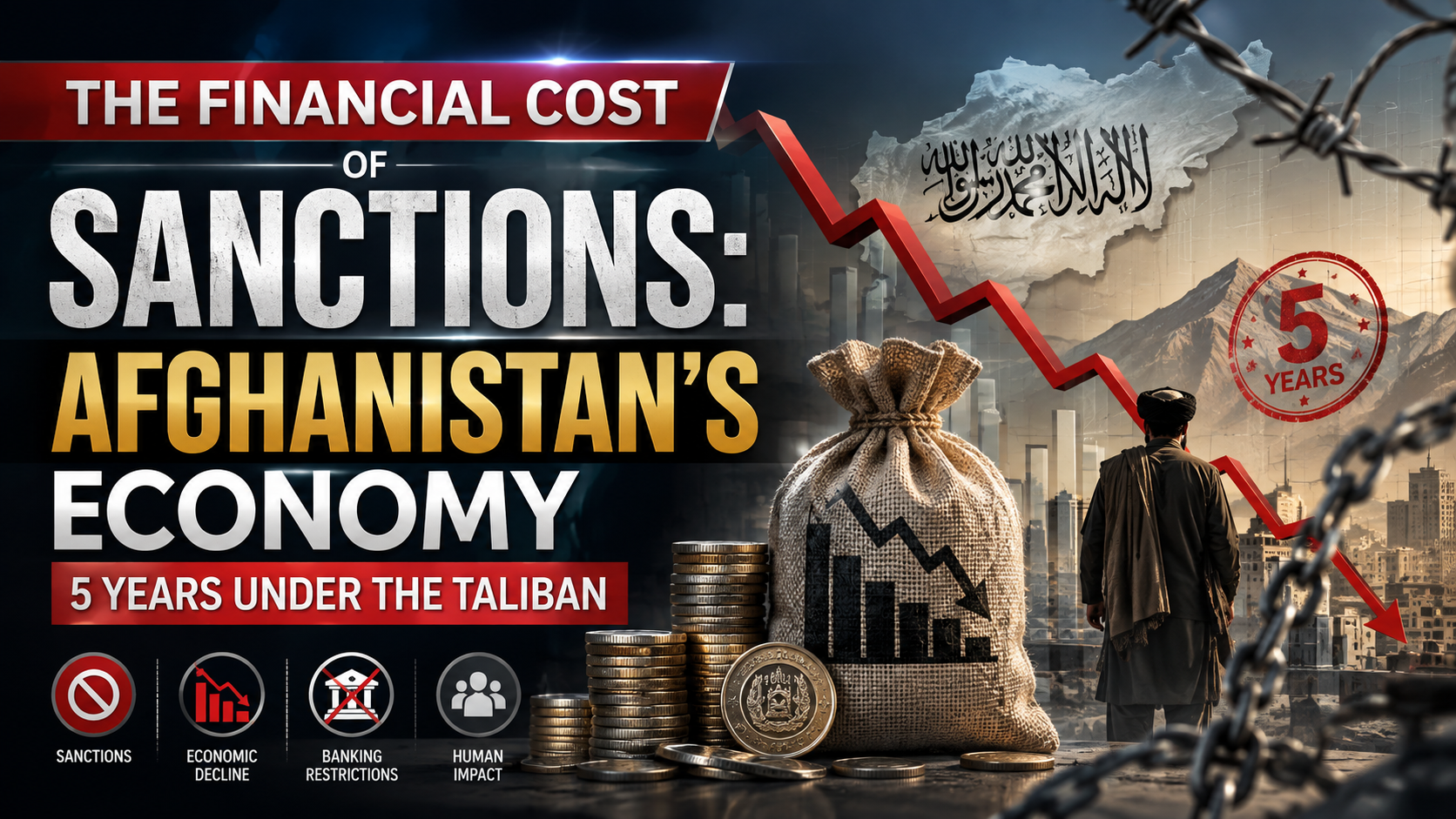
- Five years after the August 2021 takeover, Afghanistan’s economy has stabilised at a permanently lower base rather than recovered — real GDP contracted roughly 27% across 2021-2022 and has never returned to pre-Taliban output levels.
- The World Bank’s most recent estimate puts 2026 real GDP growth near 4.8%, but growth off a shrunken base still leaves living standards falling for much of the population.
- Afghanistan’s trade deficit hit a record $11.3 billion in 2025 — roughly 60% of nominal GDP — as exports stagnate and import dependency deepens.
- International aid fell 16.5% in 2025 even as humanitarian needs rose, forcing over 440 health clinics to close or reduce services.
- Frozen central bank reserves and the loss of correspondent banking access remain the two most consequential, and most reversible, financial costs of Afghanistan’s continued isolation.
A Fifth Anniversary of Consolidation, Not Recovery
On August 15, 2021, Taliban fighters entered Kabul unopposed, sealing a lightning offensive that followed the chaotic withdrawal of US-led forces. Five years on, the movement marks a milestone of political survival rather than economic success. The Taliban can be regarded as surprisingly stable, albeit through brutish means — the group hasn’t faced real threats to its political survival — though it remains globally isolated, with only Russia formally recognising it as Afghanistan’s government, its leaders sanctioned, and the group still sheltering designated terrorist organisations.
The starting point for any assessment of the financial cost of this isolation is the scale of the initial shock. The Taliban’s 2021 takeover triggered a series of economic shocks: the abrupt institutional transition, aid reductions, heightened political uncertainty, and restrictions on foreign reserves together precipitated a 27% contraction in GDP across 2021 and 2022. The economy has since stabilised around only 70% of pre-2021 output levels — a permanently lower equilibrium, not a recovery trajectory back to the prior baseline.
The Growth Numbers: Encouraging Headline, Discouraging Context
Recent growth figures look superficially reassuring. The World Bank has estimated real GDP growth at 4.8%, driven in part by strong domestic activity, even as the country inherited a structurally weak economy heavily dependent on foreign aid that has largely evaporated. That growth is attributed in part to the Taliban’s success in generating revenue through customs duties and tax collection, alongside robust domestic activity.
But growth rates measured against a base that is still roughly 30% below pre-Taliban output tell a misleading story if read in isolation. Independent forecasters are notably more conservative than the World Bank’s estimate: the Asian Development Bank projects Afghanistan’s GDP growth at just 2.3% in 2026 and 3.0% in 2027, with inflation forecast at 3.6% in 2026 and 5.5% in 2027. The gap between these estimates — 4.8% versus 2.3% — itself reflects the underlying data unreliability that plagues any economic assessment of Afghanistan under Taliban rule.
Living Standards: The Metric That Matters Most
The World Bank’s May 2026 economic outlook is titled, tellingly, “Afghanistan’s economy shows resilience but living standards are falling” — reduced aid drove a steep decline in aggregate demand and widespread disruptions to public services, and Afghanistan lost access to the international banking system and offshore foreign exchange reserves as central bank assets were frozen. Resilience at the macro level and deterioration at the household level are not contradictory in Afghanistan’s case — they are the defining feature of its post-2021 economy.
The Trade Deficit: A Widening Structural Vulnerability
Perhaps the starkest quantifiable cost of continued isolation is Afghanistan’s trade position. Afghanistan’s trade deficit widened to a record $11.3 billion in 2025, equivalent to roughly 60% of nominal GDP, driven by rising imports and stagnant exports. That is a dramatic deterioration even from the already-alarming 2024 figure: the World Bank had reported Afghanistan’s trade deficit surging 54% in 2024 to reach $9 billion, or 45% of GDP, attributing the decline to a 5% drop in exports totalling $1.8 billion, primarily due to reduced coal and textile exports.
More recent data shows the trend accelerating further: the average monthly trade deficit reached $0.95 billion for the first nine months of FY2026, 35% above the same period in FY2025, as imports rose from a monthly average of $0.85 billion while exports failed to keep pace. A trade deficit approaching two-thirds of GDP is not a sustainable long-run position for any economy, let alone one cut off from most conventional international financing.
The Human and Fiscal Cost of Declining Aid
Sanctions and financial isolation translate directly into humanitarian strain. Total international aid to Afghanistan fell by 16.5% in 2025 even as needs continued to rise — more than 440 clinics were forced to close or reduce services because of funding shortages, increasing the proportion of people unable to access healthcare from 16% in 2024 to 23% in 2025. Nearly 100 decrees issued by the Taliban de facto authorities since 2021 remain in force, limiting women’s access to employment, education, and freedom of movement — restrictions that compound the aid shortfall by further constraining the domestic labour force and consumption base.
Comparative Table: Afghanistan’s Economy Before vs. Five Years Into Taliban Rule
| Metric | Pre-August 2021 | 2025-2026 |
|---|---|---|
| Real GDP level | Baseline | ~70% of pre-2021 output |
| Central bank reserves | Accessible | Frozen, offshore access lost |
| Trade deficit (% of GDP) | Materially lower | ~60% of nominal GDP (2025) |
| International aid trend | Sustained multilateral support | Falling (-16.5% in 2025 alone) |
| Banking system access | Connected to global correspondent banking | Largely cut off; hawala-dependent |
| Healthcare access gap | 16% unable to access care (2024) | 23% unable to access care (2025) |
The Two Reversible Costs: Frozen Reserves and Banking Access
Of all the financial costs documented above, two stand out as structurally different from the rest: they are policy choices by the international community, not inherent features of Afghanistan’s economy, and could in principle be partially reversed without requiring political concessions on every other front. Afghanistan lost access to the international banking system and offshore foreign exchange reserves as central bank assets were frozen — international sanctions on Afghan banks have made international correspondent banks reluctant to provide services to Afghan financial institutions, pushing trade finance toward the hawala network, which relies heavily on informal cross-border currency transfers.
The Taliban’s own capital controls — strict limits on foreign currency withdrawals from banks — have mitigated capital flight and currency collapse to a limited extent, but at the cost of impeding the free flow of capital and raising transaction costs for trade. This is the financial architecture of a country improvising around isolation rather than one integrated into global finance — and it is the single largest driver of the persistent trade-finance friction underlying the widening deficit.
Why It Matters: A Case Study in the Limits and Costs of Sanctions
Afghanistan under the Taliban is arguably the starkest live case study of what sustained financial isolation costs an economy — and what it does not achieve politically. Five years of frozen reserves and banking exclusion have not dislodged the Taliban from power; the group faces no real threat to its political survival. What isolation has produced instead is a chronically undercapitalised, aid-starved economy running one of the widest trade deficits relative to GDP anywhere in the world, borne disproportionately by ordinary Afghans rather than the ruling authorities.
For policymakers and investors tracking frontier and conflict-economy risk more broadly, Afghanistan illustrates a durable pattern: financial sanctions targeting a regime’s international access tend to compress the formal economy and humanitarian capacity faster and more severely than they constrain the political leadership itself, particularly where informal financial networks like hawala can partially substitute for formal banking.
What to Do Next
- Track ADB vs. World Bank growth estimate divergence (2.3% vs. 4.8% for 2026) as a proxy for the genuine uncertainty in Afghanistan’s economic data — treat any single official figure with caution.
- Monitor correspondent-banking developments closely — any incremental restoration of banking access would be the single highest-leverage change available short of full diplomatic recognition.
- Watch the trade-deficit trajectory as the primary vulnerability indicator — at roughly 60% of GDP, it is arguably a more urgent signal than the headline GDP growth figures.
- Distinguish macro “resilience” narratives from household-level deterioration when assessing Taliban-era economic messaging — the World Bank’s own framing explicitly separates the two.
FAQ
Has Afghanistan’s economy recovered from the 2021 collapse?
Not fully. GDP contracted 27% across 2021-2022, and the economy has since stabilised at only around 70% of pre-2021 output levels — a lower equilibrium rather than a genuine recovery.
Why is Afghanistan’s trade deficit so large relative to its economy?
The trade deficit reached a record $11.3 billion in 2025, roughly 60% of nominal GDP, driven by rising imports and stagnant exports, compounded by sanctions-driven trade-finance friction that raises the cost of formal cross-border transactions.
Does international isolation threaten the Taliban’s hold on power?
Evidence suggests not significantly. The Taliban has faced no real threats to its political survival despite being globally isolated and sanctioned, even as the broader population absorbs the economic cost of that isolation through reduced aid, healthcare access, and employment.
Discover more from The Economy
Subscribe to get the latest posts sent to your email.

The AI Disruption in Financial Risk Management: Moving Beyond Record Banking Profits

The Rise of Green Aviation: Balancing High Fuel Prices with Sustainable Infrastructure

US-China Relations in Q3 2026: Trade Tariffs and Supply Chain Risks

Emerging Markets Rebound: Top Stock Strategies for the Gulf and South Asia

Tackling the 2026 Global Food Crisis: Policy Shifts and Market Speculation

Post-Quantum Encryption in Banking: The Next Frontier in Cybersecurity Investments

The Financial Cost of Sanctions: Afghanistan’s Economy 5 Years Under the Taliban

Supply Chain Fragmentation: 10 Trends Reshaping Global Trade This Year

The 2026 Aviation Boom: Investing in Airline Stocks as Passenger Traffic Surges

China’s 2026 Corporate Laws: Western Compliance Guide

Gold Price Forecast & Oil Volatility: Hedging Against Middle East Tensions

2026 Global Growth Slowdown: Investment Strategies at 2.6%

State Farm’s $5B Dividend 2026: Who Qualifies & Payout Dates

Bessent’s Debt Buybacks Explained: Impact on Your Mortgage

China Politburo July 2026: Stimulus Signals Explained

Russia Fuel Shortages 2026: Inside a Cracking War Economy

Top 15 Financial Stocks for Investment in PSX

Pakistan Passed Its Third IMF Review

SpaceX Stock Lockup Expiration Explained: Why $123B in Shares Could Hit the Market

Pakistan IMF Program 2026: Inside the Push Toward an Interest-Free Economy

Andy Burnham, UK Gilts and Mortgages: July 2026 Explainer

Russia Oil Revenue 2026: How Sanctions on Rosneft and Lukoil Are Draining the War Chest

Pakistan’s 2026 Monsoon Floods Threaten Fragile Economic Recovery as Inflation Nears 9%

Russia Oil Revenue 2026: The Iran War Windfall and What a Hormuz Deal Means for Moscow

Russia’s Budget Deficit Blew Past Its Full-Year Target in Three Months

Gold Price 2026: Why Bullion Has Fallen 25% From Its January Record High

Canada US Trade War 2026: Inside Carney’s Push to Cut Ties With Trump’s Tariffs
State Farm’s $5B Dividend 2026: Who Qualifies & Payout Dates
-

 Markets & Finance8 months ago
Top 15 Stocks for Investment in 2026 in PSX: Your Complete Guide to Pakistan’s Best Investment Opportunities
-

 Analysis6 months ago
Johor’s Investment Boom: The Hidden Costs Behind Malaysia’s Most Ambitious Economic Surge
-

 Analysis6 months ago
Top 10 Stocks for Investment in PSX for Quick Returns in 2026
-

 Analysis7 months ago
Brazil’s Rare Earth Race: US, EU, and China Compete for Critical Minerals as Tensions Rise
-

 Banks7 months ago
Best Investments in Pakistan 2026: Top 10 Low-Price Shares and Long-Term Picks for the PSX
-

 Investment7 months ago
Top 10 Mutual Fund Managers in Pakistan for Investment in 2026: A Comprehensive Guide for Optimal Returns
-

 Global Economy8 months ago
15 Most Lucrative Sectors for Investment in Pakistan: A 2025 Data-Driven Analysis
-

 Global Economy8 months ago
Pakistan’s Export Goldmine: 10 Game-Changing Markets Where Pakistani Businesses Are Winning Big in 2025