Connect with us

Tariffs

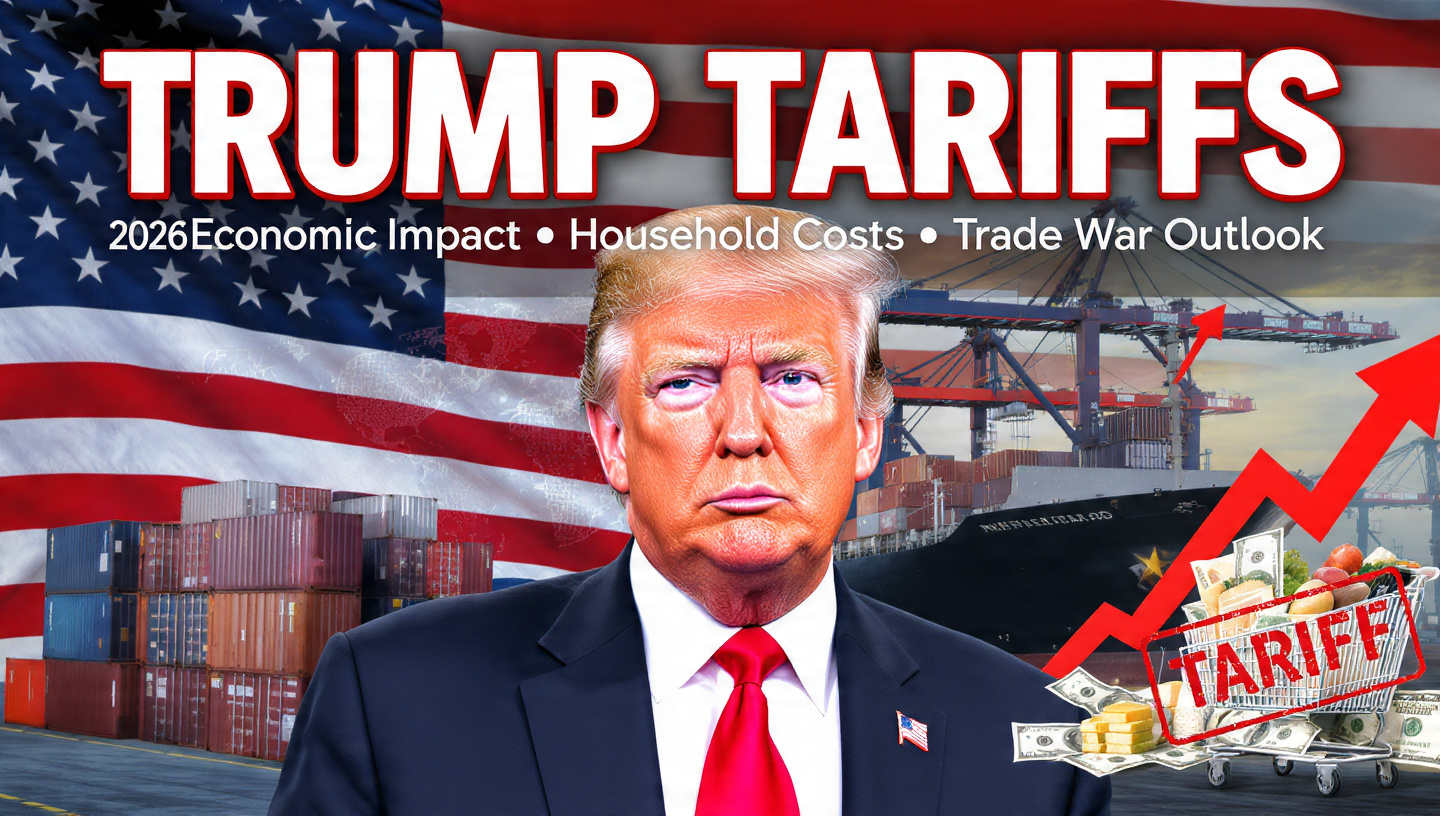
Trump Tariffs 2026: Economic Impact, Household Costs & Trade War Outlook

Published

on

Trump’s 2026 tariffs represent the largest US tax increase as a share of GDP since 1993, costing households $1,500 on average. Here’s how the trade war is reshaping global supply chains, prices, and growth.

The tariff regime assembled by the Trump administration since 2025 now constitutes the largest U.S. tax increase as a share of GDP since 1993—a fact that took more than a year to fully register in household budgets, but whose full weight is being felt with increasing force in the middle months of 2026.

The average American household will pay an estimated $1,500 more in 2026 as a direct consequence of elevated import duties, according to Tax Foundation analysis—up from roughly $1,000 in 2025. The costs are not distributed evenly. Lower-income households, which spend a higher proportion of their income on goods (particularly apparel, electronics, and food), absorb a larger relative burden.

A Legal Architecture Under Pressure

The tariff program has faced serious legal challenges. On February 20, 2026, the Supreme Court ruled that the President cannot use the International Economic Emergency Powers Act—IEEPA—to impose tariffs. The decision stripped the administration of the legal vehicle it had used to impose much of its most aggressive tariff architecture.

But the administration adapted rather than retreated. In the same week as the ruling, President Trump signed an executive order imposing a 10% tariff on all countries under Section 122—a different statutory authority tied to balance-of-payments deficits—covering approximately $1.2 trillion worth of imports. The administration also initiated multiple Section 301 investigations into 60 countries on March 11, examining whether those nations allow imports of products made by forced labor. The list includes the European Union, positioning both parties for a potential renewal of the transatlantic trade conflict that a deal in 2025 had temporarily paused.

See also  15 Most Lucrative Sectors for Investment in Pakistan: A 2025 Data-Driven Analysis

On pharmaceuticals, the administration signaled that tariffs on imported drugs could rise toward 200% by mid- to late-2026—a figure that would represent an extraordinary disruption to global pharmaceutical supply chains, though J.P. Morgan analysts noted that inventory builds and domestic manufacturing announcements by large biopharma companies should limit near-term exposure for major producers.

The China Equilibrium

U.S.-China trade relations have settled into an uneasy equilibrium. Following the June 11, 2025 trade deal announcement that left in place 20% fentanyl-related tariffs and 10% reciprocal tariffs for a combined 30%, and a subsequent series of extensions and escalations that included a 100% tariff imposed in November 2025, the two countries entered 2026 with a tense but functional trading relationship.

Chinese exporters responded to U.S. tariffs not by collapsing but by redirecting. China’s semiconductor exports surged 110% year-over-year in May 2026. That strength reflects both genuine demand from AI-related industries globally and a deliberate Chinese strategy of deepening trade relationships with Southeast Asia, the Gulf, and Europe to reduce dependence on U.S. market access.

The economic cost of U.S. tariffs on China, per J.P. Morgan Global Research, was to reduce Chinese GDP growth by roughly 0.6 percentage points through the combined effect of export drag and weaker domestic investment. But China’s export machine proved more resilient than many forecasters expected, partly because third countries absorbed Chinese goods that could not reach the U.S. market directly.

Inflation Is the Tariff’s Most Persistent Legacy

The clearest economic consequence of the tariff regime is its contribution to inflation. Businesses faced with import tariffs have three choices: absorb the cost and compress margins; pass it to consumers in higher prices; or reshore production in the U.S. at significantly higher labor costs. All three options carry economic costs, and in practice most companies have pursued a combination.

See also  Pakistan Poised for Spotlight in JPMorgan's New Frontier Debt Index Amid High-Yield Boom

Atlanta Fed President Raphael Bostic noted in research published late 2025 that U.S. firms expected tariffs to account for 40% of their total unit cost growth in 2025 and 2026. That contribution to inflation is structural rather than transitory—unlike oil prices, which can fall as conflict dynamics ease, tariff-driven cost increases remain embedded in supply chain economics until the tariffs themselves are removed or the supply chains are restructured.

The Council on Foreign Relations analysis of tariff-Treasury interactions found that tariff uncertainty—independent of the tariffs themselves—was raising the risk premium in U.S. Treasury markets: “An eventual court ruling against the administration’s reliance on IEEPA could significantly alter the implementation path,” J.P. Morgan’s Nora Szentivanyi noted, adding that even without IEEPA, alternative statutory pathways would keep elevated tariffs in place.

Where the Trade War Goes Next

The Section 301 investigations launched in March against 60 countries—including EU members—signal that the tariff posture is not an emergency measure being wound down but a permanent feature of U.S. trade policy. Many market participants expect that Treasury will need to increase issuance of longer-term bonds starting in Q4 2026 partly to ensure liquidity along the yield curve—with tariff revenue being one of the contested variables in fiscal planning.

For U.S. businesses, the clearest strategic message from the tariff regime’s staying power is that supply chain localization is no longer a nice-to-have contingency plan. It is a competitive necessity in an environment where trade routes can change with a single executive order and where the legal found

Continue Reading
Click to comment

Leave a Reply

Policy

US Tariffs 2026: How Trump’s 11.7% Effective Rate Is Reshaping Global Trade & Inflation

Published

on

The effective US tariff rate has risen from 2.1% to 11.7% under Trump. Here’s how the tariff regime is reshaping global supply chains, consumer prices, and the trade war outlook for 2026.

In 2025, the Trump administration implemented the most sweeping overhaul of US trade policy since the Smoot-Hawley Tariff Act of 1930. Through executive action — primarily invoking emergency economic powers and national security statutes — the administration raised the effective US tariff rate from 2.1% to an estimated 11.7% as of January 2026.

Eighteen months later, the consequences of that decision are visible across every dimension of the US and global economy: in consumer prices, in supply chain restructuring, in the Federal Reserve’s inflation calculations, and in the diplomatic relationships that underpin global trade.

The tariff regime is not an abstract policy debate. It is a tax — and like all taxes, it has winners, losers, and unintended consequences that took time to manifest and will take years more to fully resolve.

The Scale of the Tariff Shock

To appreciate the magnitude of the 2025 tariff escalation, the baseline comparison matters. Before the first Trump administration’s tariff actions in 2018, the average US effective tariff rate on imports was approximately 1.5%. The first Trump term raised it to approximately 3%. The second term’s actions pushed it to 11.7% — a level not seen in the US in decades.

The mechanics varied by category:

  • China-specific tariffs remained elevated and in many cases were increased further, targeting electronics, machinery, textiles, and consumer goods
  • A 10% global baseline tariff on all imports was implemented through executive action, though this was challenged in the courts
  • Sector-specific tariffs targeted steel, aluminium, solar panels, electric vehicles, and semiconductors from multiple origin countries

The Supreme Court rejected several of the most aggressive tariff actions in 2025, ruling that some executive tariff applications exceeded statutory authority. This opened the door for importers to seek refunds on improperly collected duties — a complex refund process that the administration has contested aggressively. The Supreme Court’s intervention did not eliminate the tariff regime; it trimmed its most legally exposed elements while leaving the core architecture intact.

A 10% global baseline tariff remains in effect as of June 2026.

Who Is Actually Paying the Tariffs

The most persistent economic misconception about tariffs is that foreign exporters pay them. They do not. Tariffs are paid by importing firms — US companies that purchase foreign goods — and the economic burden is distributed between exporters, importers, and consumers depending on market conditions.

The best available evidence suggests that more than 50% of Trump tariff costs are now being passed through to US consumers — a pass-through rate that has been somewhat slower than the near-100% observed under the first-term tariffs, but is accelerating as inventory buffers built before tariff implementation are depleted.

See also  Jeff Bezos's $30 Billion AI Startup Is Quietly Buying the Industrial World

For the median US household, the effective tariff tax represents a meaningful annual cost increase — concentrated in electronics, clothing, furniture, appliances, and consumer goods where import shares are high and domestic substitutes are limited or more expensive.

The pass-through to prices has been one of the primary contributors to US inflation remaining above 3% — and is a key reason why the Federal Reserve’s task of returning inflation to 2% is more difficult than a simple demand-management problem would suggest.

Supply Chain Restructuring: Three Years In

The tariff regime has succeeded in its stated objective of prompting supply chain diversification away from China. But “diversification” has not meant “reshoring.” The dominant pattern has been near-shoring — shifting production to third countries that are not subject to the highest US tariff rates.

Vietnam, Mexico, India, Bangladesh, and Indonesia have been the primary beneficiaries of China-targeted tariff diversion. US imports from these countries have increased substantially since 2022, with Vietnam in particular becoming a major hub for electronics assembly, textile production, and component manufacturing previously concentrated in China.

The irony is that much of this production still relies on Chinese inputs — materials, components, and intermediate goods that flow through third-country manufacturing before reaching the US market. The tariff regime has in many cases added a processing step to the supply chain without fundamentally reducing Chinese industrial participation in global production networks.

Mexico, benefiting from the US-Mexico-Canada Agreement, has seen a surge of near-shoring investment from both US and Chinese firms seeking US market access through a tariff-advantaged production base. This has created genuine economic activity in Mexico while raising questions about whether the tariff regime is achieving its intended effect on Chinese production capacity.

China’s Response: Export Diversification and the Trade Surplus

China’s trade surplus — the gap between what it exports and what it imports — has actually expanded in 2026, despite (or perhaps because of) the US tariff regime. Chinese exporters have aggressively diversified their market base, deepening trade relationships with:

  • Southeast Asia (ASEAN markets, particularly Vietnam, Indonesia, Thailand)
  • Latin America (Brazil, Mexico, Argentina)
  • Africa (through the Belt and Road infrastructure network)
  • Middle East (Gulf states diversifying from Western supply chains)
  • Russia (bilateral trade dramatically expanded since Western sanctions)

This market diversification has reduced China’s vulnerability to US tariff pressure while maintaining the export-led growth model. The result is a structural change in global trade flows — with Chinese goods increasingly reaching the world through routes that bypass direct US market entry.

See also  Can You Be Fired Verbally in the UAE? The Legal Reality

The EU has responded separately. European tariffs on Chinese electric vehicles, implemented in 2025, represent the most significant trade action in the China-Europe relationship in years. But China’s response has been measured — targeting European luxury goods with retaliatory measures while continuing to invest in European market access through investment in non-tariffed segments.

The Inflation Arithmetic

The tariff-inflation relationship is one of the most debated and most significant economic linkages in 2026.

The direct mechanism is straightforward: tariffs raise the cost of imported inputs, which businesses pass through to consumer prices. The indirect mechanism is subtler: tariffs reduce import competition, allowing domestic producers to raise prices without competitive constraint. Both channels are operational in the current US economy.

Stanford’s Institute for Economic Policy Research estimated that tariff pass-through to consumers now exceeds 50%, with the full pass-through taking 12–18 months from tariff implementation. Given the tariff escalation of 2025, the full inflationary impact is still working its way through the system as of mid-2026.

This creates a structural floor on US inflation that makes the Federal Reserve’s 2% target difficult to achieve without either reversing the tariff regime (a political impossibility under the current administration) or engineering a significant recession that reduces demand enough to offset the supply-side price pressure.

The Fed cannot solve a tariff-driven inflation problem with interest rate tools alone. This is the core of the policy trap that Kevin Warsh inherited upon taking the Fed chair position.

The WTO and the Multilateral Trade Framework

The US tariff regime has created significant strain on the World Trade Organization framework. Multiple WTO dispute settlement proceedings have been filed by trading partners including the EU, China, Japan, South Korea, and Canada. The US has contested these proceedings and has maintained its practice of blocking WTO Appellate Body appointments — a practice that began in the first Trump term and has effectively disabled the WTO’s binding dispute resolution mechanism.

The practical consequence: the global trading system has fragmented into a series of bilateral and regional arrangements, with the WTO’s rules-based framework increasingly supplemented or supplanted by power-based bilateral negotiations.

For businesses operating across borders, this fragmentation creates compliance complexity, supply chain uncertainty, and strategic risk that has no precedent in the post-war era of multilateral trade liberalisation.

What Comes Next: The Second Half of 2026

Several tariff-related developments are likely to shape the trade environment in the second half of 2026:

Supreme Court refund proceedings — the ongoing dispute over duty refunds for imports collected under executive actions that courts ruled as exceeding statutory authority. Resolution will affect importers’ balance sheets and the effective tariff rate going forward.

See also  Global Cooperation Barometer 2026: Why International Collaboration Isn't Dead—It's Just Evolving [WEF Report Analysis]

EU-US tariff negotiations — the Biden-era tariff truce framework has partially frayed under the Trump administration’s more aggressive posture. EU-US talks on steel, aluminium, and digital services remain ongoing and unresolved.

China-US trade dynamics — with China’s trade surplus expanding and US domestic pressure for further action on Chinese imports growing, additional tariff escalation cannot be ruled out. The November 2026 midterm elections create political incentives for trade action.

WTO dispute outcomes — while the Appellate Body remains disabled, preliminary panel rulings could create diplomatic pressure points with major trading partners.

The Bottom Line

The Trump tariff regime has fundamentally altered the US and global trade landscape. The effective tariff rate of 11.7% represents the most significant barrier the US has erected to international commerce in generations, with consequences that run from consumer prices and Federal Reserve policy to supply chain geography and WTO institutional legitimacy.

The tariff regime is not going away. Political economy — domestic manufacturing interests, national security framing, and electoral incentives — makes tariff rollback extremely unlikely under the current administration.

The relevant questions for investors and businesses are not whether tariffs will be reversed, but how supply chains adapt, how much of the inflationary pass-through remains ahead, and whether the trade war escalates or stabilises in the second half of 2026.

FAQ

Q: What is the current US tariff rate in 2026?
A: The US effective tariff rate rose from approximately 2.1% before the Trump administration to an estimated 11.7% as of January 2026. A 10% global baseline tariff on all imports remains in effect after the Supreme Court struck down some of the most aggressive executive tariff actions.

Q: How do tariffs affect inflation in 2026?
A: More than 50% of tariff costs are now being passed through to US consumers, according to Stanford SIEPR research. This represents a structural supply-side inflation pressure that the Federal Reserve cannot resolve through interest rate policy alone.

Q: What happened to US-China trade in 2026?
A: US-China direct trade has declined under tariff pressure, but China has diversified its export markets significantly — increasing flows to Southeast Asia, Latin America, Africa, and the Middle East. China’s overall trade surplus has actually expanded in 2026.

Q: How are tariffs affecting US consumers in 2026?
A: US consumers are facing higher prices on electronics, clothing, appliances, and consumer goods as tariff costs are passed through the supply chain. This contributes to the inflation reading of 4.2% in May 2026 and reduces household purchasing power.


Discover more from The Economy

Subscribe to get the latest posts sent to your email.

Continue Reading

Analysis

‘Hawkish Shift’ in US Rates Upends Global Currency Bets

Published

on

Kevin Warsh sat through his first Federal Reserve meeting as chairman on June 17, 2026, and delivered exactly what the White House didn’t want. The Fed’s hawkish shift in US interest rates sent the dollar to its strongest level in more than a year within minutes of the announcement. The Federal Open Market Committee held the federal funds rate steady at 3.50%-3.75%, an outcome almost nobody disputed. What traders hadn’t priced in was the Fed’s updated rate projections, which flipped from forecasting a cut this year to signaling a possible hike. The Dollar Index broke through 100 before the press conference even started, dragging the euro, the pound and the yen lower and forcing currency desks across six continents to rewrite their models overnight.

The Macro Backdrop: Inflation, Oil and a New Chair

The timing matters. Warsh took the gavel in May after one of the most contentious confirmation battles in Fed history — a 54-45 Senate vote that split almost entirely along party lines, according to NPR’s coverage of the confirmation. President Trump pushed hard for a chair who would cut rates aggressively. Instead, the Middle East conflict that has disrupted Gulf oil shipments pushed energy costs higher across every major economy, and Warsh’s first Summary of Economic Projections leaned the other way entirely.

The Fed’s median forecast for Personal Consumption Expenditures (PCE) inflation this year jumped to 3.6%, up from 2.7% in March, with core PCE — which strips out food and energy — revised to 3.3%, according to reporting on Warsh’s confirmation hearing and the rate path that followed. That single revision did more to move currency markets than the rate hold itself.

The decision also landed in the middle of an unusually crowded week for global rate-setters. The Bank of England met the following day. The European Central Bank had already held its deposit rate at 2.00% weeks earlier while openly debating whether to reverse course. The Bank of Japan continued its slow, deliberate path toward policy normalization. For currency traders, that compressed calendar meant every signal from Washington got measured instantly against what London, Frankfurt and Tokyo were doing — or not doing — in response.

Section 1: Inside the Dot Plot Flip

The headline number — 3.50% to 3.75% — told only half the story. The real shift sat in the Summary of Economic Projections, the Fed’s quarterly grid of where each official expects rates to land. The median projection for the federal funds rate at the end of 2026 rose to 3.8%, up from 3.4% in March. Because the current target range’s midpoint sits near 3.625%, that median crossed from implying a cut this year to implying a hike — a genuine reversal, not a rounding error.

Of the 18 officials who submitted forecasts, nine expected at least one rate hike before year-end, eight saw no change, and just one projected a cut, according to CNBC’s live coverage of the meeting. Warsh himself broke with tradition and declined to submit a dot at all, telling reporters the exercise wasn’t useful for the actual conduct of policy — an unusual stance for a sitting chair to take in his first month on the job.

Markets had been bracing for some version of this outcome for weeks. After May’s jobs report came in stronger than expected, traders priced in lower odds of a cut at the June meeting and pushed the implied probability of a hike by year-end toward 70%, according to figures CNBC’s Jeff Cox relayed from futures markets ahead of the decision. Strategists at BNP Paribas went further, warning that if the Fed failed to deliver a sufficiently hawkish signal, the bond market might begin tightening conditions on its own — effectively forcing the central bank’s hand regardless of what the committee voted. The FOMC’s actual decision to hold rates passed unanimously, a 12-0 vote that masked just how divided the projections underneath it had become.

See also  Hong Kong Is Beijing's New 'Vanguard' in the Contest for Financial Sovereignty

Markets reacted instantly. The Dollar Index (DXY) spiked through the 100.00 handle to a session high just above it, having hovered in the high 99s into the decision, according to FXStreet’s market analysis of the announcement. That’s the index’s highest level since May 2025. A few currency moves stood out immediately:

  • EUR/USD slid toward 1.15 as the euro absorbed the bulk of the dollar’s gain — the euro alone makes up more than half the DXY basket.
  • GBP/USD dropped to around 1.343, complicating the Bank of England’s own rate decision a day later.
  • USD/JPY pushed to roughly 161.30, within striking distance of the 161.62 peak last touched in July 2024, when Tokyo last intervened to defend the yen.

Goldman Sachs Asset Management’s Kay Haigh, global co-head and chief investment officer of fixed income and liquidity solutions, framed the shift as more than an oil story. Half the committee now expects a hike this year, he noted, reflecting strength in the labor market and inflation data that predates the latest spike in energy prices. His base case still calls for the Fed to avoid hikes altogether, but he described the path as narrow — and entirely dependent on the next several inflation reports.

Section 2: Why the Dollar’s Surge Reflects More Than One Rate Decision

Currency strategists have a name for this pattern: divergence. Interest-rate differentials — not absolute rate levels — are what move exchange rates, and on June 17 the gap between US policy and everywhere else widened in one stroke. The European Central Bank held its deposit rate at 2.00% in its last meeting, with policymakers debating a hike but stopping short. The Bank of Japan has raised rates gradually but remains far behind the Fed in absolute terms. Every basis point of that gap shows up in currency pricing within hours, not weeks.

How does a hawkish Fed affect currency markets?

A hawkish Fed signal typically strengthens the dollar by widening interest-rate differentials with other major economies, making dollar-denominated assets more attractive to global investors. Higher US yields draw capital inflows, pressuring the euro, pound and yen lower while raising borrowing costs for emerging-market governments and companies holding dollar debt.

That’s the textbook mechanism. The picture is more complicated this cycle because the inflation driving the Fed’s hand is largely energy-led rather than demand-led. Analysts increasingly distinguish between two flavors of “higher for longer”: rates that stay elevated because the economy is genuinely overheating, and rates that stay elevated because a supply shock — in this case, the Middle East conflict’s effect on Gulf shipping lanes — is pushing prices up independent of demand. The same projected rate path can carry very different signals depending on which force dominates, and the Fed’s own statement language hints at the ambiguity. June’s release described inflation as “elevated relative to the Committee’s 2 percent goal” and tied the pressure partly to supply shocks, while also dropping earlier language about possible additional easing.

See also  Global Cooperation Barometer 2026: Why International Collaboration Isn't Dead—It's Just Evolving [WEF Report Analysis]

That distinction matters enormously for currency traders. A demand-driven hawkish shift tends to be durable, supporting sustained dollar strength. A supply-shock-driven shift can reverse quickly once the underlying disruption clears — which is precisely the bet some desks are now making against the dollar’s rally.

Section 3: Who Absorbs the Pressure From Here

The second-order effects are already visible. Emerging-market currencies face what analysts call a double bind when the dollar strengthens: their own exchange rates weaken at the same time their dollar-denominated borrowing costs rise, squeezing government and corporate balance sheets simultaneously. Countries that built up dollar debt during the previous easing cycle are the most exposed.

Japan’s situation illustrates the strain at the developed-market end of the spectrum. The yen has weakened roughly 11% against the dollar over the past 12 months and is trading near territory last seen in July 2024 — the same level that triggered direct intervention from Japanese authorities, according to TradingEconomics’ currency tracking data. Japan’s Chief Cabinet Secretary has already signaled the government stands ready to act if volatility becomes excessive, language officials typically reserve for periods immediately preceding intervention.

In the United Kingdom, the Bank of England held its own Bank Rate at 3.75% on June 18, the day after the Fed’s decision, with UK inflation sitting at 2.8% but expected to climb again as the energy shock works through the economy, according to the Bank of England’s own policy statement. A weaker pound compounds that imported-inflation risk directly, since a large share of the UK’s energy and goods imports are priced in dollars. Mortgage lenders had already begun trimming fixed-rate deals in the weeks before the announcement, betting on a steadier rate path — a bet that now looks shakier if sterling keeps sliding and imported costs feed back into the Bank’s own inflation forecasts.

The mechanics that hurt emerging markets aren’t unique to any one country; they repeat in slightly different form from Ankara to Jakarta to São Paulo. Governments and corporates that issued dollar bonds when borrowing was cheap now face a currency mismatch: revenue collected in local currency, debt service owed in dollars that buy more of that local currency by the week. Central banks in those economies often respond by raising their own rates defensively, even when domestic conditions don’t call for it, simply to keep capital from fleeing toward higher US yields. That defensive tightening is itself a cost of the Fed’s hawkish shift, even though it never shows up in any US economic data release.

US equity markets felt the pull, too, though less violently. The dollar’s strength acts as a drag on multinational earnings: every sustained 10% rise in the Dollar Index has historically shaved 2% to 4% off S&P 500 earnings per share, concentrated in the most globally exposed names. Companies generating more than half their revenue overseas — a group that includes major technology and consumer-goods firms — see reported earnings shrink in dollar terms even when underlying demand abroad hasn’t changed. The S&P 500 itself held up reasonably well around the announcement, trading near 6,827, but strategists flagged growth stocks and long-duration bonds as the segments most likely to face continued valuation pressure if the hawkish path holds.

See also  Chip Stocks Race Toward Biggest Gains Since Dotcom Era on AI Demand

Section 4: The Dissenting Case

Not every serious analyst accepts that the Fed’s hawkish turn will stick. The single FOMC member who still projected a rate cut represents a real minority view, not a rounding error, and the argument behind it deserves a hearing. Bank of England Governor Andrew Bailey has used similar language about his own committee, telling reporters the Bank is “in no rush to raise rates” even as a minority of his colleagues pushed for a hike in April. The implicit logic on both sides of the Atlantic: an energy-driven inflation spike tied to a specific geopolitical conflict is a different animal from inflation rooted in an overheating economy, and central banks that over-tighten in response risk choking off growth just as the original shock fades.

Goldman’s Kay Haigh made essentially the same point from the sell side — his team’s base case still has the Fed avoiding a hike this year, with incoming inflation data, not the dot plot, as the deciding factor. The IMF’s broader consensus view leans toward holds rather than further tightening across most major economies for the remainder of 2026, betting that energy prices normalize before central banks feel compelled to act on the dot plot’s signal.

Skeptics of the dovish case counter that supply shocks have a habit of becoming embedded once businesses start passing higher input costs through to wages and consumer prices — the exact transmission mechanism the Bank of England flagged in its own June statement. That risk is why nine of eighteen Fed officials were willing to put a hike on paper despite the shock’s obvious geopolitical origin. Both camps are, in effect, making the same bet on how long the Middle East conflict drags on — they just disagree on what to do about it in the meantime.

The Bottom Line

The Fed’s hawkish shift didn’t emerge from a single data point or a single voice on the committee. It emerged from the collision of a genuinely uncertain inflation outlook with a new chairman determined to establish credibility independent of the president who appointed him. Warsh was picked, in part, on the expectation that he’d deliver the rate cuts Trump has demanded publicly and repeatedly. Instead, his first meeting in the chair produced the opposite signal — and currency markets, which trade on differentials rather than headlines, reacted within minutes rather than waiting for confirmation. Whether that signal survives the next two inflation reports is the question every desk from London to Tokyo is now pricing for, and the answer will likely arrive long before the Fed’s next scheduled meeting does.


Discover more from The Economy

Subscribe to get the latest posts sent to your email.

Continue Reading

Analysis

Industrial Electricity Tariffs in China Raised for Clean Energy Push

Published

on

The smoke stacks of Tangshan and the heavy smelting pots of Yunnan are facing an unprecedented economic reckoning. By altering industrial electricity tariffs in China, Beijing has signaled that the era of cheap, coal-subsidised manufacturing is over. On June 15, 2026, policymakers enacted a stringent tiered pricing framework targeting the country’s heaviest polluters. This legislative shift transforms electricity from a cheap state utility into a sharp regulatory weapon designed to eliminate structural inefficiencies. The message from the central government is unambiguous: industrial survival now requires absolute carbon efficiency.

According to data compiled by the State Grid Energy Research Institute, China’s cumulative new energy installed capacity hit 1.84 billion kilowatts at the end of last year, capturing 47.3 percent of the nation’s total power capacity and officially overtaking coal. Yet, converting this massive generation capacity into real industrial reduction requires structural economic pain. The International Energy Agency reported that wholesale electricity prices for Chinese manufacturers remained roughly 50 percent lower than European Union levels throughout 2025. This deep price discrepancy insulated domestic heavy industries from the true cost of their carbon footprint, creating a massive hurdle for the state’s broader China green transition timeline. By realigning the pricing grid, central authorities aim to close this gap, forcing capital-intensive manufacturers to choose between rapid modernisation or financial insolvency.

The core mechanism of this policy transformation hinges on administrative price penalties overseen by the National Development and Reform Commission (NDRC). Under the new mandates, factories within energy-intensive sectors that fail to meet strict state-mandated efficiency thresholds face an immediate surcharge. The policy targets specific sectors including crude steel, aluminium, cement, and synthetic chemicals. These foundational industries historically consumed the lion’s share of provincial power grids while operating on razor-thin environmental margins.

The physical implementation of these pricing tiers is handled by provincial grid monopolies like the State Grid Corporation of China. Analysts at S&P Global note that this aligns with Notice 114, an administrative order passed in January 2026 to overhaul capacity tariffs across the domestic energy sector. The price adjustments are not uniform; they scale dynamically based on a factory’s verifiable emissions profile. Factories that transform their production lines will avoid the top-tier levies, while laggards will see their operational margins erased.

+-----------------------------------------------------------------------+
|                 NDRC TIERED ELECTRICITY TARIFF STRUCTURE              |
+-----------------------------------------------------------------------+
|  Tier 1: Advanced Green Facilities  --> Baseline Market Spot Pricing  |
|  Tier 2: Standard Compliant Plants  --> Standard Provincial Tariff     |
|  Tier 3: Non-Compliant / Inefficient --> Punitive Surcharge Added     |
+-----------------------------------------------------------------------+

To prevent regional protectionism, the central government has removed local discretion over pricing exemptions. Historically, provincial authorities offered illicit energy discounts to protect local employment and tax revenue. The NDRC report for 2026 clarifies that central inspectors will audit regional grid settlements directly. This ensures that the price signal remains uncompromised across provincial borders.

See also  Budget FY2026-27: Traders assured of simplified tax scheme

The timing of this intervention is deliberately synchronized with falling renewable generation costs. The Levelised Cost of Electricity (LCOE) for onshore wind power fell to as low as 0.142 yuan per kilowatt-hour last year. Photovoltaic power costs saw similar steep reductions, dropping to between 0.131 and 0.244 yuan per kWh. The government is utilizing these market dynamics to accelerate the retirement of obsolete, coal-dependent assets without destabilizing total industrial output.

This pricing shakeup marks a profound evolution in China’s long-running power market reform. For decades, the electricity sector operated under a rigid, two-track administrative pricing grid that guaranteed returns for coal generators while keeping costs flat for heavy factories. The introduction of Document No. 136 in February 2025 began breaking this dynamic by linking renewable energy to open market bidding. The latest tariff adjustments accelerate this shift, forcing heavy manufacturers to absorb the cost volatility of an evolving grid.

How China’s differential electricity pricing affects heavy industry

The imposition of differential rates shifts the competitive landscape from a game of scale to a game of efficiency. High-efficiency smelters are rewarded with access to cheaper, direct green power contracts. Conversely, low-efficiency operations are forced onto the punitive spot market, where peak-trough spreads can exceed 1.0 yuan per kilowatt-hour on volatile days. This economic friction functions as an automated market-clearing mechanism.

What are the penalty rates for inefficient factories under the new NDRC policy?

Under the latest National Development and Reform Commission directives, inefficient factories face a power price surcharge capped at 0.1 yuan (1.4 US cents) per kilowatt-hour. This tiered penalty targets facilities failing to meet national energy-efficiency benchmarks, forcing rapid technical upgrades across heavy industrial sectors.

The state is effectively weaponising the price mechanism to resolve its renewable energy curtailment crisis. Ye Xiaoning, a senior engineer at the State Grid Energy Research Institute, points out that while wind and solar generation expanded by 25 percent last year, regional grids frequently lacked the financial incentives to distribute this clean power efficiently. By charging a premium for carbon-intensive baseload electricity, Beijing forces industrial consumers to seek out direct corporate procurement agreements for green power.

See also  Why the New Trade Order Demands Bold Adaptation, Not Nostalgia

This structural shift transforms how factories calculate their long-term capital expenditure. Rather than viewing electricity as a fixed, predictable utility cost, corporate treasurers must now treat it as a dynamic variable. Industrial operations must adjust their production schedules to align with peak renewable generation hours when spot prices fall. Those unable to build such operational flexibility face structural unprofitability as traditional baseload power costs climb.

The downstream ripples of these elevated industrial electricity tariffs in China will distort global industrial supply chains. For sectors like primary aluminium, where electricity accounts for up to 40 percent of total production costs, the NDRC surcharge represents an existential threat to margin sustainability. Global buyers will likely face higher export prices for Chinese metals as domestic producers pass these regulatory penalties down the value chain. This cost push inflation could speed up the relocation of energy-intensive manufacturing away from the Chinese mainland to regions with cheaper, unregulated power mixes.

Still, the internal pressure on small and medium-sized enterprises (SMEs) will be far more acute than the impact on state-owned giants. Large state-owned enterprises possess the capital reserves necessary to finance multi-million yuan equipment retrofits or construct dedicated solar arrays. In contrast, private SMEs operate on razor-thin margins and lack the credit access needed to upgrade legacy infrastructure. This regulatory divergence will trigger an aggressive wave of market consolidation across the industrial heartland.

       [ Punitive Grid Tariffs Imposed ]
                      │
         ┌────────────┴────────────┐
         ▼                         ▼
  [ Private SMEs ]          [ State Giants ]
  • Credit constrained      • Deep capital reserves
  • Legacy infrastructure   • Access to green PPA contracts
         │                         │
         ▼                         ▼
[ Market Exit / M&A ]     [ Supply Chain Dominance ]

Beyond domestic borders, this policy directly addresses the gathering storm of international green protectionism. The Center for Strategic and International Studies (CSIS) notes that the European Union’s Carbon Border Adjustment Mechanism (CBAM) entered a critical enforcement phase in early 2026, penalising imports with high embedded emissions. By raising domestic power prices for polluters, Beijing ensures that carbon rents are collected by the Chinese treasury rather than paid out as tariffs at European ports.

The long-term consequence will be an accelerated deployment of industrial energy storage systems. To avoid the peak penalty rates, factories are investing heavily in stand-alone Battery Energy Storage Systems (BESS). S&P Global expects this trend to drive over 1 trillion yuan in grid-edge infrastructure investments over the next five years. Industrial sites are mutating into microgrids capable of arbitrage, drawing power during midday solar surpluses and running on battery reserves during evening tariff spikes.

See also  Jeff Bezos's $30 Billion AI Startup Is Quietly Buying the Industrial World

The picture is more complicated when viewed through the lens of local economic stability and energy security. Critics of rapid tariff adjustments argue that penalising energy-intensive sectors during a delicate macroeconomic recovery risks exacerbating industrial unemployment. A policy paper from the China Academy of Macroeconomic Research warns that sudden price shocks in foundational materials like cement and steel can cause cascading financial distress for the already fragile real estate and infrastructure sectors. Can the broader economy absorb these cost increases without stoking systemic producer price inflation?

Furthermore, there is a persistent risk that these targeted price increases could inadvertently compromise grid reliability. When heavy industries face punitive tariffs on coal-fired electricity, they may curtail operations abruptly, causing severe demand shocks that disrupt grid stability. If factories opt to invest heavily in self-propelled diesel generation to bypass grid tracking, the net environmental benefit of the policy vanishes. This creates a highly complex balancing act for regional regulators who must police off-grid compliance.

The National Energy Administration (NEA) has pushed back against these concerns, arguing that market-driven demand flexibility is the only viable path to hit decarbonisation targets. Government planners maintain that temporary economic friction is a necessary price to pay for long-term supply chain security. By forcing heavy industry to decarbonise at the source, China protects its export engine from future international trade sanctions.

The recalibration of industrial electricity tariffs in China represents a definitive break from the volume-driven growth model of the past quarter-century. Beijing is making an explicit trade-off, prioritizing long-term ecological compliance and structural market efficiency over short-run manufacturing margins. It is a high-stakes bet that the nation’s dominant clean energy supply chain can absorb the economic friction of this transition without fracturing industrial stability. The success of this policy depends on whether heavy industry can adapt its factories faster than the rising cost of power destroys their competitive edge.

The true cost of the green transition is finally being written into the ledger of global trade.


Discover more from The Economy

Subscribe to get the latest posts sent to your email.

Continue Reading
Advertisement
Advertisement

Trending

Copyright © 2026 The Economy, Inc . All rights reserved .

Discover more from The Economy

Subscribe now to keep reading and get access to the full archive.

Continue reading