
Analysis
As Tehran Burns, South Asia Trembles: The Hidden Cost of the Iran War

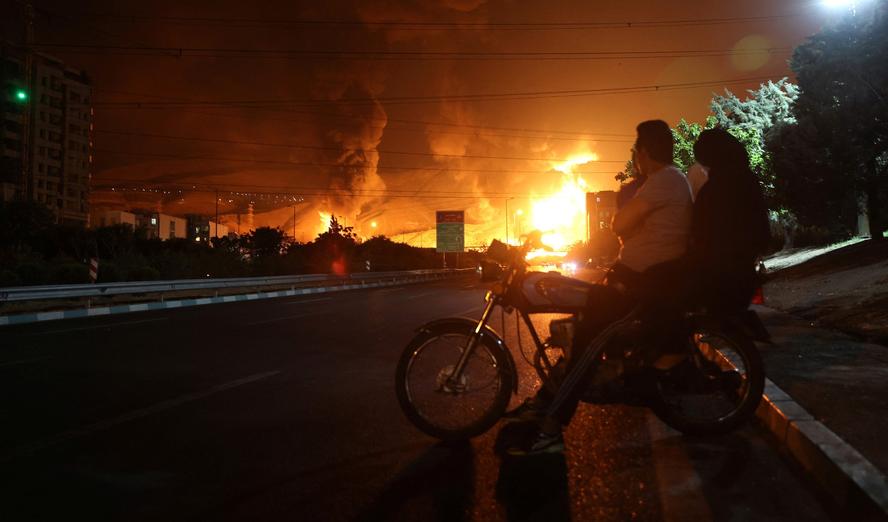
In a cramped apartment block in Sharjah — the budget emirate that houses more Pakistani migrant workers than any other Gulf city — Mohammed Irfan does the same thing every morning now: he checks his phone before he even stands up. Not for messages from home. For the oil price. He works in construction logistics, and he knows what a sustained spike above $90 means better than most analysts in Karachi ever will. It means contracts freeze. It means his employer stops hiring. It means the $800 he wires home every month to his mother and three sisters in Rahim Yar Khan could become $400. Or nothing.
That calculus — multiplied across nine million Indians, five million Pakistanis, and three million Bangladeshis scattered across Gulf labour markets — is the part of the U.S.-Israel war on Iran that no prime-time bulletin, no matter how well-produced, will ever quite capture. Since Operation Epic Fury launched on February 28, 2026, the world’s attention has been trained on the fireball skies above Tehran, the killing of Supreme Leader Ayatollah Ali Khamenei, and the daily missile exchanges between the Islamic Revolutionary Guard Corps and the combined air power of two of the world’s most technologically advanced militaries. But the aftershocks are travelling south and east with a velocity that deserves far more analytical attention than it has received.
South Asia is not a party to this war. It has not chosen sides. And yet, across the span of one week, it has been subjected to an energy shock, a remittance crisis in formation, a sectarian eruption in the streets of Karachi and Skardu, and a diplomatic tightrope walk that tests the strategic autonomy of the world’s most populous nation. The Iran conflict is South Asia’s war whether it wants it or not.
Energy Security Shock: South Asia’s Hormuz Dependency Is Staggering
The Strait of Hormuz is 21 miles wide at its narrowest point, flanked by Iran on one side and Oman on the other. Through that gap, roughly 20 percent of the world’s daily oil consumption normally flows — approximately 13 to 15 million barrels per day. Since March 2, when an IRGC commander formally declared the strait closed and threatened to set ablaze any vessel attempting passage, that flow has effectively dropped to near zero. Tanker transits fell from an average of 24 per day in January to just four on March 1, according to energy intelligence firm Vortexa, and three of those four flew Iranian flags.
The consequences for South Asia are not theoretical; they are arithmetic. India imports nearly 85 percent of its crude oil, and the Middle East — most of it transiting Hormuz — supplies approximately 55 percent of total crude requirements, according to data from Jefferies. Pakistan, smaller in absolute terms but no less exposed in structural ones, relies on the Gulf for the lion’s share of its hydrocarbons. India’s strategic petroleum reserves, government officials confirmed this week, extend the nation’s buffer to roughly 74 days. But replacement cargoes from the Atlantic Basin take weeks to route, not days.
Markets have responded with historic speed. Brent crude, which traded near $66 a barrel in late January, surged past $92 by the end of the first week of the conflict — its biggest weekly gain since April 2020, according to data from CNBC Markets. WTI posted a 35.6 percent weekly gain, the largest in the history of the futures contract dating back to 1983. Barclays analysts warned clients as early as March 1 that Brent could reach $100 if disruptions persisted, a threshold Goldman Sachs subsequently attached to a scenario of five weeks of constrained Hormuz traffic. Qatar’s energy minister, Saad al-Kaabi, went further still, telling the Financial Times that if tankers could not pass, Gulf exporters might halt production entirely — potentially driving Brent toward $150 and, in his words, threatening to “bring down the economies of the world.”
For India, the energy math is unforgiving. The country’s annual crude import bill, already substantial at elevated prices, balloons by approximately $12 billion for every $10 per barrel increase in Brent sustained over a full year — a rough internal estimate consistent with RBI modelling frameworks. At $90 Brent, sustained through the second quarter of 2026, India’s current account deficit widens materially, the rupee faces depreciation pressure, and inflation — already a persistent political headache — reignites in an economy where petrol, diesel, and LPG subsidies carry enormous political weight. India currently has 21 days of LPG supply, according to government sources cited this week, a buffer that looked comfortable in February and appears far less so today.
Pakistan’s exposure is even more acute, for a country that has spent the past two years clawing its way back from the brink of a sovereign debt crisis with IMF support. Higher oil prices translate directly into a larger energy import bill priced in dollars the State Bank of Pakistan barely has to spare. Analysis published this week by the Times of Islamabad estimates that elevated freight costs alone — war-risk insurance premiums have risen by 15 to 25 percent for vessels transiting Gulf waters — could add $50 to $100 million per month to Pakistan’s trade-related costs.
The alternative supply routes are real but imperfect. India has quietly accelerated purchases of Russian crude under long-term discounted arrangements negotiated since 2022, and Russian oil now accounts for roughly 35 percent of Indian refinery intake — a geopolitical hedge that has drawn quiet American displeasure but delivered real price relief. The question is whether Russian pipeline and port capacity can scale fast enough to meaningfully compensate for a sustained Hormuz closure. The honest answer, from most energy analysts, is: not quickly, and not fully.
Remittance Economies on the Brink: $200 Billion at Risk
If the energy shock is the visible wound, the remittance disruption is the internal bleeding that could prove harder to staunch.
Consider the scale. India received a record $135.46 billion in inward remittances in fiscal year 2024-25, the highest of any country in the world, according to Reserve Bank of India data. Of that total, approximately 38 percent — some $51.4 billion — originated in the Gulf states, per analysis by Citi published this week. The UAE alone accounts for nearly half of Gulf-origin inflows. To put this in political-economic context: India’s entire trade surplus with the United States — frequently the subject of high-stakes diplomatic negotiation — was $58.2 billion in 2025. Gulf remittances are, by this measure, almost as economically significant as America.
Pakistan’s dependency is if anything more structurally acute. The country receives more than $30 billion annually in workers’ remittances, of which over half — $15 to $18 billion — originates in the Gulf, according to State Bank of Pakistan data. A 30 to 40 percent disruption in those flows, the scenario now under active consideration by Islamabad’s finance ministry, would translate into a monthly shortfall of $500 to $700 million. A worst-case scenario involving economic paralysis in Gulf host economies could push monthly losses toward $1.5 billion, according to an analysis published this week. Combined with export disruptions, higher energy costs, and aviation losses, Pakistan’s total monthly economic exposure from the conflict could approach $3 billion — an extraordinary number for a country whose entire IMF programme is calibrated around much smaller liquidity margins.
Bangladesh, Nepal, and Sri Lanka face structurally similar vulnerabilities, though at smaller absolute scales. Bangladesh has over five million citizens in the Gulf, whose remittances account for nearly six percent of GDP. Nepal’s remittance dependency exceeds 25 percent of GDP, one of the highest ratios in the world, with Gulf construction sites representing the primary employment base. In both countries, a contraction in Gulf labour markets would not register primarily as a macroeconomic statistic — it would arrive first as a domestic crisis of livelihoods, debt repayment and household food security.
The channels of disruption are multiple. In the immediate term, the concern is not that Gulf remittance flows have collapsed — they have not, and for now, hawala networks and digital transfer platforms continue to function. The Citi note published this week identifies a counterintuitive near-term dynamic: risk aversion among migrants may accelerate repatriation of existing savings, producing a temporary increase in flows. But the medium-term trajectory is concerning. Gulf economies — particularly those that have been struck by Iranian missiles — are already contracting. Construction activity is the first sector to freeze in uncertainty. Indian workers, the Washington Times reported this week, are particularly concentrated in oil services, construction, hospitality and retail: the exact sectors most vulnerable to Gulf economic disruption. Kerala alone receives approximately 20 percent of India’s total national remittance inflows, making it a one-state stress test for what systemic Gulf income disruption looks like.
“A sharp decline in remittance inflows — particularly if combined with higher oil prices — would worsen India’s external position and could put pressure on the rupee,” an analyst from Citi told CNBC this week. S&P’s Deepa Kumar added the critical time dimension: if the conflict lasts beyond six months, the impact on the Indian economy becomes material in ways that a shorter disruption would not trigger.
Sectarian Equilibrium Tested: The View From Karachi and Skardu
The killing of Ali Khamenei — not simply a head of state but the supreme religious authority of the global Shia community — detonated a reaction across South Asia that carried a charge quite unlike ordinary anti-war protest.
Within hours of the confirmed assassination on February 28, demonstrations erupted across Pakistan. By the following day, at least 22 people were dead. Ten were killed in Karachi, where crowds stormed the U.S. Consulate, smashing windows and attempting to set the building ablaze before police responded with tear gas, batons and gunfire. In Skardu, in the heavily Shia Gilgit-Baltistan region, protesters burned the offices of the UN Military Observer Group, UNDP, and even the Aga Khan Rural Support Programme. Army deployments and a three-day curfew followed. At least eight people died there. In Islamabad, crowds marched toward the U.S. Embassy dressed in black.
Pakistan is home to between 37 and 50 million Shia Muslims — 15 to 20 percent of a population of 250 million — representing one of the largest Shia concentrations outside Iran. That community looks to Tehran for religious authority, shrine pilgrimage, and in some cases, direct political and institutional support. The Zainabiyoun Brigade, a Pakistan-origin Shia militia trained, funded and commanded by the IRGC, has recruited thousands of fighters from Pakistan’s Kurram district over the past decade. In late 2024, sectarian violence in Kurram alone killed more than 130 people in the final weeks of the year. In February 2026, the Islamic State of Khorasan Province struck a Shia mosque in Islamabad, killing 36 worshippers. The conflict has arrived in a country already carrying the weight of an unhealed sectarian wound.
The security analyst Amir Rana of the Pak Institute of Peace Studies told Al Jazeera this week that Iran holds “significant influence over Shia organisations in Pakistan” and that the Balochistan-Iran border — a 900-kilometre frontier already porous with separatist activity — represents a potential flashpoint that cannot be ignored. Dawn’s Zia ur-Rehman, in perhaps the most lucid analysis published in Pakistan this week, sketched three plausible trajectories: contained grief and political protest; a sustained period of sectarian tension that revives militant recruitment and strains Islamabad’s relations with both Riyadh and Washington; and, in the most destabilising scenario, Iranian state fragmentation producing simultaneous instability on Pakistan’s two western fronts — Iran and Taliban-led Afghanistan.
What is most analytically striking, however, is what has not happened: a clean Shia-Sunni split. The war has, at least temporarily, reconfigured South Asian Muslim politics along an anti-imperialist axis that cuts across sect. In Bangladesh — over 90 percent Sunni, with no significant Shia population — the Bangladesh Jamaat-e-Islami staged a mass rally at the Baitul Mukarram National Mosque in Dhaka, with leaders denouncing what they called a “heinous attack” on Iran.
In Jammu and Kashmir, Sunni leader Mirwaiz Umar Farooq condemned Khamenei’s killing. Left parties across India — from the CPI(M) in Kerala to the CPI(ML) Liberation in Jharkhand — organised protests. The Indian National Congress called the strikes “a disturbing revival of regime change doctrines.” Samuel Huntington’s clash of civilizations framework offers one explanatory lens: when the perceived aggressor is a U.S.-Israeli military coalition, a cross-sectarian Muslim solidarity can congeal, at least temporarily, against a common external adversary. For Islamabad’s security planners, this cross-sectarian mobilisation is in some ways harder to manage than a purely Shia reaction — because it does not have established institutional interlocutors.
Geopolitical Ripple Effects: Delhi Hedges, Islamabad Walks a Tightrope
India’s diplomatic response has been characteristic: studied, careful, and almost entirely substance-free in public. External Affairs Minister S. Jaishankar spoke with Gulf counterparts over the weekend — calls focused on protecting Indian nationals rather than expressing any political position. Official Delhi has not condemned the strikes. It has not condemned Iranian retaliation. It has called for dialogue, de-escalation, and the safety of Indian citizens. This is not evasion; it is a deliberate strategic choice by a country that has spent fifteen years building equidistant relationships with Washington, Riyadh, Abu Dhabi, Tehran, and Moscow simultaneously — and intends to preserve all of them.
That balancing act has real economic stakes. India’s decade-long investment in Iran’s Chabahar port — a strategic gateway to Afghanistan and Central Asia that bypasses Pakistan — is now formally in limbo. Washington granted New Delhi a conditional six-month waiver allowing continued terminal operations until April 26, 2026, but the war has rendered any serious commercial engagement at Chabahar politically impossible for now. More broadly, the Middle East accounts for 17 percent of India’s exports, according to Jefferies, meaning the conflict reaches into trade, not just energy and remittances.
For Pakistan, the diplomatic calculus is even more nakedly constrained. Islamabad has condemned the strikes on Iran, but has also criticised Iran’s retaliatory attacks on Gulf states where millions of Pakistani workers are employed. Prime Minister Shehbaz Sharif’s government is simultaneously aligned with Washington via the IMF programme and dependent on Saudi Arabia for both financial support and as a primary employer of its diaspora. The military establishment, which retains ultimate strategic authority in Pakistan, has cultivated ties with the Gulf monarchies for decades and has no appetite whatsoever for a confrontation that would jeopardise those relationships. “Saudi Arabia does not want to be in this war and is getting dragged into it. Pakistan will also certainly not want to be dragged into somebody else’s war,” an Islamabad-based analyst told Al Jazeera this week. The problem is that geography, demographic composition, and financial dependency ensure Pakistan cannot simply watch from a distance.
China, for its part, is navigating the crisis with characteristic discipline. Limited tanker traffic through Hormuz in the early days of the conflict included Chinese-flagged vessels, suggesting Beijing was quietly testing Iranian goodwill while maintaining supply chains. China holds substantial on-land and floating oil storage buffers that blunt the immediate energy shock. For Beijing, a prolonged conflict that weakens U.S. credibility in the region, exhausts American military and financial resources, and raises energy costs disproportionately for economic rivals in South and East Asia is not an unambiguous negative — a geopolitical calculus that shapes its studied neutrality.
Scenarios to 2027: Three Paths, One Uncomfortable Certainty
The economic and security consequences of the Iran war for South Asia will diverge sharply depending on the conflict’s duration and geographic scope. Three scenarios capture the distribution of plausible outcomes.
Scenario One: Rapid De-escalation (Base Case, 35% Probability)
A negotiated ceasefire or Iranian capitulation within four to six weeks allows Hormuz traffic to normalise by mid-April. Brent crude settles in the $75 to $85 range through the remainder of 2026. Gulf economies sustain limited damage; remittance flows from South Asia’s diaspora dip by 10 to 15 percent in Q1 but recover by Q3. India’s current account deficit widens by approximately $20 to $25 billion on an annualised basis, manageable within current reserve buffers. Pakistan requires an emergency IMF disbursement adjustment but avoids a balance of payments crisis. Sectarian tensions in Pakistan remain elevated but subside without systemic escalation. India’s GDP growth moderates by approximately 0.4 percentage points in FY2026-27.
Scenario Two: Protracted Conflict With Partial Hormuz Disruption (Most Likely, 45% Probability)
The war extends through the second quarter. Hormuz remains effectively closed for six to eight weeks, with intermittent Iranian drone and missile attacks deterring commercial traffic even after partial military normality. Goldman Sachs’ $100 Brent scenario materialises. India’s annual energy import bill rises by $50 to $60 billion, fiscal consolidation stalls, and the rupee depreciates toward 90 to 95 against the dollar. Gulf remittances to India decline by 20 to 25 percent on an annualised basis — a reduction of approximately $10 to $12 billion. Pakistan faces a monthly remittance shortfall of $500 to $700 million, triggering emergency talks with Riyadh and the IMF. Bangladesh’s central bank burns through foreign reserves defending the taka. In Pakistan, sustained street mobilisation produces at least two to three high-casualty sectarian incidents, straining civil-military relations and absorbing security force capacity already committed on the Afghan frontier.
Scenario Three: Regional Escalation and Gulf Infrastructure Targeting (Tail Risk, 20% Probability)
Iranian strikes succeed in meaningfully damaging Saudi Arabia’s Ras Tanura or Abqaiq facilities — the world’s single most consequential piece of oil infrastructure. Qatar’s energy minister’s $150 Brent warning materialises. Production cuts approach 6 million barrels per day. UBS analysts have already flagged the possibility of Brent above $120 if material disruption occurs. For India, this is a genuine macroeconomic emergency: the current account deficit becomes unfinanceable without emergency external borrowing, the rupee enters a disorderly depreciation, and inflation surges past 8 percent. For Pakistan, the IMF programme collapses and the economy requires a full restructuring. Gulf labour markets freeze, triggering mass repatriation of South Asian workers and remittance flows dry up almost entirely — a GDP hit of 2 to 3 percentage points for Bangladesh and Nepal within two quarters. Sectarian violence in Pakistan escalates to the levels of the early 2000s. The Balochistan-Iran border becomes a live security threat.
The one certainty cutting across all three scenarios is this: South Asia’s vulnerabilities — energy dependency, remittance exposure, sectarian fragility — were structural before February 28. The Iran war has not created them. It has revealed them with a clarity that should concentrate minds in Delhi, Islamabad, Dhaka, and Kathmandu in equal measure.
Conclusion: South Asia’s War, Whether It Wants One or Not
Mohammed Irfan in Sharjah checks the oil price again as this article is being written. Brent is at $92.69. He has not been told his contract is at risk. Not yet. But he knows the mechanics. He has seen this before, though never quite like this.
The U.S.-Israel war on Iran is, in its architects’ conception, a war about nuclear proliferation, regional hegemony, and the strategic architecture of the Middle East. South Asia was not consulted. It does not have a seat at the table where the terms of conflict or ceasefire will eventually be negotiated. And yet it bears, through the remorseless logic of economic integration and geographic proximity, a disproportionate share of the costs.
India’s exposure across energy, remittances, trade and diplomacy is wider than any single administration talking point about strategic autonomy can comfortably absorb. Pakistan is operating without a margin for error on any of the three dimensions — economic, security and sectarian — that this conflict is simultaneously stressing. Bangladesh and Nepal have no strategic hedges whatsoever. Their exposure is pure and their policy toolkit is thin.
The appropriate response is not panic, but it is not complacency either. It is the kind of strategic foresight — diversified energy sourcing, formalised remittance corridors, pre-positioned IMF credit lines, coordinated South Asian diplomatic signalling — that the region’s governments have historically deferred until crisis made deferral impossible.
That moment may have arrived. The fires above Tehran are visible from very far away.
Discover more from The Economy
Subscribe to get the latest posts sent to your email.



Key Takeaways
- Rolex’s secondary market rose approximately 7.9% year-over-year as of 2026 (per WatchCharts data) — trailing Patek Philippe (+16.2%) and Tudor (+11.4%) but still outperforming Audemars Piguet (+3.4%).
- Rolex raised U.S. retail prices 4–9% in January 2026 (steel models ~5.6%, gold models ~8.7%), narrowing the historical gap between retail and pre-owned pricing.
- Not every model appreciates: steel sports references (Submariner, GMT-Master II, Daytona) have held value far better than two-tone or widely available dress references like the standard Datejust.
- The Lady-Datejust posted the sharpest 2026 gain among tracked collections — up 22.73%, from roughly $9,269 to $11,376 — driven by demand for smaller, “everyday luxury” watches.
- Gold’s rise past $2,400/oz has directly lifted the investment case for Rolex’s precious-metal references (Day-Date, Sky-Dweller, Yacht-Master).
The Model-by-Model Picture
| Category | 2026 Trend |
|---|---|
| Lady-Datejust | +22.73% (strongest performer among tracked collections) |
| Steel sports models (Submariner, GMT-Master II) | Held value well; corrected from 2022 peak but stabilized above retail |
| Daytona | Corrected from highs above $50,000 to the mid-$30,000s; still among the most sought-after references |
| Two-tone/widely available Datejust | Flat to negative — “holds value” is an overstatement for this category |
| Gold references (Day-Date, Sky-Dweller) | Lifted by gold’s rise above $2,400/oz |
Why the “Rolex Always Appreciates” Myth Is Fading
The pandemic-era boom pushed some references — the Daytona above all — to speculative highs disconnected from historical norms. Since the March 2022 peak, steel sports models have compressed meaningfully, and dealers who bought inventory near the top have in some cases faced 20–40% markdowns on liquidation. The lesson for 2026 buyers: Rolex as a category is not a monolith. Value retention depends heavily on specific reference, condition, and whether the piece comes with box and papers (“full set”).
What’s Actually Driving 2026 Strength
- Retail price increases raise the floor. When a new Submariner retails at $10,050 (up from $9,500), a pre-owned example at $11,000–$12,000 suddenly represents a smaller premium — narrowing the gap without secondary prices actually moving.
- Supply discipline remains Rolex’s core lever. The brand has never confirmed production numbers, and secondary-market premiums remain entirely a function of Rolex’s own manufacturing decisions — a risk factor as much as a support.
- Certified Pre-Owned rollout. Rolex’s now fully rolled-out CPO program has changed how buyers transact in the used market, adding a layer of brand-verified legitimacy that supports pricing.
The Case for Rolex as a Portfolio Diversifier
Financial advisors increasingly frame luxury watches not as a replacement for equities or bonds, but as a tangible, historically low-correlation diversifier — one that carries its own risks (illiquidity, condition-dependent pricing, no yield) but has demonstrated multi-decade resilience for specific references.
Is Rolex a good investment in 2026?
It depends heavily on the specific reference. Steel sports models like the Submariner and Daytona have held or grown in value; two-tone and widely available dress models generally have not. Overall, Rolex’s secondary market rose about 7.9% year-over-year in 2026, trailing Patek Philippe but ahead of Audemars Piguet.
Discover more from The Economy
Subscribe to get the latest posts sent to your email.

Navigating Mortgage and Loan Refinancing in a High-Yield Environment
Global public debt crossing critical thresholds has kept central bank policies volatile, resulting in fluctuating US Treasury yields throughout 2026. For homeowners and commercial property holders burdened by previous high-interest borrowing cycles, finding optimal refinance windows has become a high-stakes financial puzzle. Stalled disinflation and stubborn employment numbers mean rate cuts are incremental, requiring borrowers to act with precision.
Timing your mortgage or commercial loan refinance in this environment requires a deep understanding of yield curve movements and lender risk appetites.
Decoding 2026 Refinance Dynamics
The 10-Year Treasury Yield Benchmark
Mortgage rates continue to track closely with the 10-year US Treasury yield. When macroeconomic anxiety spikes debt issuance, yields rise, tightening consumer borrowing capacity. Savvy borrowers monitor weekly Treasury auctions to lock in rates during brief dip windows.
Hybrid ARMs and Alternative Structures
With fixed rates remaining elevated, 7/1 and 10/1 adjustable-rate mortgages (ARMs) have surged in popularity. These products offer lower initial monthly payments, giving borrowers breathing room until central bank easing cycles fully materialize.
| Loan Product | Current Rate Range | Best For | Key Risk Factor |
| 30-Year Fixed Mortgage | 6.2% – 6.8% | Long-term predictability | Higher initial monthly outlay |
| 7/1 Hybrid ARM | 5.5% – 5.9% | Short-term ownership / flipping | Rate reset risk after year 7 |
| Commercial Refinance | 7.0% – 8.2% | Corporate asset restructuring | Strict DSCR lender covenants |
Actionable Steps for Successful Refinancing
To maximize your chances of securing favorable refinance terms in a volatile market, follow a disciplined preparation strategy.
Boost Your Credit Score Immediately: Lenders in 2026 are applying stringent credit tiering; a 20-point increase can drop your APR by a crucial quarter-point.
Shop Regional Credit Unions: Smaller financial institutions often offer portfolio loans with more flexible underwriting than major national banks.
Calculate the Break-Even Point: Ensure your total closing costs are recouped through monthly savings within 24 months of closing.
“Market Strategist View: Refinancing in 2026 is an exercise in opportunistic timing. Borrowers must maintain immaculate financial profiles ready to strike the moment Treasury yields dip.”
Mastering the complexities of today’s debt environment ensures you can successfully lower your debt service costs and protect your long-term financial stability.
Discover more from The Economy
Subscribe to get the latest posts sent to your email.

The days of pulling generic auto insurance quotes based purely on your zip code and age are officially over. In 2026, insurance comparison engines are powered entirely by generative AI and real-time telematics. These platforms digest thousands of live data points—ranging from your driving smoothness via connected vehicle sensors to real-time traffic congestion patterns—to generate hyper-personalized premiums instantly.
For consumers, this evolution represents both a massive opportunity for savings and a hidden trap for penalty pricing. Understanding how AI algorithms evaluate risk is essential for anyone looking to lower their monthly auto insurance premiums.
How AI Comparison Engines Evaluate Your Risk Profile
Behavioral Telematics and Connected Cars
Modern cars stream performance data directly to insurance aggregators. Generative AI models analyze braking sharpness, acceleration curves, cornering G-forces, and phone distraction metrics. Drivers who maintain smooth, defensive habits are rewarded with dynamic rate cuts of up to 40% compared to traditional rating tiers.
Predictive Traffic and Weather Modeling
AI tools now cross-reference your daily commute route with predictive weather and accident probability models. If your standard parking location or driving corridor has a statistically higher incidence of uninsured motorist claims, your quotes will reflect that hyper-local risk assessment.
| Comparison Factor | Traditional Rating Model | 2026 Generative AI Model | Impact on Premium |
| Mileage & Usage | Annual estimated odometer reading | GPS tracking & live trip duration | High (up to 35% savings) |
| Driving Behavior | MVR driving record & accidents | Real-time braking, speed, & G-force | Critical (determines tier) |
| Vehicle Tech | Make, model, and safety rating | ADAS calibration & repair cost data | Moderate |
Strategies to Lower Your AI-Driven Insurance Quote
To outsmart the algorithm and secure the lowest possible premium in 2026, drivers must proactively manage their digital footprint on insurance platforms.
Opt-In for Telematics Trial Periods: Many insurers offer immediate 15% discounts just for installing their driving app; let it track safe habits for 30 days to lock in permanent savings.
Scrub Unverified Public Records: Ensure your motor vehicle report is free of clerical errors that AI risk models misinterpret as reckless behavior.
Compare AI Aggregators: Use platforms that integrate multi-carrier API feeds rather than single-brand comparison sites to find the best risk-adjusted rate.
“Industry Note: AI-driven pricing rewards transparency and precision. Drivers who actively manage their telematics data consistently out-save those relying on legacy quote calculators.”
Embracing AI comparison tools allows savvy policyholders to customize coverage limits precisely to their driving habits, eliminating wasted premium spend while ensuring robust protection.
Discover more from The Economy
Subscribe to get the latest posts sent to your email.

Bitcoin & XRP 2026: Inside Crypto’s Institutional Era

Global Economy 2026: IMF Growth, AI Stocks & Market Risk

China’s Local Debt Race Against Time: Why Economists Demand Central Action Before the Deflation Window Closes

Money News: How to Protect Your Portfolio From Global Inflation

World Bank Projections: Emerging vs. Big Economies of Asia

IMF Reports 2026: What the Latest Data Means for the Global Economy

Singapore Stocks Outlook: A Safe Haven in the Asian Market?

China Stocks vs. Japan Stocks: Where Should You Invest in Late 2026?

VIX Index Explained: How to Trade Wall Street’s Fear Gauge Today

Commercial vs Residential Real Estate: Which Wins in 2026?

Presidential Stock Market Performance: How Trump’s Second Term Compares to History

2026 Real Estate Market News: Are We Heading for a Correction?

Bitcoin Price Forecast 2026–2027: Will the 4-Year Cycle Hold?

Fidelity Crypto vs. Traditional Brokerages: A Guide for Modern Investors

US-China Relations in Q3 2026: Trade Tariffs and Supply Chain Risks

Top 30 Stocks for Investment in PSX for Massive ROI in 2026

SpaceX Starship Flight 14: First Orbital Attempt & Starlink V3 Launch Explained

AI Chip Stocks 2026: The Best Semiconductor Investments Beyond Marvell

The 2026 Crypto Regulatory Shift: What It Means for Institutional Investors

Tween Back-to-School Trends 2026: What’s Driving the $85B Season

AI-Powered Training: The Next Multi-Billion Dollar Ecosystem in Fitness

Oil Prices Break $100 in 2026: Middle East Conflict & Energy Markets

10-Year Treasury Yield Hits 4.80%: What It Means for Rates & Portfolios

Fidelity Investments Review 2026: SPAXX Yields & Zero-Fee Funds

BRICS+ Cross-Border Payments 2026: Interoperability Explained

Shein Clothes Quality & Safety in 2026: What Lab Tests Show

MRVL Earnings 2026: Why Marvell Sank Despite Beating Estimates

China’s US$10.8 Billion Trade Shortcut: Why the Pinglu Canal Matters
-

 Markets & Finance9 months ago
Top 15 Stocks for Investment in 2026 in PSX: Your Complete Guide to Pakistan’s Best Investment Opportunities
-

 Analysis7 months ago
Johor’s Investment Boom: The Hidden Costs Behind Malaysia’s Most Ambitious Economic Surge
-

 Analysis7 months ago
Top 10 Stocks for Investment in PSX for Quick Returns in 2026
-

 Analysis8 months ago
Brazil’s Rare Earth Race: US, EU, and China Compete for Critical Minerals as Tensions Rise
-

 Banks8 months ago
Best Investments in Pakistan 2026: Top 10 Low-Price Shares and Long-Term Picks for the PSX
-

 Investment8 months ago
Top 10 Mutual Fund Managers in Pakistan for Investment in 2026: A Comprehensive Guide for Optimal Returns
-

 Global Economy9 months ago
15 Most Lucrative Sectors for Investment in Pakistan: A 2025 Data-Driven Analysis
-

 Global Economy9 months ago
Pakistan’s Export Goldmine: 10 Game-Changing Markets Where Pakistani Businesses Are Winning Big in 2025