
Global Economy
Southeast Asia’s Export Boom Hides an Uncomfortable Truth About Economic Growth

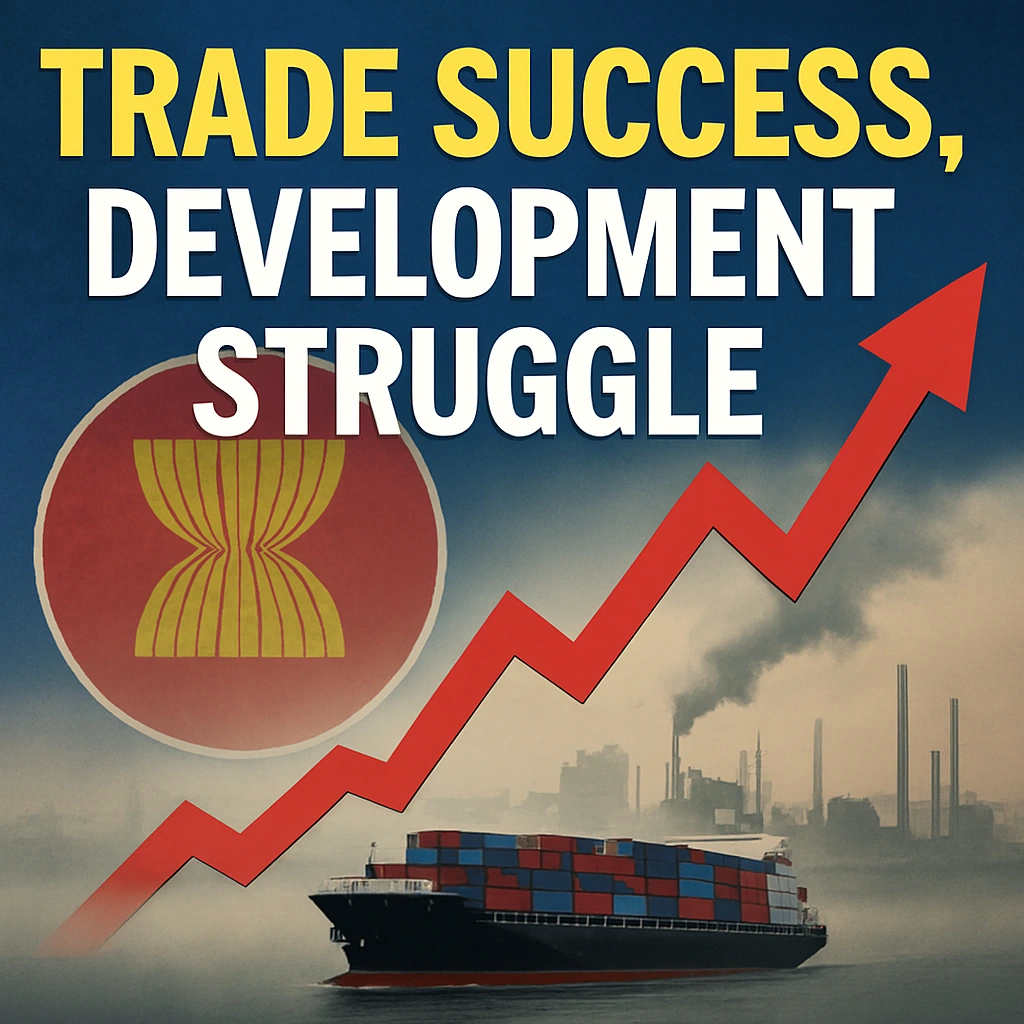
In September 2025, ASEAN’s goods exports to the United States surged 23% compared to the same period in 2024, representing an extraordinary $70 billion in additional annualized exports. Factory floors across Vietnam, Malaysia, and Thailand hum with unprecedented activity. Shipping containers stack higher at ports from Jakarta to Bangkok. By virtually every traditional metric, Southeast Asia appears to be the undisputed winner of the US-China trade war.
Yet walk through the residential neighborhoods surrounding these booming industrial parks, and a different story emerges. Vietnamese garment workers still rely on 80 overtime hours monthly just to earn $400—barely more than they made five years ago. Malaysian semiconductor assemblers package cutting-edge chips but have no pathway to becoming chip designers. Thai automotive workers watch Chinese electric vehicle factories rise around them while wondering if they’ll still have jobs in a decade.
This is ASEAN’s trade war paradox: massive export growth delivering surprisingly little genuine development. The region’s 680 million people find themselves caught in an economic illusion where rising trade numbers mask stagnating wages, limited technology transfer, and deepening dependence on foreign-controlled supply chains. What looks like industrial transformation is actually revealing itself as something far more troubling—a potential dead-end that could trap Southeast Asia in permanent middle-income status.
When Winning Feels Like Losing: ASEAN’s Deceptive Export Surge
The headline numbers tell a seductive story. Vietnam’s exports to the United States stood at $142.48 billion in 2024, making it ASEAN’s largest exporter to America, while collectively, ASEAN’s 10-member countries exported $358.56 billion worth of goods to the United States, representing 10.67% of total US imports. These figures represent extraordinary growth from just eight years ago when the trade war began.
Look closer at what’s actually being exported, and the picture becomes more complicated. Electrical machinery and equipment tops the category of goods exported by ASEAN to the United States, followed by industrial machinery and mechanical appliances. These sound impressive—high-tech products suggesting sophisticated manufacturing capabilities. The reality is more sobering.
Consider Vietnam’s electronics exports, which saw computers and electronics increase by roughly 78% to over $34 billion in just the first ten months of 2025. Yet official Vietnamese government data reveals that foreign-owned enterprises account for an astounding 75.9% of the country’s total exports. This isn’t Vietnamese companies building global competitiveness—it’s foreign corporations using Vietnamese labor to assemble products designed, engineered, and mostly sourced elsewhere.
The distinction between “made in” and “made by” Southeast Asia has never mattered more. An iPhone assembled in Vietnam generates impressive export statistics, but when Apple captures the lion’s share of value, Samsung provides the display, TSMC makes the processor, and Chinese suppliers furnish most components, what exactly does Vietnam gain besides wages for assembly workers?
Here’s where ASEAN trade war benefits diverge sharply from genuine industrial development. Malaysia faces US tariff rates officially listed at 19%, yet its effective US tariff rate stands at only 11%, compared to 0.6% in 2024. This relatively modest increase explains why exports keep growing. But the products Malaysia assembles—semiconductor packages, electronic components, machinery parts—require imported intermediate goods worth far more than the value Malaysia adds through local processing.
The same pattern replicates across Southeast Asia. Thailand’s manufacturing boom centers on automotive and electronics assembly. Indonesia leverages natural resources while struggling to move into genuine manufacturing. Cambodia and Vietnam specialize in garments and low-end assembly. All generate impressive export volumes. None are building the deep technological capabilities that historically separated countries that became rich from those that stayed middle-income.
Trade diversion effects on ASEAN economies amplify this disconnect between growth and development. When a Chinese manufacturer relocates final assembly to avoid US tariffs, ASEAN countries gain jobs and export statistics. They don’t gain the research labs, design studios, advanced component production, or systems integration expertise that China has spent three decades building. The value-added—the portion of production that actually enriches the domestic economy—remains stubbornly low.
The China Shadow: How Beijing Still Controls Southeast Asia’s Export Machine
Here’s the statistic that ASEAN governments would prefer to ignore: imports of Chinese goods to ASEAN were around 30% higher in September 2025 than the same period the previous year—a surge equivalent to almost $150 billion when annualized. This flood of Chinese imports isn’t coincidence. It’s the invisible reality behind ASEAN’s visible export success.
The mechanics of China trade diversion reveal an uncomfortable truth about Southeast Asia supply chains. Chinese companies facing punitive US tariffs have executed a masterful geographic arbitrage. Components manufactured in China—often 60-80% of a finished product’s value—flow into ASEAN countries. Workers perform final assembly, attach a “Made in Vietnam” or “Made in Malaysia” label, and ship the product to America. The export statistics credit Southeast Asia. The value capture remains firmly in China.
Over the last decade, China accounted for 21% of all new project investment in Southeast Asia, up from just 13% in the decade before 2015. This Chinese foreign direct investment ASEAN received isn’t altruistic development assistance. It’s strategic repositioning to bypass US tariffs while maintaining Chinese control over technology, supply chains, and profits.
The Vietnam manufacturing boom illustrates this dynamic. Samsung employs hundreds of thousands of Vietnamese workers in massive electronics facilities. Yet Samsung Vietnam functions primarily as an assembly platform. The sophisticated components—displays, processors, memory chips, camera modules—arrive from Korea, Japan, Taiwan, and increasingly China. Vietnamese suppliers provide packaging materials, basic plastics, and logistics support. The technology remains imported; the knowledge stays elsewhere.
Chinese companies have proven even more reluctant to transfer genuine capabilities. A Chinese solar panel manufacturer relocating to Thailand will build the factory, install Chinese equipment, employ Thai workers for basic tasks, but keep product design, process engineering, and quality control firmly under Chinese management. The promised spillover benefits—where local firms learn from foreign investors and eventually compete—largely fail to materialize.
US customs officials increasingly recognize this pattern. Vietnam faced calculated duty revenue of $11.81 billion over the 12 months through September 2025, with average applied duty rates of 6.55%—rates creeping upward as Washington scrutinizes trade circumvention. ASEAN countries find themselves walking a tightrope: attract enough Chinese investment to maintain export growth, but not so much that America starts treating them as China’s proxies.
The geopolitical dimension adds another layer of complexity. In May 2025, China and ASEAN wrapped up negotiations to upgrade their free trade agreement, expanding it to cover the digital economy, green industries, and other emerging sectors. This ASEAN-China trade relations deepening occurs as Washington demands Southeast Asian countries choose sides in what increasingly looks like a new Cold War.
The hidden costs of ASEAN export growth become clear: every dollar of exports to America requires two dollars of imports from China. The trade surplus with the United States masks a far larger trade deficit with China. ASEAN countries have become, in effect, processing platforms for Chinese manufacturing—earning assembly wages while China captures design, component production, and systems integration profits.
The Wage Trap: When Export Booms Don’t Translate to Worker Prosperity
Behind every export statistic is a human story, and in Southeast Asia, those stories reveal how little prosperity the trade war windfall has actually delivered. Vietnamese garment workers provide a stark example. Survey data shows workers must work overtime every day with about 80 overtime hours per month just to reach average income over $385, while basic salaries remain only slightly above regional minimum wage, and industry wage growth reaches only 3.3% annually—insufficient to offset inflation.
This isn’t what economic development is supposed to look like. When countries industrialize successfully, wages rise substantially as workers move from low-productivity agriculture into higher-productivity manufacturing. Japan, South Korea, and Taiwan all saw dramatic wage increases during their industrial transformation. ASEAN’s experience differs dramatically.
Official statistics paint a misleadingly optimistic picture. Vietnam’s national average monthly income reached about VND 8.3 million (US$317) by mid-2025, suggesting reasonable wage growth. Dig into the details, and problems emerge. Real wage growth of nearly 3% during the first three quarters of 2024 barely exceeds inflation, meaning purchasing power improvement remains minimal. More troublingly, wage growth concentrates in urban centers and foreign-owned enterprises, leaving vast swaths of the workforce behind.
The geographic wage gap tells part of the story. Urban workers in Vietnam earned an average VND 10.4 million (US$397) per month in 2025, compared to just VND 8.4 million (US$321) in rural areas, resulting in a wage gap of roughly 24%. But the foreign-versus-domestic gap matters more for understanding ASEAN’s development challenge. Foreign-invested enterprises typically pay 10-15% more than local companies, creating a dual economy where working for a foreign factory offers significantly better prospects than working for a domestic firm.
Why aren’t wages rising faster given booming exports and ostensibly tight labor markets? The answer reveals why ASEAN exports to the US are increasing without delivering proportionate development benefits. First, the work being performed remains relatively low-skill assembly that can be easily relocated if wages rise too much. Second, automation increasingly threatens even these jobs, putting downward pressure on wage demands. Third, workers lack bargaining power—union organization remains weak across most of ASEAN, leaving workers competing individually rather than collectively negotiating better terms.
Consider the broader economic complexity perspective. Malaysia, Thailand, Indonesia and the Philippines are defined by the World Bank as countries that failed to overcome the “middle income trap,” entering middle-income status in the late 1970s and early 1980s. Four decades later, these countries haven’t escaped despite hosting substantial manufacturing sectors. The explanation lies in what kind of manufacturing they’re doing.
Assembly platforms don’t build innovation capacity. Workers bolt together components manufactured elsewhere. They follow processes designed elsewhere. They produce to specifications created elsewhere. Yes, they gain employment and income above subsistence agriculture. But they don’t acquire the technical knowledge, problem-solving skills, or innovative capabilities that drive sustained wage growth and economic upgrading.
The comparison with electronics workers versus garment workers illustrates the stratification within ASEAN manufacturing. Vietnamese electronics workers might earn $482 monthly while garment workers earn $400, but both remain trapped in a wage band that barely supports middle-class existence. Living wages for Vietnamese garment workers should reach approximately $500 per month—$60 higher than current average income, according to calculations by the Asia Floor Wage Alliance. The gap between survival wages and living wages—incomes that support education, healthcare, and genuine upward mobility—persists despite export booms.
Here’s the deeper structural problem: ASEAN countries need wage growth to build domestic consumer markets, which in turn drive service sector development and create incentives for domestic companies to innovate. But keeping wages low remains the primary competitive advantage attracting foreign investment in the first place. This catch-22 is precisely what the middle-income trap describes—countries get stuck because the strategies that worked to escape poverty don’t work to achieve prosperity.
Between Empires: The Geopolitical Bind Choking ASEAN’s Options
Economic logic suggests ASEAN should deepen integration with China—their largest trading partner, largest investor, and geographic neighbor. Security concerns and political pressure demand closer alignment with the United States. This contradiction has become ASEAN’s defining strategic dilemma, and it’s squeezing their economic options with increasing force.
The numbers illustrate the bind. China-ASEAN trade patterns show deep interdependence built over decades. In early 2025, ASEAN surpassed all other regions to become China’s largest trading partner, with bilateral trade reaching around $420 billion in just five months. This isn’t just trade volume—it represents integration into supply chains, investment relationships, and technology dependencies that can’t be quickly unwound.
Meanwhile, the United States remains ASEAN’s second-largest export market and most important security partner for maritime Southeast Asian nations increasingly concerned about Chinese territorial assertions. The US Indo-Pacific Economic Framework promised an alternative to Chinese economic dominance, but has delivered disappointingly little for ASEAN countries seeking tangible benefits like market access improvements.
Individual ASEAN members face distinct versions of this dilemma. The Philippines under President Marcos Jr. has pivoted toward closer US security cooperation, sharpening Manila’s stance on South China Sea disputes. This shift carries economic risks—potential Chinese investment curtailment, restricted access to Chinese markets, and Beijing’s documented willingness to deploy economic pressure for political ends. Yet accepting Chinese territorial claims proves equally unpalatable for a nation watching foreign vessels operate in waters it considers sovereign territory.
Cambodia represents the opposite extreme, maintaining exceptionally close Chinese ties that bring infrastructure investment and economic support. The trade-off? Cambodia faces US tariff rates up to 49%, reflecting in part America’s concern about Cambodian economic dependence on China, which provides over 40% of Cambodia’s FDI. When Beijing and Washington issue contradictory demands, Phnom Penh faces impossible choices.
Vietnam navigates perhaps the most complex balancing act. Historical tensions with China combine with current territorial disputes, yet economic integration runs deep. Hanoi simultaneously courts US investment and security cooperation while trying to avoid antagonizing its powerful northern neighbor. This hedging strategy—attempting to benefit from both relationships while committing fully to neither—grows increasingly difficult as both powers demand clearer alignment.
The tariff environment exemplifies ASEAN’s shrinking room to maneuver. By October 2025, the effective US tariff rate on China had jumped to 31%, reflecting maintenance of the 10% baseline reciprocal tariff plus 10% “fentanyl” tariffs on all Chinese imports, as well as global sectoral tariffs of 25-50% on steel, aluminum, copper, timber, and automotives. ASEAN countries benefit from lower rates, but only conditionally—Washington watches closely for Chinese circumvention and won’t hesitate to impose punitive measures if it perceives Southeast Asia becoming China’s back door to American markets.
This creates a perverse dynamic where ASEAN countries can’t pursue economically optimal strategies because political constraints limit their options. They can’t fully integrate with China despite clear economic logic, nor can they pivot entirely to Western-led frameworks offering less tangible value. The US-China decoupling impact on Southeast Asia manifests not just in trade flows, but in paralyzed policymaking where countries can’t commit to long-term strategies because geopolitical winds might shift unpredictably.
The broader institutional implications matter enormously. ASEAN unity—always more aspirational than actual—fractures further under superpower pressure. The bloc’s joint statement in April rejected retaliation to US tariffs, opting instead for dialogue and reaffirming multilateralism. But unity in rhetoric disguises divergence in practice. Vietnam pursues frameworks with Washington while deepening production ties with China. Thailand courts Chinese EV investment while maintaining US security cooperation. Indonesia asserts resource nationalism complicating both relationships.
What gets lost in this geopolitical squeeze? The economic policy space to pursue genuine development strategies. Countries that successfully escaped middle-income status—South Korea, Taiwan, Singapore—had clear strategic focus and could implement coherent industrial policies over decades. ASEAN members today lack that luxury, constantly adjusting to external pressures rather than executing domestic development visions.
The Development Illusion: Why Growth Doesn’t Equal Progress
Economic growth and economic development aren’t synonyms, though they’re often treated as such. ASEAN’s trade war experience starkly illustrates the difference. GDP rises. Export volumes surge. Factory employment expands. Yet the fundamental transformation that characterizes genuine development—building productive capabilities, advancing up value chains, creating innovation ecosystems—remains frustratingly elusive.
According to the World Bank, it would be a ‘miracle’ if today’s middle-income economies like Indonesia and Vietnam could accomplish in 50 years what South Korea achieved in just 25. This isn’t mere pessimism—it reflects how different contemporary conditions are from the environment where East Asian Tigers industrialized. Those countries benefited from stable geopolitics, patient capital, technology transfer from friendly Western powers, and crucially, the ability to protect infant industries while building capabilities.
ASEAN countries today face a far harsher environment. Global supply chains demand immediate competitiveness. Intellectual property protections prevent the technology copying that helped earlier developers. Geopolitical tensions create uncertainty that deters long-term investment. And the work itself increasingly involves narrower tasks optimized for global value chains rather than building complete industrial ecosystems.
The economic complexity measurements capture this stagnation quantitatively. The major ASEAN economies are generally well diversified, though with varying degrees of economic complexity, led by Singapore, with countries on the lower end typically having relatively lower levels for education and labor productivity. What matters isn’t just diversity but sophistication—can countries produce complex products requiring diverse, specialized knowledge?
Vietnam exemplifies the challenge. Exports surge impressively, but remain dominated by foreign-owned enterprises performing relatively simple assembly. Domestic Vietnamese companies struggle to move beyond basic supplier roles. The knowledge required for product design, process engineering, quality systems, and supply chain orchestration stays in foreign hands. Vietnam gains GDP growth and employment. It doesn’t gain the capabilities that would allow it to eventually compete with Samsung rather than just assembling Samsung’s products.
The “premature deindustrialization” phenomenon adds another worry. Historically, countries industrialized—shifting workers from agriculture to manufacturing—before transitioning to services once they reached high income. Many ASEAN countries show signs of shifting to services while still middle-income, potentially missing the manufacturing-driven development phase that built prosperity elsewhere.
Thailand provides a cautionary example. The country successfully industrialized through the 1980s and 1990s, building genuine automotive sector capabilities. Yet growth stalled after the 1997 Asian Financial Crisis. Despite hosting substantial manufacturing, Thailand hasn’t broken through to high-income status. Real wage growth remains modest. Thailand’s exports to the United States surged about 30% compared to 2024, yet Bloomberg Economics projects potential contraction in 2026 if trade barriers persist.
Malaysia faces similar challenges. The semiconductor industry showcases the problem perfectly. Malaysia dominates global semiconductor packaging—a critical but relatively low-margin activity. Yet design capabilities, R&D centers, and advanced manufacturing remain elsewhere. Workers assemble components designed by American and Taiwanese engineers. The profits flow accordingly.
Educational systems compound the problem. In Vietnam, only about 28% of workers have received formal training, far below what’s needed for technological upgrading. ASEAN governments haven’t adequately scaled technical education, reformed curriculum to match manufacturing needs, or invested in the engineering capacity that industrial transformation requires.
Is ASEAN stuck in middle-income trap? The evidence increasingly suggests yes, at least for several major economies. Export booms create the illusion of dynamism, but the underlying reality—limited technology absorption, weak domestic firms, inadequate innovation systems, insufficient human capital development—points toward stagnation rather than transformation.
Here’s what genuine development looks like: domestic companies progressively taking on more sophisticated roles, wages rising substantially in line with productivity improvements, economic complexity increasing as countries master more advanced products, and critically, the emergence of indigenous innovation rather than perpetual technology importation. ASEAN has achieved export-led growth. It hasn’t achieved development.
Policy Failures That Turned Windfall Into Mirage
The US-China trade war created a historic opportunity for Southeast Asia. Manufacturing investment seeking alternatives to China, supply chain diversification imperatives, and geopolitical conditions favoring ASEAN should have accelerated development. Instead, short-sighted policies and institutional failures have squandered much of this opportunity, leaving countries with impressive trade statistics but little genuine advancement.
The fundamental failure involves mistaking investment quantity for investment quality. ASEAN countries adopted a “take what we can get” approach to foreign direct investment, measuring success by dollar values rather than developmental impact. Any investment that created jobs and boosted exports counted as victory, regardless of whether it transferred technology, built local capabilities, or integrated domestic firms into supply chains.
Vietnam illustrates both the success and failure. The country brilliantly attracted investment, becoming Southeast Asia’s FDI magnet. Yet that success came at a cost—accepting investments on terms favoring foreign companies over developmental objectives. No meaningful technology transfer requirements. Minimal local content mandates. Little insistence on supplier development programs that would help Vietnamese companies join supply chains. The result? Foreign enterprises dominate exports while domestic firms remain marginal.
IMF research shows that packaging together broad, economy-wide reforms spanning regulation, governance, and education could help major ASEAN emerging market economies increase long-term real economic output by 20% or more over two decades. But comprehensive reform requires political will ASEAN countries have largely lacked. Instead, governments pursued fragmented initiatives without coherent industrial strategy or sustained implementation.
Education failures loom particularly large. Despite knowing for years that manufacturing investment was coming, governments didn’t adequately scale technical training or engineering programs. The skills gap between what factories need and what workers can provide remains stubbornly wide, forcing firms to import expertise or settle for lower-value activities matching available skills. When only 28% of workers have formal training and targets aim for just 30% by 2025 and 45% by 2030, the timelines simply don’t match industrialization’s urgency.
Infrastructure bottlenecks further constrain the export boom’s potential. While the six main ASEAN economies are generally more open than the average emerging market, these countries still have more barriers to trade and are relatively harder to trade with than the median OECD country. Port congestion, unreliable electricity, and inadequate logistics networks raise costs and deter higher-value investment seeking efficient operations.
Corruption and regulatory unpredictability create additional obstacles. Indonesia’s constantly shifting regulations scare long-term investors needing policy stability. Thailand’s political instability undermines confidence. Even relatively well-governed Vietnam and Malaysia struggle with regulatory opacity and arbitrary enforcement favoring connected firms over market competition.
The comparative failure becomes stark when contrasted with East Asian development models. South Korea and Taiwan during industrialization demanded technology transfer as a condition for market access. They implemented local content requirements with graduated timelines. They ran supplier development programs systematically linking foreign and domestic firms. They invested strategically in infrastructure prioritizing manufacturing zones. They reformed education focusing on engineering and technical skills.
ASEAN did almost none of this. Instead, members raced to the bottom, competing to offer investors the best tax breaks, most lenient environmental standards, and weakest labor protections. This zero-sum competition benefited investors while limiting regional benefits. Had ASEAN countries coordinated—jointly demanding better terms, agreeing not to undercut each other, pooling resources for technology development—outcomes might have differed dramatically.
The window for correction narrows rapidly. Automation threatens to eliminate low-wage advantages before ASEAN countries can upgrade capabilities. Chinese manufacturing overcapacity intensifies competition. And the trade war itself could reverse if US-China relations stabilize, suddenly making Southeast Asian platforms less necessary. The opportunity that seemed boundless in 2018 now looks increasingly finite.
Three Futures: How This Story Could End
ASEAN’s trade war experience will ultimately yield one of three broad outcomes. Understanding these scenarios helps clarify what’s at stake and what choices might still alter trajectories.
Scenario One: The Reform Breakthrough
In this optimistic version, current pressures finally catalyze comprehensive reforms. External shocks—perhaps a sudden investment pullback or dramatic tariff changes—create political space for reformist coalitions. Governments implement aggressive industrial upgrading strategies, demanding genuine technology transfer from foreign investors while significantly supporting domestic firms.
Regional cooperation deepens beyond rhetoric. ASEAN functions as an integrated market of 680 million consumers rather than ten competing economies, creating scale advantages that attract higher-quality investment. A more integrated ASEAN could function as a massive ‘domestic’ market of 680 million people and $3.9 trillion in GDP, creating stable demand less vulnerable to external shocks.
Education reforms accelerate, producing the engineers and technicians that advanced manufacturing requires. Infrastructure investments target genuine bottlenecks. Governance improves as middle-class constituencies demand accountability. The trade war’s temporary benefits get transformed into lasting capabilities. Vietnam’s domestic companies move from low-tier suppliers to genuine competitors. Malaysia advances beyond assembly into design and R&D. Thailand successfully navigates the EV transition.
This scenario requires political will, institutional capacity, and frankly, some luck with external conditions. But it’s technically feasible—the resources exist if mobilized effectively. Southeast Asia wouldn’t be the first region leveraging external shocks for transformative change. The question is whether ASEAN countries can execute what South Korea and Taiwan accomplished decades earlier, despite facing a far more challenging global environment.
Scenario Two: Drift and Stagnation
The more probable middle scenario sees current patterns continuing. Exports remain elevated but value capture stays low. Foreign investment continues but on terms perpetuating assembly platform status. Domestic firms struggle to compete. Political elites capture what benefits do accrue while inequality widens.
GDP growth continues at modest 2-4% annually—enough to avoid crisis but insufficient for transformation. The gap between ASEAN and high-income economies persists or widens. The middle-income trap deepens as the strategies that enabled initial growth prove inadequate for reaching prosperity.
Social tensions increase as populations recognize export booms aren’t delivering broad prosperity. Youth unemployment rises despite headline growth, as education systems fail producing skills advanced economies demand. The development promise fades into frustration, potentially destabilizing political systems already under strain.
China’s role intensifies this scenario. As Chinese manufacturing becomes even more efficient through automation and scale, ASEAN’s comparative advantages erode further. The region becomes a perpetual processing platform—earning assembly wages while China, America, Taiwan, and Korea capture design, component production, and systems integration profits. Not collapse, but indefinite stagnation—countries trapped between poverty and prosperity, watching opportunities slip away while lacking will or capacity to seize them.
Scenario Three: Crisis and Reversal
The darkest scenario involves sudden disruption exposing ASEAN’s vulnerabilities. US-China trade normalization—whether through diplomatic breakthrough or political change—eliminates tariff differentials currently favoring Southeast Asian exports. Production that relocated from China suddenly becomes uncompetitive. “China-plus-one” strategies reverse to “China-only” as companies discover Southeast Asian platforms can’t match Chinese efficiency, infrastructure, and supply chain depth.
Capital outflows accelerate as firms relocate back to China or to other newly competitive locations. Factories that sprouted across ASEAN during 2018-2025 become stranded assets. Trade surpluses flip to deficits as Chinese imports continue while exports collapse. Currencies depreciate, importing inflation that erodes what wage gains workers had achieved.
Economic disruption triggers political instability, particularly in countries where growth has legitimized governance systems. Thailand’s recurring political crises intensify. Vietnam faces renewed pressures as the social contract—accept limited freedoms for rising prosperity—breaks down when prosperity stops rising. Indonesia confronts populist nationalism that complicates economic management.
This crisis scenario might paradoxically create conditions for genuine reform, as emergency measures force painful but necessary restructuring. But it could also produce a lost decade or more, setting back development by years and discrediting export-oriented strategies entirely. The risk isn’t hypothetical—Southeast Asian countries remember the 1997 financial crisis and how quickly apparent prosperity can evaporate.
What Hangs in the Balance
This isn’t just about economics. Behind every trade statistic, every FDI figure, every export surge are 680 million people whose life prospects depend on whether their countries can translate temporary advantages into lasting prosperity.
The Vietnamese factory worker assembling smartphones hopes her children will design them. The Malaysian logistics coordinator wants his son managing supply chains, not just working warehouses. The Indonesian farmer who sent his daughter to the city for factory work expects her wages to lift the family from subsistence. These individual aspirations, multiplied across Southeast Asia, define what’s at stake.
Current trends suggest many will be disappointed. The export boom has created jobs but not careers, income but not wealth, growth but not development. Without fundamental changes, ASEAN risks permanent middle-income status—prosperous enough to avoid poverty, unable to achieve affluence.
The comparison with Northeast Asian development remains stark. South Korea transformed from war-torn poverty to global industrial powerhouse in a generation. Singapore went from colonial outpost to First World city-state. Taiwan built a technology ecosystem underpinning global semiconductor supply chains. Southeast Asia possesses comparable human capital, geographic advantages, and market access. What it lacks is strategic vision, institutional capacity, and political will to leverage these advantages effectively.
Global implications extend beyond Southeast Asia. ASEAN’s experience offers lessons about 21st century development more broadly. If countries receiving massive FDI, export opportunities, and favorable geopolitical positioning still can’t escape middle-income status, what hope exists for less fortunately positioned nations? Development models that worked in the past may not function in an era of global value chains, rapid automation, and intensifying geopolitical competition.
For global supply chain resilience, ASEAN’s struggles matter enormously. If Southeast Asian manufacturing proves unsustainable—too dependent on Chinese inputs, too vulnerable to geopolitical shifts, too focused on assembly rather than genuine capabilities—then corporate “China-plus-one” strategies rest on shaky foundations. Real supply chain diversification requires developing robust alternative manufacturing ecosystems, not just relocating final assembly operations.
The next few years will be decisive. Trade war dynamics remain unstable with policies shifting unpredictably. ASEAN countries face a narrow window to implement reforms before external conditions change or opportunities close. The International Monetary Fund projects the US economy to grow by 2.1% in 2026, slightly faster than 2025, suggesting American import demand may remain relatively stable. But geopolitical risks could escalate suddenly, or automation could accelerate faster than expected, fundamentally altering ASEAN’s competitive position.
Watch Vietnam’s domestic firm development as a key indicator. Monitor whether Malaysia can move beyond assembly into design and R&D. Observe if Thailand successfully pivots to higher-value manufacturing or gets stuck hosting Chinese firms pursuing tariff avoidance. Track whether Indonesia’s resource nationalism evolves into genuine industrial policy or devolves into counterproductive protectionism.
The factories are here. The exports are real. The GDP numbers look impressive. But the critical question remains unanswered: Will the prosperity being generated actually stay in Southeast Asia, enriching its people and building lasting capabilities? Or will it continue flowing to shareholders in Beijing, Seoul, Tokyo, and San Francisco, leaving ASEAN permanently trapped between poverty and prosperity?
Southeast Asia’s 680 million people—and anyone watching to see if traditional development paths still exist in our fragmented, competitive global economy—are still waiting for that answer. The export boom is real. Whether it becomes a development breakthrough or just another false dawn depends entirely on choices ASEAN countries make in the brief window that remains open.
Discover more from The Economy
Subscribe to get the latest posts sent to your email.


When the benchmark 10-year U.S. Treasury yield crosses the 5.0% threshold, financial markets undergo a structural paradigm shift. Far beyond a routine spike in borrowing costs, a 5% yield alters the hurdle rate for global capital, re-prices risk across every asset class, and exposes systemic sovereign debt fragilities.
1. The 5.0% Benchmark: Why the “Risk-Free” Rate Reshapes Equities
The 10-year U.S. Treasury note is the foundational anchor of global finance. Its yield represents the risk-free rate ($R_f$) utilized in the Capital Asset Pricing Model (CAPM) and Discounted Cash Flow (DCF) models worldwide.
When $R_f$ rises from 2%–3% to over 5%, the present value of future corporate earnings contracts exponentially.
$$\text{Present Value} = \sum_{t=1}^{n} \frac{CF_t}{(1 + WACC)^t}$$
As the Weighted Average Cost of Capital ($WACC$) climbs alongside Treasury yields:
- Growth Stocks & Big Tech: Long-duration growth equities—where the majority of projected cash flows sit far in the future—suffer the sharpest valuation multiple compressions.
- Equity Risk Premium (ERP) Squeeze: With risk-free Treasury bills yielding 5%, the additional premium required to hold volatile equities shrinks dramatically, prompting institutional capital to migrate from stocks to bonds.
- Corporate Liquidity Crunch: Corporate debt refinancing costs double or triple compared to pre-2022 issuance levels, directly eroding net profit margins reported to the U.S. Securities and Exchange Commission.
2. Macroeconomic Catalysts: What Is Driving the Bond Sell-Off?
The surge to 5%+ yields is driven by three primary structural forces rather than a single economic data point:
┌─────────────────────────────────────────────────────────────────────────┐
│                      DRIVER 1: FISCAL EXPANSION                         │
│  U.S. national debt interest + mandatory entitlement outlays now absorb │
│  ~98% of federal tax revenues (Source: U.S. Treasury Department).       │
└────────────────────────────────────┬────────────────────────────────────┘
                                     │
                                     ▼
┌─────────────────────────────────────────────────────────────────────────┐
│                     DRIVER 2: ISSUANCE MISMATCH                         │
│  84% of 12-month Treasury debt issuance concentrated in short-term T-   │
│  Bills, creating severe rollover sensitivity to rate hikes.             │
└────────────────────────────────────┬────────────────────────────────────┘
                                     │
                                     ▼
┌─────────────────────────────────────────────────────────────────────────┐
│                     DRIVER 3: CAPITAL COMPETITION                       │
│  Corporate AI CAPEX spending (~$700B–$900B/yr) competes with sovereign  │
│  bond issuance for global institutional capital reserves.               │
└─────────────────────────────────────────────────────────────────────────┘
Sovereign Debt & Supply Shock
As documented by the U.S. Department of the Treasury, massive fiscal deficit spending has accelerated net bond issuance. Because traditional central bank buyers engaged in quantitative tightening (QT) while foreign sovereign buyers reduced purchases, price discovery has shifted to price-sensitive private institutional investors who demand higher yields (term premium) to absorb debt supply.
Global Central Bank Tightening Synchronicity
Monetary policy decisions from the Federal Reserve System and global partners—such as the Bank of Japan raising interest rates—have reinforced elevated global rate floors. Official global debt perspectives from the International Monetary Fund highlight how high real yields strain emerging market borrowing capacity.
3. Sector Impact Analysis & Asset Class Vulnerabilities
| Asset Class / Sector | Impact Level | Primary Vulnerability / Opportunity |
| Mega-Cap Big Tech | Moderate to High | CAPEX borrowing costs rise; DCF discount rate expansion reduces forward P/E multiples. |
| Commercial & Residential Real Estate | Severe Headwind | Mortgage rates track 10-year yields; refinancing resets create valuation pressure. |
| Short-Term T-Bills & Money Market | Highly Favorable | Yields above 5% offer competitive risk-adjusted real returns without duration risk. |
| Hard Assets (Gold / Precious Metals) | Strategic Hedge | Fiscal deficit concerns and dollar devaluation risks enhance gold’s monetary status. |
| Asian & Emerging Market Equities | Selective Upside | Valuations in South Korea, Japan, and India trade at significant discounts relative to U.S. multiples. |
4. Tactical Asset Allocation Framework
Navigating a 5%+ Treasury yield environment requires balancing yield capture, capital preservation, and equity growth.
Core Portfolio Takeaways
- The Cash-Equivalent Shield: Allocating 35% to short-dated T-Bills mimics Warren Buffett’s liquidity strategy at Berkshire Hathaway, locking in 5%+ yields while preserving optionality for market corrections as reported by CNBC Markets.
- Selective Equity Quality: Focus equity exposure on companies with pristine balance sheets, low debt-to-equity ratios, and pricing power capable of outrunning inflation.
- Monetary Hedges: Gold and hard assets provide downside protection against potential currency weakness if central banks step in to cap bond yields through yield curve intervention. Further macroeconomic debt analysis is regularly updated by Bloomberg Markets and Reuters Financial News.
Discover more from The Economy
Subscribe to get the latest posts sent to your email.
IMF sees 3.0% global growth in 2026, the World Bank just 2.5%. Compare Europe and Asia forecasts, the gap between them, and what it means for capital.
Executive Summary / Key Takeaways
- The IMF’s July 2026 World Economic Outlook Update projects global growth of 3.0% in 2026 and 3.4% in 2027, down from the 3.5% average of 2024–25.
- The World Bank’s June 2026 Global Economic Prospects is far darker: 2.5% in 2026, the weakest since the pandemic, with two-thirds of economies downgraded since January.
- The two institutions are not contradicting each other — they use different weighting methodologies — but the direction of both revisions is the same, and the driver is the Middle East war.
- Europe and Central Asia was cut to 2.1% for 2026; East Asia and Pacific to 4.2%. The Middle East, North Africa, Afghanistan and Pakistan region takes the worst hit at 1.6%.
- The divergence that matters for allocators is not regional but structural: economies plugged into the AI-led technology cycle are outperforming energy importers that are not.
1. Introduction & Immediate Context
Two flagship forecasts, two very different headline numbers, one identical story underneath. Anyone building a 2027 capital plan needs to understand why.
The IMF’s July update projects global growth of 3.0% in 2026 and 3.4% in 2027, down from the 3.5% average observed across 2024–25 and broadly unchanged on a cumulative basis from the April 2026 World Economic Outlook. The Fund attributes the modest slowdown to the effects of the war in the Middle East, partly offset by accelerated demand-driven momentum in the global technology cycle thanks to advances in artificial intelligence and its adoption.
The World Bank is blunter. It forecasts global growth slowing to 2.5% in 2026 from 2.9% in 2025 — the lowest rate since the onset of the COVID-19 pandemic — amid higher energy prices, steeper inflation and increased borrowing costs. Forecasts for two-thirds of economies were downgraded relative to January. Growth is expected to improve to 2.8% in 2027 but will remain 0.4 percentage point below the 2010s average.
The gap between 3.0% and 2.5% is largely methodological: the IMF aggregates at purchasing-power-parity weights, the World Bank at market exchange rates, which gives slower-growing advanced economies more influence. Read the revisions, not the levels.
2. Core Market / Strategic Analysis
2.1 Regional forecasts side by side
| Region | World Bank 2026 | World Bank 2027 | Revision direction | Source |
|---|---|---|---|---|
| World | 2.5% | 2.8% | Cut from 2.6% (Jan) | World Bank |
| East Asia & Pacific | 4.2% | 4.4% | Cut from 4.4% (Jan) | World Bank |
| Europe & Central Asia | 2.1% | 2.3% | Cut from 2.4% (Jan) | World Bank |
| South Asia | 6.3% | 6.9% | Fastest-growing region | World Bank |
| MENA, Afghanistan & Pakistan | 1.6% | 5.0% | Cut from 3.6% (Jan) | World Bank |
| Sub-Saharan Africa | 4.0% | 4.4% | Marginal easing | World Bank |
| Low-income countries | 5.4% | — | Cut 0.3pp on the conflict | World Bank |
The MENAAP line is the single most violent revision in the dataset: from 3.6% to 1.6% for 2026 in five months, followed by a mechanical 5.0% rebound in 2027 as base effects and assumed energy normalisation kick in. For frontier-market investors with Pakistan or Gulf exposure, that V-shape is the entire investment thesis — and it rests on an assumption about how long the conflict lasts.
2.2 The European picture
Growth in Europe and Central Asia is projected to decelerate to 2.1% in 2026, weakening in roughly 70% of economies in the region, according to the World Bank’s regional highlights. Domestic demand remains the primary driver but is constrained in 2026 by elevated energy prices, which raise inflation and erode real incomes, and by tighter financial conditions.
Commodity exporters in the region — Azerbaijan, Kazakhstan and Turkmenistan among them — see export revenues supported by higher energy prices even as growth slows. In Russia, the World Bank estimates oil revenue gains at roughly 1.5% of 2025 GDP for each $10 per barrel increase in prices, with those gains mainly directed toward fiscal consolidation.
The euro area itself sits at the sluggish end. The IMF’s January 2026 update had projected euro-area growth steady at 1.3% in 2026 and 1.4% in 2027, noting that the region benefits less than others from the technology-driven investment boost and that lingering energy-price effects continue to drag on manufacturing. Planned defence spending increases are expected to show up in output only in later years given phased commitments running to 2035.
2.3 The Asian picture
East Asia and Pacific is projected to fall to 4.2% in 2026 before firming to 4.4% in 2027 — a downgrade, but still comfortably the second-fastest-growing region. South Asia leads globally at 6.3% in 2026 and 6.9% in 2027.
The IMF’s framing explains why Asia holds up better than Europe: economies plugged into the technology-led upturn experience stronger activity even when they are energy importers, while activity weakens for energy importers with limited participation in that cycle. Energy exporters outside the conflict zone benefit from favourable terms of trade.
3. Structural Drivers and Competitor Gaps
Most coverage treats these as two competing headline numbers. The more useful read is that both institutions have converged on the same three-channel transmission mechanism, articulated by IMF Chief Economist Pierre-Olivier Gourinchas when the April outlook was released: higher energy and food prices themselves; persistence in wage and price inflation; and a confidence shock. The Fund noted at the time that the global economy had been on a roughly 3.3% trajectory and was heading for an upgrade before the war stopped that momentum, with inflation instead rising toward 4.4%.
Three structural points follow that competitors miss:
The dispersion is the story. The April WEO recorded a cumulative growth revision of nearly three percentage points for 2026 in the Middle East and North Africa, against comparatively modest effects in advanced economies. A single global number conceals a distribution this wide.
The 2027 rebound is conditional, not forecast. The World Bank’s recoveries across all regions in 2027–28 are driven by an assumed decline in energy prices and rebound in global activity. If Brent stays above $100, the rebound does not arrive on schedule.
AI is now a macro line item, not a sector story. Both institutions explicitly cite broader AI adoption as an upside risk offsetting the energy shock. That reframes technology capital expenditure as a national growth input, which is why Singapore, Malaysia and Taiwan are outperforming regional peers with similar energy exposure.
4. Key Implications for Stakeholders
Macro allocators. The IMF–World Bank spread is not noise to be averaged away; it is a signal about where you sit in the distribution. Market-weight exposure to advanced economies should be benchmarked against the World Bank’s 2.5%, not the IMF’s 3.0%.
Corporate strategists. Fiscal pressure is the binding constraint in developing markets. The World Bank flags that fiscal pressures will affect the ability to reduce poverty and food insecurity and to create jobs — which translates into weaker public procurement and slower infrastructure pipelines across frontier markets through 2027.
Frontier and EM investors. Emerging market and developing economies face their weakest per capita income growth since the pandemic. Pair that with the MENAAP downgrade and the case for selectivity over beta exposure is straightforward.
Watch the October calendar. The IMF’s next full World Economic Outlook lands with the Annual Meetings. Given the energy trajectory since July, the risk to the 3.0% figure is to the downside.
5. Frequently Asked Questions
Q1: What is the IMF’s global growth forecast for 2026?
The IMF projects 3.0% global growth in 2026 and 3.4% in 2027, per its July 2026 World Economic Outlook Update — down from the 3.5% average recorded across 2024–25, with the Middle East war the principal drag.
Q2: Why does the World Bank forecast lower growth than the IMF?
The World Bank aggregates using market exchange rates while the IMF uses purchasing-power-parity weights, giving slower-growing advanced economies more influence in the World Bank’s 2.5% figure. Both revised downward for the same reasons.
Q3: Which region is growing fastest in 2026?
South Asia, at a projected 6.3% in 2026 rising to 6.9% in 2027, according to the World Bank. East Asia and Pacific follows at 4.2%.
Q4: How badly has the Middle East conflict hit growth forecasts?
The World Bank cut its MENA, Afghanistan and Pakistan forecast from 3.6% to 1.6% for 2026, and downgraded two-thirds of all economies since January. Global growth is now at its weakest since the pandemic.
Discover more from The Economy
Subscribe to get the latest posts sent to your email.
Global Economy
Fed Rate Hike Projections vs. Trump’s Interest Rate Policy: What Global Markets Expect Next

The Fed hiked to 3.75%-4% on Sept 16 as Trump demanded 1% rates. See the dot plot, the market reaction and what it means for borrowers next.
Executive Summary / Key Takeaways
- On 16 September 2026 the Federal Open Market Committee voted 12-0 to raise the federal funds target range by a quarter point to 3.75%–4.00% — the first US rate increase since July 2023.
- The statement was blunt: inflation remains elevated, and the action is meant to support a timelier return to the 2% goal.
- The dot plot showed 16 of 18 participants expecting at least one more quarter-point hike before year-end, with four seeing room for two. Chair Kevin Warsh declined to submit a projection at all.
- President Trump responded within hours, demanding that US rates fall to 1% “or less” — while saying he still has confidence in the chair he appointed.
- Markets sold the decision then partly reversed: the Dow fell more than 600 points, the 10-year Treasury yield topped 5%, and the two-year reached its highest level since 2024.
1. Introduction & Immediate Context
For three and a half years the direction of travel in US monetary policy was one-way — cuts, pauses and arguments about the pace of easing. That ended on Wednesday afternoon.
The Federal Reserve approved its statement by a 12–0 vote, lifting the target range for the federal funds rate by a quarter percentage point to 3¾–4 percent while continuing its policy of maintaining ample reserves in the banking system. The Committee described economic activity as expanding at a solid pace, noted that uncertainty remains elevated partly because of geopolitical developments, and observed that domestic spending has been resilient, productivity growth strong and capital investment robust.
Alongside that assessment sat a one-line justification for tightening: inflation remains elevated, and the policy action will support a timelier return to the 2 percent objective. That combination — firm growth, firm inflation — is what separates this decision from the reflexive easing bias markets carried through the first half of the year. As CNBC reported, futures markets had priced better than a 90% chance of the move, but the accompanying projections were more hawkish than most desks expected.
2. Core Market and Policy Analysis
2.1 What the dot plot actually says
The Summary of Economic Projections is the part institutional desks will trade for the next six weeks. Sixteen of eighteen policymakers anticipate at least one more quarter-point increase by the end of this year, and only two expect rates to stay where they are, according to Reuters. Four of those officials see two further hikes as possible.
Warsh’s refusal to publish his own dot is a deliberate break with a decade of Fed communication practice; he has said repeatedly that he opposes issuing forward guidance. For rate-sensitive borrowers that matters. The committee’s central tendency is now the only signal available, and it points higher.
| Metric / Indicator | Current Status | Projected Impact | Primary Source |
|---|---|---|---|
| Federal funds target range | 3.75%–4.00% (raised 25 bps, 12-0) | At least one further hike signalled for 2026 | Federal Reserve |
| FOMC dot plot | 16 of 18 see ≥1 more hike; 4 see two | Terminal-rate debate shifts toward 4.25%–4.50% | Reuters |
| PCE inflation projection | 3.7% in 2026, falling to 2.3% in 2027 | Above target across the forecast horizon | Fox Business |
| 10-year Treasury yield | Above 5% | Higher mortgage and corporate borrowing costs | Yahoo Finance |
| Prior policy path | Three cuts in 2025 to 3.50%–3.75%, then five holds | First reversal of the easing cycle since 2023 | Trading Economics |
2.2 The inflation case for tightening
Fed projections put PCE inflation at 3.7% in 2026, falling to 2.3% in 2027, with domestic spending remaining resilient, Fox Business reported. That is a second consecutive year of above-target inflation on the central bank’s own numbers, driven substantially by energy costs.
Warsh framed the decision in unusually plain terms at his press conference, saying that inflation is too high and has been for too long, and describing the vote as a sober, serious, responsible decision. Speaking to Bloomberg, he characterised the move as removing a dose of accommodation so that financial and credit conditions would sit more consistently with the Fed’s ultimate objectives — and said the action begins to show the central bank is serious about delivering price stability. He also noted that the economy has gathered speed since the July hold, with little sign of inflation cooling.
3. Structural Drivers and Competitor Gaps: The Independence Test
This is where most coverage stops short. The interesting variable is not 25 basis points; it is the institutional test now underway.
In the week before the meeting, the president, vice president, Treasury secretary and a senior White House economic counselor all publicly urged the Fed not to raise rates and in some cases to cut — an unusually broad pressure campaign even by the standards of Trump’s long-running criticism of the central bank, CNBC reported. Vice President JD Vance said the administration believes the Fed should be lowering rates and would appreciate help from the central bank. Treasury Secretary Scott Bessent argued that the Fed typically does not raise rates during a supply shock until second- or third-order inflationary effects appear.
The decision went the other way. Warsh voted with a unanimous committee despite that pressure, in a move read by analysts as an unambiguous signal that the White House should keep its hands off the Federal Reserve. Trump had selected Warsh in January after souring on former chair Jerome Powell — which is precisely what makes the vote consequential. This was not an inherited adversary defying the administration; it was the administration’s own appointee.
The presidential response came within hours. Trump wrote on Truth Social that US interest rates should be 1% or less because America is the best credit in the world, ending with a demand that rates be lowered fast, Reuters reported. He also appeared to link persistent US trade deficits to the central bank’s borrowing costs, though the two are largely unrelated. Asked later whether he believed Warsh had decided based on White House input, the president said he did not think so, and confirmed he still has confidence in the chair.
For sovereign allocators the pricing question is whether September establishes a durable precedent of operational independence, or whether the pressure campaign intensifies into 2027 as the midterm cycle bites. Long-end term premium is the cleanest instrument for expressing a view either way.
4. Key Implications for Stakeholders
Mortgage borrowers. The transmission channel is the long end, not the policy rate. The 10-year Treasury topped 5% around the decision while oil traded solidly above $100 per barrel, according to Yahoo Finance. Thirty-year fixed mortgage pricing tracks the long bond far more closely than the funds rate, so the term-premium repricing matters more than the hike itself.
Equity investors. Stocks reversed during Warsh’s press conference as markets read his remarks as hawkish, with the Dow dropping more than 600 points — over 1.2% — while the S&P 500 fell 0.4% and the Nasdaq finished near flat. Yardeni Research cut its year-end S&P 500 target to 7,900 from 8,400, citing higher Treasury yields driven by rising energy prices and an increased risk of a downturn over the next three to six months, CNBC noted.
Global markets. By Thursday, sentiment had steadied. Bloomberg reported Treasuries paring losses and US equity futures climbing as Warsh’s resolve reassured investors, with the two-year note easing a basis point to 4.72% after touching its highest level since 2024, and the 10-year and 30-year both slipping around two basis points.
Institutional positioning. The base case is now higher-for-longer with a live December hike. Markets are pricing one more 25-basis-point increase in 2026 followed by further tightening extending into 2027, per Seeking Alpha analysis of CME FedWatch pricing.
5. Frequently Asked Questions
Q1: What is the current Fed interest rate after the September 2026 meeting?
The federal funds target range is 3.75%–4.00%, raised by 25 basis points on 16 September 2026 in a unanimous 12-0 FOMC vote. It was the first US rate increase since July 2023 and partially reversed the 2025 easing cycle.
Q2: Will the Fed raise rates again in 2026?
The dot plot indicates 16 of 18 FOMC participants expect at least one further quarter-point increase before year-end, and four see two as possible. Markets currently price one additional hike in December, with more tightening possible into 2027.
Q3: How did Trump react to the Fed rate hike?
He demanded on Truth Social that US rates be cut to 1% or less, while telling reporters afterwards that he retains confidence in Chair Kevin Warsh and does not believe Warsh acted on White House instruction.
Q4: Why is the Fed hiking when inflation was supposed to be falling?
Fed projections put PCE inflation at 3.7% in 2026, well above the 2% target, driven substantially by energy prices. The Committee judged growth, productivity and capital investment strong enough to absorb tighter policy.
Discover more from The Economy
Subscribe to get the latest posts sent to your email.

Global Pension Systems Ranked: The World’s Best and Worst Retirement Frameworks

Global Supply Chain Vulnerabilities: From Eurasian Trade Corridors to Food Consumer Recalls

Why 5% U.S. Treasury Yields Signal a Global Market Regime Shift.

Federal Reserve Defies White House Pressure: Inside Trump’s Demand for Sub-1% Interest Rates After Historic 2026 Rate Hike

How Rising Interest Rates Impact Gig Economy Apps: DoorDash, Uber, and Urban Services

GasBuddy Market Insights: How Crude Price Shifts Impact Local Fuel Cost Averages

DoorDash Driver Payouts, Fee Structures, and Market Competition Analysis

OPINION:Breaking the 3.5% Growth Trap: How Pakistan Can Build a High-Productivity Export Economy

Global Equity Market Divergence: US Tech vs. European Dividend Stocks vs. Asian Growth

Asian Markets Analysis: Navigating Volatility in China, Japan, and Singapore Stocks

Stagflation vs. Soft Landing: How Central Bank Rates Are Reshaping European and Asian Economies

IMF & World Bank Global Economic Outlook: Growth Forecasts Across Europe and Asia

Fed Rate Hike Projections vs. Trump’s Interest Rate Policy: What Global Markets Expect Next

Singapore Stocks: The Ultimate Safe Haven for Markets and Finance in 2026?

State Farm’s $5B Dividend 2026: Who Qualifies & Payout Dates

US-China Relations in Q3 2026: Trade Tariffs and Supply Chain Risks

SpaceX Starship Flight 14: First Orbital Attempt & Starlink V3 Launch Explained

Top 30 Stocks for Investment in PSX for Massive ROI in 2026

The 2026 Crypto Regulatory Shift: What It Means for Institutional Investors

AI Chip Stocks 2026: The Best Semiconductor Investments Beyond Marvell

AI-Powered Training: The Next Multi-Billion Dollar Ecosystem in Fitness

Tween Back-to-School Trends 2026: What’s Driving the $85B Season

10-Year Treasury Yield Hits 4.80%: What It Means for Rates & Portfolios

Oil Prices Break $100 in 2026: Middle East Conflict & Energy Markets

Shein Clothes Quality & Safety in 2026: What Lab Tests Show

Fidelity Investments Review 2026: SPAXX Yields & Zero-Fee Funds

MRVL Earnings 2026: Why Marvell Sank Despite Beating Estimates

China’s US$10.8 Billion Trade Shortcut: Why the Pinglu Canal Matters
-

 Markets & Finance9 months ago
Top 15 Stocks for Investment in 2026 in PSX: Your Complete Guide to Pakistan’s Best Investment Opportunities
-

 Analysis7 months ago
Johor’s Investment Boom: The Hidden Costs Behind Malaysia’s Most Ambitious Economic Surge
-

 Analysis7 months ago
Top 10 Stocks for Investment in PSX for Quick Returns in 2026
-

 Analysis7 months ago
Brazil’s Rare Earth Race: US, EU, and China Compete for Critical Minerals as Tensions Rise
-

 Banks8 months ago
Best Investments in Pakistan 2026: Top 10 Low-Price Shares and Long-Term Picks for the PSX
-

 Investment8 months ago
Top 10 Mutual Fund Managers in Pakistan for Investment in 2026: A Comprehensive Guide for Optimal Returns
-

 Global Economy9 months ago
15 Most Lucrative Sectors for Investment in Pakistan: A 2025 Data-Driven Analysis
-

 Global Economy9 months ago
Pakistan’s Export Goldmine: 10 Game-Changing Markets Where Pakistani Businesses Are Winning Big in 2025