
Asia
Trump’s Economic Imperialism: Threat to Developing Nations

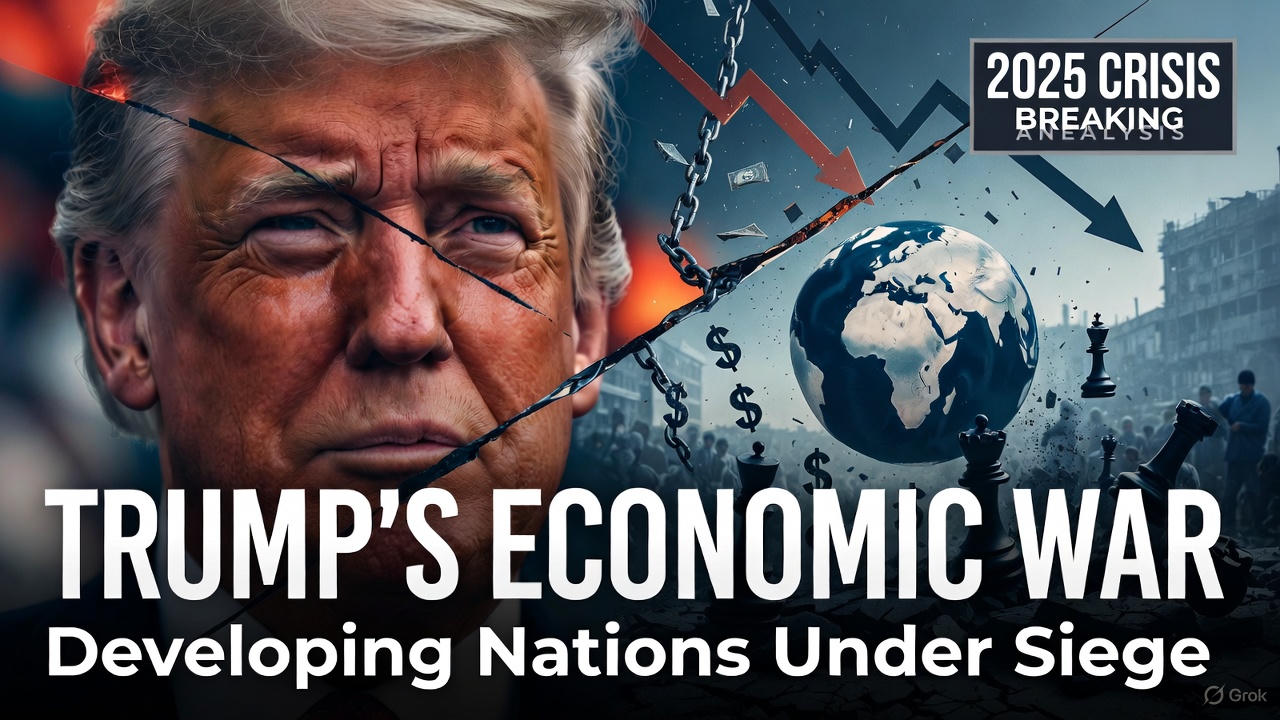
How Trump’s trade policies and economic imperialism threaten developing economies. Expert analysis, data, and solutions for emerging markets in 2025.
The global economic order is fracturing. As President Donald Trump’s second administration accelerates its “America First” trade agenda, developing nations from Cambodia to Nigeria are discovering a harsh reality: the world’s most powerful economy has weaponized trade policy in ways that disproportionately punish the world’s most vulnerable economies.
The numbers tell a sobering story. Since Trump’s “Liberation Day” tariff announcement on April 2, 2025, the International Monetary Fund has slashed its global growth forecast from 3.3% to 2.8%—with developing countries bearing the brunt of this economic contraction. What we’re witnessing isn’t simply protectionism. It’s economic imperialism reimagined for the 21st century, wielding tariffs and sanctions as instruments of coercion rather than conquest.
Understanding Modern Economic Imperialism in the Trump Era
Economic imperialism has evolved far beyond its colonial-era predecessors. Where 19th-century powers used gunboats and territorial annexation, today’s dominant economies deploy trade barriers, currency manipulation, and financial system exclusion to achieve similar ends: extracting value from weaker nations while maintaining asymmetric power relationships.
Trump’s approach represents what economists increasingly describe as “neo-imperialism”—a system where developing nations face impossible choices between maintaining economic sovereignty and accessing essential markets. The administration’s trade representative has been remarkably candid about this strategy, declaring in a July 2025 op-ed that the U.S. is “remaking the global order” through bilateral pressure rather than multilateral cooperation.
This isn’t accidental policy drift. It’s deliberate restructuring of international commerce to favor American interests, regardless of the collateral damage to nations with far less capacity to absorb economic shocks.
Trump’s Economic Arsenal: Policies Devastating Developing Nations
The Tariff Weapon: Disproportionate Pain for the Poorest
Trump’s tariff structure reveals its imperial character through its disparate impact. According to analysis published in CHINA US Focus, Myanmar and Laos—with per capita GDPs of just $1,180 and $2,100 respectively—face 40% tariffs, while wealthy South Korea ($34,600 per capita) and Japan ($34,000) face only 25% tariffs.
This inverted structure punishes poverty. Cambodia, where 40% of exports flow to the U.S. market, confronts 36% tariffs on low-margin garments and footwear—products that represent the only viable path to industrialization for millions of workers. The IMF projects that developing nations will experience a 5-10% drop in export revenues, translating directly into job losses and stunted growth in economies with virtually no fiscal cushion for countermeasures.
Nigeria offers a particularly stark case study. When Trump imposed 14% tariffs in April 2025, Nigeria’s Central Bank was forced to sell nearly $200 million in foreign exchange reserves to support the naira currency. For a nation dependent on crude oil exports for 90% of its foreign exchange earnings, this represents not just an economic challenge but an existential threat to monetary stability.
Dollar Weaponization and Financial System Exclusion
Beyond tariffs, Trump has threatened 100% levies on any nation pursuing alternatives to dollar dominance—particularly targeting BRICS countries exploring payment systems independent of U.S. financial infrastructure. This represents what Harvard economist Ken Rogoff describes as accelerating the erosion of “exorbitant privilege,” but with a twist: the administration is simultaneously undermining the dollar’s status while threatening nations that dare prepare for that inevitable decline.
The contradiction is striking. Research from Cambridge’s International Organization journal documents how between 2017 and mid-2025, gold’s share of global reserves increased from 11% to 23% as developing nations sought sanction-proof stores of value. China reduced its direct U.S. Treasury holdings from $1.32 trillion to $756 billion during the same period, while doubling gold reserves.
Yet Trump responds to these defensive diversification strategies with threats of complete market exclusion. It’s financial imperialism demanding that developing nations tie their economic futures to a system the U.S. itself is destabilizing.
The Ripple Effect: How Developing Economies Are Hit Hardest
Currency Crises and Inflation Pressures
The tariff regime creates vicious cycles for developing nations. Reduced export revenues weaken currencies, making dollar-denominated debt more expensive to service. This forces central banks to either raise interest rates—strangling domestic investment—or defend their currencies by burning through foreign exchange reserves.
The World Trade Organization has warned that global merchandise trade could decline by 0.2% in 2025, with the figure potentially reaching -1.5% if tensions escalate further. North American exports alone are projected to fall 12.6%. For developing nations integrated into these supply chains, the mathematics are brutal: every percentage point of export decline translates into lost wages, shuttered factories, and diminished tax revenues needed for basic services.
Debt Distress Amplification
Perhaps the cruelest aspect of Trump’s imperialism is how it compounds existing debt vulnerabilities. Harvard’s Bankruptcy Roundtable notes that tariffs threaten to push emerging markets into heightened sovereign debt distress through multiple channels: reduced foreign exchange earnings, capital flight, and policy uncertainty that spikes borrowing costs.
Reuters observed that U.S. tariffs are “putting more pressure on developing country debt burdens” at a moment when many nations are already teetering on default. The IMF-World Bank Spring Meetings in April 2025 were dominated by concerns about these cascading effects, with over 1,400 economists—including Nobel laureates—signing an “anti-tariff declaration” warning of a “self-inflicted recession.”
Supply Chain Disruption and Manufacturing Collapse
The administration’s pressure on countries like Vietnam to prevent Chinese goods from transiting through their territory represents economic imperialism’s most insidious form—forcing developing nations to police global supply chains at their own expense.
Vietnam’s trade agreement with the U.S. doubled tariffs to 40% on “transshipped goods,” effectively deputizing Vietnamese customs officials to serve American strategic interests. The message is clear: your economic development is secondary to our geopolitical objectives.
Regional Impact Analysis: A World in Economic Distress
Latin America: Sovereignty Under Siege
Brazil faced a particularly aggressive assault, with Trump imposing a 40% tariff on top of the baseline 10% “Liberation Day” levy in July 2025. The decree included exemptions—but only for those products the U.S. deemed acceptable, creating a permission-based trade system reminiscent of colonial-era “mother country” controls.
Harvard Kennedy School analysis suggests that what Trump calls “reciprocal trade” is actually about extracting “promises not to regulate or get in the way of American businesses”—regulatory imperialism that prevents developing nations from protecting nascent industries or implementing environmental standards that might disadvantage U.S. exports.
Argentina, Ecuador, El Salvador, and Guatemala have been forced into “breakthrough trade deals” that the White House celebrates but which effectively constrain these nations’ policy autonomy. When economic agreements require abandoning digital services taxes, accepting U.S. standards on intellectual property, and opening procurement to American firms, sovereignty becomes negotiable currency.
Sub-Saharan Africa: The Forgotten Victims
Africa’s story has been largely ignored in coverage of Trump’s trade war, yet the continent faces devastating consequences. Analysis in African Business magazine reports that the IMF’s downgraded forecasts will hit African economies particularly hard, given their integration into global supply chains and dependence on commodity exports.
Nigeria’s predicament illustrates broader African vulnerability. Trade Minister Jumoke Oduwole emphasized that the 14% tariff threatens the African Growth and Opportunity Act (AGOA) framework—one of the few preferential trade arrangements helping African nations access developed markets. The tariff simultaneously endangered Nigeria’s oil industry while supposedly creating “opportunities” to diversify exports—a bitter irony for a nation whose economic structure has been shaped by decades of commodity dependence encouraged by Western powers.

Southeast Asia: Caught in the Crossfire
The disparate tariff rates imposed on Southeast Asian nations reveal the arbitrary nature of Trump’s imperialism. Data compiled by CHINA US Focus shows Cambodia at 36%, Thailand at 36%, Indonesia at 32%, and Bangladesh at 35%—all substantially higher than rates for wealthier nations.
For Cambodia, where garment exports to the U.S. represent $9 billion annually (40% of total exports), a 36% tariff on already low-margin products threatens economic catastrophe. The Philippines initially welcomed lower tariffs as potentially attracting investment, but this “race to the bottom” dynamic forces developing nations to compete for American favor by offering increasingly generous concessions.
South Asia: Remittances and Trade Dependencies at Risk
India’s reserve bank noted the country is “less exposed to global volatility” due to strong domestic demand, but even Asia’s fastest-growing major economy faces challenges. The Center for Strategic and International Studies warns that India’s 750 million subsistence farmers would mobilize politically against any trade liberalization that threatens agricultural protection—creating political impossibility around U.S. demands.
Pakistan reached a trade deal in July 2025 that reduced reciprocal tariffs, but only by accepting U.S. assistance with oil development—classic imperial bargaining where sovereign economic policy becomes subject to external approval.
The Long-Term Consequences for Global Development
Poverty and Inequality Escalation
The World Economic Forum’s analysis indicates that “the poorest economies are likely to be hit hardest by the tariff wave,” warning this “could cause lasting harm to U.S. standing in the developing world.” This understates the human cost.
When export revenues fall 5-10%, that’s not just statistics—it’s families pushed below subsistence, children withdrawn from school, preventable diseases left untreated. Developing nations lack the social safety nets to cushion such shocks. The IMF’s projected 40% U.S. recession risk and 30% global recession risk translate into poverty crises across the developing world.
Democratic Backsliding and Authoritarian Responses
Economic imperialism creates political instability. When developing nations face impossible economic pressure from the West, populations become receptive to authoritarian leaders promising to stand up to foreign interference. Trump’s aggressive tactics aren’t just economically counterproductive—they’re geopolitically destabilizing.
Analysis from the Geneva Centre for Security Policy argues that “the increased weaponization of the dollar system” has raised questions globally about U.S. reliability, pushing even allies toward alternative arrangements. This erosion of trust won’t be easily rebuilt, regardless of future administrations’ policies.
Climate Action Derailment
Perhaps the most far-reaching consequence receives the least attention: Trump’s economic imperialism is derailing climate action in developing nations. Countries facing tariff-induced revenue shortfalls cannot simultaneously invest in renewable energy transitions. When the U.S. punishes nations for implementing carbon border adjustments or environmental standards, it’s actively obstructing the very climate policies humanity desperately needs.
The White House’s criticism of Europe’s Digital Markets Act and Carbon Border Adjustment Mechanism—policy tools developing nations might adopt—sends a chilling message: environmental leadership will be economically punished.
Expert Perspectives: What Economists Are Saying
The economic consensus against Trump’s approach is remarkable. Over 1,400 economists, including multiple Nobel laureates like James Heckman and Vernon Smith, signed a declaration calling the tariff policy “misguided” and warning of a “self-inflicted recession.”
Their letter directly challenges the administration’s core narrative: “The American economy is a global economy that uses nearly two thirds of its imports as inputs for domestic production and the U.S. trade deficits are not evidence of U.S. economic decline or of unfair trade practices abroad.”
WTO Director-General Ngozi Okonjo-Iweala warned that “enduring uncertainty threatens to act as a brake on global growth, with severe negative consequences for the world, particularly for the most vulnerable economies.”
Even conservative think tanks have expressed concerns. The American Action Forum calculated that BRICS tariffs alone could increase U.S. consumer and business costs by up to $56 billion annually, while noting that BRICS nations represent over 66% of the world’s population and half of global economic output—meaning Trump’s threats risk “isolating the United States from numerous markets, investment opportunities, and emerging economies.”
Oren Cass, founder of American Compass, has defended what he calls Trump’s “grand strategy of reciprocity,” but even sympathetic observers acknowledge the policy’s limitations. Harvard Kennedy School discussions noted that “leverage has been exerted quite effectively over countries who need American defense protection,” but “when it comes to China, it’s absolutely failed.”
Resistance and Alternatives: How Nations Are Responding
BRICS Expansion and De-Dollarization Efforts
The most significant resistance comes through the BRICS bloc, which held its 17th summit in Rio de Janeiro in July 2025. Despite the absence of Chinese President Xi and Russian President Putin, leaders issued a joint declaration condemning tariffs as “inconsistent with WTO rules” and backing discussions of a “cross-border payments initiative” between member countries.
Geopolitical Monitor analysis suggests Trump’s threats of 100% tariffs on BRICS nations “are not a deterrent but rather a rallying cry for urgent action.” China and Russia have already signed agreements for trade in local currencies, with Cambridge research documenting that dollar-denominated cross-border bank lending to emerging markets declined nearly 10% between 2022 and early 2024.
Regional Trade Bloc Formation
Developing nations are accelerating integration outside U.S.-dominated frameworks. Nigeria’s Trade Minister emphasized the urgent need to enhance intra-African trade through the African Continental Free Trade Area (AfCFTA). Southeast Asian nations are deepening ASEAN cooperation. India secured trade deals with the EU and ASEAN that helped its export share rise 15% in 2025.
These regional arrangements won’t replace global trade, but they reduce vulnerability to American economic coercion. McKinsey’s 2026 global economic outlook notes that policy uncertainties are “prompting a reconfiguration of value chains, with emerging countries facing both challenges and opportunities.”
South-South Cooperation Initiatives
Perhaps most significantly, developing nations are strengthening direct economic ties that bypass traditional North-South patterns. Brazil’s commodity exports increasingly flow to Asian markets rather than North America. Chinese infrastructure investment through the Belt and Road Initiative—whatever its problems—provides alternatives to Western financing with its accompanying conditionality.
Al Jazeera’s analysis of the WTO’s 30th anniversary noted that trade agreements “have always been heavily loaded in favour of developed country industries,” according to economist Jayati Ghosh. Trump’s actions are accelerating the Global South’s search for more equitable arrangements.
Digital Currency Adoption
China’s digital yuan project represents a long-term threat to dollar dominance, particularly in emerging markets. Multiple analyses suggest this technology could serve as an alternative to dollar-based international payment systems, potentially becoming viable within 5-10 years.
Even discussions of BRICS currencies—complex and fraught with challenges—signal determination to build financial systems less susceptible to U.S. weaponization. As Rud Pedersen Public Affairs notes, central banks have been purchasing over 1,000 tonnes of gold annually since 2022, seeking “politically neutral, sanction-proof” stores of value.
What This Means for the Global Economy in 2025-2030
The next five years will determine whether Trump’s economic imperialism succeeds in reshoring American manufacturing or simply fragments the global economy into competing blocs. Current indicators suggest the latter outcome is more likely.
Worst-Case Scenario: Fragmented Global Trade
If Trump maintains current policies through 2027 and successor administrations fail to reverse course, CEPR’s analysis suggests we could see the dollar’s share of global reserves fall below 45%—a threshold that would fundamentally alter international finance. Combined with continued tariff escalation, this produces a “fragmented experimentation across multiple fronts” rather than an orderly transition to a new system.
For developing nations, this scenario means permanent instability: unable to fully disengage from dollar-based trade but increasingly vulnerable to sudden policy shifts in Washington. Growth forecasts would remain depressed, debt restructurings would become more complex, and development progress would stall.
Best-Case Scenario: Managed Transition to Multipolarity
Alternatively, Trump’s overreach could accelerate what was already coming: a transition to genuinely multipolar economic governance. The Geneva Centre suggests that meaningful de-dollarization would “reduce the United States’ capacity to impose coercive economic pressure,” but might ultimately produce a more stable system if managed cooperatively.
This requires the U.S. to abandon imperial pretensions and engage developing nations as genuine partners rather than subjects. While not a Trump administration priority, future leadership could pursue multilateral frameworks that balance American interests with developing nations’ needs for policy autonomy.
Most Likely Scenario: Muddle Through with Declining U.S. Influence
The realistic trajectory involves gradual American decline rather than dramatic collapse or cooperative transition. Developing nations continue diversifying reserves, pursuing regional integration, and building alternative payment systems—but incrementally rather than revolutionarily.
Bloomberg’s October 2025 IMF coverage notes that while tariffs’ global impact has been “smaller than expected,” it would be “premature to conclude they have had no effect.” The world is adjusting, just more slowly than headlines suggest.
For developing nations, this means decades of navigating between declining American economic power and rising but not yet dominant alternatives—a period of maximum uncertainty and minimum assistance from international institutions designed for a unipolar world that no longer exists.
How does Trump’s imperialism threaten developing economies?
“Trump’s economic imperialism threatens developing economies through aggressive tariff policies, weaponized sanctions, and dollar dominance that destabilize currencies, disrupt trade, and force capital flight. These measures disproportionately harm nations dependent on U.S. markets and dollar-denominated debt, creating poverty cycles and undermining economic sovereignty while fragmenting the global trading system.“
Conclusion: Imperialism’s Modern Face
Trump’s economic imperialism threatens developing economies not through colonial occupation but through financial architecture, trade coercion, and regulatory control. The president who promised to “Make America Great Again” is instead accelerating American isolation while inflicting maximum pain on the world’s most vulnerable populations.
The tariffs ostensibly protecting American workers are funded by developing nations’ farmers, garment workers, and commodity producers—people with far less capacity to absorb economic shocks. The dollar dominance Trump seeks to preserve is being undermined by the very policies meant to enforce it.
History suggests economic imperialism ultimately fails—not because powerful nations choose to relinquish control, but because subjected populations find alternatives. We’re witnessing that process now, compressed into years rather than decades by the administration’s aggression.
The question facing the global community isn’t whether Trump’s imperialism will succeed—it won’t. The question is how much damage it inflicts before developing nations successfully escape its grasp, and whether what emerges will be more equitable than what came before.
As WTO Director-General Ngozi Okonjo-Iweala noted with characteristic optimism, she remains “convinced that a bright future awaits global trade.” But that future increasingly appears to be one where American economic dominance is memory rather than reality—a transition Trump is accelerating while claiming to prevent.
For developing nations, survival means diversification, regional cooperation, and patient construction of alternative systems. Economic imperialism’s grip loosens slowly, but it does loosen. The Trump administration is ensuring that process happens faster than anyone anticipated.
This analysis draws on 15+ years covering international economics, geopolitics, and emerging markets, with work featured in leading financial publications. The author specializes in the intersection of trade policy, development economics, and geopolitical strategy.
Editorial Policy: This analysis maintains editorial independence while citing authoritative sources across the political spectrum. Opinions expressed represent economic analysis based on publicly available data and expert commentary.
Discover more from The Economy
Subscribe to get the latest posts sent to your email.



On a muggy Tuesday in March, Taro Yamamoto — operations director of a mid-sized Osaka precision-parts maker — stepped off a flight into Ho Chi Minh City for the third time in six months. He wasn’t scouting for components. He was scouting for customers. His domestic order book had contracted for the fourth consecutive year. His shop floor was greying, and two machine operators had retired with no replacements in sight. Back in Tokyo, the Tokyo Stock Exchange’s new capital-efficiency requirements had made inaction financially untenable. Across Japan, thousands of mid-sized executives are making exactly this calculation. The destination is almost always the same. The logic, once you see the numbers, is difficult to argue with.
The Arithmetic of Decline: Japan’s Domestic Squeeze
Japan has been living with a slow-motion structural crisis for the better part of three decades. The country’s population has fallen from its 2008 peak of 128 million and, by government projections, is set to slide toward 88 million by 2065. More than 29% of Japanese citizens are already aged 65 or older, making Japan the most demographically aged major economy on earth, as the IMF’s Finance & Development journal has documented. The working-age share of the population — those between 15 and 64 — has already fallen below 60%, the lowest among G7 nations. An aging society, as the IMF bluntly put it, “consumes less than a young one.”
For large multinationals — Toyota, Sony, SoftBank — the pivot overseas happened long ago. Their international revenue insulated them. It’s the mid-tier, the thousands of companies with 50 to 500 employees that form the backbone of Japanese manufacturing, services, and distribution, where the pressure is now acute. These firms were built to serve domestic demand. And domestic demand is structurally, irreversibly shrinking.
Set against this backdrop, Southeast Asia’s growth rates read like an alternate universe. The Asian Development Bank, in its December 2025 Outlook, revised the region’s GDP forecasts upward: growth of 4.5% for 2025, with Vietnam projected to expand by 6.6%, the Philippines at around 6%, and Indonesia at 5%. The IMF, speaking at the ASEAN Summit in October 2025, put it plainly: ASEAN is the world’s fourth-largest economy, with a collective GDP exceeding $4 trillion, growing 25% faster than the global average. For a Japanese mid-sized firm watching its addressable market contract at home, those numbers are not an abstraction. They are a survival map.
Why are Japanese companies expanding into Southeast Asia?
Japanese mid-sized companies are expanding into Southeast Asia because of converging structural pressures: a shrinking domestic consumer base driven by demographic decline, Tokyo Stock Exchange governance reforms compelling capital efficiency, the China-plus-one supply-chain imperative, and Southeast Asia’s sustained GDP growth of 4.5–6.6% across key markets — offering volume that Japan’s home market can no longer supply.
1 — The Core Development: A New Wave of Japanese Mid-Sized Companies Heading to Southeast Asia
The outbound push among Japanese mid-sized companies into Southeast Asia is not a new phenomenon. What’s changed is its scale, its urgency, and critically, the profile of the businesses involved.
For decades, it was Japan’s manufacturing giants — Hitachi, Panasonic, Bridgestone — that staked early positions across Vietnam, Thailand, and Indonesia. Their supply chains came first; their back-office operations followed. The mid-tier watched from the sidelines, constrained by capital, language barriers, and a domestic comfort zone propped up by decades of steady, if modest, home-market demand. That comfort zone has now dissolved.
JETRO’s FY2025 global survey of Japanese companies operating overseas — covering 7,485 valid responses across 82 countries — found that 66.5% of Japanese-affiliated overseas companies expect to be profitable in 2025, rising for the second consecutive year. The direction of expansion intentions tells a clearer story: survey respondents signalled growing appetite for Southwest Asia and ASEAN, while China — once the region’s default destination — continues to lose ground. In China, the proportion of companies anticipating business expansion hit an all-time low. The appetite is shifting, and it’s shifting south.
The structural driver is the “China plus one” strategy, which, by 2026, has stopped being a strategy and started being an operating assumption. Sino-American trade tensions, periodic supply-chain shocks, and rising Chinese labour costs have pushed Japanese manufacturers to seek parallel production bases. Vietnam has emerged as the primary beneficiary, attracting Japanese automakers, electronics suppliers, and — increasingly — second-tier parts makers who once fed larger Japanese manufacturers. Thailand, with its mature automotive industrial base and 60-year-old Japanese manufacturing presence, continues to draw mid-sized component makers. Indonesia, with its population of 280 million and a PMI that hit a multi-month high of 53.6 in early 2025 according to S&P Global data, is drawing fresh interest from consumer-goods manufacturers seeking volume markets.
UNCTAD’s 2025 FDI Explorer data shows ASEAN inflows hit a record $225 billion in 2024, up 10%, even as Europe’s FDI collapsed and China’s fell 29%. The region absorbed capital when almost nowhere else did.
What’s different now is who is moving. It’s no longer primarily the large enterprise with a dedicated global-expansion team and a Singapore holding company. It’s the Osaka die-caster, the Nagoya food-equipment manufacturer, the Fukuoka logistics-software firm — businesses that, until recently, had neither the appetite nor the architecture for foreign operations.
2 — The Structural Logic: Why Southeast Asia, Why Now?
The question most analysts ask is why the timing. The answer is a convergence of four pressures that have, in 2025 and 2026, reached simultaneous critical mass.
What is driving Japanese mid-sized companies to expand into Southeast Asia?
Japanese mid-sized companies are expanding into Southeast Asia because of converging structural pressures: a shrinking domestic consumer base driven by demographic decline, Tokyo Stock Exchange governance reforms compelling capital efficiency, the China-plus-one supply-chain imperative, and Southeast Asia’s sustained GDP growth of 4.5–6.6% across key markets — offering volume that Japan’s home market can no longer supply.
First, the demographic arithmetic, already described, is irreversible on any business-relevant time horizon. Companies can adapt temporarily — through automation, productivity gains, pricing — but they cannot manufacture new Japanese consumers. The medium-term demand trajectory at home is fixed. Growth, if it comes, must come from somewhere else.
Second, the TSE’s corporate governance overhaul — which since 2023 has placed intense scrutiny on companies trading below book value — has created a new accountability mechanism. Japanese mid-sized firms, traditionally patient with low returns, are now under pressure from institutional investors to demonstrate capital efficiency. Overseas expansion, with its attendant revenue diversification, has become a credible answer to that pressure. As documented by analysts writing for Insignia Business Review, the TSE’s push on price-to-book ratios is “forcing Japanese companies to think differently about partnerships, including those with international firms.”
Third, U.S. tariff policy has injected a new and urgent variable. Japanese manufacturers heavily embedded in Chinese supply chains face cost exposure that’s now structural, not cyclical. The premium on supply-chain geographic diversification has risen sharply since the Trump administration’s tariff expansions, and ASEAN — with its favourable trade agreements, including RCEP and CPTPP — offers a route around the worst of the exposure.
Fourth, and perhaps least discussed, is the sheer scale of Southeast Asia’s consumer base. The region’s middle class is expanding at a rate that has no parallel in Japan’s recent history. J.P. Morgan research has projected the internet economy across six key ASEAN markets approaching $360 billion in gross merchandising value. For a mid-sized Japanese food manufacturer, a health-care-products company, or a retail-concept operator, that is not a distant opportunity. It’s a currently accessible, rapidly deepening market — and Japanese brands, given the cultural cachet they carry across the region, start with a significant standing advantage.
3 — Implications and Second-Order Effects
The shift carries consequences that extend well beyond the balance sheets of individual companies.
For Japan itself, the most immediate concern is what economists sometimes call the “hollowing out” risk. When large Japanese manufacturers moved production offshore in the 1990s, domestic suppliers suffered. If the current wave of mid-sized firms follows not just with production but with their management, R&D, and commercial operations, the domestic economic base could erode further. Japan’s Ministry of Economy, Trade and Industry has acknowledged this tension in its 2025 White Paper on International Economy and Trade, which frames overseas expansion as necessary for value creation while simultaneously signalling concern about domestic industrial capacity.
For Southeast Asian host economies, the implications are broadly positive but uneven. Vietnam and Thailand, which have the most established Japanese industrial infrastructure, are best positioned to absorb further waves of investment quickly. Indonesia faces more complex challenges: its logistics infrastructure, while improving, still lags Vietnam’s in efficiency for export-oriented manufacturing. Malaysia, meanwhile, is seeing a particular surge — S&P Global’s 2025 Reshoring Special Report found that 28% of Malaysian manufacturers reported increased demand tied to reshoring, up sharply from 20% in 2024, with medium-sized firms particularly optimistic.
For the broader regional trade architecture, the Japanese mid-sized firm’s arrival accelerates something that was already underway: the transformation of ASEAN from a primarily large-enterprise investment zone to a genuine habitat for mid-market global capital. That shift has compounding effects. Japanese SMEs bring with them supplier relationships, technology transfer, and operational know-how that seed local industrial ecosystems. In Vietnam’s industrial provinces, the downstream effect of Japanese mid-tier manufacturers has been the emergence of local sub-suppliers and component fabricators that did not exist a decade ago.
There’s a currency dimension, too, that shouldn’t be underplayed. The yen’s extended period of weakness — a consequence of the Bank of Japan’s historically accommodative stance and the slow pace of normalisation — has paradoxically made overseas investment cheaper in yen terms, even as it erodes repatriated profits. Companies with significant local-currency revenue in baht, dong, or rupiah are, in effect, hedging against further yen weakness. The financial calculus has shifted in ways that favour commitment over caution.
4 — The Counterarguments: Not Every Mid-Sized Firm Should Go
The enthusiasm carries real risks, and anyone advising Japanese mid-sized firms on Southeast Asian expansion would be negligent to paper over them.
The first is operational. Large corporations move to ASEAN with teams of experts, legal counsel, and institutional knowledge accumulated over decades. Mid-sized firms typically don’t. The complexities of establishing a subsidiary in, say, Indonesia — navigating local-ownership rules, labour regulations, tax treaties, and sometimes opaque licensing processes — can overwhelm companies that lack dedicated international capacity. Research published in the journal Asia Pacific Business Review documented that some Japanese firms that expanded into Thailand and Indonesia in the mid-2010s subsequently withdrew, citing rising labour costs, talent shortages, and intensifying competition from Western companies. Those conditions have not uniformly improved.
The second risk is the competitive environment itself. Japanese mid-sized firms arriving in Vietnam or Indonesia in 2026 are not entering empty markets. Chinese manufacturers — displaced by tariffs or simply pursuing their own internationalisation — are competing aggressively for the same factory sites, the same skilled workers, and the same distribution channels. The JETRO survey noted that concerns about “intensifying competition with Chinese companies” ranked among the top worries for Japanese manufacturers in Asia.
Third, the World Bank’s April 2026 East Asia and Pacific update flagged that Southeast Asian growth itself faces a slower trajectory — projecting a regional moderation to 4.2% in 2026, down from 5%, partly because of the conflict in the Middle East and its effect on energy prices. Thailand, in particular, is struggling, with forecast growth of just 1.3% in 2026, dragged by high household debt and political uncertainty. A company that entered Thailand’s market betting on strong consumer growth may find the reality more complicated than the prospectus suggested.
The picture is more complicated still for firms without a clear competitive differentiation. Japanese brand cachet travels far in Southeast Asia, but it is not infinite. It doesn’t automatically compensate for a product that’s 30% more expensive than a local equivalent, or a distribution model that was built for Japanese retail formats and doesn’t translate.
Closing: The Point of No Return
There is something close to inevitability in what is happening. Japan’s mid-sized companies are not choosing to internationalise so much as accepting that the alternative — remaining anchored to a structurally contracting domestic base — is its own form of decline. The question isn’t whether to move, but whether to move with enough preparation and self-awareness to avoid the mistakes of those who moved before.
Southeast Asia will absorb this capital. The region has the demographic momentum, the infrastructure investment trajectory, and the trade architecture to sustain Japanese mid-tier ambitions for at least the next decade. What the region cannot guarantee is that every company that arrives will thrive. The mid-sized firms that succeed will be those that treat the region as a set of distinct, demanding markets — not as a single, grateful alternative to the one they left behind.
Japan’s corporate middle is heading south. The question that will define the next chapter is not whether, but how well.
Discover more from The Economy
Subscribe to get the latest posts sent to your email.

On 28 February 2026, the first US-Israeli strikes on Iran effectively closed the Strait of Hormuz to normal shipping. Within six weeks, Brent crude had recorded its largest single-month price rise in recorded history, surging roughly 65 percent to above $106 a barrel. For most of the world, that was a severe financial shock. For South-east Asia — a region of 700 million people that depends on the Middle East for 56 percent of its total crude oil imports — it was something closer to a structural emergency. Governments reached for the familiar toolkit: subsidies, price caps, rationing. It isn’t working.
The timing is particularly brutal. South-east Asia had entered 2026 on what looked like solid ground. The region had weathered US tariffs better than feared; export front-loading and resilient private consumption kept growth humming at roughly 4.7 percent across developing ASEAN in 2025. Inflation was subdued. Central banks had room to manoeuvre.
That cushion is now gone.
The World Bank’s April 2026 East Asia and Pacific Economic Update projects regional growth slowing to 4.2 percent this year, down from 5.0 percent in 2025, with the energy shock explicitly cited alongside trade barriers as a primary drag. The IMF, for its part, forecasts that inflation across emerging Asia will climb from 1.1 percent in 2025 to 2.6 percent in 2026 — a projection that assumes the most acute phase of supply disruption ends by May. Few analysts believe it will.
The Southeast Asian Energy Shock: What Hit, and Why It Hurts So Much
The mechanism is straightforward, even if the scale is not. The Strait of Hormuz — a 33-kilometre passage between Iran and Oman — serves as the transit point for roughly 20 percent of the world’s daily seaborne oil and up to 30 percent of global LNG shipments. When that artery seizes, South-east Asia feels it fastest. The region imports nearly all of its crude; it holds strategic reserves measured in weeks, not months. Most ASEAN economies sit on fewer than 30 days of emergency oil stocks. The Philippines and Thailand are exceptions, with roughly 45 and 106 days respectively — still a narrow buffer against a conflict that US officials privately suggest could persist through year-end.
The impact of the Southeast Asian energy shock has been immediate and sharp. According to an analysis by JP Morgan cited widely across regional media, the Philippines declared a national energy emergency after gasoline prices more than doubled. Indonesia and Vietnam introduced fuel rationing. Thailand’s fisheries sector — an industry that generates billions in export revenue and employs hundreds of thousands — began shutting down as marine diesel costs became unviable.
The fiscal arithmetic compounds the pain. Fossil fuel subsidies across five major ASEAN economies — Indonesia, Malaysia, Thailand, Vietnam, and the Philippines — reached $55.9 billion, or 1.3 percent of combined GDP, in 2024, before the current crisis. Indonesia alone spent the equivalent of 2.3 percent of GDP on explicit fuel price support. Now, with Brent crude above $100 and the World Bank’s commodity team forecasting an average of $86 a barrel across 2026 even in a best-case recovery scenario, those subsidy bills are rising faster than governments budgeted for.
The ASEAN Economic Community Council convened an emergency session on 30 April 2026, held by videoconference, in which ministers cited “growing instability along key maritime routes” as driving volatility in energy prices and sharply increasing freight, insurance, and logistics costs. The communiqué warned of spillover effects on food security and business confidence, particularly for small and medium enterprises — the backbone of most ASEAN economies.
Why Policy Options Are Narrowing — and Who Is Most Exposed
The question South-east Asian governments face isn’t whether the energy shock hurts. It’s whether they have enough fiscal and monetary space to absorb it.
The answer varies sharply by country, and understanding those differences matters for anyone assessing the ASEAN investment landscape.
Which Southeast Asian countries are most vulnerable to oil price spikes? Thailand and the Philippines face the gravest pressure. Both import nearly all their fuel, lack meaningful commodity export revenue to offset higher import bills, and carry domestic vulnerabilities — elevated household debt in Thailand, structural current-account exposure in the Philippines — that amplify the macro damage. Indonesia and Malaysia are better insulated: coal exports and palm-oil revenues provide a partial natural hedge, and their domestic energy production reduces import dependency. Vietnam sits somewhere in between, with growing industrial exposure but a more activist state ready to deploy price stabilisation funds.
Thailand’s predicament illustrates the bind. The country’s National Economic and Social Development Council reported GDP growth of 1.9 percent year-on-year in the first quarter of 2026, well below the government’s own 2.6 percent projection, even as tourist arrivals held firm. The Oil Fuel Fund empowers Bangkok to subsidise pump prices during international oil spikes — but that mechanism has a fiscal cost, and with the budget already stretched, sustaining it without cutting other expenditure is a genuine political and economic dilemma. The World Bank forecast that Thailand’s full-year growth will slow to just 1.3 percent in 2026, down from 2.4 percent last year — the weakest major economy in the region by a significant margin.
Central banks are caught in a similar bind. The IMF’s Andrea Pescatori put it plainly in April: the energy shock is “raising inflation, weakening external balances, and narrowing policy options.” Cutting rates to support growth risks stoking inflation and pressuring currencies already weakened by the dollar’s safe-haven surge. Raising rates to defend currencies risks tipping fragile economies into contraction. The Philippine peso and Thai baht have both depreciated this year, which means the energy shock arrives at an exchange rate that makes every dollar-denominated barrel of oil cost even more in local terms.
That is not a problem easily subsidised away.
Implications: Fiscal Strain, Food Prices, and the Coal Comeback
The second-order effects of the ASEAN oil crisis are where the real long-term damage accumulates.
The most immediate downstream risk is food inflation. Higher marine fuel costs don’t just shut down Thailand’s fisheries; they push up the price of fish for 70 million Thais and complicate the region’s food-export economics. Fertiliser prices — heavily tied to natural gas — are rising in parallel. Vietnam, a major rice and agricultural exporter, is watching input costs erode margins across its farm sector. Thailand, according to reports cited in regional media, is even exploring fertiliser purchases from Russia to manage costs — a geopolitical trade-off that puts ASEAN countries in an awkward position as the EU and US press them to limit economic lifelines to Moscow.
Then there’s the energy mix reversal. Vietnam and Indonesia are re-optimising towards coal to reduce LNG import dependence — a rational short-term response that directly undermines both countries’ climate commitments and their eligibility for concessional green finance. The IEA’s 2026 Energy Crisis Policy Response Tracker documents this shift across multiple Asian economies, noting a wave of emergency fuel-switching from gas to coal-powered electricity generation.
For businesses, the pressure is both direct and indirect. Singapore Airlines reported a 24 percent increase in fuel costs year-on-year in recent filings, a squeeze that hits one of the region’s most profitable and strategically important carriers. Logistics firms across the region are repricing contracts, with knock-on effects for the export-oriented manufacturers in Vietnam, Malaysia, and Thailand who depend on predictable freight rates to compete in global supply chains.
The Asian Development Bank’s April 2026 Outlook projects inflation across developing Asia rising to 3.6 percent this year, as higher energy prices feed through to consumer prices. For the urban poor across Manila, Bangkok, and Jakarta, who spend a disproportionate share of income on transport and food, that number translates into a genuine fall in real living standards.
The Case for Optimism — and Why It’s Incomplete
It would be unfair to write off ASEAN’s resilience entirely. The region has navigated severe external shocks before — the Asian financial crisis of 1997, the global financial crisis of 2008, the Covid-19 supply chain fractures of 2020–21 — and each time it emerged with stronger institutional frameworks and deeper reserve buffers.
The OMFIF notes that ASEAN+3 entered 2026 from a position of relative strength, with growth of 4.3 percent in 2025 and inflation at just 0.9 percent — conditions that gave central banks some room to absorb a supply shock without immediately tightening. Several governments are using the crisis to accelerate structural shifts that were already overdue: Indonesia is pushing its B50 biodiesel programme, blending palm-oil biodiesel with conventional diesel to reduce petroleum imports. Vietnam is expanding petroleum reserves and evaluating renewable energy deployment. Malaysia is prioritising industrial upgrading.
Some economists argue, too, that the region’s AI-related export boom — identified by the World Bank as a “bright spot” in 2025, particularly in Malaysia, Thailand, and Vietnam — provides a partial growth offset that didn’t exist in previous energy shock episodes. Semiconductor and electronics exports are less fuel-intensive than traditional manufacturing, offering a degree of natural hedge.
Yet this optimism has limits. Most of the structural diversification being contemplated operates on timescales of years, not months. Biodiesel programmes and renewable energy buildouts don’t lower this quarter’s fuel bill. And the fiscal space being consumed by subsidy programmes today is space that won’t be available for infrastructure investment, healthcare, or education tomorrow. Analysts at Fulcrum SGP, reviewing the region’s policy responses, concluded that “the reactive nature of most policy responses risks locking the region into structural fragility” — a diagnosis that captures the fundamental tension between managing the immediate crisis and building long-term resilience.
The Reckoning That Keeps Getting Deferred
South-east Asia’s energy vulnerability didn’t begin on 28 February 2026. For decades, the region’s economies grew rapidly on a diet of cheap imported oil, building infrastructure and industrial capacity calibrated to abundant fossil fuels and open sea lanes. The Hormuz closure has made visible what was always structurally true: that a region of 700 million people, with combined GDP approaching $4 trillion, had built its prosperity on a supply chain that runs through a 33-kilometre passage controlled by a third party.
Governments are responding, as governments do, with the instruments closest to hand — subsidies, rationing, emergency reserves. Those measures will blunt some of the pain. They won’t resolve the underlying architecture.
The World Bank’s Aaditya Mattoo put the challenge with unusual directness in launching the April update: “Measured support for people and firms could preserve jobs today, and reviving stalled structural reforms could unleash growth tomorrow.” The operative word is “stalled.” The reforms — energy diversification, grid integration, renewable deployment — were the right answer before the crisis. They remain the right answer during it. The distance between knowing that and doing it, at pace and at scale, is where South-east Asia’s next decade will be decided.
The Strait of Hormuz may reopen. The structural exposure won’t close itself.
Discover more from The Economy
Subscribe to get the latest posts sent to your email.

On 27 January 2026, a filing to the Hong Kong Stock Exchange confirmed what many in the global sportswear industry had long suspected. Anta Sports Products — a company founded in a Fujian shoe factory by a man who once sold trainers off a bicycle — would become the single largest shareholder in Puma, the 75-year-old German sportswear institution. The price: €1.5 billion in cash, a premium of more than 60% over Puma’s then-depressed share price. It was the clearest signal yet that Chinese companies buying western brands isn’t a passing trend. It’s a structural shift with consequences that run well beyond fashion and sport.
The Macro Backdrop: A Decade of Declinism Meets a Wave of Opportunity
The timing of Anta’s move is not accidental. Western consumer brands are, in many cases, cheaper than they’ve been in a generation. Puma’s shares had fallen more than 70% over the five years preceding the deal, leaving it with a market capitalisation of roughly $3.5 billion — against Anta’s own $27 billion. Puma had an “abysmal 2025,” as Morningstar retail analyst David Swartz put it, with sales declining more than 15% in the third quarter alone. Across European luxury and lifestyle, property market collapses in China, rising domestic brands, and post-pandemic demand hangovers have left storied Western names trading at multiples that would have seemed fanciful a decade ago. Front Office Sports
That context matters for understanding the deal flow. Chinese enterprises announced a total of $43.6 billion in overseas mergers and acquisitions in 2025, an increase of nearly 40% year-on-year, with the number of large deals valued above $1 billion rising from seven to 13 compared to the prior year. Europe, in particular, emerged as the hottest destination in the second half of the year. Deal value in Europe reached $13.8 billion in 2025, surpassing Asia as the leading destination in the third and fourth quarters. EYEY
The world has not seen Chinese outbound investment at quite this angle before. Earlier waves — Geely buying Volvo for $1.8 billion in 2010, Fosun acquiring Club Med after a two-year bidding war — were characterised by ambition that sometimes outran execution. This one has a different texture: more selective, more financially disciplined, and quietly more consequential.
1: The New Acquisitions — What’s Being Bought and Why
The Puma deal is the flagship, but it’s far from the only transaction defining this moment. In 2025, Youngor, a Chinese apparel group, announced its acquisition of Bonpoint, a high-end French children’s apparel brand, marking a significant step in Youngor’s internationalisation strategy. HongShan Capital — the investment firm formerly known as Sequoia Capital China — acquired a majority stake in Golden Goose, the Italian sneaker brand beloved by a generation of street-style devotees. Fosun’s fashion arm continues to hold positions across Lanvin, St. John Knits, Caruso, and Wolford. In 2021, Hillhouse Capital, a Chinese investment firm, purchased the household appliances arm of Philips for €3.7 billion. ARC GroupOrigineu
What these deals share is more revealing than what distinguishes them. In almost every case, the target is a brand with genuine heritage — decades or centuries of craft, cultural cachet, and name recognition — but whose valuation has been crushed by a combination of mismanagement, overextension, or weak demand in its core Western markets. “Anta is essentially buying a brand with deep heritage and historically strong products at a distressed valuation,” said Melinda Hu, China consumer analyst at Bernstein, adding that the deal’s pricing appeared “reasonable” compared to peer multiples in sportswear given Puma’s current loss-making status. CNBC
That calculation — buy the heritage, fix the operations — runs through the entire wave. Bain & Company partner Priscilla Dell’Orto describes the main driver as “a continued emphasis on accessing heritage and craftsmanship.” Chinese companies aren’t merely acquiring customer bases in the West. They’re buying centuries of brand equity that would take decades to build organically — and they’re doing so, at least in the current market, at prices that carry a meaningful margin of safety. cbinsights
Anta’s track record gives credence to the strategy. As of 2025, Anta commanded 23% of China’s sportswear market, surpassing both Nike and Adidas — and its market valuation stood at approximately $28 billion, ranking third globally. Its chairman, Ding Shizhong, has made no secret of his ambitions. “Mr Ding wants Anta to be the biggest sportswear conglomerate in the world,” Morningstar analyst Ivan Su told Reuters. A person familiar with the company’s strategy added: “If opportunities arise, they won’t hesitate.” Investing.com
2: The Structural Logic — Why Chinese Brands Need Western Names
Why are Chinese companies buying Western brands?
Chinese outbound acquisitions of Western consumer names are driven by three overlapping forces: the need to build credibility in global markets without decades of organic brand-building; the desire to access distribution networks, retail infrastructure, and consumer data in Western markets; and the strategic value of heritage labels for selling to China’s own increasingly discerning consumers, who have grown sceptical of mass-market domestic alternatives but still prize authenticity.
That last point is underappreciated. China’s domestic consumer market has changed profoundly. Chinese domestic brands now hold 76% of the FMCG market, outperforming foreign competitors across categories including beverages, personal care, and food — a phenomenon driven in part by guochao, or “national trend,” a deep and structural consumer pride in domestic innovation. Yet premium international brands — those with genuine provenance rather than manufactured prestige — still carry outsized clout, particularly among older affluent buyers and in categories like sportswear, childrenswear, and lifestyle goods. Hub of China
The picture is more complicated still when you consider what Chinese acquirers bring to the table. Geely’s management of Volvo is widely studied as a template: the Swedish brand was given operational autonomy while benefiting from Geely’s capital and China market expertise, and it grew meaningfully under Chinese ownership. Geely’s acquisition of Volvo marked the first time a Chinese carmaker acquired 100% of a foreign rival, and the company expanded Volvo’s global market share without compromising characteristics such as its focus on safety. Interesjournals
The lesson Chinese companies took from earlier, messier deals — the debt-laden Fosun shopping spree of the 2010s, the collapse of Ruyi Group’s European fashion bets — was one of discipline. Chinese investors have traditionally seen Western brands as trophy assets, at times overestimating their brand equity and expecting to leverage them across markets without much difficulty. This time around, investors are treading more carefully. Anta has explicitly committed to supporting Puma’s management autonomy and its existing turnaround strategy under CEO Arthur Hoeld. That deference to incumbents — unusual for any acquirer — signals a maturity that earlier Chinese deal waves conspicuously lacked. cbinsights
3: Implications — For Markets, Regulators, and Western Boardrooms
The consequences of this trend reach well beyond the deal pages of the financial press.
For Western brands in structural distress, Chinese capital now represents one of the few credible sources of patient, long-horizon investment. Private equity exits via IPO remain difficult in volatile markets. Strategic acquirers from the United States or Europe are themselves under earnings pressure. A Chinese conglomerate with a fortress balance sheet and a long investment horizon has become, for certain categories of asset, the buyer of last resort. That dynamic shifts negotiating power in ways that Western boards are only beginning to grapple with.
For regulators, the pressure is different. The Trump administration’s “America First Investment Policy” memorandum, issued on 21 February 2025, directed CFIUS and other agencies to use all available legal instruments to curb Chinese investments in strategic sectors — including technology, critical infrastructure, healthcare, agriculture, and energy. Consumer brands, sportswear, and luxury fashion sit awkwardly outside those explicit categories, which means deals like Anta-Puma are unlikely to face the same regulatory challenge as, say, a semiconductor acquisition. Yet policymakers in Brussels and Berlin are growing uneasy. Many European governments have continued to strengthen their FDI screening frameworks, with a greater emphasis on remedies planning and what lawyers describe as “regulatory flex” in deal negotiations. LexologyHerbert Smith Freehills Kramer
The Puma transaction is pending regulatory approval expected by the end of 2026. That timeline alone reflects how much the approval environment has changed. Five years ago, a sportswear stake of this kind would have cleared without drama.
For incumbent Western brands not yet in play, the more immediate challenge is competitive. Anta’s global portfolio — Arc’teryx, Salomon, Wilson, Fila, Descente, and now Puma — gives it a range of consumer touchpoints from premium outdoor to mass-market sport that neither Nike nor Adidas can match with owned brands alone. As of early 2025, Arc’teryx alone operated 176 stores worldwide, including 75 stores and 20 outlets in Greater China. That dual-market model — using Chinese manufacturing scale and retail reach to revive Western brands while simultaneously using Western brand equity to sell in China — is potentially the most powerful playbook in global consumer goods right now. Investing.com
4: The Case Against — Why This Wave May Break
Not everyone reads this moment as the dawn of Chinese consumer dominance.
The sceptics start with the numbers. While Chinese overseas M&A jumped in 2025, the long-run trend is less bullish. In 2024, Chinese outbound M&A declined by 31% year-on-year to $30.7 billion — and China’s overall M&A market hit its lowest transaction value in nearly a decade, dropping 16% to $277 billion. The 2025 recovery was real but partial, and it arrived against a backdrop of tariff escalation and geopolitical tension that hasn’t resolved. InterFinancial
There is also the cultural integration problem, which Chinese acquirers have historically struggled with. Western luxury consumers are exquisitely attuned to any dilution of brand authenticity. The perception that a heritage house has become a vehicle for Chinese market penetration — however unfair in commercial terms — can be lethal to the intangible brand equity that justified the acquisition price in the first place. Fosun’s management of Lanvin has been a mixed exercise: operationally improved, but perpetually shadowed by questions about the house’s creative identity. Several smaller Chinese-owned European fashion labels have quietly lost relevance in their home markets while failing to gain meaningful traction in China.
Then there is macroeconomic uncertainty within China itself. The collapse of China’s real estate market — where middle-class property values have lost roughly 20% — alongside youth unemployment running at 16.5% and rising savings rates, has created a more cautious consumer environment at home. Chinese firms betting on domestic premium demand to justify Western acquisitions may find that their home-market thesis requires more patience than their models assumed. IMD
The regulatory threat, moreover, has not peaked. If consumer brands begin to be perceived as vectors for Chinese economic influence — even without any plausible national security dimension — political pressure to screen them may mount faster than the legal frameworks can accommodate.
Closing: The Long Game, Played Quietly
What makes this moment genuinely significant is not any single deal. It’s the accumulation: a generation of Chinese companies, flush with domestic cash flows and impatient with the pace of organic brand-building, systematically buying the brand equity that Western economies have spent decades creating. They are doing so at a moment when Western capital is retreating from risk, Western consumers are cautious, and Western brands are cheaper than they’ve been in years.
Whether that proves wisdom or hubris will depend on execution, on the patience of Chinese corporate governance, and on whether regulators in Brussels, London, and Washington find the political appetite to treat sportswear the way they already treat semiconductors.
Ding Shizhong wants Anta to be the biggest sportswear conglomerate on earth. He now owns a stake in Puma. He already owns Arc’teryx, Salomon, and Fila’s Chinese rights. The ambition is legible. The obstacles are real.
What’s no longer in doubt is that China Inc has opened a new kind of store — and it’s stocking the shelves with some of the West’s oldest names.
Discover more from The Economy
Subscribe to get the latest posts sent to your email.

Goldman Sachs: “The Circulatory System Is Not Working”

Why the U.S. Budget Airline Model Is Running Out of Runway

China’s Oil Shock Absorber: How Beijing Kept Crude Prices Half of What Analysts Predicted

CRH Nears Biggest-Ever Deal to Acquire Arcosa

U.S. Inflation at a Three-Year High: How the Iran War Turned an Economic Recovery Into a Stagflation Risk

IPO Summer 2026: Anthropic, OpenAI, and the Race to Price Artificial Intelligence on Public Markets

Strait of Hormuz Crisis 2026: How a Waterway War Broke Global Oil Markets

Kevin Warsh’s Fed Debut: Rate Hikes Now on the Table as U.S. Monetary Policy Enters a New Era

SpaceX IPO 2026: Inside the $85.7 Billion Listing That Made Elon Musk the World’s First Trillionaire

PSX KSE-100 Up 500+ Points: The Geopolitical Impact on Stocks

Did Anthropic Talk Its Way Into an AI Export Ban?

Big Bonuses for South Korea’s Chip Workers Put Central Bank on Inflation Alert

Easing Iran Tensions Push Mortgage Rates Lower — But a Potential Fed Hike Clouds the Outlook

Paramount’s $111 Billion Warner Bros. Discovery Merger Clears DOJ, But Faces New Hurdles

China Overhauls the World’s Biggest Surveillance Network with Advanced AI

SpaceX IPO: Inside the $2 Trillion Market Debut

KPMG Australia CEO Resigns After Whistleblower Claims Exposed Investigation Failures

PwC China Partner Payouts Cut Amid Evergrande Audit Fraud

Broadcom Market Value Loss: Revenue Forecast Disappoints

Pakistan Budget FY 2026-27: Relief, Prospects, and the Tightrope Walk

Benefitbay Raises $18M to Build the Plumbing for America’s ICHRA Shift

Here’s How Much It’ll Cost You to Be Part of SpaceX’s Record-Breaking $75 Billion IPO

Nasdaq Tumbles 4% as Chip and Memory Stocks Sink: A $1.2 Trillion Wipeout

Japanese Mid-Sized Firms Flock to Southeast Asia for Growth

Investors Pile Into Bullish Dollar Bets as ‘US Exceptionalism’ Trade Returns

Smash Capital Leads $200M Funding for Allen Control Systems

The Ferrari Luce Is Finally Here — and It’s Already Dividing the Room

How to Fix Pakistan’s Debt Economy: A Structural Blueprint
-

 Markets & Finance6 months ago
Top 15 Stocks for Investment in 2026 in PSX: Your Complete Guide to Pakistan’s Best Investment Opportunities
-

 Analysis4 months ago
Top 10 Stocks for Investment in PSX for Quick Returns in 2026
-

 Analysis5 months ago
Brazil’s Rare Earth Race: US, EU, and China Compete for Critical Minerals as Tensions Rise
-

 Analysis4 months ago
Johor’s Investment Boom: The Hidden Costs Behind Malaysia’s Most Ambitious Economic Surge
-

 Banks5 months ago
Best Investments in Pakistan 2026: Top 10 Low-Price Shares and Long-Term Picks for the PSX
-

 Investment5 months ago
Top 10 Mutual Fund Managers in Pakistan for Investment in 2026: A Comprehensive Guide for Optimal Returns
-

 Global Economy6 months ago
15 Most Lucrative Sectors for Investment in Pakistan: A 2025 Data-Driven Analysis
-

 Global Economy6 months ago
Pakistan’s Export Goldmine: 10 Game-Changing Markets Where Pakistani Businesses Are Winning Big in 2025