
AI
The AI Super Bubble Is Ready to Burst


The warnings are no longer coming from fringe contrarians. As of late June 2026, two of China’s most prominent hedge fund managers, the Bank for International Settlements, and a growing roster of institutional investors have reached a shared and uncomfortable conclusion: the artificial intelligence investment boom has entered the territory of an unsustainable asset bubble — and the collapse, when it comes, may be swift and severe.
Collapse Point May Not Be Far Away
Wealspring Asset, founded by Yang Dong — a manager celebrated in China for correctly calling the market top in 2007 — declared in a June 2026 investor letter seen by Bloomberg that global AI stocks have become a “super bubble” and that the “collapse point may not be far away.” The firm joins a growing chorus of voices that include another prominent Chinese hedge fund manager who issued similarly stark language to clients.
The warning arrives at a time when AI-related equities have driven extraordinary market gains. Yet the financial infrastructure underpinning that boom is attracting unprecedented scrutiny from the world’s most important monetary institutions.
The BIS Names AI Its Number One Risk
In its 2026 Annual Economic Report, published on June 28, the Bank for International Settlements named an AI capital expenditure bust as one of its top-tier threats to global financial stability — placing it alongside sovereign debt fragility and runaway inflation in a single integrated risk framework. It marked the first time the BIS elevated AI financial risk to a flagship annual publication, rather than a working paper.
The report identified two interconnected vulnerabilities. First, a concentration of AI infrastructure financing in private credit markets, where loans to AI-related companies surged from roughly $3 billion in 2010 to over $40 billion in 2025, according to BIS Bulletin No. 120. Second, a phenomenon the BIS calls “circular financing” — arrangements that blend equity stakes, debt instruments, and supplier contracts in ways that obscure actual leverage.
In these deals, chipmakers and cloud hyperscalers take equity positions in AI laboratories or neocloud providers, which in turn commit to multi-year purchases of chips or computing capacity. Data centre construction is outsourced to third parties that lease facilities back to hyperscalers on long-term contracts. Assets, the BIS warned, may be “pledged multiple times” across these overlapping structures.
“Disappointment in returns could trigger a sudden pullback in financing and turn the capex boom into a protracted investment bust, with potential knock-on effects on financial conditions,” the report stated.
The Scale of the Problem
Independent research has put harder numbers on the exposure. AI capital expenditure drove roughly 74 percent of US GDP growth in Q1 2026, based on analysis of Bureau of Economic Analysis sub-components. That degree of concentration transforms a potential AI capex reversal from a sector-level correction into a macroeconomic event.
The private credit market is showing early stress signals. Many listed Business Development Companies — publicly traded funds that lend heavily to mid-sized technology companies — are now trading 15 to 20 percent below the stated value of their underlying assets. A significant portion of loans held by these funds use payment-in-kind structures, meaning borrowers are rolling unpaid interest into growing debt balances rather than servicing it in cash. The share of PIK arrangements in private credit doubled between 2022 and 2025.
S&P Global has flagged a refinancing cliff ahead: leveraged debt owed by weaker borrowers is projected to surge from $56.6 billion in 2026 to $215 billion in 2028. If those companies cannot roll their debt, the forced asset sales could cascade through markets in ways that resemble — but may exceed — the 2008 shadow banking unwind.
A Transmission Mechanism to Sovereign Debt
The BIS report identified what makes the current configuration particularly dangerous: the same leveraged hedge funds that dominate sovereign bond markets through basis trades are deeply exposed to private AI credit. A shock to non-bank financial intermediaries could force fire sales in government bond markets, creating a feedback loop from tech sector bust to sovereign debt crisis.
Polymarket, the world’s largest prediction platform, placed the probability of the AI investment frenzy bursting before the end of 2026 at 26 percent in mid-June — a figure that has been climbing steadily. An equity crash of the scale comparable to the early 2000s dot-com unwinding would, at current valuations, erase approximately $33 trillion of value, more than the entirety of US GDP.
A Question of When, Not If
Man Group, the London-based alternative investment firm, has put the case with unusual directness. The AI boom is real, it argues, but the financial architecture supporting it is expanding faster than any credible adoption curve can justify. Every major technological revolution — railroads, electrification, fibre optics, the dot-com era — saw the technology endure while the financing cycle broke.
The recursive demand loops in today’s AI ecosystem share structural features with those prior cycles. Training costs are rising exponentially. Marginal improvements increasingly require reinforcement learning approaches that generate more tokens per query, worsening unit economics. The foundational leap that came from scraping the public internet is, by definition, not repeatable.
What remains is a market betting trillions of dollars that commercial AI applications will scale fast enough to justify the infrastructure already built — and the far larger infrastructure still being financed.
The BIS, Man Group, and Chinese hedge fund managers may hold different views on many things. On this, they agree: the bet is far from certain, and the financial system is not prepared for it to fail.
Discover more from The Economy
Subscribe to get the latest posts sent to your email.



The Bank of England has, for the first time in its 328-year history, openly questioned whether the regulatory architecture built to oversee human-run financial markets can contain the risks posed by autonomous artificial intelligence agents — and has begun circulating proposals for emergency kill switches to halt trading if those agents trigger a market meltdown.
The Sintra Warning
Speaking at the European Central Bank’s Sintra Forum on June 30, 2026, Bank of England Deputy Governor Sarah Breeden delivered remarks that have reverberated across global financial regulation. Breeden warned that agentic AI — systems capable of chaining autonomous actions without human mediation, executing trades, initiating payments, and responding to market signals in milliseconds — could “amplify volatility in stress” in ways that existing frameworks were never designed to address.
The speech, published in full by the Bank of England, described two categories of concern. First, that AI agents optimised toward similar objectives will tend to move as one — selling into the same decline, chasing the same trade — with a synchronised speed and scale that no crowd of human traders could match. The result would be sharper swings, faster, with correlation between agents acting as an accelerant rather than a stabiliser.
Second, that the rulebook itself is inadequate. Breeden said existing regulatory frameworks were not designed for autonomous agents, and that more sophisticated oversight may be needed — a notable signal from a senior Bank policymaker that the tools inherited from the era of human-run markets may not be fit for what markets are becoming.
Kill Switches and Enhanced Recovery
The measures under active consideration, reported by both Reuters and Bloomberg, include market-wide circuit breakers — mechanisms that would limit or halt trading entirely if faulty AI models produce correlated failures across multiple institutions simultaneously. The Bank is also exploring “enhanced recovery” arrangements that would allow one institution to absorb or take over the core functions of another if an AI-driven meltdown threatened systemic integrity.
The proposals are framed as options under consideration rather than settled policy. But as regulatory analysts have noted, the Bank rarely trails ideas publicly that it has no intention of pursuing.
52% of Finance Firms Already Running Agentic AI
The urgency behind Breeden’s remarks is anchored in deployment data. A Cambridge University survey cited in the speech found that 52 percent of financial services firms already use agentic AI systems. These are not experimental pilots confined to research environments. They are operational systems making consequential decisions — in payments, in trading, in risk assessment — with limited human intervention.
The Financial Stability Board issued a parallel call in June 2026 for tighter safeguards against agentic AI in financial services, reinforcing the Bank’s concerns with a cross-border institutional endorsement. The FCA’s chief executive Nikhil Rathi has separately said the regulator must shift from rule-making to stewardship as AI outpaces legislation, and has described trialling agentic AI to monitor markets in real time — effectively deploying AI to police AI.
The Systemic Risk Architecture
The core problem Breeden identified is one of emergent behaviour. Individual AI trading systems may each operate within their defined parameters. But when many systems optimise toward similar goals — minimising drawdown, maximising Sharpe ratio, reducing correlation to benchmarks — they may converge on identical behaviours at moments of stress, producing a collective response that no individual system’s risk controls anticipated.
The Next Web’s analysis of the Sintra speech noted that this is not a theoretical concern. Flash crashes driven by algorithmic convergence have already occurred in equity, bond, and foreign exchange markets. What Breeden is describing is a qualitative escalation: agents that do not merely execute strategies but chain multi-step plans, adapt to incoming information, and interact with other services — potentially including other AI agents — in real time.
The Bank has been stress-testing scenarios in which AI trading systems simultaneously execute similar strategies, according to reporting by The Telegraph. The simulations have focused on how rapidly losses could propagate and how limited the window for human intervention might be when systems are operating at machine speed.
What Comes Next
The Bank’s proposals raise hard technical and governance questions that regulators have not previously had to answer. How fast can a kill switch act relative to algorithmic execution speeds? Who has authority to trigger it? What determines the threshold? And can circuit breakers act fast enough to matter when an AI-driven cascade is already underway?
For the financial institutions now running agentic systems at scale, the Bank’s remarks have immediate practical implications. Regulators are signalling that adversarial stress testing, real-time behavioural telemetry, and clear human escalation playbooks are no longer optional features — they are the emerging baseline expectation for institutions deploying autonomous agents in market-sensitive functions.
The era of managing AI risk primarily through model validation and data governance is giving way to something harder: governing systems that can act, adapt, and interact in ways their designers did not specify and cannot fully predict.
Discover more from The Economy
Subscribe to get the latest posts sent to your email.

On June 22, 2026, the European Central Bank quietly launched the most significant test of a central bank digital currency (CBDC) for cross‑border payments. The digital euro cross‑border pilot connects the Eurosystem’s TARGET Instant Payment Settlement (TIPS) platform with the real‑time gross settlement systems of Singapore, the Philippines, and South Africa, allowing instant, final‑value transfers in central bank money across continents (ECB Press Release, June 2026). The test, which will run for six months with a select group of commercial banks and payment service providers, is designed to prove that a CBDC can slash the cost, time, and opacity of international transactions. If successful, it could mark the beginning of the end for the 50‑year‑old correspondent banking model.
How the Pilot Works
Unlike some earlier CBDC prototypes that created a parallel blockchain network, the digital euro pilot uses a hybrid model. The central bank issues digital euros on its own ledger, but end‑users—consumers and businesses—access them through regulated intermediaries like Deutsche Bank, BNP Paribas, and FinTech wallets such as N26. When a German importer pays a Singaporean supplier, the funds move from the importer’s digital euro wallet, through the ECB’s TIPS, and instantly settle on the Monetary Authority of Singapore’s ledger, where they are converted into digital Singapore dollars at the prevailing FX rate. The entire process takes under 10 seconds, compared with the two‑to‑three days typical of SWIFT‑based correspondent banking.
Crucially, the pilot employs programmable money features. Smart contracts can attach conditions to payments: for example, a trade finance transaction could automatically release funds when a shipment’s IoT sensor confirms arrival, or a royalty payment could split funds between multiple rights holders the instant a song is streamed. The ECB has partnered with the Bank for International Settlements Innovation Hub to develop these conditional payment triggers, using the DLT‑based “Project Nexus” blueprint that successfully connected India’s UPI and Singapore’s PayNow in 2024 (BIS Innovation Hub, Project Nexus Update, June 2026).
The European CBDC Timeline Accelerates
The pilot is the latest milestone in a timeline that has accelerated since 2023. After a two‑year investigation phase, the ECB’s Governing Council formally approved the development of a digital euro in October 2025, with a target launch for Eurozone residents in 2028. The cross‑border pilot was originally planned for 2027 but was moved forward after the success of the Eurosystem’s domestic wholesale DLT trials and mounting pressure from member states to provide a credible alternative to dollar‑dominated payment rails. ECB President Christine Lagarde, speaking at the ECB Forum in Sintra, said, “Our aim is not to kill private innovation but to provide a safe, public‑infrastructure backbone on which the private sector can build competitive services” (ECB Sintra Speech, June 2026).
Implications for Commercial Banks
For commercial banks, the digital euro cross‑border pilot is both an opportunity and an existential threat. On the opportunity side, banks can offer new products—real‑time, low‑cost international payment services to their retail and SME clients, reclaiming a market that FinTechs like Wise and Revolut have been eating into. They can build smart‑contract‑based trade finance solutions that reduce fraud and working capital needs. However, the pilot also exposes the vulnerability of traditional revenue streams. Correspondent banking generated an estimated $120 billion in global fee income in 2025, much of it from FX spreads, wire transfer charges, and float income. Instant, final‑value settlement at the central bank level compresses these margins dramatically. A study by Oliver Wyman estimates that a fully deployed CBDC‑based cross‑border system could reduce bank payment revenues by 30–40% (Oliver Wyman, “CBDC and the Future of Payments”).
The pilot also raises questions about the role of bank deposits. If corporate treasurers can hold digital euros directly at the central bank, they may withdraw sizeable balances from commercial banks during times of stress, increasing liquidity risk. To mitigate this, the ECB has imposed a tiered holding limit: individuals can hold up to €3,000 in digital euros, and businesses up to €500,000, with any excess automatically swept into a commercial bank account. This “waterfall” mechanism preserves banks’ deposit bases while offering the public the safety of central bank money for a basic tranche.
SWIFT’s Response and the Geopolitical Angle
SWIFT, the messaging network that has dominated cross‑border payments for decades, is not standing still. It has launched a competing initiative, SWIFT CBDC Interlink, which aims to connect existing domestic CBDCs through a standardized API layer without requiring each central bank to build bespoke bilateral links. In March 2026, SWIFT demonstrated that 28 central banks could trade tokenized assets across its platform in a simulated environment (SWIFT Press Release, March 2026. The digital euro pilot, however, is a direct challenge because it shows that central banks can bypass SWIFT entirely, settling through their own interconnected ledgers.
The geopolitical dimension is impossible to ignore. The pilot’s partners—Singapore, the Philippines, South Africa—are all countries with strong trade ties to Europe and a desire to diversify away from the dollar‑centric financial system. China’s digital yuan (e‑CNY) has been live for domestic use for several years, and the People’s Bank of China has been aggressively signing bilateral currency swap agreements to promote its use in Belt and Road trade. The digital euro, by providing a credible, rule‑of‑law‑based alternative, strengthens the Eurozone’s position in the emerging multipolar currency order.
What’s Next?
The six‑month pilot will be evaluated on transaction volume, latency, FX pricing efficiency, and compliance with anti‑money laundering rules. The ECB has confirmed that all transactions will be subject to existing KYC and sanctions screening, with wallet providers acting as the frontline compliance gatekeepers. If the pilot meets its success criteria, the ECB aims to expand it to the UK, Japan, and several African nations by mid‑2027, creating the largest cross‑border CBDC network outside China.
For the financial industry, the message is clear: the era of a few global correspondent banks intermediating the world’s payments is ending. The future is a multi‑polar network of interconnected public platforms, with programmable features that redefine “money” as a dynamic, conditional instrument. Banks that invest now in building compatible wallets, smart‑contract‑based trade products, and compliance tools will thrive; those that wait will find themselves disintermediated by central banks and agile FinTechs.
Discover more from The Economy
Subscribe to get the latest posts sent to your email.
Why the AI Revolution Is Breaking the Link Between Output and Labor Income
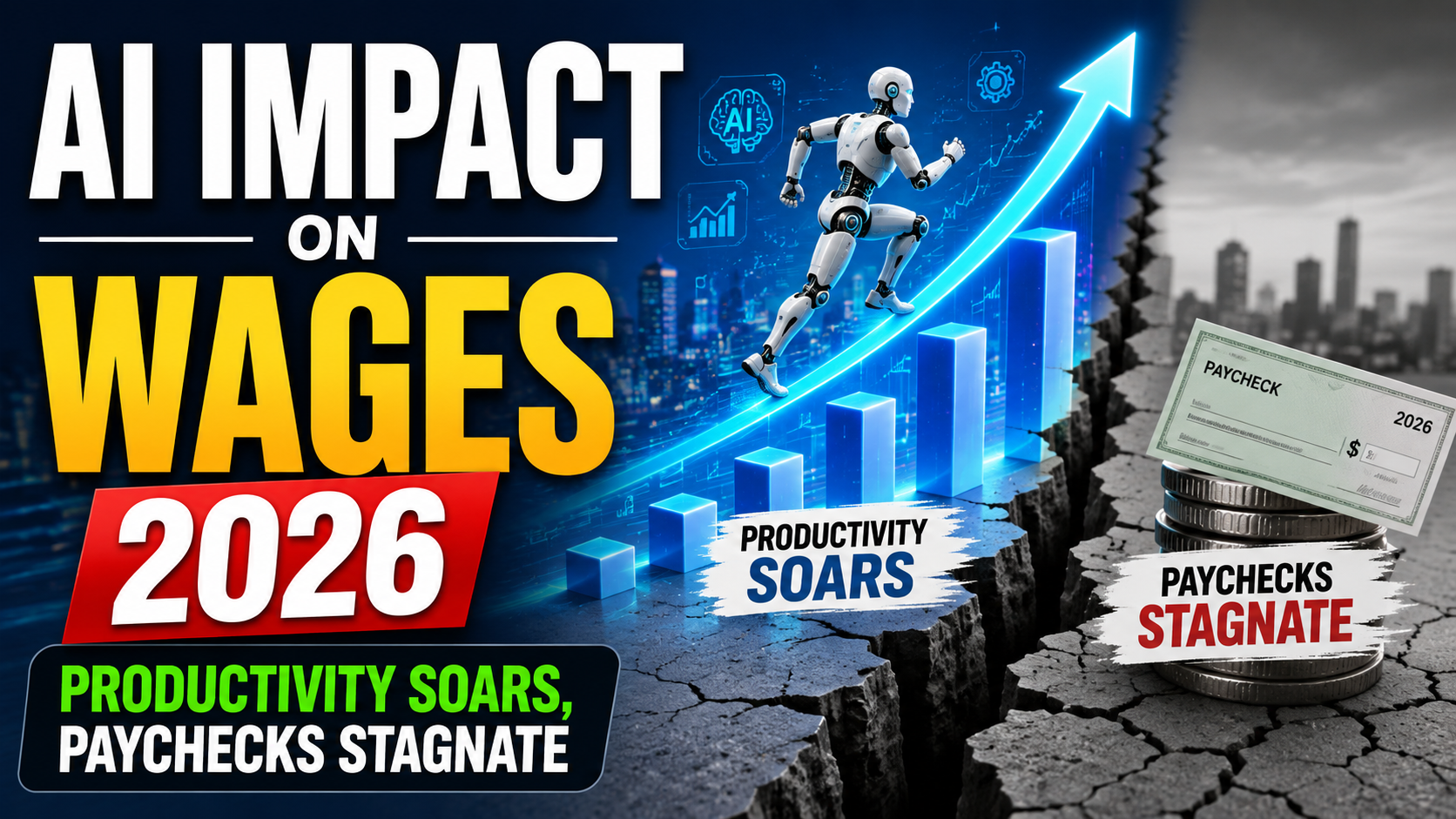
Artificial intelligence is transforming the modern workplace at a breathtaking pace. Generative AI tools are drafting legal briefs, diagnosing medical images, writing software code, and managing supply chains with superhuman efficiency. Yet a landmark report from the International Labour Organization, released on June 15, 2026, reveals a troubling disconnect: while global labor productivity has accelerated to a 3.2% annual clip, real median wages in advanced economies have risen a mere 0.8% (ILO World Employment and Social Outlook, June 2026). The AI boom, it appears, is delivering a productivity miracle that primarily rewards capital owners and the highest‑skilled technologists, leaving the typical worker behind.
The Labour Share in Freefall
The ILO’s most alarming finding is the labor share decline. The labor income share—the slice of national income that goes to workers in the form of wages, salaries, and benefits—has fallen to a historic low of 51% globally, down from 54% in 2004. The decline is sharpest in the United States and Northern Europe, where AI adoption is most advanced. In the US, the labor share has dropped to 56.5%, a level not seen since the Gilded Age. The ILO attributes 40% of this decline since 2020 to technological displacement, with AI being the primary driver.
The mechanism is subtle but powerful. AI automates cognitive routine tasks, not just physical ones. When a financial analyst’s report that once took five days can be produced by an AI in five minutes, the marginal value of that analyst’s time plummets. The analyst may keep her job, but her bargaining power for raises evaporates. Meanwhile, the firm’s profits surge because output per worker rises dramatically. The ILO found that in the top 500 AI‑adopting firms globally, operating margins expanded by an average of 4.8 percentage points between 2022 and 2026, but the wage‑to‑revenue ratio contracted by 2.3 points (McKinsey Global Institute, “The State of AI in 2026”).
Technology Unemployment 2.0
The term “technological unemployment” has moved from academic journals to mainstream policy debates. The ILO estimates that while AI will create 50 million net new jobs by 2030, it will displace or fundamentally transform 400 million roles. The occupations most exposed are those that involve information processing, pattern recognition, and language generation: paralegals, accountants, call‑center agents, radiologists, and software developers themselves. In a striking case, a major global bank announced in April 2026 that it had reduced its compliance department headcount by 35% while simultaneously cutting error rates, replacing human reviewers with a combination of natural‑language processing and robotic process automation (Financial Times).
What makes this wave different from previous automation cycles is the speed and the educational threshold. Historically, automation hit blue‑collar manufacturing; this time, it is hitting white‑collar, university‑educated professionals. A paper from the National Bureau of Economic Research circulated in May 2026 shows that for the first time, workers with a bachelor’s degree are seeing a negative return to experience in AI‑exposed roles; their earnings trajectory is flattening relative to peers in less automatable trades such as plumbing or elderly care (NBER Working Paper 31050).
The Gig Economy Entrenchment
AI is also accelerating the fissuring of the traditional employment relationship. Platforms that match freelancers with tasks, from graphic design to legal research, are increasingly using AI to manage work allocation, evaluate performance, and even set piece‑rate prices. The ILO found that 38% of the global workforce is now engaged in some form of non‑standard employment, up from 34% in 2019. While this provides flexibility, it strips away the training, benefits, and career progression that traditional employment offered. Workers in these arrangements have seen their real incomes stagnate or fall, as algorithmic management squeezes task‑by‑task compensation.
Policy Responses: From AI Taxes to Universal Basic Capital
Governments and international bodies are scrambling to rewrite the social contract. The European Parliament’s Committee on Employment is debating an AI training levy that would require firms deploying automation to contribute 1% of payroll to a reskilling fund. The idea, inspired by Singapore’s SkillsFuture credit, has drawn support from trade unions and even some tech leaders. Sam Altman’s concept of a “universal basic capital”—an ownership stake in the AI‑driven economy distributed to all citizens—has moved from concept to pilot in Finland and Kenya, where blockchain‑based digital trusts allocate shares in a portfolio of AI‑intensive public companies to citizens (World Economic Forum, “AI Governance in Practice”).
The OECD has issued new guidelines urging members to strengthen collective bargaining rights in the digital economy and to enforce antitrust laws that prevent algorithmic wage‑fixing (OECD Employment Outlook 2026). In the United States, the Federal Trade Commission has opened investigations into several large HR‑tech platforms over allegations that their “optimal wage” algorithms constitute illegal coordination among employers.
What Workers and Employers Can Do
For individuals, the advice is increasingly nuanced. The ILO recommends “AI literacy” not as a coding skill but as the ability to supervise, critique, and collaborate with AI outputs. Skills in emotional intelligence, complex negotiation, and ethical judgment are commanding a premium. Employers, on the other hand, are facing a talent paradox: they need workers who can manage AI, but if they hollow out the middle tier of employees, they lose the pipeline for future managers. Firms that invest in robust apprenticeship programs and internal mobility, such as Bosch and Siemens, are finding that they can deploy AI without triggering the toxic wage compression that hurts morale and long‑term innovation (Harvard Business Review, “The Smart Way to Automate”).
The AI productivity boom is real, but the ILO’s message is stark: without deliberate policy intervention, the link between rising output and rising living standards will remain broken. The labor share decline is not an iron law of technology; it is a consequence of institutional choices. Whether nations choose to tax, redistribute, or upskill will determine whether the 2020s are remembered as the decade of shared prosperity or of deepening divide.
Discover more from The Economy
Subscribe to get the latest posts sent to your email.

The Kill Switch: Bank of England Moves to Contain Agentic AI Before It Crashes Financial Markets

The AI Super Bubble Is Ready to Burst

Carry Trade Unwind 2026: How the Yen’s Snapback Triggered a Global Margin Call

Bitcoin $150k Milestone Achieved as US Sovereign Crypto Pivot Looms

S&P 500 7000 Target: Wall Street’s Bullish Case for Year‑End 2026

EU Greenwashing Enforcement Hits New Peak with €1.2 Billion Fast‑Fashion Fine

India Economic Rise 2026: How the Subcontinent Toppled Japan

Sovereign Debt Crisis 2026: The ‘Lost Decade’ Is Already Here for 40 Nations

Crude Oil Price Rally June 2026: OPEC+ Extends Cuts, Targets $100

China Housing Market Turnaround: White‑List Model Stabilises Prices

US Sovereign Debt Risk 2026: CBO Projects $50 Trillion, Fitch Warns

BRICS De‑Dollarization Strategy Takes Shape with $15 Billion Local‑Currency Push

Digital Euro Cross‑Border Pilot Goes Live: What It Means for Banks

AI Impact on Wages 2026: Productivity Soars, Paychecks Stagnate

PwC China Partner Payouts Cut Amid Evergrande Audit Fraud

Broadcom Market Value Loss: Revenue Forecast Disappoints

Investors Pile Into Bullish Dollar Bets as ‘US Exceptionalism’ Trade Returns

Here’s How Much It’ll Cost You to Be Part of SpaceX’s Record-Breaking $75 Billion IPO

Nasdaq Tumbles 4% as Chip and Memory Stocks Sink: A $1.2 Trillion Wipeout

Japan’s Nikkei Scales Record Peak as AI Shares Track US Chip Rally

How to Fix Pakistan’s Debt Economy: A Structural Blueprint

Smash Capital Leads $200M Funding for Allen Control Systems

Grinding the Already Ground: Pakistan’s Inflation Crisis

JPMorgan Cuts Anthropic AI Access in Hong Kong

Democrats Draw a Red Line Around Military AI — And the Pentagon Is Already Pushing Back

New Investment Super-Cycle: AI, Green Energy & Re-Shoring

Middle East Conflict Oil Prices: The $4 Surge Explained

Xponential Fitness Franchise Lawsuit: The $3.97M Judgment
-

 Markets & Finance6 months ago
Top 15 Stocks for Investment in 2026 in PSX: Your Complete Guide to Pakistan’s Best Investment Opportunities
-

 Analysis4 months ago
Top 10 Stocks for Investment in PSX for Quick Returns in 2026
-

 Analysis5 months ago
Brazil’s Rare Earth Race: US, EU, and China Compete for Critical Minerals as Tensions Rise
-

 Analysis4 months ago
Johor’s Investment Boom: The Hidden Costs Behind Malaysia’s Most Ambitious Economic Surge
-

 Banks5 months ago
Best Investments in Pakistan 2026: Top 10 Low-Price Shares and Long-Term Picks for the PSX
-

 Investment6 months ago
Top 10 Mutual Fund Managers in Pakistan for Investment in 2026: A Comprehensive Guide for Optimal Returns
-

 Global Economy6 months ago
15 Most Lucrative Sectors for Investment in Pakistan: A 2025 Data-Driven Analysis
-

 Global Economy6 months ago
Pakistan’s Export Goldmine: 10 Game-Changing Markets Where Pakistani Businesses Are Winning Big in 2025