
Analysis
Pakistan’s $3.45 Billion UAE Repayment: A Quiet Milestone in Debt Discipline or a Signal of Shifting Gulf Alliances?

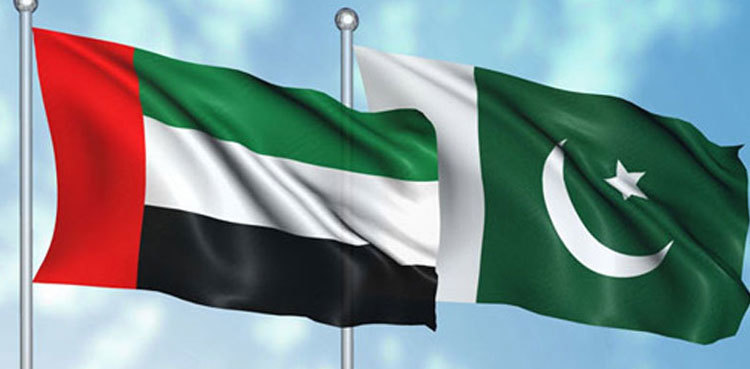
There is a particular kind of silence that follows the settlement of a long-overdue debt—not the silence of resolution, but of recalibration. When the State Bank of Pakistan quietly announced this week that it had completed the full repayment of $3.45 billion in UAE deposits—$2.45 billion transferred last week, and a final $1 billion wired to the Abu Dhabi Fund for Development on April 23—the transaction barely registered above the din of daily financial news. It deserved more scrutiny. Pakistan’s UAE repayment is not merely an accounting closure; it is a geopolitical signal, a stress test passed, and a cautionary tale compressed into a single wire transfer. Whether it marks the beginning of a more disciplined chapter in Pakistan’s external financing story—or merely the latest improvisation in a long-running drama of borrowed time—depends entirely on what Islamabad does next.
The Transaction in Context: What the Numbers Actually Mean
To understand the significance of the Pakistan UAE repayment, one must first appreciate what these deposits represented. The UAE funds were not conventional sovereign loans with rigid amortization schedules. They were bilateral support deposits—a form of quasi-balance-of-payments assistance that Gulf states have used to extend financial lifelines to Pakistan in exchange for strategic goodwill and, in this case, an interest rate of approximately 6% per annum. They had been rolled over repeatedly, functioning less like debt and more like a perennial line of diplomatic credit.
That arrangement ended. Reuters reported in late 2025 that the UAE had declined to extend further rollovers, a decision that injected considerable urgency into Pakistan’s reserve management calculus. The SBP’s foreign exchange reserves, which stood at approximately $15.1 billion as of mid-April 2026—with total liquid reserves (including commercial banks) near $20.6 billion—have been rebuilt painstakingly over the past two years from a nadir that came dangerously close to default territory in 2023.
The repayment of $3.45 billion represents roughly 22% of SBP’s current gross reserves. In isolation, that is a substantial drawdown. The critical question is: how was it financed without triggering another reserve crisis?
The answer lies in a now-familiar triangulation. Saudi Arabia provided a fresh $3 billion deposit—including recent tranches that effectively backstopped the UAE repayment. The IMF’s ongoing Extended Fund Facility (EFF), under which a disbursement of approximately $1.2 billion is expected imminently, provided additional breathing room. And Pakistan’s improved current account position—driven by remittance inflows and recovering exports—has reduced the monthly pressure on gross reserves that characterized the 2022–2023 crisis period.
Key reserve dynamics at a glance:
- SBP gross reserves (mid-April 2026): ~$15.1 billion
- Total liquid reserves: ~$20.6 billion
- UAE deposits repaid: $3.45 billion (cleared in full)
- Saudi deposit backstop: $3 billion (offsetting the drawdown)
- IMF EFF tranche (expected): ~$1.2 billion
The net reserve impact, while non-trivial, is manageable—provided the Saudi deposit holds and the IMF program stays on track. Bloomberg has noted that Pakistan’s reserve coverage of import months has improved significantly from lows below two months in early 2023 to above three months today, a threshold that marks the boundary between acute vulnerability and cautious stability.
Geopolitical Subtext: Why the UAE Said No More
The UAE’s decision not to roll over its deposits—and Pakistan’s subsequent urgency to repay—deserves deeper examination than most coverage has afforded it. This was not a routine financial decision made by a technocrat in Abu Dhabi. It was, in all probability, a deliberate recalibration of the UAE’s strategic posture toward Pakistan.
Several threads converge here. First, Abu Dhabi has grown increasingly assertive in demanding returns—economic and diplomatic—on its bilateral financial commitments. The era of unconditional Gulf patronage, rooted in Cold War-era solidarity with Muslim-majority states, has given way to a more transactional worldview under Mohammed bin Zayed’s leadership. The UAE’s sovereign wealth and development finance arms have been reoriented toward projects that generate visible economic dividends: infrastructure concessions, logistics hubs, food security corridors. A deposit earning 6% and being perpetually rolled over does not fit that framework.
Second, there are whispers—louder in Islamabad’s policy circles than in international press—that the UAE’s appetite for Pakistan exposure has been tempered by frustration over the slow progress on a previously announced $10 billion investment framework. Pakistani officials have repeatedly cited Gulf FDI commitments in press conferences; the UAE’s private posture has reportedly been more restrained, pending structural reforms that would protect investor rights and reduce bureaucratic friction.
Third, and perhaps most intriguingly, the contrasting behavior of Saudi Arabia and the UAE reflects a subtle but meaningful divergence in Gulf strategy toward South Asia. Riyadh remains deeply invested in Pakistan’s stability—economically, through the three-million-strong Pakistani diaspora that remits billions annually, and strategically, through a security relationship that predates CPEC and will outlast it. The Saudi decision to provide a fresh $3 billion deposit at a moment of Pakistani vulnerability was not charity; it was the exercise of a long-cultivated strategic option. The UAE, meanwhile, is signaling that it wants a different kind of relationship: one based on investment returns rather than deposit patronage.
For Pakistan, the implications are double-edged. The loss of UAE deposit support is a vulnerability, but the pressure it generated also forced a degree of financial discipline that years of IMF conditionality had struggled to impose. There is a perverse logic to external pressure as a reform catalyst—and Pakistan’s Pakistan UAE repayment may ultimately be remembered as the moment when bilateral goodwill stopped being a substitute for structural adjustment.
Macro Implications: Credibility Restored, Fragility Unresolved
The repayment will register positively in several dimensions that matter for Pakistan’s medium-term financial credibility.
IMF compliance and program continuity. The IMF’s EFF for Pakistan has placed significant emphasis on reserve adequacy and the reduction of “exceptional financing” dependencies—a category that bilateral deposits from Gulf states comfortably fall into. The clearance of UAE deposits, while technically a reserve drawdown, signals to the IMF’s Executive Board that Pakistan is capable of meeting obligations without emergency renegotiation. This matters enormously for the next review and for Pakistan’s credibility as a program participant. IMF staff reports have consistently flagged the risk concentration in bilateral Gulf deposits as a structural vulnerability; their elimination strengthens the external balance sheet’s quality, even if headline numbers temporarily dip.
Borrowing costs and Eurobond markets. Pakistan has been effectively shut out of international capital markets for the better part of three years. The successful repayment of Gulf deposits—without a crisis, without a default, and without a destabilizing reserve drawdown—is precisely the kind of signal that sovereign credit analysts look for when reassessing risk. Pakistan’s sovereign credit ratings, currently deep in speculative territory with a negative outlook from major agencies as recently as 2024, may receive modest upward pressure. A Eurobond issuance—tentatively discussed for late 2026 if reform momentum holds—would benefit from this restored credibility.
Interest savings. The 6% rate on UAE deposits was not punitive by global standards, but it was meaningful. Retiring $3.45 billion in 6% deposits eliminates approximately $207 million in annual interest expense—funds that can be redirected, at least in principle, toward development spending or reserve accumulation. The opportunity cost argument cuts both ways, however: Pakistan had to mobilize Saudi deposits and IMF disbursements to fund the repayment, and those arrangements carry their own conditions and costs.
The rollover trap. Perhaps the most important macro implication is conceptual. Pakistan’s repeated reliance on rollover financing—from Gulf bilaterals, from commercial banks through swap arrangements, from the IMF itself—created a sovereign balance sheet that was simultaneously over-leveraged and under-transparent. The UAE’s refusal to roll over forced Pakistan to confront the true maturity profile of its liabilities. That confrontation, painful as it was, is healthy. Emerging market economies that normalize rollover dependency tend to accumulate what economists call “hidden” short-term liabilities—debt that appears manageable until it isn’t.
Broader Lessons for Emerging Markets
Pakistan’s experience with UAE deposits contains several lessons that resonate well beyond the Indus basin.
Bilateral deposits are not reserves. For years, Pakistan included Gulf bilateral deposits in its headline reserve figures—a practice that technically complied with IMF reserve definitions but obscured the contingent nature of those funds. When the UAE declined to roll over, the “asset” evaporated. Emerging markets that rely on bilateral swap lines and deposit arrangements should distinguish carefully between genuinely usable reserves and politically contingent liquidity.
Strategic patience has a price. Gulf states have extended financial support to Pakistan for decades in exchange for labor market access, security cooperation, and diplomatic alignment. That arrangement has served both parties—but it has also insulated Pakistani policymakers from the discipline that market-based financing imposes. The UAE’s pivot toward investment-conditioned engagement is a signal that the old model is evolving. Countries that adapted early—Bangladesh with export diversification, Vietnam with FDI governance reforms—achieved financing independence faster than those who remained in the patron-client groove.
The IMF as anchor, not lifeline. Pakistan’s EFF has been criticized domestically for its austerity conditions. But the program’s most valuable contribution may be structural rather than financial: it provides a credible external commitment device that makes it harder for governments to reverse reforms. The UAE repayment was made possible, in part, because the IMF program gave international creditors confidence that Pakistan’s policy trajectory was supervised. That confidence is worth more than any single disbursement.
Forward Outlook: What Comes After the Wire Transfer
The Pakistan UAE repayment is a closing act in one chapter and an opening gambit in another. The question now is whether Islamabad can convert this moment of restored credibility into durable financial architecture.
Several developments warrant close attention in the months ahead:
- UAE investment framework reactivation. Pakistani officials have long cited a $10 billion UAE investment commitment spanning agriculture, real estate, logistics, and energy. With the deposit obligation cleared, the relationship resets to a cleaner footing. Abu Dhabi is more likely to engage on commercial investment if the precedent of perpetual deposit dependency has been broken. Negotiations over specific project structures—particularly around Karachi port logistics and solar energy concessions—should be watched as an indicator of whether the relationship has genuinely evolved.
- Reserve diversification. Pakistan’s SBP has been, by necessity, a passive manager of a thin reserve pool. As reserves stabilize above $15 billion, there is space to begin thinking about reserve composition—longer-duration instruments, modest yield enhancement—without compromising liquidity. This is a second-order consideration, but it reflects the kind of institutional maturation that transforms a country from a perpetual crisis manager into a credible emerging market.
- Structural reform momentum. The IMF’s EFF conditions include SOE privatization, energy sector circular debt reduction, and tax base broadening. Progress on these fronts will determine whether Pakistan’s improved reserve position is a durable achievement or a temporary reprieve. The history of Pakistani reform cycles—promising starts, political reversals, crises—counsels caution. But the external pressure from Gulf states, combined with IMF surveillance and a more hawkish SBP, creates a more constraining environment than Pakistan has faced in previous cycles.
- CPEC and China’s shadow. No analysis of Pakistan’s external financing is complete without acknowledging the China dimension. Chinese commercial loans and CPEC-related financing represent significant contingent liabilities that do not appear in headline bilateral deposit figures but loom large in Pakistan’s actual debt service calendar. The clearance of UAE obligations does not reduce China’s leverage; if anything, it may increase it by narrowing Pakistan’s Gulf alternative. Islamabad’s ability to maintain productive relationships with Beijing, Riyadh, Abu Dhabi, and Washington simultaneously—without being captured by any single patron—is the central foreign policy challenge of the decade.
Conclusion: The Discipline of Necessity
There is an old observation in sovereign debt circles: countries don’t reform because they want to; they reform because they must. Pakistan’s Pakistan UAE repayment fits uncomfortably but accurately into that frame. The UAE did not extend its support indefinitely, and Pakistan found a way to repay—not through transformative fiscal discipline, but through a combination of Saudi goodwill, IMF programming, and improved current account dynamics. The outcome is positive; the process was improvised.
That distinction matters. A country that repays debt because it has built the underlying capacity to do so occupies a fundamentally different position than one that repays because a Saudi backstop happened to be available at the right moment. Pakistan is, today, somewhere between those two positions—closer to sustainability than it was three years ago, but not yet at the point where its external financing story can be told without reference to the generosity of allies.
The wire transfer to Abu Dhabi is a milestone. Milestones, however, are only meaningful if they mark genuine progress on a journey that continues. The question Pakistan must now answer—more for itself than for its creditors—is whether this repayment is the beginning of financial maturity, or merely the latest successful improvisation before the next crisis finds it unprepared.
History, in this part of the world, has a long memory and a short patience. The next test is already being written.
Discover more from The Economy
Subscribe to get the latest posts sent to your email.


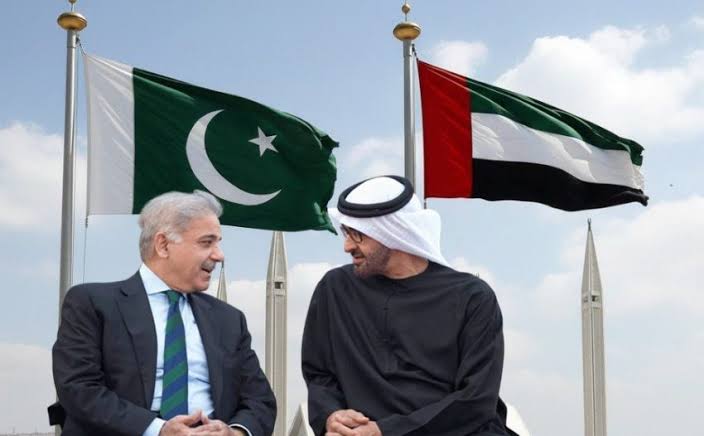
What happened: In early 2026, the United Arab Emirates declined to roll over a $3 billion loan to Pakistan — the first such refusal in seven years. The repayment equalled roughly 18% of Pakistan’s foreign currency reserves, arriving as Islamabad also faced a $1.3 billion bond payment and was waiting on the next IMF tranche.
Why it matters: It’s the clearest sign yet that Gulf sovereign patience with Pakistan’s balance-of-payments cycle is thinning, even as Gulf states simultaneously court China, Saudi Arabia, and each other for capital in a tightening regional liquidity environment.
The Story Nobody’s Connecting
Most coverage of Pakistan’s 2026 external account stress treats the UAE’s loan decision as an isolated liquidity event — a “routine financial transaction,” in the words of Pakistan’s own Ministry of Foreign Affairs. That framing misses the bigger pattern. The same weeks that Abu Dhabi called in its $3 billion, unusual delays began appearing in bank transfers from Saudi Arabia to the UAE itself — friction between the Gulf’s two largest economies, at a moment when both are also managing their own post-war oil price adjustment. (Pakistan & Gulf Economist)
Put those two data points together and a different story emerges: this isn’t just about Pakistan’s creditworthiness. It’s about Gulf capital becoming more selective, more transactional, and less willing to extend informal grace periods across the board — with Pakistan simply the most exposed borrower in the queue.
The Numbers Behind the Pressure
Pakistan’s State Bank held $16.4 billion in reserves as of late March 2026 — enough to cover roughly three months of imports, a threshold economists generally treat as a comfort floor, not a cushion. (Mettis Global News) The UAE’s declined rollover landed at the same time as a looming $1.3 billion international bond payment and dependence on the next $1.2 billion IMF disbursement — a convergence of obligations that left the State Bank with limited room to maneuver beyond import restrictions, rate hikes, or fresh commercial borrowing.
The backdrop matters too. The rupee had been trading in a comparatively narrow 278–282 band before the escalation of the Iran conflict pushed global oil prices higher, squeezing Pakistan’s import bill precisely when its Gulf safety net began to wobble. The KSE-100 benchmark, meanwhile, had already shed around 15% amid the broader pressure. (Mettis Global News)
This is not Pakistan’s first Gulf-dependency cycle. The IMF’s own record shows a now-familiar pattern: staff-level agreements reached in Dubai, UAE pledges of multibillion-dollar investment arriving alongside IMF tranches, and Gulf bridge financing used to stave off sovereign default in periods when reserves cover shrinks toward zero. (Business Standard) What’s different in 2026 is that the bridge itself is showing cracks.
Islamabad’s Official Line vs. the Structural Reality
Pakistan’s government has leaned into a “stability to sustainable growth” narrative around its FY2026–27 federal budget, with the finance minister framing the transition as export-driven rather than reserve-dependent. Business groups have broadly welcomed the budget, and the current account posted a $459 million surplus in May 2026, an improvement attributed to strong remittance inflows. (Business Recorder) The Monetary Policy Committee has held rates steady rather than reaching for emergency tightening, which is itself a signal that the central bank does not yet see the UAE episode as a systemic trigger.
But a current account surplus built substantially on remittances is different from one built on export competitiveness or durable FDI. Pakistan’s trade structure still leans heavily on a narrow set of partners: China supplies over a quarter of its imports and a meaningful share of its exports, the UAE is both a top export destination and its second-largest import source, and Gulf states collectively remain the primary channel for both remittances and emergency liquidity. (Wikipedia — Economy of Pakistan) That concentration is precisely what makes a single Gulf lender’s changed appetite so consequential.
Why the Oil Backdrop Compounds the Risk
None of this is happening in a vacuum. The IMF’s own July 2026 commentary noted that global oil markets “absorbed the war shock” from the Iran conflict, but cautioned that buffers — spare production capacity, strategic reserves, shipping insurance capacity — are running low. (IMF Blog) For an oil-importing, reserve-constrained economy like Pakistan, a second energy price shock without deeper buffers would land directly on the same reserves the UAE loan was meant to protect.
What to Watch Next
- Whether Saudi Arabia steps in as an alternative bridge lender, or whether the Riyadh–Abu Dhabi transfer friction signals a broader Gulf liquidity tightening that limits everyone’s appetite to backstop Pakistan.
- The pace and size of the next IMF tranche, and whether Fund conditionality shifts to demand deeper reserve buffers given the UAE precedent.
- Whether China increases its role as lender of last resort, deepening Pakistan’s dependency in exactly the direction Gulf financing was historically meant to offset.
Discover more from The Economy
Subscribe to get the latest posts sent to your email.
Introduction
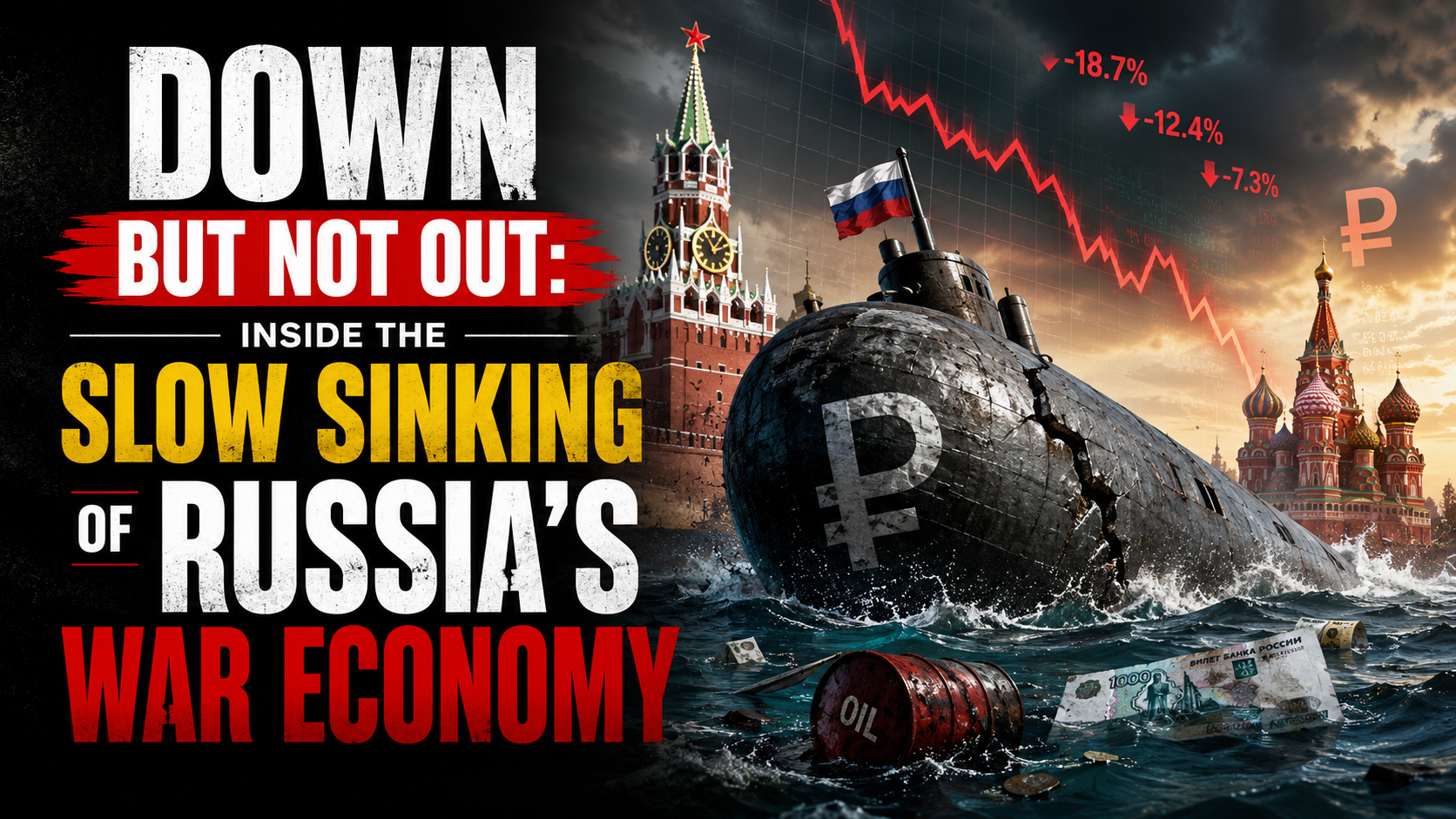
The European Council formally extended its economic sanctions against Russia for another full year on 25 June 2026, keeping restrictive measures in place until 31 July 2027 (Council of the EU). More than four years into the war, the headline story of Russia’s economy has shifted from whether sanctions would work to a more nuanced question: how much longer can the Kremlin keep financing the war before the accumulated strain becomes impossible to hide behind favorable official statistics.
The Sanctions Architecture, Renewed Again
The EU’s economic measures against Russia, first introduced in 2014 and dramatically expanded after the February 2022 full-scale invasion, now span trade, finance, energy and dual-use technology restrictions, alongside asset freezes and travel bans on a broad range of individuals and entities (Council of the EU). Since February 2022, the EU has adopted 20 separate sanctions packages, and the European Council has explicitly stated it remains determined to keep weakening Russia’s war economy by further reducing its energy revenues, curbing shadow-fleet oil shipping operations and constraining its banking system (Council of the EU). Separately, on 3 July 2026 the EU sanctioned six individuals connected to the poisoning and death of opposition figure Alexei Navalny, underscoring that the sanctions regime continues to expand on human-rights grounds as well as economic ones (Council of the EU Sanctions Timeline).
The Headline Numbers Beijing-Style Optimism Can No Longer Explain Away
Russia’s GDP is now put at roughly $2.51 trillion, the world’s eleventh-largest economy — comparable in size to South Korea despite Russia’s vastly larger landmass and resource base — with 2026 growth projected at just 1.0% and inflation running at 5.2% (Statistics of the World). More pessimistic estimates put full-year 2026 growth even lower, at around 0.4%, which would be worse than 2025’s already-weak 1% expansion and would mark a sharp deceleration from the 4.1% growth Russia posted in 2023 as it forged new trading relationships to route around initial sanctions (Forbes).
Oil and gas revenues — historically around half of Russia’s state income — have fallen to roughly a quarter, a deliberate outcome of Western sanctions strategy that targets how much Russia earns from exports rather than blocking those exports outright (Stockholm School of Economics/SITE). Russia’s oil and gas budget revenues reportedly halved in January 2026 alone, with crude prices falling below $73 a barrel before the Middle East conflict briefly reversed the trend, sending Brent surging more than 55% to near $120 a barrel at its peak (Forbes).
The Middle East War: A Temporary Lifeline With Long-Term Costs
The spike in oil prices tied to the Iran conflict, combined with a period of eased US sanctions enforcement on Russian oil under President Trump, offered Moscow unexpected fiscal breathing room in mid-2026 (Forbes). But that same conflict has undermined Russia’s longer-term energy diversification ambitions in the region: two Russian-backed power plant projects in Iran have been put on hold, along with oil and gas exploration work and plans to build new transit routes linking Russia to India via Iran (Forbes).
The Gap Between Official Statistics and Underlying Reality
Perhaps the most important analytical point from recent research is not about any single data point but about the reliability of Russian statistics themselves. Torbjörn Becker of the Stockholm Institute of Transition Economics has argued the real test of sanctions is not whether they end the war overnight, but how much they erode the Kremlin’s capacity to finance it — and by that measure, the evidence points to deeper strain than headline GDP figures suggest (Stockholm School of Economics/SITE). Becker notes that Russia’s economy grew only modestly in 2022 despite oil prices rising sharply that year — a gap between expected and actual performance that implies a considerably larger hidden economic hit than the official contraction figures showed (Stockholm School of Economics/SITE). Compounding the problem, Russian authorities have stopped publishing several key statistics since 2022, making independent assessment of inflation, consumption and real economic conditions increasingly difficult — leading Becker to conclude that “statistics have become part of the narrative” rather than a neutral measure of economic reality (Stockholm School of Economics/SITE).
The Military-Civilian Economic Split
A recurring theme across recent analysis is the growing bifurcation between Russia’s overheating military-industrial sector and a stagnating civilian economy. This imbalance has pushed interest rates higher and forced the liquidation of a striking 71% of Russia’s gold reserves to help fund continued war spending (Forbes). Russia’s total fossil fuel export revenue is estimated at roughly €734 million per day, underscoring just how central hydrocarbon income remains to the entire war financing model even as that revenue stream shrinks (Forbes).
The Counter-Narrative: Wages Still Rising
It would be inaccurate to describe Russia’s economy as in freefall. CSIS research notes that Russian salaries rose 17.8% in nominal terms and 8.7% in real terms in 2024 compared to 2023, with disposable incomes up 6.1% in 2023 and 7.3% in 2024 — growth rates not seen in Russia in almost two decades (CSIS). Government budget projections still expect real salaries to rise, albeit at a decelerating pace: 7% in 2025, 5.7% in 2026 and 4.1% in 2027 — a marked slowdown from the 2024 peak but still roughly double the pre-invasion decade average (CSIS). This wage growth, driven substantially by wartime labor shortages and military-adjacent spending, is precisely the kind of headline-stabilizing data point that has allowed Putin to argue publicly that sanctions have failed to cripple his economy (Fortune) — even as think tanks describe the broader trajectory as pushing Russia toward what one report calls an “economic, political, and military abyss” (Fortune).
What Comes Next
Renewed legislative pressure in Washington — including the Sanctioning Russia Act introduced with strong bipartisan support — signals appetite in the US for tightening the screws further, even as the loss of a key congressional champion for that effort has complicated the political path forward (TIME). Whether the EU’s renewed sanctions regime, continued oil price pressure, and constrained reserves ultimately force a shift in Kremlin calculus toward negotiation remains the central open question for 2027.
Key Takeaways
- The EU has extended Russia sanctions for a further year, through 31 July 2027, continuing a regime built from 20 separate packages since 2022.
- Russia’s 2026 GDP growth is forecast between 0.4% and 1.0%, a sharp deceleration from 2023’s 4.1% post-shock rebound.
- Oil and gas revenue’s share of Russian state income has fallen from roughly half to about a quarter as Western sanctions target export earnings specifically.
- Russia has liquidated a large share of its gold reserves to sustain war financing amid a widening split between an overheating military sector and a stagnating civilian economy.
- Official Russian statistics likely understate the true economic strain, according to independent economists who cite a widening gap between reported and expected performance.
Sources: Council of the EU, Council of the EU Sanctions Timeline, Stockholm School of Economics/SITE, Forbes, Statistics of the World, CSIS, Fortune, TIME
Discover more from The Economy
Subscribe to get the latest posts sent to your email.
Analysis
Dubai’s Millionaire Magnet: How the UAE Turned Middle East Turmoil Into a Capital Safe-Haven Boom
Introduction
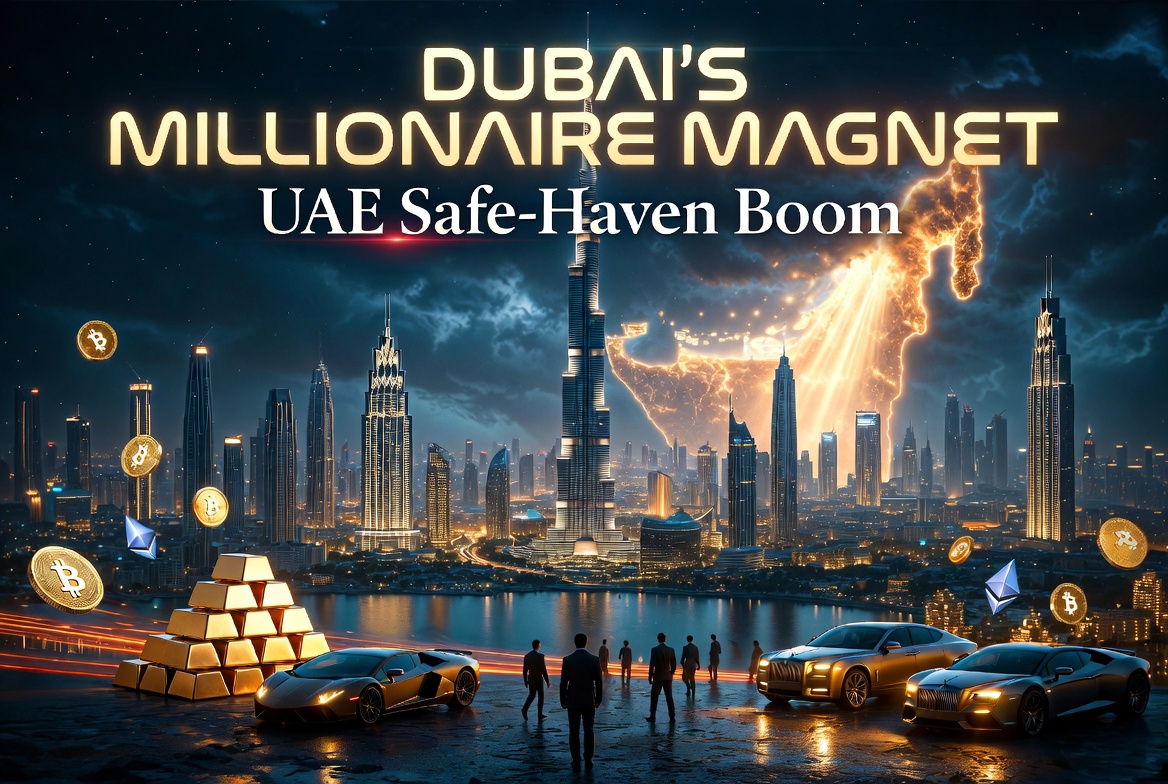
While much of the commentary on the 2026 Middle East conflict has focused on oil tankers and the Strait of Hormuz, a quieter and arguably more consequential story has been unfolding in Dubai and Abu Dhabi: capital is flowing in, not out. The UAE attracted roughly 9,800 net new millionaires in 2025 — the highest net millionaire inflow of any country globally, according to Henley & Partners — and 2026 data suggests the pattern is holding even as regional tensions have periodically spiked (Tap Fiscal). For a global content audience trying to understand why a country geographically adjacent to an active conflict zone is functioning as a safe haven rather than a risk zone, the answer lies in three decades of deliberate institutional design.
The Headline Numbers
Dubai’s economy grew 2.4% in the first quarter of 2026 alone, with GDP reaching AED 232 billion, according to figures reported via the official WAM news agency (Gateway Group UAE Weekly Business News). The UAE Central Bank’s own outlook projects national economic growth of 5.6% for 2026, outpacing the broader GCC average, with the hydrocarbon sector expected to grow 7.3% on higher oil production even as non-oil sectors — financial services, manufacturing, trade, tourism and transport — continue to carry the bulk of long-term momentum (Xinhua). Non-oil activity now accounts for roughly 75% of GDP, a diversification level that insulates the economy from oil-price shocks far more than headlines about the region typically convey (Tap Fiscal).
Why S&P and the Central Bank Both Say the UAE Can Absorb the Shock
A dedicated S&P Global Ratings assessment concluded the UAE’s banking sector has shown strong resilience and financial soundness through the recent period of regional volatility, and the agency expects solid loan growth to continue into 2027, supported by ample system liquidity amid expected monetary easing (Gulf News). S&P separately reaffirmed the UAE’s sovereign credit rating at AA/A-1+ with a stable outlook, citing strong fiscal buffers and one of the world’s largest sovereign wealth portfolios (Xinhua).
The scale of that buffer is difficult to overstate. S&P estimates the UAE’s consolidated net asset position will reach roughly 184% of GDP in 2026, with government liquid assets calculated at approximately 210% of GDP (Gulf News). That firepower sits across a small number of globally diversified institutions — the Abu Dhabi Investment Authority, Mubadala Investment Company, ADQ, the Investment Corporation of Dubai, and the Emirates Investment Authority — which generate income well beyond the oil sector and give the state fiscal flexibility that few conflict-adjacent economies possess (Gulf News).
The UAE Central Bank’s own Q1 2026 review points to the same conclusion from the market side: the Dubai Financial Market’s share price index rose 22.9% year-on-year in the fourth quarter of 2025, the Abu Dhabi Securities Market General Index gained 6.6%, and credit default swap spreads for both Abu Dhabi and Dubai narrowed further — a signal of sustained investor confidence rather than flight (Central Bank of the UAE Quarterly Economic Review).
The Short-Term Noise Was Real — But It Didn’t Stick
None of this means the conflict has been costless. In the early days of escalation, some expatriates left the UAE, private jet charter prices to exit Dubai briefly spiked to as much as $250,000, and hotel occupancy dipped alongside disrupted aviation routes (Tap Fiscal). But the institutional and long-term investor data tell a different story than the panic-driven headlines: the Dubai International Financial Centre has resumed normal operations and remains home to nearly 9,000 active firms spanning wealth management, banking and capital markets (Tap Fiscal). A UAE government minister framed the resilience explicitly, describing the economy as structurally sound and built over decades to adapt to crisis rather than be destabilized by it (Tap Fiscal).
What’s Driving the Millionaire Inflow Specifically
High-net-worth migration to the UAE is not a new phenomenon, but 2025’s record net inflow suggests the safe-haven thesis is strengthening rather than fading. The pattern is consistent with what analysts describe as a flight to stable, low-tax jurisdictions with strong rule of law during periods of global uncertainty (Tap Fiscal) — a category the UAE has spent two decades positioning itself to fit, through free zones, golden visa programs, and a deliberately diversified, sovereign-wealth-anchored economy that does not rise or fall with a single sector or a single regional headline.
Risks Worth Watching
- Banking system exposure to regional escalation: while S&P’s baseline case is resilience, further escalation involving direct disruption to Gulf shipping lanes or energy infrastructure would test the “limited and short-term” impact assumption analysts currently hold (Xinhua).
- Real estate cooling: separate reporting on new vehicle and property registrations suggests parts of the UAE’s consumer economy are cooling from exceptional prior-year growth rates, even if not contracting (Arabian Business).
- Global AI valuation correction spillover: as with other major financial centers, UAE sovereign funds carry meaningful exposure to global equity markets, including AI-related names that regulators elsewhere have flagged as a concentration risk.
Key Takeaways
- The UAE recorded the world’s highest net millionaire inflow in 2025 and Dubai’s economy grew 2.4% in Q1 2026 despite regional conflict.
- Sovereign wealth institutions (ADIA, Mubadala, ADQ, ICD) give the UAE a net asset position near 184% of GDP, its core buffer against geopolitical shocks.
- S&P has reaffirmed a stable AA/A-1+ sovereign rating, citing fiscal buffers and banking sector resilience.
- Early-conflict disruption (jet charter spikes, occupancy dips) proved short-lived; DIFC activity and equity indices have both strengthened.
- Non-oil GDP diversification, now at roughly 75%, is the structural reason the UAE decouples from pure oil-price and conflict-headline risk.
Sources: S&P/Gulf News UAE Resilience Analysis, Xinhua/UAE Central Bank, Tap Fiscal UAE Economic Outlook 2026, Central Bank of the UAE Quarterly Economic Review, March 2026, Gateway Group UAE Weekly Business News, Arabian Business
Discover more from The Economy
Subscribe to get the latest posts sent to your email.

Gulf Capital Retreat From Pakistan 2026: UAE Loan Freeze & What It Means

Pakistan’s Most Reliable Export Is Its People: Remittances Hit $41.6 Billion, Overtaking Total Exports

Indonesia’s Confidence Problem: Record Investment, a Sinking Rupiah, and a Widening Credibility Gap

Down But Not Out: Inside the Slow Sinking of Russia’s War Economy

China’s Growth Slips to a Four-Year Low: Why Beijing Still Won’t Pull the Stimulus Trigger

The Johor-Singapore Corridor: How Malaysia Became Southeast Asia’s AI Infrastructure Powerhouse

Canada’s Economy ‘On Pause’: Inside the CUSMA Deadline That Passed Without a Deal

Dubai’s Millionaire Magnet: How the UAE Turned Middle East Turmoil Into a Capital Safe-Haven Boom

Britain’s Sixth Prime Minister in a Decade: What Starmer’s Exit Means for Gilts, Sterling and Your Portfolio

Anthropic Offers Up to $600,000 Salary for Critical IPO Role as AI Giant Prepares for Wall Street Debut

EU Readies Crisis Team for Potential China Rare Earths Stand-Off as Supply Chain Risks Mount

Singapore Weighs Hedge Fund Tax Cuts to Counter Hong Kong’s Growing Financial Challenge

Facebook and Instagram Experience Global Outage

Inside the $1 Billion Tap-to-Pay Fraud Rings Targeting Banks and Retailers

Carry Trade Unwind 2026: How the Yen’s Snapback Triggered a Global Margin Call

AI Bubble Warning 2026: Why BIS, IMF and Bank of England Fear a Market Crash

BRICS De‑Dollarization Strategy Takes Shape with $15 Billion Local‑Currency Push

Male Labor Force Participation Rate 2026: Why Men Are Leaving & Economic Impact

Russia Bans Diesel Exports 2026: Global Fuel Market Impact Explained

The AI Super Bubble Is Ready to Burst

Strait of Hormuz Blockade 2026: Oil Prices Surge 9% as US-Iran Conflict Reignites

IMF Cuts Pakistan Growth Forecast, Raises Inflation to 8.4%

Private Credit Warning: Most BDCs Turn Unprofitable in 2026, Reuters Finds
Gulf Capital Retreat From Pakistan 2026: UAE Loan Freeze & What It Means

Bitcoin $150k Milestone Achieved as US Sovereign Crypto Pivot Looms

India Economic Rise 2026: How the Subcontinent Toppled Japan

Strait of Hormuz 2026: Why Markets Still Don’t Trust It’s Open

China Housing Market Turnaround: White‑List Model Stabilises Prices
-

 Markets & Finance7 months ago
Top 15 Stocks for Investment in 2026 in PSX: Your Complete Guide to Pakistan’s Best Investment Opportunities
-

 Analysis5 months ago
Johor’s Investment Boom: The Hidden Costs Behind Malaysia’s Most Ambitious Economic Surge
-

 Analysis5 months ago
Top 10 Stocks for Investment in PSX for Quick Returns in 2026
-

 Analysis6 months ago
Brazil’s Rare Earth Race: US, EU, and China Compete for Critical Minerals as Tensions Rise
-

 Banks6 months ago
Best Investments in Pakistan 2026: Top 10 Low-Price Shares and Long-Term Picks for the PSX
-

 Investment7 months ago
Top 10 Mutual Fund Managers in Pakistan for Investment in 2026: A Comprehensive Guide for Optimal Returns
-

 Global Economy7 months ago
15 Most Lucrative Sectors for Investment in Pakistan: A 2025 Data-Driven Analysis
-

 Global Economy7 months ago
Pakistan’s Export Goldmine: 10 Game-Changing Markets Where Pakistani Businesses Are Winning Big in 2025