
currency
Indonesia MSCI Downgrade Risk 2026: Why $13 Billion Still Hangs Over the Rupiah

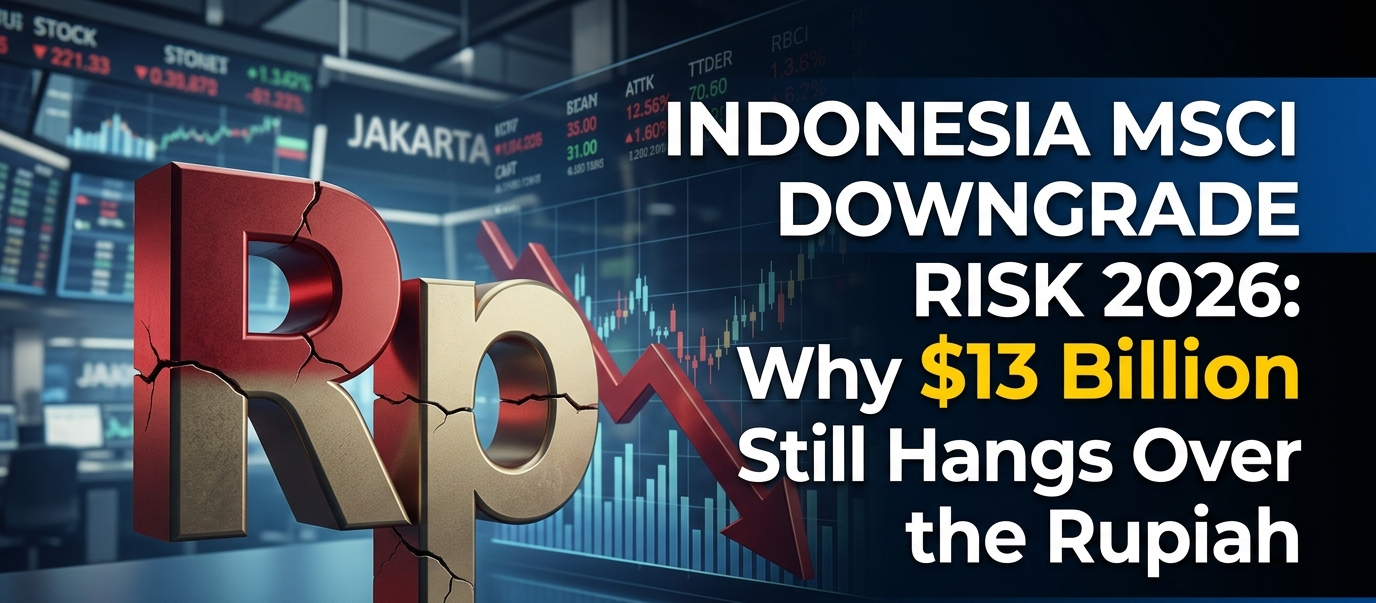
Indonesia avoided the worst-case outcome in June 2026 when MSCI declined to reclassify the country from “emerging market” to “frontier market” status, but the index provider extended its review until November and kept an active freeze on Indonesian equities — blocking a potentially significant source of structural foreign capital in the interim (Indonesia Investments).
Why This Story Deserves More Attention Than It’s Getting
Most coverage has treated the June reprieve as the end of the story. It is closer to a stay of execution. Goldman Sachs calculates that a downgrade to frontier status in November could trigger automatic selling by passive index-tracking funds worth between $2.2 billion and $13 billion, according to analysis cited by both Fortune and The Diplomat (Fortune; The Diplomat).

The Rupiah Is Already Signalling the Verdict
The rupiah fell 7.23% in the first half of 2026, ranking among Asia’s worst-performing currencies and sliding from IDR 16,670 to the dollar at the start of the year to IDR 17,875 by June 30 (Indonesia Investments). The currency has depreciated more than 14% since President Prabowo Subianto took office, and is now worth less against the dollar than during the 1997–98 Asian financial crisis, according to The Diplomat’s tracking of central bank data.
Three Compounding Shocks, Not One
The rupiah’s slide reflects at least three distinct pressures stacking on top of each other. First, the Strait of Hormuz disruption drove a $3.76 billion oil-and-gas trade deficit in May alone, ending a 72-month streak of consecutive monthly trade surpluses and pushing the current account into deficit (Indonesia Investments). Second, a corruption scandal tied to the government’s flagship Free Nutritious Meal program — including the June detention of the former National Nutrition Agency chief — has unsettled fiscal credibility. Third, MSCI’s own transparency concerns, including opaque shareholding structures and a foreign-exchange market that lacks an efficient offshore mechanism, are structural rather than cyclical, meaning they will not resolve simply because oil prices fall.
Bank Indonesia’s Blunt Instrument
Bank Indonesia delivered a surprise rate hike to 5.75% in June specifically to defend the currency, temporarily steadying the rupiah near 17,750 per dollar and easing 10-year bond yields from a near four-year high (Finimize). But as OCBC’s senior ASEAN economist Lavanya Venkateswaran notes, rate defence alone cannot substitute for the transparency reforms MSCI is demanding, and retail investors — an increasingly large share of the Jakarta stock exchange after $3.4–3.65 billion in foreign outflows this year — carry direct household balance-sheet exposure if the market falls further (Fortune).
What to Watch Before November
Fitch has already moved Indonesia’s sovereign outlook to Negative from Stable. The reforms Jakarta announced — doubling the minimum free float requirement to 15% and a leadership change at the exchange and its regulator — are the metrics that will determine the November verdict, not the headline growth rate.
Discover more from The Economy
Subscribe to get the latest posts sent to your email.



With the September 24, 2026, US-China trade truce extended rather than permanently resolved, Citibank and institutional peers are pricing dólar estadounidense forecasts around a narrow, event-driven volatility window. For cross-border businesses and remittance senders, this compressed timeline shifts the focus from a clean directional currency bet to active hedging ahead of the new Q1 2027 deadline.
Why Citibank Is a Bellwether for Dólar Estadounidense Direction
Citibank’s global markets desk remains one of the most-cited authorities in dollar-peso forecasting due to its dual footprint: a deep US retail and corporate banking presence combined with one of the most extensive correspondent-banking networks across Latin America. When Citibank’s macroeconomic strategists adjust their USD/MXN forecasts, remittance companies, importers, and forex retail platforms typically follow suit within days. Therefore, tracking Citibank’s post-summit positioning offers a highly accurate proxy for where institutional capital expects the dollar to move next.
The September 24 Trade Truce Extension: What Changed
The September 24 Trump-Xi summit at the White House did not yield the durable macroeconomic trade agreement some forex analysts had priced in. Instead, US Treasury Secretary Scott Bessent confirmed a roughly two-month extension of the existing tariff pause, which had been originally set to lapse in November 2026. Analysts at preview briefings—including China specialists at CSIS—had already flagged rare-earth export controls and AI technology restrictions as the most difficult hurdles, which proved accurate.
For currency desks, an “extension-without-resolution” sends a specific technical signal: it eliminates the tail risk of an immediate, severe trade-war escalation, but maintains the uncertainty premium that emerging market currencies have priced in since the spring. This explains the sharp, localized spike in the USD/MXN pair following the September 24 announcement, as traders unwound overly optimistic positions and re-priced for continued negotiations.
Dólar Estadounidense: Current Post-Summit Positioning
Data updated as of late September 2026.
| Metric | Current Reading / Forecast | Market Context |
| USD/MXN Spot Rate | ~17.65–17.70 pesos per dollar | Spiked from 16.95 in mid-September following the Sept 24 summit. |
| USD 12-Month Change vs. Peso | Dollar down ~2% year-over-year | Late September volatility has narrowed the dollar’s YOY deficit. |
| Citi Analyst Survey (Year-End 2026) | ~17.50 pesos per dollar | Indicates expectations of slight stabilization. |
| Monex House Forecast (2026) | ~17.80 pesos per dollar | Pricing a higher geopolitical risk premium into Q4. |
Sources: Banxico FIX rate reporting; Citi Encuesta de Expectativas survey of 37 institutions; Monex economic research.
Why the Peso Remained Historically Strong in 2026
Despite the immediate post-summit dollar spike, the peso mexicano has maintained a broader resilience through much of 2026. Three macroeconomic forces explain this dynamic:
- Persistent Carry-Trade Demand: Even with central bank adjustments, Mexico’s benchmark interest rate remains significantly higher than the US Federal Reserve’s rate. This spread keeps peso-denominated sovereign debt highly attractive to yield-seeking capital.
- Resilient Remittance and Nearshoring Flows: Despite US-China trade friction, North American supply chain integration (nearshoring) and the US-Mexico goods trade have remained robust, ensuring structural dollar inflows into Mexico.
- A Weaker Broad Dollar Trend: Tied to the broader Fed easing cycle, the dollar has occasionally softened against a basket of global currencies, limiting its ability to achieve runaway momentum against the peso.
Citibank’s Forex Playbook for the Rest of 2026
Institutional desks like Citibank are advising corporate clients to treat the current Q4 window as a critical hedging opportunity rather than a speculative directional bet. With the new truce deadline landing in the opening weeks of Q1 2027, volatility will likely cluster around that date regardless of the ultimate macroeconomic outcome.
Practical takeaways for cross-border exposure:
- Lock in Forward Contracts: Secure forex pricing before the Q1 2027 truce deadline if your business has scheduled cross-border payments in that window.
- Monitor the 10-Year Treasury Yield: Yields have acted as a more responsive, real-time indicator of trade-risk pricing this year than delayed central bank statements.
- Track the Remittance Corridor: Treat US-Mexico remittance-corridor pricing as directional context; it is one of the most liquid, closely watched proxies for broader dollar sentiment.
Q4 2026 to Q1 2027 Predictive Scenarios
| Scenario | Anticipated USD/MXN Path | Market Probability |
| Base Case: Truce holds into Q1 2027, talks continue | Peso stabilizes near the 17.40–17.70 range | Highest |
| Tail Risk: Truce collapses before the new deadline | Dollar spikes toward 18.50+ on safe-haven risk-off flows | Moderate |
| Bullish Surprise: Durable US-China deal reached | Peso strengthens back toward 16.50–16.90 | Low (Near-term) |
Frequently Asked Questions
What is the dólar estadounidense worth in pesos today?
Following the late-September 2026 summit volatility, the dollar is trading in the 17.65–17.70 peso range, up from sub-17.00 levels earlier in the month. Because forex markets fluctuate continuously, always confirm against Banxico’s FIX rate or a live institutional feed before executing a transfer.
Why does a US-China summit affect the Mexican peso?
While Mexico is not a direct party to the Xi-Trump negotiations, US-China trade tension directly impacts the broad US dollar index and global risk appetite. These macroeconomic shifts immediately spill over into every dollar-paired emerging market currency, including the highly liquid Mexican peso.
Is now a good time to send money via the US-Mexico remittance corridor?
For dollar earners sending money to Mexico, the late-September bump to ~17.67 pesos per dollar offers slightly better purchasing power than the mid-September lows. However, timing depends heavily on individual cash-flow needs rather than attempts to perfectly time geopolitical news cycles.
Discover more from The Economy
Subscribe to get the latest posts sent to your email.
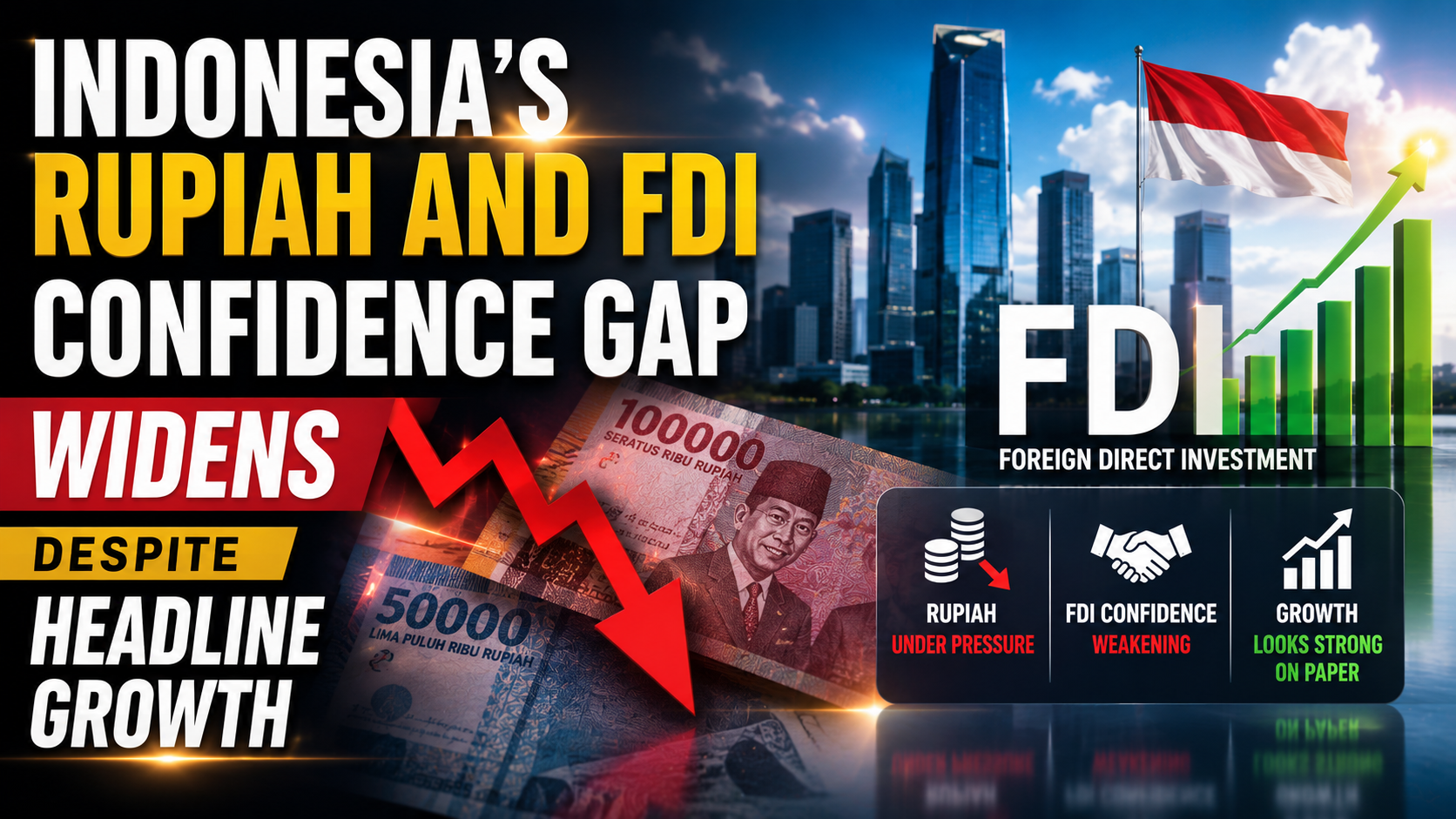
Indonesia’s official data shows resilient FDI, but independent analysts see a 26% FDI contraction and record-low rupiah levels. Here’s the real story behind the conflicting numbers.
Key Takeaways
- Indonesia’s official data (BKPM) shows Q1 2026 FDI at IDR250 trillion, up modestly and framed as FDIevidence investor confidence “remains strong.”
- Independent regional analysis from Krungsri puts the picture very differently — describing net FDI contracting 26% year-on-year in Q1 2026 amid deteriorating investor sentiment.
- The rupiah has repeatedly hit record lows despite Bank Indonesia intervention, even as GDP growth held at 5.6% in Q1 2026.
- Q2 2026 data shows a rupiah rebound tied to a reported 27.4% year-on-year FDI surge — a swing that itself illustrates how volatile the confidence signal has become.
- A 32% US tariff on key Indonesian exports, including textiles, electronics and furniture, adds a further headwind to the FDI outlook.
Indonesia’s investment story depends heavily on which data source you read. Official government messaging is unambiguously positive: per Tempo, Indonesia’s Investment Coordinating Board (BKPM) reported FDI reaching Rp250 trillion (about $15.4 billion) in Q1 2026, contributing 50.1% of total investment realization, with a BKPM spokesperson explicitly arguing that investor confidence “should not be measured solely by short-term financial market movements” and that sustained FDI growth “proves that global investors’ confidence in Indonesia remains strong.”
Independent regional analysis tells a considerably less reassuring story about the same period.
The disconnect is stark and worth stating plainly, because it’s the genuine content gap in existing coverage. Per Krungsri’s regional research, as investor sentiment continued to deteriorate through the year, net FDI actually contracted by 26% year-on-year in Q1 2026 — a figure suggesting the confidence shock had moved beyond financial markets into real investment decisions. The same analysis notes equities had fallen sharply, the rupiah had repeatedly hit record lows despite continued Bank Indonesia intervention, and government bond yields had risen as investors demanded a higher risk premium for holding Indonesian assets. Krungsri’s assessment of the underlying economy is nuanced rather than alarmist: GDP growth reached 5.6% in Q1 2026, but a closer look at the growth composition suggests much of the momentum came from fiscal stimulus and temporary factors rather than durable private investment — meaning the resilient headline growth number may not be sustainable once those supports fade.
Official BKPM data for the following quarter appears to support a more optimistic reading, though the comparison methodology differs. Per Indonesia-Investments’ coverage of BKPM’s H1 2026 report, Q2 2026 FDI realization reached IDR257.7 trillion, with total H1 investment of IDR1,010.6 trillion meeting nearly half the annual target — and, notably, Hong Kong overtook other sources to become the top FDI origin in Q2, at $5 billion, with Investment Minister Rosan Roeslani noting Chinese investment has become more aggressive via Hong Kong for the first time in a decade, partly channeled through Singapore-based subsidiaries as well.
Currency markets registered a genuinely sharp swing around this same data. Per FXStreet, the rupiah strengthened on a reported 27.4% year-over-year surge in Q2 FDI — a dramatically different trajectory from the 26% Q1 contraction Krungsri had described just weeks earlier, illustrating just how sensitive currency and confidence readings are to which quarter’s data and which source’s framing gets cited.
Structural headwinds remain layered on top of this volatility. Analysis from GBG Indonesia points to a 32% US tariff on key Indonesian exports — including textiles, electronics and furniture — set to take effect unless negotiations succeed, a risk that has itself contributed to rupiah selling pressure and reserve concerns, alongside inflation that climbed to 5.2% year-on-year in mid-2025, above Bank Indonesia’s 2-4% target range.
Why It Matters
Indonesia’s is a genuinely rare case where a country’s own official investment data and independent regional research diverge sharply on direction, not just magnitude — a distinction that matters enormously for how investors, and Indonesia’s ASEAN neighbors sizing up their own competitive position, should read the country’s underlying economic trajectory.
Data and Evidence
- BKPM Q1 2026 FDI: IDR250 trillion (~$15.4bn), 50.1% of total investment
- Krungsri’s Q1 2026 estimate: net FDI contracted 26% YoY
- Q1 2026 GDP growth: 5.6%
- Q2 2026 FDI (BKPM): IDR257.7 trillion; reported YoY growth of 27.4% per FXStreet
- Threatened US tariff on key exports: 32%
- Mid-2025 inflation: 5.2% YoY, above the 2-4% target band
Global Impact
Indonesia’s confidence volatility is a bellwether for how ASEAN’s largest economy is absorbing simultaneous pressure from US tariff threats and regional geopolitical shocks — a contrast worth reading alongside Malaysia’s (Article 10) and Singapore’s (Article 9) considerably steadier growth trajectories over the same period.
What Happens Next
Watch whether the Q2 FDI rebound BKPM reported holds up in Q3 data, whether the threatened 32% US tariff takes effect or gets negotiated down, and whether Bank Indonesia’s rupiah interventions stabilize the currency without depleting reserves.
Frequently Asked Questions
Is Indonesia’s FDI growing or shrinking?
Depends on the source and quarter — official BKPM data shows growth, while independent Q1 2026 analysis from Krungsri described a 26% year-on-year contraction; Q2 data shows a rebound.
Why has the rupiah been so volatile?
A combination of shifting FDI sentiment, Middle East-driven risk aversion, and looming US tariff threats on Indonesian exports.
What’s driving Indonesia’s resilient GDP growth despite the confidence concerns? Largely fiscal stimulus and temporary factors, according to Krungsri’s analysis, rather than durable private investment.
Which country became Indonesia’s top FDI source in Q2 2026? Hong Kong, at $5 billion, reflecting more aggressive Chinese investment channeled partly through Hong Kong and Singapore.
What tariff risk does Indonesia face? A potential 32% US tariff on textiles, electronics and furniture exports unless negotiations succeed.
Discover more from The Economy
Subscribe to get the latest posts sent to your email.
Indonesia’s economy just posted its best quarterly performance since 2023, but the central bank’s response to that strength tells a more cautious story than the headline number suggests — one with direct implications for anyone tracking capital flows into Southeast Asia’s largest economy.
The Growth Number
Indonesia’s economy expanded by 5.61 percent in the first quarter of 2026, its fastest pace in more than three years, according to McKinsey’s Southeast Asia quarterly review, boosted by a surge in government spending and strong household consumption tied to the Eid festive period. The Asian Development Bank’s July outlook has since nudged its own 2026 forecast for Indonesia higher by half a percentage point to 3 percent for the year, while separately projecting Indonesia’s growth to hold stable at 5.2 percent in both 2026 and 2027 in its base scenario — reflecting how much forecasts vary depending on the specific window and methodology used.
Why Bank Indonesia Is Playing It Safe
Despite the strong print, Bank Indonesia has kept its benchmark policy rate unchanged at 4.75 percent for a seventh consecutive meeting, prioritising rupiah stability over further easing in the face of external volatility. The central bank has explicitly signalled readiness to step up both onshore and offshore foreign exchange intervention to defend the currency and keep inflation within its 2026–2027 target range — a notably defensive posture for an economy growing at its fastest pace in years.
That caution is paying off on the capital-flow side. Foreign direct investment into Indonesia grew for a second consecutive quarter, rising 8.1 percent to 249.9 trillion rupiah, or roughly $14.5 billion, in the first quarter of 2026.
How fast is Indonesia’s economy growing in 2026?
Indonesia’s GDP grew 5.61% in Q1 2026, its fastest pace in more than three years, driven by government spending and Eid-season consumption, while Bank Indonesia held its policy rate at 4.75% to protect the rupiah amid regional currency volatility.
The Singapore Connection
Much of that capital has a specific source: Singapore. Indonesia’s Coordinating Minister for Economic Affairs, Airlangga Hartarto, confirmed that Singapore’s investment in Indonesia reached approximately $17.4 billion in 2025, calling the city-state “a reliable partner,” with investment into the Batam-Bintan-Karimun corridor specifically reaching $5.7 billion in 2025, up from the prior year. The two governments are now expanding cooperation into the digital economy and green energy, alongside a Young Farmer Development Program launched in June 2026 aimed at deepening agricultural technology ties.
The Regional Context
Indonesia’s performance sits within a broader Southeast Asian picture that is, in McKinsey’s own framing, showing “signs of softening” even as growth foundations remain broadly stable, with higher costs, currency volatility and weaker external demand weighing on households and businesses across the region. Cushman & Wakefield’s Southeast Asia Outlook similarly frames the region as expanding 4.8 percent in 2025 before slowing to a projected 4.3 percent in 2026, citing resilient domestic consumption and moderating interest rates as the main supports.
The ADB’s own assessment is blunter about the source of the regional drag: the Strait of Hormuz-linked Middle East conflict is weighing more heavily on developing Asia than previously anticipated, with higher energy costs, supply disruptions and tighter financial conditions expected to dampen growth in the months ahead even as inflation broadens and stays elevated for longer than earlier forecast.
What It Means for Investors
Indonesia’s combination of strong headline growth, disciplined currency management, and deepening Singapore-anchored capital inflows makes it one of the more structurally sound growth stories in Southeast Asia heading into the second half of 2026 — provided Bank Indonesia’s defensive rate stance succeeds in insulating the rupiah from the broader regional energy-price shock now working through the system.
Discover more from The Economy
Subscribe to get the latest posts sent to your email.

Pakistan Real Estate Tax 2026: What Buyers, Sellers and Investors Must Check

SME Finance Pakistan 2026: Why Small Businesses Still Struggle for Credit

Pakistan IMF Programme 2026: Why Bailouts Keep Returning

Agri-Tech Pakistan 2026: Where Farming Innovation Could Actually Pay

Pakistan Tax Net: Why Agriculture, Retail and Property Are So Hard to Tax

KSE-100 Index 2026: Is Pakistan’s Stock-Market Recovery Sustainable?

Pakistan IT Exports 2026: What Would It Take to Reach $10 Billion?

Pakistan AI Policy 2025: Can It Raise Productivity and Create Jobs?

Pakistan Remittances 2026: How Overseas Workers Support the Economy

Can Pakistan Reach $34 Billion in Exports? The Real Barriers and Fastest Fixes

Why Pakistan’s Inflation Is Still Near 10% Despite Economic Stabilisation

Holiday Airfare 2026: Why Flights Cost More & Fares

California Prop 40 Explained: The 2026 Billionaire Wealth Tax Ballot Measure

US–Iran Conflict in October 2026: Hormuz, Oil Prices and Diplomacy

Crude Oil & Petroleum Market Analysis: OPEC+ Decisions and Price Forecasts

World’s Largest Economies: Ranking the Top Global Powers

Pakistan Economy 2026: Inside the SBP’s Balancing Act

Asian Stock Markets 2026: Japan, China, Pakistan & More

Silver Price Today: Why the Xi-Trump AI Standoff Is Fueling a Safe-Haven Rally

SpaceX IPO 2026: History’s Biggest Stock Debut?

Oil Prices 2026: Inside the Hormuz Crisis That Won’t End

Algorithmic Dogfights: Why the U.S. and China Must Establish Rules of Engagement for Autonomous Air Power

IMF Reports 2026: What the Latest Data Means for the Global Economy

Top US Convenience Store Chains: Store Counts, EV Charging, and Sales Trends

Business Insurance: What Coverage You Actually Need and What It Costs in 2026

Who Is Shivon Zilis? The Neuralink Executive at the Center of the Musk–OpenAI Trial

Is AI a Stock Bubble in 2026? What the Data Shows

Global Economic Outlook 2026: 7 Forces Reshaping Markets, Trade and Business
-

 Markets & Finance10 months ago
Top 15 Stocks for Investment in 2026 in PSX: Your Complete Guide to Pakistan’s Best Investment Opportunities
-

 Analysis8 months ago
Johor’s Investment Boom: The Hidden Costs Behind Malaysia’s Most Ambitious Economic Surge
-

 Analysis8 months ago
Top 10 Stocks for Investment in PSX for Quick Returns in 2026
-

 Banks9 months ago
Best Investments in Pakistan 2026: Top 10 Low-Price Shares and Long-Term Picks for the PSX
-

 Analysis9 months ago
Brazil’s Rare Earth Race: US, EU, and China Compete for Critical Minerals as Tensions Rise
-

 Investment9 months ago
Top 10 Mutual Fund Managers in Pakistan for Investment in 2026: A Comprehensive Guide for Optimal Returns
-

 Global Economy10 months ago
15 Most Lucrative Sectors for Investment in Pakistan: A 2025 Data-Driven Analysis
-

 Global Economy10 months ago
Pakistan’s Export Goldmine: 10 Game-Changing Markets Where Pakistani Businesses Are Winning Big in 2025