
AI
AI Bubble Warning 2026: Why BIS, IMF and Bank of England Fear a Market Crash


Global financial regulators have moved from quiet skepticism to open warning, marking one of the most significant shifts in central-bank rhetoric since the aftermath of the 2008 crisis. The Bank for International Settlements (BIS), the International Monetary Fund (IMF), and the Bank of England have each flagged the risk that a correction in artificial-intelligence valuations could cascade through the global financial system, according to the BIS Annual Economic Report 2026 and reporting compiled by Wikipedia’s tracking of the unfolding episode.
From Confidence to Contagion Fear
The warnings did not emerge in a vacuum. In late June 2026, South Korea’s KOSPI index was forced into a trading halt after Samsung and SK Hynix shares each lost roughly 12% in a single morning, a shock that rippled into the Nasdaq, which fell 2.2% the same day. By the following week, Oracle had recorded its worst trading week since the dot-com crash, sliding 19%, after Apple raised product prices in response to soaring chip costs. The sell-off, detailed in Wikipedia’s account of the June 2026 rout, spread across global chip manufacturers before the BIS issued its formal caution on June 29.
Pablo Hernández de Cos, general manager of the BIS, framed the moment as one of “progress” colliding with “peril,” pointing to inflationary pressure, elevated public debt, and what the institution calls AI exuberance as compounding financial vulnerabilities.
Why This Cycle Looks Different — and Why It Doesn’t
Comparisons to the 1999–2000 dot-com bubble are now routine among Wall Street strategists. Deutsche Bank’s global economics team has described 2026 as resembling “1999 meets 1990,” according to Fortune’s coverage of the growing exuberance debate. JPMorgan’s chief executive Jamie Dimon has repeatedly used the phrase “irrational exuberance,” borrowed from former Fed chair Alan Greenspan, to describe dealmaking activity that he says is running “gung-ho.”
Yet analysts at Fidelity note a structural difference from 2000: hyperscalers are largely funding AI capital expenditure from earnings rather than debt, keeping the capex-to-free-cash-flow ratio below 1, compared with nearly 4 at the dot-com peak, based on Fidelity’s bubble-indicator research. That distinction matters for systemic risk, since debt-fueled busts tend to transmit further into the banking system than equity-only corrections.
The Systemic Transmission Risk
Oliver Wyman’s analysis of a potential AI-led market collapse estimates that an equity crash on the scale of the early 2000s could erase approximately $33 trillion in value — more than annual US GDP — a scenario that would compound if financing tied to data-center and digital-infrastructure debt turns out to be more opaque than banks currently report, according to Oliver Wyman’s assessment of financial-sector exposure. US equity market capitalization currently sits at close to twice GDP, a higher multiple than at the dot-com peak.
Prediction markets have already begun pricing the risk. Polymarket data cited by Tekedia shows the probability traders assign to an AI investment-frenzy collapse by the end of 2026 climbing to 26%, up sharply in recent months as valuations in chip and hyperscaler stocks stretched further.
What Regulators Are Asking Institutions to Do
The BIS is not calling for a halt to AI development. Instead, it is urging financial institutions to build greater transparency into AI-related financing, particularly the private-credit channels that now fund a large share of data-center buildouts, and to stress-test balance sheets against valuation drops of 30%, 40%, or even 50% in AI-exposed equities. The Bank of England has separately warned that investors have not been adequately cautioned about downside scenarios tied to companies such as OpenAI, whose valuation more than tripled between October 2024 and the following year.
For markets in the UK, US, Singapore, and East Asia’s chip-manufacturing hubs, the message from regulators is consistent: the innovation is real, but the financing structure underneath it has not been fully stress-tested against a reversal in sentiment.
Discover more from The Economy
Subscribe to get the latest posts sent to your email.



The artificial-intelligence investment boom has become a story about the wider economy. Powerful chips require land, buildings, power, networking equipment, finance and a workforce able to assemble and operate complex sites. Corporate spending on these inputs can contribute to construction activity and supplier revenue well before the software applications built on top generate sustainable profits. That timing difference explains both the enthusiasm and the anxiety surrounding AI infrastructure in 2026.
Major technology firms are still scaling facilities, yet investors are increasingly examining the cost of capital, financing obligations and free cash flow. Reuters reported that expected AI-related expenditure from Microsoft, Alphabet, Amazon, Meta and Oracle was putting their future free cash flow under pressure. The analysis raised a basic problem: even if AI adoption rises, those developing the infrastructure may not all enjoy attractive returns simultaneously. Reuters cash-flow analysis.
What “capex” means in an AI context
Capital expenditure is money used to acquire or improve assets that provide value over multiple accounting periods. For an AI operator, it may include specialized chips, servers, network hardware, buildings, backup power, cooling and some internal infrastructure. Not every payment labeled “AI spending” is capex: cloud usage, electricity bills, software subscriptions and wages may be operating expenses depending on the arrangement and accounting rules.
This distinction matters because capex affects cash outlays at the time money is spent, while depreciation may spread the accounting cost of an asset across future years. A company can present strong operating earnings while experiencing weak free cash flow if investment is rising faster than cash from business activities. Conversely, a new infrastructure facility may depress cash flow now yet support profitable services in later years.
Follow the dollar through the AI supply chain
One dollar committed to a new data center does not flow entirely to a chipmaker. A share reaches semiconductors and networking equipment; another pays developers, construction contractors and utilities; still more goes to real estate, cooling and electrical equipment. Suppliers may benefit from the capital build-out even if the eventual model operator struggles to generate returns. This is why “AI winner” should not be used as a universal label for all companies tied to a project.
There are also lag effects. Chips can be ordered before a building is powered. A utility may build capacity over years. A software company may book subscription revenue only after the deployment is productive. Different stock sectors therefore respond on different timelines to the same underlying investment wave. For investors and policymakers alike, tracing cash flow across layers is more illuminating than repeating a single headline spending estimate.
Power has moved from a background cost to a constraint
Data centers require dependable electricity and increasingly sophisticated cooling. High-density clusters can demand large additions to local generation and network infrastructure, while grid connections may be slow. In October, Reuters reported that Black Hills planned $1.8 billion of investment between 2027 and 2029 to help power a proposed Google data center in Wyoming. That announcement is a real-world example of AI demand prompting multiyear energy investment, not evidence that every planned facility will open on schedule. Reuters utility-investment report.
Grid capacity also changes the competitive landscape. A company with access to power at an acceptable price may deploy assets faster than one waiting for an interconnection. Nearby households and businesses can face questions about cost-sharing, water use, land development and reliability. Responsible reporting should examine local approval documents and tariff structures rather than assume that large corporate investment automatically benefits or harms surrounding communities.
How capital spending affects headline economic growth
Business fixed investment is part of measured economic output, and construction or equipment purchases can stimulate activity. But spending itself should not be confused with productivity. A data center can contribute to investment today and still deliver a disappointing economic return if utilization is low or the services it supports cannot be sold profitably. Conversely, a project may have productivity benefits that show up only after companies redesign operations around the technology.
The broader economic test is whether AI helps firms deliver more output with the same resources, lower error rates, expand useful services or develop entirely new offerings. Business announcements often emphasize potential time savings. Readers deserve evidence from measured processes, audited costs and customer outcomes—not a promise that a single technological breakthrough will transform every workplace at the same speed.
Free cash flow may matter more than impressive spending plans
Free cash flow is often approximated as cash from operations minus capital expenditure, though companies may present adjusted versions with exclusions. As an analytical measure, it helps investors estimate how much cash remains for debt reduction, dividends, buybacks, acquisitions or additional investment. A business that repeatedly spends more than it generates must eventually manage the financing difference.
The Reuters analysis of hyperscaler spending highlighted expectations that incremental investment might absorb a large share of incremental operating cash generation. Some technology groups may comfortably fund the program; others may rely on borrowing, delayed distributions to shareholders or changes to project pace. Reuters.
A strong balance sheet provides flexibility, not immunity. Investors should assess debt maturities, interest costs, equipment useful lives and the contractual terms of customers who rent computing capacity. If equipment needs replacement quickly, the depreciation and reinvestment cycle can limit returns even when sales are growing.
The missing denominator: revenue per unit of compute
A useful return-on-investment framework divides durable economic benefit by the complete cost of producing it. For an AI data center, analysts might track revenue per available accelerator, revenue per megawatt, workload utilization, service margin, cost per output and customer renewal. Each measure can be distorted by product mix and contract duration; none should be used in isolation.
This is particularly relevant because lower inference costs can have opposite financial effects. They may reduce revenue per task but encourage far greater usage. Whether that improves profits depends on demand elasticity, competition and customer willingness to pay. The market is still discovering which AI services have the clearest repeatable business models and which are demonstrations searching for customers.
The financing environment makes the test tougher
The Federal Reserve increased its policy target in September to 3.75%–4.00%, and the 10-year Treasury yield remained above 5% in early October reporting. Federal Reserve; H.15 official yields. A higher discount rate can reduce the present value of profits expected years from now. It also affects the cost of borrowing for power facilities, real estate and AI operators.
That helps explain why investors can applaud near-term earnings from AI suppliers while questioning the financing models of downstream infrastructure projects. The system’s collective investment bill must ultimately be supported by profitable use or some participants will reprice their plans. Higher rates do not invalidate AI; they demand greater attention to when its financial benefits arrive.
Five signals that the boom is maturing
First, cloud providers disclose clearer AI-specific demand and customer retention rather than only capex totals. Second, power projects move from announcements to completed connections and reliable service. Third, customer adoption produces repeated operating results, not just pilots. Fourth, hardware utilization and useful life become easier to measure. Fifth, financing arrangements become less dependent on rising asset valuations or ever-larger capital raises.
There are also warning signals: canceled facilities, delays tied to electricity access, weaker supplier order growth, falling utilization, customer concentration or a widening gap between published accounting profit and cash flow. A weaker indicator in one quarter is not proof the overall AI market has peaked, but a combination of deteriorating measures warrants scrutiny.
The most balanced conclusion for 2026
The data-center build-out is real, but its profitability will not be distributed evenly. Equipment makers, utilities, contractors, cloud platforms and AI application developers occupy different points on the risk curve. One company may collect revenue upfront while another waits years to recover its costs. Economic growth from investment is only one side of the equation; the return on deployed capital is the other.
A durable editorial approach follows capacity, financing and customer benefits together. The next question is not whether the world will spend heavily on AI—that is visible in announced projects and corporate disclosures—but whether incremental spending continues to earn returns after the easy early adopters have been served.
Frequently asked questions
Capital spending by large cloud and technology operators on long-lived assets such as servers, buildings and infrastructure.
Does more data-center construction guarantee faster productivity growth?
No. Productivity depends on whether the resulting compute is used to produce economically valuable outputs.
Who benefits from AI electricity demand?
Potentially utilities, grid-equipment suppliers and constructors, subject to contracts, regulation, capital costs and project completion.
What is the main risk to the AI capex thesis?
Spending may rise faster than monetization, leaving high depreciation, financing commitments or underutilized facilities.
Discover more from The Economy
Subscribe to get the latest posts sent to your email.

Palantir’s appeal in 2026 is not simply that it uses artificial intelligence. Many companies do. The market debate is whether the business can convert enterprise interest in AI into deployed systems that influence real operations, generate recurring customer spending and expand margins. Its latest published results show considerable momentum, while also raising the difficult question of how much growth investors should reasonably expect to continue.
The company’s software spans data integration, analytical workflows and AI-assisted operational decision-making. Buyers do not necessarily want another stand-alone chatbot. They want systems that connect permissions, proprietary information, business processes and people. That is the economic opportunity behind Palantir’s Artificial Intelligence Platform, or AIP. The term “AI sovereignty” appears prominently in company messaging, but buyers’ need to control where data goes and who can use it is a concrete business concern.
The fact check starts with reported figures
Palantir’s August 3 earnings release reported $1.935 billion in revenue for the quarter ended June 30, 2026, up 93% year over year. U.S. commercial revenue was $764 million, up 149%; U.S. government revenue was $809 million, up 90%. The company also reported $912 million in GAAP operating income and $1.194 billion in adjusted operating income. The GAAP and adjusted values use different definitions and must not be presented interchangeably.
These rates help explain the high visibility of PLTR among traders. But a growth rate describes the past period, while a share price discounts an uncertain sequence of future periods. A company can exceed every operational target and still disappoint an investor who assumed even more aggressive future progress. Readers should therefore assess the revenue base, customer retention, contract terms and operating cash flows alongside headline percentages.
What AIP customers may actually be buying
Business AI is often less about a model’s ability to produce fluent text than about whether it can operate within a secure workflow. An organization needs access controls, audit trails, approved data sources, validation of outputs and integration with existing software. These tasks are unglamorous, but they can determine whether a pilot becomes a permanent budget item.
Palantir argues that its platforms help customers move from prototypes into operational use. That is a company position, which can be evaluated with disclosed customer wins, recurring revenue and contract expansion. The more valuable deployment is one tied to a recurring process that management continues funding because it saves time, increases throughput or reduces losses. Projects based on temporary excitement without measurable benefits face greater renewal risk.
Why U.S. commercial growth deserves a separate lens
The company’s U.S. commercial growth has outpaced its global total, suggesting enterprise adoption is a leading driver. Yet percentage growth can eventually normalize as a revenue base becomes larger. Investors need both year-on-year and sequential comparisons, plus details about new-customer acquisition versus expansion of existing accounts. The latter can signal that a product grows more deeply embedded in customer operations.
Palantir disclosed $3.373 billion of total contract value signed in the quarter, with $2.132 billion attributed to U.S. commercial deals. The company explains that TCV can include options and is not equivalent to immediately recognizable or guaranteed revenue. Palantir SEC release and contract definitions. Responsible reporting should never sum contract announcements as if they were all cash collected in the current quarter.
The difference between a sales pipeline and a moat
A large potential contract can create investor enthusiasm but does not automatically mean a customer cannot replace the software. The durability of a platform business may depend on integration complexity, data quality, employee training, switching costs, procurement rules and the economic savings customers experience. Some contracts may be terminated or re-competed; others may expand for years.
A stronger moat test asks whether an enterprise would still renew when rival vendors offer cheaper models or broadly available AI tools. If Palantir controls crucial orchestration and monitoring layers, generic improvements in AI models could increase its value. If customers can reproduce the functionality through internal platforms, competitive pressure could rise. Both outcomes are plausible and should be monitored through retention and deal economics rather than assumed.
Government business brings scale—and scrutiny
Public-sector deals are an important component of Palantir’s business. They can support long deployments and mission-critical functionality, but they also invite debate about procurement transparency, privacy, national security and public dependence on particular vendors. The company faces scrutiny over some government use cases and contracts abroad; these debates are relevant to revenue risk even when the stock-market narrative focuses on AI adoption.
In October, the Financial Times reported on the cost and extension of Palantir’s work connected with the U.K.’s Homes for Ukraine program, a story that highlighted concerns around technology dependence and procurement choices. The report is relevant context, not evidence that every Palantir government contract is improper.
Companies working with public institutions must navigate political transitions, budget decisions and procurement requirements. An investor should ask how much revenue is exposed to a handful of large buyers and how the company manages security, compliance and public trust. Customer concentration can improve initial growth but also increase vulnerability to policy changes.
Cash flow is central to the valuation argument
Palantir’s reported $1.216 billion cash from operations and $1.220 billion adjusted free cash flow in Q2 provide evidence that its rapid growth was not solely a headline about future demand. These are company-reported measures, and adjusted free cash flow should be read alongside its reconciliation and exclusions.
Margins may reflect favorable software economics, but sustaining them while expanding staff, infrastructure and international reach is an open question. Investors should examine stock-based compensation, cash conversion, deferred revenue, capital requirements and recurring contract mix. A business with exceptional margins today may face new spending needs as deployment demands evolve or competition intensifies.
What would justify investor confidence?
Evidence would include repeated quarterly performance, durable commercial renewals, increasing value from existing customers, lower customer acquisition friction, limited dependence on any one buyer and transparent profitability measures. Palantir forecast third-quarter 2026 revenue of roughly $2.160 billion to $2.164 billion in its August release; this is management guidance, not a reported October result.
A skeptical reader may ask whether valuation already presumes these favorable developments. That is a reasonable question even when operational performance is exceptional. Conversely, strong growth can sometimes justify a high multiple if durability and market opportunity are underestimated. The key is to specify the evidence necessary for either interpretation.
The FinTwit signal, with context
Palantir appeared fourth by composite buzz score in an October 10 snapshot of one finance-specific X tracker. Such rankings reveal subject interest within a methodology, not a directional price forecast. Adanos. Social excitement can increase short-run share volatility, while enterprise contracts are usually negotiated over much longer periods. This mismatch between the market’s daily clock and business development’s quarterly or yearly clock explains why a fast-growing company can remain a battleground stock.
A useful weekly editorial dashboard would update company disclosures, major contract wins, analyst estimate changes and notable regulatory developments separately. That structure prevents repeated opinion pieces from drifting into unsourced hype.
Frequently asked questions
What did Palantir report for Q2 2026 revenue?
$1.935 billion, up 93% year over year, according to its August 3 SEC-hosted results.
Is AIP the same as a consumer chatbot?
No. Palantir positions its AI platform around enterprise data integration and operational workflows rather than a consumer-facing assistant alone.
Does total contract value equal booked revenue?
No. Contract values may include options or future periods and must be separated from recognized revenue and collected cash.
Why does government procurement matter to PLTR?
Government buyers can be major customers, but political, compliance, privacy and procurement decisions may affect contracts and future growth.
Discover more from The Economy
Subscribe to get the latest posts sent to your email.
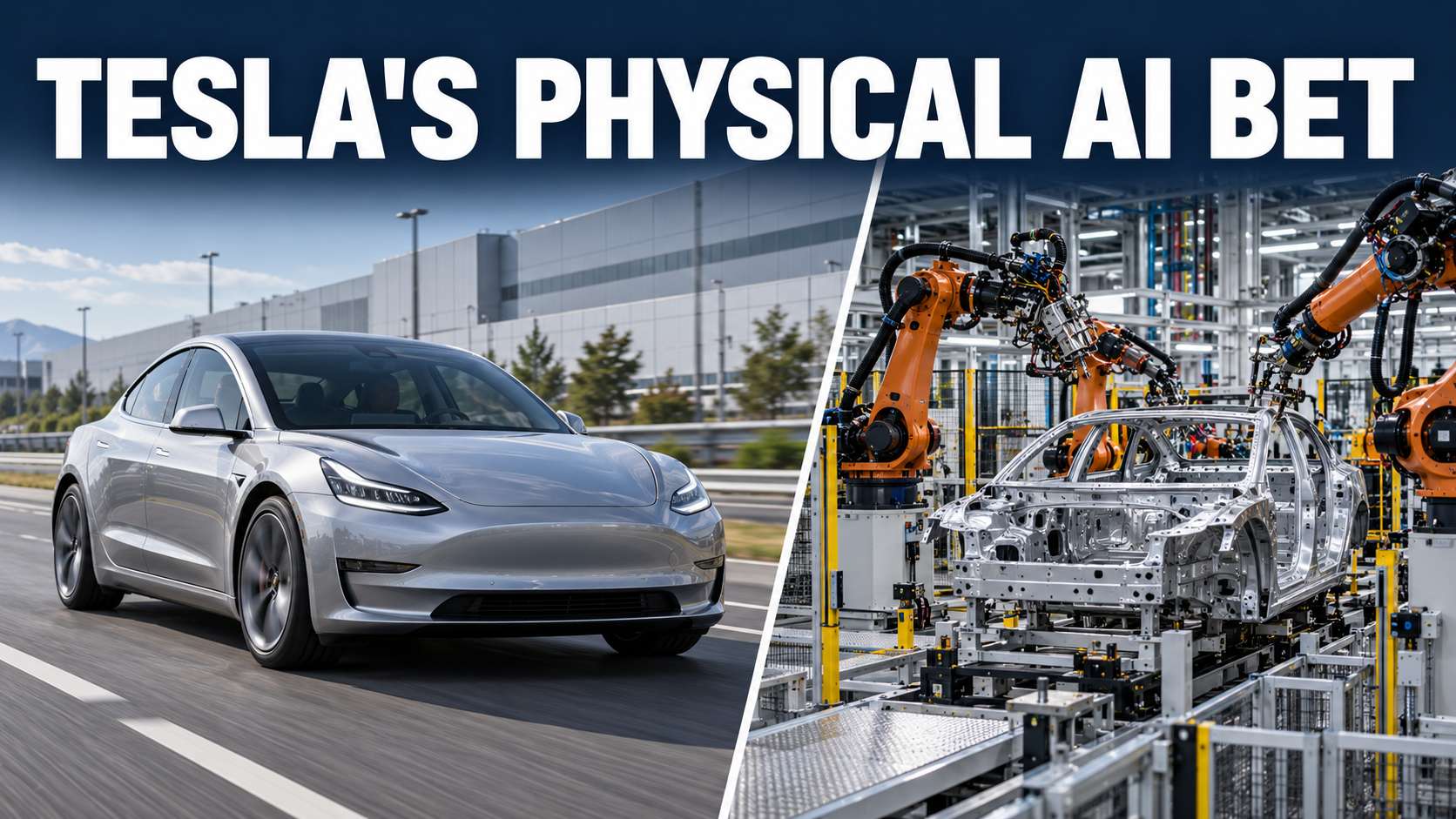
Tesla increasingly appears in market conversation as a bet on machines that sense and act in the physical world. The umbrella term “physical AI” covers autonomous driving, robotics, machine perception and control systems. Tesla’s stock appeal to some investors now extends far beyond the number of cars it sells. Yet the company’s existing manufacturing business remains essential because it generates the reported revenue and operating data from which investors can judge the cost of developing future products.
This tension creates a more interesting question than whether Tesla is a “robot stock” or a conventional automaker. How much of today’s business can support heavy investment in a future that may be valuable but is not yet fully deployed or proven at commercial scale? October offers two fresh reference points: Tesla’s third-quarter deliveries disclosure and a regulatory change in how its driver-assistance software is described in Europe.
What the third-quarter vehicle numbers actually show
In its October 2 investor-relations disclosure, Tesla reported 486,532 vehicle deliveries and 464,391 vehicles produced during the third quarter of 2026, as well as 13.7 GWh of energy-storage deployments. It scheduled its third-quarter financial results for October 21, 2026. These are units and storage volumes, not a substitute for revenue, net income, automotive margins or free cash flow, which were not included in that delivery announcement.
The breakdown also matters. Tesla reported 478,237 Model 3/Y deliveries, while other models accounted for 8,295. The concentration illustrates how important the high-volume core lineup still is. A reader should resist two common errors: treating a delivery beat as proof that margins grew, or treating investment in new technology as proof that the old business is no longer financially relevant.
An earnings review should compare realized selling prices, manufacturing costs, inventory, cash generation and capital investment—not simply quarterly unit growth. Those variables determine how much operating flexibility Tesla has when it chooses to fund long-horizon programs.
The physical AI thesis has distinct parts
Autonomous cars and humanoid robots rely on overlapping capabilities, including computer vision, decision-making and real-world control, but they are not the same business. A vehicle can use assisted-driving software while still requiring an attentive human driver. A fully driverless commercial operation demands different validation, redundancy, regulation, insurance and operational support. A robot used within a structured factory environment faces different challenges from one expected to work in unpredictable households.
Investors should separate demonstrations, limited deployments, approved service territories and broad commercial availability. Each marks a different stage of technical and business maturity. A promising demonstration may show capability without establishing that hardware can be built cheaply, insured affordably, serviced reliably and operated with acceptable safety results at large scale.
Why the European software name change matters
Reuters reported on October 9 that Tesla changed the name of its “Full Self-Driving” feature on several European websites to “Tesla Assisted Driving,” in the context of ongoing regulatory scrutiny and efforts to secure broader approval. The United States continued using “Full Self-Driving (Supervised)” in its branding. The name change is a product-marketing and regulatory development; it does not, by itself, tell investors whether a specific vehicle has become more or less capable.
Words like “self-driving” can create unrealistic assumptions about driver responsibility. Consumer-facing reporting should use the terminology regulators and official manuals apply to the particular jurisdiction and version. Approval in one place cannot be automatically generalized worldwide. Markets and roads vary in permitted use, required human supervision and applicable safety laws.
The robotaxi unit economics test
A profitable robotaxi model needs more than software that handles a route. It also needs high utilization, low intervention rates, an operating license, cleaning and charging systems, maintenance, insurance, support staff and a cost structure competitive with existing transportation options. An app can attract riders quickly, but the business only becomes compelling when revenue per vehicle comfortably exceeds depreciation, operations and service costs.
A simple editorial framework is to track hours active per vehicle, fare revenue per hour, empty miles, paid intervention events and monthly ownership costs. These figures should be reported only when disclosed or independently measured. Creating a precise return-on-investment estimate using promotional demos would give readers false confidence. Safety performance must be interpreted relative to operating conditions rather than cherry-picked mileage totals.
If the business works, it could create recurring revenue and deepen Tesla’s customer relationship. If the scaling effort is expensive or regulated narrowly, the company could spend heavily for a service whose economic contribution initially remains small.
Optimus and the industrial-robotics opportunity
The attraction of humanoid robotics is straightforward: a general-purpose machine could potentially perform tasks that would otherwise require multiple specialized systems. But commercial production and repetitive demonstrations differ. Robot safety, dexterity, endurance, battery replacement, maintainability and workplace integration all affect whether a deployment is economically viable.
A manufacturer may buy robots for predictable factory functions before approving them for customer-facing or domestic work. That intermediate path can be commercially important even if widespread household deployment is distant. Tesla could benefit from shared engineering across cameras, chips, batteries and motion control, but those synergies should be quantified through operating results when possible, not assumed from the existence of shared technology.
What higher rates do to Tesla’s strategy
Physical AI is capital intensive. Factories, vehicles, computing clusters and advanced tooling must be paid for before all expected future revenues arrive. In September, the Federal Reserve lifted its target range to 3.75%–4.00%, and long-dated Treasury yields were materially higher in October. Higher required returns generally place greater valuation pressure on cash flows expected far into the future.
That does not mechanically predict Tesla’s share price. Stock performance reflects earnings, risk sentiment, competition, optionality and expectations as well. But it increases the importance of cash generation from actual sales today. A company able to self-fund an emerging technology has different financing choices from one dependent on repeatedly raising expensive capital.
Competitors are solving adjacent problems
Legacy automakers, EV specialists, autonomous-vehicle companies, software developers and robotics manufacturers compete across different parts of Tesla’s future plans. Some focus on constrained autonomous environments; others prioritize driver-assistance features sold into millions of cars. Industrial robotics providers often target narrow tasks where safety and productivity are easier to demonstrate.
Tesla’s advantage, if it emerges, may come from scaling integrated hardware and software. A competitor’s advantage may come from specialization, regulatory experience or faster partnership deployment. Editorial analysis should avoid comparing a prototype robot with an established industrial automation business as if both are delivering the same product today.
What to ask on the October 21 earnings call
First, how did vehicle sales translate into gross profit and operating cash flow? Second, what was spent on AI computing, capacity expansion and robotics—and which portions may be recurring? Third, what safety, approval or service milestones were achieved in autonomy? Fourth, has energy storage become a stabilizing earnings contributor or does its growth require outsized additional capital?
The answer could be a mixed picture. Vehicle deliveries may look strong while prices pressure margins; autonomy may make technical progress without material revenue; energy deployments may grow but demand capital. An article that examines these effects separately will be more useful than one declaring an unequivocal victory or failure based on a single headline.
Frequently asked questions
Is Tesla only an automaker?
No. Tesla also develops energy and autonomy technologies, but vehicles remain central to its measurable current operating scale.
How many cars did Tesla deliver in Q3 2026?
Tesla reported 486,532 deliveries in its October 2 release, ahead of full earnings scheduled for October 21.
Does “Full Self-Driving” mean full autonomy everywhere?
No. Product branding, supervised operation, permitted capabilities and jurisdiction-specific approvals must be checked separately.
Is Optimus revenue already large enough to determine Tesla’s value?
This article does not establish that. Meaningful investor analysis requires disclosed commercialization, volume, profitability and deployment evidence.
Discover more from The Economy
Subscribe to get the latest posts sent to your email.

Q3 2026 Earnings Preview: Can Record Profit Expectations Keep Wall Street’s Rally Alive?

Russia Diesel Deal 2026: Oil Prices and Inflation Risks

Fed Rates 2026: Treasury Yields, Bonds and SGOV Explained

S&P 500 Market Breadth 2026: Weak Rally or Rotation?

The AI Capex Boom: Data Centers Reshaping Growth

Palantir Stock in 2026: Extraordinary AI Growth

Tesla Physical AI 2026: Robotaxis, Optimus and TSLA Risks

NVIDIA’s AI Grip in 2026: Record Revenue Is Only Half the Investment Story

Hormuz Diesel Shortage: Why Crude Oil Recovery Isn’t Enough

Social Security Extra $90 Deposit: Who Qualifies for the October 2026 Medicare Rebate?

Anthropic Bans Sustained Abuse of Claude AI Under New Usage Policy Effective November 12, 2026

Jeff Bezos Three-Day Workweek View: What He Really Said

Celeste Frozen Pizza Discontinued: What Conagra Confirmed

US–China Critical Minerals Competition: Why a Trade Deal Cannot Fix Every Supply Risk

Oil Prices Break $100 in 2026: Middle East Conflict & Energy Markets

Middle East War Economics 2026: Oil Prices & Energy Markets

PSX Forecast 2026: KSE-100, IMF Reviews & Geopolitics

China Stocks Today: Are Big Economies in Asia Nearing a Market Bottom?

Crypto Daily Outlook: Bitcoin, Altcoins, and the Future of Decentralized Finance

Global Pension Systems Ranked: The World’s Best and Worst Retirement Frameworks

World’s Largest Economies: Ranking the Top Global Powers

Elon Musk’s Next Moves: Disrupting the 2026 Global Economy

Pakistan Economy 2026: Inside the SBP’s Balancing Act

GasBuddy Market Insights: How Crude Price Shifts Impact Local Fuel Cost Averages

World Bank & IMF Reports 2026: Why the “3% Growth” Consensus Is Actually a Debate

Global Equity Market Divergence: US Tech vs. European Dividend Stocks vs. Asian Growth

IMF & World Bank Global Economic Outlook: Growth Forecasts Across Europe and Asia

Silver Price Today: Why the Xi-Trump AI Standoff Is Fueling a Safe-Haven Rally
-

 Markets & Finance9 months ago
Top 15 Stocks for Investment in 2026 in PSX: Your Complete Guide to Pakistan’s Best Investment Opportunities
-

 Analysis8 months ago
Johor’s Investment Boom: The Hidden Costs Behind Malaysia’s Most Ambitious Economic Surge
-

 Analysis8 months ago
Top 10 Stocks for Investment in PSX for Quick Returns in 2026
-

 Banks9 months ago
Best Investments in Pakistan 2026: Top 10 Low-Price Shares and Long-Term Picks for the PSX
-

 Analysis8 months ago
Brazil’s Rare Earth Race: US, EU, and China Compete for Critical Minerals as Tensions Rise
-

 Investment9 months ago
Top 10 Mutual Fund Managers in Pakistan for Investment in 2026: A Comprehensive Guide for Optimal Returns
-

 Global Economy10 months ago
15 Most Lucrative Sectors for Investment in Pakistan: A 2025 Data-Driven Analysis
-

 Global Economy10 months ago
Pakistan’s Export Goldmine: 10 Game-Changing Markets Where Pakistani Businesses Are Winning Big in 2025