
AI
The New Global Metabolism: How Electrostates Are Eating the World Petrostates Built


The rupture in world order is not merely political. It is thermodynamic. Two civilizational models—one running on molecules, one on electrons—are now in direct and irreversible collision. The side that misreads this as a trade dispute will lose the century.
When Mark Carney stepped to the podium in Davos on January 20, 2026, he did not arrive with a policy platform. He arrived with a death certificate. The rules-based liberal international order—that elaborate postwar architecture of interlocking institutions, U.S.-guaranteed public goods, and lawyerly multilateralism—was finished, he told a stunned room of hedgers, ministers, and central bankers. Not wounded. Not strained. Finished. “The old order is not coming back,” he said, to a rare standing ovation. “Nostalgia is not a strategy.”
He was right. But Carney, precise and sober as ever, still understated the depth of the break. What is ending is not merely a diplomatic arrangement or a particular configuration of great-power relations. What is ending is the fossil-fueled metabolic order that made the liberal world profitable, politically stable, and physically possible for three-quarters of a century. We are not watching a geopolitical transition. We are watching a civilizational one—the close of the Carbon Age and the violent, disorganized birth of the Electric Century. And the central story of that birth is the contest now taking shape between electrostates and petrostates: between nations rewiring the global grid and nations weaponizing the pipelines of the past.
The Metabolic Rupture: Why This Is Different From Every Previous Energy Shift
Energy transitions have happened before. Coal displaced wood. Oil displaced coal. Each shift reshuffled geopolitical hierarchies, created new empires, and ruined old ones. But what distinguishes the current transition is its deliberately competitive character. This is not a market quietly rotating from one fuel to another. It is a strategic mobilization—two superpower blocs making diametrically opposed bets about what will power the 21st-century economy, and consciously constructing the institutions, alliances, and supply chains to back those bets.
The term “electrostate” has proliferated rapidly in the analytical literature of 2025 and 2026, and for good reason: it captures something real about how national power is being reconstituted. An electrostate, in its cleanest definition, is a nation that draws a large and growing share of its total final energy consumption in the form of electricity—and that has positioned itself to dominate the technologies, supply chains, and standards that make mass electrification possible. A petrostate, by contrast, is a nation whose political economy, fiscal base, and civilizational identity remain anchored in the extraction and export of fossil fuels—and, crucially, in the perpetuation of a global order that keeps those fuels indispensable.
By this reckoning, the contest is not simply China versus America, though that is its sharpest edge. It is a structural divide running through the global economy, separating nations whose relative geopolitical position improves as the world electrifies from those whose position deteriorates with every solar panel installed and every internal combustion engine retired.
The Electrostate: China’s Monopoly on the Future’s Hardware
No serious analyst disputes China’s position. The numbers are not debatable; they are staggering. According to the International Energy Agency, China controls more than 90 percent of global rare earth processing and 94 percent of permanent magnet production—the components essential for EV motors and wind turbines. Its share in manufacturing solar panels exceeds 80 percent. It produces more than 70 percent of all lithium-ion EV batteries and accounts for over 70 percent of global electric vehicle production. In 2025, China installed nearly twenty times the wind and solar capacity of the United States. Nine-tenths of China’s investment growth in 2025 was concentrated in the green energy sector.
These figures describe not a market participant but a hegemon. China has, in less than a generation, constructed what analysts at the Columbia University Center on Global Energy Policy call the “electric stack”—a vertically integrated command of every layer of the clean energy supply chain, from rare earth mining to battery chemistry to EV software. Critically, it has decoupled this dominance from Western demand: nearly half of China’s green technology exports now flow to emerging markets across Africa, Southeast Asia, and Latin America, embedding Beijing as the indispensable infrastructure partner for the global south’s electrification journey.
This is not accidental. It is the product of what historian Nils Gilman has called China’s “authoritarian developmental state” operating with a generational strategic horizon that democratic governments structurally cannot match. Beijing’s dominance of the green supply chain is simultaneously an industrial policy triumph, a geopolitical masterstroke, and—for nations that have not yet grasped its implications—a slow-motion trap. The leverage here is not the blunt instrument of a gas cutoff. It is subtler and more durable: control over standards, compatibility, long-term dependency, and the terms on which the developing world modernizes its energy metabolism.
The Petrostate Counterplay: Washington’s Bet on Molecules
Against this, consider the American wager. By early 2026, U.S. crude production remained near record highs—approximately 13.6 million barrels per day—making the United States the world’s largest oil and gas producer and its largest LNG exporter. The Trump administration, having dismissed climate change as a “disastrous ideology” in its 2025 National Security Strategy, has doubled down on what it calls “energy dominance”: rolling back renewable subsidies, fast-tracking fossil fuel permits, and positioning American LNG as the geopolitical tether that keeps European and Asian allies aligned with Washington.
There is a coherent strategic logic here, and it should not be dismissed. The “shale shield” is real. When Russian gas flows to Europe collapsed after 2022, American LNG kept the lights on in Berlin and Warsaw. Energy secretary Chris Wright’s comment at Davos—that global renewable investment had been “economically a failure”—was received as ideological dogma by most of the room, but it contained a grain of tactical truth: energy density, portability, and the ability to dispatch power on demand still matter enormously in a crisis. A China that produces 70 percent of the world’s EV batteries remains the world’s largest importer of oil and gas. In a military confrontation, an electrostate without domestic hydrocarbon reserves has vulnerabilities that no number of solar panels eliminates overnight.
And yet. The petrostate counterplay is a strategy for the next decade, not the next half-century. It is a bet that the world will continue to need molecules at current volumes for long enough that the political and fiscal costs of the green transition can be deferred indefinitely. That bet is becoming harder to sustain with each passing year. As the Thucydides trap of the 21st century closes not around military force but around industrial capacity, the United States is bringing a very good weapon to a fight that has already changed its rules.
The most consequential piece of strategic self-harm in the Trump administration’s energy posture is not any particular rollback but a systemic failure of industrial policy imagination. By withdrawing renewable subsidies and erecting tariff walls against Chinese solar and battery imports, Washington has not protected American industry—it has orphaned it. Hyperscale AI companies, desperate to power vast compute clusters, are theoretically the vanguard of an American electrostate. But as economist Adam Tooze has argued, even if generating capacity could be built, the U.S. grid interconnection process is so bureaucratically broken that it cannot be hooked up efficiently. The United States is not incapable of electrification. It is structurally slowing itself down while Beijing sprints.
The Middle Powers: Crucible of the New Order
Between the two blocs lies a crowded, strategically consequential middle ground that will determine which model ultimately prevails. The EU, India, Brazil, Indonesia, South Korea, Japan, Australia, and a constellation of African and Latin American nations are all, in different ways, being forced to choose their metabolic alignment—or to construct a third path that neither bloc controls.
This is where Carney’s Davos architecture becomes genuinely interesting, even if its execution remains uncertain. His call for “coalitions of the willing” based on “common values and interests” is not mere diplomatic boilerplate. It is an acknowledgment that the middle powers possess something neither superpower bloc can replicate: legitimacy without hegemony. They can act as bridge-builders, standard-setters, and coalition anchors in a way that neither Beijing nor Washington can, precisely because they are not superpowers.
The material basis for middle-power leverage in the electrostate era is minerals. The lithium deposits of Argentina’s salt flats, the nickel and cobalt reserves of Australia’s Kalgoorlie Basin, the rare earth distributions across Indonesia and Kazakhstan—these are not peripheral endowments. They are the physical foundation of the electric economy, and nations that hold them possess a form of structural leverage that the postcolonial Non-Aligned Movement of the 1950s could only dream of. The difference is that this leverage is technologically activated: it only converts into power if mineral-rich middle powers invest in the processing, refining, and value-added manufacturing capacity to avoid simply re-running the colonial commodity trap under a green banner.
Australia’s position is illustrative. It holds some of the world’s largest reserves of lithium, nickel, and rare earth elements. Whether it becomes an electrostate—a nation that converts mineral endowment into clean-tech manufacturing dominance—or remains a raw material exporter shipping inputs to Chinese factories will be one of the defining strategic choices of the decade. The EU’s Carbon Border Adjustment Mechanism, which took effect in 2026 and taxes carbon-intensive imports at the border, creates a powerful incentive structure for middle powers to electrify their own production before they lose market access.
The Alliance of Petrostates: A Marriage of Inconvenience
The petrostate camp is more fractured than its rhetorical solidarity suggests. The United States, Russia, and Saudi Arabia may share a tactical interest in prolonging global fossil fuel consumption and spreading doubt about the clean energy transition. But their strategic interests diverge sharply—on oil pricing, on Ukraine, on regional proxy conflicts from Sudan to Syria, and on the fundamental question of who leads a post-liberal world order. This coalition has the structural instability of the Berlin-Rome-Tokyo Axis: a convergence of reactionary interests rather than a coherent vision.
Saudi Arabia’s position is particularly revealing. Riyadh has simultaneously championed oil’s long-term future at every COP negotiation while investing its sovereign wealth aggressively in clean technology and AI. The Saudi Aramco CEO’s performance at Davos—insisting on sustained oil demand while the Kingdom quietly deepens its relationship with Chinese EV manufacturers and battery infrastructure—was a masterclass in strategic ambiguity. The Gulf states understand, even if Washington currently does not, that the question is not whether the transition happens but who controls it.
Russia’s calculus is grimmer. Cut off from Western capital and technology markets by sanctions, and with its economy increasingly a raw material appendage of China’s industrial machine, Moscow is perhaps the most purely dependent member of the petrostate axis. Its leverage—natural gas to Europe, oil to China—is eroding on the European flank and being repriced downward on the Chinese one. The much-discussed revival of Nord Stream 2 under a potential U.S.-Russia détente would be a geopolitical paradox: a move that simultaneously serves American deal-making ambitions and further entrenches the fossil fuel dependency that the electrostate transition is designed to escape.
The Irreversibility Thesis: Why the Split Cannot Be Undone
The deepest analytical error in most coverage of the electrostates-versus-petrostates contest is to treat it as reversible—as though a change of administration in Washington, a commodity price shock, or a diplomatic reset could restore the pre-2020 energy geopolitical equilibrium. It cannot, for three structural reasons.
First, the cost curve. Solar and wind electricity generation costs have fallen by roughly 90 percent over the past decade and are continuing to decline. At current trajectories, clean electricity is becoming the cheapest form of power in most of the world’s major economies, regardless of subsidies. Economic gravity works in only one direction here.
Second, the infrastructure lock-in. Every electric vehicle sold, every heat pump installed, every grid-scale battery deployed creates a physical constituency for electrification that compounds over time. Nations that electrify early create self-reinforcing industrial ecosystems; nations that delay face progressively higher entry costs into industries where learning curves have already been climbed.
Third, the security logic. For the 70 percent of the world’s population that lives in fossil fuel-importing countries, as Columbia’s Center on Global Energy Policy notes, domestic renewable energy is not merely a climate preference—it is an energy security imperative. Every geopolitical crisis that drives oil prices above $100 per barrel (as the U.S.-Israeli war on Iran’s infrastructure did in early 2026) provides fresh proof that dependence on fossil fuel imports is a strategic vulnerability. Each shock accelerates the electrostate transition.
These three forces interact and compound. The question is not whether the global energy metabolism will shift from molecules to electrons. The question is whether that shift will be led by a democratic electrostate bloc that embeds open standards, interoperability, and developmental equity into the emerging infrastructure—or whether it will be captured by a Chinese-dominated Green Entente whose infrastructural leverage over the global south will be, in its own way, as coercive as the petrostates’ pipelines ever were.
Conclusion: What Carney Knew, and What He Left Unsaid
Carney’s Davos eulogy was remarkable for its honesty. It was incomplete in its prescription. Naming the rupture is necessary but insufficient. The harder task—the one that policymakers, investors, and strategists across the middle-power world now face—is constructing an electrostate architecture that is genuinely pluralistic rather than substituting one form of infrastructural dependency for another.
For the United States, the strategic error is not that it remains a major fossil fuel producer. Hydrocarbons will remain part of the global energy mix for decades. The error is abdicating industrial policy leadership in the technologies that will define the economy of the 2040s and 2050s. A nation that simultaneously abandons renewable subsidies, blocks cheap Chinese clean-tech imports, and fails to fix its grid interconnection crisis is not pursuing energy dominance. It is pursuing energy nostalgia.
For middle powers—from India to Indonesia to Brazil to Canada—the window for strategic positioning is open but will not remain so indefinitely. Nations with mineral wealth, demographic dividends, and genuine diplomatic capital must convert those endowments into manufacturing depth and supply chain participation before the electric infrastructure of the 21st century is locked in around them rather than built with them.
The fossil-fueled liberal order is over. Carney was right about that. What replaces it—an Electric Century shaped by openness, interoperability, and distributed prosperity, or a new metabolic hegemony as coercive as the one it replaced—remains genuinely undecided. That is the contest worth watching. That is the rupture that matters.
For Policymakers, Investors, and Strategists
The electrostate transition is not a speculative future. It is the present, disaggregated unevenly across geographies. Nations and institutions that treat it as a distant trend will find themselves navigating a world whose infrastructure, alliances, and leverage structures have already been rebuilt around them. The actionable imperative is bilateral: accelerate domestic electrification to reduce fossil fuel strategic vulnerability, and secure supply-chain participation in the clean-tech stack through partnerships, investment, and minerals diplomacy—before the commanding heights of the Electric Century are beyond reach.
The molecules are running out of time. The electrons are just getting started.
Discover more from The Economy
Subscribe to get the latest posts sent to your email.



The artificial-intelligence investment boom has become a story about the wider economy. Powerful chips require land, buildings, power, networking equipment, finance and a workforce able to assemble and operate complex sites. Corporate spending on these inputs can contribute to construction activity and supplier revenue well before the software applications built on top generate sustainable profits. That timing difference explains both the enthusiasm and the anxiety surrounding AI infrastructure in 2026.
Major technology firms are still scaling facilities, yet investors are increasingly examining the cost of capital, financing obligations and free cash flow. Reuters reported that expected AI-related expenditure from Microsoft, Alphabet, Amazon, Meta and Oracle was putting their future free cash flow under pressure. The analysis raised a basic problem: even if AI adoption rises, those developing the infrastructure may not all enjoy attractive returns simultaneously. Reuters cash-flow analysis.
What “capex” means in an AI context
Capital expenditure is money used to acquire or improve assets that provide value over multiple accounting periods. For an AI operator, it may include specialized chips, servers, network hardware, buildings, backup power, cooling and some internal infrastructure. Not every payment labeled “AI spending” is capex: cloud usage, electricity bills, software subscriptions and wages may be operating expenses depending on the arrangement and accounting rules.
This distinction matters because capex affects cash outlays at the time money is spent, while depreciation may spread the accounting cost of an asset across future years. A company can present strong operating earnings while experiencing weak free cash flow if investment is rising faster than cash from business activities. Conversely, a new infrastructure facility may depress cash flow now yet support profitable services in later years.
Follow the dollar through the AI supply chain
One dollar committed to a new data center does not flow entirely to a chipmaker. A share reaches semiconductors and networking equipment; another pays developers, construction contractors and utilities; still more goes to real estate, cooling and electrical equipment. Suppliers may benefit from the capital build-out even if the eventual model operator struggles to generate returns. This is why “AI winner” should not be used as a universal label for all companies tied to a project.
There are also lag effects. Chips can be ordered before a building is powered. A utility may build capacity over years. A software company may book subscription revenue only after the deployment is productive. Different stock sectors therefore respond on different timelines to the same underlying investment wave. For investors and policymakers alike, tracing cash flow across layers is more illuminating than repeating a single headline spending estimate.
Power has moved from a background cost to a constraint
Data centers require dependable electricity and increasingly sophisticated cooling. High-density clusters can demand large additions to local generation and network infrastructure, while grid connections may be slow. In October, Reuters reported that Black Hills planned $1.8 billion of investment between 2027 and 2029 to help power a proposed Google data center in Wyoming. That announcement is a real-world example of AI demand prompting multiyear energy investment, not evidence that every planned facility will open on schedule. Reuters utility-investment report.
Grid capacity also changes the competitive landscape. A company with access to power at an acceptable price may deploy assets faster than one waiting for an interconnection. Nearby households and businesses can face questions about cost-sharing, water use, land development and reliability. Responsible reporting should examine local approval documents and tariff structures rather than assume that large corporate investment automatically benefits or harms surrounding communities.
How capital spending affects headline economic growth
Business fixed investment is part of measured economic output, and construction or equipment purchases can stimulate activity. But spending itself should not be confused with productivity. A data center can contribute to investment today and still deliver a disappointing economic return if utilization is low or the services it supports cannot be sold profitably. Conversely, a project may have productivity benefits that show up only after companies redesign operations around the technology.
The broader economic test is whether AI helps firms deliver more output with the same resources, lower error rates, expand useful services or develop entirely new offerings. Business announcements often emphasize potential time savings. Readers deserve evidence from measured processes, audited costs and customer outcomes—not a promise that a single technological breakthrough will transform every workplace at the same speed.
Free cash flow may matter more than impressive spending plans
Free cash flow is often approximated as cash from operations minus capital expenditure, though companies may present adjusted versions with exclusions. As an analytical measure, it helps investors estimate how much cash remains for debt reduction, dividends, buybacks, acquisitions or additional investment. A business that repeatedly spends more than it generates must eventually manage the financing difference.
The Reuters analysis of hyperscaler spending highlighted expectations that incremental investment might absorb a large share of incremental operating cash generation. Some technology groups may comfortably fund the program; others may rely on borrowing, delayed distributions to shareholders or changes to project pace. Reuters.
A strong balance sheet provides flexibility, not immunity. Investors should assess debt maturities, interest costs, equipment useful lives and the contractual terms of customers who rent computing capacity. If equipment needs replacement quickly, the depreciation and reinvestment cycle can limit returns even when sales are growing.
The missing denominator: revenue per unit of compute
A useful return-on-investment framework divides durable economic benefit by the complete cost of producing it. For an AI data center, analysts might track revenue per available accelerator, revenue per megawatt, workload utilization, service margin, cost per output and customer renewal. Each measure can be distorted by product mix and contract duration; none should be used in isolation.
This is particularly relevant because lower inference costs can have opposite financial effects. They may reduce revenue per task but encourage far greater usage. Whether that improves profits depends on demand elasticity, competition and customer willingness to pay. The market is still discovering which AI services have the clearest repeatable business models and which are demonstrations searching for customers.
The financing environment makes the test tougher
The Federal Reserve increased its policy target in September to 3.75%–4.00%, and the 10-year Treasury yield remained above 5% in early October reporting. Federal Reserve; H.15 official yields. A higher discount rate can reduce the present value of profits expected years from now. It also affects the cost of borrowing for power facilities, real estate and AI operators.
That helps explain why investors can applaud near-term earnings from AI suppliers while questioning the financing models of downstream infrastructure projects. The system’s collective investment bill must ultimately be supported by profitable use or some participants will reprice their plans. Higher rates do not invalidate AI; they demand greater attention to when its financial benefits arrive.
Five signals that the boom is maturing
First, cloud providers disclose clearer AI-specific demand and customer retention rather than only capex totals. Second, power projects move from announcements to completed connections and reliable service. Third, customer adoption produces repeated operating results, not just pilots. Fourth, hardware utilization and useful life become easier to measure. Fifth, financing arrangements become less dependent on rising asset valuations or ever-larger capital raises.
There are also warning signals: canceled facilities, delays tied to electricity access, weaker supplier order growth, falling utilization, customer concentration or a widening gap between published accounting profit and cash flow. A weaker indicator in one quarter is not proof the overall AI market has peaked, but a combination of deteriorating measures warrants scrutiny.
The most balanced conclusion for 2026
The data-center build-out is real, but its profitability will not be distributed evenly. Equipment makers, utilities, contractors, cloud platforms and AI application developers occupy different points on the risk curve. One company may collect revenue upfront while another waits years to recover its costs. Economic growth from investment is only one side of the equation; the return on deployed capital is the other.
A durable editorial approach follows capacity, financing and customer benefits together. The next question is not whether the world will spend heavily on AI—that is visible in announced projects and corporate disclosures—but whether incremental spending continues to earn returns after the easy early adopters have been served.
Frequently asked questions
Capital spending by large cloud and technology operators on long-lived assets such as servers, buildings and infrastructure.
Does more data-center construction guarantee faster productivity growth?
No. Productivity depends on whether the resulting compute is used to produce economically valuable outputs.
Who benefits from AI electricity demand?
Potentially utilities, grid-equipment suppliers and constructors, subject to contracts, regulation, capital costs and project completion.
What is the main risk to the AI capex thesis?
Spending may rise faster than monetization, leaving high depreciation, financing commitments or underutilized facilities.
Discover more from The Economy
Subscribe to get the latest posts sent to your email.

Palantir’s appeal in 2026 is not simply that it uses artificial intelligence. Many companies do. The market debate is whether the business can convert enterprise interest in AI into deployed systems that influence real operations, generate recurring customer spending and expand margins. Its latest published results show considerable momentum, while also raising the difficult question of how much growth investors should reasonably expect to continue.
The company’s software spans data integration, analytical workflows and AI-assisted operational decision-making. Buyers do not necessarily want another stand-alone chatbot. They want systems that connect permissions, proprietary information, business processes and people. That is the economic opportunity behind Palantir’s Artificial Intelligence Platform, or AIP. The term “AI sovereignty” appears prominently in company messaging, but buyers’ need to control where data goes and who can use it is a concrete business concern.
The fact check starts with reported figures
Palantir’s August 3 earnings release reported $1.935 billion in revenue for the quarter ended June 30, 2026, up 93% year over year. U.S. commercial revenue was $764 million, up 149%; U.S. government revenue was $809 million, up 90%. The company also reported $912 million in GAAP operating income and $1.194 billion in adjusted operating income. The GAAP and adjusted values use different definitions and must not be presented interchangeably.
These rates help explain the high visibility of PLTR among traders. But a growth rate describes the past period, while a share price discounts an uncertain sequence of future periods. A company can exceed every operational target and still disappoint an investor who assumed even more aggressive future progress. Readers should therefore assess the revenue base, customer retention, contract terms and operating cash flows alongside headline percentages.
What AIP customers may actually be buying
Business AI is often less about a model’s ability to produce fluent text than about whether it can operate within a secure workflow. An organization needs access controls, audit trails, approved data sources, validation of outputs and integration with existing software. These tasks are unglamorous, but they can determine whether a pilot becomes a permanent budget item.
Palantir argues that its platforms help customers move from prototypes into operational use. That is a company position, which can be evaluated with disclosed customer wins, recurring revenue and contract expansion. The more valuable deployment is one tied to a recurring process that management continues funding because it saves time, increases throughput or reduces losses. Projects based on temporary excitement without measurable benefits face greater renewal risk.
Why U.S. commercial growth deserves a separate lens
The company’s U.S. commercial growth has outpaced its global total, suggesting enterprise adoption is a leading driver. Yet percentage growth can eventually normalize as a revenue base becomes larger. Investors need both year-on-year and sequential comparisons, plus details about new-customer acquisition versus expansion of existing accounts. The latter can signal that a product grows more deeply embedded in customer operations.
Palantir disclosed $3.373 billion of total contract value signed in the quarter, with $2.132 billion attributed to U.S. commercial deals. The company explains that TCV can include options and is not equivalent to immediately recognizable or guaranteed revenue. Palantir SEC release and contract definitions. Responsible reporting should never sum contract announcements as if they were all cash collected in the current quarter.
The difference between a sales pipeline and a moat
A large potential contract can create investor enthusiasm but does not automatically mean a customer cannot replace the software. The durability of a platform business may depend on integration complexity, data quality, employee training, switching costs, procurement rules and the economic savings customers experience. Some contracts may be terminated or re-competed; others may expand for years.
A stronger moat test asks whether an enterprise would still renew when rival vendors offer cheaper models or broadly available AI tools. If Palantir controls crucial orchestration and monitoring layers, generic improvements in AI models could increase its value. If customers can reproduce the functionality through internal platforms, competitive pressure could rise. Both outcomes are plausible and should be monitored through retention and deal economics rather than assumed.
Government business brings scale—and scrutiny
Public-sector deals are an important component of Palantir’s business. They can support long deployments and mission-critical functionality, but they also invite debate about procurement transparency, privacy, national security and public dependence on particular vendors. The company faces scrutiny over some government use cases and contracts abroad; these debates are relevant to revenue risk even when the stock-market narrative focuses on AI adoption.
In October, the Financial Times reported on the cost and extension of Palantir’s work connected with the U.K.’s Homes for Ukraine program, a story that highlighted concerns around technology dependence and procurement choices. The report is relevant context, not evidence that every Palantir government contract is improper.
Companies working with public institutions must navigate political transitions, budget decisions and procurement requirements. An investor should ask how much revenue is exposed to a handful of large buyers and how the company manages security, compliance and public trust. Customer concentration can improve initial growth but also increase vulnerability to policy changes.
Cash flow is central to the valuation argument
Palantir’s reported $1.216 billion cash from operations and $1.220 billion adjusted free cash flow in Q2 provide evidence that its rapid growth was not solely a headline about future demand. These are company-reported measures, and adjusted free cash flow should be read alongside its reconciliation and exclusions.
Margins may reflect favorable software economics, but sustaining them while expanding staff, infrastructure and international reach is an open question. Investors should examine stock-based compensation, cash conversion, deferred revenue, capital requirements and recurring contract mix. A business with exceptional margins today may face new spending needs as deployment demands evolve or competition intensifies.
What would justify investor confidence?
Evidence would include repeated quarterly performance, durable commercial renewals, increasing value from existing customers, lower customer acquisition friction, limited dependence on any one buyer and transparent profitability measures. Palantir forecast third-quarter 2026 revenue of roughly $2.160 billion to $2.164 billion in its August release; this is management guidance, not a reported October result.
A skeptical reader may ask whether valuation already presumes these favorable developments. That is a reasonable question even when operational performance is exceptional. Conversely, strong growth can sometimes justify a high multiple if durability and market opportunity are underestimated. The key is to specify the evidence necessary for either interpretation.
The FinTwit signal, with context
Palantir appeared fourth by composite buzz score in an October 10 snapshot of one finance-specific X tracker. Such rankings reveal subject interest within a methodology, not a directional price forecast. Adanos. Social excitement can increase short-run share volatility, while enterprise contracts are usually negotiated over much longer periods. This mismatch between the market’s daily clock and business development’s quarterly or yearly clock explains why a fast-growing company can remain a battleground stock.
A useful weekly editorial dashboard would update company disclosures, major contract wins, analyst estimate changes and notable regulatory developments separately. That structure prevents repeated opinion pieces from drifting into unsourced hype.
Frequently asked questions
What did Palantir report for Q2 2026 revenue?
$1.935 billion, up 93% year over year, according to its August 3 SEC-hosted results.
Is AIP the same as a consumer chatbot?
No. Palantir positions its AI platform around enterprise data integration and operational workflows rather than a consumer-facing assistant alone.
Does total contract value equal booked revenue?
No. Contract values may include options or future periods and must be separated from recognized revenue and collected cash.
Why does government procurement matter to PLTR?
Government buyers can be major customers, but political, compliance, privacy and procurement decisions may affect contracts and future growth.
Discover more from The Economy
Subscribe to get the latest posts sent to your email.
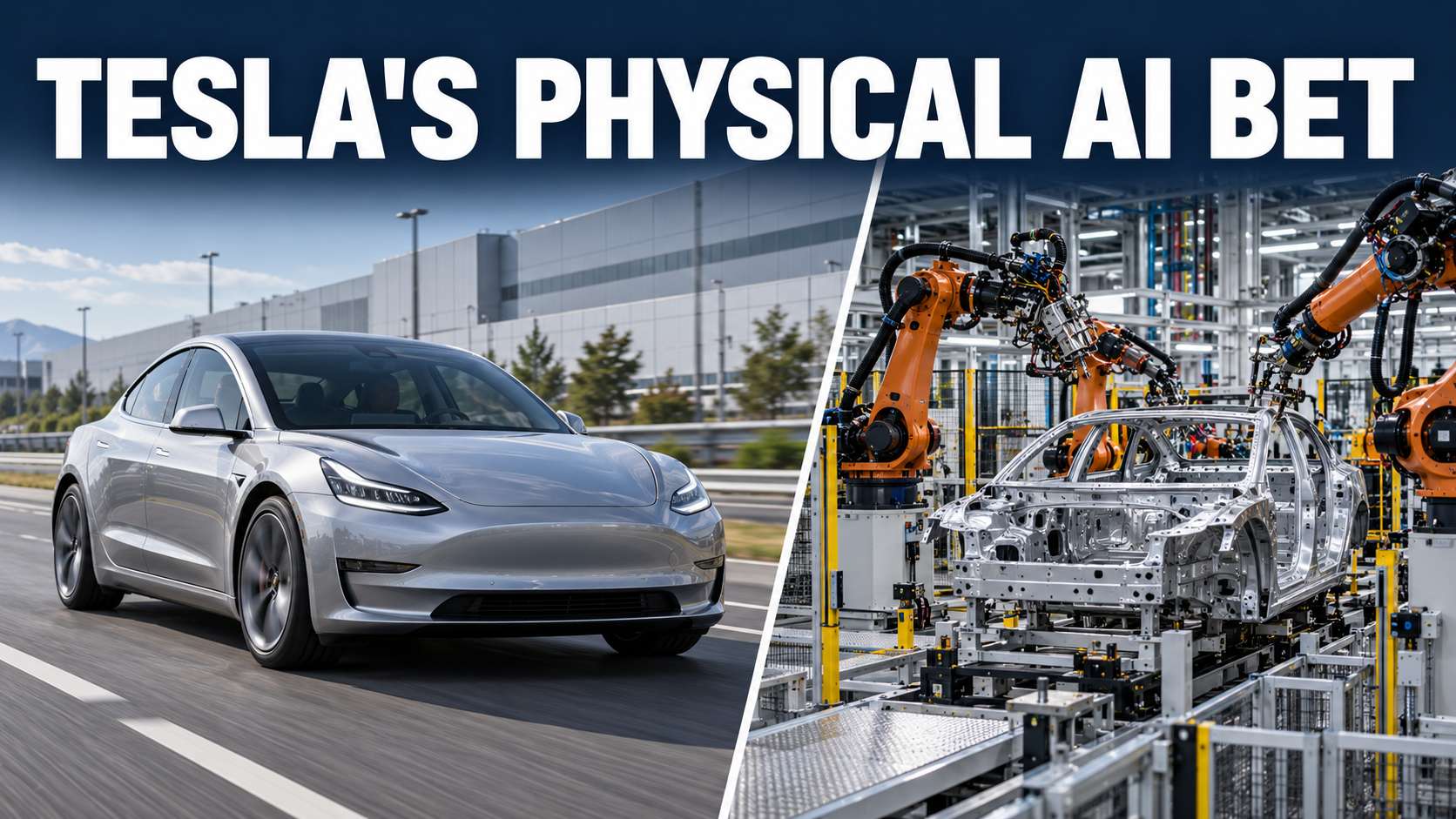
Tesla increasingly appears in market conversation as a bet on machines that sense and act in the physical world. The umbrella term “physical AI” covers autonomous driving, robotics, machine perception and control systems. Tesla’s stock appeal to some investors now extends far beyond the number of cars it sells. Yet the company’s existing manufacturing business remains essential because it generates the reported revenue and operating data from which investors can judge the cost of developing future products.
This tension creates a more interesting question than whether Tesla is a “robot stock” or a conventional automaker. How much of today’s business can support heavy investment in a future that may be valuable but is not yet fully deployed or proven at commercial scale? October offers two fresh reference points: Tesla’s third-quarter deliveries disclosure and a regulatory change in how its driver-assistance software is described in Europe.
What the third-quarter vehicle numbers actually show
In its October 2 investor-relations disclosure, Tesla reported 486,532 vehicle deliveries and 464,391 vehicles produced during the third quarter of 2026, as well as 13.7 GWh of energy-storage deployments. It scheduled its third-quarter financial results for October 21, 2026. These are units and storage volumes, not a substitute for revenue, net income, automotive margins or free cash flow, which were not included in that delivery announcement.
The breakdown also matters. Tesla reported 478,237 Model 3/Y deliveries, while other models accounted for 8,295. The concentration illustrates how important the high-volume core lineup still is. A reader should resist two common errors: treating a delivery beat as proof that margins grew, or treating investment in new technology as proof that the old business is no longer financially relevant.
An earnings review should compare realized selling prices, manufacturing costs, inventory, cash generation and capital investment—not simply quarterly unit growth. Those variables determine how much operating flexibility Tesla has when it chooses to fund long-horizon programs.
The physical AI thesis has distinct parts
Autonomous cars and humanoid robots rely on overlapping capabilities, including computer vision, decision-making and real-world control, but they are not the same business. A vehicle can use assisted-driving software while still requiring an attentive human driver. A fully driverless commercial operation demands different validation, redundancy, regulation, insurance and operational support. A robot used within a structured factory environment faces different challenges from one expected to work in unpredictable households.
Investors should separate demonstrations, limited deployments, approved service territories and broad commercial availability. Each marks a different stage of technical and business maturity. A promising demonstration may show capability without establishing that hardware can be built cheaply, insured affordably, serviced reliably and operated with acceptable safety results at large scale.
Why the European software name change matters
Reuters reported on October 9 that Tesla changed the name of its “Full Self-Driving” feature on several European websites to “Tesla Assisted Driving,” in the context of ongoing regulatory scrutiny and efforts to secure broader approval. The United States continued using “Full Self-Driving (Supervised)” in its branding. The name change is a product-marketing and regulatory development; it does not, by itself, tell investors whether a specific vehicle has become more or less capable.
Words like “self-driving” can create unrealistic assumptions about driver responsibility. Consumer-facing reporting should use the terminology regulators and official manuals apply to the particular jurisdiction and version. Approval in one place cannot be automatically generalized worldwide. Markets and roads vary in permitted use, required human supervision and applicable safety laws.
The robotaxi unit economics test
A profitable robotaxi model needs more than software that handles a route. It also needs high utilization, low intervention rates, an operating license, cleaning and charging systems, maintenance, insurance, support staff and a cost structure competitive with existing transportation options. An app can attract riders quickly, but the business only becomes compelling when revenue per vehicle comfortably exceeds depreciation, operations and service costs.
A simple editorial framework is to track hours active per vehicle, fare revenue per hour, empty miles, paid intervention events and monthly ownership costs. These figures should be reported only when disclosed or independently measured. Creating a precise return-on-investment estimate using promotional demos would give readers false confidence. Safety performance must be interpreted relative to operating conditions rather than cherry-picked mileage totals.
If the business works, it could create recurring revenue and deepen Tesla’s customer relationship. If the scaling effort is expensive or regulated narrowly, the company could spend heavily for a service whose economic contribution initially remains small.
Optimus and the industrial-robotics opportunity
The attraction of humanoid robotics is straightforward: a general-purpose machine could potentially perform tasks that would otherwise require multiple specialized systems. But commercial production and repetitive demonstrations differ. Robot safety, dexterity, endurance, battery replacement, maintainability and workplace integration all affect whether a deployment is economically viable.
A manufacturer may buy robots for predictable factory functions before approving them for customer-facing or domestic work. That intermediate path can be commercially important even if widespread household deployment is distant. Tesla could benefit from shared engineering across cameras, chips, batteries and motion control, but those synergies should be quantified through operating results when possible, not assumed from the existence of shared technology.
What higher rates do to Tesla’s strategy
Physical AI is capital intensive. Factories, vehicles, computing clusters and advanced tooling must be paid for before all expected future revenues arrive. In September, the Federal Reserve lifted its target range to 3.75%–4.00%, and long-dated Treasury yields were materially higher in October. Higher required returns generally place greater valuation pressure on cash flows expected far into the future.
That does not mechanically predict Tesla’s share price. Stock performance reflects earnings, risk sentiment, competition, optionality and expectations as well. But it increases the importance of cash generation from actual sales today. A company able to self-fund an emerging technology has different financing choices from one dependent on repeatedly raising expensive capital.
Competitors are solving adjacent problems
Legacy automakers, EV specialists, autonomous-vehicle companies, software developers and robotics manufacturers compete across different parts of Tesla’s future plans. Some focus on constrained autonomous environments; others prioritize driver-assistance features sold into millions of cars. Industrial robotics providers often target narrow tasks where safety and productivity are easier to demonstrate.
Tesla’s advantage, if it emerges, may come from scaling integrated hardware and software. A competitor’s advantage may come from specialization, regulatory experience or faster partnership deployment. Editorial analysis should avoid comparing a prototype robot with an established industrial automation business as if both are delivering the same product today.
What to ask on the October 21 earnings call
First, how did vehicle sales translate into gross profit and operating cash flow? Second, what was spent on AI computing, capacity expansion and robotics—and which portions may be recurring? Third, what safety, approval or service milestones were achieved in autonomy? Fourth, has energy storage become a stabilizing earnings contributor or does its growth require outsized additional capital?
The answer could be a mixed picture. Vehicle deliveries may look strong while prices pressure margins; autonomy may make technical progress without material revenue; energy deployments may grow but demand capital. An article that examines these effects separately will be more useful than one declaring an unequivocal victory or failure based on a single headline.
Frequently asked questions
Is Tesla only an automaker?
No. Tesla also develops energy and autonomy technologies, but vehicles remain central to its measurable current operating scale.
How many cars did Tesla deliver in Q3 2026?
Tesla reported 486,532 deliveries in its October 2 release, ahead of full earnings scheduled for October 21.
Does “Full Self-Driving” mean full autonomy everywhere?
No. Product branding, supervised operation, permitted capabilities and jurisdiction-specific approvals must be checked separately.
Is Optimus revenue already large enough to determine Tesla’s value?
This article does not establish that. Meaningful investor analysis requires disclosed commercialization, volume, profitability and deployment evidence.
Discover more from The Economy
Subscribe to get the latest posts sent to your email.

Q3 2026 Earnings Preview: Can Record Profit Expectations Keep Wall Street’s Rally Alive?

Russia Diesel Deal 2026: Oil Prices and Inflation Risks

Fed Rates 2026: Treasury Yields, Bonds and SGOV Explained

S&P 500 Market Breadth 2026: Weak Rally or Rotation?

The AI Capex Boom: Data Centers Reshaping Growth

Palantir Stock in 2026: Extraordinary AI Growth

Tesla Physical AI 2026: Robotaxis, Optimus and TSLA Risks

NVIDIA’s AI Grip in 2026: Record Revenue Is Only Half the Investment Story

Hormuz Diesel Shortage: Why Crude Oil Recovery Isn’t Enough

Social Security Extra $90 Deposit: Who Qualifies for the October 2026 Medicare Rebate?

Anthropic Bans Sustained Abuse of Claude AI Under New Usage Policy Effective November 12, 2026

Jeff Bezos Three-Day Workweek View: What He Really Said

Celeste Frozen Pizza Discontinued: What Conagra Confirmed

US–China Critical Minerals Competition: Why a Trade Deal Cannot Fix Every Supply Risk

Oil Prices Break $100 in 2026: Middle East Conflict & Energy Markets

Middle East War Economics 2026: Oil Prices & Energy Markets

China Stocks Today: Are Big Economies in Asia Nearing a Market Bottom?

PSX Forecast 2026: KSE-100, IMF Reviews & Geopolitics

Crypto Daily Outlook: Bitcoin, Altcoins, and the Future of Decentralized Finance

Global Pension Systems Ranked: The World’s Best and Worst Retirement Frameworks

World’s Largest Economies: Ranking the Top Global Powers

Elon Musk’s Next Moves: Disrupting the 2026 Global Economy

Pakistan Economy 2026: Inside the SBP’s Balancing Act

GasBuddy Market Insights: How Crude Price Shifts Impact Local Fuel Cost Averages

World Bank & IMF Reports 2026: Why the “3% Growth” Consensus Is Actually a Debate

Global Equity Market Divergence: US Tech vs. European Dividend Stocks vs. Asian Growth

IMF & World Bank Global Economic Outlook: Growth Forecasts Across Europe and Asia

Silver Price Today: Why the Xi-Trump AI Standoff Is Fueling a Safe-Haven Rally
-

 Markets & Finance9 months ago
Top 15 Stocks for Investment in 2026 in PSX: Your Complete Guide to Pakistan’s Best Investment Opportunities
-

 Analysis8 months ago
Johor’s Investment Boom: The Hidden Costs Behind Malaysia’s Most Ambitious Economic Surge
-

 Analysis8 months ago
Top 10 Stocks for Investment in PSX for Quick Returns in 2026
-

 Banks9 months ago
Best Investments in Pakistan 2026: Top 10 Low-Price Shares and Long-Term Picks for the PSX
-

 Analysis8 months ago
Brazil’s Rare Earth Race: US, EU, and China Compete for Critical Minerals as Tensions Rise
-

 Investment9 months ago
Top 10 Mutual Fund Managers in Pakistan for Investment in 2026: A Comprehensive Guide for Optimal Returns
-

 Global Economy10 months ago
15 Most Lucrative Sectors for Investment in Pakistan: A 2025 Data-Driven Analysis
-

 Global Economy10 months ago
Pakistan’s Export Goldmine: 10 Game-Changing Markets Where Pakistani Businesses Are Winning Big in 2025