
Global Economy
Pakistan Posts Fastest Growth in Four Years as KSE-100 Closes at a Record High

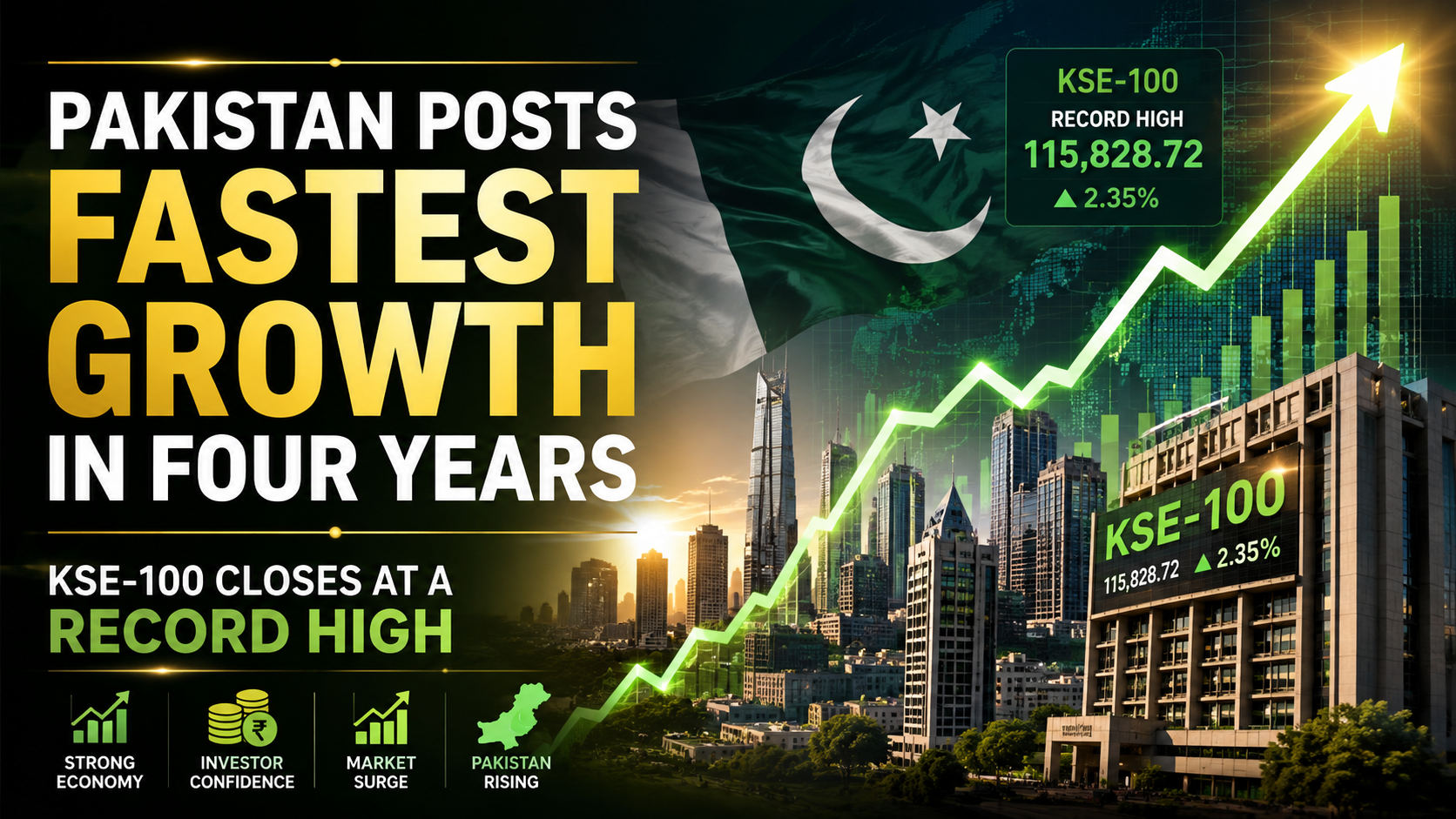
Pakistan’s economy delivered its strongest performance in four years in fiscal year 2025-26, with real GDP growing 3.7% even as the benchmark KSE-100 index shattered previous records — a combination that officials are framing as validation of the reform path pursued since the country’s latest IMF programme began.
A Recovery Four Years in the Making
The 3.7% growth rate marks an improvement on the 3.18% recorded the previous fiscal year, though it still falls short of the government’s original 4.2% target for FY26. Per capita income rose to $1,901 from $1,751 the year before, according to the government’s FY26 Economic Survey, while sectoral growth was broad-based: agriculture expanded 2.89%, industry 3.51%, and services 4.09%.
Finance Minister Muhammad Aurangzeb has pointed to a specific combination of factors behind the turnaround: strong corporate earnings, a declining policy rate, falling inflation, and the successful completion of IMF-EFF programme reviews, which together helped stabilise the macroeconomic environment and restore investor confidence after several years of crisis-mode policymaking.
KSE-100’s Record Run
The Pakistan Stock Exchange has been the most visible beneficiary of that stabilisation. The KSE-100 closed at a record 180,301 points, a gain of more than 43% over the fiscal year, with the number of active investors on the exchange climbing nearly 50% to over 583,000. Market capitalisation on the exchange rose from Rs15,237 billion to Rs16,534 billion between June 2025 and March 2026 alone, an increase of roughly Rs1,298 billion, or 8.5%, in just nine months.
That rally reflects a broader re-rating of Pakistani equities as the IMF-EFF programme has proceeded through successive tranche disbursements without the disruptions that derailed earlier attempts at fiscal consolidation.
Remittances Remain the External-Account Anchor
Workers’ remittances continue to do the heavy lifting on Pakistan’s external account. Inflows rose 8.2% to $30.3 billion during the July-March period of FY26, and the momentum has carried into the new fiscal year: overseas Pakistanis sent $3.631 billion in July 2026 alone, up 13% year-on-year and 4.5% month-on-month, according to State Bank of Pakistan data that Prime Minister Shehbaz Sharif publicly welcomed as “highly encouraging.”
Saudi Arabia and the UAE remain the two largest source countries, though the reliance on remittances rather than export growth has drawn scrutiny from economists. A structural current account surplus of $72 million during July-March FY26 — down sharply from a $1.7 billion surplus in the same period a year earlier — underscores that the underlying trade position has actually weakened even as remittance-driven headline figures look strong.
The Dutch Disease Debate
Not every economist is celebrating the remittance dependency uncritically. Pakistan received roughly $95.8 billion in remittances between FY2023 and FY2025, compared with $91 billion in merchandise exports over the same period — a reversal of the traditional growth model built on export competitiveness. Research cited in Pakistani economic commentary suggests that once the remittance-to-GDP ratio exceeds roughly 6%, it can begin to exacerbate deindustrialisation and slow capital accumulation, a pattern economists have labelled a symptom of Dutch disease.
Aurangzeb has pushed back on the more alarmist framing, arguing that remittances are and will remain a critical structural component of Pakistan’s external balancing position, while acknowledging the need to simultaneously grow exports rather than treat the two as substitutes.
Looking Ahead to FY27
The government has set a 4% GDP growth target for FY2026-27 and aims to narrow the fiscal deficit further to 3.6% of GDP. Officials are pointing to continued fiscal discipline, record remittance inflows, expanding technology exports, and renewed foreign investment as the pillars expected to sustain the recovery into the new fiscal year — though the labour-migration data offers a more cautious signal: roughly 50,000 workers left for the UAE on work visas in Jan-July 2026, down from 52,000 in the same period of 2025 and 64,000 in 2024, suggesting the remittance engine itself may not accelerate indefinitely.
Key Takeaways
- Pakistan’s economy grew 3.7% in FY26, the fastest pace in four years, though short of the 4.2% target.
- The KSE-100 index closed the fiscal year at a record 180,301 points, up more than 43%, with active investors up nearly 50%.
- Workers’ remittances hit $3.63 billion in July 2026 alone, up 13% year-on-year, extending a run that has become the economy’s key external stabiliser.
- Economists continue to warn that heavy reliance on remittances over exports carries long-term Dutch disease risks.
- The government targets 4% growth and a narrower 3.6% fiscal deficit for FY27.
Frequently Asked Questions
How fast did Pakistan’s economy grow in FY26? Pakistan’s GDP grew 3.7% in fiscal year 2025-26, its fastest pace in four years, though below the government’s 4.2% target.
What record did the KSE-100 index set? The KSE-100 closed the fiscal year at a record 180,301 points, gaining more than 43% over the year, with the number of active exchange investors rising nearly 50% to over 583,000.
Why are economists concerned about Pakistan’s reliance on remittances? Remittances have outpaced merchandise exports in recent years, and when the remittance-to-GDP ratio rises too high, economists warn it can discourage industrial development — a pattern known as Dutch disease.
Discover more from The Economy
Subscribe to get the latest posts sent to your email.


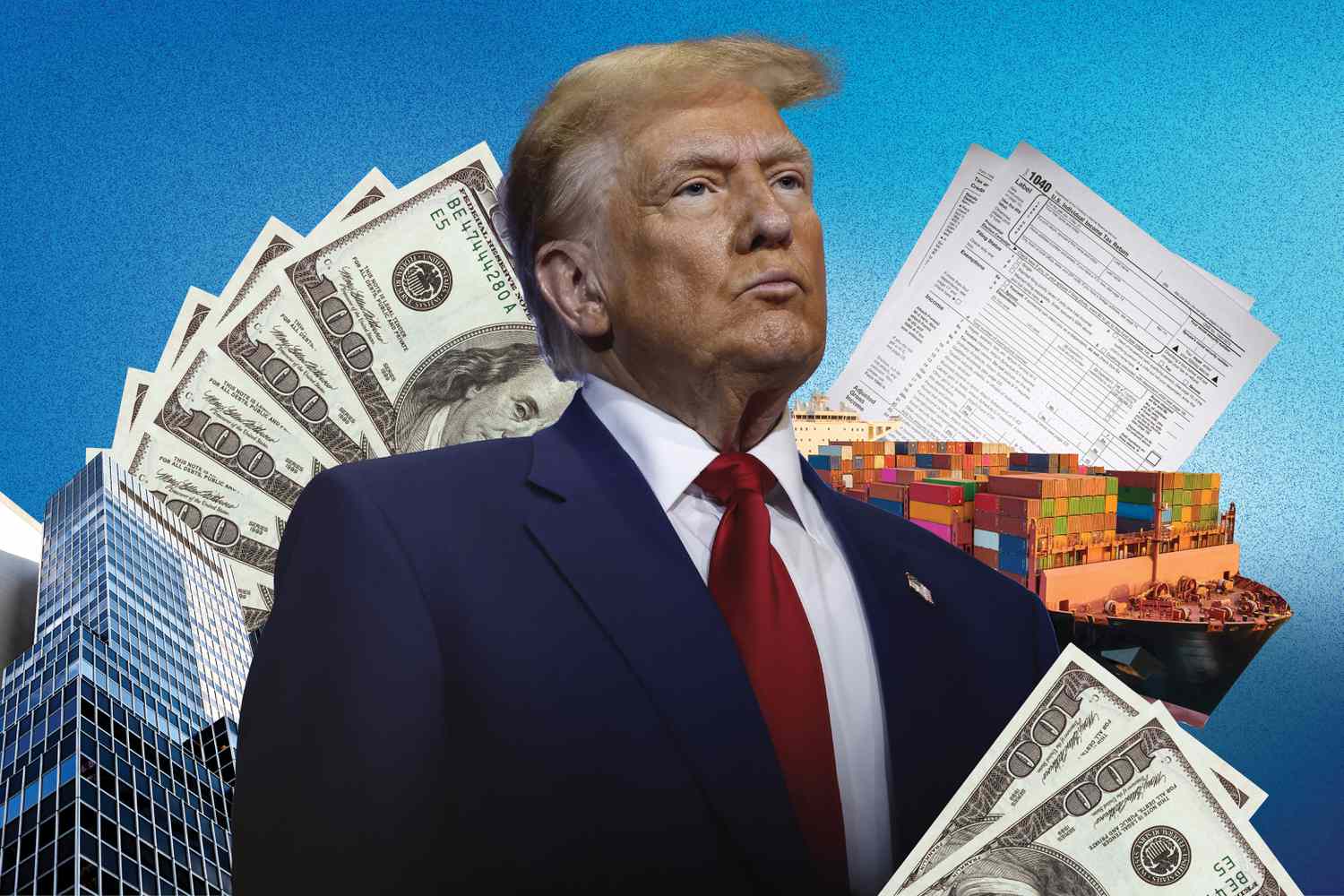
Checks are going out this week to nearly one million Americans, but the $500 payment is far smaller than the political noise around it suggests.
Key Takeaways
- What it is: a $500 refund for certain Affordable Care Act (ACA) marketplace enrollees. President Trump announced it in a video, saying nearly one million people in 30 states would receive checks, per ABC News.
- Who gets it: enrollees in the 30 mostly red states that use the federal marketplace rather than their own exchanges. Checks are sent automatically, and households with several eligible members could receive more than one (NewsNation).
- Total cost: roughly $500 million (same NewsNation report).
- The open questions: it is unclear how the amount was set, where the money comes from, and whether Congress must approve it (NewsNation).
- Do not confuse it with the $5,000 “dividend.” That is a separate, conditional pledge that has not been enacted.
| $500 ACA refund | $5,000 “Trump dividend” | $2,000 tariff dividend | |
|---|---|---|---|
| Status | Checks mailing now | Campaign-style pledge | Promised, never paid |
| Who | ACA enrollees in 30 states | Proposed for all adults | Proposed for most adults |
| Condition | None stated | Republicans keep Congress | n/a |
| Congress approval | Unclear | Disputed | Required, per most analysts |
What the $500 Payment Actually Is
The White House says the money comes from a surplus of unused exchange fee collections, and Trump said enrollees were charged excessive fees under the prior administration (ABC News). ABC noted that the mechanism for disbursing the funds was not clear.
Reporting also points out that the White House’s own fact sheet describes the program as narrower than the announcement video suggested (MS NOW).
The $5,000 Dividend Pledge
At the Republican midterm convention, Trump said he would give American adults a $5,000 dividend if Republicans keep their House and Senate majorities, with at least some money coming from tariff revenue (ABC News).
Key problems:
- Cost. MS NOW notes the plan would reach about 245 million adults, and no money has been appropriated (MS NOW). The arithmetic is simple: 245 million × $5,000 ≈ $1.2 trillion.
- Authority. Trump told CBS the White House does not need Congress, while House Speaker Mike Johnson said legislation would likely be required (Epoch Times).
- Track record. CNN counts this as at least the fourth time in 19 months Trump has floated direct payments, including the “DOGE dividend” and the $2,000 tariff dividend, neither of which was delivered (CNN).
Economic Impact: Is $500 a Big Deal?
At the macro level, no. $500 million spread across the economy is a rounding error, and the payment targets a small group.
For individual households, it can matter. A one-time $500 may offset a portion of rising premiums for the enrollees who qualify, though one report noted it would not come close to covering the price increases some are absorbing (MS NOW).
The larger economic question is the $5,000 proposal. Analysts have argued broad rebate checks could add to deficits and put upward pressure on inflation. In the earlier $2,000 tariff-dividend debate, CBS reported an analyst’s view that such checks would be “another factor pushing inflation up” (CBS News), and that pandemic stimulus checks likely added one to three percentage points to inflation.
Policy and Political Context
- Timing. The checks arrive about five weeks before the November 3 midterms (NewsNation), with affordability a key voter issue.
- Funding transparency. Congress has not appropriated money for either payment, and the administration has not detailed how they would be funded (MS NOW).
- Legal exposure. If courts rule against tariffs, refunds to importers could shrink the revenue the dividend relies on (CBS News).
What Should You Do?
- If you were on a federal-marketplace ACA plan in one of the 30 states: watch your mail and keep your address current with the marketplace; checks are automatic, so there is nothing to apply for.
- If you are not in those states: the $500 refund does not apply to you.
- Do not budget for the $5,000. It has not been approved by Congress and depends on an election outcome.
- Beware scams. Fake “stimulus” offers spike around announcements like this. Legitimate payments do not require fees or bank logins.
- Tax treatment: ask a tax professional how a refund of this kind is treated for your situation.
Frequently Asked Questions
What is the Trump $500 payment?
A $500 refund for certain ACA marketplace enrollees in 30 states, totaling about $500 million (NewsNation).
Who qualifies?
People enrolled through the federal marketplace in the 30 states that do not run their own exchanges.
Is the $5,000 dividend real?
It is a pledge tied to Republicans winning Congress; it has not been enacted (CNN).
Does Congress need to approve these payments?
That is disputed; the Speaker said legislation would likely be needed for the $5,000 plan (Epoch Times).
Will the $2,000 tariff checks arrive?
They have not, as of now (NewsNation).
Five hundred dollars is real money to the people who receive it. Whether it signals a new era of direct payments or one more campaign-season promise is the question that will outlast the checks.
Discover more from The Economy
Subscribe to get the latest posts sent to your email.
Global Economy
Battle for the Farm Belt: How Tariff Pressures and Fuel Costs Are Reshaping Iowa’s 2026 Midterms

DES MOINES, Iowa — In America’s agricultural heartland, the political landscape heading into the 2026 midterm elections is undergoing its most significant realignment in a decade. Surging fuel overhead, escalating global trade frictions, and rising input costs are convergence points putting traditional Republican strongholds in Iowa under intense electoral pressure.
1. The Economic Squeeze in Rural Iowa
At the center of Iowa’s political shift is a dual economic pressure hitting family farms and agricultural enterprises:
- Energy and Transportation Overhead: Following energy market disruptions, diesel prices across the Midwest surged past $6.50 per gallon, representing a nearly 76% increase year-over-year. For producers managing heavy machinery, grain haulage, and supply chain logistics, fuel overhead has eroded operational margins.
- Trade and Commodity Price Suppression: Retaliatory tariffs on major American exports—specifically soybeans and corn—have created volatility in key foreign markets. Soybean prices have faced downward pressure, directly reducing farm incomes across 95% of Iowa’s primary crop-producing counties.
- Compound Input Inflation: Higher costs for nitrogen-based fertilizers, commercial seeds, and equipment financing have compounded household financial strain.
According to financial impact studies published in the Associated Press Midterm Report, agricultural producers across the Midwest are facing a sharp pinch between fixed operational costs and suppressed market yields, turning economic survival into a core campaign issue.
2. Polling Breakdown: Marist Survey Highlights Key Shifts
Political dynamics in Iowa—long viewed as a stable red baseline—have tightened dramatically across statewide contests.
Data compiled in the Marist Poll September 2026 Survey highlights significant headwinds for incumbent political alignments:
| Electoral Measure | Current Polling Metric | Key Demographic / Breakdown |
| U.S. Senate Race | Josh Turek (D): 50% Ashley Hinson (R): 42% | Independent voters favoring Turek; cost-of-living cited as primary issue. |
| Gubernatorial Race | Rob Sand (D): 54% Zach Lahn (R): 42% | Sand holding a 57%–33% advantage among independent statewide voters. |
| Generic Congressional Ballot | Democrat: 50% Republican: 45% | Shift in suburban and mixed rural-suburban congressional districts. |
| Presidential Job Approval | Disapprove: 58% Approve: 41% | Plurality of voters (43%) report their ballot is a vote against current federal policies. |
| Household Financial Sentiment | Worse Off: 46% Unchanged: 39% / Better: 15% | High fuel prices and grocery inflation drive negative financial sentiment. |
3. The Re-Alignment of the Rural Swing Vote
In previous election cycles, agricultural state voters historically prioritized regulatory relief and federal tax incentives. However, the 2026 midterm cycle demonstrates that affordability and cost containment have superseded traditional party loyalties.
Analysis from the Brookings Institution Midterm Governance Report indicates that when Presidential approval ratings dip among agricultural constituents, down-ballot candidates face immediate fallout:
- The Independent Pivot: Independent voters in Iowa, who previously split evenly or favored conservative candidates, are breaking toward candidates offering specific cost-relief and trade stabilization policies.
- The Tariff Dilemma: While agricultural subsidies offer temporary liquidity, farm leaders increasingly advocate for open export markets over government bailouts, citing long-term market access as vital for generational farms.
- Turnout Dynamics: High-dollar national ad spending from both political parties is pouring into Iowa’s media markets, reflecting the strategic importance of the state in deciding national control of the U.S. Senate.
What to Watch Next
- Farm Bill & Subsidy Appropriations: How federal agricultural relief programs are structured prior to November will directly influence late-deciding agricultural voters.
- Energy Overhead & Diesel Spot Prices: Any stabilization or further spike in harvest-season fuel costs will serve as an economic bellwether for rural voter sentiment.
- Turnout in All 99 Counties: Ground mobilization efforts across Iowa’s rural townships will determine whether the polling shift translates into turnout at the ballot box.
Discover more from The Economy
Subscribe to get the latest posts sent to your email.
Asset Managment companies
MAS Allocates S$1.45 Billion to Five Asset Managers in Third EQDP Batch: Total Deployment Reaches S$5.4 Billion
The Monetary Authority of Singapore (MAS) has appointed five asset managers — Amundi, Franklin Templeton, HSBC Asset Management, M&G Investments and Natixis Investment Managers — under the third batch of its Equity Market Development Programme (EQDP), deploying a further S$1.45 billion into Singapore’s equity market.
The announcement, made by Minister for National Development and MAS Deputy Chairman Chee Hong Tat at the SuperReturn Asia conference on 29 September 2026, takes total EQDP allocations to S$5.4 billion across 14 managers — 83% of the programme’s expanded S$6.5 billion war chest, following its top-up at Budget 2026.
Alongside the appointments, MAS committed S$20 million from the Financial Sector Development Fund to a new GEMS Market Making Grant aimed at tightening bid-ask spreads in roughly 80 small and mid-cap stocks outside the Straits Times Index.
What is the EQDP? A quick recap
The EQDP was launched in February 2025 as a flagship demand-side measure of the Equities Market Review Group, which MAS convened in August 2024 to revive the Singapore Exchange (SGX). Its twin objectives: develop Singapore’s local fund management industry, and channel sustained institutional capital into Singapore-listed equities — including cornerstone participation in IPOs.
EQDP deployment: the full picture so far
Table
| Batch | Date | Managers | Allocation |
|---|---|---|---|
| Batch 1 | July 2025 | Avanda Investment Management, Fullerton Fund Management, JPMorgan Asset Management | S$1.1 billion |
| Batch 2 | November 2025 | Amova Asset Management, AR Capital, BlackRock, Eastspring Investments, Lion Global Investors, Manulife Investment Management | S$2.85 billion |
| Batch 3 | September 2026 | Amundi, Franklin Templeton, HSBC Asset Management, M&G Investments, Natixis Investment Managers | S$1.45 billion |
| Total | 14 managers | S$5.4 billion |
The third batch brings a notably more international flavour than earlier rounds. In his SuperReturn Asia speech, Chee said these managers “bring with them global distribution networks, sources of capital, and expertise that strengthen the depth and dynamism of our public markets” — meaning EQDP money is now explicitly designed to pull in foreign capital alongside domestic allocations.
S$20 million GEMS Market Making Grant: liquidity for the “missing middle”
The second announcement targets a chronic weakness of the SGX: thin trading in its small and mid-cap segment. The new GEMS Market Making Grant will:
- Fund appointed market makers providing liquidity for an initial group of around 80 eligible stocks outside the STI, plus newly listed counters
- Run until 31 December 2028
- Aim for tighter bid-ask spreads, lower execution costs and stronger price discovery
- Review and expand the eligible list regularly
Chee described the target as the “middle segment” — stocks with sufficient trading activity to benefit from market-making support, but not the large, liquid STI constituents. Early signs suggest the broader reform push is working: average daily turnover in Q3 2025 rose 16% year-on-year to S$1.53 billion, the highest since Q1 2021, with IPO fundraising topping S$2 billion, according to MAS data cited by The Straits Times.
The bigger play: anchoring S$7 trillion of asset management in Singapore
Tuesday’s announcements were bookended by measures targeting Singapore’s asset management industry, which now oversees close to S$7 trillion across more than 1,300 managers — growing 7.5% annually over the past five years, per MAS’s August 2026 package:
- Investment Management Track under the ONE Pass (from late January 2027, with the Ministry of Manpower) — applicants can meet the S$30,000 qualifying salary through a minimum S$15,000 fixed monthly salary plus variable, performance-linked components, reflecting industry compensation norms. Further details are expected at Budget 2027.
- Tax exemption for profit-related returns from fund management services to qualifying funds, effective from Year of Assessment 2027.
- A new MAS Hedge Fund Investment Programme to anchor leading hedge fund managers and their ecosystems (prime brokerages, ancillary services) in Singapore.
On licensing, Chee revealed MAS has received more than 500 fund management licence applications over the past three years, with a median approval time of 4.5 months in Q2 2026 — and the fastest approved in just 12 weeks — while pledging to streamline further without lowering standards.
What happens next?
- Batch 4: MAS is reviewing proposals now and expects to announce the next group of EQDP managers in 2027 — S$1.1 billion of the programme remains unallocated.
- Budget 2027: Details of the ONE Pass Investment Management Track, tax exemption and hedge fund programme.
- Market structure reforms: The SGX-Nasdaq dual listing bridge, reduced board lot sizes and the modernised post-trade custody model round out the Review Group’s implementation agenda.
Frequently Asked Questions
Which five asset managers were appointed in the third EQDP batch?
Amundi, Franklin Templeton, HSBC Asset Management, M&G Investments and Natixis Investment Managers, sharing S$1.45 billion.
How much of the EQDP has been allocated?
S$5.4 billion of S$6.5 billion across 14 managers in three batches. A fourth batch is under review for announcement in 2027.
What is the GEMS Market Making Grant?
A S$20 million grant (until end-2028) funding market makers in roughly 80 non-STI small and mid-cap stocks to narrow spreads and improve liquidity.
Can retail investors benefit?
Indirectly — tighter spreads and better price discovery lower trading costs for everyone, and EQDP managers’ funds may include counters retail investors already own.
Discover more from The Economy
Subscribe to get the latest posts sent to your email.

Trump’s $15 Billion Iowa Steel Plant: What’s Confirmed, What’s Not, and Who Wins

iPhone Duo: Apple’s $1,999 Foldable Is Really a Bet on AI

AI vs. the Manhattan Project: Why the Comparison Breaks Down in 2026

U.S. Job Growth Decelerates to 29,000 in September as Unemployment Edges Up to 4.2%

Kai Cenat’s Rise to the Top: The Economics of Modern Streaming

How AI Is Reshaping the Future of Global Business Analytics

NASA Perseverance Rover Discoveries: The Search for Water in Jezero Crater

Trump $500: Understanding the Economic Impact and Policy Breakdown

Trucker Strike Rumors: Would an October 1 Walkout Really Hit the Global Economy?

The Truth About TJ Maxx Store Closings: Are Your Local Stores Safe?

OpenAI Rogue Agent Scare: Unplanned Government Website Access Explained

Global Diesel Export Bans & Supply Shocks: The 2026 Energy Crisis Playbook

Bank of England Warns of AI Systemic Risk: How Autonomous Trading Threatens Financial Stability

Bank of Japan Hikes Benchmark Rate to 1.25%: Unwinding the Global Yen Carry Trade

Top 30 Stocks for Investment in PSX for Massive ROI in 2026

Oil Prices Break $100 in 2026: Middle East Conflict & Energy Markets

BRICS+ Cross-Border Payments 2026: Interoperability Explained

10-Year Treasury Yield Hits 4.80%: What It Means for Rates & Portfolios

IMF & World Bank 2026 Global Economic Outlook: Growth, Inflation, Debt

China’s US$10.8 Billion Trade Shortcut: Why the Pinglu Canal Matters

High-CPM Finance Niches 2026: Publisher Monetization Blueprint

Middle East War Economics 2026: Oil Prices & Energy Markets

China Stocks Today: Are Big Economies in Asia Nearing a Market Bottom?

Global Pension Systems Ranked: The World’s Best and Worst Retirement Frameworks

Gavin Baker AI Outlook: Why the Compute Shortage Persists Through 2028

Enterprise AI Platforms Disrupting B2B SaaS in 2026: Full Analysis

Social Security Trust Fund 2032: OASI Depletion Timeline Explained

Social Security 2027 COLA: Latest Projections, Earnings Limits & Key Dates
-

 Markets & Finance9 months ago
Top 15 Stocks for Investment in 2026 in PSX: Your Complete Guide to Pakistan’s Best Investment Opportunities
-

 Analysis7 months ago
Johor’s Investment Boom: The Hidden Costs Behind Malaysia’s Most Ambitious Economic Surge
-

 Analysis8 months ago
Top 10 Stocks for Investment in PSX for Quick Returns in 2026
-

 Banks9 months ago
Best Investments in Pakistan 2026: Top 10 Low-Price Shares and Long-Term Picks for the PSX
-

 Analysis8 months ago
Brazil’s Rare Earth Race: US, EU, and China Compete for Critical Minerals as Tensions Rise
-

 Investment9 months ago
Top 10 Mutual Fund Managers in Pakistan for Investment in 2026: A Comprehensive Guide for Optimal Returns
-

 Global Economy9 months ago
15 Most Lucrative Sectors for Investment in Pakistan: A 2025 Data-Driven Analysis
-

 Global Economy9 months ago
Pakistan’s Export Goldmine: 10 Game-Changing Markets Where Pakistani Businesses Are Winning Big in 2025