
Economy
Trucker Strike Rumors: Would an October 1 Walkout Really Hit the Global Economy?


Diesel just crossed $6 a gallon for the first time, and a viral rumor says America’s truckers will park their rigs today. The fuel crisis is real. The strike, so far, is not.
Key Takeaways
- There is no organized nationwide trucker strike. A rumor of an October 1 strike spread from a social media video posted September 15, and fact-checkers found no credible evidence for it; the Owner-Operator Independent Drivers Association (OOIDA) and the Teamsters said they knew of no plans (Yahoo News fact check).
- The pressure behind the rumor is genuine. The national average for on-highway diesel hit $6.285 for the week of September 14, the first time above $6, according to Bluebook, and rose again to $6.529 the week of September 21 after eleven straight weekly gains, per Supply Chain 24/7.
- Any action would likely be small. Reports say a protest would include only independent drivers, because union drivers are restricted by antitrust and boycott laws (News4Jax).
- The real economic risk is cost, not an empty highway. Higher diesel flows into freight rates and shelf prices whether or not a single truck stops.
What Is Actually Happening
In mid-September, videos urged truckers to stop work from October 1 in protest of fuel costs. Some posts claimed the stoppage would last days and trigger food shortages.
The facts on the ground are narrower:
- A Fox 5 Atlanta report noted independent drivers were discussing a strike while Georgia diesel neared $7, but organizers had set no formal date or named leaders (Fox 5 Atlanta).
- A trucking executive told NewsNation on September 27 that a nationwide strike was unrealistic, because carriers depend on reliability and contracts (NewsNation).
- OOIDA has said it does not support truck strikes, and News4Jax reported that no official or organized strike was planned, though individual protests were possible (News4Jax).
| Claim | What the reporting shows |
|---|---|
| “Truckers are striking October 1” | No credible source confirms an organized strike |
| “Union drivers are walking out” | Union drivers are generally not included; legal limits apply |
| “Diesel is at record highs” | Confirmed by federal weekly data |
| “Small carriers are squeezed” | OOIDA says small businesses are over 90% of trucking companies and hit hardest |
Why Diesel Is the Real Story
Diesel at $6.285 was up $2.546 per gallon, or 68%, from a year earlier, and every U.S. region averaged above $6, with the West Coast at $7.25 (Bluebook). Distillate inventories were also falling as refineries entered fall maintenance while harvest demand rose.
Diesel is the fuel of trucking, rail, farming, and construction, so it hits freight costs before it hits consumers. Coverage of the price spike has linked it to the war involving Iran (Al Jazeera).
What If a Strike Did Happen?
Trucks haul the bulk of U.S. freight; industry figures cited by NewsNation put the share near 72% of goods moved. A broad stoppage would therefore ripple fast:
- Grocery and pharmacy restocking is the first visible strain, because those supply chains run on tight, frequent deliveries.
- Ports and warehouses back up when containers cannot move onward.
- Manufacturers that rely on just-in-time parts slow production.
- Prices rise as scarce capacity chases cargo.
- Global links matter because ports, shipping schedules, and export commitments are interconnected.
How bad it gets depends on three variables: how many drivers participate, how long it lasts, and whether shippers can reroute through rail.
The Likelier Economic Impact: Surcharges and Prices
Even without a walkout, carriers are passing costs along. A logistics CEO told NewsNation her firm’s contracts were signed before the fuel spike, and that extra driving hours help but do not solve the margin squeeze (NewsNation).
Expect to see:
- Higher fuel surcharges on freight invoices
- Smaller carriers exiting or reducing routes
- Gradual price increases on goods that travel long distances
What Businesses and Shoppers Should Do
- Shippers: lock in capacity early and review fuel-surcharge clauses.
- Retailers: avoid panic ordering, which creates the shortages people fear.
- Households: there is no need to stockpile based on a rumor; watch official updates from carriers and trade groups.
- Everyone: check claims against OOIDA, Teamsters, or major news outlets before sharing.
Frequently Asked Questions
Is there a truckers’ strike on October 1, 2026?
No organized nationwide strike has been confirmed, per fact checks.
Why are truckers threatening to strike?
Record diesel prices are squeezing small operators.
What is the diesel price now?
The federal weekly average reached $6.529 for the week of September 21 (Supply Chain 24/7).
Would a strike cause food shortages?
A large, prolonged one could strain restocking, but there is no evidence one is coming.
Can truckers legally strike?
Union drivers face legal limits, and independent drivers coordinating prices or boycotts risk antitrust problems, according to News4Jax.
The truck that never leaves the lot would not be the story. The truck that keeps running on $6.50 diesel, and the prices that follow it, already are.
Discover more from The Economy
Subscribe to get the latest posts sent to your email.



The world continues to produce extraordinary wealth, yet public confidence in capitalism is increasingly unsettled. The problem may not be that markets have stopped working, but that economic power, opportunity and the rewards of prosperity are becoming dangerously disconnected.
The market economy has a peculiar problem: it continues to demonstrate its extraordinary capacity to create wealth while struggling to persuade millions of people that the system is working in their interests.
The contradiction is becoming difficult to ignore.
The International Monetary Fund’s October 2026 World Economic Outlook projects global economic growth of 3.1 percent this year and 3.4 percent in 2027. Technological investment continues to transform industries, while international trade remains a powerful engine of production and innovation.
Yet another assessment tells a less reassuring story. The World Bank reported in October that approximately 811 million people—roughly one in ten globally—still live below its international extreme-poverty threshold of $3 a day. Progress against extreme poverty has largely stalled since the pandemic.
Meanwhile, Americans’ relationship with capitalism is becoming increasingly complicated. A Gallup survey published in September 2026 found that 55 percent viewed capitalism positively, compared with 43 percent who viewed socialism positively. Only 35 percent expressed favourable opinions of big business, while an overwhelming 95 percent viewed small businesses favourably.
These figures do not describe a worldwide rejection of markets. They reveal something more interesting: at least in the United States, enthusiasm for enterprise can coexist with profound skepticism toward the institutions that dominate an economy.
That distinction points toward a potentially defining economic conflict of our time.
The market economy’s greatest vulnerability may no longer be its ability to generate prosperity. It may be its diminishing ability to convince people that prosperity remains genuinely accessible.
The question is not simply whether capitalism can survive. It is whether a market economy can remain legitimate when competition becomes concentrated, opportunity becomes expensive and economic success increasingly depends on advantages that newcomers cannot easily acquire.
The Economy Can Grow While Opportunity Shrinks
Economic growth is often presented as the ultimate measure of national success. Governments celebrate rising output, investors applaud stronger corporate earnings, and economists search for signs of productivity improvements.
These achievements matter. Without sustained growth, improving living standards and financing public services become considerably harder.
But growth is an aggregate statistic. Economic security is an individual experience.
A national economy can expand while the household confronting higher rents, uncertain employment and expensive childcare feels no corresponding improvement. Companies may become more productive without workers receiving proportional gains. Property values may rise while younger generations find homeownership increasingly remote.
The divergence is not merely psychological.
According to the OECD Employment Outlook 2026, employment across OECD economies reached historically high levels, but real wages remained below early-2021 levels in approximately one-third of member countries.
This is precisely the kind of contradiction that conventional economic debate struggles to explain. Employment can be strong without purchasing power having fully recovered. Inflation can slow without reversing earlier increases in prices.
For households, the distinction between a declining inflation rate and declining prices is not academic. A family that has absorbed several years of rising expenses does not automatically regain its former standard of living simply because prices begin increasing more slowly.
The distribution of economic income presents another concern.
Writing in The New York Times in September 2026, economist Brent Neiman examined the long decline in labour’s share of American income, estimating that it had fallen to approximately 53 percent from around 65 percent after World War II.
The causes are contested, and labor-share measures require careful interpretation. Technological change, globalization, industrial composition, capital investment and market power may all contribute.
Nevertheless, the underlying political problem is unmistakable.
When an economy becomes more productive without delivering commensurate improvements in ordinary economic security, citizens begin to question the relationship between effort and reward.
That relationship is fundamental to the moral legitimacy of capitalism.
People do not require perfect equality to support a market economy. They do, however, need convincing reasons to believe that work, enterprise, ingenuity and reasonable risk can improve their circumstances.
A market economy that preserves the possibility of enormous wealth while narrowing the perceived pathways toward it risks transforming aspiration into resentment.
The Public Is Not Rejecting Markets. It Is Questioning Who Controls Them.
One of the most consequential mistakes in contemporary economic debate is treating dissatisfaction with capitalism as equivalent to hostility toward markets.
The two are not the same.
A market economy is fundamentally a mechanism through which decentralized producers and consumers coordinate decisions through prices, exchange and competition. Capitalism generally adds an institutional structure in which productive assets are predominantly privately owned.
Neither concept requires every industry to be dominated by a handful of corporations. Nor does either guarantee that concentrated private economic power will remain accountable to public interests.
Indeed, the popularity of small businesses in Gallup’s polling suggests that many Americans remain deeply attracted to entrepreneurship, competition and independent ownership.
Their skepticism appears more strongly directed at the behaviour and influence of large institutions.
This matters because the free-market tradition contains a longstanding suspicion of concentrated power.

Adam Smith, whose The Wealth of Nations turned 250 in 2026, did not imagine an economy in which business interests should be permitted to shape public rules without scrutiny. As a Washington Post discussion of Smith’s economic philosophy emphasised, the distinction between wealth earned through competition and advantage secured through political access remains central to his intellectual legacy.
The distinction is especially important today.
When a company succeeds because it produces better goods, develops superior technology or serves customers more efficiently, its profits can signal genuine economic value.
When it succeeds because competitors cannot obtain financing, access distribution channels, overcome regulatory favouritism or escape a dominant platform’s control, profits may instead reflect restricted competition.
Both outcomes can produce impressive earnings statements. Only one necessarily demonstrates that competitive markets are functioning well.
This is the uncomfortable question confronting modern capitalism: Are the largest economic rewards increasingly going to those who create value, or to those best positioned to control access to it?
The answer varies considerably across industries and countries. But the distinction should be at the centre of economic policy.
When the Winners Become the Gatekeepers
The market economy depends on a paradox.
Successful businesses must be allowed to grow, accumulate capital and benefit from innovation. Yet the greater their economic power becomes, the more capable some may be of protecting their position from competitive threats.
An efficient market rewards successful companies. A genuinely competitive market also preserves the possibility that those companies can be displaced.
These principles are complementary only when entry remains possible.
The OECD’s research on competition and market dynamism documents weakening competition across several advanced economies. In a sample covering 15 European countries and 127 industries, the combined market share of the four largest firms increased from 26 percent in 2000 to 32 percent in 2019.
The OECD also identifies higher average markups and declining business dynamism.
Concentration alone, however, does not establish abusive market power. Some companies become large precisely because economies of scale allow them to produce more efficiently and offer customers better prices.
A market filled exclusively with small businesses would not necessarily be more productive, innovative or equitable.
Indeed, an October 2026 Financial Times argument in defense of big business made an important counterpoint: large firms can contribute disproportionately to research, productivity, exports, employee training and higher-quality employment.
The proper objective, therefore, cannot simply be to make big companies smaller.
It must be to ensure that size is a consequence of competitive success rather than a permanent exemption from competition.
A recent Centre for Economic Policy Research discussion paper by Giammario Impullitti and Pontus Rendahl offers a theoretical explanation of how declining competition can simultaneously increase firm valuations, weaken productivity growth and intensify wealth concentration.
The research is a model-based contribution, not definitive proof that one mechanism explains every industry. Its significance lies in identifying how market power can reshape the distribution of economic gains over time.
The political consequences may be equally important.
If citizens increasingly perceive economic success as inherited, protected or purchased through political influence, then even legitimate corporate achievements become suspect.
An economy in which businesses can compete but outsiders cannot realistically challenge incumbents is not merely unequal. It risks becoming less dynamic.
And when competition weakens, the market economy begins losing the feature that historically provided one of its strongest defenses against concentrated economic authority.
Artificial Intelligence Is the Market Economy’s Defining Test
No contemporary development exposes this contradiction more clearly than artificial intelligence.
AI promises extraordinary possibilities: greater productivity, cheaper services, new scientific discoveries, lower barriers to entrepreneurship and economic activities that previously required enormous technical resources.
It also raises the possibility that the ownership of computational infrastructure, data and intellectual property will become an increasingly powerful source of economic advantage.
The outcome is not predetermined.
According to OECD research published in 2026, the number of developers producing language models for cognitive tasks increased from nine in January 2024 to 47 in April 2026.
Over the same period, the number of active text-to-text models rose from 22 to 453, while quality-adjusted model prices fell sharply.
This is genuine evidence of technological dynamism. It complicates the assumption that AI development has already become an irreversible monopoly.
Yet competition in AI applications does not guarantee competition across the infrastructure supplying them.
Advanced semiconductors, cloud computing, specialized data centers, electricity, and access to large datasets remain costly and strategically important.
A small developer may create a successful product while depending on infrastructure controlled by companies that could eventually become competitors.
The central issue, therefore, is not simply how many AI companies exist. It is whether new entrants can obtain essential inputs under fair and competitive conditions.
The stakes extend beyond Silicon Valley.
A July 2026 IMF working paper examining global AI usage found that the estimated economic value associated with AI use in developing economies is concentrated heavily within relatively small professional groups.
This suggests that technological diffusion does not automatically translate into broadly shared opportunity.
In countries where electricity, computing capacity, digital infrastructure and advanced skills remain scarce, the productivity revolution may initially benefit the people already best positioned to take advantage of it.
There is a further distinction between creating wealth and distributing the returns from technological change.
If AI enables a company to produce more with fewer employees, productivity may rise. Consumers may enjoy lower prices. Shareholders may receive higher profits. Workers may move into more valuable occupations—or find that their bargaining power has weakened.
These outcomes are not mutually exclusive, and their relative importance will differ across industries.
A recent Financial Times examination of AI investment risks also underscores the financial vulnerability that can accompany extraordinary technological expectations.
The market economy has repeatedly financed innovations that transformed society. It has also repeatedly generated investment booms in which enthusiasm outran sustainable commercial returns.
Neither possibility cancels the other.
The essential question is whether AI becomes an instrument for widening economic participation or an accelerator of advantages already concentrated among owners of capital and infrastructure.
A technological revolution should not be judged solely by the wealth it creates. It should also be judged by how widely it expands the capacity to participate in creating that wealth.
The State Is Returning. But It Never Really Left.
The political response to these economic tensions has increasingly involved a stronger role for government.
Industrial subsidies, strategic investment, trade restrictions, energy-security measures and supply-chain policies have moved toward the center of economic debate.
The apparent return of industrial policy, however, should not be confused with the disappearance of the market economy.
Markets have always depended on institutions: enforceable contracts, property rights, stable currencies, public infrastructure, transparent regulations and functioning legal systems.
The meaningful question is not whether governments participate in economic life. They inevitably do.
It is whether their participation strengthens competition and productive investment—or protects politically favored interests.
An IMF analysis published in May 2026 examined more than 52,000 industrial-policy interventions recorded across 75 countries since 2009. It found that such measures have increased significantly, often driven by supply-chain resilience, security concerns and geopolitical competition.
But the evidence of success remains mixed.
Targeted subsidies can stimulate investment, yet their effects on productivity and output may fade. Support for strategic industries can address genuine market failures, but it can also transfer public resources toward politically influential firms.
This is where contemporary policy debates become dangerously simplistic.
Advocates of unrestricted markets sometimes overlook the extent to which public investment, effective regulation and legal institutions enable private prosperity.
Advocates of state intervention sometimes underestimate the ability of governments to misallocate capital, suppress competition and entrench inefficient producers.
Both failures can generate concentrated privilege.
The global trading system illustrates what is at stake.
The World Trade Organization’s 2026 World Trade Report estimates that approximately 72 percent of global merchandise trade continues under non-discriminatory most-favored-nation tariff terms.
Its economic simulations also suggest that severe fragmentation of multilateral trade cooperation could impose substantial long-term global output losses.
These are conditional model scenarios, not predictions of inevitable collapse. But they establish an important point: dismantling international cooperation would carry costs, particularly for smaller and poorer economies.
A functioning market economy needs public authority strong enough to enforce competition, yet constrained enough to prevent government from becoming the distributor of permanent economic privileges.
The choice between markets and the state is therefore often misleading.
The more consequential distinction is between institutions that make markets contestable and institutions that make economic power untouchable.
The Developing World’s Problem Is More Complicated
For developing economies, the debate cannot simply be imported from the United States or Europe.
The institutional failures facing countries such as Pakistan are not identical to those confronting wealthy economies.
Advanced economies frequently struggle with the distribution of accumulated prosperity, entrenched market power and the social consequences of technological transformation.
Many developing economies face a more fundamental challenge: generating sufficient productive employment and investment in the first place.
Pakistan offers a revealing example.
The World Bank’s October 2026 Pakistan Development Update reported real GDP growth of 3.7 percent in fiscal 2026, while real per-capita growth remained around 1.6 percent.
The country’s return to stronger macroeconomic stability matters. But stability alone cannot guarantee adequate jobs, sustained productivity growth or rising household incomes.
The World Bank has also documented an increase in Pakistan’s national poverty rate from 22 percent in 2018–19 to 29 percent in 2024–25.
These findings illustrate why the quality of growth matters as much as its existence.
In economies characterized by large informal sectors, weak institutions, costly energy, limited financing and barriers to investment, the promise of markets may remain unrealized not because competition has become too intense, but because genuinely competitive conditions never fully developed.
Government ownership, preferential taxation, politically connected enterprise and regulatory unpredictability can distort investment incentives.
Yet wholesale deregulation would not automatically resolve shortages of infrastructure, skills, credit or effective public services.
The productive alternative requires institutional reform: more predictable rules, wider access to finance, reliable energy, better education, broader tax compliance and competition that is not reserved for privileged economic groups.
The World Bank’s analysis suggests that sufficiently ambitious reforms could substantially improve Pakistan’s long-run growth trajectory. Such outcomes are scenarios dependent on sustained implementation, not guaranteed forecasts.
There is also a wider global dimension.
Developing countries that cannot build competitive digital infrastructure or participate meaningfully in international production networks may find themselves excluded from the most profitable stages of the AI-driven economy.
For them, the future of the market economy will depend not merely on opening borders or attracting foreign investment.
It will depend on building the institutional capacity to turn access to global markets into domestic productivity, employment and rising living standards.
The Case Against Abandoning Capitalism
Criticism of capitalism becomes intellectually weak when it overlooks the system’s achievements—or assumes government intervention is inherently more equitable.
Competitive markets remain exceptionally effective mechanisms for processing dispersed information, coordinating economic activity and encouraging innovation.
Prices convey information that no central authority can collect perfectly. Entrepreneurs discover opportunities that established institutions overlook. Competition can pressure companies to lower costs and improve quality.
These advantages are not theoretical curiosities. They help explain the durability of mixed market economies across different political systems.
The fact that economic growth has failed to benefit everyone equally does not mean growth is dispensable.
The World Bank’s latest poverty assessment emphasizes the importance of faster per-capita income growth and better employment opportunities. Redistribution without expanding productive capacity cannot, by itself, sustainably eliminate extreme poverty.
Nor are politically attractive interventions necessarily well designed.
Writing in The Atlantic in July 2026, Idrees Kahloon challenged proposals that promise broad consumer subsidies without sufficiently addressing the supply constraints and fiscal costs underlying expensive services.
His criticism raises a serious objection to simplistic affordability politics.
Subsidizing demand without expanding housing, childcare or other constrained services can create new costs rather than solve the original problem.
A similar concern applies to permanent price suppression.
The IMF’s October 2026 analysis of cost-of-living crises finds that temporary, targeted transfers can protect vulnerable households more efficiently than broad measures designed to suppress prices.
Effective economic policy must distinguish among failures of competition, failures of supply, unequal bargaining power and inadequate social protection.
Different problems require different instruments.
There is no convincing case for dismantling market coordination simply because existing market institutions distribute opportunity imperfectly.
But there is equally little reason to defend every concentration of wealth or every entrenched corporate advantage as an expression of economic freedom.
The strongest defense of the market economy may be to make its promise of competition more credible.
A New Social Contract for the Market Economy
The debate over capitalism’s future needs a more demanding definition of economic success.
GDP growth, corporate profitability and stock-market performance should remain important indicators. But they cannot independently establish whether an economy is competitive, inclusive or politically sustainable.
A better assessment would ask three fundamental questions.
First, can new participants realistically enter the economy?
An entrepreneur’s freedom to establish a business means little if essential infrastructure, financing or distribution channels are inaccessible.
Competition policy should therefore examine not merely whether consumers face high prices today, but whether markets remain open to potential competitors tomorrow.
That means scrutinizing exclusionary contracts, unnecessary licensing barriers, discriminatory access to infrastructure and acquisitions that eliminate emerging competition.
Second, can ordinary workers and households share meaningfully in productivity gains?
An economy that generates innovation without expanding purchasing power and opportunity will struggle to maintain broad political consent.
Education, retraining, portable social benefits, affordable housing, access to healthcare and effective labor-market institutions can help people adapt to economic change.
The precise policy mix will differ across countries. These measures are not substitutes for productivity growth; they are ways to make participation in a changing economy more feasible.
Third, can economic power be challenged and corrected?
Market competition requires credible public institutions capable of resisting political capture.
Regulators must be independent enough to challenge dominant enterprises, but accountable enough to avoid arbitrary intervention.
Governments must be able to support strategic investment without converting subsidies into permanent entitlements.
And citizens must retain meaningful democratic authority over the rules governing economic power.
The necessary reforms will involve trade-offs.
Stronger competition enforcement can create uncertainty for investment. More extensive social protection requires sustainable financing. Industrial policy may be justified where coordination failures are severe, but badly designed subsidies can encourage rent-seeking.
No serious economic argument should pretend these costs disappear simply because its objectives are desirable.
Still, the consequences of inaction could be greater.
If markets become less contestable, economic opportunity increasingly depends on inherited advantages. If technological gains remain concentrated, productivity becomes politically divisive. If governments respond by protecting favored firms, the resulting system risks combining the worst features of private monopoly and state favoritism.
That is neither a persuasive defense of free enterprise nor a promising model of inclusive development.
The essential reform is to restore a distinction that contemporary economic debate too often neglects: being pro-market is not necessarily the same as being pro-business.
A government committed to competitive markets may sometimes need to challenge powerful corporations. A government seeking productive investment may need to reject subsidies demanded by politically connected industries.
Protecting capitalism from its own excesses can require policies that established capitalists oppose.
The Real Question Is Who Gets to Compete
The market economy has survived wars, financial crises, technological revolutions and repeated predictions of its demise.
Its adaptability remains one of its most impressive qualities.
But adaptability is not automatic. Economic systems evolve through institutions, political decisions and the distribution of power.
The central danger today is not necessarily that capitalism will collapse under the weight of its contradictions.
It is that markets may continue producing wealth while their most important legitimizing promise—the possibility of advancement through open competition—gradually loses credibility.
That would represent a quieter, more enduring crisis than a stock-market crash or recession.
A market economy can survive considerable inequality. It can even survive prolonged political dissatisfaction. What it cannot indefinitely preserve is public confidence in competition if the rules increasingly appear designed to protect those who have already won.
The task is not to choose between unrestricted capitalism and comprehensive state control.
It is to build an economic order in which innovation remains profitable, productive enterprise remains possible, public institutions remain accountable and ordinary citizens have a credible opportunity to improve their circumstances.
The market economy does not need fewer winners.
It needs a system in which winning does not mean acquiring the power to prevent everyone else from competing.
Discover more from The Economy
Subscribe to get the latest posts sent to your email.

In an era defined by global economic volatility, supply chain fracturing, and the relentless search for post-pandemic growth drivers, middle powers face a stark choice: passively import technological paradigms dictated by foreign tech superpowers or aggressively architect a sovereign framework that harnesses next-generation efficiencies. Under Prime Minister Anthony Albanese, Australia has chosen the latter.
Navigating the delicate equilibrium between accelerating productivity gains and enforcing robust governance, the Albanese administration’s strategic pivot toward artificial intelligence (AI) has emerged as a compelling blueprint for modern statecraft. Far from a mere policy footnote, Australia’s calculated embrace of AI integration is positioning the nation’s economy for an unprecedented transformation—one projected to inject billions into the domestic ledger while safeguarding social cohesion.
The Productivity Imperative: Bridging the Gap
For years, advanced economies have grappled with sluggish productivity growth—a trend that has severely tested traditional fiscal and monetary levers. Australia has been no exception, confronting multi-decade lows in labour productivity growth that have squeezed profit margins, constrained real wage progression, and fueled cost-of-living anxieties.
Enter artificial intelligence. Economic modelling highlights that large-scale AI adoption could unlock up to AUD $142 billion annually for the Australian economy by 2030, serving as a multi-factor productivity catalyst. Rather than viewing technological automation as a displacement threat, Canberra’s policy machinery has reframed AI as an essential force multiplier across key national sectors—from mining optimisation and agricultural tech to precision manufacturing under the Future Made in Australia agenda.
Small and medium-sized enterprises (SMEs)—the lifeblood of the domestic economy—stand to gain immensely. By automating administrative burdens, streamlining compliance, and optimising supply chain logistics, AI integration allows local businesses to redirect capital toward innovation and high-value creation.
Pioneering a World-First Regulatory Framework
What separates Australia’s approach from the fragmented regulatory environments of the United States or the heavy-handed compliance models of the European Union is its proactive, harmonised architecture.
In July 2026, the Albanese government unveiled a world-leading national AI framework designed to provide certainty for investors while establishing strict guardrails for ethical deployment. Key pillars of this strategy include:
- Sovereign Standards and Intellectual Property Protection: Australia became a global pioneer by enacting clear protections ensuring that local creative works, literature, music, and journalistic output cannot be scraped for AI training models without explicit artist consent and compensation.
- Streamlined Compliance for Frontier Investments: By establishing unified national standards, the framework cuts through bureaucratic red tape, offering international investors expedited approval pathways conditional on adherence to safety and security benchmarks.
- A Binding Social Licence: The framework emphasises that technology must serve human agency. Ensuring public trust remains paramount; algorithms cannot operate as black boxes when critical public services, employment markets, and national security are involved.
Navigating the Geopolitical and Economic Crosswinds
Australia’s economic strategy does not exist in a vacuum. As great power competition reshapes global trade and globalisation pivots toward regional resilience, Canberra is leveraging its vast reserves of critical minerals, rare earths, and clean energy assets.
AI acts as the computational glue binding these traditional resource strengths with future-facing capabilities. For instance, optimising the extraction and processing of critical minerals required for global energy transitions relies heavily on advanced machine learning models and automated logistics. By coupling its natural resource abundance with top-tier university research and skilled graduate pipelines, Australia is making a compelling pitch to global venture capital: come build here, on Australian terms.
Comparative Strategic Advantages
| Strategic Pillar | Traditional Model | Australia’s AI-Integrated Approach |
| Productivity Driver | Capital investment & raw volume expansion | Multi-factor efficiency via sovereign AI deployment |
| Regulatory Stance | Reactive policy or unbridled laissez-faire | Proactive, world-first unified national standards |
| Workforce Strategy | Reliance on lagging skills adaptation | Empowering workers through institutional AI literacy and secure transitions |
| IP & Innovation | Lax protections for digital creators | Enforceable ownership rights over AI training inputs |
The Road Ahead: Can Australia Stick the Landing?
While the macroeconomic projections are dazzling, translating policy ambition into structural reality carries inherent risks. The success of Albanese’s vision will ultimately be judged by execution metrics over the remainder of the decade:
- Skills Alignment: Ensuring that the national education and vocational training sectors can rapidly upskill workers to meet the demands of an AI-augmented labour market.
- Cybersecurity Resilience: As critical infrastructure becomes increasingly digitised and reliant on automated machine-learning networks, national security frameworks must scale defensively to prevent state-sponsored cyber exploitation.
- Equitable Distribution: Ensuring that productivity dividends do not concentrate solely within major metropolitan tech hubs, but actively flow to regional communities and working-class Australians.
Conclusion
Australia’s economic narrative under the Albanese administration is shedding the old tropes of the “lucky country” relying purely on cyclical commodity booms. Instead, it is writing a new chapter of purposeful economic design. By harmonising technological disruption with rigorous ethical standards and worker-centric policies, Australia is proving that middle powers do not have to be passive spectators in the digital revolution—they can help write the rules of the game.
Discover more from The Economy
Subscribe to get the latest posts sent to your email.
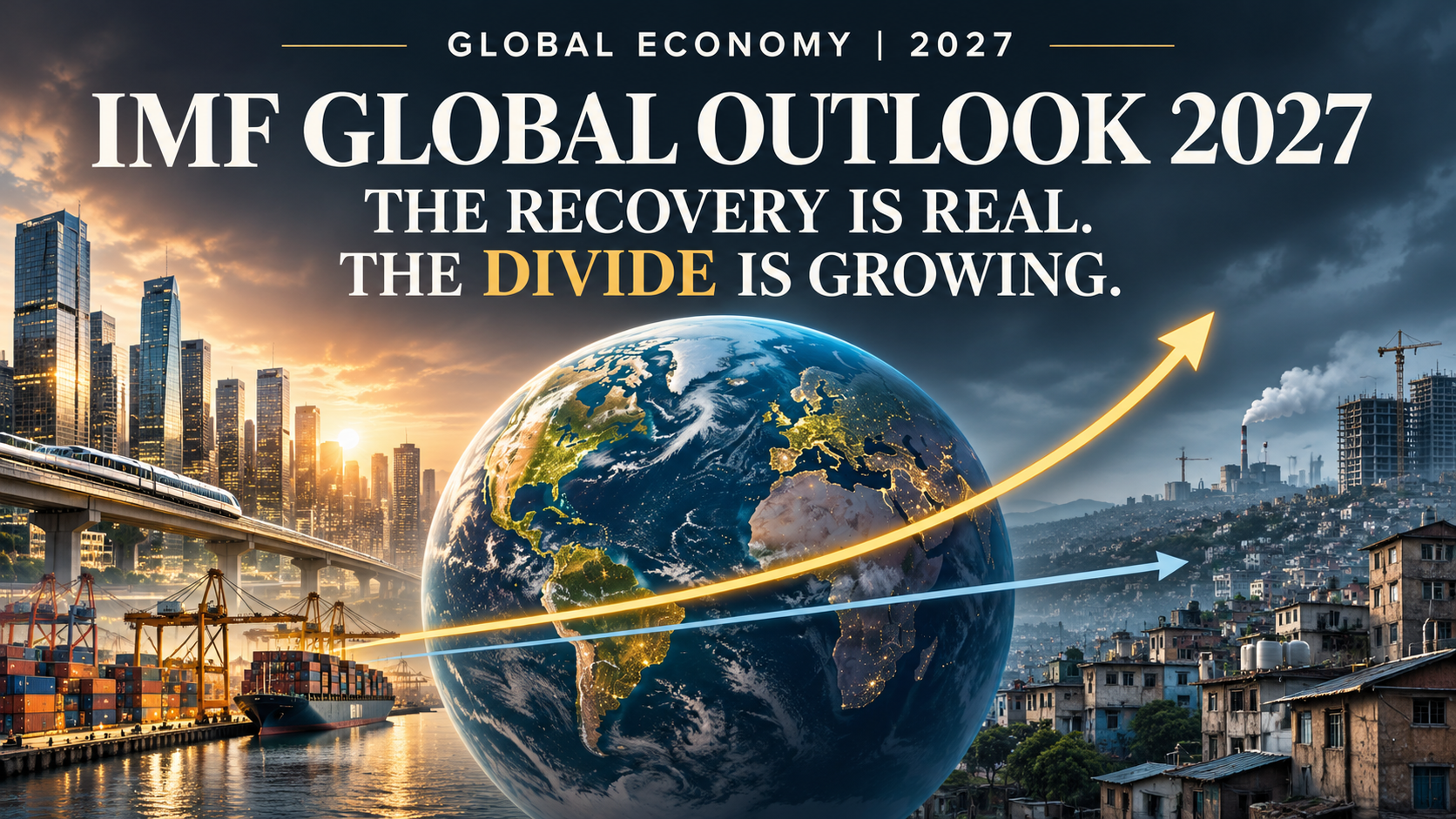
The IMF expects a modest rebound in 2027. Yet an energy shock and AI investment are distributing growth unevenly across countries and industries.
The IMF expects a modest rebound in 2027. Yet an energy shock and AI investment are distributing growth unevenly across countries and industries. This analysis draws on primary documents and contemporaneous reports available on November 6, 2026; subsequent market movements or policy announcements may change the outlook.
The IMF’s October 2026 World Economic Outlook forecasts global growth of 3.1% in 2026 and 3.4% in 2027, with headline inflation moderating from 4.7% to 4.1%. These figures are not a declaration that the world economy has fully recovered. The report, subtitled Resilience Under Strain, Urgent Choices, stresses geopolitical conflict, trade tension, stretched fiscal positions and the possibility of a change in investors’ expectations for AI.
One of its most important caveats is the underlying information cutoff: October 1, 2026. Subsequent market movements, including the November technology sell-off, should be assessed against—not silently folded into—that earlier baseline.
The two-speed world economy
AI-capital investment can sustain exports from economies integrated into advanced technology supply chains, while energy-importing countries outside those networks absorb higher bills. That distinction makes national growth forecasts more useful than one global average. Look at whether earnings are broadening across sectors, whether consumer demand is strengthening and whether investment is productive rather than merely speculative.
The IMF’s Asia-Pacific economic briefing forecasts regional growth of 4.8% in 2026 and 4.4% in 2027. A slowdown can still represent substantial economic expansion. But growth quality, distribution and fiscal headroom determine what households actually experience.
Inflation remains an economic constraint
Global inflation projected at 4.1% in 2027 would be lower than in 2026 yet still imply an increase in overall prices. Consumers care about cumulative food, rent and transport bills, not just whether an inflation percentage has fallen. Central banks must also distinguish one-off supply shocks from persistent wage-price dynamics.
The World Bank’s October commodity outlook projects an easing in broad commodity prices for 2027, but explicitly conditions that outlook on no major further conflict escalation. Policymakers should plan for both baseline normalization and a plausible renewed energy shock rather than assuming a smooth downward path.
The risk of an AI expectations reset
Massive AI investment contributes to GDP through construction, equipment orders and business spending. A correction in the expected profit from those investments can affect valuations immediately even if factories continue operating. If financing becomes harder, projects may be delayed and demand for chips, networking equipment and electricity infrastructure could soften.
The IMF explicitly includes a repricing of AI expectations among downside risks. That is not a prediction that AI will fail. It means that strong technology demand and vulnerable financial valuations can coexist. Investors should distinguish deployment and productivity metrics from the price paid for participating in the boom.
Policy choices are becoming harder
Governments want to support vulnerable households after energy and food shocks but cannot ignore rising interest costs. Broad subsidies can suppress immediate inflation while increasing fiscal pressure or discouraging adjustment. Narrowly targeted support may be cheaper but harder to administer.
A sensible 2027 policy agenda protects essential social spending, mobilizes investment with measurable returns and restores credible medium-term public finances. The key test is whether inflation declines without a severe employment shock, and whether productivity gains spread beyond the technology supply chain.
What a closer look at the source record shows
The available record supports a useful separation between confirmed developments and interpretation. The first column below identifies the type of evidence; the second explains the analytical use, not an independently measured market statistic.
| Research focus | How it informs this story |
|---|---|
| Confirmed evidence | IMF October 2026 World Economic Outlook |
| Interpretive opportunity | Translate forecast into household consequences |
| Secondary question | Date-source cutoffs |
| Next verification | Follow 2027 revisions, incoming inflation prints, oil inventories and credit markets. |
The research priority is relevance rather than sheer citation volume. Repeated references to the same press release do not represent independent confirmation, and authoritative data can support a narrower claim than an ambitious headline suggests. Wherever a numerical fact is used, the source date and stated coverage should travel with it.
How to interpret the evidence without overclaiming
Forecast vintages matter. A projection issued in October must not be quietly represented as knowledge of a market event in November. When comparing forecasts, preserve each report’s publication date and information cutoff. In this article’s subject—IMF global outlook 2027—that distinction prevents superficially precise figures from becoming misleading conclusions. A credible account should explain exactly which evidence supports each inference and what would change the analysis.
Growth is not the same as welfare. Higher output can coexist with falling affordability in some households or regions. Distribution, employment and access to public services matter when judging the quality of recovery. Follow 2027 revisions, incoming inflation prints, oil inventories and credit markets. These checks are important because individual data points can be correct while the story assembled from them is incomplete.
Three specific tests make the coverage stronger:
- Translate forecast into household consequences. Ask what the underlying observation actually measures, which population or companies it covers, and how recent it is. A relevant primary document outweighs a popular unsourced claim.
- Date-source cutoffs. Compare plausible explanations and resist attributing every market or policy movement to one event. When an observed change has several possible causes, explain which are supported and which remain hypotheses.
- Explain divergence between AI winners and importers. Describe what new fact would falsify the prevailing interpretation. Reporting that cannot be revised in the face of new evidence is advocacy, not analysis.
What could validate or derail the IMF baseline
Disinflation becomes broad-based. If oil and food pressures ease and central banks can reduce restrictive settings without destabilizing currencies, more countries may participate in the projected 2027 growth improvement. The strongest confirmation would be rising real household purchasing power and business investment outside the AI supply chain, not merely higher financial-asset prices.
AI and energy risks collide. A renewed disruption in shipping or oil production could sustain inflation just as markets reassess the profitability of massive technology investments. That combination would be harder than a conventional slowdown: authorities could face weak spending and elevated import costs simultaneously. The October IMF forecast explicitly warns about both classes of risk, but does not prescribe one inevitable sequence.
Recovery continues unevenly. The global average reaches something near the baseline while oil importers, indebted states and low-income households lag. That outcome matters for international institutions because a world growth figure can conceal worsening financing and development trade-offs. Country-level revisions, real wages and public debt-service burdens would be more useful tests than headline GDP alone.
A practical research checklist
A reader evaluating this issue should first open the primary sources linked in the article and check their publication dates. Next, identify the specific claim being tested, its units and its geographic or institutional scope. Then compare that evidence with at least one independent account, asking whether the sources are reporting the same underlying data or repeating one another. Finally, distinguish a dated observation from a prediction and note the developments that would demand an update.
For a working editorial desk, this sequence is equally important. A clearly dated article can remain valuable after prices or politics change if its explanations endure and its volatile numbers are identified as snapshots. An article that quietly presents yesterday’s quote as today’s fact, by contrast, loses credibility even when the broader argument is sensible.
A final distinction worth checking
For an editor, the IMF forecast should be paired with the date on which underlying information was available. October 1 is not November 6. If a November market disruption materially changes borrowing or investment assumptions, it is appropriate to discuss that development as a new risk, but not to claim it was already incorporated into the published forecast. Country-specific IMF tables provide a more precise starting point than a global average when evaluating household or corporate consequences.
Questions readers are asking
What is IMF world growth forecast for 2027?
The October 2026 IMF outlook projects 3.4% global growth in 2027.
What inflation does the IMF expect?
Global headline inflation is forecast at 4.1% for 2027, down from 4.7% in 2026.
What are key downside risks?
Conflict escalation, renewed trade tension, fiscal vulnerabilities and reassessment of AI investment expectations.
Is the IMF forecast updated daily?
No. The October outlook uses statistical information available through October 1, 2026; later developments require separate analysis.
The judgment
The IMF expects a modest rebound in 2027. Yet an energy shock and AI investment are distributing growth unevenly across countries and industries. The most responsible conclusion is conditional: Follow 2027 revisions, incoming inflation prints, oil inventories and credit markets. The argument should evolve when new source material is published, rather than being defended simply because it made a compelling headline on November 6. For readers, the value is a clearer distinction among what has already happened, what remains uncertain and what developments would actually change the decision.
Discover more from The Economy
Subscribe to get the latest posts sent to your email.

Tesla Cybercab and Robotaxi Economics in a Post-Midterm Environment

Impact of Pakistan’s Auto Policy on Local Manufacturers and Importers

Anthropic’s Financials and the AI Investment Thesis

Open Banking Trends 2026: What Consumers Should Know

Nvidia After the Selloff: What to Watch Before Earnings

Black Friday 2026 Early Deals: A Data-Driven Shopping Guide

Fed Policy Path 2027: Rate Expectations After the Hold

Asia’s Economic Resilience in 2026: The Strategic Blueprint for Sustaining the Global Growth Engine

Credit Scoring Changes 2026: What Mortgage Buyers Need to Know

10-Year Treasury Yield Outlook for 2027 After the Democratic Sweep

Is the AI Infrastructure Boom Sustainable? A Reality Check

Disability Insurance Demand in 2026: Who’s Buying and Why

What the 2026 Midterms Mean for Treasury Yields and Bond Markets

Payroll Outlook After the Midterms: 2027 Tax Changes, Compliance Risks and AI Trends

Dow Jones Today: Dow Slips 237 Points After the Worst Day Since April 2025

US–Iran Conflict in October 2026: Hormuz, Oil Prices and Diplomacy

Pakistan IMF Programme 2026: Why Bailouts Keep Returning

Singapore Stock Market Outlook 2027: The STI’s Bank-and-Yield Test

SSI November 2026 Payment: Why Benefits Arrive October 30

IMF Global Outlook 2027: The Recovery Is Real, but the Divide Is Growing

2027 Federal Tax Brackets: New IRS Rates and Standard Deductions Explained

World Bank Debt Report 2026: The $9.4 Trillion Burden Behind the Recovery

Stock Market Crash 2026? What the November Rout Actually Tells Us

KSE-100 Index 2026: Is Pakistan’s Stock-Market Recovery Sustainable?

Germany–France ‘Made in Europe’ Deal Could Reshape China’s EV Ambitions

Zhuhai Airshow 2026: How China’s Stealth Jets, Drones and Missiles Are Redrawing Global Air Power

Global Markets Today: The AI Sell-Off Has Become a Test of Liquidity

Singapore’s Bank Sell-Off Is Really a Test of What Stability Is Worth
-

 Markets & Finance10 months ago
Top 15 Stocks for Investment in 2026 in PSX: Your Complete Guide to Pakistan’s Best Investment Opportunities
-

 Analysis9 months ago
Johor’s Investment Boom: The Hidden Costs Behind Malaysia’s Most Ambitious Economic Surge
-

 Analysis9 months ago
Top 10 Stocks for Investment in PSX for Quick Returns in 2026
-

 Banks10 months ago
Best Investments in Pakistan 2026: Top 10 Low-Price Shares and Long-Term Picks for the PSX
-

 Analysis9 months ago
Brazil’s Rare Earth Race: US, EU, and China Compete for Critical Minerals as Tensions Rise
-

 Investment10 months ago
Top 10 Mutual Fund Managers in Pakistan for Investment in 2026: A Comprehensive Guide for Optimal Returns
-

 Global Economy11 months ago
15 Most Lucrative Sectors for Investment in Pakistan: A 2025 Data-Driven Analysis
-

 Global Economy11 months ago
Pakistan’s Export Goldmine: 10 Game-Changing Markets Where Pakistani Businesses Are Winning Big in 2025