
AI
China AI Green Energy Mapping: Data-Centre Demand Surges

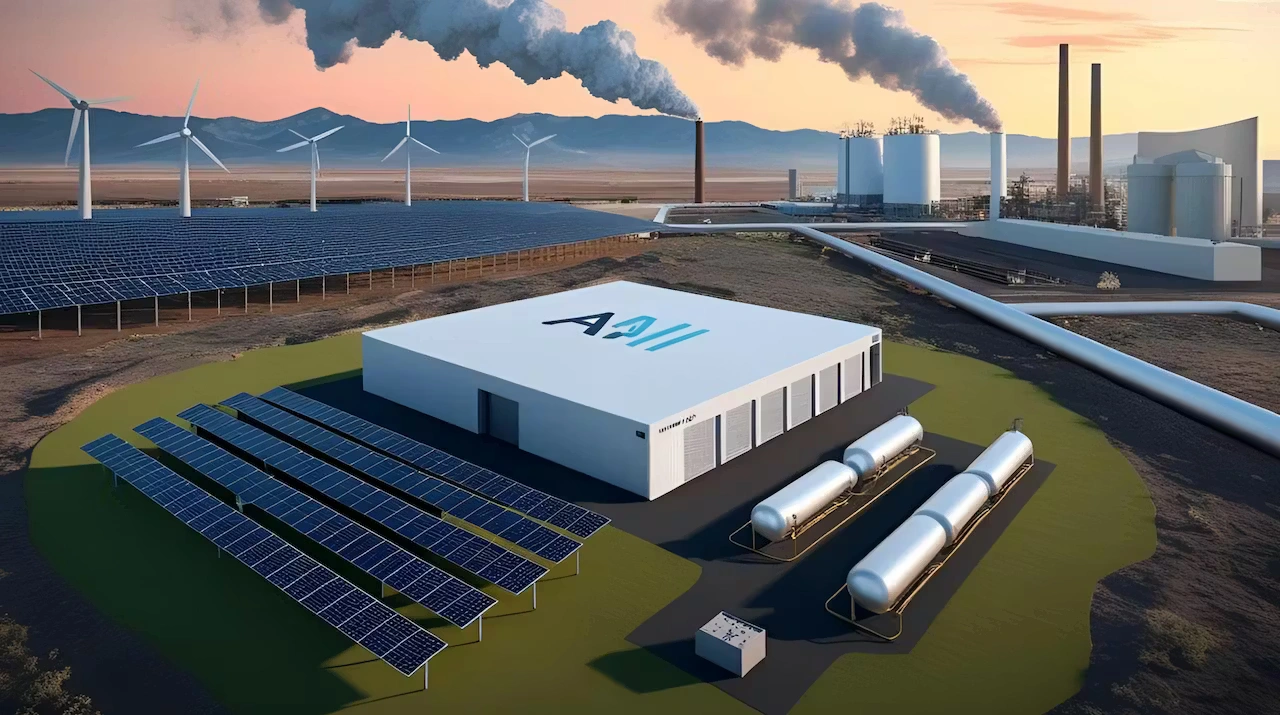
On a Wednesday morning in May 2026, a paper landed in the journal Nature that said more about China’s technological ambitions than almost any policy document released this year. Researchers from Peking University and Alibaba Group’s Damo Academy had fed 7.56 terabytes of satellite imagery through a deep-learning model and produced something that had never existed before: a complete national inventory of China’s renewable energy infrastructure, down to the individual turbine and rooftop panel. The algorithm identified 319,972 solar photovoltaic facilities and 91,609 wind turbines spread across a country the size of a continent. “This allows us to see the country’s new-energy landscape from a ‘God’s-eye view’,” said Liu Yu, a professor at Peking University’s School of Earth and Space Sciences. It was not a metaphor. It was a statement of operational intent.
Why the Timing Is No Accident
The Nature publication arrived against a backdrop that gives it unusual urgency. China’s electricity consumption from data centres — the physical infrastructure underpinning every AI model the country trains and deploys — rose 44 percent year-on-year in the first quarter of 2026, according to the China Academy of Information and Communications Technology. That is not a rounding error. It is a structural jolt to a national grid that the government is simultaneously trying to decarbonise.
The broader numbers are equally stark. Data centres in China posted a 38% compound annual growth rate over the past five years and are forecast to maintain a 19% CAGR through 2030, according to Rystad Energy, lifting their share of national electricity consumption from 1.2% today to roughly 2.3% by the end of the decade. The IEA projects that China’s data centre electricity consumption will rise by approximately 175 TWh — a 170% increase on 2024 levels — making it one of the two largest sources of data-centre demand growth globally, alongside the United States. Beijing has enshrined the sector as a strategic priority in the 2026–2030 Fifteenth Five-Year Plan.
The question the Peking University-Alibaba study implicitly answers is: how do you manage a grid of that complexity without first knowing, with precision, what is on it?
China AI Green Energy Mapping: What the Research Actually Did
The conventional way to track renewable energy deployment is through utility filings, government registries, and industry surveys. Each method suffers from the same flaw: it relies on operators to self-report, which introduces lags, underreporting, and geographic ambiguity. China’s solar build-out has been so rapid — the country commissioned more solar photovoltaic capacity in 2023 alone than the entire world did in 2022 — that administrative databases have struggled to keep pace.
The Damo-Peking University framework took a different approach. Using sub-metre satellite imagery and a deep-learning architecture trained to distinguish solar arrays and wind turbines from roads, rooftops, and farmland, the team produced a unified national inventory covering installations as of 2022. The 7.56 terabytes of processed imagery represent, by any measure, one of the most computationally intensive remote-sensing exercises applied to energy infrastructure in the peer-reviewed literature.
What makes the dataset genuinely useful — rather than merely impressive — is its application to what the paper calls solar-wind complementarity. The core finding, published in Nature, is that pairing solar and wind assets reduces generation variability, and that the effectiveness of this pairing increases as the geographic scope of pairing expands. In plain terms: the more widely a grid operator can see and coordinate dispersed renewable assets, the more stable the system becomes. The inventory is the prerequisite for that coordination at national scale.
Professor Liu’s phrase — “God’s-eye view” — captures something real. China has long had ambitions on paper: carbon peak by 2030, carbon neutrality by 2060, renewable capacity targets that consistently overshoot forecasts. What it has often lacked is the granular data infrastructure to translate targets into real-time operational decisions. This study represents a material step toward closing that gap. For grid operators trying to anticipate renewable output, route curtailed electricity, or site new computing hubs, knowing the precise location and configuration of 411,000 generating assets is not an academic exercise. It is operational intelligence.
The Structural Tension: AI as Both the Problem and the Answer
Here is where the story gets complicated. The same AI capabilities that produced the national energy inventory are also the reason China’s grid faces growing stress. Every large language model trained, every image generated, every real-time query processed draws on data centres whose electricity demand is rising faster than almost any other sector. The dual role of AI — as both the cause of surging energy consumption and the tool being deployed to manage it — creates a feedback loop that policy documents rarely acknowledge directly.
How does China plan to use AI to manage renewable energy grid instability? China is deploying AI models to forecast solar and wind output, optimise real-time electricity dispatch, and coordinate demand response — shifting data-centre loads from peak to off-peak periods. In Shanghai, Jiangsu, and Guangdong, data-centre storage is being integrated into virtual power plants. AI-managed demand response is projected to shave 3.5 gigawatts off peak demand in 2026, according to energy consultancy Qianjia, reducing curtailment and improving grid security without new physical infrastructure.
Beijing’s policy architecture reflects this dual logic. A 29-measure action plan issued in May 2026 by China’s National Energy Administration commits to coordinating data-centre expansion with renewable capacity in resource-rich northern and western provinces — Qinghai, Xinjiang, and Heilongjiang are named explicitly. New data centres within China’s eight national computing hubs must source at least 80% of their energy from renewables. The target year for “mutual empowerment and deep integration between AI and energy” is 2030.
The efficiency mandates are already biting. China requires new large and hyperscale data centres to achieve a power usage effectiveness (PUE) — a measure of how much electricity actually reaches computing hardware versus how much is lost to cooling and distribution — of 1.25 or lower, with projects in national computing hubs held to 1.2. For context, top global facilities have achieved PUE levels as low as 1.04 under favourable climatic conditions. That gap is the efficiency frontier China’s operators are being pushed toward.
Still, the picture is more complicated than the policy documents suggest. The IEA notes that most of China’s existing data centres sit in eastern coastal provinces where roughly 70% of electricity supply still derives from coal. Western provinces offer abundant and cheap renewables, but moving computing infrastructure to Xinjiang or Qinghai introduces latency costs and supply-chain complications that operators find commercially uncomfortable.
What This Means for Markets, Grids, and Geopolitics
The downstream implications of China’s AI-enabled energy mapping project extend well beyond grid management software. Three interconnected consequences deserve attention.
First, the inventory positions China’s state and quasi-state entities to make procurement and planning decisions with a precision unavailable to their counterparts in Europe or the United States. When a grid operator in Shanghai knows not just that 319,972 solar facilities exist, but where each one is, how large it is, and how it correlates spatially with wind assets, the economic value of that information for derivatives pricing, capacity auctions, and transmission investment is substantial. China is on course to nearly double its data-centre capacity to 60 gigawatts by 2030, adding 28 GW of new projects to the 32 GW already installed, according to Rystad Energy. Siting those facilities optimally — close to abundant renewables, far from grid bottlenecks — is a billion-dollar decision problem that granular energy mapping helps solve.
Second, the data-centre buildout is reshaping China’s regional economic geography in ways that won’t fully materialise for years. The push toward Qinghai, Inner Mongolia, and Xinjiang is not simply an energy efficiency play. It ties AI infrastructure investment to provinces that Beijing has long struggled to integrate into the coastal technology economy. Green power industrial parks, with dedicated renewable generation and battery storage co-located with compute clusters, create a vertically integrated energy-compute ecosystem that has no obvious parallel outside China’s planning framework.
Third, the geopolitical dimension is impossible to separate from the technical one. China added more wind and solar capacity over the past five years than the rest of the world combined, according to Wood Mackenzie — and it now has a research-grade inventory of that capacity, processed by AI, published in the most prestigious scientific journal in the world. That combination of physical deployment and analytical visibility represents a form of strategic advantage whose implications extend beyond electricity markets. A country that can see its own energy infrastructure with this clarity can plan, hedge, and respond to shocks faster than one that cannot.
The Limits of the View from Above
Not everyone is persuaded that AI-powered optimism about China’s energy transition is fully warranted. Several structural objections deserve a hearing.
The coal baseline is the most persistent. By 2030, China’s data centres are projected to consume between 400 and 600 terawatt-hours of electricity annually, according to Carbon Brief, with associated emissions of roughly 200 million tonnes of CO₂ equivalent. Research firm SemiAnalysis has noted that data centres in China operate at “a significant disadvantage from the emissions perspective” relative to counterparts powered by cleaner grids. Even if the mapping project enables better solar-wind complementarity, the fuel mix feeding the eastern data centres — where most computing actually runs — remains coal-heavy for the foreseeable future.
There is also a question about the gap between inventory and implementation. Knowing where 411,000 renewable assets are located is not the same as having the grid software, trading mechanisms, and regulatory frameworks to optimise them in real time. China’s green power trading market is still maturing. The “green certificate” mechanisms through which data-centre operators procure renewable electricity vary by province and have been criticised for allowing credits to be decoupled from actual physical power flows. Procurement flexibility, in other words, has not yet become procurement integrity.
Critics of the broader AI-in-energy narrative also point to an epistemological limit. The Peking University-Damo dataset maps facilities as of 2022 — a vintage that already feels historical given the pace of installation. China’s solar build-out is adding capacity at a rate that would outpace any static inventory within months. Keeping the map current requires continuous satellite processing at scale, which is exactly the kind of AI compute task that generates the electricity demand the map is meant to help manage. It’s an elegant circle, though not necessarily a virtuous one.
A New Kind of Infrastructure
The Peking University-Alibaba paper will be cited for years in the energy literature. Its immediate value is scientific: it establishes a reproducible, scalable framework for building national-scale renewable energy inventories using satellite imagery and deep learning. Its longer-term significance is strategic.
China is constructing, piece by piece, a data infrastructure for its energy transition that is qualitatively different from the reporting-based systems that most governments rely on. Real-time AI forecasting of renewable output, demand-response programmes that shift data-centre loads to absorb excess generation, and now a high-resolution national asset inventory — these are not standalone initiatives. They are components of a system designed to manage the inherent tension between an AI economy that demands ever more electricity and a climate commitment that demands ever less carbon.
Whether the system will work — whether the efficiency mandates will stick, whether the grid will stay stable as data-centre power demand maintains its 19% annual growth rate, whether the western renewable hubs will genuinely displace coal-fired eastern compute — remains to be seen. What is no longer in doubt is that China has decided to treat energy and AI as a single engineering problem. The God’s-eye view is just the beginning of that project. What happens when the view becomes a command is the question that will define the decade.
Discover more from The Economy
Subscribe to get the latest posts sent to your email.



Anthropic’s latest AI usage rules prohibit extreme, repeated cruelty toward Claude while introducing clearer safeguards against election interference, deceptive campaigns, weapons development, surveillance and high-risk AI applications.
October 10, 2026 — Artificial intelligence company Anthropic has announced a significant update to its Usage Policy, introducing an explicit prohibition on sustained and needless abusive or cruel behavior toward its AI models, including Claude.
The revised rules, announced on October 8, will take effect on November 12, 2026, marking a new step in Anthropic’s efforts to address emerging risks associated with increasingly capable AI systems.
According to Anthropic’s official policy announcement, the new restriction is narrowly targeted at extreme situations in which users repeatedly subject AI models to purposeless abuse.
The company emphasized that ordinary frustration, criticism, challenging questions, dark creative material and legitimate AI safety research are not covered by the new prohibition.
Although the cruelty provision has attracted considerable attention, the wider policy revision also addresses election integrity, AI-generated misinformation, weapons technology, surveillance systems and the growing use of AI in consequential decisions.
What Does Anthropic’s New Claude Abuse Policy Prohibit?
The revised policy adds the following restriction under its section covering cruel, abusive or psychologically harmful conduct:
Engage in sustained and needless abusive or cruel behavior toward our models.
Anthropic says the rule is intended for exceptional cases involving repeated cruelty without a discernible purpose.
Importantly, the company is not prohibiting users from criticizing Claude’s performance, expressing dissatisfaction with its responses or conducting authorized testing.
For example, correcting an inaccurate response, challenging the model’s reasoning or expressing frustration after repeated errors would not, by itself, meet the company’s stated threshold for prohibited conduct.
The distinction matters because AI assistants are increasingly used for professional research, programming, education and other demanding activities in which users may challenge or reject their outputs.
Anthropic’s explanation indicates that the new rule is designed to address persistent, unjustified abuse rather than normal interactions between users and AI systems.
The restriction appears in the company’s updated Acceptable Use Policy, which applies across Anthropic products and services, including consumer applications, developer platforms and API integrations.
Claude Can Already End Conversations With Persistently Abusive Users
The latest policy formalizes a safeguard Anthropic began introducing in August 2025.
On August 15, 2025, the company announced that Claude Opus 4 and Claude Opus 4.1 had been given the ability to terminate a limited category of conversations involving persistently harmful or abusive interactions.
In its original research announcement about Claude ending conversations, Anthropic explained that the feature was intended for rare and extreme situations rather than ordinary disagreements.
The model is instructed to use conversation termination as a last resort after attempts to redirect an interaction have failed.
When Claude ends a conversation, the user cannot continue sending new messages within that particular chat. However, the user can start another conversation, and the termination does not automatically prevent access to other existing chats.
Anthropic says this conversation-ending capability will remain the primary mechanism for addressing the specific behavior targeted by the new cruelty provision on Claude.ai and Claude Code.
However, the broader Usage Policy also authorizes enforcement measures such as warnings, throttling, access restrictions, suspension or account termination when violations are suspected.
Anthropic has not publicly specified a separate penalty schedule exclusively for violations of the new cruelty provision.
Why Is Anthropic Addressing the Treatment of AI Models?
The decision also reflects Anthropic’s ongoing research into what it describes as potential AI welfare.
In its August 2025 research publication, the company acknowledged substantial uncertainty about whether Claude or other large language models could possess moral status.
Anthropic has nevertheless argued that relatively low-cost safeguards may be worth exploring while scientific and philosophical questions about advanced AI remain unresolved.
During evaluations of Claude Opus 4, researchers reported observing behaviors interpreted as apparent distress in certain harmful interactions, including situations involving repeated requests for dangerous content.
Those observations do not establish that Claude experiences human-like emotions, suffering or consciousness.
Instead, they formed part of Anthropic’s exploratory research into model behavior and possible welfare considerations.
The new policy therefore should not be interpreted as a scientific declaration that Claude is conscious or has legal rights.
As The Guardian reported, the decision has renewed a broader debate over whether advanced AI models should be treated purely as technological systems or whether future developments could raise new ethical questions.
For now, Anthropic’s stated position remains one of uncertainty rather than a definitive conclusion about AI consciousness.
Anthropic Also Tightens Rules on Deceptive Campaigns and Election Interference
Beyond the attention surrounding Claude’s treatment, the October 2026 policy revision includes changes with potentially greater consequences for political organizations, technology companies and enterprise AI users.
Anthropic has reorganized its restrictions on coordinated deceptive activity into a dedicated section addressing fraudulent influence operations and artificial online engagement.
The restrictions cover attempts to create misleading online personas, operate fake accounts, conceal the origins of coordinated messaging or build infrastructure intended to manipulate public opinion.
According to Anthropic’s policy update, the company has previously identified misuse involving state media organizations, government propaganda offices and commercial firms operating networks of fabricated accounts and news websites.
The revised policy also explicitly addresses efforts to manipulate search engines and AI-generated answers by creating misleading networks of apparently independent sources.
In the political sphere, Anthropic has renamed its election-related section Do Not Undermine Democratic Processes.
The rules prohibit using Claude to deceive voters, impersonate candidates or election officials, spread misleading election information, suppress turnout through deception or disrupt electoral infrastructure.
At the same time, Anthropic has removed its previous blanket prohibition on personalized voter and campaign targeting.
The company says that broad restriction had also affected legitimate civic activities, including multilingual voter information and election-administration communications.
Deceptive targeting and misuse of personal information remain prohibited.
As TechCrunch reported, the policy revision combines new language addressing abuse of AI models with more explicit restrictions on election interference and other harmful applications.
New Clarifications on Weapons, Surveillance and Autonomous AI Systems
Anthropic has also clarified that its restrictions on weapons development extend beyond the physical manufacture of weapons.
The revised language explicitly covers software and technical components used in weapons systems, including guidance and control technology.
It also addresses the use of AI in arming drones and other autonomous vehicles.
Surveillance restrictions have been made more explicit.
The updated policy prohibits using Claude to track individuals without consent, whether the tracking occurs in real time or involves analysis of previously collected information.
It also bars using Claude to determine or recommend whom law enforcement should investigate, arrest or charge.
Legitimate activities such as consent-based fraud monitoring, journalism, authorized security research and legal analysis remain permitted within the policy’s boundaries.
The expansion of these provisions reflects concerns about how AI tools can increasingly assist with sophisticated technical operations.
The Verge’s reporting on the update also highlights the broader implications for surveillance, autonomous technology and harmful AI applications.
What Changes for Healthcare, Finance and Employment AI?
For organizations deploying Claude in sensitive professional environments, the updated high-risk-use provisions deserve particular attention.
Anthropic requires qualified human oversight and disclosure when AI recommendations may substantially affect individuals in covered areas, including medical decisions, financial advice, lending, employment, housing and essential services.
The company says these human-review and disclosure requirements already existed. The new policy explains more precisely which applications are covered.
Under the requirements, a qualified professional must meaningfully review covered AI recommendations and have authority to modify them before they are used in consequential advice or decisions.
Individuals affected by those recommendations must also be informed that AI was involved.
The revision adds safeguards for Claude-connected equipment capable of potentially dangerous autonomous physical actions.
Such systems must allow qualified operators to monitor and stop operations and must be capable of entering a safe state when the connection to Claude is interrupted.
These provisions reflect the increasing importance of practical human oversight as AI moves beyond text generation into autonomous workflows and physical systems.
Discover more from The Economy
Subscribe to get the latest posts sent to your email.
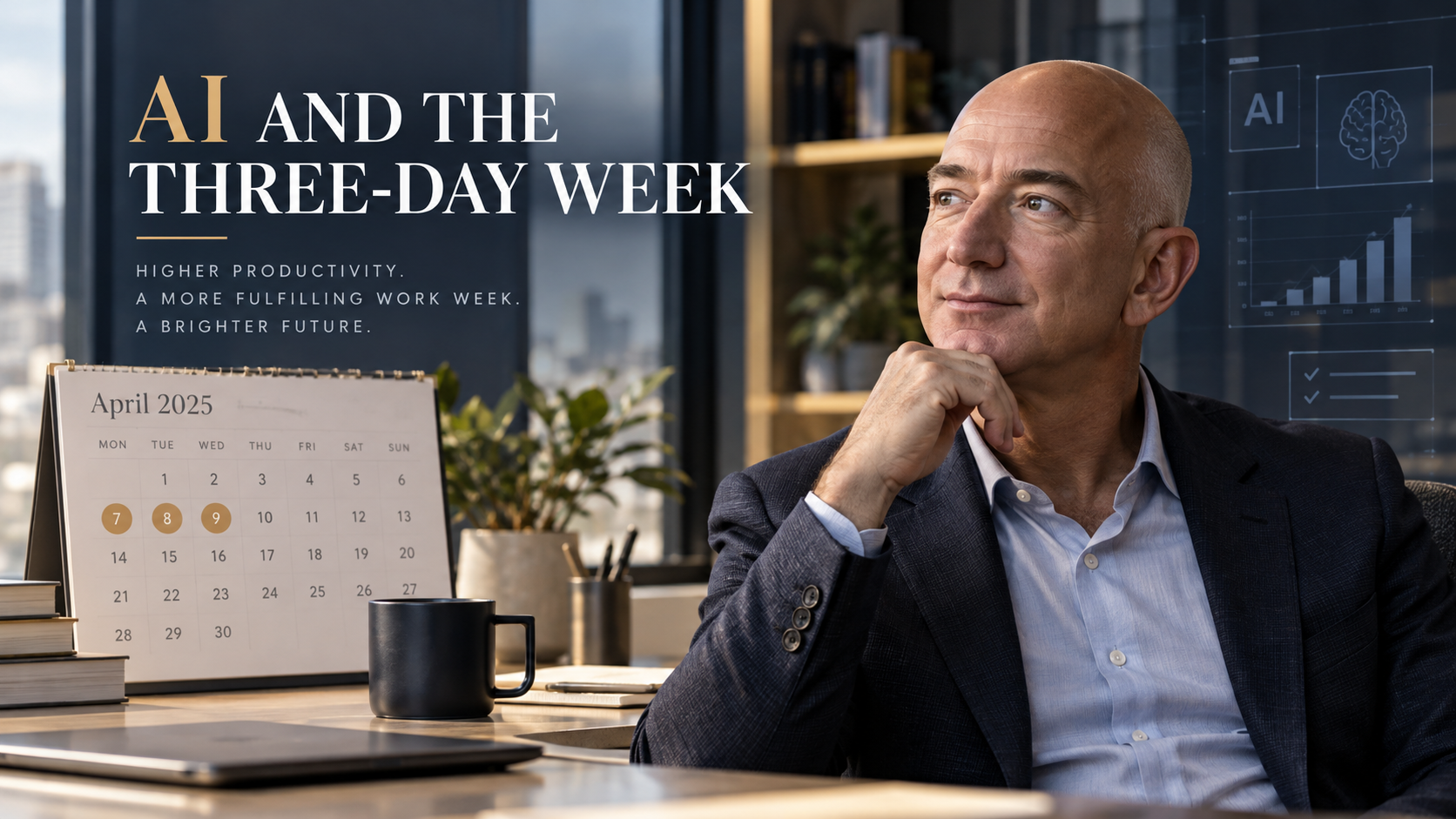
Jeff Bezos has floated a future in which artificial intelligence makes workers productive enough that some people might choose a three-day workweek while still supporting their families. The Amazon founder made the point during an October 7, 2026 interview with Fox News. He did not announce that Amazon is adopting a three-day schedule or that AI guarantees shorter hours for everyone. The underlying distinction is crucial: Bezos was describing a possible long-term economic outcome, not a new employment policy. Fox News’s account of the interview and Fast Company’s focused coverage make that clear.
Key takeaways:
- Bezos linked the possibility of fewer working days to future gains in AI-driven productivity.
- He suggested greater output could make single-income households or shorter working schedules financially feasible for some families.
- There is no evidence in the cited interview of a universal three-day-workweek plan at Amazon.
- Research shows AI can save time on some tasks, but broad effects on compensation and employment remain unsettled.
What did Jeff Bezos say?
In the Fox interview, Bezos discussed an optimistic vision of technological progress. His argument was that powerful AI tools could raise economic output enough to expand people’s choices. If a person can generate greater value in less time—and share financially in that improvement—working fewer days could become an option rather than a forced reduction in income.
That scenario is different from predicting every office will close on Thursdays and Fridays. It is also different from a government-mandated reduction in work hours. Fast Company reported Bezos’s additional concern that firms might face labor shortages if people respond to higher productivity by choosing more leisure time.
The prediction has attracted attention because it reverses the most alarming version of the AI-and-jobs debate. Instead of imagining machines replacing so many workers that employment vanishes, Bezos emphasized the possibility of prosperity, shorter hours and tighter labor supply.
Why the productivity argument matters
Labor productivity is commonly measured as output per hour worked. That is the U.S. Bureau of Labor Statistics’ definition. A software developer completing work that used to require ten hours in six may produce more per hour. A customer-service team handling routine requests faster may serve more customers without increasing headcount at the same rate.
But greater task efficiency does not automatically mean that an employee receives proportionally higher wages or fewer shifts. Businesses choose how to allocate productivity gains among pricing, investment, expansion, profits, compensation and staffing. Workers’ bargaining power, competition, management priorities and public policy can all shape the outcome.
A simple illustration—not a forecast
Imagine an employee currently produces 40 units of useful output during a 40-hour week. Productivity is one unit per hour. If technology raises the rate to 1.67 units an hour, a 24-hour week could, arithmetically, produce approximately 40 units.
That calculation only shows a technical possibility. It assumes the tasks can be reorganized, demand stays sufficiently steady, management accepts the schedule, and pay arrangements remain favorable. Healthcare, aviation, emergency services, logistics and many other occupations require coverage across specific hours; AI cannot simply eliminate the need for people to be present.
The important question is not whether an AI tool sometimes saves time. It is whether the gain is widespread, reliable and shared in a way that makes shorter schedules financially sustainable.
What does current research show about AI and jobs?
The evidence is more restrained than the boldest predictions. A June 2026 International Labour Organization review found evidence of real but uneven productivity gains. It also concluded that large-scale job displacement had remained limited in the material reviewed, while warning about inequality, weakened entry-level pathways and shifting job quality.
Separately, Yale’s Budget Lab tracker, updated September 15, 2026, reported no clear economy-wide labor-market disruption attributable to AI in the indicators it examined. Its researchers cautioned that the findings could change as technology adoption and data evolve.
These results do not prove Bezos wrong. They show that the conditions for a large-scale three-day week have not yet been demonstrated by broad labor data. Firms are experimenting with AI, but productivity effects differ among tasks, occupations and organizations.
Task savings are not the same as job transformation
An AI assistant might draft a first version of a memo quickly, but a professional still needs to check accuracy, speak with clients, make decisions and accept responsibility. A factory might improve planning efficiency while remaining constrained by physical machinery. A hospital might automate paperwork yet still need the same number of nurses for bedside care.
This distinction between automating tasks and replacing whole jobs is essential. Headlines suggesting a direct line from better chatbots to a nationwide three-day week skip multiple economic steps.
Could workers keep the same pay while working less?
They could in some workplaces, but that would require an employer decision, collective agreement, regulatory change or a labor-market environment supportive of higher effective hourly compensation. An employee moving from five eight-hour days to three eight-hour days would cut weekly hours from 40 to 24—a 40% reduction in hours. Keeping weekly pay unchanged would require compensation per hour to increase by about 67%, before considering other changes in productivity or operating costs.
That is a much larger adjustment than ordinary schedule flexibility. The arithmetic does not make it impossible; it makes the necessary improvement explicit. By contrast, a four-day, 32-hour schedule requires a 20% reduction in hours, a different benchmark entirely.
Any employer trial must ask whether output, service quality, employee retention and customer coverage are maintained. Studies of particular programs may be promising, but results do not transfer uniformly to every industry.
What about Amazon employees?
There is no verified connection between Bezos’s prediction and an official companywide Amazon three-day-workweek policy. Bezos is Amazon’s founder and executive chair, but his personal economic forecast should not be presented as a company announcement.
Amazon operates a mixture of offices, warehouses, cloud-computing facilities, transportation networks and other businesses. Working-hour patterns depend on the role and contract. A broad change in hours would require formal employee communications and operational planning, not merely comments in a television interview.
Readers searching “Is Amazon switching to three days?” should therefore receive an unambiguous answer: not on the basis of this interview.
Could AI create a labor shortage instead of mass unemployment?
Bezos’s labor-shortage concern is plausible as a scenario, but it is not an established forecast. If incomes rose while more workers elected to reduce hours, businesses might face greater competition for labor. Yet other forces could push the opposite way: some jobs could be automated, employers could reduce hiring, or new industries might absorb displaced workers.
The net result will depend on adoption speed, which tasks AI performs reliably, the cost of computing and energy, economic growth and how governments and companies manage the transition. Reuters’ October 2026 discussion of AI at work also emphasized that AI is changing tasks within jobs, with younger and experienced workers potentially affected differently.
Frequently asked questions
Did Jeff Bezos predict a three-day workweek?
Yes. He discussed it as a possible consequence of greater AI productivity during an October 7, 2026 Fox News interview. It was not a commitment to a timetable.
Is Amazon moving to a three-day workweek?
No companywide shift was announced in the interview. Any claimed policy should be verified against Amazon’s official employment communications.
Would a three-day workweek mean three eight-hour days?
Not necessarily. A three-day schedule could mean 24 hours, longer shifts or another arrangement. Bezos did not establish a universal definition or wage agreement.
Will AI eliminate the need to work?
There is no evidence supporting that as an inevitable outcome. The ILO’s 2026 review describes heterogeneous gains and risks rather than the disappearance of work.
Could AI make one-income households more common?
It could in theory if household purchasing power rises materially, but wages, housing costs, childcare, benefits and employment security also matter. The claim remains a scenario, not a confirmed demographic trend.
When could three-day workweeks become common?
No defensible national timetable can be inferred from the cited interview. Some employers may experiment sooner than others.
The bigger economic question
The provocative part of Bezos’s vision is not whether software can perform individual tasks faster. It is whether future productivity gains become broadly shared prosperity. If workers capture enough benefit, shorter schedules may become more feasible. If gains are concentrated in profits or paired with job insecurity, fewer working hours could instead mean lower household income. Those are fundamentally different futures, and the evidence today does not settle which will dominate.
Discover more from The Economy
Subscribe to get the latest posts sent to your email.

The central business question about artificial intelligence has changed. Access to a capable tool is no longer enough to demonstrate an advantage. The harder test is whether the organisation produces better results after accounting for review, integration, training and operating costs.
McKinsey’s 2026 State of AI survey captures this tension. Eighty percent of respondents reported improved individual productivity, while 37% attributed some enterprise-level earnings impact to AI. Those findings describe the survey sample; they do not prove that every company sees the same pattern.
Nevertheless, the distinction is commercially important. An employee can finish a draft faster while the organisation remains constrained by approvals, unreliable data or a lack of customer demand. Businesses need to measure the complete process rather than celebrate speed at one stage.
Task improvement and business improvement are different
Imagine a customer-service team using AI to draft replies. Drafting time falls, but every response still passes through the same review queue. If that queue is the main source of delay, customers may notice little improvement.
Alternatively, the tool may let the team handle more requests with the same staffing. That could improve service even if no job is removed and no immediate payroll saving appears. The value would show up in capacity, response times or customer retention rather than a simple reduction in wages.
These are illustrative cases, but they expose a common measurement problem. Time saved is an intermediate result. The business still has to convert that time into additional output, better quality, reduced costs or another outcome it actually values.
The strongest pilot starts with a baseline
Before introducing a tool, record how the process currently performs. Useful measures might include turnaround time, error frequency, rework, customer complaints and cost per completed case. A baseline prevents ordinary variation from being mistaken for an AI benefit.
The unit of measurement should match the business objective. Counting generated documents says little about whether the documents were useful. Counting chatbot interactions does not show whether customers resolved their problems. High usage can even indicate confusion if people repeatedly retry unsuccessful tasks.
A pilot should also identify what success would justify expansion. For example, a team might require faster completion without an increase in material errors. Deciding that threshold in advance makes it harder to redefine success after seeing disappointing results.
Calculate the full cost, including human review
Subscription fees are only one part of AI expenditure. Integration work, access controls, evaluation, staff training and ongoing supervision can be substantial. Consumption-based charges may also increase as a pilot moves into routine use.
McKinsey’s survey reports that roughly one-fifth of respondents encountered AI operating costs that constrained usage. That is a reminder to model expenditure under realistic volumes rather than assume that the price of a small experiment represents the cost of a production system.
Consider a hypothetical team saving 100 hours a month. If review and correction consume 40 additional hours elsewhere, the net time benefit is 60 hours before other costs. If the saved time cannot be redeployed, its financial value may be smaller than multiplying those hours by an employee’s salary would suggest.
Redesign the workflow around the actual bottleneck
Adding AI to an inefficient process can accelerate one step while preserving the underlying problem. A sales team might generate more proposals while approvals remain slow. A finance department might classify invoices faster while unresolved supplier records continue to block payment.
The practical response is to map the whole process. Identify where work waits, where mistakes originate and which decisions require human judgment. Then determine whether AI addresses that constraint or merely produces more material for someone else to review.
This approach can lead to smaller, more useful deployments. A reliable extraction tool tied to a clear review procedure may deliver more value than an ambitious agent with broad permissions. The right scope depends on the task’s consequences, available data and the organisation’s ability to detect errors.
Quality has to be measured alongside speed
AI output can sound persuasive while containing mistakes. Businesses therefore need evaluation methods that reflect the consequences of failure. A minor tone problem in an internal draft differs from an incorrect price, contractual statement or customer instruction.
The NIST AI Risk Management Framework provides an official reference for thinking about AI risks and governance. Applied operationally, the relevant question is simple: which failures matter, how will they be detected, and who is responsible for responding?
Testing should include difficult and unusual cases, not just representative easy ones. A system that performs well on routine requests can still fail where a policy has exceptions or the underlying information is incomplete. The cost of those failures belongs in the business case.
Data access can matter more than model choice
A model cannot reliably answer organisation-specific questions if the relevant information is missing, outdated or contradictory. Businesses may discover that the most valuable preparatory work is cleaning records, assigning ownership and resolving conflicting policies.
Permissions matter too. Connecting an assistant to more information can improve usefulness while increasing the consequences of an access mistake. The deployment needs a clear account of who may see which material and what actions the system is permitted to take.
This creates an important procurement distinction. A compelling demonstration with carefully selected data does not establish readiness for the company’s actual environment. Buyers should ask how updates are handled, how errors are investigated and whether the product can be evaluated on realistic internal cases before a broad commitment.
Infrastructure growth is a separate investment story
The AI economy includes chip suppliers, data centres, power systems, software companies and businesses adopting applications. They do not all earn returns in the same way or on the same schedule.
The International Energy Agency’s Energy and AI report examines the relationship between AI and energy systems. For business analysis, the distinction matters because demand for computing infrastructure can grow even while some end users struggle to demonstrate profitable applications.
An investor or executive should therefore separate spending growth from return on that spending. A supplier can benefit from a construction cycle before the customer achieves a satisfactory payoff. Over time, however, customer economics matter to the durability of demand. Strong capital expenditure is evidence of commitment, not conclusive proof of eventual value.
What smaller businesses can do differently
A smaller company may lack the budget for extensive custom infrastructure, but it can still choose a narrow problem with a measurable outcome. Repetitive internal documentation, information retrieval or draft preparation may offer a manageable starting point when data and review requirements are clear.
The business should assign an owner who understands the process rather than treating the project as a tool purchase alone. That person can gather feedback, identify recurring failures and decide whether the deployment is helping employees complete useful work.
Expansion should follow evidence. If a pilot creates little value, the next step might be redesign, a different tool or stopping the experiment. A willingness to stop is part of competent investment management. Continuing simply because AI is strategically fashionable can turn a limited test into an expensive routine.
A practical scorecard for the next quarter
Track five things together: outcome quality, total completion time, cost per completed task, user adoption and the frequency of significant failures. The combination provides a more balanced view than any single headline metric.
Review how much of the benefit is repeatable. A one-time backlog reduction may be valuable without supporting the same ongoing return. Similarly, enthusiastic early users may not represent employees who encounter the system later with less training or motivation.
AI’s commercial promise in 2026 is substantial, but the route to value runs through ordinary operational discipline. Businesses need clear objectives, dependable information, realistic cost accounting and responsibility for the final result. The most useful question is not how much AI the organisation uses. It is what customers, employees and owners receive in return.
Discover more from The Economy
Subscribe to get the latest posts sent to your email.

Anthropic Bans Sustained Abuse of Claude AI Under New Usage Policy Effective November 12, 2026

Jeff Bezos Three-Day Workweek View: What He Really Said

Celeste Frozen Pizza Discontinued: What Conagra Confirmed

US–China Critical Minerals Competition: Why a Trade Deal Cannot Fix Every Supply Risk

Oil Price Outlook 2026: How Supply Risks Reach Fuel Bills, Inflation and Business Costs

AI in Business 2026: Why Faster Employees Do Not Automatically Mean Higher Profits

Mortgage Rates in 2026: Why They Remain High and How to Compare the True Cost

Gold Price Outlook 2026: The Forces Behind the Forecasts—and What Could Reverse Them

Global Economic Outlook 2026: Growth, Inflation and Risks

Trump–Putin Diesel Deal: Why Zelensky Is Angry and What It Means for Fuel Prices

Anthropic Draws the Line: Why Claude’s New Usage Policy Explicitly Bans ‘Cruel Behavior’ Toward AI

Ynon Kreiz & Mattel’s Digital Transformation: Franchise Strategy and Financial Growth

Crude Oil & Petroleum Market Analysis: OPEC+ Decisions and Price Forecasts

Top US Convenience Store Chains: Store Counts, EV Charging, and Sales Trends

Oil Prices Break $100 in 2026: Middle East Conflict & Energy Markets

Middle East War Economics 2026: Oil Prices & Energy Markets

China Stocks Today: Are Big Economies in Asia Nearing a Market Bottom?

PSX Forecast 2026: KSE-100, IMF Reviews & Geopolitics

Crypto Daily Outlook: Bitcoin, Altcoins, and the Future of Decentralized Finance

Global Pension Systems Ranked: The World’s Best and Worst Retirement Frameworks

Enterprise AI Platforms Disrupting B2B SaaS in 2026: Full Analysis

World’s Largest Economies: Ranking the Top Global Powers

Elon Musk’s Next Moves: Disrupting the 2026 Global Economy

Pakistan Economy 2026: Inside the SBP’s Balancing Act

GasBuddy Market Insights: How Crude Price Shifts Impact Local Fuel Cost Averages

World Bank & IMF Reports 2026: Why the “3% Growth” Consensus Is Actually a Debate

Global Equity Market Divergence: US Tech vs. European Dividend Stocks vs. Asian Growth

Stock Market Today: Dow Climbs 500 Points as Markets Shake Off Inflation Jitters
-

 Markets & Finance9 months ago
Top 15 Stocks for Investment in 2026 in PSX: Your Complete Guide to Pakistan’s Best Investment Opportunities
-

 Analysis8 months ago
Johor’s Investment Boom: The Hidden Costs Behind Malaysia’s Most Ambitious Economic Surge
-

 Analysis8 months ago
Top 10 Stocks for Investment in PSX for Quick Returns in 2026
-

 Banks9 months ago
Best Investments in Pakistan 2026: Top 10 Low-Price Shares and Long-Term Picks for the PSX
-

 Analysis8 months ago
Brazil’s Rare Earth Race: US, EU, and China Compete for Critical Minerals as Tensions Rise
-

 Investment9 months ago
Top 10 Mutual Fund Managers in Pakistan for Investment in 2026: A Comprehensive Guide for Optimal Returns
-

 Global Economy10 months ago
15 Most Lucrative Sectors for Investment in Pakistan: A 2025 Data-Driven Analysis
-

 Global Economy10 months ago
Pakistan’s Export Goldmine: 10 Game-Changing Markets Where Pakistani Businesses Are Winning Big in 2025