
Terms & Definitions
Understanding Foreign Exchange Reserves: Key Purposes and Global Impact

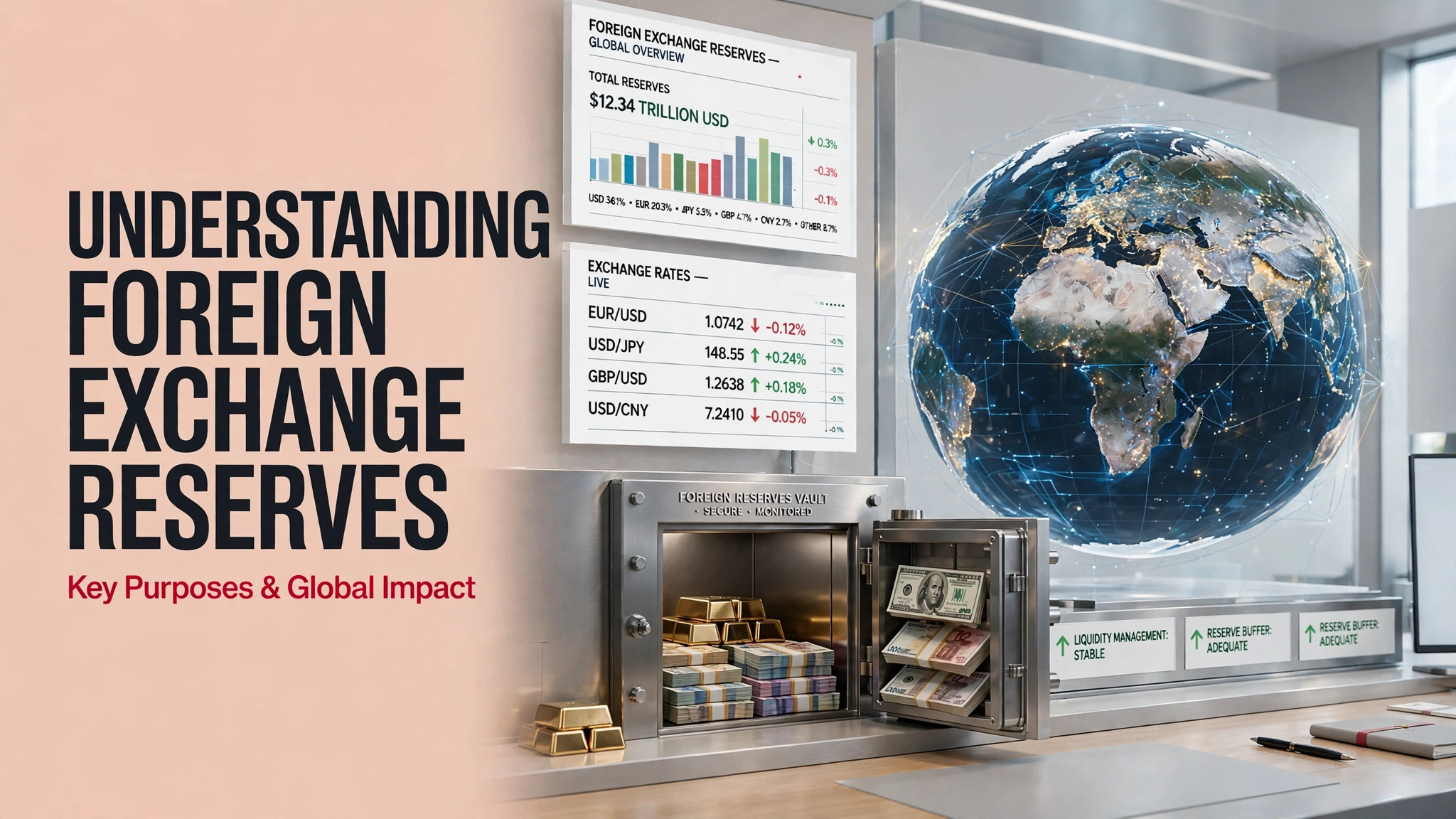
A Nation’s Ultimate Financial Safety Net and Macroeconomic Shield
Foreign Exchange Reserves (often referred to as forex reserves or FX reserves) are reserve assets held in foreign currencies by a central bank or monetary authority. These assets typically include major global currencies like the US Dollar, Euro, British Pound, Japanese Yen, and Chinese Yuan, alongside gold holdings, special drawing rights (SDRs) with the International Monetary Fund (IMF), and reserve position tranches.
For readers of Thefinance.pk and Economy.com.pk, monitoring foreign exchange reserves is akin to tracking a patient’s vital signs in an intensive care unit. In an interconnected global economy where international trade is settled in hard currencies, a central bank’s reserves represent its ultimate financial shield against external shocks, capital flight, and speculative currency attacks.
The Composition of Forex Reserves
Not all foreign exchange holdings are created equal. Central banks meticulously diversify their reserve portfolios based on liquidity, safety, and yield considerations. The primary constituents of a modern reserve portfolio include:
- Foreign Currencies: This is the lion’s share of any reserve portfolio. Because global trade—particularly commodities like crude oil, natural gas, and industrial metals—is predominantly invoiced in US Dollars, central banks hold massive amounts of USD-denominated assets, primarily liquid US Treasury bonds.
- Gold Reserves: For centuries, gold has served as the ultimate hedge against geopolitical instability, systemic banking crises, and hyperinflation. Central banks hold physical gold bars in domestic vaults or safe havens like the Bank of England to maintain long-term sovereign credibility.
- Special Drawing Rights (SDRs): An international reserve asset created by the IMF in 1969. The SDR is not a currency itself, but rather a potential claim on the freely usable currencies of IMF member countries. It acts as a supplemental reserve asset for nations facing liquidity squeezes.
- Reserve Position in the IMF: Each IMF member country is assigned a quota, part of which must be paid in reserve assets (foreign currencies or SDRs). This portion can be withdrawn almost unconditionally if the country faces an urgent balance of payments need.
The Critical Metric: Import Cover
To determine whether a country’s foreign exchange reserves are healthy, economists do not look at the absolute dollar figure in isolation. A reserve pile of $10 billion might sound massive to an individual, but for a nation of 240 million people that imports billions in fuel and food every month, it could be dangerously low.
Instead, analysts use the metric of Import Cover. Import cover measures how many months of continuous imports a country can sustain using strictly its existing foreign exchange reserves, assuming zero new export earnings or foreign inflows.
- The Safe Threshold: International financial institutions like the IMF generally recommend that developing economies maintain a minimum of 3 months of import cover.
- The Danger Zone: When import cover drops below 2 months, panic sets in. Importers struggle to open Letters of Credit (LCs) for raw materials, manufacturing lines halt, and sovereign risk ratings plummet.
- The Comfortable Zone: Emerging markets striving for absolute macroeconomic stability aim for 4 to 6 months of import cover to insulate themselves against global supply chain shocks or sudden spikes in global oil prices.
How Reserves Are Built and Depleted
Foreign exchange reserves are not static; they fluctuate continuously based on the inflows and outflows of a nation’s external sector.
Accumulating Reserves:
- Export Surpluses: When domestic companies sell more goods and services abroad than they buy, foreign currency flows into the country, which the central bank can buy up.
- Worker Remittances: Funds sent home by expatriates enter commercial banks, providing a steady stream of foreign exchange that bolsters central bank reserves.
- Foreign Direct Investment (FDI) and Sovereign Borrowing: International loans from multilateral lenders (World Bank, Asian Development Bank) or sovereign bond issuances directly inject hard currency into the reserve pool.
Depleting Reserves:
- Defending the Local Currency: If the local currency begins to crash due to market panic, the central bank intervenes by selling US Dollars out of its reserves and buying up local currency to artificially prop up its value. This is often a losing battle if the underlying economic fundamentals are weak.
- Debt Servicing: Governments must pay the principal and interest on their foreign debt in hard currency. In years where debt repayments peak, reserves take a massive hit.
- Financing Trade Deficits: When export earnings fall short of import bills, the gap must be settled using central bank reserves.
The Role of Reserves in Speculative Attacks
Foreign exchange reserves serve as a deterrent against currency speculators. During the 1997 Asian Financial Crisis, several Southeast Asian nations saw their currencies collapse because hedge funds realized their central banks had dangerously low reserves and could not maintain their fixed exchange rates.
When a central bank’s reserves are robust, speculators know that any attempt to short the local currency will be met with overwhelming intervention by the central bank, which can flood the market with dollars to stabilize prices. Conversely, when reserves are depleted, it serves as an open invitation for capital flight. For analysts at economist.media, tracking reserve fluctuations is the single most reliable way to predict whether a government will successfully navigate an economic crisis or be forced into an emergency IMF bailout.
Key Takeaways:
- Foreign exchange reserves are hard currencies and gold held by central banks to back domestic liabilities and pay for international trade.
- Import cover is the gold standard for measuring reserve health, with 3 months being the minimum safe threshold.
- Reserves are depleted by trade deficits, debt servicing, and futile attempts to defend a crashing local currency.
- Robust reserves protect a nation from speculative attacks and ensure uninterrupted imports of critical commodities like oil and medicine.
Authoritative Sources & Further Reading:
- World Bank: Total Reserves (includes gold, current US$) Data Portal
- International Monetary Fund (IMF): Guidelines for Foreign Exchange Reserve Management
- State Bank of Pakistan (SBP): Liquid Foreign Exchange Reserves Weekly Data
Discover more from The Economy
Subscribe to get the latest posts sent to your email.


Economics
Purchasing Power Parity (PPP) Explained: Global Rankings, Living Standards & Why Nominal Exchange Rates Mislead in 2026
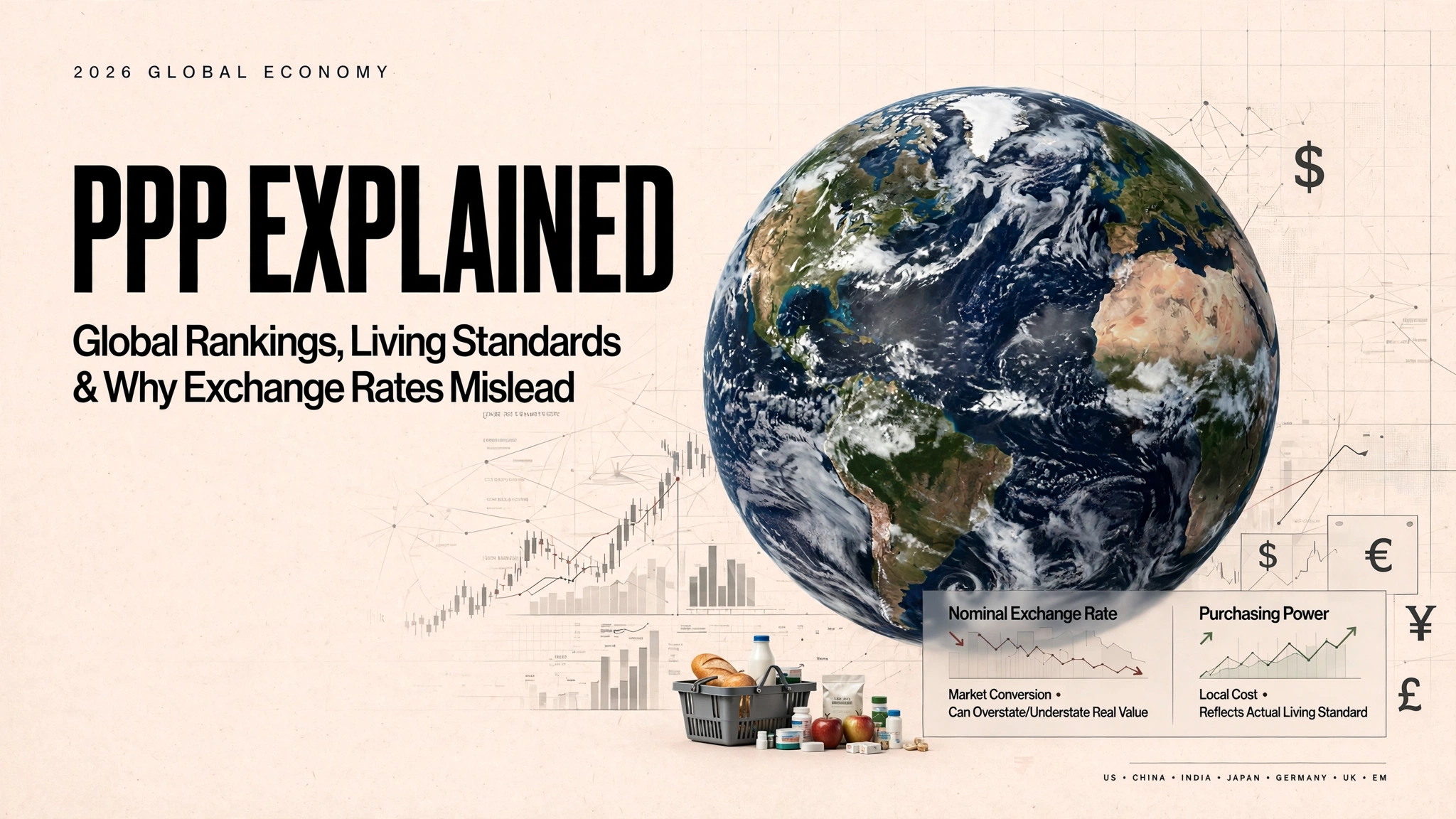
Comparing Global Living Standards Beyond Nominal Exchange Rates
Purchasing Power Parity (PPP) is a foundational economic theory and measurement technique used to compare the economic productivity, price levels, and standards of living between different countries.
If you look strictly at nominal Gross Domestic Product (GDP) converted to US Dollars at prevailing market exchange rates, developing economies often appear drastically smaller than they actually are in real terms. PPP solves this distortion by calculating what an exchange rate should be if a identical basket of goods and services cost the exact same amount in two different countries.
For financial analysts, macroeconomists, and readers of Thefinance.pk and Economy.com.pk, PPP provides the most accurate “apples-to-apples” comparison of global economic power.
The Core Concept: The Law of One Price
The theoretical foundation of PPP is the Law of One Price. This economic principle states that in an efficient, frictionless global market with no transport costs or trade barriers, an identical good must sell for the exact same price everywhere when expressed in a common currency.
To understand how this works in practice, economists use the famous benchmark created by The Economist magazine: The Big Mac Index.
- Suppose a McDonald’s Big Mac costs $5.00 in the United States and Rs. 500 in Pakistan.
- According to PPP theory, the implied exchange rate is $5.00 = Rs. 500, which means $1.00 should equal Rs. 100.
- If the actual market exchange rate is $1.00 = Rs. 280, the Big Mac Index suggests that the Pakistani Rupee is heavily undervalued on a purchasing power basis, meaning local goods and services are remarkably cheap for someone holding US Dollars.
Nominal GDP vs. GDP at PPP
When international financial institutions like the IMF and the World Bank publish global economic rankings, they always provide two distinct lists: Nominal GDP and GDP based on Purchasing Power Parity.
- Nominal GDP (Market Exchange Rates): Converts local economic output into US Dollars using daily Wall Street currency exchange rates. While useful for measuring international trade and global financial transactions, it is heavily flawed for measuring domestic living standards because market exchange rates fluctuate wildly based on speculation, capital flows, and political sentiment.
- GDP (PPP Adjusted): Recalculates total economic output by eliminating the price differences between countries. Because non-traded goods and services (like haircuts, domestic rent, public transport, and locally grown food) are significantly cheaper in developing nations, PPP-adjusted GDP gives a much truer picture of physical output, material well-being, and internal market size.
For example, when ranked by nominal GDP, a developing nation might sit far down the global list. However, when ranked by GDP (PPP), that same nation often leaps into the top tier of the world’s largest economies because its domestic purchasing power is vastly greater than market exchange rates imply.
Limitations and Criticisms of PPP
While PPP is an invaluable analytical tool, economists acknowledge several structural limitations:
- Non-Traded Goods and Services: Haircuts, restaurant meals, local real estate, and healthcare cannot be easily shipped across borders. Because labor costs are lower in developing nations, these non-traded services skew price levels heavily, making PPP calculations complex.
- Transport Costs and Trade Barriers: The Law of One Price assumes zero friction. In reality, shipping heavy machinery across oceans, paying customs duties, and navigating trade tariffs mean identical goods will naturally cost more in landlocked or import-heavy nations.
- Quality Differences: An identical category name (e.g., “automobiles” or “housing”) can represent vastly different levels of quality, technological sophistication, and safety standards from one country to another, making precise basket comparisons imperfect.
Why PPP Matters for Policymakers and Investors
For editors and researchers at economist.media, understanding PPP is essential when analyzing global poverty lines, long-term economic convergence, and multinational corporate expansion strategies.
Multinational corporations use PPP metrics to determine consumer purchasing power in emerging markets, allowing them to price products appropriately for local populations rather than simply converting Western prices into local currencies—a strategy that would price them out of the market entirely. Furthermore, PPP provides the most reliable gauge of whether a nation is catching up to developed economies in terms of actual productivity and standard of living over the long horizon.
Key Takeaways:
- Purchasing Power Parity (PPP) compares economic productivity and price levels across countries using a standardized basket of goods.
- It eliminates the distortions of volatile market exchange rates, providing a true picture of local living standards.
- The Big Mac Index is a popular, informal illustration of PPP principles in action.
- PPP-adjusted GDP is typically much higher for developing nations because local non-traded services and food are significantly cheaper.
Authoritative Sources & Further Reading:
- World Bank: International Comparison Program (ICP) and PPP Methodology
- International Monetary Fund (IMF): Purchasing Power Parity Weights Explained
- OECD: Purchasing Power Parities (PPP) Statistics
Discover more from The Economy
Subscribe to get the latest posts sent to your email.
Remittance
Remittances 2026: Global Trends, Household Resilience & Economic Lifeline for Developing Nations
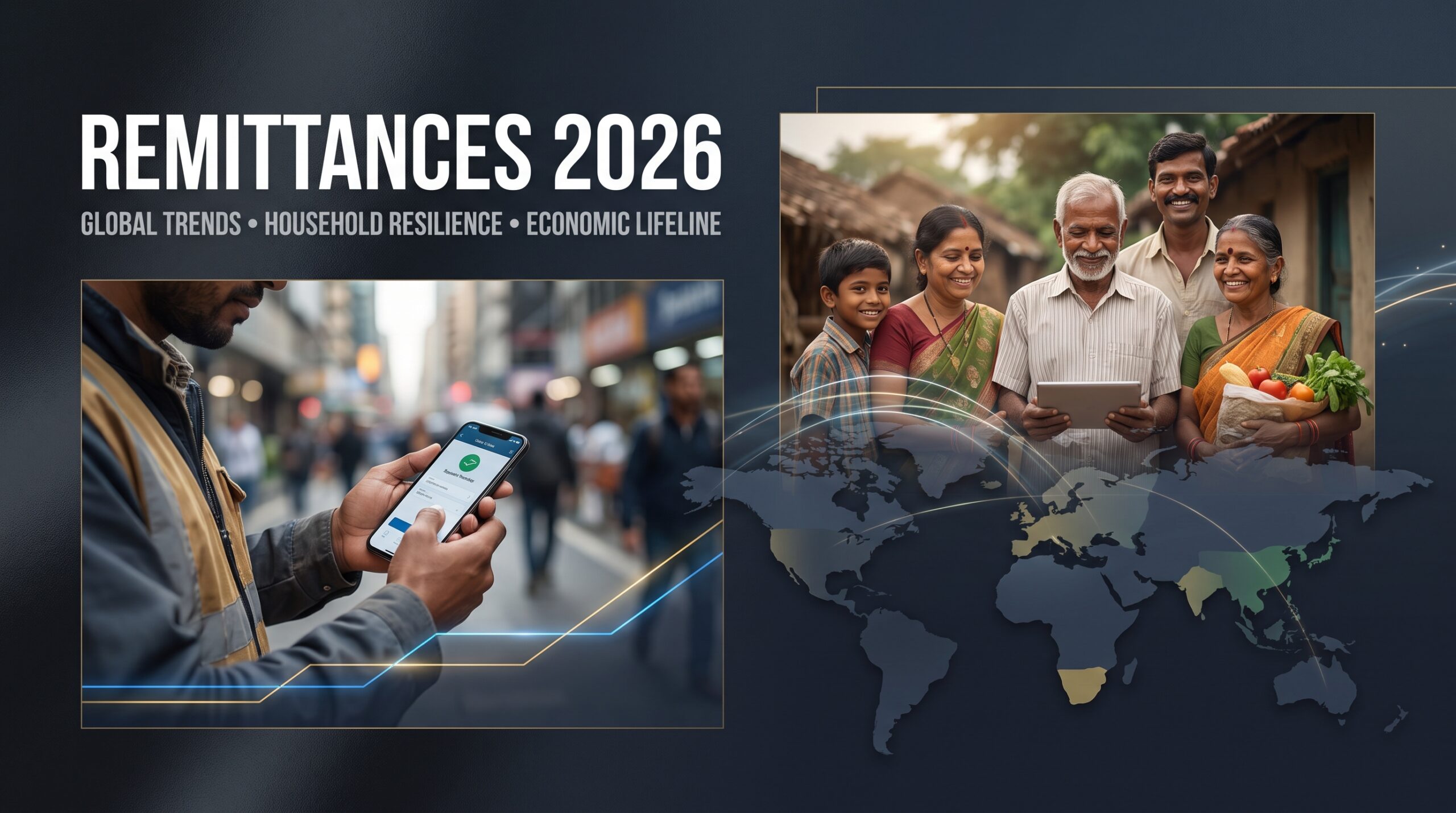
The Economic Lifeline of Developing Nations and Household Resilience
Remittances are financial transfers sent by migrant workers living and working abroad directly to individuals, families, or communities in their home countries. Unlike foreign direct investment (FDI) or sovereign loans, remittances are private, unrequited capital flows that do not create future debt liabilities or foreign ownership stakes in domestic enterprises.
For developing economies across South Asia, Africa, and Latin America—and for platforms like Thefinance.pk and Economy.com.pk—remittances are nothing short of an economic lifeline. They represent one of the largest sources of foreign exchange earnings, frequently eclipsing total merchandise export revenues and foreign aid combined.
The Macroeconomic Impact of Remittances
While remittances are initiated at the microeconomic level by individual families, their cumulative macroeconomic impact is staggering:
- Alleviating the Current Account Deficit: In countries burdened by heavy trade deficits (importing far more than they export), inward remittances act as a vital balancing mechanism. They inject hard currency into the banking system, directly strengthening the central bank’s foreign exchange reserves and providing essential import cover.
- Stabilizing the Local Currency: The constant inflow of US Dollars, Euros, and Gulf Dinars through official remittance channels helps supply the foreign exchange market, reducing downward pressure on the local currency and curbing imported inflation.
- Poverty Reduction and Social Safety Net: Remittances go directly into the hands of households. They are immediately utilized for basic necessities such as food, healthcare, school tuition, and housing construction. In many developing regions, remittances lift millions out of absolute poverty without requiring government bureaucracy or welfare programs.
- Boosting Domestic Consumption: Because remittance recipients spend their funds locally on retail goods, utilities, and construction services, these transfers stimulate domestic demand and support local small-and-medium enterprises (SMEs).
Official vs. Informal Channels (Hawala/Hundi)
A major challenge for governments and central banks tracking remittances is the prevalence of informal transfer networks, commonly known as Hawala or Hundi.
- Informal Channels: Workers often use unlicensed brokers because they offer faster delivery, better exchange rates, and require zero paperwork. However, informal channels drain hard currency from the formal banking sector, depriving the central bank of vital reserves and hiding true economic flows.
- Formal Channels: Commercial banks, licensed money transfer operators (MTOs like Western Union or MoneyGram), and digital fintech wallet apps route funds through official banking channels.
To incentivize workers to use formal channels, central banks and governments—such as the State Bank of Pakistan through its Rosette Digital Account and matching incentive programs—implement policies that eliminate transfer fees, offer superior exchange rates, and reward top-remitting households.
Remittances vs. Foreign Direct Investment (FDI)
Economists frequently compare remittances to Foreign Direct Investment, as both are major sources of foreign capital. However, their behaviors during global crises differ dramatically:
- FDI is Pro-Cyclical: When a developing nation enters an economic crisis or political instability, foreign multinational corporations immediately halt investments, freeze factory expansions, and pull their capital out. FDI dries up precisely when a country needs it most.
- Remittances are Counter-Cyclical: Interestingly, when a home country faces economic turmoil, natural disasters, or currency devaluations, migrant workers often increase the amount of money they send home. Knowing their families are suffering from inflation, expatriate workers sacrifice their own savings in destination countries to provide emergency financial support back home. This makes remittances one of the most reliable, resilient forms of external capital inflow in the world.
The Challenges and Costs of Remittances
Despite their immense benefits, the global remittance ecosystem faces structural bottlenecks:
- High Transfer Fees: Historically, sending money across borders has been plagued by extortionate transaction fees charged by traditional banks and wire services. The United Nations Sustainable Development Goals (SDGs) explicitly target reducing remittance transaction costs to under 3%.
- Macro-Dependence Risk: While remittances fund consumption, critics argue they can sometimes create “remittance dependency,” where local labor force participation drops because families rely entirely on money sent from abroad, disincentivizing domestic industrial productivity and structural reforms.
For editors and researchers at economist.media, tracking monthly remittance data published by central banks provides an immediate read on the health of diaspora communities in North America, Europe, and the Gulf, as well as a reliable gauge of domestic household purchasing power.
Key Takeaways:
- Remittances are private financial transfers sent home by migrant workers to their families.
- They serve as a vital source of foreign exchange, helping developing nations offset trade deficits and build up FX reserves.
- Unlike FDI, remittances are counter-cyclical, often increasing during times of domestic crisis to support struggling families.
- Encouraging workers to use formal banking channels over informal networks (Hawala) is a top priority for central banks.
Authoritative Sources & Further Reading:
- KNOMAD (World Bank): Migration and Development Briefs and Remittance Data
- World Bank: Personal Remittances, Received Data Portal
- State Bank of Pakistan (SBP): Workers’ Remittances Monthly Summaries
Discover more from The Economy
Subscribe to get the latest posts sent to your email.

The Economic Nightmare of Stagnant Growth and Persistent Inflation
Stagflation is one of the most dreaded macroeconomic phenomena in economic history. It describes an economic condition characterized by three simultaneous afflictions: stagnant economic growth (or a recession), high unemployment, and high inflation.
For decades, mainstream economic theory dictated that this combination should be virtually impossible. According to traditional Keynesian economics—specifically the Phillips Curve—inflation and unemployment had an inverse relationship: when inflation was high, unemployment was low because a booming economy created jobs; when unemployment was high, inflation subsided due to weak consumer demand. Stagflation shattered this dogma, proving that an economy can suffer from soaring prices and stagnant output at the very same time.
For financial analysts and readers of economist.media, understanding stagflation is crucial because standard monetary and fiscal playbooks completely fail when it strikes.
The Historical Anatomy of Stagflation
The term “stagflation” was famously coined in the United Kingdom in 1965 by politician Iain Macleod during a parliamentary speech, but the phenomenon became a global crisis in the 1970s.
Prior to 1973, Western economies enjoyed robust post-war growth. However, the 1973 OPEC oil embargo—triggered by geopolitical conflicts in the Middle East—caused the price of crude oil to quadruple almost overnight. Because oil was the primary energy source powering global manufacturing, transport, and agriculture, this supply shock drove production costs sky-high.
Factories had to pay vastly more for energy and raw materials, forcing them to raise prices (fueling inflation) while simultaneously laying off workers and cutting production (triggering stagnation and unemployment). It was a masterclass in cost-push inflation.
Why Stagflation Puzzles Policymakers
To understand why stagflation is a nightmare for central banks, we must look at how monetary policy traditionally works:
- To fight inflation: A central bank raises interest rates to cool down consumer spending and corporate borrowing. But in a stagflationary environment, raising rates further strangles an already stagnant economy, driving unemployment even higher.
- To fight stagnation and unemployment: A central bank lowers interest rates to make borrowing cheap and stimulate business expansion. But in a stagflationary environment, flooding the market with cheap money pours gasoline on the fire, causing inflation to skyrocket out of control.
Central bankers are trapped between Scylla and Charybdis. Whichever policy lever they pull to fix one problem violently exacerbates the other.
The Modern Triggers of Stagflation
While oil shocks triggered the historic episodes of the 1970s, modern economies face new systemic vulnerabilities that can ignite stagflation:
- Supply Chain Disruptions: Events like global pandemics, geopolitical trade wars, and maritime shipping blockages create severe bottlenecks in raw material delivery. When supplies vanish, prices spike while production stalls.
- Aggressive Commodity Price Volatility: As seen during recent global crises, sudden spikes in agricultural commodities, natural gas, and fertilizer prices due to regional wars can push import-dependent developing nations straight into cost-push inflation while domestic growth grinds to a halt.
- Wage-Price Spirals: When inflation outpaces wage growth, workers demand higher pay. If companies grant these raises without a corresponding increase in productivity, they hike retail prices further, entrenching stagflationary psychology across the labor market.
Policy Responses: How to Survive Stagflation
Because monetary policy alone cannot solve stagflation, governments must deploy a coordinated mix of supply-side economics and fiscal discipline:
- Supply-Side Reforms: Governments must focus on deregulation, investing in domestic agricultural productivity, diversifying energy sources (such as transitioning to renewables or domestic hydrocarbons), and reducing trade barriers to lower the cost of production.
- Targeted Fiscal Support: Instead of broad-based money printing or universal stimulus checks—which only worsen inflation—governments must provide targeted cash transfers to the most vulnerable segments of society while cutting wasteful public expenditures.
- Structural Labor Market Improvements: Enhancing workforce training and matching labor skills to modern industries can reduce structural unemployment without triggering wage-driven inflation spikes.
For readers of Thefinance.pk, recognizing the early signs of stagflation is vital for asset allocation. In a stagflationary environment, traditional cash savings and fixed-income bonds get decimated by inflation. Investors typically pivot toward hard assets (like gold and real estate) and companies with strong pricing power that can pass rising costs onto consumers without losing market share.
Key Takeaways:
- Stagflation is the toxic combination of stagnant economic growth, high unemployment, and high inflation.
- It defies traditional economic models like the Phillips Curve, which assumed inflation and unemployment moved in opposite directions.
- Historical stagflation was triggered by massive supply shocks, such as the 1970s oil embargoes.
- Standard monetary policy fails during stagflation because raising rates hurts growth, while lowering rates worsens inflation.
Authoritative Sources & Further Reading:
- Federal Reserve Economic Data (FRED): Historical Inflation and Unemployment Analysis
- World Bank: Global Economic Prospects and Stagflation Risks Report
- International Monetary Fund (IMF): Dealing with Supply Shocks and Inflation
Discover more from The Economy
Subscribe to get the latest posts sent to your email.

Purchasing Power Parity (PPP) Explained: Global Rankings, Living Standards & Why Nominal Exchange Rates Mislead in 2026

Remittances 2026: Global Trends, Household Resilience & Economic Lifeline for Developing Nations

Stagflation Explained: Causes, Global Impact & 2026 Economic Outlook

Understanding Foreign Exchange Reserves: Key Purposes and Global Impact

The Business of Gaming and Tech: How Global Economies Are Driven by Digital Consumerism

Crypto Daily Outlook: Bitcoin, Altcoins, and the Future of Decentralized Finance

Anthony Scaramucci’s Crypto Prediction: Why MicroStrategy’s Move Is Bitcoin’s “iPhone Moment”

Best Dividend Stocks 2026: European & Asian Blue Chips

World Bank & IMF Reports 2026: Why the “3% Growth” Consensus Is Actually a Debate

Elon Musk’s Boring Company Hits $23B Valuation After UAE-Led $3 Billion Series D

Middle East War Economics 2026: Oil Prices & Energy Markets

PSX Forecast 2026: KSE-100, IMF Reviews & Geopolitics

Asian Markets Outlook 2026: China, Japan & Singapore Stocks

Global Economy 2026: IMF Growth, Inflation & Private Credit

State Farm’s $5B Dividend 2026: Who Qualifies & Payout Dates

US-China Relations in Q3 2026: Trade Tariffs and Supply Chain Risks

Gold’s Wild 2026: From a Record $5,600 Peak to a 24% Crash and Back Toward $4,500

Oil Surges as Strait of Hormuz Traffic Collapses Again

The Rocket That Won’t Quit: Inside SpaceX’s Falcon 9 Launch Machine

Bank of England Set to Hold Rates Through Year-End, Reuters Poll Shows

SpaceX Starship Flight 14: First Orbital Attempt & Starlink V3 Launch Explained

The 2026 Crypto Regulatory Shift: What It Means for Institutional Investors

AI Chip Stocks 2026: The Best Semiconductor Investments Beyond Marvell

Top 30 Stocks for Investment in PSX for Massive ROI in 2026

Retail Earnings Week: What Home Depot, Target & Walmart Reveal

AI-Powered Training: The Next Multi-Billion Dollar Ecosystem in Fitness

Russia’s Black Sea Oil Exports Fall for a Fifth Straight Week

Tween Back-to-School Trends 2026: What’s Driving the $85B Season
-

 Markets & Finance8 months ago
Top 15 Stocks for Investment in 2026 in PSX: Your Complete Guide to Pakistan’s Best Investment Opportunities
-

 Analysis7 months ago
Johor’s Investment Boom: The Hidden Costs Behind Malaysia’s Most Ambitious Economic Surge
-

 Analysis7 months ago
Top 10 Stocks for Investment in PSX for Quick Returns in 2026
-

 Analysis7 months ago
Brazil’s Rare Earth Race: US, EU, and China Compete for Critical Minerals as Tensions Rise
-

 Banks8 months ago
Best Investments in Pakistan 2026: Top 10 Low-Price Shares and Long-Term Picks for the PSX
-

 Investment8 months ago
Top 10 Mutual Fund Managers in Pakistan for Investment in 2026: A Comprehensive Guide for Optimal Returns
-

 Global Economy9 months ago
15 Most Lucrative Sectors for Investment in Pakistan: A 2025 Data-Driven Analysis
-

 Global Economy9 months ago
Pakistan’s Export Goldmine: 10 Game-Changing Markets Where Pakistani Businesses Are Winning Big in 2025