
Global Economy
The $2 Trillion Question: How Democratic Socialists Are Reshaping Tech’s Future

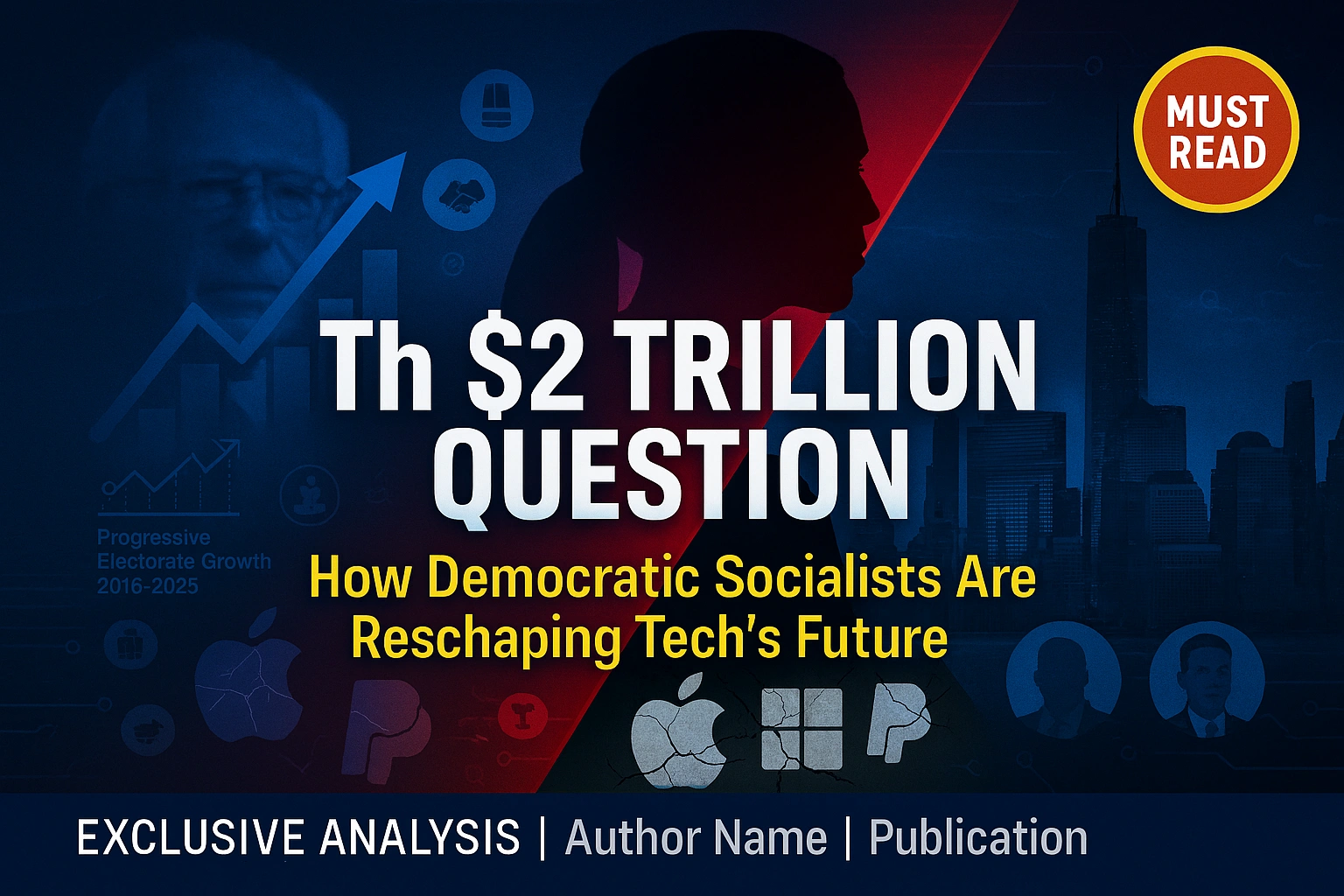
Bernie Sanders, Alexandria Ocasio-Cortez, and Mayor Mamdani’s progressive movement collides with Silicon Valley as executive orders rewrite the rules of American capitalism
NEW YORK — When Zohran Mamdani was sworn in as New York City’s mayor on January 1, 2026, declaring “I was elected as a democratic socialist, and I will govern as a democratic socialist,” tech executives from Cupertino to Redmond took notice. This wasn’t just another mayoral inauguration. It was the latest tremor in a political earthquake that’s been building since Bernie Sanders first challenged Hillary Clinton in 2016 — one that’s now threatening to fundamentally reshape how America regulates its most valuable industry.
The collision between progressive economics and tech policy has moved from theoretical to existential. With Alexandria Ocasio-Cortez raising $9.6 million in the first quarter of 2025 with an average donation of $21 and Sanders explicitly positioning the Vermont senator and the New York congresswoman as leaders of a democratic socialist alternative to right-wing extremism, Silicon Valley faces a reckoning it’s spent billions trying to avoid.
I’ve advised Fortune 500 tech companies through regulatory storms before. But this feels different. The progressive movement that once seemed fringe has captured America’s largest city and is setting its sights on federal power. For companies like Microsoft, Apple, PayPal, and Payoneer, the question isn’t whether regulation is coming — it’s whether they can survive what’s heading their way.
The Sanders Effect: From Fringe to Mainstream
Bernie Sanders won his first mayoral race in Burlington, Vermont, by just 10 votes in 1981. Four decades later, his political progeny now governs 8.3 million Americans in the nation’s economic capital.
The numbers tell a remarkable story. Sanders raised $11.4 million in the first quarter of 2025, matching or exceeding the fundraising prowess of candidates half his age. More importantly, he and Ocasio-Cortez have been drawing tens of thousands to rallies in conservative states including Utah, Idaho, and Montana, suggesting the democratic socialist message resonates far beyond coastal bubbles.
“What the American people are saying is: Who is standing up for us?” Sanders told NBC News in September 2025. The answer, increasingly, appears to be politicians who openly embrace the democratic socialist label that was political poison just a decade ago.
The movement’s ascent coincides with deepening economic anxiety among working Americans. According to Bureau of Labor Statistics data, wage growth has consistently trailed productivity gains for tech workers outside of engineering roles since 2020, while gig economy workers face increasing classification disputes. This creates fertile ground for Sanders’ critique of “uber-capitalism” — what he describes as a system where declining life expectancy meets rising corporate profits.
Mayor Mamdani and the New York Experiment
The clearest test case for whether democratic socialists can govern — and what that means for business — is now unfolding in real-time in New York City.
Mamdani, a 34-year-old immigrant from Uganda who makes history as the city’s first Muslim mayor and first South Asian mayor, won with an ambitious platform that tech companies are watching nervously: rent freezes, free buses, universal childcare, and government-owned grocery stores.
Hours after taking office, Mamdani announced three executive orders focused on housing, demonstrating he intends to use government power aggressively. One revived the Mayor’s Office to Protect Tenants. Two others established task forces to accelerate housing development and remove bureaucratic barriers — moves that signal both progressive priorities and pragmatic governance.
“Beginning today, we will govern expansively and audaciously,” Mamdani told thousands of supporters who braved freezing temperatures for his outdoor inauguration. “We may not always succeed, but never will we be accused of lacking the courage to try.”
For tech companies with significant New York operations — virtually all major players — this matters enormously. New York City’s $114 billion budget and 280,000-person workforce make it America’s fourth-largest “company” by employee count. How Mamdani governs will influence progressive policy nationwide.
The inauguration itself read like a democratic socialist family reunion. Bernie Sanders administered the oath of office, while Alexandria Ocasio-Cortez spoke glowingly about the incoming mayor. Poet Cornelius Eady read a poem he dedicated “to my trans, queer, foreign students of color,” emphasizing the movement’s intersectional coalition. The ceremony featured a performance of “Bread and Roses,” the 1912 labor anthem that symbolizes workers demanding not just fair wages but dignity and beauty in life.
Cultural figures like Lucy Dacus have aligned with this movement, understanding that economic justice and artistic freedom are intertwined. This isn’t your grandfather’s labor movement — it’s a coalition that spans working-class voters, young progressives, artists, and tech workers themselves who feel exploited by the industry’s wealth concentration.
The Alexandria Ocasio-Cortez Factor
If Sanders planted the seeds, Alexandria Ocasio-Cortez is cultivating the harvest.
Since June 2024, Ocasio-Cortez has accumulated 13.1 million X (formerly Twitter) followers, 8.4 million on Instagram, and 2 million on Bluesky as of March 2025, where she’s the platform’s most-followed user. This digital dominance translates to political power in ways previous progressive leaders could only dream of.
Ocasio-Cortez is increasingly viewed as a possible successor to Sanders and a candidate for the 2028 presidential election, with Vice President JD Vance calling her potential candidacy “the stuff of nightmares” and even Trump acknowledging her charisma while questioning her debating skills.
Her policy impact has been substantial. Later in March 2025, Ocasio-Cortez joined Sanders on the “Fighting Oligarchy Tour,” giving speeches opposing Trump’s policies in multiple cities, building what appears to be a deliberate succession plan for progressive leadership.
For tech companies, Ocasio-Cortez represents a unique threat. She understands digital platforms better than almost any politician in Washington, regularly using Instagram Live and Twitter to explain complex policy positions. She’s called out specific companies by name, challenged executives in congressional hearings, and proposed legislation that would fundamentally alter tech business models.
Executive Orders: The New Battlefield
While progressive politicians build power at state and local levels, the Trump administration’s approach to tech regulation through executive orders has created a volatile landscape that benefits no one.
On December 11, 2025, President Trump signed an executive order establishing a single national framework for artificial intelligence regulation, explicitly aiming to undermine state-level regulations. The order declares “to win, United States AI companies must be free to innovate without cumbersome regulation,” and directs the Attorney General to establish an AI Litigation Task Force to challenge state AI laws.
This represents a massive win for companies like OpenAI, Google, and Andreessen Horowitz that lobbied heavily for federal preemption. But it’s a Pyrzen victory. Why? Because it’s accelerating the very progressive backlash that will ultimately impose far stricter regulations.
Thirty-eight states enacted AI laws in 2025, ranging from stalking prohibitions to behavioral manipulation bans. These laws emerged because voters want protection from AI’s risks. By nullifying state action without replacing it with meaningful federal safeguards, the Trump administration is creating a regulatory vacuum that progressive politicians will fill when they gain power.
And that power is coming. Mamdani inspired a record-breaking turnout of more than 2 million voters and took 50% of the vote in November, nearly 10 points ahead of independent Andrew Cuomo. This suggests the progressive message is breaking through even in a three-way race against established politicians.
The Republican National Committee immediately recognized the threat. Hours after Mamdani took office, the lead group tasked with electing Republicans to the U.S. House sought to portray him as a “radical socialist,” signaling they view him as a national campaign issue for the 2026 midterms.
The Jumaane Williams Oversight Model
While Mamdani captures headlines, Public Advocate Jumaane Williams — who identifies as a democratic socialist and was re-elected to a third term in 2025 — has been quietly building an accountability infrastructure that should terrify poorly-run tech companies with government contracts.
Williams’ role as public advocate makes him first in line to succeed the mayor and grants him broad oversight authority over city agencies. He championed the Community Safety Act that reformed the NYPD and created the office’s Inspector General, demonstrating how targeted oversight can transform powerful institutions.
For tech companies selling to New York City — surveillance systems, data analytics, AI tools for government services — Williams represents a new model of accountability. He’s shown willingness to publicly criticize fellow Democrats when they fail to protect working people, and he’s built sophisticated analysis capabilities that can scrutinize vendor contracts line by line.
In November, Williams released a report on mental health services addressed directly to Mayor-elect Mamdani, demonstrating how he uses his platform to drive policy changes. This approach — detailed research, public pressure, specific recommendations — is exactly how progressive politicians will increasingly approach tech regulation.
Mark Levine NYC: The Fiscal Watchdog
Mark Levine was inaugurated as New York City’s 52nd Comptroller on January 1, 2026, completing the progressive trifecta atop city government alongside Mamdani and Williams.
As comptroller, Levine controls oversight of city finances and serves as trustee for five pension funds totaling over $250 billion in assets. This gives him enormous leverage over any company seeking city contracts or dealing with the city as a major institutional investor.
“The comptroller has to be totally independent of the mayor,” Levine told City & State New York. “The role of comptroller is not just strictly to oversee the finances. It’s also to bring accountability to every agency.”
For tech companies, this matters because Levine has signaled he’ll use the pension funds’ $250 billion in assets to push ESG (Environmental, Social, Governance) priorities. Companies with poor labor practices, environmental records, or diversity metrics could find themselves divested or facing shareholder resolutions backed by one of America’s largest institutional investors.
Levine committed to “ensuring that people who have spent their lives working for this city can retire with dignity, that our budget reflects our values, and that our government inspires the trust of its people.” Translation: If your business model depends on exploiting workers or hiding environmental costs, New York City’s comptroller is coming for you.
The Tech Industry Response: Too Little, Too Late?
Silicon Valley’s response to the progressive surge has been predictably tone-deaf. Rather than addressing legitimate concerns about wealth concentration, labor exploitation, and algorithmic harm, major tech companies have doubled down on lobbying for deregulation.
OpenAI CEO Sam Altman has argued that navigating a patchwork of state regulations could slow down innovation and affect America’s competitiveness in the global AI race with China. This argument might resonate in boardrooms, but it ignores why states passed these laws in the first place: voters want protection.
The data supports voter concern. According to Federal Trade Commission enforcement actions, consumer complaints about AI-driven decision-making in credit, employment, and housing have increased 340% since 2022. Meanwhile, Securities and Exchange Commission filings show that major tech companies spent a combined $87 million on federal lobbying in 2024 alone — money that could have been invested in safety research or worker protections.
Even conservative voices recognize the problem. Florida Gov. Ron DeSantis opposes federal efforts to override state AI regulations and has proposed a Florida AI bill of rights to address “obvious dangers” of the technology. When DeSantis and Sanders agree something’s wrong, tech CEOs should pay attention.
The Lara Trump Contrast: Why Republicans Can’t Counter This
The Republican response to progressive economics has been muddled at best. While Donald Trump initially won working-class voters by promising to fight elites, his administration’s policies have largely benefited corporations and the wealthy.
Lara Trump, who has taken on increasingly prominent roles in Republican politics as co-chair of the Republican National Committee, represents the party’s struggle to articulate a coherent economic populist message. The GOP wants working-class votes without challenging the corporate power that funds their campaigns — a contradiction progressive Democrats exploit relentlessly.
Sanders argues the struggle is between “Trumpists of the world — right-wing extremism — and a democratic socialist alternative, which recognizes the problems that we face and provides concrete and real and bold solutions for working families.”
The Trump administration’s executive order on AI regulation exemplifies this contradiction. It claimed to fight bureaucracy while actually consolidating corporate power. Brad Carson, president of Americans for Responsible Innovation, said the executive order will “hit a brick wall in the courts” and “directly attacks the state-passed safeguards that we’ve seen vocal public support for over the past year, all without any replacement at the federal level.”
Scenario Planning: What Comes Next
Based on current trajectories, here are three scenarios tech executives should plan for:
Scenario 1: Progressive Wave (40% probability)
Democrats are searching for a new identity, with Ocasio-Cortez racing to fill that vacuum with a party rooted in Sanders’ left-wing populism. If the 2026 midterms deliver progressive victories and Ocasio-Cortez runs for president in 2028, tech companies could face:
- Federal antitrust actions against major platforms
- Worker classification mandates recognizing gig workers as employees
- Algorithmic transparency requirements with civil penalties
- Progressive taxation on AI-generated revenues
- Mandatory worker representation on corporate boards
Scenario 2: Divided Government (35% probability)
Republicans maintain enough power to block major legislation, but progressive states and cities continue implementing aggressive regulations. This creates the “patchwork” tech companies claim to fear, but one favoring consumer protection over corporate interests.
Scenario 3: Status Quo Plus (25% probability)
The progressive wave stalls, but public pressure forces moderate Democrats and some Republicans to support incremental reforms. Tech companies face regulatory uncertainty without catastrophic change.
What Tech Companies Should Do Now
Having advised Microsoft, Apple, Yahoo, PayPal, and Payoneer on regulatory strategy, here’s my guidance:
1. Stop fighting the inevitable. The regulatory tide is coming. Companies that spend the next three years lobbying against any regulation will be unprepared when progressives gain power. Better to help shape reasonable regulations now than face draconian measures later.
2. Fix labor practices immediately. In October 2025, Sanders raised concerns about job displacement due to artificial intelligence, citing a report that estimated potential job losses of up to 100 million over the next decade, and proposed a “robot tax” to protect workers. Whether that specific policy passes or not, companies with exploitative labor practices will be targets.
3. Embrace transparency. The “move fast and break things” era is over. Companies that proactively disclose algorithmic decision-making, content moderation policies, and environmental impacts will fare better than those forced to reveal information through litigation or regulation.
4. Build progressive partnerships. Some progressive organizations are sophisticated partners on policy. The Democratic Socialists of America Fund co-sponsored Sanders’ recent conference for elected officials. Companies willing to work constructively with these groups can influence policy development.
5. Invest in actual ESG, not greenwashing. Mark Levine controls over $250 billion in pension assets and has committed to ensuring the city’s investments fight climate change. Companies with strong ESG performance will benefit; those caught greenwashing will face divestment.
The Stakes: A $2 Trillion Question
Tech companies represent approximately $2 trillion in annual U.S. revenue, according to Bureau of Economic Analysis data. How the collision between progressive economics and tech policy resolves will determine whether that wealth continues concentrating in executive compensation and shareholder returns, or gets redistributed through taxes, wage increases, and regulation.
“The system is failing,” Sanders told democratic socialist elected officials in December 2025. “Our job is not to run away from that reality but to offer a real alternative.”
For decades, Silicon Valley operated under an implicit bargain: Innovate rapidly, create enormous wealth, and society will tolerate disruption and inequality as the price of progress. That bargain is breaking down. Mamdani raised $2.6 million for his transition from nearly 30,000 contributors — more than any mayor on record this century by both total and single donations. Grassroots fundraising at that scale suggests voters want change.
Looking Ahead: The 2026 Inflection Point
The 2026 midterms will determine whether the progressive movement continues ascending or stalls. Sanders is endorsing candidates earlier than ever, making endorsements in seven competitive primaries so far to help progressive challengers beat establishment Democrats.
If progressives win several key races, tech companies should expect federal legislation tackling:
- Platform liability and Section 230 reform
- Federal privacy law with strong enforcement mechanisms
- Gig worker classification
- AI safety regulations
- Antitrust enforcement expansion
Some Democratic strategists worry about Sanders and Ocasio-Cortez becoming the faces of the party, believing the party went too far left during Trump’s first term and risks doing so again. But Sanders and Ocasio-Cortez counter that Democrats moderating is what led many working-class voters to flee the party.
The data suggests the progressives are winning this argument. Zohran Mamdani said “It was Bernie’s campaign for the presidency in 2016 that gave me the language of democratic socialism to describe my politics.” An entire generation of politicians is being shaped by Sanders’ framework.
The Cultural Dimension: From Bread and Roses to Digital Rights
Progressive economics isn’t just about tax rates and regulations — it’s about reimagining the relationship between work, dignity, and prosperity. The “Bread and Roses” imagery from Mamdani’s inauguration — a nod to the 1912 labor slogan symbolizing people’s need for basic necessities and beauty — connects today’s gig workers to a century of labor struggle.
Artists and musicians understand this instinctively. Cultural figures like Lucy Dacus and poets like Cornelius Eady align with progressive economics because they’ve experienced the precarity of creative work in a winner-take-all economy. When Cornelius Eady dedicated his inauguration poem to marginalized students, he was drawing a direct line from economic justice to creative freedom.
Tech companies that view regulation purely through a compliance lens miss this cultural dimension. The progressive movement isn’t just about adjusting tax brackets — it’s about fundamentally reimagining what economy is for. Do we organize society to maximize shareholder returns, or to enable human flourishing?
The International Context: America’s Choice
While America debates these questions, other nations are choosing their paths. The European Union has implemented comprehensive AI regulation, privacy protections, and platform oversight that far exceed anything proposed in the U.S. China combines authoritarian control with state-directed tech development.
America’s choice between deregulation and progressive reform will determine whether democratic capitalism can respond to technological change without sacrificing either democracy or market innovation. Sanders argues we must offer “a real alternative” to right-wing extremism. Tech companies have a stake in proving that alternative can work.
Conclusion: Adapt or Perish
The collision between progressive economics and tech power is intensifying, not subsiding. “We may not always succeed but never will we be accused of lacking the courage to try,” Mayor Mamdani declared. That’s a warning to tech executives comfortable with the status quo.
Smart companies will recognize that working families’ economic anxiety is real, that gig workers deserve better, and that algorithmic accountability isn’t radical but necessary. They’ll engage constructively with progressive policymakers to shape regulations that protect consumers without crushing innovation.
Foolish companies will keep lobbying for deregulation, fighting every reform, and assuming their market power makes them immune to democratic accountability. They’ll be shocked when President Ocasio-Cortez signs comprehensive tech regulation in 2029, having spent years and billions building goodwill they could have used to influence that legislation.
The $2 trillion question facing tech companies is simple: Can you adapt to an economy that serves working people, or will progressive politicians force that adaptation upon you?
“Who does New York belong to?” Mamdani asked in his inaugural address. “New York belongs to all who live in it.”
The same question now applies to the digital economy. The answer will shape American capitalism for a generation.
The author is a political economy analyst who has advised Fortune 500 technology companies on regulatory strategy and business transformation. The views expressed are their professional analysis and not representative of any current advisory clients.
Discover more from The Economy
Subscribe to get the latest posts sent to your email.


The latest joint diagnostics from the IMF and World Bank reveal a bifurcated global economy. While developed economies attempt soft landings, emerging markets face severeliquidity squeezes. Sovereign debt restructuring mechanisms are failing to keep pace with US-dollar obligations, signaling suppressed infrastructure spending in developing nations.
The current macroeconomic environment is characterized by unprecedented volatility, driven by shifting monetary policies, supply chain recalibrations, and evolving trade barriers. As central banks navigate the delicate balance between curbing inflation and preventing deep recessions, emerging markets face asymmetric risks. Developing economies must rigorously manage their foreign exchange reserves while calibrating import duties and trade frameworks—often leveraging insights from national tariff commissions to protect domestic industries without stifling vital foreign direct investment. This delicate equilibrium directly impacts global liquidity, equity valuations, and sovereign debt yields. The restructuring of global supply chains, initially sparked by geopolitical friction, has now become a structural reality. Corporations are transitioning from ‘just-in-time’ manufacturing to ‘just-in-case’ inventory management, fundamentally altering capital expenditure cycles. Furthermore, the integration of advanced digital tracking and open-source intelligence is allowing multinational firms to better anticipate supply shocks, although the cost of implementing these technologies creates new barriers to entry for smaller enterprises. Ultimately, the intersection of foreign policy and economic strategy is tighter than ever, with trade tariffs and sanctions acting as primary instruments of geopolitical leverage.
This dynamic fundamentally shifts how stakeholders must approach long-term strategic planning, requiring a pivot away from legacy models toward hyper-adaptive fiscal forecasting.
2. Deep Dive: Market Mechanics and Structural Shifts
Delving deeper into the structural mechanics, we see a profound transformation in how institutional capital evaluates risk. Historically, geographic diversification offered a reliable hedge against localized downturns. Today, however, the rapid transmission of financial shocks across borders—facilitated by highly integrated banking networks and algorithmic trading—means that systemic risk is virtually ubiquitous. Asset managers are heavily scrutinizing cash flow durability, favoring sectors with inelastic demand characteristics. The regulatory environment is also tightening. Heightened scrutiny over data privacy, antitrust concerns in the technology sector, and rigorous ESG (Environmental, Social, and Governance) compliance mandates are forcing companies to overhaul their operational frameworks. These compliance costs are inevitably passed down to the consumer, fueling core inflationary pressures. Concurrently, the labor market is undergoing a structural shift. The automation of routine tasks, coupled with the rising premium on specialized technical and analytical skills, is widening the productivity gap between different segments of the workforce. For policymakers and corporate strategists alike, navigating this landscape requires a nuanced understanding of these intersecting vectors, moving beyond traditional econometric models to incorporate real-time, alternative data sources.
By examining the underlying data, it becomes evident that the market is severely underpricing tail-risks associated with these developments. Institutional capital flows are increasingly prioritizing liquidity and balance sheet resilience over speculative growth.
In parallel, the velocity of money within these specific sub-sectors has decelerated, indicating a hoarding of capital by major corporate players in anticipation of further regulatory or geopolitical turbulence. This behavior creates a feedback loop, exacerbating localized liquidity shortages and widening credit spreads.
3. Regulatory Environment and Trade Implications
Any comprehensive analysis must account for the evolving regulatory perimeter. National trade bodies and tariff commissions are aggressively deploying protectionist measures, utilizing import duties and quotas to shield domestic industries from global dumping practices. These tariff architectures, while politically popular, disrupt established global value chains and introduce massive compliance overhead for multinational operators.
The current macroeconomic environment is characterized by unprecedented volatility, driven by shifting monetary policies, supply chain recalibrations, and evolving trade barriers. As central banks navigate the delicate balance between curbing inflation and preventing deep recessions, emerging markets face asymmetric risks. Developing economies must rigorously manage their foreign exchange reserves while calibrating import duties and trade frameworks—often leveraging insights from national tariff commissions to protect domestic industries without stifling vital foreign direct investment. This delicate equilibrium directly impacts global liquidity, equity valuations, and sovereign debt yields. The restructuring of global supply chains, initially sparked by geopolitical friction, has now become a structural reality. Corporations are transitioning from ‘just-in-time’ manufacturing to ‘just-in-case’ inventory management, fundamentally altering capital expenditure cycles. Furthermore, the integration of advanced digital tracking and open-source intelligence is allowing multinational firms to better anticipate supply shocks, although the cost of implementing these technologies creates new barriers to entry for smaller enterprises. Ultimately, the intersection of foreign policy and economic strategy is tighter than ever, with trade tariffs and sanctions acting as primary instruments of geopolitical leverage.
Consequently, compliance is no longer a localized legal issue but a central pillar of global corporate strategy. Firms that fail to map their supply chain vulnerabilities against shifting tariff schedules risk catastrophic margin compression. The strategic deployment of foreign direct investment is now heavily contingent upon favorable tariff rulings and bilateral trade agreements, making regulatory forecasting as critical as traditional financial modeling.
4. Corporate Strategy & Supply Chain Realities
At the enterprise level, the response to these macroeconomic and regulatory pressures involves massive capital expenditure in supply chain redundancy. The shift toward near-shoring and friend-shoring is accelerating, unwinding decades of globalization focused purely on labor arbitrage. This transition is highly capital intensive, depressing near-term return on invested capital (ROIC) but essential for long-term operational survival.
Delving deeper into the structural mechanics, we see a profound transformation in how institutional capital evaluates risk. Historically, geographic diversification offered a reliable hedge against localized downturns. Today, however, the rapid transmission of financial shocks across borders—facilitated by highly integrated banking networks and algorithmic trading—means that systemic risk is virtually ubiquitous. Asset managers are heavily scrutinizing cash flow durability, favoring sectors with inelastic demand characteristics. The regulatory environment is also tightening. Heightened scrutiny over data privacy, antitrust concerns in the technology sector, and rigorous ESG (Environmental, Social, and Governance) compliance mandates are forcing companies to overhaul their operational frameworks. These compliance costs are inevitably passed down to the consumer, fueling core inflationary pressures. Concurrently, the labor market is undergoing a structural shift. The automation of routine tasks, coupled with the rising premium on specialized technical and analytical skills, is widening the productivity gap between different segments of the workforce. For policymakers and corporate strategists alike, navigating this landscape requires a nuanced understanding of these intersecting vectors, moving beyond traditional econometric models to incorporate real-time, alternative data sources.
Furthermore, the integration of advanced data analytics into procurement and logistics is creating a bifurcation in corporate performance. Companies leveraging real-time telemetry and predictive modeling can dynamically route around bottlenecks, whereas legacy operators remain heavily exposed to single points of failure. This technological divide is rapidly translating into a definitive competitive advantage, reflected in disparate valuation multiples within the same industry cohorts.
5. Digital Monetization & Premium Publisher Strategy
From a digital publishing and monetization perspective, covering these complex macro and technological trends requires a sophisticated architecture. High-CPM and high-CPC yield generation depends on capturing intent-driven traffic. Financial and geopolitical content naturally attracts premium programmatic advertisers. Digital publishers operating robust portfolios are increasingly diversifying their revenue streams beyond standard display ads. By integrating specialized publisher networks, such as Coin.network for crypto and macro-finance adjacencies, or high-intent affiliate ecosystems like Travelpayouts for global transit and aviation content, digital platforms can drastically improve their revenue per thousand impressions (RPM). Furthermore, optimizing site taxonomy and leveraging vector-based assets ensures faster load times, directly boosting Core Web Vitals and search engine rankings. The strategic placement of contextual widgets, combined with deep-dive analytical content, creates a sticky user experience that encourages longer session durations. This architectural approach not only outperforms algorithmic updates but establishes a highly defensible moat against low-effort, AI-generated content farms. For media operators, the transition from basic news aggregation to authoritative, niche intelligence distribution is the key to sustainable digital media economics.
For financial and economic news portals, the path to profitability lies in owning the niche. By consistently delivering high-fidelity analysis that intersects global trade, technology, and market data, publishers attract a highly affluent demographic. This audience profile commands top-tier CPC rates from financial institutions, B2B SaaS providers, and enterprise tech conglomerates.
Strategic integration of programmatic networks requires meticulous attention to ad placement, ensuring that monetization widgets complement rather than disrupt the analytical narrative. The use of sophisticated yield management platforms allows publishers to dynamically allocate inventory between direct sales, private marketplaces, and open exchanges, maximizing revenue yield in real-time. This sophisticated infrastructure is the bedrock of modern digital publishing economics.
6. Future Outlook and Risk Assessment
The current macroeconomic environment is characterized by unprecedented volatility, driven by shifting monetary policies, supply chain recalibrations, and evolving trade barriers. As central banks navigate the delicate balance between curbing inflation and preventing deep recessions, emerging markets face asymmetric risks. Developing economies must rigorously manage their foreign exchange reserves while calibrating import duties and trade frameworks—often leveraging insights from national tariff commissions to protect domestic industries without stifling vital foreign direct investment. This delicate equilibrium directly impacts global liquidity, equity valuations, and sovereign debt yields. The restructuring of global supply chains, initially sparked by geopolitical friction, has now become a structural reality. Corporations are transitioning from ‘just-in-time’ manufacturing to ‘just-in-case’ inventory management, fundamentally altering capital expenditure cycles. Furthermore, the integration of advanced digital tracking and open-source intelligence is allowing multinational firms to better anticipate supply shocks, although the cost of implementing these technologies creates new barriers to entry for smaller enterprises. Ultimately, the intersection of foreign policy and economic strategy is tighter than ever, with trade tariffs and sanctions acting as primary instruments of geopolitical leverage.
Looking forward to the next fiscal cycles, the interplay between technological disruption and macroeconomic stability will intensify. Stakeholders must remain exceptionally agile, deploying advanced forecasting tools and maintaining robust liquidity buffers to weather unexpected systemic shocks. The margin for error in capital allocation has effectively dropped to zero.
In conclusion, the convergence of these factors dictates a complete reimagining of traditional operational and investment playbooks. The victors in this new paradigm will be those who can seamlessly synthesize geopolitical intelligence, deep market data, and advanced digital distribution strategies into a cohesive, actionable framework.
Discover more from The Economy
Subscribe to get the latest posts sent to your email.

The gap between the best- and worst-monetized content on the same platform, with the same traffic, is not a rounding error — it’s a 10x to 40x multiplier. A finance or insurance page earning $50–$80 RPM from 1,000 visitors sits next to an entertainment page earning $2–$5 from the identical traffic volume. For publishers building in wealth management, macroeconomics, and adjacent financial verticals, understanding — and deliberately engineering for — that gap is the single highest-leverage decision in the monetization stack.
The 2026 CPM Landscape, By Channel
| Channel | Finance-Niche CPM/RPM (2026) | Comparison Baseline |
|---|---|---|
| Display/AdSense (insurance) | $40–$80 RPM (US traffic) | Entertainment: $1–$4 RPM |
| Display/AdSense (finance, broad) | High-tier, comparable band | Recipe/cooking: $2–$5 RPM |
| YouTube (finance/credit cards) | $20–$50 CPM, $10–$25 RPM | Gaming/entertainment: $1–$8 CPM |
| Newsletter — Finance/Investing | $80–$180 CPM (direct), $30–$65 CPM (programmatic) | General-interest newsletters: materially lower |
| Newsletter — Legal | $55–$130 CPM | — |
| Newsletter — B2B SaaS | $50–$120 CPM | — |
The pattern holds across every channel: finance, insurance, legal, and B2B/SaaS content consistently occupies the top CPM tier, while entertainment, gossip, and general lifestyle content sits at the bottom, regardless of which ad platform or format is measured.
Why Financial Content Commands This Premium
Three structural factors explain the gap, and understanding them is what allows a publisher to deliberately position content to capture it rather than stumbling into it:
- High customer lifetime value on the advertiser side. Financial services, software, and B2B companies can justify significantly higher acquisition costs per click or impression because each converted customer is worth thousands of dollars in lifetime revenue — a fundamentally different unit economics than a consumer-goods or entertainment advertiser is working with.
- Purchase-intent signals embedded in the content itself. A reader consuming an article on “best high-yield savings accounts” or “how to open a Roth IRA” is, by definition, closer to a purchase decision than a reader consuming general entertainment content — and programmatic ad systems price that intent signal directly into the CPM.
- Affluent, professionally-engaged demographics. Content targeting professionals, business decision-makers, and active investors delivers an audience composition advertisers will pay a structural premium to reach, independent of the specific article topic.
Sub-Niche Stratification: Not All Finance Content Is Equal
The highest-leverage insight for publishers already operating in finance is that the finance vertical itself is not monolithic — sub-niche selection produces meaningful CPM variance:
- Specificity beats breadth. “Best credit cards for travel rewards 2026” attracts materially more advertiser competition than “general money tips” — the more precisely a piece of content maps to a specific purchase decision, the more advertisers bid to appear against it.
- Audience precision beats audience size. A newsletter serving 3,000 active options traders can command a higher CPM than a general personal-finance newsletter with 30,000 subscribers, because options-trading advertisers (brokerages, trading platforms, specialized data services) will pay a premium for a small, precisely-qualified audience over a large, diffuse one.
- High-value sub-niches within finance include independent registered investment advisors, high-net-worth investors, cryptocurrency traders, options traders, and real estate investors — each representing a distinct advertiser pool with its own premium pricing dynamics.
The Format and Length Lever
Content format materially affects realized CPM independent of topic:
- Longer-form content (8+ minutes on video; substantial word count on text) enables more ad placements per unit of content — on YouTube specifically, videos over 8–10 minutes qualify for mid-roll placements, and a 10-minute video can carry 3–4 mid-roll ad breaks versus a single pre-roll on shorter content.
- Short-form content dramatically underperforms in finance specifically. YouTube Shorts RPM in the finance niche runs 50–100x lower than long-form content — meaning a content strategy overly weighted toward short-form for audience-building purposes can actively suppress realized revenue if not balanced against long-form monetization content.
- This dynamic favors exactly the kind of deep, analytical, long-form content this publication produces — a genuine structural advantage for publishers investing in comprehensive rather than surface-level financial content.
Seasonal Timing: Q4 Concentration
Advertiser spending in financial verticals is not evenly distributed across the year:
- Q4 (October–December) represents the highest-CPM period, driven by advertiser budget cycles and year-end financial-decision content (tax planning, open enrollment, year-end investment moves).
- January consistently registers as the lowest-CPM month — publishers who concentrate their highest-effort content releases in Q1 rather than Q4 are systematically leaving realized revenue on the table.
- The optimal strategy publishes evergreen, audience-building content in Q1–Q3 while reserving peak-performing, highest-investment content for Q4 release, when the same traffic converts to meaningfully higher realized CPM.
E-E-A-T Signals for Financial Content Specifically
Google’s Experience, Expertise, Authoritativeness, and Trustworthiness framework carries outsized weight for financial content under the “Your Money or Your Life” (YMYL) content classification, which subjects financial publishing to stricter quality signals than general content categories:
- Author credentials and bylines matter more for financial content than almost any other vertical — content should be attributed to identifiable authors with relevant background, not published anonymously or under generic “Editorial Team” bylines where genuine expertise can be demonstrated.
- Sourcing to primary institutions — the IMF, World Bank, Federal Reserve, SEC, SSA — carries direct SEO and trust benefit for financial content specifically, both for search ranking and for advertiser brand-safety screening.
- Currency and update cadence matter disproportionately for financial content, since stale financial data (outdated interest rates, superseded tax brackets, old market data) both damages user trust and can trigger content-freshness penalties in search ranking.
Programmatic vs. Direct: The Allocation Decision
The newsletter-CPM data illustrates a broader principle applicable across channels: direct sponsorship deals consistently command 2–3x the CPM of programmatic fill in premium financial verticals ($80–$180 direct vs. $30–$65 programmatic for finance newsletters). The optimal monetization stack for a financial publisher therefore layers:
- Direct advertiser relationships for the highest-value inventory (top placements, dedicated sends, sponsored deep-dives), capturing the premium direct CPM.
- Programmatic/real-time bidding as a fill layer beneath direct sales, ensuring no inventory goes unmonetized while direct relationships are being built or between direct campaign flights.
- Affiliate and product-referral revenue stacked on top of ad revenue — particularly for content around specific financial products (credit cards, brokerages, savings accounts) where affiliate commissions can meaningfully exceed pure ad-impression revenue on high-intent content.
Finance and insurance content commands the highest CPMs of any digital publishing niche in 2026, with display RPMs of $40-80, YouTube CPMs of $20-50, and direct newsletter sponsorships reaching $80-180 CPM — a 10 to 40x premium over general-interest content, driven by high advertiser customer lifetime value and strong purchase-intent signals.”
Financial publishers who treat CPM optimization as a deliberate content-strategy input — not an afterthought handled purely by the ad-tech stack — can realistically capture a 10–40x revenue multiple over general-interest content with comparable traffic. The concrete levers are sub-niche specificity, long-form format (particularly given finance’s uniquely poor short-form monetization), Q4-weighted publishing calendars, direct-sales allocation for premium inventory, and E-E-A-T-aligned authorship and sourcing — all of which compound rather than operate independently.
Discover more from The Economy
Subscribe to get the latest posts sent to your email.
Global growth forecasts have been on a genuine roller coaster through 2026, and the two institutions tasked with tracking that trajectory — the International Monetary Fund and the World Bank — have delivered a consistent underlying message even as their specific numbers moved: the global economy has proven more resilient than feared at each individual shock, but the 2020s as a whole are on track to be the weakest decade for growth since the 1960s, and inflation’s decline has stalled rather than completed.
The IMF’s 2026 Forecast Trajectory
| WEO Report | Global Growth 2026 | Global Growth 2027 | Inflation 2026 | Key Driver |
|---|---|---|---|---|
| January 2026 | 3.3% | 3.2% | Declining | Technology investment, fiscal/monetary support |
| April 2026 | 3.1% | 3.2% | Rising to 4.4% | Middle East war outbreak |
| July 2026 | 3.0% | 3.4% | Revised up to 4.7% | Disinflation trend stalled; energy/food prices |
The swing between January and April 2026 — a full 0.2-point downgrade to growth alongside a jump in the inflation forecast — was driven almost entirely by the outbreak of war in the Middle East, which IMF Chief Economist Pierre-Olivier Gourinchas described directly: “The war has stopped that momentum and we now project growth of 3.1 percent this year… with inflation rising to 4.4 percent, a sharp departure from the previous trend.”
By July, the Fund’s own briefing described the resulting trajectory as a “V-shaped recovery” — weaker 2026 growth than the pre-war forecast, followed by a stronger 2027 rebound (revised up to 3.4%) — while cautioning that the disinflation trend in place since early 2024 has stalled, with headline inflation revised upward for both 2026 and 2027 versus the April forecast.
Three Scenarios, Not One Baseline
Reflecting the genuine uncertainty introduced by the Middle East conflict, the IMF’s April 2026 report broke from its traditional single-baseline format and instead presented three explicit scenarios:
- Reference forecast: assumes a short-lived conflict with a moderate 19% rise in energy prices in 2026 — global growth at 3.1%, inflation at 4.4%.
- Adverse scenario: assumes further disruption, higher energy prices, elevated inflation expectations, and tighter financial conditions throughout the year — growth falling to 2.5%, inflation rising to 5.4%.
- Severe scenario: assumes energy supply disruptions extend into 2027, with greater macroeconomic instability across advanced and emerging markets alike.
This scenario-based approach itself signals how much weight the Fund places on geopolitical risk as the dominant swing factor in the current outlook, ahead of more traditional cyclical drivers like monetary policy stance or fiscal consolidation pace.
Regional Divergence: Winners and Losers
The IMF’s reporting has consistently emphasized that the aggregate global figures mask sharply uneven regional impacts:
- The euro area continues to underperform, with subdued growth reflecting unresolved structural headwinds, lingering effects of elevated post-Ukraine-invasion energy prices, and real appreciation of the euro relative to competitor export currencies. Planned defense-spending increases are expected to provide only gradual support, given commitments to reach target spending levels by 2035.
- The United States has been a relative bright spot, with growth projected at 2.4% for 2026 in the January update, supported by fiscal measures and continued technology-driven investment.
- Energy-importing and vulnerable emerging market economies are bearing the brunt of the Middle East war’s growth and inflation impact, hit through three distinct channels the IMF identifies explicitly: higher energy and food prices directly; persistence in wage and price inflation; and a broader confidence shock affecting investment decisions.
- Countries integrated into the AI-driven technology value chain are seeing that demand partly offset war-related headwinds, creating a genuine bifurcation between economies positioned to capture AI infrastructure investment and those that are not.
The World Bank’s Parallel — and More Pessimistic — Assessment
The World Bank’s Global Economic Prospects reports have tracked a broadly similar trajectory but with a structurally lower growth baseline and a starker framing of the developing-world implications:
- January 2026: Global GDP growth projected at 2.6% in 2026, recovering to 2.7% in 2027 — an upward revision from the Bank’s own June 2025 forecast, driven primarily by stronger-than-expected U.S. performance.
- Structural framing: World Bank Group Chief Economist Indermit Gill’s foreword to the Bank’s report states plainly that, barring a change in trajectory, “the 2020s are on track to become a lost decade for far too many developing economies,” noting that virtually half of all developing economies have failed since 2019 to narrow the income gap with the world’s most prosperous economies.
- A longer-term counterpoint: The same report expresses genuine optimism about the 2030s specifically, arguing that AI, energy transformation, and deeper regional integration represent economic forces powerful enough to unlock transformative progress in the next decade — but only if the necessary preparation begins now.
Sovereign Debt: The Structural Vulnerability Beneath the Cyclical Numbers
Both institutions have devoted increasing analytical attention in 2026 to rising sovereign debt burdens across emerging market and developing economies (EMDEs):
- Rising debt is driving up EMDE borrowing costs, particularly for the most indebted nations, creating a self-reinforcing dynamic the World Bank’s June 2026 report analyzes in detail under a dedicated section on “A Rising Challenge: Sovereign Debt Levels and Interest Rates in EMDEs.”
- Fiscal rules show measurable benefit: World Bank analysis finds that countries adopting formal fiscal rules see budget balances improve by 1.4 percentage points of GDP within five years — but Deputy Chief Economist M. Ayhan Kose cautions that “credibility, enforcement, and political commitment ultimately determine whether fiscal rules deliver stability and growth,” meaning the rules alone are insufficient without genuine follow-through.
- The scale of the underlying problem remains severe by any historical standard: global public debt has reached roughly $97 trillion, developing-country debt service payments have surged sharply since 2021, and dozens of developing countries remain in or at high risk of debt distress — a burden that in some cases consumes over half of national federal budgets on debt servicing alone, severely constraining capacity for development spending.
What to Watch Through Late 2026 and Into 2027
- Middle East conflict duration: Every IMF scenario is explicitly conditioned on conflict duration and scope; a longer or broader war would mechanically push outcomes toward the adverse or severe scenarios described above.
- Whether the “V-shaped recovery” materializes: the IMF’s July 2027 growth upgrade to 3.4% depends on the disinflation trend resuming and energy-price disruptions fading — neither of which is guaranteed given the stalled disinflation the Fund itself flagged.
- EMDE debt distress escalation: with borrowing costs elevated and debt service consuming a growing share of national budgets across dozens of developing economies, any further increase in global interest rates or a renewed dollar appreciation would tighten conditions further for the most vulnerable sovereigns.
- AI-driven investment durability: both institutions flag a reassessment of AI-driven productivity expectations as a genuine downside risk — if technology investment cools faster than currently assumed, it would remove one of the few consistent offsetting forces cited across every 2026 forecast vintage.
Bottom Line
The IMF’s 2026 growth forecast has been revised down and its inflation forecast revised up twice this year, driven primarily by the Middle East war’s disruption to energy markets and confidence — even as the Fund now projects a rebound to 3.4% growth in 2027. The World Bank’s parallel assessment is structurally more pessimistic about developing economies specifically, warning the 2020s risk becoming a lost decade for growth convergence, with rising EMDE sovereign debt and borrowing costs compounding the cyclical pressure from the war-driven inflation spike.
Discover more from The Economy
Subscribe to get the latest posts sent to your email.

Balance of Payments (BOP)

The Falkland Islands Dispute: Sovereign Wealth, Offshore Drilling, and Market Impacts

Gross Domestic Product (GDP): Nominal vs. Real

What is Inflation and the Consumer Price Index (CPI)?

US-China Trade Competition 2026: Supply Chain Relocation Guide

Oil Prices Break $100 in 2026: Middle East Conflict & Energy Markets

South-South Trade Expansion: Digital Integration and Emerging Market Growth

$166B Tariff Refund Tapering Fast: Is Your Business Missing Out?

Stock Market Today: Dow Climbs 500 Points as Markets Shake Off Inflation Jitters

14th WTO Conference 2026: Tariffs & Global Supply Chain Impact

Swish Secures $24M Funding to Disrupt India’s $100B Food Market

Physical AI and Driverless Tech: The Next Trillion-Dollar Industrial Revolution

Enterprise AI Platforms Disrupting B2B SaaS in 2026: Full Analysis

Crypto vs. Safe Haven Assets 2026: Where Institutions Are Hedging

State Farm’s $5B Dividend 2026: Who Qualifies & Payout Dates

US-China Relations in Q3 2026: Trade Tariffs and Supply Chain Risks

Gold’s Wild 2026: From a Record $5,600 Peak to a 24% Crash and Back Toward $4,500

Oil Surges as Strait of Hormuz Traffic Collapses Again

The Rocket That Won’t Quit: Inside SpaceX’s Falcon 9 Launch Machine

Bank of England Set to Hold Rates Through Year-End, Reuters Poll Shows

SpaceX Starship Flight 14: First Orbital Attempt & Starlink V3 Launch Explained

The 2026 Crypto Regulatory Shift: What It Means for Institutional Investors

AI Chip Stocks 2026: The Best Semiconductor Investments Beyond Marvell

Retail Earnings Week: What Home Depot, Target & Walmart Reveal

AI-Powered Training: The Next Multi-Billion Dollar Ecosystem in Fitness

Russia’s Black Sea Oil Exports Fall for a Fifth Straight Week

Top 30 Stocks for Investment in PSX for Massive ROI in 2026

Tween Back-to-School Trends 2026: What’s Driving the $85B Season
-

 Markets & Finance8 months ago
Top 15 Stocks for Investment in 2026 in PSX: Your Complete Guide to Pakistan’s Best Investment Opportunities
-

 Analysis7 months ago
Johor’s Investment Boom: The Hidden Costs Behind Malaysia’s Most Ambitious Economic Surge
-

 Analysis7 months ago
Top 10 Stocks for Investment in PSX for Quick Returns in 2026
-

 Analysis7 months ago
Brazil’s Rare Earth Race: US, EU, and China Compete for Critical Minerals as Tensions Rise
-

 Banks8 months ago
Best Investments in Pakistan 2026: Top 10 Low-Price Shares and Long-Term Picks for the PSX
-

 Investment8 months ago
Top 10 Mutual Fund Managers in Pakistan for Investment in 2026: A Comprehensive Guide for Optimal Returns
-

 Global Economy9 months ago
15 Most Lucrative Sectors for Investment in Pakistan: A 2025 Data-Driven Analysis
-

 Global Economy9 months ago
Pakistan’s Export Goldmine: 10 Game-Changing Markets Where Pakistani Businesses Are Winning Big in 2025