
Global Economy
Goldman vs. Citi: Which Banking Giant Leads Modern Global Finance in 2026?


Key Takeaways
- Goldman Sachs wins on profit and returns. In the second quarter of 2026 it reported net earnings of $6.63 billion on net revenues of $20.34 billion. By our math, that is roughly 33 cents of profit per revenue dollar.
- Citigroup wins on sheer revenue. Citi booked $24.8 billion of revenue and $5.8 billion of net income in the same quarter. That works out to about 23 cents of profit per revenue dollar.
- They are different kinds of bank. Goldman is a markets, advisory and asset-management house. Citi is a global transaction bank with a wealth arm, a markets desk and a U.S. consumer business.
- Returns separate the two. Goldman’s return on tangible common equity was 21.3% in the first quarter, while Citi was running at about 13% in the second quarter and still guiding to 10% to 11% for the full year.
- “Leads” depends on the yardstick. Profitability points to Goldman. Global payments plumbing, balance-sheet breadth and turnaround upside point to Citi.
Ask ten bankers which of these two firms leads global finance and you will get ten answers, usually shaped by which floor they work on. A trader at Goldman and a treasury specialist at Citi are, in practice, living in different industries that happen to share a zip code.
So let’s settle it with a scoreboard instead of a debate. This guide compares the two banks using their own filings for the quarter ended June 30, 2026, then adds the context raw numbers can’t carry: strategy, capital return and the unfinished business sitting inside Citi’s turnaround.
One caution before the table. Per-share figures are not comparable across the two firms. Goldman’s $20.98 earnings per share and Citi’s $3.15 reflect very different share prices and share counts, not a seven-fold gap in quality. Compare margins, growth and returns instead.
The Q2 2026 Scorecard
| Metric (Q2 2026) | Goldman Sachs | Citigroup |
|---|---|---|
| Revenue | $20.34B (up 39% year over year) | $24.8B (up 14%) |
| Net income | $6.63B | $5.8B (up 45%) |
| Earnings per share | $20.98 | $3.15 (vs. $1.96 a year ago) |
| Profit per revenue dollar (our calculation) | About 33 cents | About 23 cents |
| Latest return on tangible common equity cited | 21.3% (Q1 2026) | 13% (Q2 2026) |
| Headline capital return | Quarterly dividend raised to $5.00 per share | $30B buyback commitment; dividend increase of about 12% |
Sources: Goldman Sachs Q2 2026 earnings release, Citigroup’s Q2 2026 Form 10-Q and Citi’s Q2 earnings-call highlights. The Goldman return figure comes from the first quarter, the latest in our sources, so treat the ROTCE gap as directional rather than a perfect like-for-like comparison.
How Goldman Sachs Makes Its Money
Goldman’s second quarter was loud. Net revenues rose 39% from a year earlier and 18% from the first quarter. The filing credits the jump primarily to Global Banking & Markets, which produced $15.52 billion, up 53% year over year.
The second engine, Asset & Wealth Management, added $4.60 billion, up 20%. Across the first half of 2026, Goldman generated $37.57 billion of net revenues and $12.26 billion of net earnings.
What does that mix tell you?
- Trading and advisory income is cyclical. It tends to swell when volatility is high and clients are repositioning, which describes much of 2026 so far.
- Asset and wealth management is steadier. Management fees and client inflows give Goldman a base that doesn’t depend on any single week of market chaos.
- The model is capital-light relative to a deposit-funded bank. That is part of why profit per revenue dollar looks so strong, and part of why earnings can swing harder than Citi’s.
The board also lifted the quarterly dividend to $5.00 per share for the third quarter. That is the kind of move a firm makes when it feels good about its earnings power, though dividends are never guaranteed.
How Citigroup Makes Its Money
Citi is built differently. It reports five interconnected businesses (Services, Markets, Banking, Wealth and U.S. Personal Banking) plus a set of legacy franchises being wound down or sold.
In the second quarter, net interest income reached $17.1 billion, up 13%, while non-interest revenue was $7.6 billion, up 18%. One detail stands out: Markets non-interest revenue was $3.0 billion against $3.2 billion a year earlier, so the growth did not come from the trading floor. It came from deposits, fees and the transaction-banking machinery underneath.
That machinery is Services, Citi’s treasury, trade and securities-services franchise. CEO Jane Fraser said it delivered its highest quarterly revenue ever and a return above 30%, per the earnings-call recap.
Think of Services as the plumbing of cross-border commerce. When a multinational moves cash between 90 countries, Citi often sits in the middle. That position is slow to build, hard to replicate and surprisingly sticky.
Profitability and Returns: The Gap That Matters
Return on tangible common equity (ROTCE) measures how much profit a bank earns on the shareholder capital that isn’t tied up in goodwill and intangibles. Analysts lean on it because it translates “how big is the bank” into “how well does the bank use its capital.”
Here is how the two stack up against peers, using first-quarter 2026 figures from Banking Dive:
- JPMorgan: 23%
- Goldman Sachs: 21.3%
- Bank of America: 16%
- Wells Fargo: 14.5%
- Citigroup: 13.1%
Citi is improving fast, with second-quarter net income up 45%, but it is still catching up to the pack. Goldman sits near the top of the table.
Citi’s Unfinished Business
If Goldman’s story is “keep executing,” Citi’s story is “finish the rebuild.” Four items matter.
1. A long runway of return targets
Citi still guides to 10% to 11% ROTCE for 2026. At its May investor day it set a path of 11% to 13% for 2027 and 2028, then 14% to 15% across 2029 to 2031, according to Reuters. Some investors wanted a bolder near-term number, and RBC analysts called the near-term target underwhelming. Management keeps describing 2026 as a waypoint, not a destination.
2. The Banamex exit
Citi has now sold 49% of Banamex, its Mexican consumer franchise. It does not expect further sales in 2026, plans to deconsolidate early in 2027, and will pursue an IPO when markets allow.
3. Capital return
The $30 billion buyback commitment and the planned dividend increase signal confidence, and they shrink the share count, which helps per-share math over time.
4. The transformation program
Fraser said a large body of work passed internal-audit validation during the quarter. For a bank that has spent years under regulatory pressure to fix its controls, that is quiet but meaningful progress.
Which Bank Leads? Seven Lenses
| Lens | Edge | Why |
|---|---|---|
| Profitability and returns | Goldman | Higher profit per revenue dollar and a much higher ROTCE |
| Revenue scale (Q2 2026) | Citi | $24.8B versus $20.34B |
| Cross-border transaction banking | Citi | Services is a record-setting, 30%-plus-return franchise |
| Advisory and capital-markets brand | Goldman | Global Banking & Markets revenue up 53% |
| Earnings stability | Citi, narrowly | Deposit and fee income is less tied to deal and trading cycles |
| Turnaround upside | Citi | More room to close the returns gap if targets are hit |
| Earnings momentum (net income growth) | Goldman | Revenue up 39% year over year in Q2 |
If you force a single verdict, Goldman “leads” on the metric Wall Street weighs most, which is returns on capital. Citi “leads” on the breadth of its global footprint. Neither answer is wrong. They just answer different questions.
What to Watch Next
If you follow bank stocks, three things deserve a spot on your calendar. This is general information, not investment advice.
- Third-quarter earnings. Both banks typically report in mid-October, so check each firm’s investor-relations calendar for exact dates.
- Citi’s ROTCE path. The gap between roughly 13% today and the 14% to 15% medium-term target is the whole equity story.
- Goldman’s trading durability. A quarter of revenue up 39% sets a high bar for the next one.
Asked & Answered
Is Goldman Sachs more profitable than Citigroup?
On the latest quarterly numbers, yes. Goldman earned $6.63 billion on $20.34 billion of revenue, while Citi earned $5.8 billion on $24.8 billion. Goldman converts more of each revenue dollar into profit.
What is ROTCE, and why do analysts care so much?
ROTCE is return on tangible common equity. It shows how efficiently a bank turns shareholder capital into profit, excluding goodwill and intangibles. It is the cleanest single yardstick for comparing banks of different sizes.
Are Goldman and Citi direct competitors?
Partly. They overlap in investment banking and markets trading. Beyond that, Citi is also a global payments, custody, wealth and credit-card business, while Goldman is far more focused on markets, advisory and asset management.
Does the Banamex sale matter for investors?
It does. Selling Banamex releases capital, simplifies the company and clears a long-running distraction. Deconsolidation is expected early in 2027, with an IPO to follow when conditions are right.
When do Goldman and Citi report next?
Both normally publish third-quarter results in mid-October. Confirm the exact dates on each company’s investor-relations page before you plan around them.
Discover more from The Economy
Subscribe to get the latest posts sent to your email.


Markets & Finance
Analytical Review of The Economist’s “What is the Right Tax System for the 21st Century?”
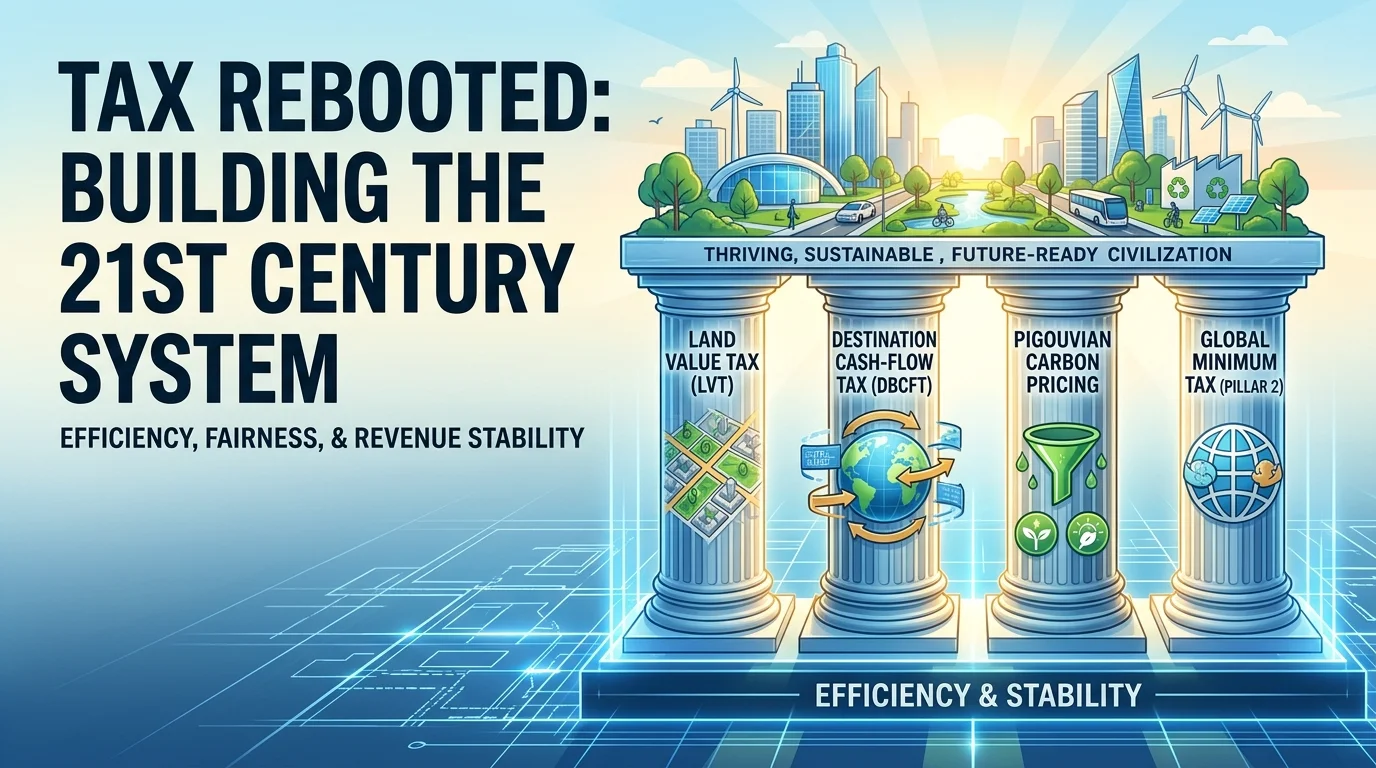
Core Premise & Scope
The Economist correctly diagnoses the structural breakdown of 20th-century tax systems across advanced economies. As sovereign debt loads surge, long-term bond yields remain elevated, demographic aging inflates entitlements, and defense and climate commitments expand, standard fiscal architectures are failing. The article argues that current systems rely too heavily on distortive income and labor taxes while ignoring immobile wealth, land, and environmental negative externalities.
Critical Analytical Gaps
While The Economist identifies key symptoms, its analysis exhibits four primary operational gaps:
- Failure to Address the AI Labor Tax Erosion: High-income nations derive over 40–60% of total tax revenues from Personal Income Tax (PIT) and Social Security Contributions (SSCs). As artificial intelligence and autonomous workflows displace high-wage cognitive labor, standard income tax bases will erode. The Economist treats labor taxation as static rather than declining.
- Abstract Land & Wealth Taxation Without Transition Economics: Advocating for Land Value Taxes (LVT) and property tax overhauls is theoretically sound but politically non-viable without explicit transitional mechanisms (such as tax credits against capital gains or phased revenue-neutral shifts).
- Over-reliance on OECD Consensus Enforcement: The piece assumes smooth global coordination via the OECD Inclusive Framework. In reality, jurisdictional profit-shifting and implementation friction between market nations and headquarters hubs create major enforcement leaks.
- Omission of Cash-Flow Expenditure Architectures: The analysis fails to evaluate Destination-Based Cash-Flow Taxation (DBCFT), which removes incentives for corporate inversion while exempting marginal investment from capital distortion.
Designing the Optimal Tax System for the 21st Century
Tax codes across the developed world are relics of a 1950s industrial economy. Built on the assumption of immobile domestic corporations, fixed physical factories, and stable wage labor, 20th-century tax models create massive deadweight losses, disincentivize capital formation, and fuel wealth inequality.
A modern tax architecture must maximize economic efficiency and neutrality while maintaining progressive distribution and fiscal solvency. Achieving this requires shifting the tax base away from productive inputs (labor and investment) toward unearned economic rents, immobile assets, and negative externalities.
       TRADITIONAL TAX BASE                   21ST-CENTURY TAX ARCHITECTURE
┌─────────────────────────────────┐       ┌─────────────────────────────────┐
│ • High Marginal Income Taxes   │       │ • Land Value Taxation (LVT)     │
│ • Corporate Income Tax (CIT)   │  ───► │ • Progressive Expenditure Tax   │
│ • Payroll & SSC Distortions    │       │ • Pigouvian Carbon Pricing      │
│ • Capital Gains Penalties       │       │ • Destination Cash-Flow Model   │
└─────────────────────────────────┘       └─────────────────────────────────┘
Structural Failures of Current Fiscal Architectures
Modern sovereign states face a structural triad of fiscal pressures:
- Demographic Entitlement Creep: Aging populations reduce the working-age tax base while accelerating expenditures on public pensions and healthcare.
- Labor Income Erosion: Technological displacement and the growth of independent digital work dismantle traditional payroll tax collection mechanisms.
- Capital Mobility & Base Erosion: Intangible assets (IP, algorithms, digital platforms) allow multinational entities to shift taxable profits across borders, undermining standard corporate income taxes.
According to data from the Urban-Brookings Tax Policy Center, high marginal tax rates on capital and labor depress long-run economic growth by creating deadweight loss wedges between pre-tax returns and post-tax rewards.
The Four Pillars of the Modern Tax System
                  ┌─────────────────────────────────────────┐
                  │    21st Century Tax Architecture        │
                  └────────────────────┬────────────────────┘
                                       │
        ┌──────────────────┬───────────┴───────────┬──────────────────┐
        ▼                  ▼                       ▼                  ▼
┌───────────────┐  ┌───────────────┐       ┌───────────────┐  ┌───────────────┐
│  Land Value   │  │  Destination  │       │   Pigouvian   │  │  Global Min   │
│ Tax (LVT)     │  │  Cash-Flow    │       │ Carbon Pricing│  │  Pillar 1/2   │
└───────────────┘  └───────────────┘       └───────────────┘  └───────────────┘
1. Land Value Taxation (LVT)
Land is inelastic in supply. Taxing the unimproved value of land creates zero economic deadweight loss because land cannot relocate or shrink in response to taxation.
- Abolish Standard Property Taxes on Improvements: Traditional property taxes penalize building construction and urban development. Taxing only the underlying land value incentivizes efficient land use and infill development.
- Recapture Unearned Location Value: Urban land values appreciate primarily due to public infrastructure (transit, utilities, public safety) and community growth. An LVT captures these economic rents for public revenue without taxing private capital improvements.
2. Progressive Destination-Based Consumption Tax
Replacing corporate income taxes and high personal income brackets with a progressive cash-flow consumption tax removes the double-taxation penalty on savings and investment.
- Destination-Based Cash-Flow Tax (DBCFT): Tax is levied where goods or services are consumed, rendering corporate tax avoidance via offshore profit-shifting obsolete.
- Full Expensing of Capital Investments: Businesses immediately deduct all capital expenditures, removing investment distortions and accelerating productivity growth.
- Individual Progressive Consumption Tax: Individuals report total income minus net savings. The remaining spending is taxed at progressive rates, shielding low-income households via prebates or personal allowances.
3. Pigouvian Externality Pricing
Taxes should actively discourage activities that impose unpriced costs on society. Pigouvian levies convert social harms into direct fiscal revenue.
- Upstream Carbon Taxation: Implementing a border-adjusted carbon tax prices environmental damage directly into energy and goods production. As outlined in the IMF Fiscal Policy Frameworks, pricing carbon provides market signals for green technology transitions while generating revenue to offset lower income taxes.
- Resource and Congestion Levies: Variable tolling on urban roadways and extraction fees on finite natural resources internalize spatial and environmental costs.
4. Coordinated Multilateral Corporate Minimum Taxes
To address profit-shifting by digital multinationals, international tax law must transition from physical presence rules to destination-based profit allocation.
- Implementation of OECD Pillar 1 & Pillar 2: Adopting a global minimum corporate tax rate of 15% eliminates race-to-the-bottom tax competition, as detailed in the OECD Global Tax Framework.
- Formula Apportionment for Digital Services: Allocating multinational taxable income based on sales destination and active user bases ensures fair revenue distribution without requiring physical offices.
Comparative Analysis of Tax Regimes
| Tax Model | Economic Efficiency | Distributional Equity | Evasion Resilience | Administrative Complexity |
| Traditional Income & Corporate Tax | Low (High deadweight loss, double taxation of savings) | Moderate (Progressive on paper, vulnerable to deductions) | Low (Prone to offshore shifting and tax shelters) | High (Requires extensive compliance and auditing) |
| Wealth & Inheritance Taxation | Low-Moderate (Risks capital flight and valuation disputes) | High (Targets accumulated asset concentration) | Low (Capital moves to non-reporting jurisdictions) | Very High (Requires complex annual asset valuations) |
| Land Value Taxation (LVT) | Maximum (Zero supply distortion on unimproved land) | High (Progressive; land ownership is heavily concentrated) | Maximum (Immobile physical asset) | Low (Requires transparent cadastral land valuation) |
| Destination Cash-Flow Consumption Tax | High (Promotes investment, eliminates capital penalties) | High (Progressive spending tiers + prebates) | High (Border adjustments eliminate transfer pricing) | Moderate (Relies on border adjustments and financial transaction data) |
Mitigating AI-Driven Disruption to Public Finance
As AI tools and automation displace labor income, tax systems relying on payroll fees face declining receipts. Attempting to tax AI directly through “robot taxes” slows innovation and distorts technical adoption.
┌────────────────────────────────────────────────────────────────────────┐
│                        AI DISRUPTION & TAX BASE                        │
├──────────────────────────────────┬─────────────────────────────────────┤
│  Flawed Approach: Robot Taxes    │  Optimal Approach: Cash-Flow Tax    │
├──────────────────────────────────┼─────────────────────────────────────┤
│ • Penalizes technology adoption  │ • Taxes economic output at spending │
│ • Arbitrary definition of "robot" │ • Captures AI super-normal rents    │
│ • Slows productivity growth      │ • Neutral to technology choice      │
└──────────────────────────────────┴─────────────────────────────────────┘
The solution is to decouple public revenues from labor payrolls altogether:
- Shift Base to Corporate Cash-Flow and Land: As capital yields an increasing share of national income relative to wages, taxation must target corporate economic rents and land values rather than wage receipts.
- Eliminate Payroll Tax Caps: Remove income thresholds on social insurance contributions to maintain equity during structural shifts in high-earner distributions.
- Expand Universal Citizen Dividends: Fund social safety nets using revenues generated from Pigouvian carbon taxes and land value capture rather than taxing wage transactions.
Political Execution & Transition Roadmap
Reforming a tax code requires managing transition shocks to prevent capital flight or political paralysis.
Phase 1: Stabilization (Years 1-2)
├── Introduce upstream Carbon Tax with dividend returns
└── Enact OECD Pillar 2 15% global minimum tax

Phase 2: Base Shift (Years 3-5)
├── Replace local property taxes with Land Value Tax (LVT)
└── Allow 100% immediate expensing for business investments

Phase 3: Structural Realignment (Years 6-10)
├── Consolidate Personal Income Tax into Progressive Consumption Tax
└── Phase down distortionary corporate income tax rates
- Revenue-Neutral Phase-In: Pair new Land Value Taxes and carbon levies with immediate rate reductions on wage income and full capital expensing for businesses.
- Granular Tax Prebates: Mitigate regressivity in consumption taxes by distributing monthly advance rebates to low-and-middle-income households.
- International Harmonization: Secure treaty compliance through the IMF International Tax Reform Guidelines, ensuring uniform adoption of destination-based rules across major trading blocs.
Discover more from The Economy
Subscribe to get the latest posts sent to your email.
Global Economy
Johor Bahru-Singapore RTS Link Passenger Service Delayed to February 2027: Economic and Cross-Border Implications

The commencement of passenger operations for the highly anticipated Johor Bahru-Singapore Rapid Transit System (RTS) Link has been officially postponed to February 2027. Originally slated to launch by the end of 2026, the updated timeline reflects a necessary extension for independent safety certification and final regulatory approvals, shifting the debut past the critical Chinese New Year travel window.
Why the Launch Date Shifted
While physical construction has hit major milestones, the delay is strictly tied to operational safety testing and multi-national regulatory compliance. The project’s operator, RTS Operations (RTSO)—a joint venture between Singapore’s SMRT and Malaysia’s Prasarana—expects all system tests and trial runs to conclude by December 31, 2026.
However, translating completed tests into a live public service requires third-party vetting. According to The Straits Times, passenger service cannot commence until RTSO obtains independent safety certification, which must then be individually reviewed and approved by grantors from both nations: Singapore’s Land Transport Authority (LTA) and Malaysia’s Ministry of Transport (MOT).
Infrastructure and Technical Readiness
Despite the administrative timeline extension, the hard infrastructure on both sides of the Strait remains robustly on track.
- Substantial Completion: Authorities confirmed that civil infrastructure works on the 4-kilometer rail link between Bukit Chagar station in Johor Bahru and Woodlands North station in Singapore are substantially complete.
- Rolling Stock: As detailed by Malay Mail, the light rail system will operate utilizing eight trains manufactured by China Railway Rolling Stock Corporation (CRRC) Zhuzhou Locomotive.
- Border Control: The system will feature co-located customs, immigration, and quarantine (CIQ) facilities, a major legislative hurdle cleared earlier this year, allowing commuters to clear both authorities at their point of departure.
Project Status Overview
| Component | Status / Detail |
| System Tests & Trial Runs | Targeted completion by December 31, 2026 |
| Safety Certification | Pending independent 3rd-party review in early 2027 |
| Rolling Stock | 8 Trains (CRRC Zhuzhou Locomotive) |
| Signalling System | Siemens (Germany) |
| Revised Passenger Launch | February 2027 |
Economic Repercussions for the Johor-Singapore SEZ
The timeline revision is more than just an operational update; it carries notable macroeconomic implications. The RTS Link is heavily relied upon to alleviate chronic congestion on the Causeway and is structurally vital to the success of the upcoming Johor-Singapore Special Economic Zone (SEZ).
Pushing the launch to February 2027 means the rail link is at high risk of missing the peak travel and retail surge leading up to the Lunar New Year. According to coverage by Channel News Asia, this delay impacts cross-border commerce forecasts, extending the wait for businesses banking on enhanced consumer mobility and workforce fluidity between the two nations.
While the delay may temporarily stall the expected retail and real estate momentum in Johor Bahru, the strict adherence to independent safety certification underscores a long-term commitment to a reliable, high-capacity trade and transit corridor.
Discover more from The Economy
Subscribe to get the latest posts sent to your email.

Checks are going out this week to nearly one million Americans, but the $500 payment is far smaller than the political noise around it suggests.
Key Takeaways
- What it is: a $500 refund for certain Affordable Care Act (ACA) marketplace enrollees. President Trump announced it in a video, saying nearly one million people in 30 states would receive checks, per ABC News.
- Who gets it: enrollees in the 30 mostly red states that use the federal marketplace rather than their own exchanges. Checks are sent automatically, and households with several eligible members could receive more than one (NewsNation).
- Total cost: roughly $500 million (same NewsNation report).
- The open questions: it is unclear how the amount was set, where the money comes from, and whether Congress must approve it (NewsNation).
- Do not confuse it with the $5,000 “dividend.” That is a separate, conditional pledge that has not been enacted.
| $500 ACA refund | $5,000 “Trump dividend” | $2,000 tariff dividend | |
|---|---|---|---|
| Status | Checks mailing now | Campaign-style pledge | Promised, never paid |
| Who | ACA enrollees in 30 states | Proposed for all adults | Proposed for most adults |
| Condition | None stated | Republicans keep Congress | n/a |
| Congress approval | Unclear | Disputed | Required, per most analysts |
What the $500 Payment Actually Is
The White House says the money comes from a surplus of unused exchange fee collections, and Trump said enrollees were charged excessive fees under the prior administration (ABC News). ABC noted that the mechanism for disbursing the funds was not clear.
Reporting also points out that the White House’s own fact sheet describes the program as narrower than the announcement video suggested (MS NOW).
The $5,000 Dividend Pledge
At the Republican midterm convention, Trump said he would give American adults a $5,000 dividend if Republicans keep their House and Senate majorities, with at least some money coming from tariff revenue (ABC News).
Key problems:
- Cost. MS NOW notes the plan would reach about 245 million adults, and no money has been appropriated (MS NOW). The arithmetic is simple: 245 million × $5,000 ≈ $1.2 trillion.
- Authority. Trump told CBS the White House does not need Congress, while House Speaker Mike Johnson said legislation would likely be required (Epoch Times).
- Track record. CNN counts this as at least the fourth time in 19 months Trump has floated direct payments, including the “DOGE dividend” and the $2,000 tariff dividend, neither of which was delivered (CNN).
Economic Impact: Is $500 a Big Deal?
At the macro level, no. $500 million spread across the economy is a rounding error, and the payment targets a small group.
For individual households, it can matter. A one-time $500 may offset a portion of rising premiums for the enrollees who qualify, though one report noted it would not come close to covering the price increases some are absorbing (MS NOW).
The larger economic question is the $5,000 proposal. Analysts have argued broad rebate checks could add to deficits and put upward pressure on inflation. In the earlier $2,000 tariff-dividend debate, CBS reported an analyst’s view that such checks would be “another factor pushing inflation up” (CBS News), and that pandemic stimulus checks likely added one to three percentage points to inflation.
Policy and Political Context
- Timing. The checks arrive about five weeks before the November 3 midterms (NewsNation), with affordability a key voter issue.
- Funding transparency. Congress has not appropriated money for either payment, and the administration has not detailed how they would be funded (MS NOW).
- Legal exposure. If courts rule against tariffs, refunds to importers could shrink the revenue the dividend relies on (CBS News).
What Should You Do?
- If you were on a federal-marketplace ACA plan in one of the 30 states: watch your mail and keep your address current with the marketplace; checks are automatic, so there is nothing to apply for.
- If you are not in those states: the $500 refund does not apply to you.
- Do not budget for the $5,000. It has not been approved by Congress and depends on an election outcome.
- Beware scams. Fake “stimulus” offers spike around announcements like this. Legitimate payments do not require fees or bank logins.
- Tax treatment: ask a tax professional how a refund of this kind is treated for your situation.
Frequently Asked Questions
What is the Trump $500 payment?
A $500 refund for certain ACA marketplace enrollees in 30 states, totaling about $500 million (NewsNation).
Who qualifies?
People enrolled through the federal marketplace in the 30 states that do not run their own exchanges.
Is the $5,000 dividend real?
It is a pledge tied to Republicans winning Congress; it has not been enacted (CNN).
Does Congress need to approve these payments?
That is disputed; the Speaker said legislation would likely be needed for the $5,000 plan (Epoch Times).
Will the $2,000 tariff checks arrive?
They have not, as of now (NewsNation).
Five hundred dollars is real money to the people who receive it. Whether it signals a new era of direct payments or one more campaign-season promise is the question that will outlast the checks.
Discover more from The Economy
Subscribe to get the latest posts sent to your email.

Goldman vs. Citi: Which Banking Giant Leads Modern Global Finance in 2026?

Beyond Hanoi & HCMC: How Northern Industrial Clusters Are Driving Vietnam’s 10% Growth Surge

Analytical Review of The Economist’s “What is the Right Tax System for the 21st Century?”

Southeast Asia’s LNG Dilemma: Navigating Price Volatility, Infrastructure Gaps, and Energy Security

Who Is Shivon Zilis? The Neuralink Executive at the Center of the Musk–OpenAI Trial

ChatGPT Traffic Rebounds in 2026: Why OpenAI’s AI Giant Is Winning Users Back

U.S.-Ireland Trade Dynamics: Trump’s Investment Push

Energy Crisis Action: G7 Agrees to Release 100 Million Barrels of Diesel and Crude

Johor Bahru-Singapore RTS Link Passenger Service Delayed to February 2027: Economic and Cross-Border Implications

Trump’s $15 Billion Iowa Steel Plant: What’s Confirmed, What’s Not, and Who Wins

iPhone Duo: Apple’s $1,999 Foldable Is Really a Bet on AI

AI vs. the Manhattan Project: Why the Comparison Breaks Down in 2026

U.S. Job Growth Decelerates to 29,000 in September as Unemployment Edges Up to 4.2%

Kai Cenat’s Rise to the Top: The Economics of Modern Streaming

Oil Prices Break $100 in 2026: Middle East Conflict & Energy Markets

IMF & World Bank 2026 Global Economic Outlook: Growth, Inflation, Debt

High-CPM Finance Niches 2026: Publisher Monetization Blueprint

China Stocks Today: Are Big Economies in Asia Nearing a Market Bottom?

Middle East War Economics 2026: Oil Prices & Energy Markets

Global Pension Systems Ranked: The World’s Best and Worst Retirement Frameworks

Enterprise AI Platforms Disrupting B2B SaaS in 2026: Full Analysis

Social Security Trust Fund 2032: OASI Depletion Timeline Explained

Crypto Daily Outlook: Bitcoin, Altcoins, and the Future of Decentralized Finance

Elon Musk’s Next Moves: Disrupting the 2026 Global Economy

GasBuddy Market Insights: How Crude Price Shifts Impact Local Fuel Cost Averages

Global Equity Market Divergence: US Tech vs. European Dividend Stocks vs. Asian Growth

World Bank & IMF Reports 2026: Why the “3% Growth” Consensus Is Actually a Debate

PSX Forecast 2026: KSE-100, IMF Reviews & Geopolitics
-

 Markets & Finance9 months ago
Top 15 Stocks for Investment in 2026 in PSX: Your Complete Guide to Pakistan’s Best Investment Opportunities
-

 Analysis8 months ago
Johor’s Investment Boom: The Hidden Costs Behind Malaysia’s Most Ambitious Economic Surge
-

 Analysis8 months ago
Top 10 Stocks for Investment in PSX for Quick Returns in 2026
-

 Banks9 months ago
Best Investments in Pakistan 2026: Top 10 Low-Price Shares and Long-Term Picks for the PSX
-

 Analysis8 months ago
Brazil’s Rare Earth Race: US, EU, and China Compete for Critical Minerals as Tensions Rise
-

 Investment9 months ago
Top 10 Mutual Fund Managers in Pakistan for Investment in 2026: A Comprehensive Guide for Optimal Returns
-

 Global Economy9 months ago
15 Most Lucrative Sectors for Investment in Pakistan: A 2025 Data-Driven Analysis
-

 Global Economy9 months ago
Pakistan’s Export Goldmine: 10 Game-Changing Markets Where Pakistani Businesses Are Winning Big in 2025