
Banks
Deutsche Bank Seeks to Expand Private Credit Offerings Amid $30 Billion Exposure and Mounting Industry Risks

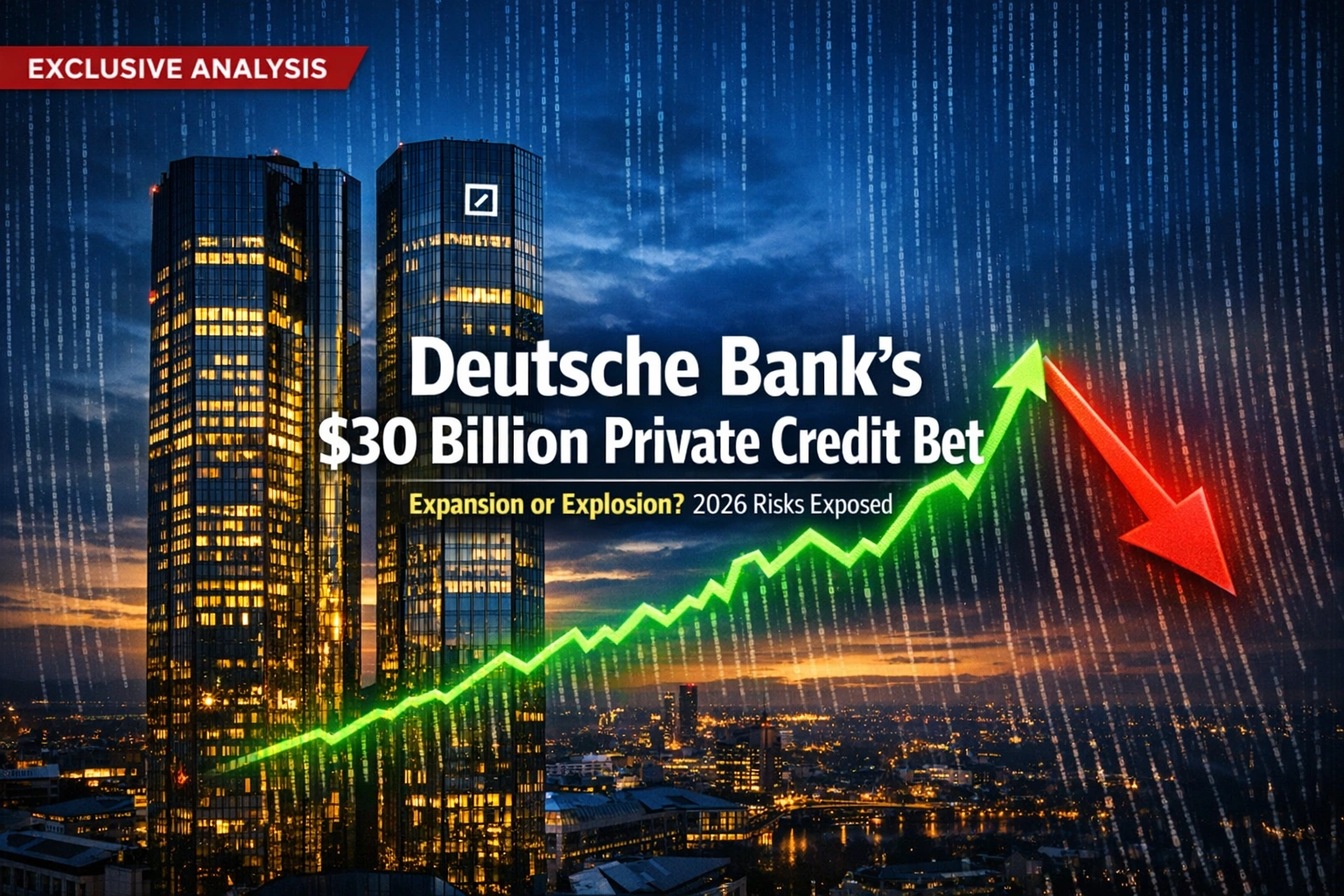
There is a peculiar kind of institutional courage — or, depending on your disposition, institutional hubris — in publishing a document that simultaneously discloses a €25.9 billion risk and announces your intention to take on more of it. Deutsche Bank did precisely that on Thursday morning when its 2025 Annual Report and Pillar 3 disclosures landed on investor terminals across three continents.
The numbers were striking enough on their own: the Frankfurt-headquartered lender’s private credit portfolio had grown roughly 6% year on year, rising from €24.5 billion in 2024 to nearly €26 billion — just over $30 billion at current exchange rates — making it one of the most substantial disclosed private-credit exposures on any European bank’s balance sheet. But it was the three words buried deeper in the filing that stopped seasoned credit analysts mid-scroll. Deutsche Bank, the report stated plainly, “seeks to expand private credit offerings.”
That phrase landed in a market already skittish about the asset class. Shares in Deutsche Bank fell in early Frankfurt trading, joining a broader rotation away from names perceived to carry outsized private-credit risk. The decline echoed a pattern seen six weeks earlier when a separate Deutsche Bank research note warned that software and technology companies — the sector most loved by private credit lenders — posed what its analysts called one of the “all-time great concentration risks” to speculative-grade credit markets. The analysts were speaking about an industry-wide problem. Today, their own institution disclosed that its technology-sector loan exposure had jumped to €15.8 billion, up sharply from €11.7 billion the prior year — an increase of 35% in a single twelve-month period.
To its critics, Thursday’s disclosure is evidence of a systemic contradiction at the heart of modern banking: institutions that identify a risk in public research simultaneously deepen their exposure to it in private transactions. To its defenders — and Deutsche Bank has articulate ones — the expansion is a deliberate, conservatively underwritten bet on a structural shift in how the world’s capital flows. Both positions deserve a serious hearing, because the stakes extend well beyond any single bank’s quarterly earnings.
1: The Numbers Behind Deutsche Bank’s Private Credit Bet
A Portfolio That Represents 5% of the Entire Loan Book
Deutsche Bank’s 2025 Annual Report is a document with the heft of a minor encyclopedia, but the private credit section rewards close reading. The €25.9 billion exposure — roughly 5% of the bank’s total loan book — did not arrive overnight. It has been built methodically, brick by brick, across the Corporate & Investment Bank, the Private Bank, and through the bank’s asset management arm, DWS.
That tripartite structure is deliberate. DWS, Germany’s largest asset manager, has been quietly building a private markets capability for institutional and increasingly retail clients, offering access through vehicles including a European Long-Term Investment Fund launched in partnership with Deutsche Bank and Partners Group. The Private Bank, meanwhile, has been developing digital investment solutions to bring private credit products to high-net-worth individuals who previously had no practical route into the asset class. The CIB provides origination firepower — deal flow, syndication, and leveraged finance relationships that few European peers can match.
The Technology Sector Concentration
The most acute number in Thursday’s filing, however, is the technology figure. At €15.8 billion, loans to the technology sector — including software companies — now account for approximately 61% of the bank’s total private credit book. This is not incidental. Software businesses became the flagship borrowers of the private credit boom for a set of well-understood reasons: predictable subscription revenues, high gross margins, low capital intensity, and sticky customer bases that offered lenders reliable cash flow visibility.
What changed — abruptly, and with world-historical speed — was the artificial intelligence revolution. As Bloomberg reported in February, Deutsche Bank’s own research analysts, led by Steve Caprio, warned that software companies account for roughly 14% of the speculative-grade credit universe, representing approximately $597 billion in debt outstanding. The AI disruption risk is not theoretical: it is already repricing loans. Payment-in-kind usage — where borrowers pay interest in additional debt rather than cash — has climbed to 11.3% in business development company portfolios, more than 2.5 percentage points above the already-elevated market average of 8.7%. These are the early signatures of distress.
Growth Ambitions Across Three Vectors
Deutsche Bank’s expansion strategy, as stated in its annual report, runs through three coordinated channels:
Selective regional expansion — deepening penetration in markets where private credit infrastructure remains underdeveloped, particularly continental Europe and selective Asia-Pacific corridors, where regulatory capital requirements have pushed traditional bank lending back and created origination vacuums that non-bank lenders, and bank-affiliated funds, are rushing to fill.
CIB integration — leveraging the Investment Bank’s leveraged finance, debt capital markets, and structured finance relationships to originate transactions that DWS-managed funds then hold.
Digital private banking solutions — using technology to distribute private credit products to a broader base of Private Bank clients, addressing the longstanding illiquidity premium that has historically confined the asset class to the largest institutional investors.
2: Conservative Underwriting vs. Industry Red Flags
Deutsche Bank’s Stated Defensive Architecture
In a period of mounting industry-wide scrutiny, Deutsche Bank has been emphatic — perhaps strategically so — about the conservative character of its underwriting. The annual report states that the bank applies “conservative underwriting standards” to its private credit portfolio, and that it is not exposed to “significant risks” through its relationships with non-bank financial institutions. It does, however, acknowledge that “the bank could face potential indirect credit risks through interconnected portfolios and counterparties.”
This language matters. The distinction between direct and indirect risk is not merely semantic — it is the central architectural question in private credit today. A bank that originates loans and holds them on balance sheet faces direct mark-to-market and default risk. A bank that originates, then distributes to third-party funds — while maintaining warehouse lines, revolving credit facilities, and fund-level leverage — faces indirect risk that is harder to quantify, harder to stress-test, and potentially far more systemic in a scenario of simultaneous redemptions.
Advance rates of approximately 65% — meaning Deutsche Bank typically lends against 65 cents of every dollar of collateral value — place it meaningfully below the leverage levels typical of the most aggressive direct lenders in the market. The portfolio is also weighted toward investment-grade or near-investment-grade borrowers rather than the deep-sub-investment-grade exposures that characterise some U.S.-based business development companies.
The Industry’s Red Flags in 2026
That conservatism, however, exists within an ecosystem that is developing structural fault lines. Reuters reporting on Thursday noted that “failures of a select number of sub-prime lenders in the U.S. increased investor focus on risks associated with private credit and raised wider concerns around underwriting standards and fraud risk.” The phrase in quotation marks came directly from Deutsche Bank’s own annual report — a remarkable degree of institutional candour.
Several interconnected pressures are now converging on the $2 trillion global private credit market simultaneously:
Redemption pressure — As CNBC documented in February, publicly traded business development companies with heavy software exposure experienced dramatic sell-offs, with Ares Management falling over 12%, Blue Owl Capital losing more than 8%, and KKR declining close to 10% in a single week. These are liquid proxies for an illiquid market, and their moves signal what institutional redemption pressure, if sustained, could do to private fund valuations.
AI-driven obsolescence risk — UBS Group has modelled a scenario in which, under aggressive AI adoption assumptions, default rates in U.S. private credit climb to 13% — substantially above the stress projections for leveraged loans (approximately 8%) and high-yield bonds (around 4%). Software payment-in-kind loans now represent a growing share of BDC portfolios precisely because many software borrowers are already struggling to service debt in cash.
Opacity and interconnection — JPMorgan’s Jamie Dimon warned in late 2025 about private credit’s “cockroaches” — the concern that stress in one borrower signals more hidden trouble elsewhere. The ECB and the Bank of England have both flagged concentration risk in their recent financial stability reviews, noting that banks’ indirect exposures through fund-level financing may be materially understated in regulatory disclosures.
3: Global Implications — European Banks, AI, and the $1.8 Trillion Private-Credit Shift
Europe’s Structural Opportunity
To understand why Deutsche Bank seeks to expand private credit offerings despite these headwinds, it is necessary to understand the structural logic that makes European banks’ private credit ambitions almost inevitable.
Following the Global Financial Crisis and successive rounds of Basel regulatory tightening, European banks sharply curtailed their lending to mid-market corporates, leveraged buyouts, and growth-stage technology companies. Non-bank lenders — Blackstone, Apollo, Ares, Blue Owl, and their peers — filled that vacuum with extraordinary efficiency. By most estimates, the global private credit market has grown from under $500 billion a decade ago to somewhere between $1.8 trillion and $2 trillion today, depending on definitional boundaries, with some forecasters projecting it reaching $3.5 trillion by the end of the decade.
European banks have watched this transfer of margin and relationship capital to predominantly U.S.-headquartered asset managers with the quiet fury of entities losing market share in their home territory. Deutsche Bank’s expansion strategy is, in part, a reclamation effort — an attempt to intermediate capital flows that would otherwise bypass Frankfurt entirely and flow directly from pension funds and sovereign wealth vehicles in Oslo, Abu Dhabi, and Seoul to private equity-owned software companies in San Francisco and London, with U.S. managers collecting the management fees.
The AI Dimension
The artificial intelligence disruption to software borrowers is not a risk that Deutsche Bank — or any lender — can underwrite away entirely. According to analysis published by S&P Global, software and technology companies account for approximately 25% of the private credit market through year-end 2025. Deutsche Bank’s own analysts have noted that the software sector’s exposure to AI-driven disruption “would rival that of the Energy sector in 2016” — a period that produced widespread credit losses and a restructuring cycle that took years to resolve.
What makes the current situation structurally different from the 2016 energy analogy is the speed of the disruption vector and the opacity of the affected portfolios. When oil prices collapsed, the mechanism of loss was transparent: commodity prices are public, reserves are reported, and the chain of causation from price to default was legible. AI disruption to software revenue is subtler, faster, and far harder to detect in quarterly borrower updates until it crystallises into a covenant breach or, worse, a payment default.
Macro Implications for Policymakers
The ECB’s most recent Financial Stability Review identified the nexus of banks and non-bank financial institutions as a primary risk amplification channel. What Deutsche Bank’s disclosure crystallises — in unusually stark terms for an institution not known for gratuitous transparency — is that European banks’ exposure to private credit is not merely an investment banking line item. It is a macro-financial variable.
If private credit suffers a disorderly repricing — triggered by AI-driven software defaults, a redemption cascade, or a combination of both — European banks with direct lending exposure face mark-to-market losses. Those with indirect exposure, through warehouse lines and fund-level leverage, face contingent liabilities that may not appear on regulatory balance sheets until stress has already propagated. The IMF’s Global Financial Stability Report has warned repeatedly that the non-bank sector’s interconnection with regulated banking creates channels of contagion that supervisors lack adequate tools to monitor in real time.
4: Peer Comparison — Deutsche Bank vs. Private Credit Titans
How Deutsche Bank’s Exposure Stacks Up
The following table provides a structured comparison of Deutsche Bank’s private credit approach against key peers and specialist alternative asset managers operating in the same market:
| Institution | Estimated Private Credit AUM / Exposure | Technology Sector Weight | Underwriting Approach | Key Risk Flag |
|---|---|---|---|---|
| Deutsche Bank | €25.9bn ($30bn) direct exposure | ~61% (€15.8bn tech) | Conservative; ~65% advance rates; investment-grade bias | Indirect NBFI contagion; tech concentration |
| Blackstone | ~$300bn credit & insurance AUM | Diversified; <20% software | Institutional, collateralised | Redemption queues in flagship vehicles |
| Apollo Global | ~$500bn total AUM; large private credit sleeve | Moderate software exposure | Originate-to-distribute; balance sheet light | NAV lending; leverage at fund level |
| Blue Owl Capital | ~$200bn AUM; pure-play direct lending | High; software-heavy BDCs | Senior secured, covenant-lite | AI disruption; stock -8% in Feb 2026 |
| Goldman Sachs Asset Mgmt | ~$130bn private credit | Diversified, IG bias | Hybrid bank/asset manager model | Regulatory capital consumption |
| Ares Management | ~$450bn AUM; ~$300bn+ credit | ~6% software of total assets | Conservative; low software weight | AUM growth costs; manager fee compression |
Sources: Company reports, Bloomberg, Reuters, Pitchbook, as of March 2026. AUM figures approximate and include broader credit franchises where private credit is not separately disclosed.
What the Comparison Reveals
Several conclusions emerge from even a cursory reading of this landscape. First, Deutsche Bank is not a private credit manager in the Blackstone or Apollo sense — it is a bank with lending relationships that overlap substantially with the same universe of borrowers those managers are financing. This creates both complementarity (the bank originates deals that asset managers hold) and potential competition (as asset managers build their own origination infrastructure).
Second, Deutsche Bank’s technology concentration — at roughly 61% of its disclosed private credit book — is high relative to conservative peers like Ares, which has deliberately capped software exposure at around 6% of total assets. This is the number most likely to attract regulatory attention.
Third, the bank’s disclosed exposure at €25.9 billion is, by global standards, a mid-tier position. It is dwarfed by the dedicated private credit franchises of Blackstone, Apollo, and Ares. But it is substantial enough — and sufficiently concentrated in a single stressed sector — to represent a material tail risk on Deutsche Bank’s balance sheet in an adverse scenario.
5: What This Means for Investors and Policymakers
The Investment Calculus
For institutional investors holding Deutsche Bank equity, Thursday’s disclosure contains both reassurance and residual unease. The reassurance: management has been transparent, the underwriting is described as conservative, there are no loss provisions against the private credit book, and the bank’s overall financial performance in 2025 was materially strong — revenues reached €32.1 billion, up 7% year on year, with net profits and capital distributions significantly improved from prior years. The bank’s CET1 ratio remains robust, and cumulative shareholder distributions for 2021–2025 have reached €8.5 billion, above the original €8 billion target.
The residual unease: the technology exposure has grown by 35% in a single year, from €11.7 billion to €15.8 billion, precisely as the AI disruption thesis has become more acute and more credible. If UBS’s stress scenario — 13% default rates in U.S. private credit — were to materialise, even a portfolio that is 65% loan-to-value and investment-grade-biased would generate meaningful losses at these concentrations.
For sovereign wealth funds and central bank reserve managers — who are both increasingly active as direct investors in private credit funds and as counterparties to the banks that finance those funds — the systemic question is more pressing than the idiosyncratic one. A banking system that is simultaneously the lender of last resort for private credit funds (through warehouse facilities and NAV loans) and an originator competing with those same funds is not a system whose risk exposures can be easily ring-fenced. The 2008 crisis demonstrated, with brutal efficiency, that what cannot be ring-fenced tends not to be.
The Regulatory Horizon
European banking supervisors at the ECB have signalled increasing discomfort with banks’ private-credit-adjacent activities since at least 2024. The ECB’s Single Supervisory Mechanism has sought more granular reporting on banks’ exposures to leveraged finance and non-bank financial institutions, and Deutsche Bank’s disclosure — voluntary, detailed, and self-critical — may be read partly as a pre-emptive act of regulatory diplomacy.
In Washington, the Federal Reserve has similarly flagged interconnection between banks and the private credit ecosystem as an emerging macro-prudential concern. The next round of stress tests, scheduled for mid-2026, is expected to include private credit scenarios that were not present in previous years.
Conclusion: The Inflection Point
There is a phrase used by geologists to describe the moment before a faultline slips: they call it “stress loading.” For years, pressure builds invisibly, tectonic plates locked against each other, until some marginal additional force triggers a release that had been inevitable for decades. Private credit in 2026 has the texture of a market under stress loading.
Deutsche Bank’s disclosure is important not because it reveals a crisis — it does not — but because it reveals, with unusual precision, the scale and composition of one institution’s position ahead of what could be a significant realignment. The bank’s €25.9 billion portfolio is conservatively underwritten relative to many peers. Its ambitions to expand are strategically coherent. Its transparency, in an asset class not known for it, is genuinely welcome.
And yet: a 35% increase in technology-sector loans in a single year, at precisely the moment when AI is rewriting software’s competitive dynamics, is not a trivial coincidence. Nor is the simultaneous reality that the private credit market’s fastest-growing risks — payment-in-kind escalation, redemption pressure, opacity, interconnection — are also the hardest to observe until they crystallise.
For international investors, the Deutsche Bank private credit expansion story is neither a disaster nor a triumph in waiting. It is something more uncomfortable: a test of whether European banking’s late arrival to the private credit party is disciplined reclamation or expensive imitation. The answer will likely arrive between 2026 and 2028 — precisely the window Deutsche Bank has identified as its “Scaling the Global Hausbank” strategic horizon.
Sophisticated readers will note the symmetry. So, presumably, will the ECB.
FAQ: Deutsche Bank Private Credit — Your Questions Answered
Q1: How large is Deutsche Bank’s private credit portfolio as of 2025?
Deutsche Bank’s private credit portfolio stood at approximately €25.9 billion ($30 billion) at year-end 2025, representing around 5% of the bank’s total loan book and a 6% increase from €24.5 billion at year-end 2024, according to the bank’s 2025 Annual Report published on 12 March 2026.
Q2: Why is Deutsche Bank expanding private credit despite rising risks?
Deutsche Bank seeks to expand private credit offerings through three strategic vectors: selective regional expansion into underserved markets, integration with its Corporate & Investment Bank for deal origination, and digital product development through its Private Bank for high-net-worth distribution. The rationale is structural — European banks lost significant mid-market lending share to U.S. non-bank managers over the past decade, and expanding private credit is partly an attempt to recapture that margin and relationship capital.
Q3: What is the biggest risk in Deutsche Bank’s private credit portfolio?
The single greatest concentration risk is technology-sector exposure, which reached €15.8 billion in 2025 — a 35% increase from €11.7 billion in 2024. This concentration is particularly sensitive to AI-driven disruption of software company business models, which has already caused payment-in-kind loan usage to rise and prompted analysts, including Deutsche Bank’s own research team, to warn of potential industry-wide default rates rivalling the energy sector crisis of 2016.
Q4: How does Deutsche Bank’s underwriting compare to industry peers?
Deutsche Bank applies conservative underwriting standards, including advance rates of approximately 65% and a bias toward investment-grade or near-investment-grade borrowers. This compares favourably to some U.S. business development companies that operate with higher leverage and deeper-sub-investment-grade exposure. However, the technology sector concentration remains high relative to conservative peers like Ares Management, which has capped its software exposure at around 6% of total assets.
Q5: What is the total size of the global private credit market?
Estimates vary by methodology, but the global private credit market is broadly estimated at $2–$3 trillion as of early 2026, depending on whether indirect structures such as NAV lending and warehouse facilities are included. Industry forecasters project growth to $3.5 trillion or beyond by 2030, driven by continued bank disintermediation, demand from institutional investors for yield premium, and expansion into new geographies and borrower segments.
Q6: Has Deutsche Bank reported any losses on its private credit portfolio?
As of the 2025 Annual Report, Deutsche Bank has not reported any losses or provisions directly tied to its private credit exposure. The bank has, however, flagged private credit as a “key risk” and acknowledged the potential for indirect credit risks through interconnected counterparties, representing an honest — and notable — departure from the more sanguine disclosures common in the sector.
Q7: How does AI specifically threaten private credit markets?
AI threatens private credit primarily through its disruption of software company revenue models. Software-as-a-service businesses — the largest single borrower segment in private credit, accounting for roughly 25% of the market — derive value from subscription revenue, sticky customer bases, and high gross margins. Generative AI and agentic coding tools risk eroding those moats by automating functions that enterprise software previously monopolised, compressing multiples and, in severe cases, triggering revenue declines that cannot be serviced from existing debt loads. UBS has modelled an aggressive-disruption scenario in which U.S. private credit default rates reach 13%, compared to 8% for leveraged loans and 4% for high-yield bonds.
Discover more from The Economy
Subscribe to get the latest posts sent to your email.



Spot gold traded around $4,020 to $4,035 an ounce on Thursday 29 October, down roughly 1% on the day, and moved briefly close to $3,983 later, according to Kitco’s live quote. Reuters reported bullion on track for a second straight monthly decline. The metal remains roughly 27-28% below its 2026 record of about $5,600, set in late January.
In Pakistan, one local market report put gold at about Rs423,436 per tola on 26 October. Tola prices also depend on the dollar-rupee rate and local premiums, so check the day’s rate.
Why Gold Is Under Pressure
A hawkish Fed hold. The Fed held rates at 3.75%-4.00% on 28 October, but Governor Lisa Cook and Cleveland Fed President Beth Hammack voted for a hike. On Thursday, Reuters reported markets pricing about a 90% chance of a December hike on the CME FedWatch tool.
Strong US data. Q3 GDP grew 3.4% and core PCE inflation rose to 2.5%, per Kitco, reinforcing the case for restrictive policy. The 10-year yield stayed near 5%.
Why this matters for gold. Gold pays no interest, so higher yields raise the opportunity cost of holding it, and a firmer dollar makes it costlier for non-US buyers. TDS strategist Bart Melek called the Fed’s stance a hawkish pause and expects gold to stay vulnerable in a $3,900-$4,250 range; Sucden Financial warned of a possible fall to $3,900.
Spot gold fell to about $4,020-4,035 an ounce on 29 October 2026 as strong US growth (3.4% in Q3) and higher core inflation kept a December Fed rate hike in play. Higher rates raise the opportunity cost of holding gold, which pays no interest.
What Could Push Gold Back Up
- A softer Fed: TDS expects the Fed to eventually turn toward its employment mandate, which could lift gold, though not immediately.
- Geopolitical shocks: Reuters quoted an analyst noting markets are wary of another spike in tensions after the 3 November US midterms.
- Oil, a double-edged factor: an oil spike raises inflation fears and hawkish expectations, which hurts gold in the short run. The same analyst said gold could post a fresh yearly low if oil revisits $120 and above.
Technical Levels Traders Watch
Kitco’s technical commentary points to $4,000 as a pivot, with downside objectives near $4,024 on a break lower and $3,986 beyond, and resistance in the $4,084-$4,146 zone. Treat these as trader reference points, not predictions.
What It Means for Pakistani Buyers
- Dollar-rupee matters as much as the gold price. If the rupee weakens, local gold can stay firm even when dollar gold falls.
- Time horizon. Analysts quoted expect volatility in a range over the coming weeks; long-term holders and short-term traders face different risks.
- Compare with alternatives. With the SBP policy rate at 12%, yield-bearing assets compete with gold for savings.
- Mind premiums and purity. Jewellery carries making charges; bars and coins track the spot price more closely.
Gold is stuck between a hawkish Fed and geopolitical risk. The $4,000 level has become the focus, and the next US inflation data and Iran’s response on the Qatari deal are the nearest catalysts.
Discover more from The Economy
Subscribe to get the latest posts sent to your email.

The Federal Open Market Committee left its target range unchanged at 3.75%-4.00% on Wednesday 28 October, according to Admiral Markets’ FOMC summary. The vote was 10-2. The two dissenters, Governor Lisa Cook and Cleveland Fed President Beth Hammack, wanted to raise rates by 25 basis points. A committee that is split towards tightening rather than easing is a notable shift in tone.
The statement pointed to strong economic growth and elevated inflation. Chair Kevin Warsh said the committee held to gather more information, and he floated cutting the number of rate decisions from eight to six a year, per Trading Economics.
Why the Dissents Matter More Than the Hold
A hold was expected. The significance is the direction of dissent. Two voters wanting a hike signals that part of the committee sees inflation risks, aggravated by energy prices from the Middle East conflict, as large enough to justify tightening now. FXStreet and MUFG Research both framed the outcome as a hold with a hawkish edge, with the committee not explicitly committing to further hikes but not ruling them out.
MUFG’s read is that a December hike remains live, with more of another move priced by March. On Thursday, Reuters reported the CME FedWatch tool showing roughly a 90% chance of a December hike. That pricing, rather than the unchanged rate, is what moved currencies and precious metals around the decision.
The Inflation Problem Is an Energy Problem
The Fed’s challenge is that the inflation pressure is not purely domestic demand. Brent oil has climbed to around $115, a six-month high, as attacks on tankers and Saudi infrastructure keep supply worries alive, and Iran is weighing a Qatari draft deal that could ease or inflame the market depending on the answer. Central banks cannot lower oil prices with interest rates, but they can stop an energy shock from becoming embedded in wages and expectations, which is the argument the hawkish dissenters appear to be making.
Market Reaction
Crude oil barely moved on the decision, according to FXStreet, as traders waited on Iran’s response to the Qatari proposal. Gold slid toward $4,000 an ounce on Thursday after US Q3 growth printed at 3.4% and core PCE at 2.5%, per Kitco, with the 10-year yield near 5%.
What It Means Beyond the US
- Emerging markets: a Fed leaning hawkish tightens global financial conditions and raises the bar for easing elsewhere. Pakistan’s central bank raised its policy rate to 12% two days before the Fed meeting for domestic inflation reasons, but a firmer dollar adds pressure to the rupee.
- Gulf central banks: several Gulf central banks held rates after the decision, since their currencies are pegged to the dollar.
- Asia-Pacific: officials such as RBNZ’s governor have said another hike is plausible if inflation does not ease.
What to Watch Before December
- Inflation data: the next PCE and CPI prints will decide whether the dissenters gain allies.
- Oil: Iran’s reply on the Qatari draft, due by the end of the week, is the biggest swing factor. A deal would remove part of the hawks’ case; a breakdown would strengthen it.
- Chair Warsh’s messaging: his comments on the balance between AI-driven productivity and inflation risk.
- Labour market data ahead of the December meeting.
The Fed held, but the committee is no longer debating how fast to cut. It is debating whether to hike. Unless oil retreats, the December meeting is genuinely open.
Discover more from The Economy
Subscribe to get the latest posts sent to your email.

A US government bond can change the required return on a Pakistani investment without a single dollar physically crossing the border. The link runs through a basic idea: when a benchmark asset yields more, investors demand a stronger reason to take additional currency, liquidity and credit risks elsewhere.
The yield on the US 10-year Treasury stood near 5.00% on October 23, 2026, after reaching about 5.24% on October 9, according to historical Treasury-yield data. The user-friendly phrase above 5% should therefore be treated as a description of much of October, not a guaranteed quote for every moment of the latest trading day.
A bond yield is not a savings-account rate
A government-bond yield is the return implied by its market price and promised cash flows, assuming the relevant payment and holding assumptions. When investors sell an existing fixed-coupon bond and its price falls, its yield typically rises. That inverse relationship is central to interpreting the US Treasury market.
The 10-year yield reflects a mixture of expected short-term policy rates, expected inflation and a term premium for holding longer-dated debt. It can fall even while central-bank inflation concerns persist, for example if growth fears rise or investor demand for safe securities strengthens. Reading any single yield move as a pure Fed forecast is a mistake.
Four ways it reaches Pakistan
1. Dollar funding becomes a tougher benchmark. Investors weighing dollar-denominated assets may compare emerging-market returns with those available in US government debt. Pakistani external bonds must compensate for additional sovereign and market risk, although observed spreads change independently of benchmark yields.
2. Currency calculations shift. A domestic bond offering a high rupee yield can still disappoint a foreign investor if depreciation erodes converted returns. For Pakistani investors with future dollar obligations, currency exposure is similarly relevant.
3. Valuations face a higher discount rate. Equity valuations are sensitive to the interest rate used to discount expected future earnings. Companies promising distant profits may be more exposed than businesses generating cash immediately, but there is no perfect sector rule.
4. Sovereign refinancing risk draws scrutiny. Global debt investors assess not only current yields but also how costly it will be for governments to refinance existing obligations. Local T-bills and PIBs are nevertheless priced mainly by Pakistan-specific inflation, liquidity, central-bank policy and credit conditions; US yields do not mechanically set auction cutoffs.
The price-risk example
Imagine a fixed-coupon bond with a duration of seven years. A one-percentage-point increase in yields would imply an approximate 7% price decline, all else equal, using the basic duration approximation. That is not a prediction and not an exact valuation; convexity, yield-curve changes and cash-flow structure matter. It illustrates why holding a bond fund is different from locking in a bank deposit.
Duration risk also works in reverse: bond prices can rise when market yields fall. An investor buying only because the quoted coupon looks attractive may discover later that the resale price has moved against them.
What the latest global backdrop adds
The Federal Reserve raised its policy range to 3.75%–4.00% in September, amid persistent inflation concerns. At the same time, oil-market instability has made imported inflation a more acute concern for Pakistan. The IMF’s October World Economic Outlook forecasts 3.1% world growth for 2026 and highlights downside risks from conflict and financing strains.
This combination means bond yields may be high for reasons that are not benign. A superficially attractive yield could reflect inflation anxiety, fiscal uncertainty or a global risk premium. Investors need to ask why the yield is high, not just how high it is.
A useful comparison table
| Asset | Return quoted in | Main extra risk to examine |
|---|---|---|
| US 10-year Treasury | USD | Duration, inflation, reinvestment |
| Pakistan T-bill | PKR | Domestic rate/inflation, reinvestment |
| Pakistan Investment Bond | PKR | Duration, inflation, liquidity |
| Pakistan dollar bond | USD | Sovereign credit spread, liquidity, duration |
| PSX equity | PKR | Earnings, valuation, currency and market risk |
Currency hedging is not a free lunch
A Pakistani saver comparing foreign-currency investments with domestic government paper must think about more than headline yield. Converting rupees to dollars and back can involve spreads, banking charges, legal requirements and foreign-exchange movement. A hedging instrument, where available and suitable, usually embeds a cost related to interest-rate differences and market conditions. It cannot simply erase currency risk without consequence.
Tax treatment also matters. A quoted yield before withholding tax, custody expense or fund fees is not comparable with an after-tax return from another product. Similarly, a dollar asset can generate a positive dollar return but a different return in rupees. The investor should calculate both if future expenses are split between currencies.
For institutional portfolios, bond duration and liquidity become central. A long-maturity bond may have an attractive yield to maturity but be unsuitable for liabilities due next month. For individuals, the ability to meet an emergency expense without selling at a loss may be worth more than an extra percentage point of advertised return.
The sound comparison is liability-matched, not headline-driven: decide when the money is needed, in what currency and how much market-price movement is tolerable before selecting an asset.
Does a 5% US yield mean Pakistan must offer 5% plus a fixed margin?
No. Each instrument differs in currency, maturity, credit, liquidity and taxation; spreads vary with markets and policy.
Are US Treasuries risk-free?
They are commonly treated as a benchmark for dollar credit risk, but their market prices are not risk-free. Inflation and interest-rate changes can erode purchasing power and resale value.
What should a Pakistani retail investor do first?
List liabilities by currency and timing, then compare instruments on an after-tax, after-inflation and liquidity-adjusted basis. Seek licensed guidance where suitable.
The takeaway: a 5% US benchmark changes the world’s price of patience. Pakistani investors should respond by measuring real cash flows and risks, not by chasing whichever country advertises the biggest nominal yield.
Discover more from The Economy
Subscribe to get the latest posts sent to your email.

Brian Kemp’s Georgia Legacy: Economic Growth, Elections and the Costs of His Policy Choices

Dow Futures vs Dow Jones: What E-mini Contracts Really Tell You Before Wall Street Opens

China Tape Maker Stock Debut: Crown New Materials Soared 787%

Apple’s Earnings Beat Had a Catch: Look Past the Tariff Refund

Social Security Payments in November 2026: The Full Calendar and Two Important Changes

Johor–Singapore SEZ’s $21.8 Billion Bet: The Hard Part Starts Now

China’s 175 Trillion AI Tokens Reveal a Bigger Shift: The AI Boom

The Philippines’ Stagflation Trap: Higher Interest Rates

Alphabet’s $500 Billion Reckoning: Wall Street Is Losing Patience With the AI Boom

4 Reasons Why China’s Trade Concessions to Europe Will Not Solve the Crisis

The AI Revolution Needs Atomic Power. Southeast Asia Is Ready to Build It.

Zhuhai Airshow 2026: How China’s Stealth Jets, Drones and Missiles Are Redrawing Global Air Power

The $8 Billion Runway: China’s Strategic Bet on Guangzhou and the Future of Aviation

The Sandbox Imperium: Why Beijing’s Digital Yuan Needs Hong Kong

Crude Oil & Petroleum Market Analysis: OPEC+ Decisions and Price Forecasts

Top US Convenience Store Chains: Store Counts, EV Charging, and Sales Trends

Social Security Extra $90 Deposit: Who Qualifies for the October 2026 Medicare Rebate?

Gold Price Outlook 2026: The Forces Behind the Forecasts—and What Could Reverse Them

Algorithmic Dogfights: Why the U.S. and China Must Establish Rules of Engagement for Autonomous Air Power

Corporate America Faces a New Debt Test as US Borrowing Costs Surge

Global Economic Outlook 2026: 7 Forces Reshaping Markets, Trade and Business

Stock Market Crash in 2026? Warning Signs, Scenarios and a Calm Investor Checklist

US–Iran Conflict in October 2026: Hormuz, Oil Prices and Diplomacy

Stock Market Today: Dow, S&P 500, and Nasdaq Retreat as Treasury Yields

Geopolitics and Your Portfolio: How International Affairs Move Global Markets

Anthropic Bans Sustained Abuse of Claude AI Under New Usage Policy Effective November 12, 2026

Why Did I Get $90 From Social Security? 8 Reasons Behind an Unexpected SSA Payment

US–China Critical Minerals Competition: Why a Trade Deal Cannot Fix Every Supply Risk
-

 Markets & Finance10 months ago
Top 15 Stocks for Investment in 2026 in PSX: Your Complete Guide to Pakistan’s Best Investment Opportunities
-

 Analysis9 months ago
Johor’s Investment Boom: The Hidden Costs Behind Malaysia’s Most Ambitious Economic Surge
-

 Analysis9 months ago
Top 10 Stocks for Investment in PSX for Quick Returns in 2026
-

 Banks10 months ago
Best Investments in Pakistan 2026: Top 10 Low-Price Shares and Long-Term Picks for the PSX
-

 Analysis9 months ago
Brazil’s Rare Earth Race: US, EU, and China Compete for Critical Minerals as Tensions Rise
-

 Investment10 months ago
Top 10 Mutual Fund Managers in Pakistan for Investment in 2026: A Comprehensive Guide for Optimal Returns
-

 Global Economy10 months ago
15 Most Lucrative Sectors for Investment in Pakistan: A 2025 Data-Driven Analysis
-

 Global Economy10 months ago
Pakistan’s Export Goldmine: 10 Game-Changing Markets Where Pakistani Businesses Are Winning Big in 2025