
Analysis
Warren Raises €10M to Fix Belgium’s Broken Workplace Pensions

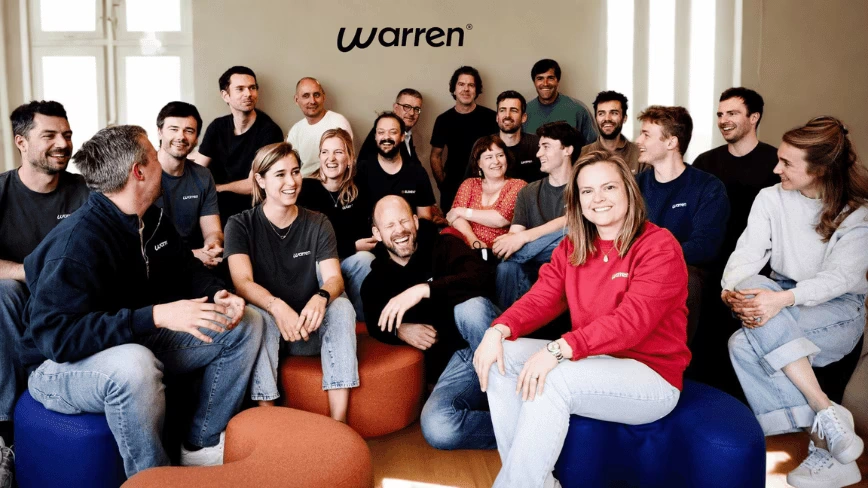
A Belgian worker who clocks 40 years on the job retires, on average, with a supplementary pension worth less than a second-hand car. That’s not a metaphor — it’s the median outcome for employees aged 56 to 65 in Belgium’s second pillar, where reserves sit below €10,000. Warren, a Ghent-based fintech founded in 2024, wants to break that pattern, and it’s just raised €10 million in seed funding to do it.
The round, announced this week, was led by Motive Ventures, the venture arm of transatlantic investment firm Motive Partners, with F Capital joining as a new backer alongside returning investors Entourage, Syndicate One, and 100IN. It follows a €3 million pre-seed raise in March 2025 — putting Warren’s total funding north of €13 million in just over a year.
The Macro Picture: A Pension System Running on Borrowed Time
Belgium’s pension architecture rests on three pillars: a state pension, an employer-sponsored “second pillar” of occupational plans, and voluntary private savings. The first pillar is doing nearly all the work. According to the OECD, Belgians depend on the state pension for 85% of their monthly retirement income, compared with an average of 57% across other developed economies — and the replacement rate it delivers, around 45% of final salary, trails the OECD average of 54%.
That imbalance is becoming harder to sustain. Public pension expenditure is projected to climb from 13.1% of GDP to 15.1% over the next 30 years, a trajectory the OECD ranks as the second-steepest in the bloc after Spain. Belgium’s new “Arizona” coalition government has responded with a pledge to guarantee employer contributions of at least 3% to workplace pensions for all employees by 2035 — an acknowledgment that the second pillar can no longer be left to drift.
Warren isn’t a broker or an advisory layer bolted onto existing insurers. It operates its own licensed pension fund, investing employer and employee contributions directly into a diversified portfolio of low-cost ETFs — with no entry fees, no asset-based management fees, and no hidden commissions.
That structural choice is the company’s central pitch. Most workplace pension reserves in Belgium sit inside Branch 21 group insurance contracts — products that guarantee a nominal return but, after fees and inflation, frequently erode real purchasing power over a multi-decade horizon. Warren’s founders, led by CEO Cedric De Vleeschauwer, argue this is the quiet mechanism behind the country’s threadbare second-pillar outcomes.
- Flat subscription pricing: Employers pay a fixed fee rather than a percentage of assets under management, so returns compound without being skimmed year after year.
- Full fee transparency: No layered commissions embedded in the underlying insurance wrapper.
- Financial coaching built in: The platform pairs pension administration with employee-facing financial education, addressing what the company calls a literacy gap as much as a savings gap.
In its first year of commercial operation, Warren says it has signed roughly 100 Belgian companies, building toward a stated target of 100,000 employees on the platform by 2028. The new capital will fund close to thirty additional hires on top of the 25-person team already in place — and lay groundwork for expansion into one or two further European markets once Belgium is consolidated.
Is the Second Pillar Pension Adequate in Belgium?
Belgium’s second-pillar pension is not adequate by international standards: the median reserve for workers aged 56–65 sits under €10,000, the state pension covers 85% of retirement income versus a 57% OECD average, and statutory replacement rates lag the OECD norm of 54%.
A €10 million seed round is modest by fintech standards. What makes it notable is the regulatory vacuum Warren is stepping into. In the UK, where comparable players like Penfold and Smart Pension operate, workplace pension participation is mandatory under auto-enrolment law — Penfold raised €4.6 million in May 2025 and grew its employer base from 1,200 to over 4,000 companies inside roughly eighteen months, while Smart Pension secured a €69.4 million credit facility to scale within that same compulsory framework.
Belgium has no equivalent mandate yet. The Arizona coalition’s 3% employer-contribution pledge is a policy direction, not enacted law, and its 2035 horizon leaves nearly a decade of voluntary adoption ahead. Warren is effectively betting that it can build category leadership before the rules force employers to act — a higher-risk, higher-reward sequencing than its UK peers ever had to attempt. If the mandate eventually arrives, first-mover platforms stand to inherit the compliance wave; if it stalls, growth depends entirely on employers choosing better pensions voluntarily, which is a slower and less certain path.
The downstream effects of this round extend beyond one company’s balance sheet. Three groups have a direct stake in what Warren does with its new capital.
For employers, particularly SMEs that have historically defaulted to whichever insurer their broker recommended, Warren’s flat-fee model creates a price comparison point that didn’t really exist before. Belgium’s tax treatment of second-pillar contributions — contributions taxed at 4.4%, with employer contributions subject to 8.86% social security and an extra 3% levy above roughly €37,872 a year — already shapes how generous employers can afford to be. A platform that strips out asset-based fees changes the net return calculation without touching that tax framework at all.
For employees, the gender dimension is hard to ignore. Belgium’s gender pension gap stood at 31% in 2024, well above the OECD average of 23%, driven partly by lower participation in occupational schemes among women in part-time or interrupted careers. Whether Warren’s coaching layer meaningfully narrows that gap, or simply digitizes the existing disparity, is a question the company hasn’t yet had to answer at scale.
For the broader fintech market, Warren’s raise lands alongside a wave of pension-adjacent funding across Europe — evidence that investors increasingly see retirement infrastructure, not just retirement advice, as the more durable wedge. Expect more entrants to test Belgium’s pre-mandate window over the next 18 months.
Not everyone is convinced that a fintech wrapper solves a structural problem. Critics of the “fee disruption” narrative point out that Branch 21 products exist precisely because they guarantee capital — a feature some risk-averse savers, particularly those nearing retirement, value more than upside potential. Stripping out guarantees in favor of ETF exposure shifts market risk onto the employee, and a downturn in the years immediately before retirement could leave a worker worse off than under a low-yield but capital-protected scheme.
There’s also the adoption question. Belgium’s pension brokers and incumbent insurers have decades of employer relationships, and switching providers involves real administrative friction — works council consultations, collective labor agreements, and union sign-off in many sectors. A flat-fee pitch is compelling on a spreadsheet; it still has to survive a slower, more political procurement process than consumer fintech is used to.
That tension — between the speed startups want and the consensus-building Belgian labor relations require — may end up shaping Warren’s growth curve more than its product does.
Warren’s €10 million says less about the appetite for pension fintech than it does about how exposed Belgium’s second pillar has become. The numbers — a median reserve under €10,000, an 85% reliance on a state system already absorbing a growing share of GDP — aren’t new, and they haven’t moved much despite years of warnings from pension bodies like PensioPlus. What’s changed is that a venture-backed company is now betting real capital on the idea that fixing the product, not just waiting for the mandate, is where the leverage actually sits.
Whether that bet pays off will be decided less in a pitch deck than in thousands of quiet HR meetings across Belgium over the next few years.
Discover more from The Economy
Subscribe to get the latest posts sent to your email.



Key Takeaways
- Rolex’s secondary market rose approximately 7.9% year-over-year as of 2026 (per WatchCharts data) — trailing Patek Philippe (+16.2%) and Tudor (+11.4%) but still outperforming Audemars Piguet (+3.4%).
- Rolex raised U.S. retail prices 4–9% in January 2026 (steel models ~5.6%, gold models ~8.7%), narrowing the historical gap between retail and pre-owned pricing.
- Not every model appreciates: steel sports references (Submariner, GMT-Master II, Daytona) have held value far better than two-tone or widely available dress references like the standard Datejust.
- The Lady-Datejust posted the sharpest 2026 gain among tracked collections — up 22.73%, from roughly $9,269 to $11,376 — driven by demand for smaller, “everyday luxury” watches.
- Gold’s rise past $2,400/oz has directly lifted the investment case for Rolex’s precious-metal references (Day-Date, Sky-Dweller, Yacht-Master).
The Model-by-Model Picture
| Category | 2026 Trend |
|---|---|
| Lady-Datejust | +22.73% (strongest performer among tracked collections) |
| Steel sports models (Submariner, GMT-Master II) | Held value well; corrected from 2022 peak but stabilized above retail |
| Daytona | Corrected from highs above $50,000 to the mid-$30,000s; still among the most sought-after references |
| Two-tone/widely available Datejust | Flat to negative — “holds value” is an overstatement for this category |
| Gold references (Day-Date, Sky-Dweller) | Lifted by gold’s rise above $2,400/oz |
Why the “Rolex Always Appreciates” Myth Is Fading
The pandemic-era boom pushed some references — the Daytona above all — to speculative highs disconnected from historical norms. Since the March 2022 peak, steel sports models have compressed meaningfully, and dealers who bought inventory near the top have in some cases faced 20–40% markdowns on liquidation. The lesson for 2026 buyers: Rolex as a category is not a monolith. Value retention depends heavily on specific reference, condition, and whether the piece comes with box and papers (“full set”).
What’s Actually Driving 2026 Strength
- Retail price increases raise the floor. When a new Submariner retails at $10,050 (up from $9,500), a pre-owned example at $11,000–$12,000 suddenly represents a smaller premium — narrowing the gap without secondary prices actually moving.
- Supply discipline remains Rolex’s core lever. The brand has never confirmed production numbers, and secondary-market premiums remain entirely a function of Rolex’s own manufacturing decisions — a risk factor as much as a support.
- Certified Pre-Owned rollout. Rolex’s now fully rolled-out CPO program has changed how buyers transact in the used market, adding a layer of brand-verified legitimacy that supports pricing.
The Case for Rolex as a Portfolio Diversifier
Financial advisors increasingly frame luxury watches not as a replacement for equities or bonds, but as a tangible, historically low-correlation diversifier — one that carries its own risks (illiquidity, condition-dependent pricing, no yield) but has demonstrated multi-decade resilience for specific references.
Is Rolex a good investment in 2026?
It depends heavily on the specific reference. Steel sports models like the Submariner and Daytona have held or grown in value; two-tone and widely available dress models generally have not. Overall, Rolex’s secondary market rose about 7.9% year-over-year in 2026, trailing Patek Philippe but ahead of Audemars Piguet.
Discover more from The Economy
Subscribe to get the latest posts sent to your email.

Navigating Mortgage and Loan Refinancing in a High-Yield Environment
Global public debt crossing critical thresholds has kept central bank policies volatile, resulting in fluctuating US Treasury yields throughout 2026. For homeowners and commercial property holders burdened by previous high-interest borrowing cycles, finding optimal refinance windows has become a high-stakes financial puzzle. Stalled disinflation and stubborn employment numbers mean rate cuts are incremental, requiring borrowers to act with precision.
Timing your mortgage or commercial loan refinance in this environment requires a deep understanding of yield curve movements and lender risk appetites.
Decoding 2026 Refinance Dynamics
The 10-Year Treasury Yield Benchmark
Mortgage rates continue to track closely with the 10-year US Treasury yield. When macroeconomic anxiety spikes debt issuance, yields rise, tightening consumer borrowing capacity. Savvy borrowers monitor weekly Treasury auctions to lock in rates during brief dip windows.
Hybrid ARMs and Alternative Structures
With fixed rates remaining elevated, 7/1 and 10/1 adjustable-rate mortgages (ARMs) have surged in popularity. These products offer lower initial monthly payments, giving borrowers breathing room until central bank easing cycles fully materialize.
| Loan Product | Current Rate Range | Best For | Key Risk Factor |
| 30-Year Fixed Mortgage | 6.2% – 6.8% | Long-term predictability | Higher initial monthly outlay |
| 7/1 Hybrid ARM | 5.5% – 5.9% | Short-term ownership / flipping | Rate reset risk after year 7 |
| Commercial Refinance | 7.0% – 8.2% | Corporate asset restructuring | Strict DSCR lender covenants |
Actionable Steps for Successful Refinancing
To maximize your chances of securing favorable refinance terms in a volatile market, follow a disciplined preparation strategy.
Boost Your Credit Score Immediately: Lenders in 2026 are applying stringent credit tiering; a 20-point increase can drop your APR by a crucial quarter-point.
Shop Regional Credit Unions: Smaller financial institutions often offer portfolio loans with more flexible underwriting than major national banks.
Calculate the Break-Even Point: Ensure your total closing costs are recouped through monthly savings within 24 months of closing.
“Market Strategist View: Refinancing in 2026 is an exercise in opportunistic timing. Borrowers must maintain immaculate financial profiles ready to strike the moment Treasury yields dip.”
Mastering the complexities of today’s debt environment ensures you can successfully lower your debt service costs and protect your long-term financial stability.
Discover more from The Economy
Subscribe to get the latest posts sent to your email.

The days of pulling generic auto insurance quotes based purely on your zip code and age are officially over. In 2026, insurance comparison engines are powered entirely by generative AI and real-time telematics. These platforms digest thousands of live data points—ranging from your driving smoothness via connected vehicle sensors to real-time traffic congestion patterns—to generate hyper-personalized premiums instantly.
For consumers, this evolution represents both a massive opportunity for savings and a hidden trap for penalty pricing. Understanding how AI algorithms evaluate risk is essential for anyone looking to lower their monthly auto insurance premiums.
How AI Comparison Engines Evaluate Your Risk Profile
Behavioral Telematics and Connected Cars
Modern cars stream performance data directly to insurance aggregators. Generative AI models analyze braking sharpness, acceleration curves, cornering G-forces, and phone distraction metrics. Drivers who maintain smooth, defensive habits are rewarded with dynamic rate cuts of up to 40% compared to traditional rating tiers.
Predictive Traffic and Weather Modeling
AI tools now cross-reference your daily commute route with predictive weather and accident probability models. If your standard parking location or driving corridor has a statistically higher incidence of uninsured motorist claims, your quotes will reflect that hyper-local risk assessment.
| Comparison Factor | Traditional Rating Model | 2026 Generative AI Model | Impact on Premium |
| Mileage & Usage | Annual estimated odometer reading | GPS tracking & live trip duration | High (up to 35% savings) |
| Driving Behavior | MVR driving record & accidents | Real-time braking, speed, & G-force | Critical (determines tier) |
| Vehicle Tech | Make, model, and safety rating | ADAS calibration & repair cost data | Moderate |
Strategies to Lower Your AI-Driven Insurance Quote
To outsmart the algorithm and secure the lowest possible premium in 2026, drivers must proactively manage their digital footprint on insurance platforms.
Opt-In for Telematics Trial Periods: Many insurers offer immediate 15% discounts just for installing their driving app; let it track safe habits for 30 days to lock in permanent savings.
Scrub Unverified Public Records: Ensure your motor vehicle report is free of clerical errors that AI risk models misinterpret as reckless behavior.
Compare AI Aggregators: Use platforms that integrate multi-carrier API feeds rather than single-brand comparison sites to find the best risk-adjusted rate.
“Industry Note: AI-driven pricing rewards transparency and precision. Drivers who actively manage their telematics data consistently out-save those relying on legacy quote calculators.”
Embracing AI comparison tools allows savvy policyholders to customize coverage limits precisely to their driving habits, eliminating wasted premium spend while ensuring robust protection.
Discover more from The Economy
Subscribe to get the latest posts sent to your email.

Fidelity Investments Review: Maximizing Returns in a Volatile Stock Market

How Crypto Transformed the Trump Fortune: A $1.4 Billion Financial Breakdown

Global Pension Systems Ranked: The World’s Best and Worst Retirement Frameworks

Global Supply Chain Vulnerabilities: From Eurasian Trade Corridors to Food Consumer Recalls

Why 5% U.S. Treasury Yields Signal a Global Market Regime Shift.

Federal Reserve Defies White House Pressure: Inside Trump’s Demand for Sub-1% Interest Rates After Historic 2026 Rate Hike

How Rising Interest Rates Impact Gig Economy Apps: DoorDash, Uber, and Urban Services

GasBuddy Market Insights: How Crude Price Shifts Impact Local Fuel Cost Averages

DoorDash Driver Payouts, Fee Structures, and Market Competition Analysis

OPINION:Breaking the 3.5% Growth Trap: How Pakistan Can Build a High-Productivity Export Economy

Global Equity Market Divergence: US Tech vs. European Dividend Stocks vs. Asian Growth

Asian Markets Analysis: Navigating Volatility in China, Japan, and Singapore Stocks

Stagflation vs. Soft Landing: How Central Bank Rates Are Reshaping European and Asian Economies

IMF & World Bank Global Economic Outlook: Growth Forecasts Across Europe and Asia

State Farm’s $5B Dividend 2026: Who Qualifies & Payout Dates

US-China Relations in Q3 2026: Trade Tariffs and Supply Chain Risks

SpaceX Starship Flight 14: First Orbital Attempt & Starlink V3 Launch Explained

Top 30 Stocks for Investment in PSX for Massive ROI in 2026

The 2026 Crypto Regulatory Shift: What It Means for Institutional Investors

AI Chip Stocks 2026: The Best Semiconductor Investments Beyond Marvell

AI-Powered Training: The Next Multi-Billion Dollar Ecosystem in Fitness

Tween Back-to-School Trends 2026: What’s Driving the $85B Season

Oil Prices Break $100 in 2026: Middle East Conflict & Energy Markets

10-Year Treasury Yield Hits 4.80%: What It Means for Rates & Portfolios

Shein Clothes Quality & Safety in 2026: What Lab Tests Show

Fidelity Investments Review 2026: SPAXX Yields & Zero-Fee Funds

MRVL Earnings 2026: Why Marvell Sank Despite Beating Estimates

China’s US$10.8 Billion Trade Shortcut: Why the Pinglu Canal Matters
-

 Markets & Finance9 months ago
Top 15 Stocks for Investment in 2026 in PSX: Your Complete Guide to Pakistan’s Best Investment Opportunities
-

 Analysis7 months ago
Johor’s Investment Boom: The Hidden Costs Behind Malaysia’s Most Ambitious Economic Surge
-

 Analysis7 months ago
Top 10 Stocks for Investment in PSX for Quick Returns in 2026
-

 Analysis7 months ago
Brazil’s Rare Earth Race: US, EU, and China Compete for Critical Minerals as Tensions Rise
-

 Banks8 months ago
Best Investments in Pakistan 2026: Top 10 Low-Price Shares and Long-Term Picks for the PSX
-

 Investment8 months ago
Top 10 Mutual Fund Managers in Pakistan for Investment in 2026: A Comprehensive Guide for Optimal Returns
-

 Global Economy9 months ago
15 Most Lucrative Sectors for Investment in Pakistan: A 2025 Data-Driven Analysis
-

 Global Economy9 months ago
Pakistan’s Export Goldmine: 10 Game-Changing Markets Where Pakistani Businesses Are Winning Big in 2025