
Sanctions
US Senate Passes Sweeping Russia Sanctions Bill, Threatening 100% Tariffs on Oil Buyers

The U.S. Senate passed a sweeping new sanctions bill on Friday, August 7, targeting Moscow’s energy revenues in what could become the most consequential piece of Russia-related legislation since the war in Ukraine began. The bill, dubbed the “Lindsey O. Graham Sanctioning Russia and Iran Act of 2026,” authorizes tariffs of up to 100% on countries that continue importing Russian oil and gas (Al Jazeera).
A Bill Years in the Making
The legislation had been stalled for months, previously blocked by the Trump administration before securing White House approval in the days before its passage. Senator Lindsey Graham, working with a bipartisan group of colleagues, called the measure one that “will make a decisive impact that goes beyond what can be achieved on the battlefield,” according to Al Jazeera’s reporting on the Senate vote.
The bill’s scope extends well past Russia’s direct trading partners. Reporting from the Hindustan Times flagged that India risks new US tariffs over its continued purchases of discounted Russian crude, illustrating how the legislation is designed to pressure third-country buyers, not just Moscow directly (NewsNow aggregation).
Why Now: Russia’s Oil Windfall From the Iran War
The timing is notable. According to a mid-year assessment from the Kyiv School of Economics Institute, the Iran war has inadvertently boosted Russian oil export earnings, which climbed from an average of $10.4 billion per month in January–February to $21.5 billion in April and $20.8 billion in May as global energy prices spiked (KSE Institute).
That windfall has complicated Western sanctions strategy. The KSE Institute’s analysis notes that disruptions to global energy flows caused by the Iran war have prevented more transformative measures against Russian energy exports, even as the EU has continued layering on incremental sanctions packages — its 21st so far — targeting the shadow fleet and anti-circumvention structures.
The Domestic Squeeze Continues Regardless
Even with the oil windfall, Russia’s underlying fiscal position remains under strain. The Moscow Times reports that Russian authorities are hiking the value-added tax rate from 20% to 22% starting January 1, 2027, while lowering the mandatory VAT registration threshold from 60 million to 10 million rubles — a move that will sweep far more small businesses into the tax net (The Moscow Times).
Forbes contributor analysis from mid-July estimated Russia’s 2026 growth at just 0.4%, down from an already weak 1% in 2025, even as the economy remains dependent on fossil fuel revenues that bring in roughly €734 million a day (Forbes). The World Bank, meanwhile, projects a global oil supply surplus will push Brent crude down to around $60 a barrel on average in 2026 — the lowest in five years — which would sharply cut into the same export revenues the Iran war has temporarily inflated.
What the New Sanctions Regime Adds
Beyond the Senate bill, the UK’s Office of Trade Sanctions Implementation published fresh guidance on August 3 covering banknote trade restrictions with Russia and Belarus, part of a broader tightening across Western jurisdictions (Fieldfisher). China has also been drawn into the sanctions crossfire: on July 24, Beijing added 14 EU-based companies to its own export control list in retaliation for the EU’s designation of 14 Chinese and Hong Kong entities under its Russia sanctions package — a sign the sanctions fight is becoming a genuinely multipolar affair rather than a purely US-Russia dispute.
The Bottom Line
The Graham bill’s real test will come in implementation. Secondary tariffs on buyers like India and China carry significant diplomatic and economic risk for Washington itself, given how deeply intertwined those countries are with US trade and investment flows. Whether the administration follows through on the threatened 100% tariffs — or uses the legislation primarily as negotiating leverage — will shape both the endgame of the Ukraine war and the next chapter of global energy markets.
For Russia, the near-term picture is one of contradiction: elevated oil revenues from a war it isn’t party to, layered atop a domestic economy showing every sign of a prolonged, tax-funded slowdown.
What does the new US Russia sanctions bill do?
The Senate-passed “Lindsey O. Graham Sanctioning Russia and Iran Act of 2026” authorizes tariffs of up to 100% on countries, including India, that continue importing Russian oil, gas, and uranium, aiming to cut off Moscow’s energy revenues.
Discover more from The Economy
Subscribe to get the latest posts sent to your email.


Key Takeaways
- Five years after the August 2021 takeover, Afghanistan’s economy has stabilised at a permanently lower base rather than recovered — real GDP contracted roughly 27% across 2021-2022 and has never returned to pre-Taliban output levels.
- The World Bank’s most recent estimate puts 2026 real GDP growth near 4.8%, but growth off a shrunken base still leaves living standards falling for much of the population.
- Afghanistan’s trade deficit hit a record $11.3 billion in 2025 — roughly 60% of nominal GDP — as exports stagnate and import dependency deepens.
- International aid fell 16.5% in 2025 even as humanitarian needs rose, forcing over 440 health clinics to close or reduce services.
- Frozen central bank reserves and the loss of correspondent banking access remain the two most consequential, and most reversible, financial costs of Afghanistan’s continued isolation.
A Fifth Anniversary of Consolidation, Not Recovery
On August 15, 2021, Taliban fighters entered Kabul unopposed, sealing a lightning offensive that followed the chaotic withdrawal of US-led forces. Five years on, the movement marks a milestone of political survival rather than economic success. The Taliban can be regarded as surprisingly stable, albeit through brutish means — the group hasn’t faced real threats to its political survival — though it remains globally isolated, with only Russia formally recognising it as Afghanistan’s government, its leaders sanctioned, and the group still sheltering designated terrorist organisations.
The starting point for any assessment of the financial cost of this isolation is the scale of the initial shock. The Taliban’s 2021 takeover triggered a series of economic shocks: the abrupt institutional transition, aid reductions, heightened political uncertainty, and restrictions on foreign reserves together precipitated a 27% contraction in GDP across 2021 and 2022. The economy has since stabilised around only 70% of pre-2021 output levels — a permanently lower equilibrium, not a recovery trajectory back to the prior baseline.
The Growth Numbers: Encouraging Headline, Discouraging Context
Recent growth figures look superficially reassuring. The World Bank has estimated real GDP growth at 4.8%, driven in part by strong domestic activity, even as the country inherited a structurally weak economy heavily dependent on foreign aid that has largely evaporated. That growth is attributed in part to the Taliban’s success in generating revenue through customs duties and tax collection, alongside robust domestic activity.
But growth rates measured against a base that is still roughly 30% below pre-Taliban output tell a misleading story if read in isolation. Independent forecasters are notably more conservative than the World Bank’s estimate: the Asian Development Bank projects Afghanistan’s GDP growth at just 2.3% in 2026 and 3.0% in 2027, with inflation forecast at 3.6% in 2026 and 5.5% in 2027. The gap between these estimates — 4.8% versus 2.3% — itself reflects the underlying data unreliability that plagues any economic assessment of Afghanistan under Taliban rule.
Living Standards: The Metric That Matters Most
The World Bank’s May 2026 economic outlook is titled, tellingly, “Afghanistan’s economy shows resilience but living standards are falling” — reduced aid drove a steep decline in aggregate demand and widespread disruptions to public services, and Afghanistan lost access to the international banking system and offshore foreign exchange reserves as central bank assets were frozen. Resilience at the macro level and deterioration at the household level are not contradictory in Afghanistan’s case — they are the defining feature of its post-2021 economy.
The Trade Deficit: A Widening Structural Vulnerability
Perhaps the starkest quantifiable cost of continued isolation is Afghanistan’s trade position. Afghanistan’s trade deficit widened to a record $11.3 billion in 2025, equivalent to roughly 60% of nominal GDP, driven by rising imports and stagnant exports. That is a dramatic deterioration even from the already-alarming 2024 figure: the World Bank had reported Afghanistan’s trade deficit surging 54% in 2024 to reach $9 billion, or 45% of GDP, attributing the decline to a 5% drop in exports totalling $1.8 billion, primarily due to reduced coal and textile exports.
More recent data shows the trend accelerating further: the average monthly trade deficit reached $0.95 billion for the first nine months of FY2026, 35% above the same period in FY2025, as imports rose from a monthly average of $0.85 billion while exports failed to keep pace. A trade deficit approaching two-thirds of GDP is not a sustainable long-run position for any economy, let alone one cut off from most conventional international financing.
The Human and Fiscal Cost of Declining Aid
Sanctions and financial isolation translate directly into humanitarian strain. Total international aid to Afghanistan fell by 16.5% in 2025 even as needs continued to rise — more than 440 clinics were forced to close or reduce services because of funding shortages, increasing the proportion of people unable to access healthcare from 16% in 2024 to 23% in 2025. Nearly 100 decrees issued by the Taliban de facto authorities since 2021 remain in force, limiting women’s access to employment, education, and freedom of movement — restrictions that compound the aid shortfall by further constraining the domestic labour force and consumption base.
Comparative Table: Afghanistan’s Economy Before vs. Five Years Into Taliban Rule
| Metric | Pre-August 2021 | 2025-2026 |
|---|---|---|
| Real GDP level | Baseline | ~70% of pre-2021 output |
| Central bank reserves | Accessible | Frozen, offshore access lost |
| Trade deficit (% of GDP) | Materially lower | ~60% of nominal GDP (2025) |
| International aid trend | Sustained multilateral support | Falling (-16.5% in 2025 alone) |
| Banking system access | Connected to global correspondent banking | Largely cut off; hawala-dependent |
| Healthcare access gap | 16% unable to access care (2024) | 23% unable to access care (2025) |
The Two Reversible Costs: Frozen Reserves and Banking Access
Of all the financial costs documented above, two stand out as structurally different from the rest: they are policy choices by the international community, not inherent features of Afghanistan’s economy, and could in principle be partially reversed without requiring political concessions on every other front. Afghanistan lost access to the international banking system and offshore foreign exchange reserves as central bank assets were frozen — international sanctions on Afghan banks have made international correspondent banks reluctant to provide services to Afghan financial institutions, pushing trade finance toward the hawala network, which relies heavily on informal cross-border currency transfers.
The Taliban’s own capital controls — strict limits on foreign currency withdrawals from banks — have mitigated capital flight and currency collapse to a limited extent, but at the cost of impeding the free flow of capital and raising transaction costs for trade. This is the financial architecture of a country improvising around isolation rather than one integrated into global finance — and it is the single largest driver of the persistent trade-finance friction underlying the widening deficit.
Why It Matters: A Case Study in the Limits and Costs of Sanctions
Afghanistan under the Taliban is arguably the starkest live case study of what sustained financial isolation costs an economy — and what it does not achieve politically. Five years of frozen reserves and banking exclusion have not dislodged the Taliban from power; the group faces no real threat to its political survival. What isolation has produced instead is a chronically undercapitalised, aid-starved economy running one of the widest trade deficits relative to GDP anywhere in the world, borne disproportionately by ordinary Afghans rather than the ruling authorities.
For policymakers and investors tracking frontier and conflict-economy risk more broadly, Afghanistan illustrates a durable pattern: financial sanctions targeting a regime’s international access tend to compress the formal economy and humanitarian capacity faster and more severely than they constrain the political leadership itself, particularly where informal financial networks like hawala can partially substitute for formal banking.
What to Do Next
- Track ADB vs. World Bank growth estimate divergence (2.3% vs. 4.8% for 2026) as a proxy for the genuine uncertainty in Afghanistan’s economic data — treat any single official figure with caution.
- Monitor correspondent-banking developments closely — any incremental restoration of banking access would be the single highest-leverage change available short of full diplomatic recognition.
- Watch the trade-deficit trajectory as the primary vulnerability indicator — at roughly 60% of GDP, it is arguably a more urgent signal than the headline GDP growth figures.
- Distinguish macro “resilience” narratives from household-level deterioration when assessing Taliban-era economic messaging — the World Bank’s own framing explicitly separates the two.
FAQ
Has Afghanistan’s economy recovered from the 2021 collapse?
Not fully. GDP contracted 27% across 2021-2022, and the economy has since stabilised at only around 70% of pre-2021 output levels — a lower equilibrium rather than a genuine recovery.
Why is Afghanistan’s trade deficit so large relative to its economy?
The trade deficit reached a record $11.3 billion in 2025, roughly 60% of nominal GDP, driven by rising imports and stagnant exports, compounded by sanctions-driven trade-finance friction that raises the cost of formal cross-border transactions.
Does international isolation threaten the Taliban’s hold on power?
Evidence suggests not significantly. The Taliban has faced no real threats to its political survival despite being globally isolated and sanctioned, even as the broader population absorbs the economic cost of that isolation through reduced aid, healthcare access, and employment.
Discover more from The Economy
Subscribe to get the latest posts sent to your email.
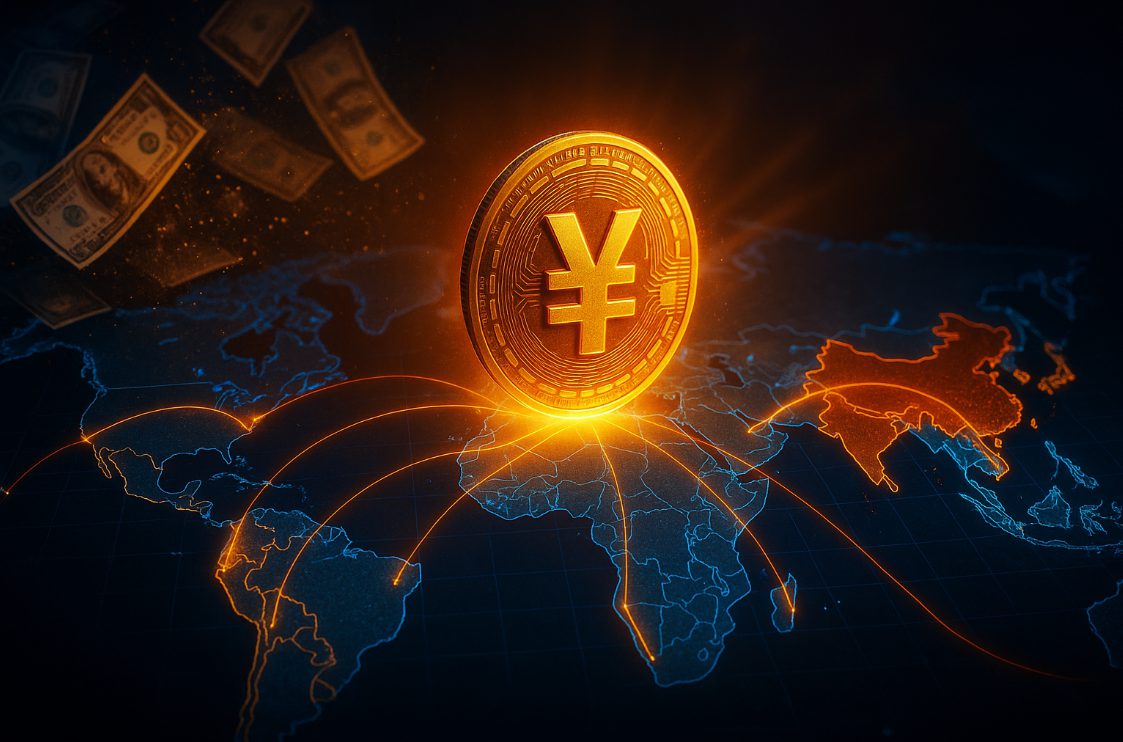
One of the least-covered consequences of the Western sanctions campaign against Russia is a quiet but historically significant shift in which currency actually settles global oil trade. According to J.P. Morgan data cited in sanctions-tracking research, only about 5% of Russia’s oil exports are now settled in dollars — down sharply from 55% before the 2022 invasion of Ukraine. The ruble now accounts for 24% of payments. The Chinese yuan dominates the rest, settling roughly 67% of Russian oil transactions — putting the large majority of Russian barrels entirely outside the US dollar financial system.
This is arguably the most consequential and least-reported financial story to come out of the Russia sanctions regime: Washington’s own sanctions architecture has become one of the yuan’s biggest internationalization boosts in its history, achieved not through Chinese policy design but as an unintended side effect of US and EU enforcement.
How the Shift Happened
The mechanism is straightforward. As the US and EU escalated sanctions on Russia’s oil majors — designating Rosneft and Lukoil, which together account for roughly 80% of Russia’s oil exports — dollar-clearing banks became unwilling to process transactions tied to sanctioned entities, regardless of the underlying legality of a specific trade. Russian exporters and their remaining major customers, chiefly China and India, needed an alternative settlement currency that wasn’t subject to US correspondent-banking veto power. The yuan filled that gap because China’s own banking system, while not immune to secondary sanctions risk, offered a viable channel that Chinese state banks were willing to maintain for a strategically important energy supplier.
Layered on top of currency settlement is a physical logistics workaround: a “shadow fleet” of tankers now numbering in the hundreds, which Ukraine’s allies have been sanctioning vessel-by-vessel — reaching 640 designated ships across the US, UK, and EU — to try to deter buyers from taking on the compliance risk of purchasing oil from a sanctioned carrier.
Why This Matters Beyond Russia
The precedent this sets is the real story. Any country facing a dollar-based sanctions regime in the future — for any reason, in any conflict — now has a working, real-world template for restructuring its trade settlement around the yuan instead of the dollar. That is precisely the kind of “weaponisation of the dollar” outcome that US Treasury officials have historically warned against, because it erodes the dollar’s structural advantage: the assumption that there is no viable alternative reserve and settlement currency at scale.
For emerging economies, including Pakistan, watching how sanctions regimes actually function in practice — not in theory — is now directly relevant to reserve and trade-settlement planning. A financial system increasingly split into a dollar-clearing bloc and a yuan-clearing bloc changes the calculus for how countries diversify their own reserves and structure energy-import payment arrangements, an issue already relevant given Pakistan’s own reserve-diversification pressures.
The Limits of the Yuan’s Rise
This shift should not be overstated as evidence of imminent dollar decline. The yuan’s gains here are almost entirely confined to Russia-specific trade, driven by sanctions necessity rather than organic global demand for yuan-denominated reserves or contracts. China’s own capital controls, the yuan’s limited convertibility, and the absence of deep, liquid yuan-denominated bond markets outside China continue to cap its broader reserve-currency ambitions. What sanctions have done is prove the yuan can function as an alternative settlement currency at meaningful scale under stress conditions — a proof of concept rather than a completed transition.
What Comes Next
The two numbers worth tracking going forward are the dollar-settlement share of Russian oil trade — to see whether it stabilises near 5% or falls further — and whether China begins extending similar yuan-settlement arrangements to other sanctioned or sanctions-adjacent energy exporters, such as Iran, which would confirm this is becoming a durable financial architecture rather than a one-off wartime adaptation.
Discover more from The Economy
Subscribe to get the latest posts sent to your email.

SpaceX Starship Achieves First Full Orbit on Historic 10-Hour Test Flight 14

Google’s $15B Finland AI Investment: Data Centers, Nuclear Power & Jobs

Fast Invoice Factoring: Rates, APR Math & Contract Traps

SOC 2 Type II Guide: Cost, Timeline & Compliance Companies

Hong Kong Wages Surge 3.4% in June: Sector Data & Analysis

Silver Price Today: Why the Xi-Trump AI Standoff Is Fueling a Safe-Haven Rally

Citibank & Dólar Estadounidense: Forex Playbook After the Xi-Trump Truce

How the Trump-Xi White House Summit Is Reshaping Mortgage Rates Today for Real Estate Investors

Indonesia Navigates Mega-Project Risks as China and Russia Eye the 2,772km Trans-Kalimantan Railway

Trump-Xi 2026 Summit Takeaways: The Trade Truce, Taiwan, and the AI Divide

Solar Panel Installation Cost in 2026: Why the Math Changed Overnight

Business Insurance: What Coverage You Actually Need and What It Costs in 2026

Auto Insurance Quotes: How to Get the Lowest Rate Without Losing Coverage

Huntington Online Banking: Full Features, Fees, and How It Compares in 2026

Top 30 Stocks for Investment in PSX for Massive ROI in 2026

SpaceX Starship Flight 14: First Orbital Attempt & Starlink V3 Launch Explained

Oil Prices Break $100 in 2026: Middle East Conflict & Energy Markets

BRICS+ Cross-Border Payments 2026: Interoperability Explained

Fidelity Investments Review 2026: SPAXX Yields & Zero-Fee Funds

Tween Back-to-School Trends 2026: What’s Driving the $85B Season

10-Year Treasury Yield Hits 4.80%: What It Means for Rates & Portfolios

Shein Clothes Quality & Safety in 2026: What Lab Tests Show

IMF & World Bank 2026 Global Economic Outlook: Growth, Inflation, Debt

China’s US$10.8 Billion Trade Shortcut: Why the Pinglu Canal Matters

High-CPM Finance Niches 2026: Publisher Monetization Blueprint

Middle East War Economics 2026: Oil Prices & Energy Markets

China Stocks Today: Are Big Economies in Asia Nearing a Market Bottom?

Social Security Trust Fund 2032: OASI Depletion Timeline Explained
-

 Markets & Finance9 months ago
Top 15 Stocks for Investment in 2026 in PSX: Your Complete Guide to Pakistan’s Best Investment Opportunities
-

 Analysis7 months ago
Johor’s Investment Boom: The Hidden Costs Behind Malaysia’s Most Ambitious Economic Surge
-

 Analysis7 months ago
Top 10 Stocks for Investment in PSX for Quick Returns in 2026
-

 Banks8 months ago
Best Investments in Pakistan 2026: Top 10 Low-Price Shares and Long-Term Picks for the PSX
-

 Analysis8 months ago
Brazil’s Rare Earth Race: US, EU, and China Compete for Critical Minerals as Tensions Rise
-

 Investment9 months ago
Top 10 Mutual Fund Managers in Pakistan for Investment in 2026: A Comprehensive Guide for Optimal Returns
-

 Global Economy9 months ago
15 Most Lucrative Sectors for Investment in Pakistan: A 2025 Data-Driven Analysis
-

 Global Economy9 months ago
Pakistan’s Export Goldmine: 10 Game-Changing Markets Where Pakistani Businesses Are Winning Big in 2025