
Governance
Singapore’s Carbon Tax Surge: Leading Asia in a Fractured Global Pricing Landscape

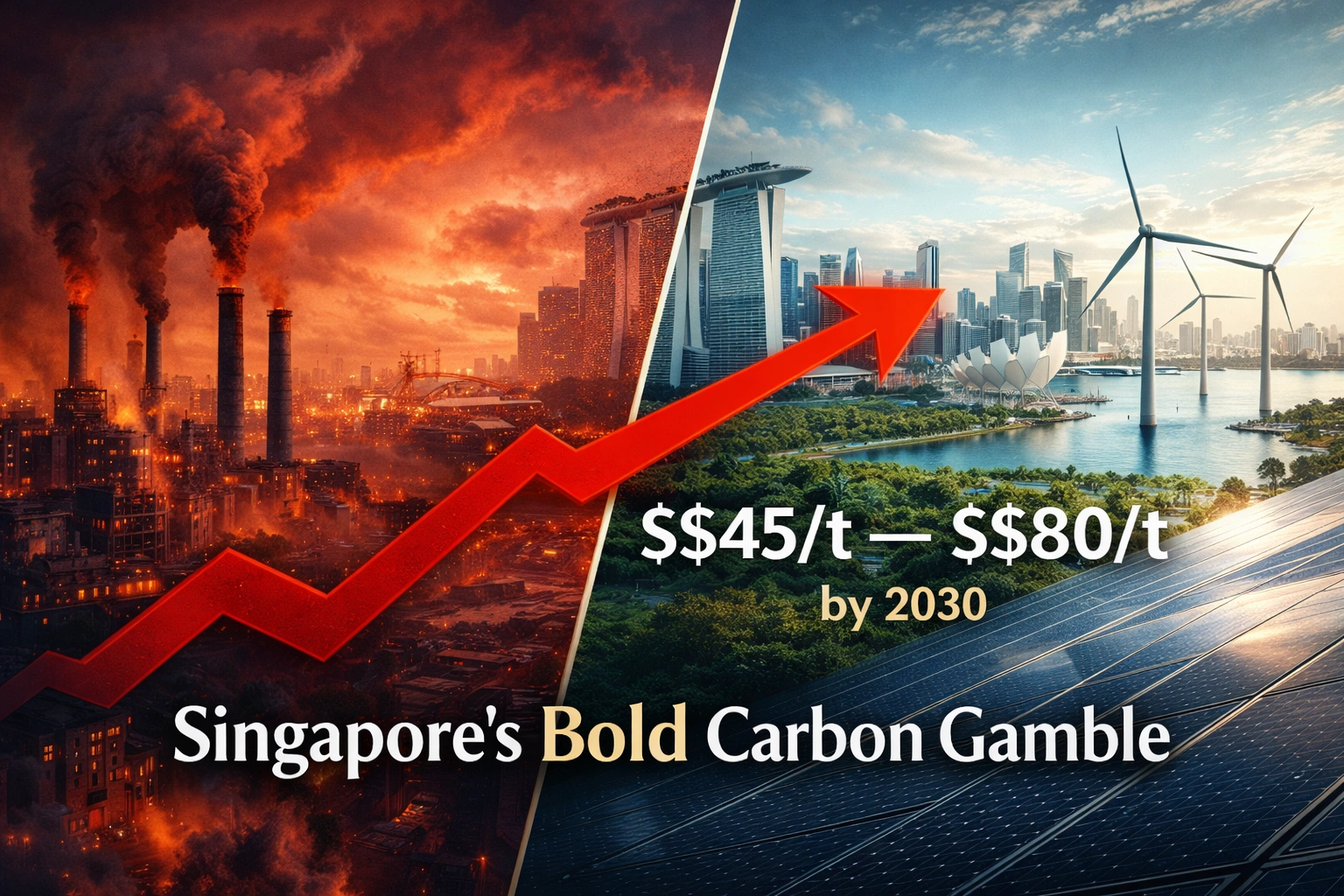
Singapore’s carbon tax jumps to S$45 in 2026, positioning it among Asia’s highest. Analysis of global pricing gaps, climate vulnerability, and what this means for regional leadership.
The elevator ride in Marina Bay’s glittering financial district just became more expensive—not because of rising real estate, but because Singapore is making an unequivocal bet on carbon pricing. As of January 2026, the city-state has nearly doubled its carbon levy to S$45 per tonne of CO₂ equivalent, a rate that would make even European policymakers take notice. For context, this translates to roughly US$33 per tonne—a figure that places this Southeast Asian financial hub alongside some of the world’s most aggressive climate jurisdictions, yet in a region where carbon pricing remains the exception rather than the rule.
This isn’t incrementalism. It’s a calculated escalation in a world where carbon prices span a chasm from under US$1 to over €80 per tonne, and where the policy architecture for pricing emissions looks less like coordinated global action and more like a fragmented patchwork of competing national strategies.
The Trajectory: From Symbolic to Substantive
Singapore’s carbon pricing journey began modestly in 2019 with a S$5 per tonne levy—Southeast Asia’s first carbon tax, but hardly more than a signal of intent. The tax remained static through 2023, providing what officials called a “transitional period” for the economy to adjust. Then came 2024, when the rate quintupled to S$25, and now in 2026, it stands at S$45 for both this year and 2027.
The government has been explicit about future intentions: S$50–80 per tonne by 2030, with the endpoint deliberately left as a range to maintain policy flexibility. These aren’t abstract figures. According to government estimates, the average four-room Housing & Development Board flat will see utility bills rise by approximately S$3 monthly in 2026, assuming stable market conditions—though authorities have cushioned the blow with enhanced U-Save rebates providing up to S$380 annually for eligible households.
Behind the numbers lies an uncomfortable reality: Singapore is acutely exposed to climate impacts. As a low-lying island nation where 70% of the land sits less than five meters above mean sea level, rising oceans aren’t a distant threat—they’re an existential one. Climate vulnerability has translated into climate policy urgency in ways that landlocked nations with higher elevations simply don’t experience.
The Global Pricing Divide: An Uneven Playing Field
To understand Singapore’s position, one must first grasp the extraordinary fragmentation of global carbon pricing. According to the World Bank’s State and Trends of Carbon Pricing 2025, there are now 80 carbon pricing instruments operating worldwide, covering approximately 28% of global emissions. Yet the average price across these instruments sits at just US$19 per tonne—barely a third of what Singapore now charges.
The variance is staggering. At the upper end, the EU Emissions Trading System (EU ETS) has seen prices fluctuate between €60–80 per tonne through 2025, with analysts projecting an average of €92 per tonne in 2026. The UK ETS, though operationally independent since Brexit, has tracked below EU levels, ranging between £40–60, with forecasts suggesting £57–76 per tonne in 2026.
Canada presents a more complex picture. While the federal consumer carbon tax was eliminated in early 2025 under Prime Minister Mark Carney’s administration, the industrial Output-Based Pricing System remains in place, with rates reaching CA$80 per tonne in 2024 and scheduled to climb toward CA$170 by 2030—though provincial fragmentation and a critical 2026 benchmark review introduce significant uncertainty.
| Jurisdiction | 2026 Carbon Price (USD equivalent) | Mechanism Type | Coverage |
|---|---|---|---|
| EU ETS | ~€80–92 (~$88–101) | Cap-and-trade | ~75% of emissions (ETS1 + ETS2) |
| UK ETS | ~£57–76 (~$73–97) | Cap-and-trade | ~37% of emissions |
| Singapore | S$45 (~$33) | Carbon tax | ~70% of emissions |
| Canada (Industrial) | CA$80 (~$59) | Hybrid OBPS | Large emitters only |
| South Korea K-ETS | ~$5–8 | Cap-and-trade | ~73% of emissions |
| China ETS | ~¥100 (~$13) | Cap-and-trade | ~60% of emissions |
| Australia Safeguard | Variable (ACCUs ~$40–80) | Baseline-and-credit | Large industrial facilities |
Sources: World Bank, ICAP, national government sources
Asia’s Pricing Gap: Singapore as an Outlier
Within Asia, Singapore’s S$45 rate stands in stark relief. China’s national ETS, the world’s largest by emissions coverage, saw prices averaging around ¥100 (approximately US$13) through 2024, with projections suggesting a gradual rise to ¥200 (US$25) by 2030. The system expanded beyond power generation in 2024 to include steel, cement, and aluminum, but its intensity-based cap and generous free allowances have kept prices suppressed—by design, critics argue, to protect industrial competitiveness.
South Korea’s K-ETS, operational since 2015 and covering nearly three-quarters of national emissions, has similarly struggled with oversupply issues that have kept prices in the single digits. A recent analysis from IEEFA noted that Asian ETS systems—with the notable exceptions of South Korea and Kazakhstan—lack the strict, gradually increasing reduction rates that have driven price discipline in Europe.
Australia’s reformed Safeguard Mechanism, which became operational in mid-2023, occupies a middle ground. Rather than setting explicit carbon prices, it mandates that facilities exceeding 100,000 tonnes of annual emissions must keep within declining baselines or purchase Australian Carbon Credit Units (ACCUs). Market analysis suggests ACCUs could reach $80 per tonne before 2035, positioning Australia closer to Western price levels—though the system’s production-adjusted framework and reliance on offsets introduce complexity.
Singapore’s decision to employ a straightforward carbon tax rather than a cap-and-trade system reflects both administrative efficiency and a recognition that, as a city-state without extensive heavy industry, the transaction costs of a trading system would outweigh its benefits. The approximately 50 facilities currently covered—spanning manufacturing, power generation, waste, and water treatment—account for 70% of national emissions, a concentration that makes monitoring and enforcement relatively straightforward.
Economic Calculus: Competitiveness Versus Climate Ambition
The tension between carbon pricing and industrial competitiveness has dominated policy debates globally. Singapore’s response has been pragmatic: a transition framework for emissions-intensive, trade-exposed (EITE) sectors that provides temporary relief through allowances, phasing down through 2030. Sectors like refining, petrochemicals, and semiconductors received transitional support that effectively reduced their 2024–2025 tax burden by up to 76% of the nominal rate.
These allowances will taper sharply as the S$45 rate takes hold. For multinationals with operations in Singapore, the math is becoming unavoidable: a facility emitting 500,000 tonnes annually now faces a tax bill of S$22.5 million ($16.5 million), up from S$12.5 million in 2024–2025. By 2030, at the midpoint of the S$50–80 range, that same facility could be looking at S$32.5 million ($24 million) annually—assuming no emissions reductions.
Yet Singapore’s bet is that higher carbon costs will accelerate rather than deter investment—specifically, investment in low-carbon solutions. The city-state has positioned itself as a regional hub for carbon services, launching the Climate Impact X marketplace and actively developing carbon market infrastructure aligned with Article 6 of the Paris Agreement. From 2024, facilities can use high-quality international carbon credits (ICCs) to offset up to 5% of taxable emissions, provided credits meet stringent eligibility criteria including host country authorization and corresponding adjustments to prevent double-counting.
This 5% limit is deliberate policy. As officials noted in public consultations, the goal is to prioritize domestic emissions reduction while providing flexibility for hard-to-abate sectors. It mirrors similar limits in South Korea and California, reflecting a global consensus that carbon credits should complement, not replace, direct abatement.
The 2026 Inflection: Why Now?
The timing of Singapore’s escalation is no accident. The European Union’s Carbon Border Adjustment Mechanism (CBAM) entered its transitional phase in 2023 and will begin imposing charges in 2026 on imports of carbon-intensive goods—initially cement, steel, aluminum, fertilizers, electricity, and hydrogen. For Asian exporters, CBAM creates a powerful incentive to demonstrate domestic carbon pricing, as jurisdictions with credible carbon costs may receive credit against CBAM charges.
Analysis from IEEFA suggests China’s recent ETS expansion was partly motivated by CBAM considerations—a tacit acknowledgment that carbon pricing is becoming a trade competitiveness issue, not merely an environmental one. Singapore, with its open economy and export orientation, cannot afford to be perceived as a carbon haven. Higher carbon taxes signal climate seriousness to trading partners while potentially generating leverage in future trade negotiations.
There’s also a fiscal dimension. The Singapore government has been transparent that carbon tax revenues fund decarbonization initiatives and support measures for businesses and households. With revenues exceeding S$1 billion annually at current rates, and set to grow substantially, the carbon tax has become a meaningful budget line—though officials insist the policy is revenue-neutral when accounting for support programs.
Forward Projections: The 2030 Question and Beyond
Forecasting carbon prices is notoriously difficult—markets respond to policy signals, technological breakthroughs, and economic shocks in ways that defy linear projection. Yet several modeling exercises suggest where Singapore’s trajectory might lead.
If the government opts for the lower end of its 2030 range (S$50), Singapore would still rank among Asia’s most expensive jurisdictions but would fall short of European and North American levels. At the upper end (S$80), the city-state would be pricing carbon at rates comparable to projected 2030 levels in Canada and approaching EU territory. Independent analysis suggests that factoring in economic growth and energy transition dynamics, effective carbon prices could reach US$57 by 2030 and potentially US$145 by 2050—though these figures assume continued policy tightening that remains politically uncertain.
The critical question is whether Singapore’s approach will catalyze regional convergence or remain an outlier. There are tentative signs of movement. Malaysia has indicated plans to introduce carbon pricing by 2026. Vietnam is piloting ETS concepts. Indonesia, whose emissions dwarf Singapore’s, has explored carbon tax mechanisms, though implementation remains uncertain. Yet these developments could equally fizzle—carbon pricing has a history of political reversal, as Canada’s recent consumer tax elimination demonstrates.
Criticisms and Constraints: The Limits of Unilateral Action
Not everyone applauds Singapore’s carbon ambition. Industry groups have argued that steep increases impose competitiveness burdens without commensurate climate benefit, noting that Singapore accounts for barely 0.1% of global emissions. The “polluter pays” principle, critics contend, becomes economically punitive when applied asymmetrically—local firms bear costs that international competitors avoid.
Environmental advocates, conversely, argue that even S$80 falls short of the social cost of carbon. The High-Level Commission on Carbon Prices in 2017 estimated that prices between US$40–80 per tonne were needed by 2020, rising to US$50–100 by 2030, to meet Paris Agreement targets. By this metric, Singapore’s 2026 rate reaches the lower threshold, but the 2030 ambiguity leaves open whether sufficient ambition will materialize.
There’s also concern about regressive impacts. Carbon taxes, by raising energy costs, disproportionately affect lower-income households. Singapore’s U-Save rebates attempt to address this, but the adequacy of support remains contested, particularly as utility bills compound with broader cost-of-living pressures.
Perhaps most fundamentally, unilateral carbon pricing faces inherent limits. Without coordinated global action, emissions simply migrate to jurisdictions with lower costs—the carbon leakage problem that bedevils every climate policy architect. Singapore’s EITE transition framework acknowledges this reality, but the framework itself is time-limited. What happens post-2030, when support phases out but regional price convergence remains elusive?
Implications: Singapore as Climate Policy Laboratory
For all its limitations, Singapore’s carbon tax surge offers a testing ground for several propositions central to global climate governance. Can explicit carbon pricing drive emissions reductions in small, trade-exposed economies without triggering capital flight? Will linking carbon taxation to international credit markets under Article 6 create viable flexibility mechanisms, or simply open avenues for greenwashing? And can early movers establish first-mover advantages in emerging green sectors that offset near-term competitiveness costs?
The answers won’t be evident for years, but the experiment matters beyond Singapore’s borders. As a financial hub with extensive regional networks, Singapore’s policy choices influence corporate decision-making across Southeast Asia. If carbon-intensive industries successfully adapt while maintaining competitiveness, it weakens the argument that climate ambition and economic growth are irreconcilable. If, conversely, the policy provokes relocations or undermines growth, it will embolden skeptics elsewhere.
What’s increasingly clear is that the global carbon pricing landscape entering 2026 remains deeply fractured. Europe leads on price and coverage. Asia lags, with pockets of ambition but systemic oversupply and low prices. North America vacillates between provincial experimentation and federal retreat. And emerging economies, despite producing the majority of emissions growth, largely abstain from pricing mechanisms altogether.
Into this fragmented terrain, Singapore has placed a substantial wager—that pricing carbon aggressively, even unilaterally, positions the city-state favorably for the inevitable transition to a decarbonized global economy. It’s a bet that acknowledges vulnerability: when you’re five meters above sea level and rising waters are undeniable, climate policy isn’t ideological—it’s existential. Whether that urgency translates into effective policy remains the question that S$45 per tonne is designed to answer.
Discover more from The Economy
Subscribe to get the latest posts sent to your email.


Key Takeaways
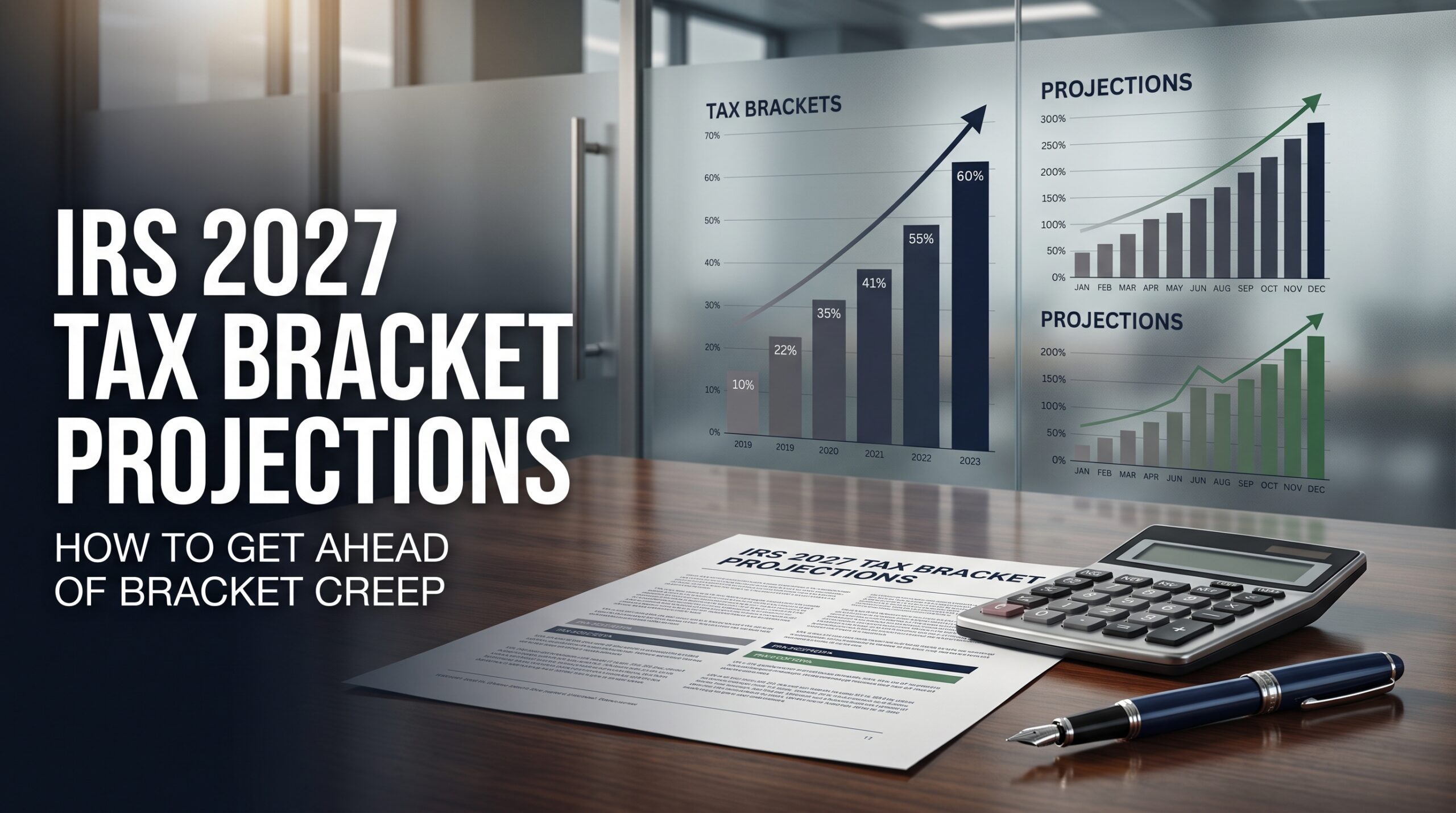
- Bloomberg Tax projects federal income tax brackets will rise 3.2% for 2027 — up from the 2.7% inflation adjustment applied for 2026.
- All seven federal tax tiers are expected to shift upward, meaning taxpayers can earn more before crossing into a higher bracket.
- The IRS has not yet confirmed these figures; an official announcement is typically made in October or November.
- Bracket creep — when income grows faster than the tax thresholds — is the core risk these adjustments are designed to offset.
- Bloomberg Tax’s 2026 projections proved accurate against the IRS’s final figures, lending the 2027 forecast reasonable credibility, though it remains unofficial.
What Is “Bracket Creep” and Why It Matters
Bracket creep happens when a raise or cost-of-living adjustment pushes your income into a higher marginal tax bracket, even though your real purchasing power hasn’t improved. The IRS’s annual inflation adjustment exists specifically to prevent this — recalibrating the income thresholds for each of the seven federal brackets so inflation alone doesn’t quietly raise your tax bill.
Projected 2027 vs. 2026: What’s Changing
| Factor | 2026 (Confirmed) | 2027 (Projected) |
|---|---|---|
| Inflation adjustment | 2.7% | 3.2% (projected) |
| Number of brackets adjusted | 7 | 7 (projected) |
| Filing deadline | April 15, 2026 | April 15, 2027 |
| Source of figures | Official IRS | Bloomberg Tax forecast |
Exact dollar thresholds for each of the seven brackets were not yet published by the IRS at the time of writing and should be sourced directly from irs.gov once released.
Why a 3.2% Increase, and Why It’s Larger Than Last Year
The projected jump from 2.7% to 3.2% reflects a modest reacceleration in the inflation data the IRS uses (chained CPI) through the summer of 2026. A larger adjustment is generally favorable for taxpayers — it means:
- More income taxed at lower marginal rates before hitting the next bracket.
- A modestly larger paycheck in 2027 for many W-2 earners once employers update withholding tables.
- Potential increases to related figures — the standard deduction, retirement contribution limits, and estate tax exemption — though the IRS calculates these separately and on its own timeline.
How to Plan Before the Official Numbers Land
- Don’t restructure your withholding yet. Projections aren’t official; wait for the IRS’s confirmed 2027 figures before making payroll changes.
- Revisit tax-advantaged account contributions. If you’re near a bracket threshold, year-end moves — retirement contributions, HSA funding, charitable giving — can still shift where 2026 income lands.
- Watch for the official release. The IRS historically publishes final brackets in Revenue Procedure form each October or November for the following tax year.
- Talk to a tax professional before making decisions based on projected, not confirmed, figures — this article is informational and not individualized tax advice.
Will 2027 tax brackets change?
Yes — Bloomberg Tax projects a 3.2% inflation adjustment across all seven federal income tax brackets for 2027, up from 2.7% in 2026. The IRS has not yet confirmed these figures; official numbers are expected in October or November 2026.
Discover more from The Economy
Subscribe to get the latest posts sent to your email.

Key Takeaways
- Tariff revenue currently covers only about one-tenth of the cost of Trump’s promised $5,000 dividend — the Tax Foundation estimates 2027 net tariff revenue at roughly $125 billion, versus the $1.25 trillion the payout would actually cost.
- Because the dividend is being framed as a “dividend” rather than a tax refund, its tax treatment is genuinely unclear — experts note there’s no legislative text specifying whether it would be taxable income, a tax credit, or an untaxed transfer.
- One tax-policy analysis estimates the payments could function like a demogrant, potentially eliminating positive net federal income tax liability for more than half of American families at 2026 median income levels.
- VP JD Vance has suggested wealthy Americans likely wouldn’t qualify for the full payment, but no income cutoff or definition of “wealthy” has been specified — leaving retail investors with taxable investment income unable to gauge their own eligibility.
- Absent significant new revenue or spending cuts, funding the dividend would require additional government borrowing on top of an already-projected $1.9 trillion FY2027 deficit — a dynamic that could raise yields and offset any net financial benefit for investors holding bonds or rate-sensitive equities.
Beyond the political theater surrounding Trump’s pledged $5,000 “dividend,” retail investors face a more practical question that has received far less attention: how would this payment actually be taxed, and what are the second-order effects on portfolios if it moves toward passage? This piece works through the tax-policy mechanics that most mainstream coverage has skipped.
The Math Doesn’t Add Up — And That Matters for Taxation
The dividend concept originated from Trump’s earlier proposal to distribute tariff revenue back to taxpayers. But according to Tax Foundation analysis, that revenue simply isn’t sufficient: net tariff collections are projected at roughly $125 billion in 2027, and $1.4 trillion cumulatively from 2026 through 2035. Against a $1.25 trillion one-time cost for the $5,000 dividend, tariff revenue would cover only about a tenth of the bill in any given year — meaning it would take nearly a decade of tariff collections to fund a single year’s dividend payout.
This funding gap is directly relevant to taxation because it determines how Congress would need to structure the payment if it ever moved toward passage. A dividend funded from an identifiable revenue stream (tariffs) could plausibly be treated differently under tax law than a dividend funded through general deficit borrowing — and right now, the proposal is light on the details needed to determine which path lawmakers would take.
Is the $5,000 Dividend Taxable Income?
This is the single biggest open question for retail investors trying to plan around the pledge, and as of now, there is no definitive answer because no legislative text exists. Tax-policy experts have noted that Trump’s proposal lacks specificity not just on funding, but on basic structural questions: would the payment count as taxable income requiring a 1099 or similar reporting, would it function as a refundable tax credit similar to COVID-era stimulus payments, or would it be structured as a wholly untaxed transfer?
Precedent cuts both ways. The 2020 CARES Act stimulus checks were structured as advance tax credits and were not taxed as income. But those payments were explicitly legislated with clear implementing rules — something the current $5,000 pledge doesn’t yet have. Until Congress produces actual bill text, retail investors cannot reliably model the after-tax value of the payment, nor factor it into year-end tax planning.
The “Demogrant” Analysis: A Progressive Side Effect
One notable tax-policy analysis frames the dividend as functioning similarly to a demogrant — a flat, universal cash transfer historically associated with progressive tax-reform proposals (echoing ideas like George McGovern’s 1972 “demogrant” plan). Using post-2025 tax law (following the One Big Beautiful Bill Act, or OBBBA), the analysis estimates that for a joint-filing household near the 2026 median family income of roughly $110,000, two Trump dividends worth $10,000 combined could offset their entire federal income tax liability for the year.
If accurate at scale, this means the dividend’s practical tax effect — regardless of its formal legislative characterization — would function as a substantial, broad-based tax cut concentrated among middle-income households, since the flat $5,000-per-adult structure delivers a proportionally larger benefit to lower-income filers than to high earners for whom $5,000 represents a smaller share of income and tax liability.
Who Might Actually Be Excluded?
Vice President JD Vance has already signaled that the dividend may not be truly universal, stating that wealthy Americans likely would not qualify for the full payment — though he offered no income threshold or definition of what “wealthy” means in this context. For retail investors with meaningful capital-gains income, dividend income, or other investment earnings, this ambiguity is a genuine planning problem: it’s currently impossible to know whether investment income would even be counted toward an eligibility test, or whether eligibility would instead be based purely on adjusted gross income from wages.
Comparison: How the Trump Dividend Stacks Up Against Prior Direct Payments
| Payment | Legal Basis | Tax Treatment | Funding Source |
|---|---|---|---|
| 2020 CARES Act checks | Legislated, advance tax credit | Not taxed as income | Deficit spending |
| 2025 “Warrior dividend” ($1,776) | Legislated, appropriated funds | N/A — bonus for active-duty military | Existing appropriations |
| Trump Accounts (child investment fund) | Congress-authorized | Tax-advantaged investment account | Appropriated funds |
| Proposed 2026 “$5,000 dividend” | Not yet legislated | Undetermined | Tariff revenue (insufficient) + likely borrowing |
The Second-Order Risk: Rates and Bond Yields
Even setting aside direct taxation of the payment itself, tax-policy and economics experts warn of a second, less visible cost to investors: financing $1.2–1.3 trillion in new spending — whether through borrowing or otherwise — on top of an already-elevated national debt above $40 trillion could push Treasury yields higher. David Ditch, a policy analyst at the Cato Institute, has warned that injecting that much money into the economy “would automatically lead to higher prices,” potentially eroding the real value of the dividend itself through inflation before investors ever see a tax bill on it. For portfolios, that means the practical “tax” on the dividend may show up less through the IRS and more through compressed bond returns and rate-sensitive equity valuations.
Why This Matters for Retail Investors
The prudent approach for now is treating the $5,000 dividend as a low-probability scenario with genuinely unresolved tax mechanics rather than incorporating it into near-term financial planning. Congress would need to pass specific implementing legislation — addressing taxability, income eligibility, and funding — before the payment could be modeled with any precision. Investors should watch for draft legislative language, which would be the first concrete signal of how lawmakers intend to structure both the payment and its tax treatment.
Frequently Asked Questions
Will Trump’s $5,000 dividend be taxed as income? It’s currently unknown. No legislative text exists specifying whether the payment would be taxable income, a tax credit modeled on 2020 stimulus checks, or an untaxed transfer — this is one of the proposal’s biggest open questions.
Would wealthy Americans receive the $5,000 dividend? Vice President JD Vance has said wealthy Americans likely wouldn’t qualify for the full payment, but no income threshold or definition of “wealthy” has been specified, leaving eligibility rules genuinely undefined.
How would the $5,000 dividend affect my taxes if I own investments? Beyond direct tax treatment of the payment itself, funding a $1.2–1.3 trillion payout through borrowing could push Treasury yields higher and add inflation pressure, potentially affecting bond returns and rate-sensitive equity valuations independent of how the payment is formally taxed.
Discover more from The Economy
Subscribe to get the latest posts sent to your email.

Corporate government affairs teams have long treated lobbying disclosure as a routine compliance function — a form filed, a box checked. That assumption is breaking down across major jurisdictions in 2026. From Canada’s newly drafted Foreign Influence Transparency and Accountability Act to expanded US foreign-agent disclosure bills and the EU’s ongoing overhaul of its mandatory Transparency Register, multinational corporations now face a rapidly tightening, increasingly public web of lobbying disclosure regimes — with the reputational risk of exposure, not just the legal penalty for non-compliance, emerging as the dominant business concern.
Key Takeaways
- Canada’s draft Foreign Influence Transparency and Accountability Act (FITAA) regulations, published January 3, 2026, impose short reporting deadlines — 14 days for new arrangements and 60 days for pre-existing ones — with an estimated 2,422 businesses and individuals expected to be affected and a projected $25.90 million total compliance cost through 2035.
- The US Senate passed two bills in December 2025 to broaden foreign-agent disclosure requirements: the Disclosing Foreign Influence in Lobbying Act and the Lobbying Disclosure Improvement Act, which would require registered lobbyists to identify any foreign government or political party participating in the “direction, planning, supervision, or control” of their lobbying activities — regardless of whether that entity provides financing.
- The EU’s Transparency Register has faced formal criticism from the European Court of Auditors, which found the EU awarded over €7 billion in NGO funding between 2021 and 2023 with more than 90% of recipients not clearly categorized, and identified self-declaration without verification as a source of legal uncertainty and misuse risk.
- The OECD’s Anti-Corruption and Integrity Outlook 2026 finds that lobbying regulation quality remains among the lowest-scoring areas of integrity systems across OECD member and partner countries, even as adoption of lobbying registers has expanded in recent years.
- A growing number of countries are adopting dedicated foreign-influence frameworks distinct from general lobbying rules, specifically targeting activities conducted on behalf of foreign governments, political organizations, and state-affiliated actors — a regulatory category largely separate from domestic corporate lobbying disclosure.
The Shift From Domestic Lobbying Disclosure to Foreign Influence Transparency
The most consequential regulatory development for multinational corporations in 2026 is not incremental tightening of existing domestic lobbying rules, but the emergence of a distinct, more aggressive regulatory category: foreign influence transparency frameworks. These are explicitly designed to capture lobbying and influence activities conducted on behalf of foreign governments, political organizations, or state-affiliated actors — a category that OECD analysis identifies as a growing global regulatory trend, separate from and layered on top of general lobbying disclosure requirements.
This distinction matters enormously for multinational corporations, which frequently engage in advocacy activity that could plausibly be characterized as connected to a foreign principal’s interests — whether through subsidiary structures, joint ventures with state-linked entities, or advocacy coordinated with a home-country government’s economic interests abroad. A company that has treated its domestic lobbying registration as sufficient compliance may find itself newly exposed under a foreign-influence framework that was not previously relevant to its activities.
Canada’s FITAA: A Case Study in the New Compliance Burden
Canada’s Foreign Influence Transparency and Accountability Act (FITAA) illustrates both the scope and speed of this regulatory shift. Draft regulations published January 3, 2026 require organizations to disclose substantial detail to a newly created Commissioner: core corporate information, identification of individuals significantly involved in influence activities, and a detailed description of the arrangement — including its duration, compensation, the political or governmental processes targeted, and the foreign principal’s objectives. Additional disclosure is required for activities involving communications with public officeholders, information dissemination, or the provision of money, items of value, services, or facilities.
The compliance timeline is notably aggressive: businesses face just 14 days to report new arrangements and 60 days for pre-existing ones. The Canadian government’s own regulatory impact analysis estimates approximately 2,422 businesses and individuals will be affected (872 individuals and 1,550 businesses), with a projected total compliance cost of $25.90 million between 2026 and 2035 — a figure derived in part by benchmarking against Australia’s existing Foreign Influence Transparency Scheme, suggesting Canadian regulators are explicitly modeling FITAA on precedents from other jurisdictions rather than building an isolated framework.
Critically, while only a portion of submitted information will be publicly accessible, the registry will still publicly display corporate and foreign-principal identities and the individuals involved — meaning the reputational exposure exists independent of the underlying compliance penalty structure. A company’s public association with a specific foreign principal, once disclosed in a searchable public registry, cannot be walked back through subsequent compliance.
The United States: Broadening Foreign-Agent Disclosure
The US regulatory trajectory in 2026 points in the same direction. Two bills passed by the Senate in December 2025 — the Disclosing Foreign Influence in Lobbying Act and the Lobbying Disclosure Improvement Act — would materially broaden existing disclosure requirements under the Foreign Agents Registration Act (FARA) and the Lobbying Disclosure Act (LDA). The core expansion: registered lobbyists would need to disclose any foreign government entity or political party that merely participates in the “direction, planning, supervision, or control” of their lobbying activities, regardless of whether that entity actually finances the activity.
This financing-independent disclosure trigger is a significant expansion of scope. Under prior frameworks, financial ties were often central to establishing a foreign-agent relationship requiring disclosure; the new standard would capture coordination and influence relationships even in the absence of direct payment — a structure that could implicate multinational corporations whose government affairs strategy is coordinated, even informally, with a parent company’s home-government interests or with joint-venture partners linked to foreign states.
The EU Transparency Register: A Cautionary Tale on Enforcement Gaps
The European Union’s experience with its mandatory Transparency Register — made compulsory via a 2021 interinstitutional agreement, later joined by the Council — offers a useful caution for multinationals assuming that registration alone satisfies compliance expectations. The European Court of Auditors’ special report found that while the register provides useful information for tracking lobbying activity, its enforcement measures fall short in practice: the primary enforcement mechanism available is removal of lobbyists from the register itself, and the system’s substantial reliance on self-declaration without independent verification creates both legal uncertainty and elevated misuse risk.
The Court of Auditors specifically flagged that the EU awarded over €7 billion in NGO funding between 2021 and 2023 with more than 90% of recipients not clearly categorized, and that disclosure of advocacy activities financed by these grants was often weak. This finding has fueled a broader debate — with some arguing NGOs face insufficient scrutiny, and others arguing companies and business associations face comparatively fewer transparency obligations than non-profit entities and frequently bypass them. For multinationals, the practical lesson is that formal registration does not equate to reputational safety: register quality, enforcement gaps, and asymmetric scrutiny across sectors remain live political and media narratives that can surface regardless of a company’s technical compliance status.
The Reputational Risk Dimension
The OECD’s Anti-Corruption and Integrity Outlook 2026 identifies lobbying regulation quality as among the lowest-scoring areas of integrity systems across OECD member and partner countries, despite wider adoption of lobbying registers in recent years — a gap between formal regulatory adoption and substantive regulatory quality that creates a specific reputational hazard: a company can be in full technical compliance with a weak or inconsistently enforced register while still facing significant reputational exposure if investigative journalism, NGO research, or opposition political actors highlight the substance of its disclosed lobbying relationships.
This dynamic has already played out in EU institutional contexts, where high-profile corruption scandals (such as the case widely known as “Qatargate”) exposed the gap between formal transparency register participation and the actual influence relationships operating around EU institutions, damaging the reputations of both public institutions and the private and non-profit actors implicated — even where formal registration requirements had technically been observed.
Compliance and Reputational Risk Management Strategies
- Map foreign-influence exposure separately from domestic lobbying compliance. Given that frameworks like FITAA and the expanded FARA/LDA bills are structured as distinct regulatory categories, corporate compliance teams should conduct a dedicated foreign-principal relationship audit rather than assuming domestic lobbying registration covers this exposure.
- Treat public registry disclosure as a permanent reputational fact, not a reversible compliance step. Since FITAA and comparable frameworks will publicly display corporate and foreign-principal identities regardless of confidentiality around other submitted details, government affairs teams should evaluate disclosure implications before entering into arrangements that could trigger registration, not after.
- Prepare for financing-independent disclosure triggers. The US bills’ focus on “direction, planning, supervision, or control” — independent of financing — signals a broader global regulatory direction that compliance frameworks built around financial-flow tracking alone will not adequately capture.
- Anticipate short compliance windows as the emerging global standard. FITAA’s 14-day/60-day reporting windows reflect a regulatory design trend toward rapid disclosure; compliance infrastructure built around slower, retrospective reporting cycles common under older lobbying laws will likely need modernization.
- Monitor enforcement-quality gaps as a distinct risk category from registration itself. Given the OECD’s finding that lobbying regulation quality lags adoption, and the EU’s documented self-declaration verification gaps, multinationals should assume that being technically registered does not insulate against reputational exposure if the substance of disclosed relationships becomes a media or political focal point.
Frequently Asked Questions
What is Canada’s FITAA and who does it affect?
The Foreign Influence Transparency and Accountability Act requires organizations engaging in influence activities on behalf of foreign governments or state-affiliated actors to register and disclose detailed information within 14 days (new arrangements) or 60 days (existing ones); an estimated 2,422 businesses and individuals are expected to be affected.
How is the new US foreign-agent legislation different from existing FARA rules?
Bills passed by the Senate in December 2025 would require disclosure of any foreign government or political party involved in directing, planning, supervising, or controlling lobbying activities — even without financial ties — broadening the trigger for mandatory disclosure beyond the traditional financing-based standard.
Does registering in a lobbying transparency register protect a company’s reputation? Not necessarily. The European Court of Auditors found the EU’s Transparency Register relies heavily on unverified self-declaration, and the OECD finds lobbying regulation quality generally lags its adoption — meaning technical registration compliance does not eliminate reputational risk if the substance of disclosed relationships draws scrutiny.
Conclusion
The 2026 shift toward mandatory foreign-influence transparency registers — layered on top of, and structurally distinct from, existing domestic lobbying disclosure regimes — represents a genuine new compliance category for multinational corporations, not an incremental tightening of familiar rules. With Canada’s FITAA, expanded US foreign-agent disclosure legislation, and ongoing scrutiny of the EU’s Transparency Register all moving in the same direction, corporate government affairs and legal teams face a landscape where public, permanent disclosure of foreign-principal relationships is becoming the norm — and where reputational risk management now requires evaluating relationships before they are formed, not merely reporting them accurately after the fact.
Discover more from The Economy
Subscribe to get the latest posts sent to your email.

Bitcoin & XRP 2026: Inside Crypto’s Institutional Era

Global Economy 2026: IMF Growth, AI Stocks & Market Risk

China’s Local Debt Race Against Time: Why Economists Demand Central Action Before the Deflation Window Closes

Money News: How to Protect Your Portfolio From Global Inflation

World Bank Projections: Emerging vs. Big Economies of Asia

IMF Reports 2026: What the Latest Data Means for the Global Economy

Singapore Stocks Outlook: A Safe Haven in the Asian Market?

China Stocks vs. Japan Stocks: Where Should You Invest in Late 2026?

VIX Index Explained: How to Trade Wall Street’s Fear Gauge Today

Commercial vs Residential Real Estate: Which Wins in 2026?

Presidential Stock Market Performance: How Trump’s Second Term Compares to History

2026 Real Estate Market News: Are We Heading for a Correction?

Bitcoin Price Forecast 2026–2027: Will the 4-Year Cycle Hold?

Fidelity Crypto vs. Traditional Brokerages: A Guide for Modern Investors

US-China Relations in Q3 2026: Trade Tariffs and Supply Chain Risks

Top 30 Stocks for Investment in PSX for Massive ROI in 2026

SpaceX Starship Flight 14: First Orbital Attempt & Starlink V3 Launch Explained

AI Chip Stocks 2026: The Best Semiconductor Investments Beyond Marvell

The 2026 Crypto Regulatory Shift: What It Means for Institutional Investors

Tween Back-to-School Trends 2026: What’s Driving the $85B Season

Oil Prices Break $100 in 2026: Middle East Conflict & Energy Markets

AI-Powered Training: The Next Multi-Billion Dollar Ecosystem in Fitness

10-Year Treasury Yield Hits 4.80%: What It Means for Rates & Portfolios

Fidelity Investments Review 2026: SPAXX Yields & Zero-Fee Funds

BRICS+ Cross-Border Payments 2026: Interoperability Explained

Shein Clothes Quality & Safety in 2026: What Lab Tests Show

MRVL Earnings 2026: Why Marvell Sank Despite Beating Estimates

China’s US$10.8 Billion Trade Shortcut: Why the Pinglu Canal Matters
-

 Markets & Finance9 months ago
Top 15 Stocks for Investment in 2026 in PSX: Your Complete Guide to Pakistan’s Best Investment Opportunities
-

 Analysis7 months ago
Johor’s Investment Boom: The Hidden Costs Behind Malaysia’s Most Ambitious Economic Surge
-

 Analysis7 months ago
Top 10 Stocks for Investment in PSX for Quick Returns in 2026
-

 Analysis8 months ago
Brazil’s Rare Earth Race: US, EU, and China Compete for Critical Minerals as Tensions Rise
-

 Banks8 months ago
Best Investments in Pakistan 2026: Top 10 Low-Price Shares and Long-Term Picks for the PSX
-

 Investment8 months ago
Top 10 Mutual Fund Managers in Pakistan for Investment in 2026: A Comprehensive Guide for Optimal Returns
-

 Global Economy9 months ago
15 Most Lucrative Sectors for Investment in Pakistan: A 2025 Data-Driven Analysis
-

 Global Economy9 months ago
Pakistan’s Export Goldmine: 10 Game-Changing Markets Where Pakistani Businesses Are Winning Big in 2025