
Economic Reforms
Argentina Economy 2026: Milei’s Fiscal Surplus, Inflation Drop to 29%, and What Comes Next


Argentina has achieved its first primary fiscal surplus in over a decade and cut inflation from 300% to a projected 29.4% in 2025. But the structural challenge of 2026 tests whether the transformation is real.No economy in the world has undergone a more dramatic reversal in such a compressed timeframe — and no economy in the world inspires more analytical caution about whether that reversal will hold.
Argentina enters the second half of 2026 having achieved something that eluded every previous government for over a decade: a primary fiscal surplus of 1.8% of GDP, maintained through austerity measures, deregulation, and structural reforms that President Javier Milei forced through against sustained political opposition. Inflation, which peaked near 300% in 2024 — one of the highest rates recorded by any major economy in modern history — is projected to fall to 29.4% in 2025 and 13.7% in 2026, a disinflation trajectory that most conventional economists did not believe was achievable without a social or political rupture.
The Policy Architecture That Produced the Turnaround
Milei‘s programme launched in December 2023 combined fiscal consolidation, the elimination of central bank monetary financing, and a managed exchange-rate regime that began with a sharp devaluation and continued with a gradual crawl to anchor inflation expectations. The approach was deliberately abrupt — a shock therapy designed to quickly eliminate the deficit that had sustained years of money printing and debt accumulation.
Deloitte’s 2026 global economic outlook characterises the result as “two years of profound macroeconomic adjustment that reshaped its policy framework and restored a degree of stability to an economy long challenged by chronic imbalances.” Monthly inflation, which had been running at rates exceeding 20% per month at the peak, had stabilised to approximately 2% by late 2025 — still elevated by international standards, but representing a near-complete dismantling of the hyperinflationary momentum that had been building for years.
The nominal anchors that have underpinned this disinflation include tight monetary policy from the central bank, the crawling peg exchange rate regime, and credible commitment to the fiscal surplus as a non-negotiable political line. The international investment community has responded: Argentine sovereign spreads have narrowed materially, and the country’s ability to access capital markets — previously constrained by its serial default history — has improved.
What Structural Reforms and Deregulation Have Changed
Beyond the macroeconomic stabilisation, Milei has pursued a broader structural reform agenda encompassing labour market deregulation, privatisation of state enterprises, elimination of energy subsidies, and reductions in public employment. These reforms carry distributional consequences — real wages fell sharply during the adjustment period, and social safety nets came under pressure — but Milei argued that the alternative was economic collapse rather than a managed adjustment.
The political durability of this programme remains the central uncertainty. Argentina has a long history of economic reform cycles that stabilise inflation and public finances in the short run before unravelling under political pressure, social protest, or an adverse external shock. The Iran war-related global slowdown represents exactly the kind of external headwind that has historically tested the resilience of Argentine stabilisation programmes — higher commodity prices support agricultural export revenues (a tailwind) but global demand uncertainty weighs on growth prospects.
The 2026 Challenge: Converting Stabilisation to Growth
Stabilisation is not growth. The Milei programme has restored macroeconomic credibility but the private investment and productivity gains that translate credibility into sustainable prosperity require additional time and policy continuity. Deloitte notes that the 2026 economic trajectory will rely on whether “other drivers” of demand beyond inventory rebuilding can sustain momentum — export diversification, foreign direct investment, and domestic consumption recovery all remain works in progress.
The comparison that Milei’s critics and supporters both invoke is Chile in the 1970s and 1980s, where a comparable shock therapy produced long-run macroeconomic stability at significant short-term social cost. The comparison that Milei’s critics prefer is the Argentine convertibility programme of the 1990s, which also achieved price stability and fiscal balance before collapsing in the 2001 default crisis. The distinction between the two outcomes depends on variables — debt dynamics, exchange rate flexibility, and external conditions — that will not be resolved in 2026.
The Lesson Argentina Offers Emerging Markets
Whether or not Argentina‘s transformation proves durable, the speed and scale of the disinflation has attracted analytical attention from economists studying how much inflation can be unwound through institutional commitment and fiscal discipline alone. The answer in Argentina’s case — from 300% to a projected 13.7% within approximately two years — challenges some prior assumptions about the minimum time horizon required for disinflation.
Deloitte’s global team places Argentina alongside France, Germany, and the US in their comparative country outlooks — a recognition that this formerly crisis-ridden economy is now generating analysis that other nations find instructive rather than merely cautionary. The hardest part of Argentina‘s economic story may not be what has already happened. It may be what sustaining the turnaround requires in 2027 and beyond.
Discover more from The Economy
Subscribe to get the latest posts sent to your email.


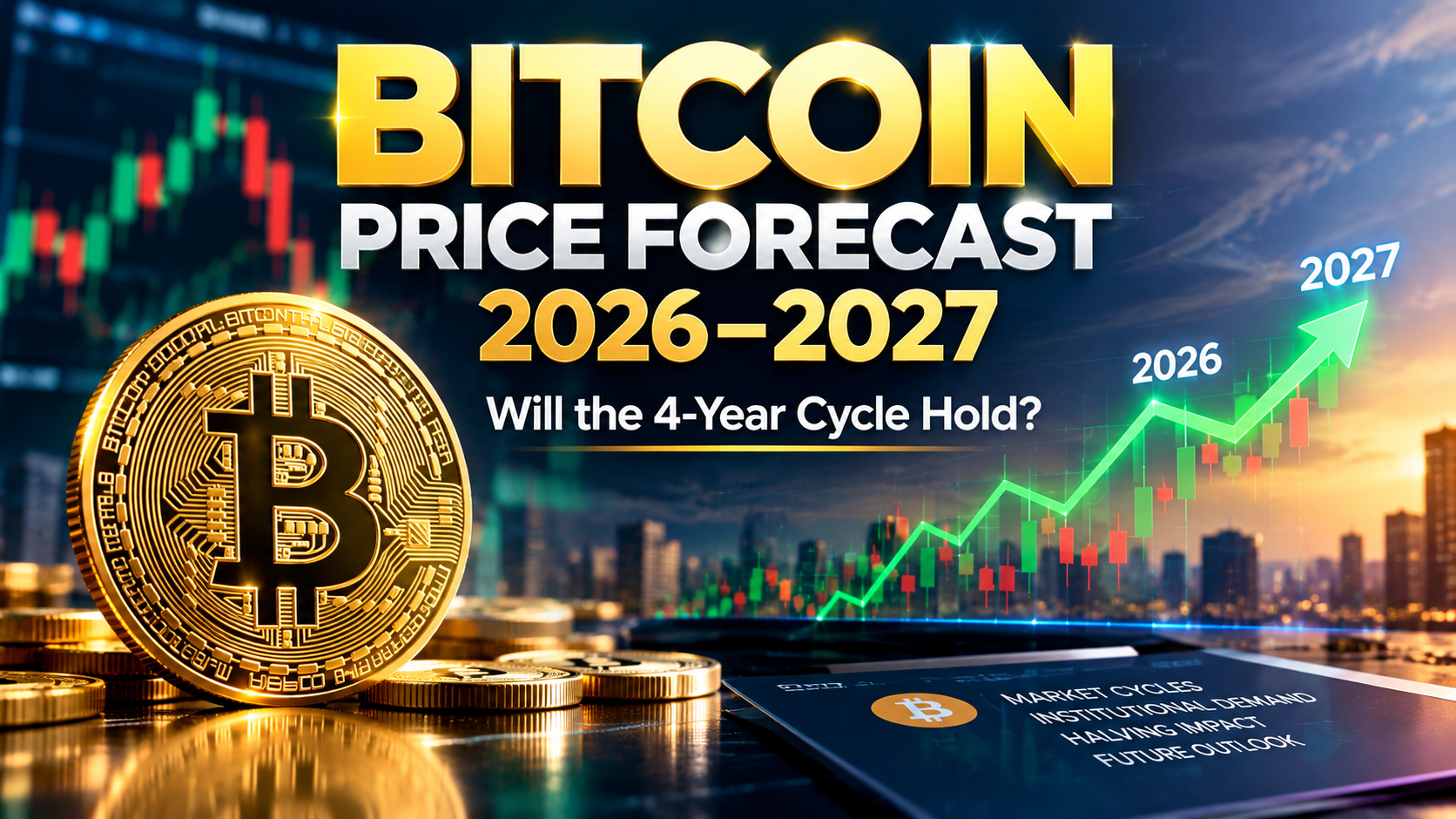
Bitcoin’s four-year cycle has been one of the most-watched patterns in crypto. It links price peaks and crashes to the supply event known as the halving.
So far, 2026 has looked a lot like the pattern. Here is where the price stands, what the cycle predicts and what analysts expect.
Key Takeaways
- Where we are: Bitcoin traded near $77,566 on September 16, 2026. CoinDCX
- The peak: Bitcoin peaked at $126,000 in October 2025 and had fallen roughly 50% by August. Mudrex
- Cycle theory: If history repeats, a bottom would land in late 2026.
- Analysts have cut targets: Major banks have lowered their 2026 forecasts.
- Key level: The 200-day moving average is the line technical traders are watching.
What Is the Bitcoin Four-Year Cycle?
Bitcoin’s supply issuance halves about every four years. Historically, price peaks followed each halving by roughly a year, then a deep drawdown followed.
Past cycles support this. The 2017 rally and the 2021 high both followed halvings. Each peak was followed by a long decline.
Bitcoin’s decline this cycle, about 54%, is milder than the 75% to 90% peak-to-trough crashes of 2014, 2018 and 2022. Some analysts read that as evidence of a maturing asset. CoinGecko
Bitcoin Price Today and Key Levels
| Level | Meaning |
|---|---|
| $126,000 | October 2025 all-time high |
| About $64,000 | Early August 2026 trading level |
| $73,077 | 200-day EMA, a key pivot |
| $80,000–$82,000 | Resistance zone traders watch |
The 50-day average recently crossed above the 200-day, a “golden cross” for the first time this year. Technical signals are mixed, and such patterns often fail. Treat them as one input, not a prediction. CoinDCX
One analysis says a sustained break below the 200-day EMA at $73,077 would invalidate the recent breakout. CoinDCX
Bitcoin Price Forecast for 2026: What Analysts Say
Forecasts have moved lower this year. Citi cut its target twice, from $143,000 to $82,000, and Standard Chartered cut from $150,000 to $100,000. Bernstein cut once, from $200,000 to $150,000. CoinGecko
If the four-year pattern holds, a market bottom could arrive between October and December 2026, with a possible range of $50,000 to $55,000. That range lines up with the 200-week moving average. Mudrex
Prices have already moved above that level, so the cycle bottom may have come earlier and higher than the pattern suggested. Nobody knows.
Prediction markets turned bearish in July, putting under 20% odds on $90,000 by year-end. Sentiment has improved since, but expectations remain cautious. CoinGecko
Bitcoin Price Forecast 2027
Long-range forecasts are speculative. Scenarios help frame the range.
| Scenario | Rough Outcome | What Would Need to Happen |
|---|---|---|
| Cycle holds | Slow recovery in 2027 | Bottom confirmed, gradual accumulation |
| Cycle breaks bullish | New highs sooner | Strong institutional inflows |
| Deeper bear | Retest of lower support | Macro shock or weak demand |
These are frameworks, not predictions. Anyone quoting a precise 2027 price is guessing.
What Could Break the Cycle
The cycle is a pattern, not a law. Four forces could change it.
- ETFs and institutions. Large regulated funds bring different buyers than earlier cycles.
- Interest rates. Central bank policy affects appetite for risk assets.
- Regulation. Clearer rules could attract capital, and tighter ones could deter it.
- Macro shocks. Energy prices and geopolitical events can hit all risk assets.
How Investors Can Approach the Market
- Use dollar-cost averaging. Spreading purchases reduces timing risk.
- Size positions carefully. Only invest money you can afford to see drop 50% or more.
- Know your holding route. Direct coins and spot ETFs carry different costs and risks.
- Watch the 200-day level and macro news.
- Keep records for taxes.
This article is general information, not financial advice.
What This Means for the Global Market in 2027
Most forecasts fixate on a single price. Here is what matters more.
Liquidity decides the next leg. Bitcoin has tracked global liquidity and risk appetite. Watch central bank policy.
Institutional adoption is the wild card. If ETFs and brokerages keep bringing in long-term holders, volatility may narrow.
The next halving is in 2028. Some analysts already anchor forecasts to it. The cycle may shift in timing if it continues at all.
Correlation with tech stocks. Bitcoin’s moves have followed large AI-linked stocks at times, so the two markets can turn together.
Frequently Asked Questions
What is the Bitcoin price prediction for 2026?
Forecasts vary widely, and major banks have cut their targets. Prices traded near $77,000 in mid-September.
Will Bitcoin hit a new high in 2027?
Nobody can say. If the four-year cycle holds, a new high is more likely later than in 2027.
Is the Bitcoin four-year cycle still valid?
It has matched 2026 so far, with a drop from an October 2025 peak. The decline has been milder than in past cycles.
When will Bitcoin bottom?
The cycle suggests late 2026, but bottoms are only clear in hindsight. Watch the 200-day and 200-week averages.
Discover more from The Economy
Subscribe to get the latest posts sent to your email.

Bitcoin is doing something it hasn’t done cleanly all year: holding a range. After a brutal first half of 2026 and a sharp recovery through the summer, BTC has settled into the high-$70,000s heading into a week that could reshape U.S. crypto market structure for good. Here’s the full picture across Bitcoin, the major altcoins, and the DeFi regulatory fight that’s about to come to a head.
Bitcoin: From 21-Month Low to Cautious Recovery
Bitcoin’s 2026 has been a genuine round trip. After topping out at an all-time high near $128,200 in October 2025, BTC fell to roughly $58,000 by late June 2026 — a 21-month low — before staging a real recovery, climbing about 37% to touch $80,000 by late August, according to KuCoin’s market roundup. As of mid-September 2026, Bitcoin was trading in the $77,000–$79,000 range, per CoinDesk and Fortune’s daily price tracker, still roughly 37–39% below its October 2025 peak.
Bitcoin’s 2026 price arc:
| Date | Price | Note |
|---|---|---|
| Oct 6, 2025 | ~$128,200 | All-time high |
| Late June 2026 | ~$58,000 | 21-month low |
| Late August 2026 | ~$80,000 | +37% off the bottom |
| Sept 8, 2026 | $78,346 | |
| Sept 9, 2026 | $78,737 | Lost the $80,000 level after holding it for four sessions |
| Sept 11, 2026 | ~$77,200–$77,300 | Recovering as zcash-related leverage unwinds |
The macro backdrop is the dominant driver right now, more than crypto-native news. The Federal Reserve, under Chair Kevin Warsh, has held its policy rate at 3.50%–3.75% for five consecutive meetings in 2026 without a single cut, with the median 2026 dot plot sitting at 3.8% — pointing toward continued tightness rather than the easing cycle many crypto investors were positioned for, according to KuCoin’s analysis. August’s core CPI print, released mid-September, rose a faster-than-forecast 0.3% month-on-month, though the annual pace of 2.4% was the slowest since early 2021, per CoinDesk market coverage — a mixed signal that has kept the market betting on the possibility of a rate hike rather than a cut in the near term, an unusual dynamic for crypto markets historically primed for rate-cut tailwinds.
Altcoins: Ethereum, Solana, and XRP Hold Steady Amid Regulatory Noise
The broader altcoin market has been comparatively rangebound. As of September 11, 2026, Ethereum traded around $2,539, up 2.8% over 24 hours; XRP sat near $1.36–$1.39, roughly flat to slightly down; and Solana traded around $101–$104, according to Investing News Network’s crypto recap.
Major token snapshot (Sept 8–11, 2026):
| Token | Price | 24h Move |
|---|---|---|
| Bitcoin (BTC) | ~$77,000–$79,000 | Mixed |
| Ethereum (ETH) | ~$2,460–$2,540 | +2.8% (Sept 11) |
| XRP | ~$1.36–$1.39 | Roughly flat |
| Solana (SOL) | ~$101–$104 | +1% (Sept 11) |
| BNB | Under pressure | -3.4% in one session |
| Dogecoin (DOGE) | Under pressure | -4.3% in one session |
The ETF complex has meaningfully broadened beyond Bitcoin this year. Solana and XRP-linked ETF products each entered September 2026 with assets near $1.5 billion, according to KuCoin — a sign that institutional demand for regulated altcoin exposure is no longer a Bitcoin-only phenomenon, even as individual token prices remain well below their 2025 highs.
DeFi’s “Killer Use Case”: Institutional Credit
The most consequential DeFi development this month has come from the XRP Ledger rather than Ethereum. According to CoinMarketCap’s coverage of comments from Ripple’s product head, institutional credit is emerging as DeFi’s potential “killer use case” — new XRP Ledger amendments (XLS-65 and XLS-66) enable pooled vaults and fixed-term, uncollateralized lending, with underwriting handled off-chain while the loans themselves settle on-chain. The pitch is straightforward: bring institutional-grade lending mechanics onto a public ledger without forcing institutions to accept crypto-native over-collateralization requirements that don’t match how traditional credit underwriting works.
This is part of a broader pattern of DeFi maturing toward institutional rails rather than remaining a purely retail, yield-farming-driven segment. Ripple’s own treasury business — following its $1 billion acquisition of GTreasury in October 2025 and the April 2026 launch of Digital Asset Accounts — is layering AI-driven policy interpretation and analytics on top of these on-chain lending primitives, aimed squarely at corporate finance teams rather than retail DeFi users.
The Regulatory Cliffhanger: CLARITY Act Vote on September 15
The single biggest near-term catalyst for the entire crypto market is not a price level — it’s a Senate procedural vote. Senate Republicans released a revised, 630-page version of the Digital Asset Market Clarity Act on September 10, 2026, ahead of a pivotal procedural vote scheduled for September 15, according to Investing News Network. The updated bill specifically targets “decentralized-in-name-only” (DINO) protocols — platforms that claim decentralization but remain effectively controlled by an individual or corporate entity — requiring them to register with the CFTC.
Market participants remain skeptical the bill actually becomes law in 2026. CNBC reported that SALT CEO John Darsie told the Wyoming Blockchain Symposium in August that he is “a bit pessimistic about the Clarity Act being passed,” citing the difficulty of moving major legislation heading into midterm elections. The bill already missed one legislative window when the Senate adjourned for August recess without a vote.
Corporate and Institutional Flows to Watch
Beyond regulation, institutional capital continues flowing into crypto infrastructure. Nasdaq Ventures announced a $100 million investment in Payward, the parent company of Kraken, valuing the exchange at $21 billion, according to Investing News Network’s recap — one of several signs that traditional financial infrastructure players are taking direct equity stakes in crypto exchanges rather than simply building competing products.
Final Verdict
The crypto market’s “daily outlook” for mid-September 2026 is really a story about two collisions happening at once: a Federal Reserve that refuses to deliver the rate-cut tailwind crypto bulls were counting on, and a Senate that is finally forced to vote on the market-structure legislation the industry has wanted for years, with genuine uncertainty about whether it passes. Bitcoin’s technical picture — holding above its 200-day EMA near $72,800 while losing the psychologically important $80,000 level — reflects that tension directly. Short-term, expect continued chop around the $75,000–$82,000 range pending the September 15 CLARITY Act vote and the next FOMC decision; the DeFi institutional-credit narrative and altcoin ETF expansion remain the more durable, multi-quarter stories worth tracking independent of daily price action.
Discover more from The Economy
Subscribe to get the latest posts sent to your email.
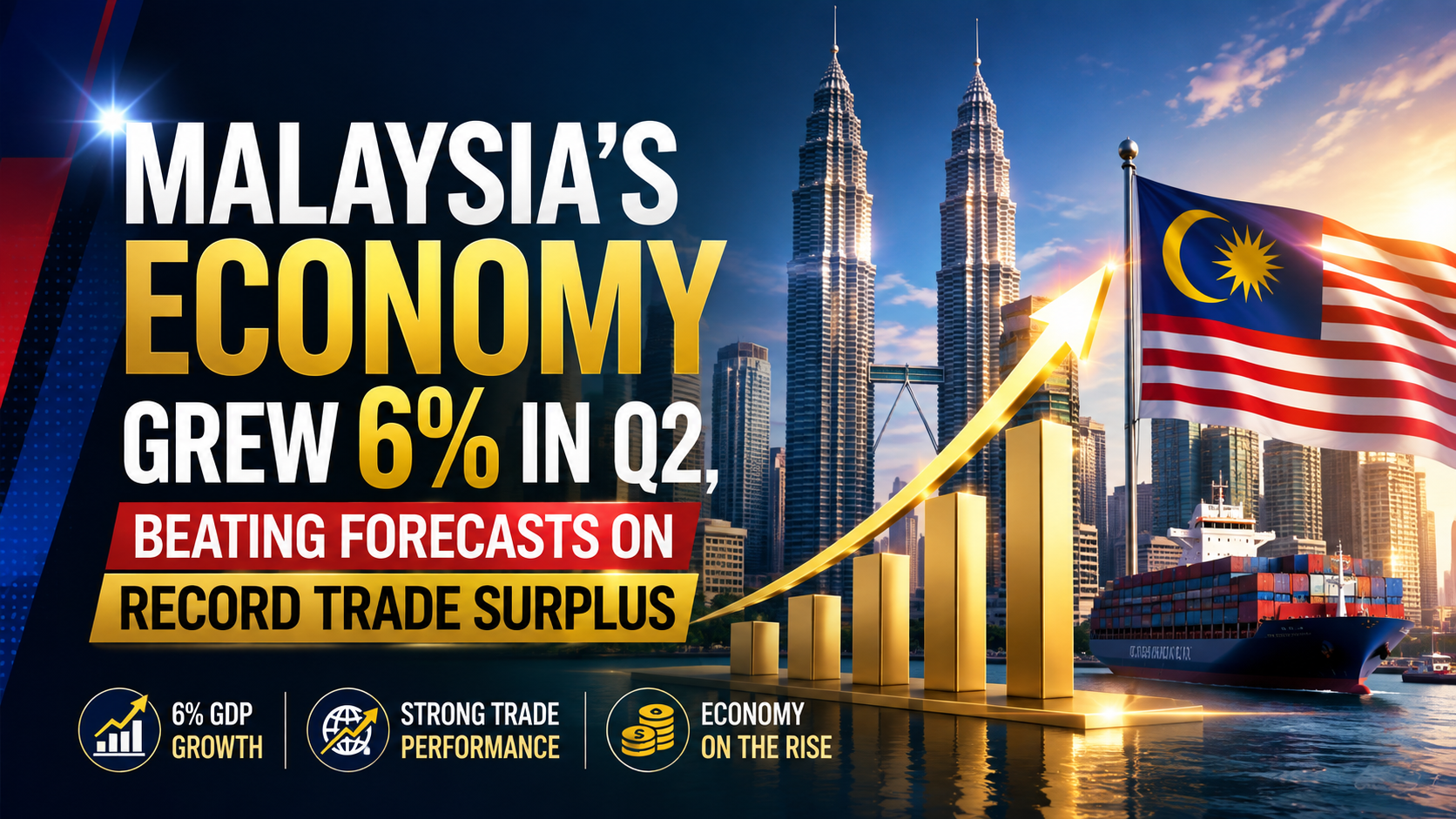
Malaysia delivered one of the standout growth surprises among Southeast Asian economies this year, with confirmed second-quarter GDP data showing the economy accelerated to 6% — comfortably ahead of consensus and its own first-quarter pace — powered by a record trade surplus and a semiconductor and AI-hardware export boom that has become the defining theme of the region’s 2026 growth story.
Growth Accelerates, Beating Consensus
Bank Negara Malaysia confirmed that the Malaysian economy grew 6% in the second quarter of 2026, up from 5.4% in the first quarter, driven by continued domestic demand and robust exports. The print beat consensus estimates of 5.8%, a margin significant enough to move currency markets on the announcement.
On the external side, exports accelerated on continued strength in electrical and electronics products and sustained expansion in services, alongside a rebound in liquefied natural gas exports and non-E&E manufacturing products. Household spending was supported by steady income growth and ongoing policy support, while investment growth was underpinned by continued spending on structures, machinery and equipment.
A Record Trade Surplus
The external numbers are, if anything, even more striking than the growth print. Malaysia’s exports surged 27.5% in the first half of 2026 while imports rose 16.9%, widening the trade surplus to RM147.1 billion from RM56.6 billion a year earlier. First-half trade rose 22.4% to a record RM1.8 trillion, according to separate commentary citing government data — a scale of expansion that puts Malaysia among the fastest-growing trade economies in Asia this year.
Kenanga Investment Bank attributed the resilience directly to the AI investment cycle, noting that Malaysia’s exposure to softer global demand is cushioned by the electrical and electronics and AI upcycle, particularly semiconductors, servers, and data-centre infrastructure. The bank added that hyperscaler capital expenditure and inventory normalisation across advanced economies should keep Malaysia’s export demand supported through the rest of 2026.
What This Means for the Ringgit
Currency strategists moved quickly to recalibrate their near-term ringgit forecasts on the data. One analyst told Bernama the ringgit is expected to trade around RM4.07 to RM4.08 with an upside bias in the immediate aftermath of the GDP release, while a separate analysis projected the ringgit trading within a 3.90-4.20 range against the US dollar through the second half of 2026, underpinned by Bank Negara Malaysia’s decision to hold its Overnight Policy Rate steady at 2.75%.
Juwai IQI global chief economist Shan Saeed argued the ringgit’s case rests less on raw momentum and more on policy credibility and external ballast — Bank Negara’s consistency in balancing price stability, domestic growth, and orderly financial conditions without defending an explicit exchange-rate target.
That said, the ringgit’s year-to-date performance has been more modest than the trade data alone might suggest: on a year-to-date basis through mid-August, the ringgit was down about 0.9% against the US dollar, with its nominal effective exchange rate down roughly 1%, reflecting the broader tug-of-war between Malaysia’s strong fundamentals and global factors including shifting US monetary policy expectations and Middle East-linked risk aversion.
Current Account Set to Stay Comfortably in Surplus
Looking further ahead, Kenanga IB projects Malaysia’s current account surplus will remain firm at 2.1% of GDP in 2026, with tourism and digital-infrastructure spending expected to lift services exports even as costlier energy and softer global demand crimp some parts of world trade. The bank cautioned that a firmer ringgit could nudge imports higher and that energy costs remain a “swing factor,” but expects the external balance to stay comfortably positive regardless.
Inflation Pervasiveness on the Rise
Not every indicator in the release was unambiguously positive. Inflation pervasiveness — the share of CPI items registering monthly price increases — rose to 45.5% in the second quarter from 38.3% in the first, close to its historical average of 45.6%, driven mainly by a sharp increase in April before moderating in May and June. That pattern suggests price pressures broadened out even as they moderated somewhat by quarter-end — a dynamic the central bank will need to watch closely alongside its currently steady policy stance.
Key Takeaways
- Malaysia’s economy grew 6% in Q2 2026, up from 5.4% in Q1 and beating the 5.8% consensus estimate.
- Exports surged 27.5% in H1 2026, pushing the trade surplus to a record RM147.1 billion and H1 trade to RM1.8 trillion.
- The AI-hardware and semiconductor export cycle, alongside a rebound in LNG shipments, is the key driver behind Malaysia’s outperformance.
- The ringgit is expected to trade in a 3.90-4.20 range against the US dollar through 2H26, supported by Bank Negara Malaysia’s steady policy stance.
- Inflation pervasiveness rose to 45.5% in Q2, a metric worth watching even as headline growth impresses.
Frequently Asked Questions
How fast did Malaysia’s economy grow in Q2 2026? Malaysia’s GDP grew 6% year-on-year in the second quarter of 2026, up from 5.4% in the first quarter and above the 5.8% consensus forecast.
What is driving Malaysia’s trade surplus to record levels? A 27.5% surge in exports in the first half of 2026 — led by electrical and electronics products, semiconductors, and a rebound in LNG shipments — pushed the trade surplus to a record RM147.1 billion.
What is the ringgit’s outlook for the rest of 2026? Analysts expect the ringgit to trade within a 3.90-4.20 range against the US dollar through the second half of 2026, supported by Malaysia’s strong export performance and Bank Negara Malaysia’s steady policy rate.
Discover more from The Economy
Subscribe to get the latest posts sent to your email.

SpaceX Starship Achieves First Full Orbit on Historic 10-Hour Test Flight 14

Google’s $15B Finland AI Investment: Data Centers, Nuclear Power & Jobs

Fast Invoice Factoring: Rates, APR Math & Contract Traps

SOC 2 Type II Guide: Cost, Timeline & Compliance Companies

Hong Kong Wages Surge 3.4% in June: Sector Data & Analysis

Silver Price Today: Why the Xi-Trump AI Standoff Is Fueling a Safe-Haven Rally

Citibank & Dólar Estadounidense: Forex Playbook After the Xi-Trump Truce

How the Trump-Xi White House Summit Is Reshaping Mortgage Rates Today for Real Estate Investors

Indonesia Navigates Mega-Project Risks as China and Russia Eye the 2,772km Trans-Kalimantan Railway

Trump-Xi 2026 Summit Takeaways: The Trade Truce, Taiwan, and the AI Divide

Solar Panel Installation Cost in 2026: Why the Math Changed Overnight

Business Insurance: What Coverage You Actually Need and What It Costs in 2026

Auto Insurance Quotes: How to Get the Lowest Rate Without Losing Coverage

Huntington Online Banking: Full Features, Fees, and How It Compares in 2026

Top 30 Stocks for Investment in PSX for Massive ROI in 2026

SpaceX Starship Flight 14: First Orbital Attempt & Starlink V3 Launch Explained

Oil Prices Break $100 in 2026: Middle East Conflict & Energy Markets

BRICS+ Cross-Border Payments 2026: Interoperability Explained

Fidelity Investments Review 2026: SPAXX Yields & Zero-Fee Funds

10-Year Treasury Yield Hits 4.80%: What It Means for Rates & Portfolios

Shein Clothes Quality & Safety in 2026: What Lab Tests Show

IMF & World Bank 2026 Global Economic Outlook: Growth, Inflation, Debt

China’s US$10.8 Billion Trade Shortcut: Why the Pinglu Canal Matters

High-CPM Finance Niches 2026: Publisher Monetization Blueprint

Middle East War Economics 2026: Oil Prices & Energy Markets

China Stocks Today: Are Big Economies in Asia Nearing a Market Bottom?

Social Security Trust Fund 2032: OASI Depletion Timeline Explained

Gavin Baker AI Outlook: Why the Compute Shortage Persists Through 2028
-

 Markets & Finance9 months ago
Top 15 Stocks for Investment in 2026 in PSX: Your Complete Guide to Pakistan’s Best Investment Opportunities
-

 Analysis7 months ago
Johor’s Investment Boom: The Hidden Costs Behind Malaysia’s Most Ambitious Economic Surge
-

 Analysis7 months ago
Top 10 Stocks for Investment in PSX for Quick Returns in 2026
-

 Banks8 months ago
Best Investments in Pakistan 2026: Top 10 Low-Price Shares and Long-Term Picks for the PSX
-

 Analysis8 months ago
Brazil’s Rare Earth Race: US, EU, and China Compete for Critical Minerals as Tensions Rise
-

 Investment9 months ago
Top 10 Mutual Fund Managers in Pakistan for Investment in 2026: A Comprehensive Guide for Optimal Returns
-

 Global Economy9 months ago
15 Most Lucrative Sectors for Investment in Pakistan: A 2025 Data-Driven Analysis
-

 Global Economy9 months ago
Pakistan’s Export Goldmine: 10 Game-Changing Markets Where Pakistani Businesses Are Winning Big in 2025