
Taxation
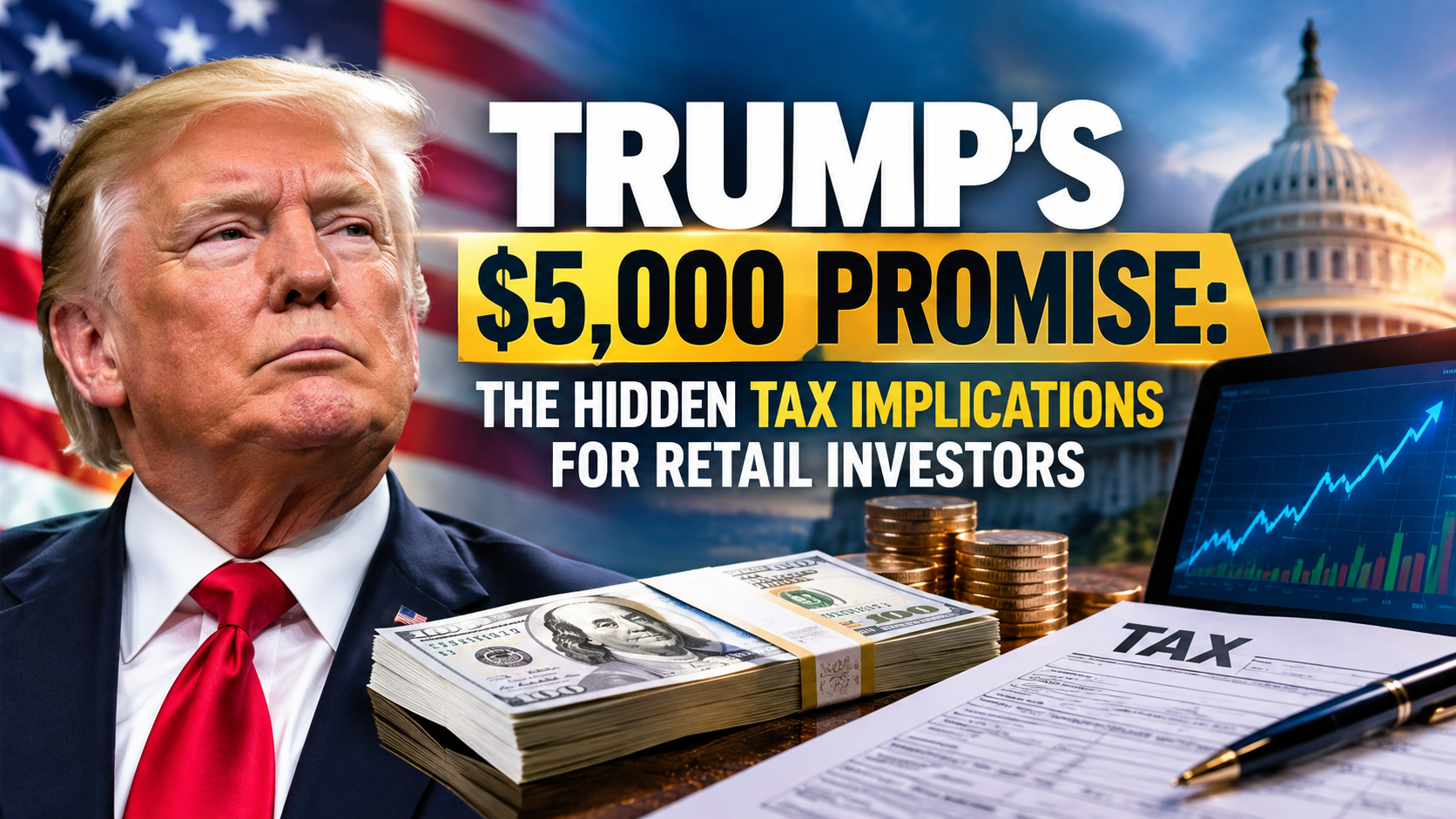
Trump’s $5,000 Promise: The Hidden Tax Implications for Retail Investors

Key Takeaways
- Tariff revenue currently covers only about one-tenth of the cost of Trump’s promised $5,000 dividend — the Tax Foundation estimates 2027 net tariff revenue at roughly $125 billion, versus the $1.25 trillion the payout would actually cost.
- Because the dividend is being framed as a “dividend” rather than a tax refund, its tax treatment is genuinely unclear — experts note there’s no legislative text specifying whether it would be taxable income, a tax credit, or an untaxed transfer.
- One tax-policy analysis estimates the payments could function like a demogrant, potentially eliminating positive net federal income tax liability for more than half of American families at 2026 median income levels.
- VP JD Vance has suggested wealthy Americans likely wouldn’t qualify for the full payment, but no income cutoff or definition of “wealthy” has been specified — leaving retail investors with taxable investment income unable to gauge their own eligibility.
- Absent significant new revenue or spending cuts, funding the dividend would require additional government borrowing on top of an already-projected $1.9 trillion FY2027 deficit — a dynamic that could raise yields and offset any net financial benefit for investors holding bonds or rate-sensitive equities.
Beyond the political theater surrounding Trump’s pledged $5,000 “dividend,” retail investors face a more practical question that has received far less attention: how would this payment actually be taxed, and what are the second-order effects on portfolios if it moves toward passage? This piece works through the tax-policy mechanics that most mainstream coverage has skipped.
The Math Doesn’t Add Up — And That Matters for Taxation
The dividend concept originated from Trump’s earlier proposal to distribute tariff revenue back to taxpayers. But according to Tax Foundation analysis, that revenue simply isn’t sufficient: net tariff collections are projected at roughly $125 billion in 2027, and $1.4 trillion cumulatively from 2026 through 2035. Against a $1.25 trillion one-time cost for the $5,000 dividend, tariff revenue would cover only about a tenth of the bill in any given year — meaning it would take nearly a decade of tariff collections to fund a single year’s dividend payout.
This funding gap is directly relevant to taxation because it determines how Congress would need to structure the payment if it ever moved toward passage. A dividend funded from an identifiable revenue stream (tariffs) could plausibly be treated differently under tax law than a dividend funded through general deficit borrowing — and right now, the proposal is light on the details needed to determine which path lawmakers would take.
Is the $5,000 Dividend Taxable Income?
This is the single biggest open question for retail investors trying to plan around the pledge, and as of now, there is no definitive answer because no legislative text exists. Tax-policy experts have noted that Trump’s proposal lacks specificity not just on funding, but on basic structural questions: would the payment count as taxable income requiring a 1099 or similar reporting, would it function as a refundable tax credit similar to COVID-era stimulus payments, or would it be structured as a wholly untaxed transfer?
Precedent cuts both ways. The 2020 CARES Act stimulus checks were structured as advance tax credits and were not taxed as income. But those payments were explicitly legislated with clear implementing rules — something the current $5,000 pledge doesn’t yet have. Until Congress produces actual bill text, retail investors cannot reliably model the after-tax value of the payment, nor factor it into year-end tax planning.
The “Demogrant” Analysis: A Progressive Side Effect
One notable tax-policy analysis frames the dividend as functioning similarly to a demogrant — a flat, universal cash transfer historically associated with progressive tax-reform proposals (echoing ideas like George McGovern’s 1972 “demogrant” plan). Using post-2025 tax law (following the One Big Beautiful Bill Act, or OBBBA), the analysis estimates that for a joint-filing household near the 2026 median family income of roughly $110,000, two Trump dividends worth $10,000 combined could offset their entire federal income tax liability for the year.
If accurate at scale, this means the dividend’s practical tax effect — regardless of its formal legislative characterization — would function as a substantial, broad-based tax cut concentrated among middle-income households, since the flat $5,000-per-adult structure delivers a proportionally larger benefit to lower-income filers than to high earners for whom $5,000 represents a smaller share of income and tax liability.
Who Might Actually Be Excluded?
Vice President JD Vance has already signaled that the dividend may not be truly universal, stating that wealthy Americans likely would not qualify for the full payment — though he offered no income threshold or definition of what “wealthy” means in this context. For retail investors with meaningful capital-gains income, dividend income, or other investment earnings, this ambiguity is a genuine planning problem: it’s currently impossible to know whether investment income would even be counted toward an eligibility test, or whether eligibility would instead be based purely on adjusted gross income from wages.
Comparison: How the Trump Dividend Stacks Up Against Prior Direct Payments
| Payment | Legal Basis | Tax Treatment | Funding Source |
|---|---|---|---|
| 2020 CARES Act checks | Legislated, advance tax credit | Not taxed as income | Deficit spending |
| 2025 “Warrior dividend” ($1,776) | Legislated, appropriated funds | N/A — bonus for active-duty military | Existing appropriations |
| Trump Accounts (child investment fund) | Congress-authorized | Tax-advantaged investment account | Appropriated funds |
| Proposed 2026 “$5,000 dividend” | Not yet legislated | Undetermined | Tariff revenue (insufficient) + likely borrowing |
The Second-Order Risk: Rates and Bond Yields
Even setting aside direct taxation of the payment itself, tax-policy and economics experts warn of a second, less visible cost to investors: financing $1.2–1.3 trillion in new spending — whether through borrowing or otherwise — on top of an already-elevated national debt above $40 trillion could push Treasury yields higher. David Ditch, a policy analyst at the Cato Institute, has warned that injecting that much money into the economy “would automatically lead to higher prices,” potentially eroding the real value of the dividend itself through inflation before investors ever see a tax bill on it. For portfolios, that means the practical “tax” on the dividend may show up less through the IRS and more through compressed bond returns and rate-sensitive equity valuations.
Why This Matters for Retail Investors
The prudent approach for now is treating the $5,000 dividend as a low-probability scenario with genuinely unresolved tax mechanics rather than incorporating it into near-term financial planning. Congress would need to pass specific implementing legislation — addressing taxability, income eligibility, and funding — before the payment could be modeled with any precision. Investors should watch for draft legislative language, which would be the first concrete signal of how lawmakers intend to structure both the payment and its tax treatment.
Frequently Asked Questions
Will Trump’s $5,000 dividend be taxed as income? It’s currently unknown. No legislative text exists specifying whether the payment would be taxable income, a tax credit modeled on 2020 stimulus checks, or an untaxed transfer — this is one of the proposal’s biggest open questions.
Would wealthy Americans receive the $5,000 dividend? Vice President JD Vance has said wealthy Americans likely wouldn’t qualify for the full payment, but no income threshold or definition of “wealthy” has been specified, leaving eligibility rules genuinely undefined.
How would the $5,000 dividend affect my taxes if I own investments? Beyond direct tax treatment of the payment itself, funding a $1.2–1.3 trillion payout through borrowing could push Treasury yields higher and add inflation pressure, potentially affecting bond returns and rate-sensitive equity valuations independent of how the payment is formally taxed.
Discover more from The Economy
Subscribe to get the latest posts sent to your email.


Wealth Management
UK Wealth Tax Fears Trigger Record £13.9bn Investor Exodus Ahead of October Budget
There is no bank queue, no dramatic headline photo — just a steady, monthly bleed of capital out of UK equity funds that has now become the worst sustained withdrawal pattern investment platforms have recorded in years. According to fund-flow data from Calastone, UK investors pulled £1.6 billion out of stock market funds in July alone, making it the weakest month for UK equity fund flows since late 2025. Zoom out further and the picture sharpens: withdrawals over the trailing twelve months have reached a record £13.9 billion.
This is not a market-timing story. It is a policy-anticipation story, and it is unfolding in the run-up to one of the most closely watched fiscal events of Prime Minister Andy Burnham’s government: Chancellor John Healey’s first Budget, scheduled for October 28, 2026.
What Investors Are Actually Afraid Of
A Boring Money survey cited in UK business coverage found that capital gains tax is the single biggest concern among investors, cited by 76% of respondents, followed by fears of a possible wealth tax at 64%, land and stamp duty reform at 51%, and inheritance tax changes at 50%. Strikingly, only 7% of investors surveyed believe the Burnham government’s policies will improve their personal financial position, while half expect an outright negative effect.
This sentiment is not occurring in a vacuum. It follows a period in which prior changes to inheritance-tax treatment of pensions already unsettled long-term savers, and it comes as speculation mounts — fueled in part by public commentary from figures including US President Donald Trump, who has separately described the UK’s fiscal position in blunt terms — about the scale of revenue-raising measures Healey may need to close the country’s fiscal gap.
The Broader Economic Backdrop
The capital-flight story is unfolding against a genuinely mixed UK economic picture. On one hand, the Services PMI has returned to expansion territory at 52.1, with the Composite PMI reaching 52.2, and construction’s downturn has eased. On the other, UK job postings fell 11% during the first half of 2026 and remain roughly 32% below pre-pandemic levels, according to Indeed data — with private-sector employment now in its 22nd consecutive month of decline, according to PMI figures.
Housing tells a similarly split story. Britain’s largest residential developers issued eight profit warnings in the first half of 2026 — matching the number recorded at the start of the 2008 financial crisis — with Vistry among the worst affected as its first-half home sales fell 11% to roughly 6,100 units. That makes the government’s pledge to deliver 1.5 million new homes before the 2029 general election an increasingly difficult target, with knock-on effects for the SME contractors and material suppliers that depend on housebuilding activity.
One notable bright spot: small-business growth expectations tell a bleaker story than the headline PMI figures suggest. Novuna Business Finance research found business growth confidence in England has dropped to just 24% — the lowest reading in the survey’s 12-year history, with construction, retail, and hospitality recording the sharpest declines. Only the North West bucked the trend, with growth expectations rising modestly.
Where the Money Is Going
For SEO content strategists and wealth advisors serving cross-border clients, the practical question is not whether UK capital is leaving equity funds — the data already answers that — but where it is relocating. Historical patterns during periods of UK wealth-tax anxiety point toward two primary destinations that recur consistently in advisor conversations: Dubai’s zero personal income tax regime under DIFC structuring, and Singapore’s combination of political stability, low capital gains exposure, and its role as a base for family offices serving Asian and Gulf wealth simultaneously. Both jurisdictions have spent 2025 and 2026 actively courting exactly this demographic through streamlined golden-visa and family-office licensing regimes.
What to Watch Before October 28
Three signals will matter most between now and Budget day:
- Whether Calastone’s monthly outflow figures accelerate or stabilize in August and September — a stabilization would suggest markets have already priced in the worst-case Budget scenario; continued acceleration would suggest investors expect measures more severe than currently rumored.
- Any pre-Budget signaling from Chancellor Healey or Number 10 about the scope of capital gains, wealth, or inheritance tax changes — governments frequently use August recess speeches and September party conference season to test-float measures.
- Bank of England commentary on energy price volatility, given BOE Deputy Governor Pill’s warning that energy price volatility is likely to persist into 2027, a factor that will constrain the Chancellor’s room to maneuver on the spending side of the Budget.
The Bottom Line
Britain is experiencing a slow-motion, policy-anticipation capital exodus rather than a market crash — but the effect on long-term investment, housebuilding, and small-business confidence is proving just as corrosive. With Chancellor Healey’s October 28 Budget now the single most consequential date on the UK fiscal calendar, the £13.9 billion already gone may be only the opening chapter.
Discover more from The Economy
Subscribe to get the latest posts sent to your email.

China’s global hunt for billions in unpaid taxes is rewriting the rules for its wealthy citizens.
Just after the Lunar New Year in 2026, a Shenzhen-based family office manager began fielding a new, unwelcome kind of call from his clients. Chinese tax authorities were asking them to settle liabilities on overseas capital gains—some dating back to 2017, others as far as 2000. He had no explanation for the arbitrary five-year window, only the stark reality of a new era: the era of Beijing’s global tax hunt.
Within weeks, the picture became clearer and more alarming for the country’s ultra-wealthy. Banks in mainland China had received instructions to freeze the accounts of wealthy depositors until they could prove taxes on foreign assets, trusts, and investments had been paid. As one banker put it, speaking to the Financial Times under the condition of anonymity: “These wealthy individuals now immediately need to pay penalties and taxes in cash to reactivate their accounts.” The policy response is unambiguous: the People’s Republic has launched a campaign to recover what it believes to be hundreds of billions of dollars in unpaid taxes.
It is, by any measure, a foundational shift in China’s fiscal policy, prompted by a grinding budget deficit and a genuine overhaul of its tax system to align more closely with the United States’ model of global taxation.
The Crunch and the Crackdown
The reason for the campaign’s urgency is a stark one: Beijing is running out of money. The traditional engines of state revenue have seized. Total government land sales, once a core source of funding for local governments, have collapsed from a peak of 8.7 trillion yuan ($1.3 trillion) in 2021 to just 4.15 trillion yuan after the spectacular unwinding of the property market .
This is not a short-term liquidity crisis. It is a structural fiscal realignment. Since the pandemic, overall budget revenue in China has largely stagnated, falling by 1.7% to 21.6 trillion yuan ($3.2 trillion) in 2025 . With the property sector no longer the reliable cash cow it once was, the state has been forced to look elsewhere, and it has set its sights on the billions of dollars in wealth held offshore by its citizens. The State Taxation Administration and the Ministry of Finance confirmed the new measures, formalising a pursuit that was already well underway .
This is the hard data behind the crackdown: a fiscal imperative. It signals that the government is willing to reach decades back into the past—some accounts are being scrutinised as far back as the year 2000—to plug the hole in the present.
The Core Development: A Data-Driven Manhunt
What makes this campaign different from previous sporadic efforts is its technological sophistication and its sheer scope. The hunt is not merely targeted; it is systematic and data-driven.
Chinese authorities are leveraging the full force of modern financial surveillance, utilising data obtained through the OECD’s Common Reporting Standard (CRS), which China has been an active participant in since 2018. As tax lawyer Ye Yongqing of Anli Partners noted, regulators are steadily strengthening the supervision of cross-border capital flows and foreign exchange transactions, narrowing the scope for wealthy Chinese to transfer assets offshore .
Private bankers and wealth managers are already seeing the impact. Singapore-based bankers who manage assets for Chinese families have confirmed that new rules on foreign trusts have “shocked” their clients . Last month, China introduced comprehensive tax rules on assets transferred to foreign trusts, closing a long-standing loophole. Under the new regime, income generated by overseas trusts will be taxed at 20% across multiple stages.
The specific assets under scrutiny are varied, including real estate, stocks, precious metals, and even cryptocurrencies . Financial institutions are being asked to verify whether income from these assets has been declared to Beijing. The retroactive nature of the campaign—in some cases extending more than 25 years—has been confirmed by multiple officials, bankers, and advisors .
Why are banks freezing accounts?
Chinese banks have been instructed to cooperate with tax authorities by freezing the accounts of wealthy depositors until they settle tax liabilities on their overseas assets. This includes gains from foreign stocks, real estate, trusts, and insurance policies. The freeze is only lifted when the individual pays the outstanding tax and penalties in cash, creating powerful leverage for the state to enforce compliance quickly.
An American Model, A Chinese Reality
The structural ambition of this campaign reaches well beyond a one-off tax grab. It represents a deliberate strategy to move China’s tax system closer to the US model.
Just as the US Internal Revenue Service taxes American citizens on their worldwide income regardless of where they reside, China is beginning to adopt a similar territorial approach. This is a significant escalation. For years, wealthy Chinese individuals have used offshore trusts and other complex structures to defer or eliminate tax liabilities on foreign earnings. These structures were often established during the heyday of Hong Kong IPOs, providing a “perfect income tax shield,” according to a Singapore-based banker . The new rules aim to dismantle those shields.
The implications are profound. When the taxman begins to treat offshore gains the same as domestic profits, the calculus of wealth management for high-net-worth individuals changes entirely. As Ye Yongqing noted, this “reduces the scope for wealthy Chinese to transfer their assets abroad or structure their tax affairs through offshore vehicles” .
Victor Shih, a professor of political economy at the University of California, San Diego, summed up the driving force simply: “The motive behind the new campaign is clearly fiscal” . That fiscal necessity is now reshaping the legal architecture of Chinese wealth.
The Second-Order Effects: Compliance and Capital Flight
Downstream consequences of this policy are already rippling through the economy and across borders.
For those in the cross-border trade business, the squeeze is tangible. Zhejiang-based exporter Henry Huang told the South China Morning Post that the heightened scrutiny of unreported overseas income is “taking a real bite out of profits,” forcing him to rethink cross-border operations with little room to pass on costs to price-sensitive US and European customers .
Chinese authorities are also ramping up the legal and psychological pressure. The public security ministry’s “Fox Hunt” campaign, which focuses on extraditing economic fugitives, has already captured over 880 overseas suspects, demonstrating a hardened stance on economic crime .
Yet the most significant risk might be a self-inflicted wound. There is a growing concern that such an aggressive enforcement posture, while potentially lucrative, could accelerate the very capital flight it is designed to reverse. If the wealthy feel they are being pursued relentlessly and facing punitive fines, they may seek to move not just their cash but their entire operations to jurisdictions they perceive as safer.
A Dissenting View: The Cost of Compliance
Of course, the narrative is not without its critics. Some experts warn that the crackdown could have unintended consequences that outweigh the potential revenue gains. The shift in policy, while designed to boost state coffers, might create an exodus of talent and capital.
Furthermore, the operational challenges for tax authorities are immense. While big data and the CRS give them a new level of visibility, they are still largely in the dark about the total quantum of overseas assets. A Bloomberg report from January noted that “even in Beijing’s tightly controlled society, the crackdown is proving spotty,” with local authorities largely unaware of the amount of wealth stashed abroad .
The risk is that a “one-size-fits-all” approach could drive the most mobile taxpayers away. A banker in Singapore managing Chinese wealth observed that many trust owners now face “one-off tax liabilities” and may be forced to sell assets to cover the bills . The campaign may ultimately shrink the tax base it is trying to capture, a classic Laffer Curve dilemma applied to capital.
The “global tax hunt” is, at its heart, a story of transformation. It illustrates a China trying to build a modern welfare state without the traditional safety net of property speculation. The era of the tax-free offshore account for Chinese citizens is ending, not with a whimper but with a series of account freezes and data-driven audits. The policy represents a historic pivot, a move to international norms that at once strengthens Beijing’s fiscal position and challenges the global mobility of its wealthiest citizens. The state’s appetite for its own citizens’ foreign wealth has only just begun, and it is ravenous.
Discover more from The Economy
Subscribe to get the latest posts sent to your email.

A group of senior UK economists led by Lord O’Neill of Gatley has proposed scrapping income tax, National Insurance, and capital gains, dividend and inheritance taxes in favor of a single “national contributions” levy, alongside replacing stamp duty with a 1% property valuation charge. The plan claims it could unlock £38bn in fiscal headroom and raise £18bn — and it’s landing just as Andy Burnham prepares to become prime minister.
Why this is surfacing right now
Most UK coverage has focused on the horse-race politics of Keir Starmer’s resignation and Andy Burnham’s expected succession as prime minister on July 20, 2026. What’s been under-covered is the structural tax reform proposal now sitting on the desk of whoever holds that office. Lord O’Neill and five other economists have published a report through the UCL Institute for Global Prosperity calling for a fundamental redesign of how the UK taxes income and wealth (CPA).
The mechanics: instead of stacking income tax, National Insurance, and separate levies on capital gains, dividends and inheritance, the UK would consolidate all of it into one “national contributions” tax. Stamp duty on property transactions would be replaced with an annual 1% levy on property valuations. The report’s authors argue this could create £38bn of additional fiscal headroom while raising £18bn in net new revenue — a combination that would matter enormously to a new government already facing warnings from the Office for Budget Responsibility about UK debt trajectories.
The bigger fiscal backdrop making this urgent
This isn’t a proposal floating in a vacuum. The OBR has warned that public debt could climb toward 300% of GDP by 2075 without intervention, and that nearly 50 million people could eventually fall into the higher tax bracket if current thresholds stay frozen while spending goes uncontrolled — potentially pulling even full-time workers on the National Living Wage into the 40% band by the late 2060s (CPA). The UK’s tax-to-GDP ratio is already projected to rise from 37% in 2019/20 to 43% by 2030/31.
Against that backdrop, the political calculation facing Burnham is unusually tight: he has signaled Labour’s manifesto still leaves room for maneuver on taxes, provided the party avoids raising the headline rates of income tax, VAT or National Insurance (CPA). A single consolidated levy could, in theory, let a government reshape effective tax burdens without technically breaking that pledge — which is precisely why business groups are watching this proposal so closely.
Who wins and loses under a consolidated levy
- Higher earners and investors currently benefiting from the gap between income tax rates and lower capital gains rates would likely see that gap close, which is why fintech entrepreneurs have already pushed back hard. Thought Machine founder Paul Taylor has called proposals to align capital gains tax with income tax “profoundly unfair” and warned it could discourage the investment the UK needs to support venture-backed IPOs (CPA).
- Property owners would trade a one-off stamp duty charge for an ongoing annual valuation-based levy — a structural shift with very different cash-flow implications for anyone holding property long-term versus trading it frequently.
- The Treasury gains a simpler, harder-to-avoid tax base, which is the core appeal for fiscal planners worried about long-run debt sustainability.
What UK businesses and investors should track next
Business confidence in the UK has already fallen to an 18-month low, with firms citing tax uncertainty as a leading factor, according to S&P Global data (CPA). Until the new government clarifies whether it will pursue anything resembling the national contributions model, expect continued caution on hiring and investment — a dynamic we cover in depth in our UK business confidence explainer.
Discover more from The Economy
Subscribe to get the latest posts sent to your email.

10-Year Treasury Yield Tops 5%: What It Means for Mortgages, Stocks, and the Fed

Ceasefire Negotiations in 2026: Predicting the Rebound of European and Asian Economies

Emerging Markets Update: The Impact of World Bank Policies on PSX Stability

Costco Oil Shortage 2026: Will Prices Double for All Synthetic Motor Oils?

Trump’s $5,000 Promise: The Hidden Tax Implications for Retail Investors

Global Economy Outlook 2026: What Ceasefire Talks Mean for the Tech Sector

China Stocks Today: Are Big Economies in Asia Nearing a Market Bottom?

Stock Market Crash 2026? How the Trump $5,000 Dividend Impacts Global Inflation

Tax-to-GDP Ratio Explained: Global Benchmarks, Fiscal Sovereignty & 2026 Insights

Trade Deficit & Terms of Trade Explained: Global Impact, Real-World Examples, and 2026 Insights

Supply vs Demand Shocks Explained: Market Equilibrium, Inflation Risks & Policy Responses in 2026

Microeconomics vs. Macroeconomics Explained: Key Differences, Interdependence & Global Impact

Devaluation vs Depreciation: Clear Differences, Causes, and Economic Impact

Purchasing Power Parity (PPP) Explained: Global Rankings, Living Standards & Why Nominal Exchange Rates Mislead in 2026

State Farm’s $5B Dividend 2026: Who Qualifies & Payout Dates

US-China Relations in Q3 2026: Trade Tariffs and Supply Chain Risks

Gold’s Wild 2026: From a Record $5,600 Peak to a 24% Crash and Back Toward $4,500

Oil Surges as Strait of Hormuz Traffic Collapses Again

Bank of England Set to Hold Rates Through Year-End, Reuters Poll Shows

SpaceX Starship Flight 14: First Orbital Attempt & Starlink V3 Launch Explained

The 2026 Crypto Regulatory Shift: What It Means for Institutional Investors

Top 30 Stocks for Investment in PSX for Massive ROI in 2026

AI Chip Stocks 2026: The Best Semiconductor Investments Beyond Marvell

AI-Powered Training: The Next Multi-Billion Dollar Ecosystem in Fitness

Russia’s Black Sea Oil Exports Fall for a Fifth Straight Week

Tween Back-to-School Trends 2026: What’s Driving the $85B Season

Global Chip Selloff Deepens: What’s Driving the Aug. 19 Semiconductor Rout

Shein Clothes Quality & Safety in 2026: What Lab Tests Show
-

 Markets & Finance8 months ago
Top 15 Stocks for Investment in 2026 in PSX: Your Complete Guide to Pakistan’s Best Investment Opportunities
-

 Analysis7 months ago
Johor’s Investment Boom: The Hidden Costs Behind Malaysia’s Most Ambitious Economic Surge
-

 Analysis7 months ago
Top 10 Stocks for Investment in PSX for Quick Returns in 2026
-

 Analysis7 months ago
Brazil’s Rare Earth Race: US, EU, and China Compete for Critical Minerals as Tensions Rise
-

 Banks8 months ago
Best Investments in Pakistan 2026: Top 10 Low-Price Shares and Long-Term Picks for the PSX
-

 Investment8 months ago
Top 10 Mutual Fund Managers in Pakistan for Investment in 2026: A Comprehensive Guide for Optimal Returns
-

 Global Economy9 months ago
15 Most Lucrative Sectors for Investment in Pakistan: A 2025 Data-Driven Analysis
-

 Global Economy9 months ago
Pakistan’s Export Goldmine: 10 Game-Changing Markets Where Pakistani Businesses Are Winning Big in 2025