
Banks
Kevin Warsh’s Fed Delivers “Regime Change”: Rate Hike Now Looms Over US Economy

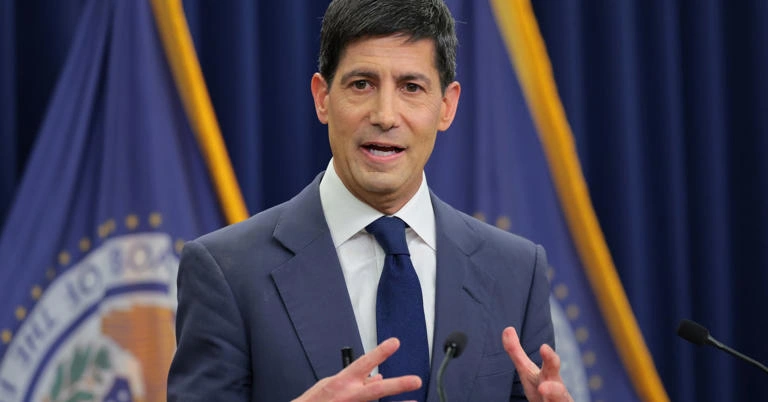
Federal Reserve Chair Kevin Warsh held rates steady in his first FOMC meeting but signaled a hawkish pivot — nine of 18 members now project a 2026 rate hike. Here’s what it means for markets, mortgages, and inflation.
Introduction: A New Sheriff at the Fed — And Markets Are Still Learning His Rules
When Kevin Warsh walked into his first Federal Open Market Committee (FOMC) meeting on June 17, 2026, Wall Street knew the era of Jerome Powell’s careful, consensus-driven central banking was over. What they didn’t fully anticipate was just how decisively — and how immediately — Warsh would begin dismantling the communication architecture that markets had grown dependent on for more than a decade.
The result: a historic policy pivot that left rates unchanged but sent a powerful signal that the next move at the Federal Reserve might not be a cut. It might be a hike.
This article breaks down everything that happened, what it means for borrowers, investors, and the broader US economy — and why this FOMC meeting may be remembered as one of the most consequential in years.
What Happened: Rates on Hold, But the Tone Has Shifted Dramatically
In a unanimous 12-0 vote, the Federal Reserve held its benchmark federal funds rate steady at a range of 3.50% to 3.75% — the fourth consecutive meeting with no change, following the last rate cut in December 2025 (CNBC).
But the rate hold was almost beside the point. What rattled markets was the dot plot — the Fed’s internal forecast of where interest rates are headed.
According to the Summary of Economic Projections released alongside the decision:
- Nine of 18 voting FOMC members now project at least one rate hike before end of 2026
- Six members project two 25-basis-point increases this year
- The Fed’s PCE inflation forecast for year-end was revised sharply upward to 3.6%, up from just 2.7% in March (Fox Business)
- GDP growth was nudged down slightly to 2.2%, while the unemployment projection fell marginally to 4.3%
In short: more inflation, slower growth — and a committee increasingly inclined to fight prices rather than stimulate growth.
Warsh’s Missing Dot: A Statement in Itself
In what may become one of the defining gestures of the Warsh era, the new Fed chair declined to submit his own interest rate projection — leaving the dot plot with 18 rather than the usual 19 entries.
“I did not submit a dot for me. It’s not helpful in the conduct of policy,” Warsh told reporters at his first post-meeting press conference (CNBC).
The move was consistent with Warsh’s long-standing critique of the dot plot as a tool that distorts market expectations and creates undue reliance on Fed signaling. He suggested the entire forward guidance apparatus — including the dot plot, press conferences, and detailed meeting minutes — could be up for review by year-end.
Forward Guidance: Gone
Perhaps the most market-moving structural change announced at this meeting was Warsh’s decision to eliminate forward guidance entirely.
“I think financial markets perform best when they react to incoming data. I think the financial markets work less efficiently when they ask the question, ‘How will the Federal Reserve react to that incoming information?'” (Al Jazeera)
The Fed’s post-meeting policy statement reflected this philosophy dramatically — it was trimmed to just 130 words, compared to 341 words in the April statement (CNBC). The statement stripped out all easing-leaning language, focusing instead on a bare-bones summary of economic conditions and an unambiguous commitment to price stability.
This represents a fundamental shift in how the Fed communicates — and it means that investors can no longer look to the central bank for hints about the future path of rates.
Five Task Forces: The Warsh Overhaul Begins
Warsh announced the formation of five internal task forces to conduct a top-to-bottom review of Fed operations. The areas under review include:
- The Fed’s inflation framework
- Monetary policy communications (including press conferences and minutes)
- Data sources and productivity measurement
- Labor market analysis
- Broader conduct of monetary policy
“Each task force will serve an objective shared by everyone around that table — a Federal Reserve that is clear-eyed about its mission, fit for purpose, and focused on the future,” Warsh said (Al Jazeera).
He added that the task forces would enlist “some of the very best minds, both inside and outside the economics profession” and that outcomes would be presented by year-end.
The Inflation Problem: Why Rate Cuts Are Off the Table
The backdrop to all of this is an inflation surge that has fundamentally complicated Warsh’s position. The Consumer Price Index for May came in at 4.2% year-over-year — the highest reading since April 2023 — driven largely by energy prices tied to the Iran war and Strait of Hormuz closure (CBS News).
Core inflation, which strips out food and energy, was more moderate at 2.9% — still well above the Fed’s 2% target. The Fed has now been above its inflation target for more than five years.
“We recognize that inflation has been running well ahead of the Fed’s long-stated inflation goal of 2%. That’s been going on for more than five years. Persistently high prices are a burden for the American people, but the recent past need not be prologue,” Warsh said (Fox Business).
The labor market, meanwhile, remains resilient. Nonfarm payrolls rose by 172,000 in May while unemployment held steady at 4.3% — giving the Fed little cover to cut rates on economic growth grounds (CNBC).
The Trump Paradox: Appointed to Cut, Facing Pressure to Hike
Warsh’s position is politically delicate. President Trump appointed him — after declining to reappoint Jerome Powell — explicitly seeking lower interest rates. But rising inflation has flipped the script entirely.
“There’s no reason to raise rates,” Trump stated on NBC’s Meet the Press just days before the FOMC meeting (Al Jazeera).
Yet if Warsh bows to that pressure, he risks undermining Fed independence — potentially triggering a bond market selloff and higher long-term borrowing costs. As Capital Economics analyst Stephen Brown noted, “an overtly dovish tone would reignite concerns about Fed independence and risk pushing up long-end bond yields.” (Al Jazeera)
What This Means for Borrowers and Investors
Mortgage Rates
With rate hikes now more likely than cuts, mortgage rates are unlikely to fall meaningfully in the near term. The 30-year fixed rate has remained elevated throughout 2026. Any further tightening could push housing affordability — already at generational lows — even further out of reach for first-time buyers.
Stock Market
Markets initially read the hawkish FOMC statement negatively, though the reopening of the Strait of Hormuz has provided a partial offset. Investors are now navigating a rare dual-risk environment: geopolitical normalization on one side, domestic monetary tightening on the other.
Bonds
The short end of the curve has repriced to reflect hike expectations. Longer-dated Treasuries remain sensitive to any signal from Warsh about the Fed’s ultimate terminal rate.
Savings & CDs
For savers, an extended period of higher rates — or even a hike — means high-yield savings accounts and certificates of deposit remain attractive compared to recent history.
The Bigger Picture: What “Regime Change” Really Means
Warsh’s language of “regime change” at the Fed is not rhetorical. It signals a deliberate move away from the post-2008 model of ultra-transparent, market-sensitive central banking toward a leaner, more data-dependent institution that speaks less and acts more deliberately.
Whether this philosophy succeeds will depend on whether inflation falls back toward 2% — ideally driven by the normalization of energy prices as the Hormuz reopens — without requiring the Fed to raise rates into a slowing economy.
The next FOMC meeting will be closely watched. For the first time in years, the outcome is genuinely uncertain.
Key Takeaways
| Indicator | Current Reading | Fed Projection (Year-End) |
|---|---|---|
| Federal Funds Rate | 3.50%–3.75% | Potential hike to 3.75%–4.00% |
| CPI Inflation (May) | 4.2% YoY | 3.6% PCE |
| Core CPI (May) | 2.9% YoY | 3.3% core PCE |
| GDP Growth | Solid | 2.2% |
| Unemployment | 4.3% | 4.3% |
Frequently Asked Questions (FAQ)
Q: Did the Fed raise interest rates in June 2026?
No. The Fed held rates steady at 3.50%–3.75% in a unanimous 12-0 vote at the June 2026 FOMC meeting.
Q: Will the Fed hike rates in 2026?
Nine of 18 FOMC members now project at least one rate hike before year-end 2026. Markets are pricing in a roughly 50/50 chance of one hike.
Q: Why did Kevin Warsh not submit a dot plot forecast?
Warsh has long criticized the dot plot as distorting markets. By withholding his own projection, he signaled his intention to eventually reform or eliminate the forward guidance tool.
Q: What is Kevin Warsh’s view on inflation?
Warsh views supply-shock inflation — like the energy spike from the Iran war — as something that should generally be “looked through.” However, he has committed unanimously with the FOMC to deliver price stability and bring inflation back to 2%.
Q: What are the five Fed task forces Warsh announced?
The task forces cover the Fed’s inflation framework, monetary policy communications, data sources, labor market analysis, and the broader conduct of monetary policy.
Discover more from The Economy
Subscribe to get the latest posts sent to your email.


American payrolls contracted by 23,000 in July, a stunning miss against consensus expectations of an 80,000 gain, while the unemployment rate ticked down to 4.1% — a combination that reads less like resilience than like a shrinking labour force (e-Morning Coffee). The labour-force participation rate fell to its lowest level in fifty years outside the pandemic, a structural detail markets have been slower to price than the headline payrolls miss (e-Morning Coffee).
Why bad news was good news for stocks
The market reaction was immediate and largely one-directional: Treasury yields fell across the curve, growth stocks recaptured months of losses in a single session, and rate-hike probability for the September and November FOMC meetings collapsed toward zero (Clearbrook). The S&P 500 posted its best weekly performance since the spring’s Iran-ceasefire rally, gaining 3.59%, with Information Technology leading all sectors at +7.22% — its largest single-week advance of 2026 — powered by the combination of a strong Apple earnings print and the sharp repricing of Fed expectations (Clearbrook).
The rally was notably broad rather than concentrated in mega-cap technology: the equal-weighted S&P 500 advanced 2.43%, Materials gained 5.61%, Industrials rose 3.03%, and the Russell Micro Cap index — which benefits disproportionately from lower rate expectations given its more leveraged constituents — surged 5.77% (Clearbrook). Growth stocks also outperformed value for the week, though value still leads decisively on a year-to-date basis, 23.48% versus growth’s 5.68% (Clearbrook).
The Fed’s dissenters, suddenly exposed
Perhaps the most consequential detail is political rather than statistical: three FOMC members who had dissented in favour of an immediate rate hike just a week before the report was released now find themselves in a significantly weakened position within the committee (Clearbrook). A single data print has shifted the internal balance of the Fed’s policy debate heading into September.
This is the third straight “cruel summer”
What distinguishes 2026 from a one-off shock is the pattern. In each of the last two years, a comparable summer weakening in US employment data has pushed the Federal Reserve into a short cycle of rate cuts — meaning July’s contraction fits a now-recognisable seasonal-plus-structural trend rather than standing as an isolated anomaly (Bloomberg).
What to watch next
Two threads now dominate the September calendar: whether the Fed opts for a standard 25-basis-point cut or moves more aggressively given the depth of the labour miss, and whether the falling participation rate — rather than the unemployment rate — becomes the metric investors and policymakers watch most closely. A shrinking labour force can flatter the headline unemployment number while masking real economic softness, and that distinction will shape how credible the “soft landing” narrative remains through year-end.
Discover more from The Economy
Subscribe to get the latest posts sent to your email.
A labor market that looked resilient just weeks ago has cracked, and traders are now wagering the Federal Reserve will have no choice but to cut interest rates as soon as next month.
The US Bureau of Labor Statistics reported on August 7 that nonfarm payrolls fell by a seasonally adjusted 23,000 in July — a stunning miss against the Dow Jones consensus forecast of an 83,000 gain, according to CNBC. Worse, the agency slashed prior estimates for May and June by a combined 103,000 jobs, dragging the trailing 12-month average payroll gain down to just 34,000 — among the weakest stretches outside a recession in over a decade.
A Report That Rewrites the Narrative
For much of 2026, the prevailing story on Wall Street was that the US economy had shrugged off tariff shocks and geopolitical turbulence. That narrative is now under serious strain. The unemployment rate ticked down to 4.1%, but for the wrong reason: the Bureau of Labor Statistics confirmed the labor force participation rate slid to 61.4%, its lowest level in more than five years outside the pandemic, as hundreds of thousands of Americans simply stopped looking for work.
Household employment — the survey used to calculate the jobless rate — actually fell by 87,000, even as the official rate declined. That divergence is a red flag economists watch closely, because it signals discouraged-worker dynamics rather than genuine labor market strength.
“The July employment report solidified that the labor market is not out of the woods quite yet,” ZipRecruiter labor economist Nicole Bachaud told CNBC.
Where the Damage Is Concentrated
The sectoral breakdown tells a story of an economy bifurcating under pressure. According to a detailed Spokesman-Review analysis of the BLS release:
- Leisure and hospitality employment fell to its lowest level in nearly a year, with restaurants and bars shedding staff — a particularly bitter disappointment given forecasters had expected a boost from the FIFA World Cup, which concluded July 19.
- Financial activities payrolls dropped to a four-year low, with the BLS confirming losses concentrated in credit intermediation (-9,000) and insurance carriers (-7,000). The sector — seen as among the most exposed to AI-driven automation — is now down 121,000 jobs since its May 2025 peak.
- Retail trade shed jobs at warehouse clubs, supercenters and general merchandise stores (-21,000), alongside a smaller decline at gasoline stations.
- Manufacturing and construction, by contrast, continued to climb, a trend economists partly attribute to the ongoing AI data-center build-out even as high interest rates keep homebuilding subdued.
The month also arrived alongside a wave of high-profile layoff announcements from Microsoft, Uber and Visa, reinforcing the sense that white-collar hiring caution has broadened beyond tech.
Why the Iran War Keeps Showing Up in Economic Data
Bloomberg’s economics desk framed the report bluntly: a surprise drop in US payrolls has renewed worries about the health of the world’s largest labor market, with employers growing cautious “amid rising prices and fallout from the Iran war,” according to Bloomberg. Elevated energy costs stemming from Middle East supply disruption have fed directly into hiring plans, compounding the drag from tariff-related input cost inflation that has squeezed margins across retail and manufacturing since early in the year.
Notably, the US is not alone. The same Bloomberg dispatch pointed to the UK, where private-sector employment surveys are even more negative — a downturn now rivaling the length of the 2008-09 financial crisis in the country’s dominant services sector.
What It Means for the Federal Reserve
Markets moved fast. Futures pricing shifted decisively toward a September rate cut in the hours following the release, as traders concluded the Fed’s dual mandate now tilts firmly toward the employment side of the ledger. A weakening labor market, combined with a participation rate at generational lows, gives the Federal Open Market Committee cover to ease even with inflation still running above target — a trade-off that will be closely watched at the Fed’s next meeting.
The revisions matter as much as the headline. A downward adjustment of 103,000 jobs across just two months suggests the “resilient” labor market story that dominated the first half of 2026 was, in part, a statistical mirage. Economists now widely expect the upcoming preliminary benchmark revision — due August 28 from the BLS — to confirm further softness in the annual payroll count.
The Investor Playbook
For traders and portfolio managers across the nine markets this publication tracks, the implications cascade quickly:
- Rate-sensitive equities — regional banks, homebuilders, and small caps — are best positioned to benefit from a confirmed dovish pivot.
- The dollar faces downward pressure as rate-cut expectations firm, a dynamic that matters directly for emerging-market currencies from the Pakistani rupee to the Indonesian rupiah, both of which import inflation partly through dollar-denominated debt and energy costs.
- Treasury yields have room to fall further if the September cut is confirmed, which would ease financing costs for governments and corporates globally.
- Gold and other haven assets typically firm on rate-cut expectations paired with geopolitical risk — a combination now squarely in play.
The Bottom Line
The July jobs report did not show a labor market in freefall, but it did puncture the illusion of a soft landing achieved without cost. Falling participation, deep downward revisions, and sector-specific stress in finance and hospitality point to an economy where headline resilience is increasingly propped up by fewer people working, not more people finding jobs. With the Fed’s September meeting now the market’s central focus, the coming weeks of data — including the August 28 benchmark revision — will determine whether this was a one-month air pocket or the start of a genuine slowdown.
Discover more from The Economy
Subscribe to get the latest posts sent to your email.
Pakistan is running two demanding reform programs at once, and they don’t obviously fit together. On one track, the IMF is pressing for stricter fiscal controls, expanded tax collection, and continued tight monetary policy under its Extended Fund Facility. On the other, Pakistan’s own constitution now mandates the removal of “riba” — interest — from the economy entirely, with a deadline set for January 2028, following a constitutional amendment passed in October 2024, according to IMF Country Report 25/109.
The IMF’s side of the ledger
Pakistan’s economic recovery gained real momentum in the first half of FY26, with GDP growth averaging 3.8% year-on-year, driven by the auto, construction, and garment industries, even as flooding in July-August weighed on output, according to IMF staff reporting. Inflation, however, climbed to 7.3% year-on-year in March as higher global commodity prices passed through to domestic energy costs. Foreign reserves have been rebuilding steadily — from $14.5 billion at end-June 2025 to $16 billion by end-December — while the primary fiscal surplus is expected to reach 1.6% of GDP in FY26, in line with IMF targets.
In May 2026, the IMF Executive Board completed the third review of Pakistan’s Extended Fund Facility and second review of its Resilience and Sustainability Facility, unlocking roughly $1.1 billion and $220 million respectively and bringing total disbursements under the two programs to about $4.8 billion, according to the IMF’s official press release. The Fund explicitly credited Pakistan’s “strong implementation” for maintaining stability despite the disruption from the Middle East war.
The parallel Islamic finance transformation
Running alongside that fiscal program is a structural transformation few outside Pakistan are tracking closely: the State Bank of Pakistan is required to develop a full financial sector strategy detailing the legal, regulatory, and strategic path to a riba-free economy, addressing monetary policy implementation, public debt management, and bank supervision — with a strategy deadline the IMF set for end-June 2026, per the same country report. Parliament has already moved on a related front, approving the Virtual Assets Bill in March 2026 and formally establishing the Pakistan Virtual Assets Regulatory Authority.
Why the IMF is watching this transition warily
The IMF’s own language signals concern about execution risk: publishing the riba-free transition plan “will help align the expectations of market participants, investors, and regulators… and mitigate concerns about any possible cliff effect,” according to the country report language. That is diplomatic phrasing for a real structural risk — an abrupt, poorly sequenced transition away from conventional interest-based finance could destabilize a banking sector the IMF has spent years helping stabilize.
The tax reform Pakistan still owes
Beyond monetary policy, Pakistan has committed to finalizing a new audit manual and centralizing taxpayer audit selection by August 2026, accelerating its Retailer Tax Registration Scheme, and making its Tax Policy Office fully operational, according to ProPakistani’s summary of IMF commitments. The Federal Board of Revenue has continued missing collection targets, prompting the IMF to propose making FBR revenue goals a formal Quantitative Performance Criteria — a stricter enforcement mechanism than before.
Why this matters for Gulf and global investors
Pakistan’s dual reform track — IMF-style fiscal orthodoxy alongside a constitutionally mandated Islamic finance transition — is unusual among IMF program countries and is drawing renewed Gulf capital interest, visible in DIFC’s decision to bring its Dubai FinTech Summit to Pakistan for the first time in August 2026 (see our companion report). Investors assessing Pakistan’s banking sector need to model both trajectories simultaneously, not just the more familiar IMF fiscal metrics.
Discover more from The Economy
Subscribe to get the latest posts sent to your email.

Singapore’s AI Boom Is Now a Two-Country Story

Why Global Family Offices Are Converging on Dubai in 2026

A Weak Jobs Report Just Rewired the Fed’s Autumn — And Wall Street Cheered

Britain’s Fragile Rebound Meets a Budget Deadline and a Trump Ultimatum

Pakistan’s Economy Grew 3.7% — So Why Doesn’t It Feel Like a Recovery?

Top 15 Financial Stocks for Investment in PSX

Pakistan Exports 2026: Record $35.6B Forecast Masks Trade Deficit Risk

UK’s Jobs Downturn Now Matches the 2008 Financial Crisis — And AI Is Accelerating It

Fed Rate Cut Bets Surge After Shock US Jobs Report Exposes Labor Market Cracks

Pakistan’s Trade Gap Widens to $3.95bn Despite Meeting FY26 Current Account Target

Why Ottawa Is Betting on Dubai: Inside Canada’s Gulf Trade Pivot

UK Wealth Tax Fears Trigger Record £13.9bn Investor Exodus Ahead of October Budget

July Jobs Shock: Why the Fed’s September Rate Decision Just Flipped (2026 Analysis)

Global Growth Forecast 2026: IMF, World Bank Outlooks and the “Slow-Hire, Slow-Fire” Labor Market

Gold Price Forecast 2026: Fed’s July 29 Decision and Record Central Bank Buying Explained

China Politburo July 2026: Stimulus Signals Explained

Pakistan Economy 2026: GDP Grows 3.7% as IMF Completes EFF Review Amid Middle East Risk

Strait of Hormuz Blockade 2026: Oil Prices Surge 9% as US-Iran Conflict Reignites

Down But Not Out: Inside the Slow Sinking of Russia’s War Economy

Apple vs OpenAI Lawsuit: The Economic Story Behind the Headline

Gulf Capital Retreat From Pakistan 2026: UAE Loan Freeze & What It Means

Global Stock Market Selloff 2026: Stagflation Fears Return as Iran Conflict Reignites

Pakistan’s Economic Survey FY26: Inflation Spike Insights

Russia Fuel Shortages 2026: Inside a Cracking War Economy

Russia’s Shadow Fleet Insurance Economy: How Sanctions Really Work in 2026

Strait of Hormuz Crisis 2026: How Trump’s Toll U-Turn Exposes Global Economic Risk

Bank of England Rate Decision Amid Energy Crisis

Russia’s War Economy Model Is Starting to Crack, Think Tank Warns
-

 Markets & Finance7 months ago
Top 15 Stocks for Investment in 2026 in PSX: Your Complete Guide to Pakistan’s Best Investment Opportunities
-

 Analysis6 months ago
Johor’s Investment Boom: The Hidden Costs Behind Malaysia’s Most Ambitious Economic Surge
-

 Analysis6 months ago
Top 10 Stocks for Investment in PSX for Quick Returns in 2026
-

 Analysis6 months ago
Brazil’s Rare Earth Race: US, EU, and China Compete for Critical Minerals as Tensions Rise
-

 Banks7 months ago
Best Investments in Pakistan 2026: Top 10 Low-Price Shares and Long-Term Picks for the PSX
-

 Investment7 months ago
Top 10 Mutual Fund Managers in Pakistan for Investment in 2026: A Comprehensive Guide for Optimal Returns
-

 Global Economy8 months ago
15 Most Lucrative Sectors for Investment in Pakistan: A 2025 Data-Driven Analysis
-

 Global Economy8 months ago
Pakistan’s Export Goldmine: 10 Game-Changing Markets Where Pakistani Businesses Are Winning Big in 2025