Connect with us

Analysis

Trump Considers Seizing Iran’s Kharg Island to ‘Take the Oil’ | Analysis

Published

on

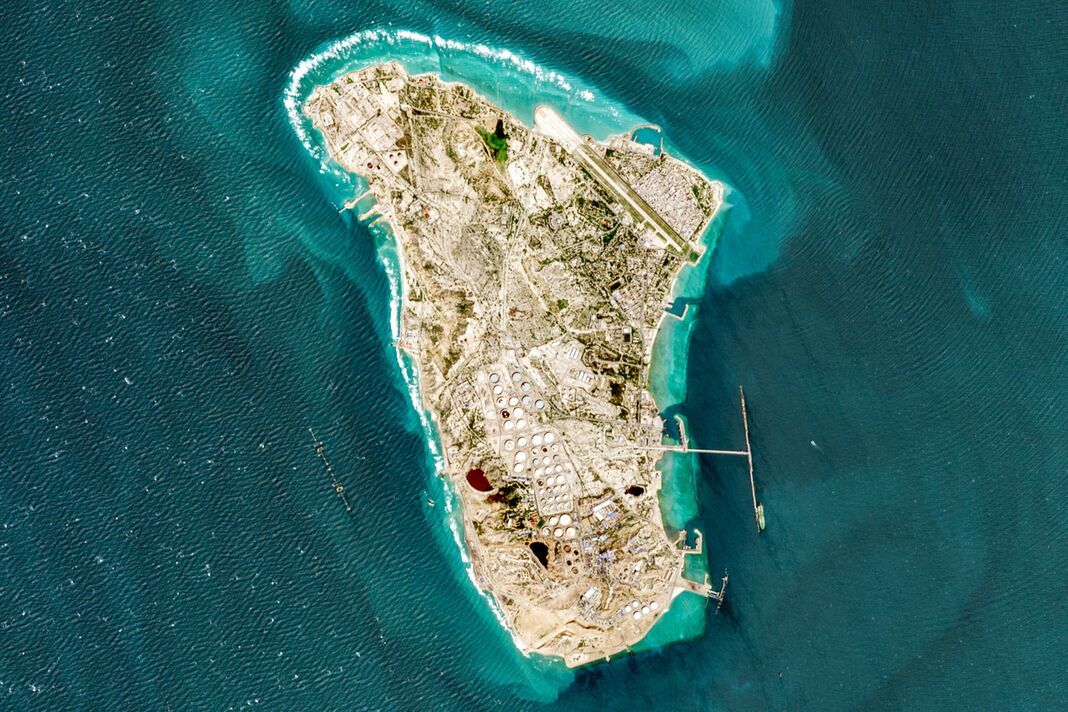
The popular Idiom : “The Cat comes out of bag” reveals the actual designs of trump by imposing illegal war on Iran . All he wants to occupy Oil reserves like he did in Venezuela.There are moments in geopolitics when a single sentence, dropped casually into a newspaper interview, reconfigures the strategic landscape. Donald Trump provided one such moment on Sunday when he told the Financial Times that his “favourite thing is to take the oil in Iran” — and that he was weighing whether to order U.S. forces to seize Kharg Island, the sun-scorched coral outcrop in the northern Persian Gulf that serves as the beating heart of the Islamic Republic’s petrostate economy.

“To be honest with you, my favourite thing is to take the oil in Iran, but some stupid people back in the US say: ‘why are you doing that?’ But they’re stupid people,” Trump told the newspaper. When pressed on whether U.S. forces might seize the island, he replied: “Maybe we take Kharg Island, maybe we don’t. We have a lot of options.” CNN

The markets did not wait for clarification. May futures for Brent crude rose over 3.2% to $116.12 per barrel during early Asia hours, with the international benchmark heading for a record monthly jump, while U.S. West Texas Intermediate futures gained 3.4% to $102.9ba6 per barrel. CNBC The words of one man in an Oval Office interview had, within hours, threatened to reroute the global economy.

The Island That Runs an Empire

To understand why Trump’s remarks triggered such alarm, one must first appreciate the extraordinary concentration of strategic value contained within nine square miles of Persian Gulf coral.

Around 96% of Iran’s crude exports pass through Kharg, making it one of the most concentrated oil-export chokepoints in the world. Over the past year Iran exported about 1.64 million barrels per day of crude, roughly 1.577 million bpd of which departed from Kharg’s terminals. The terminal can theoretically load up to 5 million bpd, far above current export levels. The island also hosts 55 storage tanks capable of holding about 34 million barrels of crude. Iranopendata

Kharg Island lies in the northern Middle East Gulf, around 25 km off Iran’s coast and more than 480 km northwest of the Strait of Hormuz. Its importance begins with geography. Much of Iran’s coastline is too shallow for the world’s largest tankers, but Kharg is surrounded by naturally deep water, allowing Very Large Crude Carriers to berth directly and load cargoes of up to roughly two million barrels. Kpler

This is not merely infrastructure. It is the fiscal spine of the Iranian state. Disrupt Kharg, and you do not merely inconvenience Tehran — you amputate its primary source of hard currency. Iran has spent decades and billions of dollars attempting to build alternatives, but as Kpler data confirms, the Jask terminal’s effective capacity is widely estimated at closer to 0.3 million barrels per day, with historically low utilization. By comparison, Kharg alone has historically exported around 1.5 to 2.0 million barrels per day. Kpler

The island’s vulnerability was not lost on Iran either. During the 15 to 20 February period before hostilities commenced, Iran increased its oil export to three times its normal rate and reduced oil storage — probably in anticipation of an attack. Wikipedia A regime that had spent years insisting Kharg was inviolable was hedging in ways that suggested otherwise.

The Venezuela Parallel — and Its Limits

Trump’s framing of the Kharg question is revealing. He likened the potential move to the U.S. ambitions to control Venezuela’s oil industry following the capture of its leader Nicolás Maduro in January. CNN The comparison illuminates both the president’s strategic logic and its considerable weaknesses.

Venezuela’s oil infrastructure was seized after a regime change that unfolded largely through domestic political collapse, accelerated by economic strangulation. Iran is a different proposition entirely. It is a sovereign state with a standing military, substantial missile and drone arsenals, and — crucially — geography that does not afford the United States the luxury of standoff control. Kharg Island sits within range of Iranian rocket artillery and short-range ballistic missiles. Unlike Venezuela’s Maracaibo Basin, it is embedded within a conflict zone where Iranian forces retain the capacity to strike daily.

Real dangers to the troops would come after the initial invasion. Iran would turn the U.S. presence on the key island into a priority target and focus its firepower there. Iran has been hit hard, but still retains the ability to fire drones and missiles, including daily barrages at Israel and the UAE. Unlike Israel, Kharg is in range of Iranian rocket artillery, as well as multiple types of suicide drones. The Times of Israel

Trump acknowledged this arithmetic only obliquely: “It would also mean we had to be there [in Kharg Island] for a while,” CNBC he told the FT — a rare concession that even optimistic scenarios involve an extended, contested occupation of hostile territory deep in the Persian Gulf.

The Military Backdrop: Strikes, Troops, and Escalating Posture

Trump’s remarks do not emerge from a vacuum of rhetorical speculation. They land in a conflict that is now in its fifth week and has already made Kharg Island a theatre of direct U.S. military action.

The United States on March 14 targeted military assets on Kharg Island as part of a broader campaign aimed at protecting maritime traffic in the Strait of Hormuz. U.S. Central Command said American forces struck military targets on the island while deliberately avoiding its oil infrastructure. “Moments ago, at my direction, the United States Central Command executed one of the most powerful bombing raids in the history of the Middle East and totally obliterated every military target in Iran’s crown jewel, Kharg Island,” Trump wrote in a post on Truth Social. Iran International

The deliberate sparing of oil infrastructure was itself a message — one that Trump has now placed under explicit review. “Should Iran, or anyone else, do anything to interfere with the free and safe passage of ships through the Strait of Hormuz, I will immediately reconsider this decision,” he wrote at the time. Iran International

The troop posture reinforces the strategic intent. The Washington Post reported that the Pentagon was preparing for weeks of potential ground conflict in Iran with around 3,500 troops arriving in the region on Friday, while thousands of soldiers from the 82nd Airborne Division have also been ordered to support the war effort. CNBC An amphibious assault team arrived in the Persian Gulf on Saturday. The combination of airborne and marine assets in the region is precisely the force package one would assemble to secure and hold a fortified island.

Three Scenarios the Market Is Now Pricing

Analysts surveying the current landscape have begun structuring their outlook around three distinct trajectories, each with materially different energy-market implications:

  • Scenario A — Negotiated settlement: Parallel diplomatic efforts, notably Pakistan’s offer to host talks, produce a ceasefire framework. Trump told reporters aboard Air Force One that Iran had agreed to “most of” the 15-point list of demands conveyed via Pakistan to end the war, adding: “They’re agreeing with us on the plan.” CNN In this scenario, Kharg Island serves as a pressure lever rather than an occupation target; oil recedes toward the $90 range. Probability: rising but fragile.
  • Scenario B — Blockade or encirclement: U.S. naval forces impose a maritime cordon around Kharg without a physical landing, severing Iranian oil exports through economic rather than military occupation. This hedges U.S. casualty risk while achieving the fiscal strangulation objective, though it invites Iranian retaliation against Gulf energy infrastructure and risks a protracted naval standoff.
  • Scenario C — Physical seizure: American marines and paratroopers land on Kharg Island, securing the oil terminal under U.S. military administration. This is Trump’s stated preference. Such an attempt would likely require a ground troop operation, and an attack would also likely prompt further energy market volatility at a time when oil prices have soared to nearly $120 a barrel. CNBC In the worst-case variant, Iranian retaliation extends to Saudi Arabia’s Ras Tanura and Abu Dhabi’s Fujairah terminals, removing a combined 15 to 20 million barrels per day from global supply and triggering recession conditions across import-dependent economies.

The Hormuz Dimension

Any analysis of Kharg Island must account for the Strait of Hormuz, the nautical bottleneck whose closure has already inflicted severe damage on global energy flows since the war began in late February.

Before the disruption, about 14.7 million bpd of crude and 4.8 million bpd of petroleum products moved through the strait each day. Energy prices have surged roughly 30%, pushing oil above $100 per barrel. The ripple effects extend beyond crude: Qatar has halted exports of roughly 330 million cubic metres of LNG per day, about one-fifth of global liquefied natural gas trade. Iranopendata

Iran’s naval doctrine emphasizes the use of asymmetric tactics, including naval mines, fast-attack boats and anti-ship missiles. Iran is believed to possess between 2,000 and 6,000 naval mines. Even a limited number could disrupt maritime traffic in the narrow waterway. Iran International

The seizure of Kharg Island is, in part, Trump’s proposed solution to the Hormuz problem: occupy the oil infrastructure Iran uses to fund its naval doctrine, and the regime’s capacity to sustain a blockade erodes. The logic is not without merit — but it rests on the assumption that an occupied Kharg would remain operational. That assumption is far from guaranteed. JPMorgan’s commodities research team found it likely that an attack on Kharg Island could trigger retaliation in the Strait of Hormuz or against major regional energy facilities, including Saudi Arabia’s Ras Tanura, the Abqaiq processing facility, and the UAE’s Fujairah. Euronews

Expert Perspectives: A Divided Strategic Community

The analyst community reflects the genuine strategic ambiguity of the moment.

Senator Lindsey Graham, a Republican influential in guiding Trump’s policy on Iran, argued that controlling the island could shorten the war. “Seldom in warfare does an enemy provide you a single target like Kharg Island that could dramatically alter the outcome of the conflict,” he wrote on X. Time

Former Israeli defence minister Yoav Gallant was equally direct. “On the strategic chessboard of this war, Kharg Island is the next piece,” he wrote. “It may be the move that decides the conflict. If it is going to be made, it must be made now.” The Times of Israel

But seasoned military and energy analysts are considerably more cautious. Marc Gustafson, former head of the White House Situation Room who served under presidents Trump, Biden and Obama, acknowledged that Trump may be tempted by the opportunity to claim a “big PR win” and give U.S. troops a natural barrier from mainland Iran, but this must be weighed against force protection risks. CNBC

Jan van Eck, CEO of VanEck Funds, had earlier offered a prescient framing of the strategic calculus: “It’s where 90% of Iran’s oil gets exported out of — that is a choke point. And if you think that Trump just follows the same playbook that he did in Venezuela — he cut off their oil exports, their hard currency, and I think he is going to want that leverage point going forward.” CNBC

The critical distinction, however, is one of sequencing. Richard Goldberg of the Foundation for Defense of Democracies offered a pointed qualifier: “If you could actually deny them that oil export, it would likely mean we’ve so degraded the regime’s threat capacity that we don’t fear for our own force protection whether on or near Kharg.” The Times of Israel The question, in other words, is not whether Kharg is a prize worth having — it manifestly is — but whether the conditions for holding it can be created before the attempt is made.

The Wider Regional Fragmentation

Iran has not stood still while these calculations are being made in Washington. As hostilities continue for a fifth week, Tehran has escalated attacks on Gulf energy and civilian infrastructure, with a service building at a power generation and water desalination plant in Kuwait damaged Sunday evening, killing one worker. CNBC The Houthi rebels in Yemen formally entered the conflict over the weekend, adding another axis of missile and drone pressure. Oil prices surged to about $115 a barrel after Iranian media reported a suspected US-Israeli strike on the Tabriz Petrochemical Company in northwestern Iran on Monday. RT International

Meanwhile, analysts warned that the most significant risk remains broader escalation targeting energy infrastructure across the region, with particular concern about attacks on Saudi Arabia’s East-West pipeline and the UAE’s Abu Dhabi crude oil pipeline, both of which are being used to re-route oil flows disrupted by the Strait of Hormuz’s closure. Euronews

The global macroeconomic implications are no longer hypothetical. Asian equities fell sharply on Monday morning. LNG-dependent economies in South Korea, Japan, and Taiwan face acute near-term supply deficits. European energy ministers convened emergency calls. The economic impact of a prolonged U.S. seizure of Iran’s oil terminal — combined with the pre-existing Hormuz disruption — would constitute the most severe peacetime energy shock since the 1973 Arab oil embargo, and arguably surpass it in duration and geographic scope.

Historical Echoes: Oil as the Currency of Power

Trump’s instinct to “take the oil” is neither new nor confined to Iran. It reflects a persistent thread in his strategic worldview — one that treats energy infrastructure as sovereign collateral in the service of American power projection.

He made similar arguments about Iraqi oil during both his 2016 campaign and first term. He framed the Venezuela intervention in part through the lens of oil control. The difference in 2026 is that, for the first time, the rhetorical posture has been coupled with deployed military assets, live combat operations against Kharg’s military facilities, and an explicit public statement of preference — delivered not on a rally stage but to the Financial Times.

That distinction matters. Presidents who tell the Financial Times what they “really want” to do are rarely speaking entirely off the cuff.

Conclusion: The Most Consequential Nine Square Miles on Earth

Kharg Island has occupied a unique position in the geography of global energy since the 1960s, when Mohammad Reza Shah partnered with American oil companies to transform a coral outcrop into the engine of Iran’s petrostate. It has survived the Iran-Iraq War, international sanctions, and decades of strategic calculation by adversaries who understood that destroying it would inflict more pain on global markets than on Tehran alone.

It now confronts an entirely new category of threat: not destruction, but seizure. A U.S. president publicly stated that taking it is his “favourite option.” Whether that preference translates into orders depends on the outcome of parallel diplomatic tracks, the resilience of Tehran’s negotiating position, and the tolerance of American allies for a ground operation that could, depending on Iranian retaliation, spiral into the most consequential regional conflict since the Second World War.

What is already beyond doubt is the economic verdict. Oil above $116 a barrel, LNG flows disrupted, a Strait effectively closed to commercial traffic — these are not hypothetical stress tests. They are today’s reality. The decision on Kharg Island will determine whether they become tomorrow’s starting point.

The stakes, as Trump himself might say, are very, very big.

References

Euronews Business. (2026, March 16). Explainer: Why Kharg Island is vital to Iran and the global economy. Euronews. https://www.euronews.com/business/2026/03/16/explainer-why-kharg-island-is-vital-to-iran-and-the-global-economy

Financial Times. (2026, March 30). Trump says US could ‘take the oil in Iran’ as president eyes Kharg Island. Financial Times. https://www.ft.com/content/3bd9fb6c-2985-4d24-b86b-23b7884031f5

Kpler. (2026). Explainer: Why Kharg Island is the backbone of Iran’s oil economy — and its greatest vulnerability. Kpler Intelligence. https://www.kpler.com/blog/explainer-why-kharg-island-is-the-backbone-of-irans-oil-economy—and-its-greatest-vulnerability

CNBC. (2026, March 9). Iran war, US-Israel conflict, oil prices and Kharg Island. CNBC. https://www.cnbc.com/2026/03/09/iran-war-us-israel-conflict-oil-prices-kharg-island.html

Times of Israel. (2026). Taking Kharg Island is seen as key to opening Hormuz — there are better options. The Times of Israel. https://www.timesofisrael.com/taking-kharg-island-is-seen-as-key-to-opening-hormuz-there-are-better-options/

Washington Post. (2026, March 30). Iran-US-Israel conflict: Trump, Lebanon, latest updates — March 30, 2026. The Washington Post. https://www.washingtonpost.com/business/2026/03/30/iran-us-israel-trump-lebanon-march-30-2026/


Discover more from The Economy

Subscribe to get the latest posts sent to your email.

Analysis

One year of Trump tariffs: What has changed and what’s next for South-east Asia?

Published

on

Nguyen Thi Lan still remembers the WhatsApp messages that flooded her factory floor in Bac Ninh on the morning of April 3, 2025. The production manager at a Foxconn supplier had stayed up watching the “Liberation Day” announcement from Washington—and by dawn, she was fielding panicked calls from buyers in Texas who wanted to know whether to rush their orders before new tariffs hit. Within seventy-two hours, her factory was running double shifts. Twelve months later, that same plant exported more electronics than ever before. Her story, repeated across thousands of workshops from Hanoi to Ho Chi Minh City, encapsulates the central paradox of one year of Trump tariffs on South-east Asia: a region initially earmarked for punishment has, in many respects, survived—and in some corners, even thrived.

But survival is not the same as security. Twelve months on from Liberation Day, the landscape for Trump tariffs in South-east Asia has been permanently altered by front-loaded shipments, bilateral deal-making, a landmark Supreme Court ruling, and now a fresh wave of legal uncertainty. The full reckoning is still unfolding—and what comes next may be more consequential than the original shock.

The Initial Shock: Liberation Day Hits ASEAN Where It Hurts

On April 2, 2025, President Donald Trump invoked the International Emergency Economic Powers Act (IEEPA) to impose a 10% baseline tariff on most US imports, layered with country-specific “reciprocal” duties tied to bilateral trade surpluses. South-east Asia bore a disproportionate share of the pain.

The headline rates were staggering:

  • Cambodia: 49%
  • Vietnam: 46%
  • Thailand: 36%
  • Indonesia: 32%
  • Malaysia: 25%
  • Philippines: 17%
  • Singapore: 10%

For a region whose economic model is built on export-led growth and deep integration into US-bound supply chains, the numbers were existential. Vietnam’s exports to the United States had reached $136.6 billion in 2024, representing roughly 30% of its GDP. Cambodia’s garment sector, which ships nearly 40% of its textiles to American retailers, faced near-annihilation at a 49% rate. Thailand’s automotive and electronics exporters confronted the steepest competitive shock in a generation.

The CSIS Southeast Asia programme noted that Vietnam, Indonesia, Thailand, and Cambodia were among the first governments to reach out to Washington after the announcement, reflecting acute exposure rather than diplomatic formality. ASEAN’s collective response was muted—Malaysian Prime Minister Anwar Ibrahim urged a unified bloc response, but cohesion proved elusive when every nation was simultaneously scrambling for bilateral favours.

How South-east Asia Weathered the Storm

The region’s initial survival relied on four mechanisms that, taken together, blunted the sharpest edges of the tariff regime.

Front-loading and shipment surges were the first reflex. US importers, facing an April 9 implementation date on the reciprocal tariffs, accelerated orders en masse. Vietnam’s Hai Phong port logged record throughput in Q2 2025. According to PwC’s Vietnam economic update, total exports grew by approximately 16% in the first nine months of 2025, led by electronics, computers and components—up 46% year-on-year—with the US accounting for roughly 32% of total exports throughout. Some of this was inventory stuffing; buyers pulled forward months of orders to beat the tariff clock. It worked—temporarily.

The ninety-day pause bought critical breathing room. Within a week of Liberation Day, Trump suspended the reciprocal tariffs after claiming over 75 countries had sought negotiations. That window became the region’s dealmaking season.

Sector exemptions provided a structural lifeline, especially for technology. Under heavy lobbying from Apple, Nvidia, and other US tech giants, consumer electronics—including laptops, smartphones and components—were carved out of the reciprocal tariff regime. This was quietly transformative for Malaysia and Vietnam, where semiconductor and electronics exports constitute the bulk of trade flows. The Lowy Institute estimates that Malaysia’s effective US tariff rate in late 2025 was approximately 11%—far below its headline 19% rate—precisely because electronics, its dominant export, remained largely exempt.

Bilateral deals followed in rapid succession. By October 2025, the US had announced trade agreements with Cambodia and Malaysia and framework deals with Thailand and Vietnam at the ASEAN summit. These deals collectively covered approximately $323 billion in US-ASEAN trade—about 68% of the two-way total. The resulting tariff rates, 19% for most ASEAN exporters and 20% for Vietnam, were far higher than pre-Liberation Day levels, but dramatically lower than the initial shock rates—and, critically, lower than the 145% still applied to Chinese goods.

The deals had teeth beyond tariffs. Cambodia and Malaysia agreed to adopt US tariff schedules on third countries—a thinly veiled anti-China clause. Vietnam committed to cracking down on transshipment, accepting a punitive 40% levy on goods rerouted from China. Malaysia pledged a $70 billion capital investment fund in the US and commitments to purchase $150 billion in American semiconductors, aerospace components and data centre equipment over the life of the deal.

The Supreme Court Ruling: Game Changer or New Uncertainty?

The most dramatic chapter of this twelve-month arc arrived not in a trade negotiating room but in the marble halls of the US Supreme Court.

On February 20, 2026, the Court ruled 6-3 in Learning Resources, Inc. v. Trump that IEEPA does not authorise the President to impose tariffs. Chief Justice John Roberts, writing for the majority, held that IEEPA’s authority to “regulate importation” cannot be stretched to encompass the power to tax—a power that, under the Constitution, belongs to Congress alone. “Those words,” Roberts wrote of the two clauses invoked by the administration, “cannot bear such weight.” The ruling invalidated both the reciprocal tariffs and the fentanyl-related duties on China, Canada and Mexico—the entire IEEPA-based tariff architecture.

The Court’s decision was, technically, a victory for free trade. In practice, it was a pivot, not a retreat.

Within hours, Trump signed a proclamation invoking Section 122 of the Trade Act of 1974 to impose a replacement 10% global tariff, which he raised to the statutory maximum of 15% the following day. Section 122, rarely used before this administration, authorises a temporary import surcharge of up to 15% for up to 150 days to address balance-of-payments deficits. Treasury Secretary Scott Bessent stated publicly that combining Section 122, Section 232, and Section 301 tariffs “will result in virtually unchanged tariff revenue in 2026″—an extraordinary admission that the intent was to maintain the same aggregate tax burden through different legal wrappers. The Section 122 tariffs are set to expire on July 24, 2026, unless extended by Congress.

For South-east Asia, the ruling introduced a new problem: legal fragility. Trade deals struck under the IEEPA regime now occupy uncertain territory. If the underlying executive orders were unlawful, the bilateral concessions extracted from ASEAN governments—market access commitments, anti-transshipment pledges, investment promises—rest on a legally contested foundation. Importers who paid an estimated $160–$175 billion in IEEPA tariffs over the past year are now pursuing refunds through the Court of International Trade, though the administration has signalled it does not plan to issue refunds voluntarily.

As the Peterson Institute for International Economics warned, the central challenge for businesses in 2026 is not the level of tariffs—it is their chronic instability. “Rates changed with little notice, creating planning challenges for firms managing inventory, contracts, and payroll,” PIIE analysts noted. The US average effective tariff rate climbed to nearly 17% in 2025—the highest since the early 1930s.

What Has Changed: Supply Chain Reshaping, Winners and Losers

Vietnam: The Reluctant Champion

No country in South-east Asia embodies the tariff era’s contradictions more sharply than Vietnam. Despite facing a 46% headline rate—among the steepest globally—the country’s economy grew 8.02% in 2025, its second-best performance in fifteen years. Exports to the US leapt 28% year-on-year to $153.2 billion, and its trade surplus with Washington hit a record $134 billion—higher, not lower, than before Liberation Day.

The engine of this paradox was electronics. A Bloomberg analysis of customs data published in April 2026 found that Foxconn’s Fukang Technology factory in Bac Ninh alone exported $8.6 billion in electronics—more than double its 2024 value—with most shipments being MacBooks bound for the US. Laptop output in Bac Ninh province surged 130% in 2025; smartphone production rose 39%. Vietnam had quietly surpassed neighboring Southeast Asian competitors as one of the US’s leading chip and electronics suppliers.

The caveat is profound. The same Bloomberg analysis revealed that Fukang’s exports generated only 7.8% of their value in Vietnam—the rest was imported components, primarily from China. The China+1 story is, in many cases, a China+assembly story. As ING analysts noted, imports from China into Vietnam surged 24% year-on-year in the first half of 2025, raising the spectre of rampant transshipment. The 40% tariff on Vietnamese transshipped goods is designed to address exactly this structural problem—but enforcement is technically complex and politically fraught.

Malaysia: Tech’s Safe Harbour

Malaysia’s effective tariff arithmetic worked strongly in its favour. Its headline rate of 19% masked an effective rate of roughly 11% due to electronics exemptions—and the country’s deal with Washington, anchored by that landmark $70 billion investment pledge and semiconductor purchase agreement, secured considerable market access. FDI inflows into Malaysia’s semiconductor ecosystem, already boosted by TSMC’s and Intel’s regional expansions, accelerated through 2025. The East Asia Forum noted that Malaysia’s effective tariff advantage over China has widened substantially, reinforcing its role as a chip-packaging and testing hub.

Cambodia: The Casualty

The story of Cambodia is the story the tariff triumphalists do not tell. As a garment-dominated economy with limited capacity for deals or diversification, Phnom Penh was structurally exposed. Even after negotiations brought its rate from 49% down to 19%, Cambodian textiles—unlike Vietnamese electronics—enjoy no sector exemptions and limited productivity edge. The Lowy Institute found that Chinese consumer imports into Cambodia rose by 128% as deflected Chinese goods flooded the domestic market, squeezing local producers from both directions: losing US market access at the top while competing with surging Chinese imports at the bottom.

Indonesia and Thailand: Cautious Resilience

US goods trade data shows the deficit with Indonesia rose 11% and with Thailand 23% in 2025, with US imports actually rising even under 19-20% tariffs. Indonesia’s September 2025 effective tariff rate was 19.7%—the highest among ASEAN’s five largest trading partners—because its electronics sector, smaller than Malaysia’s or Vietnam’s, captures fewer exemptions. Thailand’s effective rate was around 10%, reflecting both sector exemptions and its July 2025 deal, but automotive and industrial exporters remain squeezed.

What’s Next: The 2026 Outlook

The 150-day Section 122 tariff clock is running. It expires on July 24, 2026—and Congress, which has passed bills disapproving of the IEEPA tariffs, is unlikely to extend them. What happens after July 24 will define South-east Asia’s trade environment for years.

The Section 301 Sword

The most alarming development for the region arrived on March 11, 2026, when the US Trade Representative launched sweeping Section 301 investigations targeting 16 economies for “structural excess manufacturing capacity”. The target list reads like an ASEAN who’s who: Vietnam, Thailand, Malaysia, Cambodia, Indonesia, Singapore. Unlike Section 122, Section 301 tariffs carry no time limit and no statutory cap. They are the administration’s mechanism of choice for permanent, targeted levies—and the March investigations are almost certainly the vehicle for reimposing tariffs equivalent to the now-unlawful IEEPA rates after July.

For governments that signed bilateral deals under the IEEPA regime, this creates a Kafkaesque dilemma: they made substantial concessions in exchange for tariff relief that the Supreme Court has since voided—and they may face equivalent tariffs again through a different legal channel, without the negotiating leverage that initial shock created.

The Diversification Imperative

The one structural positive to emerge from this tumultuous year is the acceleration of diversification. The EU has concluded FTAs with Indonesia and is exploring enhanced cooperation with Malaysia, the Philippines, and Thailand. The CPTPP has expanded its footprint; Indonesia and the Philippines have applied for membership. The China-ASEAN FTA has been upgraded. These initiatives will not replace US demand in the near term—the American market’s $1+ trillion appetite for manufactured goods remains without peer—but they create structural alternatives that previous generations of ASEAN policymakers never fully developed.

The China Tilt Risk

There is also a darker possibility that few in Washington appear to be taking seriously. Every punitive measure that the US imposes on ASEAN without commensurate market access has a mirror-image effect: it pushes the region’s economic centre of gravity toward Beijing. China is already Vietnam’s largest trading partner, Malaysia’s top import source, and the primary origin of investment capital flooding into Cambodia and Myanmar. If the Section 301 investigations result in tariff rates that undo the competitive advantages ASEAN countries have spent a decade cultivating, the incentive to deepen China linkages—on infrastructure financing, digital standards, and supply chain integration—grows commensurately.

Conclusion: The Long Game Has Only Just Begun

One year of Trump tariffs has produced a South-east Asia that is, by most headline metrics, more resilient than anyone predicted in April 2025. Vietnam grew 8%, Malaysia deepened its semiconductor edge, and even Cambodia negotiated its tariff rate down by 30 percentage points. The region demonstrated formidable diplomatic agility.

But the structural uncertainties compounding through 2026—the Section 301 sword hanging over every bilateral deal, the Section 122 expiry cliff, the unresolved refund litigation, and the administration’s demonstrated willingness to use trade as a geopolitical lever for any and all foreign policy goals—mean that celebration is premature. As the Brookings Institution noted, the challenge was never just the size of the tariffs; it was the instability surrounding them that forced businesses to make hiring, pricing and investment decisions in a fog.

For South-east Asia’s policymakers, three imperatives now dominate. First: lock in trade diversification with the EU and CPTPP partners before the next tariff wave hits, reducing the region’s structural vulnerability to a single bilateral relationship. Second: invest urgently in domestic value-add capacity—Vietnam’s 7.8% local content share in its flagship electronics exports is a long-term vulnerability that no trade deal can fix. Third: present a unified ASEAN voice in the next round of Section 301 negotiations; the fragmented, each-nation-for-itself approach of 2025 produced deals of widely varying quality and left smaller economies like Cambodia badly exposed.

The Liberation Day tariffs may have been struck down by the Supreme Court. But the forces that produced them—America’s $760 billion goods trade deficit with Asia, domestic manufacturing anxieties, bipartisan economic nationalism—remain entirely intact. What’s next for South-east Asia after Trump tariffs is, ultimately, what has always been true: the region’s best defence is not diplomatic dependence on any single patron, but structural self-sufficiency that no tariff schedule can easily undo.


Key Data at a Glance (April 2026)

CountryLiberation Day RateCurrent Effective RateGDP Growth 2025Key Sector
Vietnam46%~12.7% (post-deal, 20% headline)8.02%Electronics, semiconductors
Malaysia25%~11% (exemptions)~4.5% est.Chips, manufacturing
Thailand36%~10% (exemptions)~3.2% est.Automotive, electronics
Indonesia32%~19.7%~4.8% est.Commodities, manufacturing
Cambodia49%~19%~5.1% est.Textiles, garments
Singapore10%~2.6% (FTA buffer)~3.0% est.Financial services, logistics


Discover more from The Economy

Subscribe to get the latest posts sent to your email.

Continue Reading

Analysis

KSE-100 Surges 7,500 Points as Iran War De-escalation Hopes Grip Pakistan’s Markets

Published

on

As foreign central banks dump $90 billion in US Treasuries and Brent crude convulses near $120, Islamabad’s unlikely role as peacebroker is paying an unexpected dividend on the trading floor.

There is a peculiar kind of optimism that only emerges in the eye of a hurricane. Wednesday morning at the Pakistan Stock Exchange felt exactly like that. At 12:05 p.m., the benchmark KSE-100 Index stood at 156,204.89 — having gained 7,461.58 points, or 5.02%, from the previous close — a move so violent that it triggered a mandatory market halt, suspending all equity-based trading under PSX circuit-breaker rules. ProPakistani The previous session had already closed higher. Tuesday’s KSE-100 session had ended at 148,743.32, up 1,900.34 points, as investors began pricing in whispers of a ceasefire from Washington. Profit by Pakistan Today By Wednesday noon, those whispers had become a roar.

This is not, however, a story only about Karachi. It is a story about a world economy convulsing under the weight of a war in the Persian Gulf, a $30 trillion US Treasury market being quietly liquidated by desperate central banks, and — most improbably — Pakistan sitting at the centre of the most consequential diplomatic negotiation of 2026. The KSE-100’s surge is at once a relief rally, a geopolitical signal, and a referendum on how tightly Pakistan’s financial fate is now knotted to its new role as peacebroker between Washington and Tehran.

Why Karachi Erupted: The Anatomy of a 5% Day

Buying momentum on Wednesday was broad-based, with strong activity across automobile assemblers, cement, commercial banks, fertiliser, oil and gas exploration, oil marketing companies, and power generation firms. Major index-heavyweights — HBL, MCB, MEBL, UBL, MARI, OGDC, PPL, POL, PSO, HUBCO, and ARL — all traded firmly in the green, reflecting renewed investor confidence amid easing geopolitical risk. ProPakistani

The rally follows emerging hopes of de-escalation in the Iran war after US President Donald Trump and Secretary of State Marco Rubio signalled that the conflict could end soon, with Washington indicating potential direct talks with Tehran’s leadership and a winding down of hostilities even without a formal deal. Profit by Pakistan Today Trump, speaking from the White House on Tuesday, said the US exit could come “within two weeks, maybe two or three.”

The market context matters enormously here. The rebound follows a brutal first-quarter correction, during which the Pakistan Stock Exchange benchmark declined around 15% amid geopolitical uncertainty and relentless selling pressure. Profit by Pakistan Today That selloff was not irrational. Pakistan’s economy is structurally exposed to Middle East energy prices — the country imports the overwhelming majority of its oil and LNG, and any sustained spike in Brent crude flows directly into inflation, the current account deficit, and State Bank of Pakistan reserves. When the war began on February 28, the PSX reacted the way a patient loses colour when told bad news: quickly, and all at once.

Wednesday’s reversal tells a different story. It tells you that the market had been pricing in far worse than what may now materialise. It tells you that institutional and retail buyers in Karachi, Lahore, and Islamabad are not just trading geopolitics abstractly — they are trading Pakistan’s specific role in ending this crisis.

The $90 Billion Treasury Liquidation: A Slow-Motion Earthquake Under Bond Markets

While traders in Karachi were celebrating, bond desks in New York, London, and Tokyo were navigating something far more structurally significant. New York Fed custody data shows that since the week before the conflict broke out — the week of February 25 — foreign monetary authorities have been net sellers of US Treasuries for five consecutive weeks, with the total sell-off exceeding $90 billion, and holdings falling to the lowest level since 2012. All-Weather Media

The Financial Times, citing Federal Reserve data, confirmed that the value of Treasuries held in custody at the New York Fed by official institutions — a group largely made up of central banks but also including governments and international institutions — has dropped by $82 billion since February 25 to $2.7 trillion. X

The mechanics driving this sell-off are not mysterious, even if their consequences are underappreciated. The direct cause of this round of selling is the urgent need for dollar liquidity among countries — from foreign exchange market intervention to paying energy import bills and financing defense spending, the surge in demand for dollars is forcing foreign central banks to liquidate their most liquid dollar assets: US Treasuries. Futu News

The single most striking data point in the disaggregated country-level picture is Turkey’s. Official figures show that since February 27 — the day before the US attacked Iran — Turkey’s central bank sold about $22 billion in foreign government bonds from its reserves, mainly US Treasuries. Turkey also sold or swapped about 58 tons of gold valued at over $8 billion. All-Weather Media

Brad Setser, Senior Fellow at the Council on Foreign Relations and arguably the world’s foremost tracker of sovereign reserve flows, has been clear about who else is in the queue. Setser stated that “many countries are unwilling to let their currencies depreciate further, as this would drive up oil prices denominated in local currencies — either implying more fiscal subsidies or increasing the burden on people’s daily lives. Therefore, many countries have generally decided to intervene in the foreign exchange market to try to limit the depreciation of their currencies.” Futu News India and Thailand, both large oil importers, have also seen foreign reserve drawdowns since the war began, though it remains unclear whether those represent outright Treasury sales or dollar deposit liquidations.

Bank of America US rates strategist Meghan Swiber has been unambiguous: the foreign official sector is selling US Treasuries, and the selling “confirms a more macro narrative — that foreign reserve managers and official accounts are diversifying away from US Treasuries.” All-Weather Media

The structural backdrop is equally sobering. A recent Morgan Stanley report shows the proportion of US Treasuries held by foreign investors has dropped to its lowest since 1997, with the share of coupon-bearing Treasuries held by foreign investors falling steadily since the 2008 peak of 64.4% and now near multi-decade lows. All-Weather Media The Iran war has not created this trend — but it has violently accelerated it. As the Financial Times reported on Tuesday, the bond market’s largest and most stable category of buyer is now, in a period of maximum global stress, a net seller.

This matters for Pakistan in a roundabout but real way. Higher US Treasury yields — the mathematical consequence of this selling pressure — tighten global dollar funding conditions, increase the cost of Pakistan’s external debt servicing, and strengthen the dollar in ways that amplify imported inflation. A faster resolution to the Iran conflict is, in this sense, not just a geopolitical good but a financial one for Islamabad.

The Strait, the Shock, and the Oil Market Nobody Saw Coming

The International Energy Agency has called it the biggest oil supply shock in history. Due to Iran’s selective blockade of the Strait of Hormuz, the world is losing as much as 20 million barrels of oil per day from Middle East producers. Since the war began five weeks ago, Brent crude has risen more than 50%. CNN

Brent crude was trading at just over $118 per barrel for May deliveries, while the more widely traded June delivery contract was around $103.50. The average price of gasoline in the United States crossed $4 per gallon for the first time since 2022. CBS News For emerging markets that import most of their energy, these numbers translate into something far more corrosive than headline inconvenience: they represent a structural transfer of wealth from oil-importing nations to a geopolitical standoff, mediated by a narrow chokepoint 21 miles wide at its narrowest point.

The Wall Street Journal, citing administration officials, reported that Trump and his aides had concluded that a military mission to reopen the Strait of Hormuz would extend beyond his four-to-six-week timeline, and he had decided to focus on targeting Iran’s missiles and navy before seeking to pressure Iran diplomatically to reopen it. Euronews

That shift — from military maximalism to diplomatic realism — is precisely what equity markets in Karachi, and indeed across emerging Asia, have been waiting for.

Pakistan’s Diplomatic Dividend: The Unlikely Peacebroker

The most remarkable subplot of this crisis is not the Treasury sell-off, nor the oil price spike. It is Islamabad’s transformation, over the past two weeks, from a country wracked by internal protests over the US strikes on Iran into a credible diplomatic interlocutor between Washington and Tehran.

Pakistan’s Foreign Minister Ishaq Dar confirmed that “US-Iran indirect talks are taking place through messages being relayed by Pakistan,” adding that Turkey and Egypt were also extending support to the initiative. US envoy Steve Witkoff confirmed presenting a 15-point action list as the framework for a peace deal, which mediator Pakistan gave to Iran. NPR President Trump then paused his deadline for the destruction of Iran’s energy plants by ten days to April 6, citing the ongoing talks. Special envoy Steve Witkoff confirmed at President Trump’s Cabinet meeting that the US has been negotiating with Iran through diplomatic channels with Pakistan as the conduit. CNN

Foreign Policy has described this as a role that makes more geopolitical sense than it initially appears. Pakistan is a rare country that has warm ties with both the United States and Iran and is engaged with the highest levels of both governments. Pakistan also represents Tehran’s diplomatic interests in Washington. Furthermore, Pakistan has dealt closely with the family of a key player on the US side — Middle East envoy Steve Witkoff. Foreign Policy

The domestic calculus is equally clear: Pakistan’s mediation push is driven by economic strain, security concerns, and strategic calculation. With energy markets volatile and the country reliant on Gulf oil and LNG imports, any sustained spike in global crude prices could deepen a crisis Pakistan can ill afford. Pakistan’s fragile economic recovery is under renewed stress, with constrained fiscal space and minimal strategic oil reserves. The Researchers

The PSX’s 7,500-point single-session surge is, in a narrow sense, investors pricing in the probability that Pakistan’s diplomatic gamble pays off. A ceasefire, even an imperfect one, would lower oil prices, ease imported inflation, reduce pressure on State Bank of Pakistan foreign reserves, and reopen the possibility of further monetary easing by the SBP — all of which are bullish for Pakistani equities.

Risks: The Rally Is Real, But the Ceasefire Isn’t — Yet

Markets have a well-documented habit of pricing in peace talks before those talks produce peace. The KSE-100’s gain on Wednesday is a bet, not a receipt.

Several credible risks remain. Iran has countered the US 15-point plan with its own five conditions, including recognition of Iran’s legitimate rights, payment of war reparations, and firm international guarantees against future aggression. Al Jazeera Those are not trivial demands from a country that has seen its Supreme Leader killed and its military infrastructure methodically dismantled. Ending the war with Iran retaining effective control of the Strait of Hormuz would be seen internationally as a strategic defeat for the United States — Iran would claim victory and might monetize its position by imposing tolls on transiting tankers, providing revenues to rebuild its military and nuclear programmes. CNN

Secretary of State Rubio has been clearer on the endgame than almost anyone. Rubio told Al Jazeera that “the Strait of Hormuz will be open when this operation is over — one way or another,” and rejected Iran’s demand to maintain sovereignty over the waterway as part of any agreement. Al Jazeera That language, while reassuring to oil markets in the abstract, leaves significant space for a breakdown in negotiations — and a resumption of exactly the kind of escalatory cycle that sent the KSE-100 down 15% in the first quarter.

Oil market participants appear to be processing this nuance already. Bond yields have been steadily rising throughout March as investors race to reprice the chances of rate hikes from central banks, with expectations of rate cuts at the Federal Reserve and the Bank of England having fallen sharply and in many cases being replaced by anticipations of hawkish monetary policy. CNBC That global repricing of central bank paths — driven directly by energy-led inflation — is a structural headwind for emerging market assets, Pakistan included, that does not disappear even if a ceasefire is signed.

Global Macro Implications: When the World’s Safe Asset Isn’t Safe Enough

Beneath the headline drama of the oil price spike and the stock market surge, the most consequential development of this crisis may be the one attracting the least retail attention: the systematic erosion of US Treasury demand at precisely the moment that Washington’s finances require it most.

Stephen Jones, Chief Investment Officer at Aegon Asset Management, described central banks’ actions as countries “raising war funds,” saying, “They are drawing on emergency reserves.” This round of selling is not an isolated event but a microcosm of a longer-term structural shift: global reserve management institutions are systematically reducing exposure to dollar assets. All-Weather Media

If the Iran conflict ends quickly, some of this pressure on the Treasury market will ease. Central banks in Turkey, India, and Thailand that have been intervening in FX markets to defend their currencies will face less pressure to continue liquidating reserves once oil prices fall. That normalisation would provide some relief to US bond yields. But the structural share of foreign holdings — already at a 27-year low — is not a tap that turns back on quickly. The trend that the war has accelerated was years in the making.

For Pakistan’s capital markets, the near-term playbook favours the bulls — as long as the diplomatic process holds. A ceasefire, lower Brent crude, a softer dollar, and resumed SBP rate cuts would be a nearly perfect cocktail for further PSX gains. The index, even after Wednesday’s surge, remains roughly 18% below its all-time high of approximately 189,556 points reached in January 2026. There is significant mean-reversion potential if geopolitical risk genuinely abates.

Outlook: Watch April 6 — and the Address to the Nation

The immediate calendar is unusually consequential. President Trump is scheduled to deliver a prime-time address to the nation on Wednesday evening providing what the White House described as “an important update on Iran.” The April 6 deadline for Iran to reopen the Strait of Hormuz — or face strikes on its energy infrastructure — creates a hard binary. Either the diplomatic track delivers a meaningful framework before that date, or markets face the prospect of a sharp escalatory spike.

Secretary of State Rubio, before departing for a G7 foreign ministers meeting in France, confirmed that “there are intermediary countries that are passing messages and progress has been made — some concrete progress has been made,” describing negotiations as “an ongoing and fluid process.” CNN

For investors in Karachi and beyond, the single most important watch item is not the KSE-100 level, nor the US Treasury yield, nor even Brent crude. It is whether Pakistan’s mediation — this extraordinary diplomatic intervention by a country whose consulate in its own largest city was attacked just a month ago — delivers enough of a framework before April 6 to allow both sides to step back from the precipice.

If it does, Wednesday’s 7,500-point surge will look, in hindsight, like the opening chapter of a recovery story rather than a false dawn in a prolonged storm. If it doesn’t, the circuit-breaker that paused trading on Wednesday could, in the weeks ahead, be pointing in the other direction.

Pakistan has been here before — not as a victim of great-power competition, but as its unexpected architect. It was Islamabad that facilitated Nixon’s 1971 opening to China. It may yet be Islamabad that writes the first line of a postwar order in the Persian Gulf. The KSE-100, for one day at least, has decided to believe it.


Discover more from The Economy

Subscribe to get the latest posts sent to your email.

Continue Reading

Analysis

Foreign Central Banks Are Dumping US Treasuries in the Wake of the Iran War

Published

on

The $82 billion exodus from America’s debt market signals more than wartime liquidity stress — it may mark the beginning of a structural reckoning for the dollar’s exorbitant privilege.

As oil prices pierced $110 a barrel and Iran’s blockade of the Strait of Hormuz choked the arteries of global energy trade, something quieter — and potentially more consequential — was unfolding in the marble-floored corridors of the New York Federal Reserve. Foreign central banks were liquidating American debt at the fastest pace in more than a decade.

Federal Reserve custody data shows that holdings of US Treasuries by foreign official institutions at the New York Fed have plunged by $82 billion since February 25, collapsing to $2.7 trillion — the lowest level since 2012. All-Weather Media The timing is not coincidental. The sell-off began almost precisely as the first missiles fell on Iranian soil, and it has accelerated with every week of conflict that grinds on. What began as a wartime liquidity scramble now carries the contours of a deeper structural shift — one that has economists in Frankfurt, Washington, and Beijing quietly updating their long-term models.

This is not merely a story about bond markets under pressure. It is a story about the foundations of American financial power.

The Mechanics of a Wartime Sell-Off

To understand why central banks are selling Treasuries into a crisis that would historically have driven buying, one must follow the energy channel rather than the geopolitical headline.

After Iran blocked the Strait of Hormuz, global oil prices soared, and oil-importing countries were hit hardest. Foreign exchange reserves shrank passively, combined with the need to intervene in currency markets, prompting central banks in many countries to accelerate the liquidation of US Treasuries. All-Weather Media

The logic is grimly circular. An oil-importing nation — say, India or Thailand — suddenly faces a surging import bill denominated entirely in dollars. Its currency weakens under the pressure of that trade shock. To defend the exchange rate and prevent a domestic inflationary spiral, the central bank must sell dollar assets to buy its own currency. The most liquid, deep dollar asset most central banks hold? US Treasuries. Brad Setser, senior fellow at the Council on Foreign Relations, pointed out that Turkey, India, Thailand, and other oil-importing countries are likely the main participants in this round of selling, because these countries must pay higher oil prices in dollars. All-Weather Media

Meghan Swiber, US rate strategist at Bank of America, confirmed the dynamic bluntly: “Foreign official institutions are selling US Treasuries.” All-Weather Media

The distinction that animates debate among market participants is whether this selling is passive — a mechanical consequence of reserve depletion — or active, reflecting a more deliberate choice to reduce dollar exposure. Stephen Jones, Chief Investment Officer at Aegon Asset Management, described the selling as countries “raising war funds,” saying, “They are drawing on emergency reserves.” All-Weather Media In practice, it is likely both, and the combination is what makes the current episode remarkable.

The Scale of It: A Data Table in Words

The numbers are stark and merit clear articulation.

Official data shows that since February 27 — the day before Iran was attacked — the Turkish central bank alone has sold $22 billion in foreign government bonds from its foreign reserves. All-Weather Media Turkey, battling a persistently weak lira and an energy import dependency that leaves it acutely exposed to oil shocks, has been the most aggressive seller. But it is hardly alone.

Independent data from the central banks of Thailand and India also show that both countries’ foreign exchange reserves have declined after the outbreak of the conflict. All-Weather Media Whether the drawdown came from Treasuries specifically or dollar deposits held elsewhere remains partially unclear, but the directional signal is unambiguous: oil importers across Asia and the emerging world are under intense balance-of-payments stress.

At the other end of the oil equation, Gulf exporters face a different calculus. Saudi Arabia held $149.5 billion in US Treasuries as of December 2025. The Gulf states collectively maintain over $2 trillion in dollar-denominated assets. Saudi Arabia, the UAE, Kuwait, Qatar, and Bahrain all peg their currencies to the US dollar, requiring them to keep vast amounts of dollars to support that peg and, in doing so, help sustain Treasury demand. Middle East Eye Their behavior in the weeks ahead — whether they hold, or quietly reduce — will be among the most consequential signals to watch in global bond markets.

Yields Surge: America’s Borrowing Costs Bite Back

The sell-off is not happening in a vacuum. It is coinciding with — and amplifying — a broader repricing of US government debt that has unsettled investors and policymakers alike.

The 10-year US Treasury yield has risen from around 3.9% to a peak of 4.4%, while the 2-year yield climbed from 3.35% to above 4% — both hitting eight-month highs. Euronews That may not sound catastrophic in isolation, but it arrives against a backdrop of acute fiscal vulnerability. The US national debt crossed $39 trillion on March 18, 2026 — a milestone reached just weeks into the war in Iran — with interest costs projected to become the fastest-growing line item in the federal budget, after credit downgrades from all three major ratings agencies. Fortune

RSM Chief Economist Joseph Brusuelas captured the market’s collective anxiety: “The US Treasury bond market has finally responded to the Mideast war, giving its assessment of the energy shock’s severity and the war’s effect on US fiscal imbalance and inflation.” The MOVE index, which tracks volatility in the Treasury market, has spiked to levels consistent with price instability and policy dysfunction. Fortune

BCA Research’s Chief Fixed Income Strategist Robert Timper has characterized the pattern as “aggressive bear flattening of yield curves,” reflecting a hawkish monetary policy repricing in response to inflation fears stemming from the Iran war. Euronews On a conventional reading, this is stagflationary: energy-driven inflation pushes short-term rates higher even as growth expectations deteriorate. The Fed, caught between an oil shock and a slowing labor market, finds itself precisely where it least wants to be — with no clean policy option.

Central banks are concerned that another inflation shock, even if caused by a temporary spike in oil, might convince consumers and businesses that inflation is going to be high for a long time. Marketplace The confidence channel, in other words, may matter as much as the oil price level itself.

The Petrodollar’s Perfect Storm

Here is where the analysis shifts from cyclical to structural — and where the Iran conflict becomes geopolitically transformative rather than merely disruptive.

Deutsche Bank FX strategist Mallika Sachdeva has argued that the conflict could be remembered as a key catalyst for “erosion in petrodollar dominance, and the beginnings of the petroyuan.” CNBC That is a remarkable sentence to see in a research note from a major Western bank, and it demands unpacking.

The petrodollar system — born from a secret 1974 agreement between the US and Saudi Arabia — is elegantly simple in its design. Riyadh agreed to price its oil exports in dollars and invest its petroleum windfalls into US Treasuries; in return, Washington provided military protection and security guarantees for Gulf infrastructure. Other OPEC members followed, locking the dollar in as the indispensable currency of the modern world. Fortune That recycling loop allowed Washington to borrow cheaply, run persistent deficits, and still command the world’s reserve currency — what the French famously called America’s “exorbitant privilege.”

The Iran war has directly challenged every pillar of that arrangement. US military assets and bases in the Gulf have come under attack. Oil infrastructure in the Gulf has been hit. And the US ability to provide maritime security to ensure the global flow of oil has been challenged by the closure of Hormuz. The US security umbrella has been fundamentally tested. The Canary

Deutsche Bank’s Sachdeva wrote that the conflict “may expose further fault lines, by challenging the US security umbrella for Gulf infrastructure and maritime security for global trade in oil,” adding that “damage to Gulf economies could encourage an unwind in their foreign asset savings held largely in dollars.” Middle East Eye

The most concrete manifestation of this risk is already visible. Reports from multiple outlets confirm that Iran has been negotiating tanker passage through the Strait of Hormuz only when transactions are settled in yuan — a policy Deutsche Bank flags as a potential watershed moment. Bitcoin News At least 11.7 million barrels have moved through Chinese-linked tankers since late February, with many vessels going dark to avoid tracking. Discussions with at least eight non-Middle Eastern countries on yuan-based oil trade for safe transit have also been reported. Bitcoin News

This is not yet the petroyuan. But it is its audition.

Dedollarization: Accelerant, Not Origin

It would be analytically sloppy to present the Iran war as the singular cause of dedollarization. The trend predates the current conflict by years — accelerated by US sanctions on Russia in 2022, the rise of BRICS payment alternatives, and China’s persistent push to internationalize the renminbi through mechanisms like the mBridge central bank digital currency project.

Even before the Iran war, hypotheses about the petrodollar’s erosion had been building. US sanctions on Russian and Iranian oil had already created illicit trade routes settled in yuan and roubles. Saudi Arabia had joined mBridge, taking a seat in China’s alternative payment infrastructure. Fortune

What the Iran war has done is compress the timeline. Structural shifts that might have taken a decade now have a geopolitical accelerant behind them. And critically, this wave of selling reflects a deeper trend: global reserve management institutions have been diversifying dollar asset allocations for years, and the status of US Treasuries as the primary global reserve asset is being increasingly eroded. All-Weather Media

That said, the dollar doomsayers deserve scrutiny alongside the dollar optimists. The offshore dollar credit market stood at $2.5 trillion in 2000 and has hit $14.2 trillion more recently — evidence of structural resilience that should temper apocalyptic narratives. Fortune The dollar index is on track to gain around 3% in March, with energy-driven stagflation risks supporting the greenback in the near term, according to OCBC strategists. CNBC Crises, paradoxically, often strengthen the dollar even when they degrade its long-term foundations.

The distinction — between short-term safe-haven demand for the currency and long-term diversification away from the asset — is exactly what makes this moment so analytically treacherous. Central banks may be buying dollars even as they sell Treasuries. As Wells Fargo’s Brendan McKenna noted, investors who want dollar safety have plenty of options beyond Treasuries — money market funds, savings accounts, corporate bonds — all dollar-denominated, none of which require holding sovereign debt. Marketplace

What Comes Next: The Fed’s Dilemma and the Gold Trade

The Federal Reserve finds itself boxed in on multiple fronts. Prediction markets now price only a 23.5% probability of a Fed rate hike in 2026, and only 37% probability of zero cuts — meaning the majority of investors still expect the Fed to remain relatively more dovish compared to major central banks like the ECB, which markets now give an 85% probability of hiking. Benzinga

That divergence matters for Treasury markets. If the Fed stays patient while inflation creeps higher, the risk premium on longer-dated Treasuries will widen further. If it hikes preemptively, it risks tipping a slowing economy into recession — and potentially triggering exactly the kind of demand destruction that would crash oil prices and resolve the inflationary shock anyway. Neither path is comfortable.

Meanwhile, the private investment alternatives are multiplying. Gold — the original reserve asset, abandoned by Bretton Woods but never fully forgotten — has surged as central banks globally have accelerated purchases. For emerging market central banks now questioning the sanctity of US sovereign debt, gold offers something Treasuries currently cannot: an asset without geopolitical counterparty risk.

The deeper implication, the one that keeps Treasury officials awake, is about the fiscal term premium — the extra yield investors demand to hold long-duration US debt given fiscal and policy uncertainty. Brusuelas warned that if uncertainty continues, it could trigger broader funding stress in debt markets already under pressure from concerns about private credit — with total investment-grade supply coming to market in 2026 estimated at around $14 trillion. Fortune The competition for global capital has never been fiercer, and the US no longer bids from a position of unquestioned supremacy.

The Long View: A Privilege Under Audit

The $82 billion drop in foreign official Treasury holdings is, in isolation, manageable. The US Treasury market is the deepest and most liquid in the world; $82 billion is noise in a $28 trillion market. What is not manageable — if it continues — is the structural message embedded in the data.

For fifty years, the petrodollar system functioned as a self-reinforcing cycle: oil exported in dollars, dollars recycled into Treasuries, cheap US borrowing reinforcing dollar dominance, dollar dominance reinforcing oil pricing. The Iran war has not broken that cycle. But it has introduced friction into every link of the chain simultaneously — energy shock, currency stress, reserve drawdown, yield surge, and a nascent yuan-for-oil experiment at the world’s most critical chokepoint.

Policymakers in Washington should be paying close attention not just to where Treasury yields are today, but to where foreign central bank buying will be in six, twelve, and twenty-four months. The exorbitant privilege was never guaranteed. It was maintained by confidence — in American institutions, American security commitments, and American fiscal restraint. The Iran war is testing all three at once.

For now, the dollar holds. The question is whether it holds the same thing it did before the war began.


Discover more from The Economy

Subscribe to get the latest posts sent to your email.

Continue Reading

Trending

Copyright © 2025 The Economy, Inc . All rights reserved .

Discover more from The Economy

Subscribe now to keep reading and get access to the full archive.

Continue reading