
Analysis
US Appeals Court Overturns $16 Billion Argentina Ruling in Devastating Blow to Burford Capital


A US appeals court overturned a $16.1 billion judgment against Argentina in the YPF nationalization case — obliterating Burford Capital’s biggest bet. Here’s what it means for sovereign litigation and global investors.
The Biggest Bet in Litigation Finance Just Collapsed
On the morning of Friday, March 28, 2026, traders in London, New York, and Buenos Aires woke up to a number that seemed almost hallucinatory: –47%. That was the overnight implosion in shares of Burford Capital (NYSE: BUR), the world’s largest litigation finance firm — and it happened in a single session, on a single ruling, from a single court in lower Manhattan.
The 2nd U.S. Circuit Court of Appeals had just voided a $16.1 billion judgment against the Republic of Argentina — a judgment that had, with eight years of accruing 8% interest, ballooned to roughly $18 billion by the time it was argued on appeal last October. In a 2-1 decision that rewrites the rules of sovereign liability in U.S. courts, the appeals panel determined that Judge Loretta Preska’s landmark 2023 award rested on a fundamental misreading of Argentine law. The claims, Circuit Judge Denny Chin wrote for the majority, were simply “not cognizable.”
For Burford — which had purchased the litigation rights for a mere 15 million euros (roughly $17.3 million) and stood to collect a transformative windfall — the ruling was not merely a setback. It was an existential reckoning with the sovereign risk that has always lurked beneath the shimmering surface of third-party litigation finance.
The YPF Nationalization: A Decade of Legal Warfare
To understand Friday’s ruling, you need to go back to April 2012, when Argentine President Cristina Fernández de Kirchner announced one of the most audacious resource nationalizations in Latin American history. Citing YPF’s failure to invest sufficiently in domestic oil and gas production, her government expropriated a 51% controlling stake in YPF from Spain’s Repsol for $5 billion — a sum Repsol publicly derided as a fraction of fair value.
The move left two minority shareholders — Petersen Energía Inversora and Eton Park Capital Management, YPF’s second- and third-largest investors — stranded. Under YPF’s own corporate bylaws, any acquirer of a controlling stake was obligated to make a tender offer to all remaining shareholders at the same price. Argentina, exercising sovereign power of expropriation, simply didn’t. For Petersen and Eton Park, that omission cost them billions.
The lawsuit that followed wound its way through New York courts for the better part of a decade, clearing a Supreme Court hurdle on jurisdictional grounds before finally reaching its climax in September 2023, when Judge Preska handed down her $16.1 billion award — the largest judgment ever leveled against a sovereign nation in a U.S. commercial court. Petersen was owed $14.39 billion; Eton Park, $1.71 billion. Argentina’s total budget that year? About $36 billion. The judgment amounted to nearly half of it.
Burford Capital, which had acquired the litigation rights from Petersen for 15 million euros, was in line to collect the lion’s share. Its stock soared. Analysts revised valuations upward. The case was described, not without hyperbole, as the most valuable single legal asset in history.
Then came Friday.
The 2-1 Decision: What the Court Actually Said
In a 2-1 ruling authored by Circuit Judge Denny Chin, the Second Circuit held that Argentina’s breach-of-contract claims failed as a matter of Argentine law. The core logic is as elegant as it is consequential: when a sovereign state exercises its constitutional power of expropriation, the legal framework governing that act is public law — not the private corporate bylaws of a company it happens to be seizing.
YPF’s bylaws may well have required a tender offer when a private buyer acquired a controlling stake. But Argentina wasn’t acting as a private buyer. It was acting as a sovereign. And sovereigns, the majority held, are not bound by bylaw obligations designed to govern ordinary commercial transactions. The lower court, in the majority’s assessment, had conflated the two — and in doing so, manufactured a $16 billion liability from a legal theory the Argentine civil code simply does not support.
Dissenting Judge José Cabranes disagreed sharply. His dissent, which Burford’s statement pointedly described as giving rise to a ruling “sufficiently extraordinary” to warrant further review, argued that the bylaws created obligations that survived the nationalization. The 2-1 split is important: it signals genuine legal tension, which is precisely the kind of ambiguity that can attract Supreme Court attention.
Argentina’s lead attorney, Robert Giuffra of Sullivan & Cromwell, was characteristically blunt in victory. Burford, he said, had “paid just 15 million euros for the right to sue and collected… seeking to turn U.S. courts into a casino by using its own made-up interpretation of Argentine law.”
From Buenos Aires, President Javier Milei was rather less restrained. “WE WON THE YPF LAWSUIT,” he wrote on X, in full capitals. “It’s historic, unthinkable, the greatest legal achievement in national history.”
Burford Capital: Anatomy of a Collapse
Few moments in modern finance illustrate the volatility of litigation finance quite like Friday’s trading session. Burford’s stock had opened the year near $8 per share; by mid-morning on March 27, trading was halted multiple times as the price spiraled toward $4.14 — levels not seen since the company’s earlier controversies in 2019.
The magnitude of the collapse reflects a deeper truth about how Burford had positioned this asset in its books. The YPF judgment wasn’t merely a potential recovery; it had been carried as an “accrued gain” — a cornerstone of the company’s net asset valuation for years. When that cornerstone evaporated, so did the investment thesis for a significant slice of Burford’s shareholder base.
The company’s official statement, filed as an 8-K with the SEC on Friday, was notably measured given the carnage. Burford said it expects the plaintiffs to seek en banc rehearing before the full 13-judge Second Circuit within the 14-day window permitted by court rules — a process it candidly acknowledged is “disfavored and rarely granted.” Should that fail, a petition to the U.S. Supreme Court would follow within 90 days, though the Supreme Court accepts only a small fraction of cases presented to it each year, with a particular focus on cases presenting genuinely novel legal questions.
There is, however, a third path: investment treaty arbitration. Burford’s statement noted that arbitration “has always been available should the U.S. courts not entertain the case” and that Argentina has lost substantial investment arbitrations in the past — including at least one claim funded by Burford itself. But treaty arbitration is a long, expensive, and enforcement-uncertain road. The firm’s own documents suggest it could take five to seven years to reach a conclusion, with enforcement against sovereign assets notoriously difficult.
For investors, the calculus is brutally simple: a company that once counted an $18 billion notional gain as an asset now holds, in its place, a highly uncertain claim on a legal process that may take a decade to resolve — and may ultimately yield nothing.
What This Means for Argentina — and Milei’s Reform Agenda
For Argentina, the timing is exquisite, if not entirely serendipitous. President Milei has spent the better part of 15 months dismantling the statist economic architecture built by his Peronist predecessors — slashing subsidies, floating the peso, negotiating a fresh IMF program worth tens of billions of dollars, and attempting to re-open Argentina to foreign direct investment after decades of capital controls and default cycles.
An $18 billion judgment — equivalent, as Milei himself noted, to the entirety of Argentina’s recent IMF facilities — hanging over the sovereign balance sheet was precisely the kind of liability that spooked foreign investors and complicated debt market access. With it gone, at least provisionally, the macroeconomic picture improves meaningfully.
“It is an extremely positive ruling,” Roberto Geretto, an economist at Argentine financial consultancy Adcap, told Reuters, “because it not only implies a reduction in sovereign risk but also removes a significant overhang on state-controlled assets.” YPF shares, which had faced the extraordinary threat of forced transfer to plaintiffs under a June 2025 lower-court order, are now entirely free of that encumbrance. That order, too, was vacated by the Second Circuit once the underlying judgment was voided.
The ruling also removes a major distraction from Milei’s crown-jewel energy play: the Vaca Muerta shale formation in Patagonia, one of the world’s largest unconventional hydrocarbon basins, which his administration has been aggressively marketing to U.S. and European energy majors. Foreign oil executives who might have hesitated to invest in a company potentially stripped of its shares have one less reason for caution.
None of this, of course, resolves the structural challenges facing the Argentine economy — a history of serial default, political volatility, and an electorate not entirely sold on fiscal austerity. But in the short term, this ruling is unambiguously positive for Argentine sovereign debt, peso-denominated assets, and Milei’s narrative of technocratic renewal.
The Deeper Lesson: Sovereign Litigation Risk and the Limits of Litigation Finance
The YPF ruling is more than a single case outcome. It is a warning shot, fired from the most influential commercial appeals court in the United States, about the hazards of attempting to apply private contract law to sovereign acts.
Litigation finance funds have flourished over the past decade on the premise that undervalued legal claims — particularly those against deep-pocketed defendants, including sovereign states — represent a compelling asset class. The model is elegant in theory: buy distressed claims cheaply, absorb the legal costs, and capture a large share of any eventual award. Burford, the sector’s undisputed leader, built a multi-billion dollar business on precisely this logic.
But the YPF case exposes the model’s most dangerous assumption: that a U.S. court will act as a global enforcement mechanism for whatever legal theory the plaintiff can construct. The Second Circuit, in essence, refused that role. When Argentina nationalized YPF, it was acting under its own constitutional authority, on its own territory, under its own public law. The fact that those acts had financial consequences for U.S.-connected investors does not automatically transform them into violations of private contractual obligations enforceable in Manhattan.
This is not a novel insight — it is, in fact, a foundational principle of international law. What the YPF saga illustrates is how easily that principle can be temporarily overwhelmed by creative legal engineering and a sympathetic district court judge, only to reassert itself on appeal. For the litigation finance industry, the lesson is uncomfortable: sovereign risk is not just political risk. It is legal-structural risk — and U.S. courts, it turns out, are not infinitely malleable.
The broader fallout for third-party litigation funding may be felt most acutely in the growing pipeline of investment-treaty and commercial claims against Latin American, African, and Asian governments that have followed Argentina’s model of high-profile resource nationalization. Funders who priced those claims assuming U.S. court enforceability will now need to recalibrate.
What Comes Next
Burford and the plaintiffs have several options, none of them quick or cheap.
En banc rehearing is the first and most immediate step. The plaintiffs have 14 days to request that all 13 active judges of the Second Circuit reconsider the panel’s ruling. The odds are long — such requests are “disfavored and rarely granted,” as Burford’s own filings note — but Judge Cabranes’s forceful dissent gives grounds for a credible petition.
Supreme Court certiorari remains on the table within 90 days of the final Second Circuit disposition. Whether the Court takes the case depends heavily on whether it views the question — when does a sovereign’s expropriation trigger private contractual obligations under the target company’s bylaws? — as presenting a genuinely novel and nationally important legal issue. Given the U.S. government’s own interests in sovereign immunity jurisprudence, there is a non-trivial chance the Court calls for the Solicitor General’s views, as it did during the earlier jurisdictional phase of this very case in 2019.
Investment treaty arbitration may, in the long run, be the most viable path. Argentina has signed bilateral investment treaties with Spain (Petersen’s home country) and potentially with other relevant jurisdictions. Treaty arbitration bypasses U.S. court skepticism about sovereign acts and operates under international law standards that are arguably more favorable to aggrieved investors. Burford has won treaty arbitrations before. But the timeline — five to seven years, minimum — and the enforcement challenges against a sovereign with a documented history of refusing to honor adverse awards make this a patience-testing avenue.
For investors considering whether Friday’s crash represents an opportunity or a value trap, the honest answer is: it depends entirely on your assessment of those three paths, and your appetite for a long wait with uncertain outcomes.
The Bottom Line
A decade after Cristina Fernández de Kirchner nationalized YPF in a fit of resource nationalism, the legal edifice built to hold Argentina accountable has crumbled — not in Buenos Aires, but in a federal courthouse in lower Manhattan. The 2nd Circuit’s ruling is a reminder that U.S. courts have limits, that sovereign acts occupy a distinct legal category, and that litigation finance, however sophisticated, cannot fully price the risk that the legal theory underlying a $17 million investment turns out not to hold water.
For Milei’s Argentina, it is a gift: an $18 billion liability erased, a key state asset secured, and a narrative of pragmatic reform reinforced. For Burford Capital, it is a reckoning that will reshape how the firm — and the industry it dominates — thinks about sovereign exposure for years to come.
The story is not over. En banc petitions will be filed. Supreme Court arguments may yet be made. Treaty arbitrators may eventually weigh in. But for now, the court has spoken: the greatest legal bet in the history of litigation finance came up short.
Discover more from The Economy
Subscribe to get the latest posts sent to your email.


When the Trump administration’s tariff regime rattled export-dependent Asian economies in 2025, Malaysia’s finance ministry response stood out for its composure. “We didn’t panic,” the finance minister told reporters, describing a deliberate strategy of diversification and negotiation rather than reactive concessions (Fortune).
From crisis response to execution agenda
That composure has carried into 2026. Malaysia’s economy minister has described this year explicitly as one of “execution,” as the Anwar Ibrahim administration works to lock in the policy gains built through 2025’s trade turbulence (Fortune). The framing matters: it signals Putrajaya sees 2026 less as a year of new initiatives and more as a year of delivering on commitments already made — the Johor-Singapore Special Economic Zone chief among them.
The semiconductor exposure that both helps and constrains
Malaysia’s electrical and electronics sector accounts for roughly 40% of total exports, with semiconductors alone comprising about 65% of E&E exports (J.P. Morgan Private Bank). That concentration is precisely why Malaysia benefited from 2025’s tariff exemptions on semiconductors, electronics and pharmaceuticals, and precisely why any future change to those exemptions carries outsized risk for Malaysian growth relative to more diversified regional peers (J.P. Morgan Private Bank).
The Johor-Singapore SEZ as the structural bet
Johor’s 7,300-acre innovation sandbox, part of the new special economic zone with Singapore, is Malaysia’s clearest attempt to convert its manufacturing base into a higher-value regional hub rather than remain a low-cost assembly point (Fortune). The zone’s stated ambition — combining Johor’s “land and scale” with Singapore’s “capital and speed” — positions the region to capture AI-linked infrastructure and hardware investment that would otherwise bypass both countries individually (Fortune).
Corporate consolidation follows the growth signal
Confidence in Malaysia’s execution story is visible in corporate activity too: two Southeast Asia 500 companies are reportedly exploring a merger that would form Malaysia’s largest construction conglomerate, a scale bet that typically follows — rather than precedes — genuine confidence in a multi-year infrastructure pipeline (Fortune).
The regulatory friction points
Not every 2026 storyline is frictionless. Malaysia has moved to temporarily block the Grok AI platform alongside Indonesia following a sexual-deepfake scandal, illustrating that Malaysia’s AI-forward economic strategy is running in parallel with an increasingly assertive AI-governance posture — a tension regional investors should track as a signal of how Malaysia intends to regulate the same technology sector it is courting for investment (Fortune).
What “execution” needs to mean by year-end
For Malaysia’s 2026 narrative to hold, three things need to materialise beyond announcements: measurable Johor SEZ tenant commitments, continued semiconductor export resilience against any tariff-exemption rollback, and a construction-sector consolidation that actually delivers infrastructure rather than simply consolidating market share.
Discover more from The Economy
Subscribe to get the latest posts sent to your email.
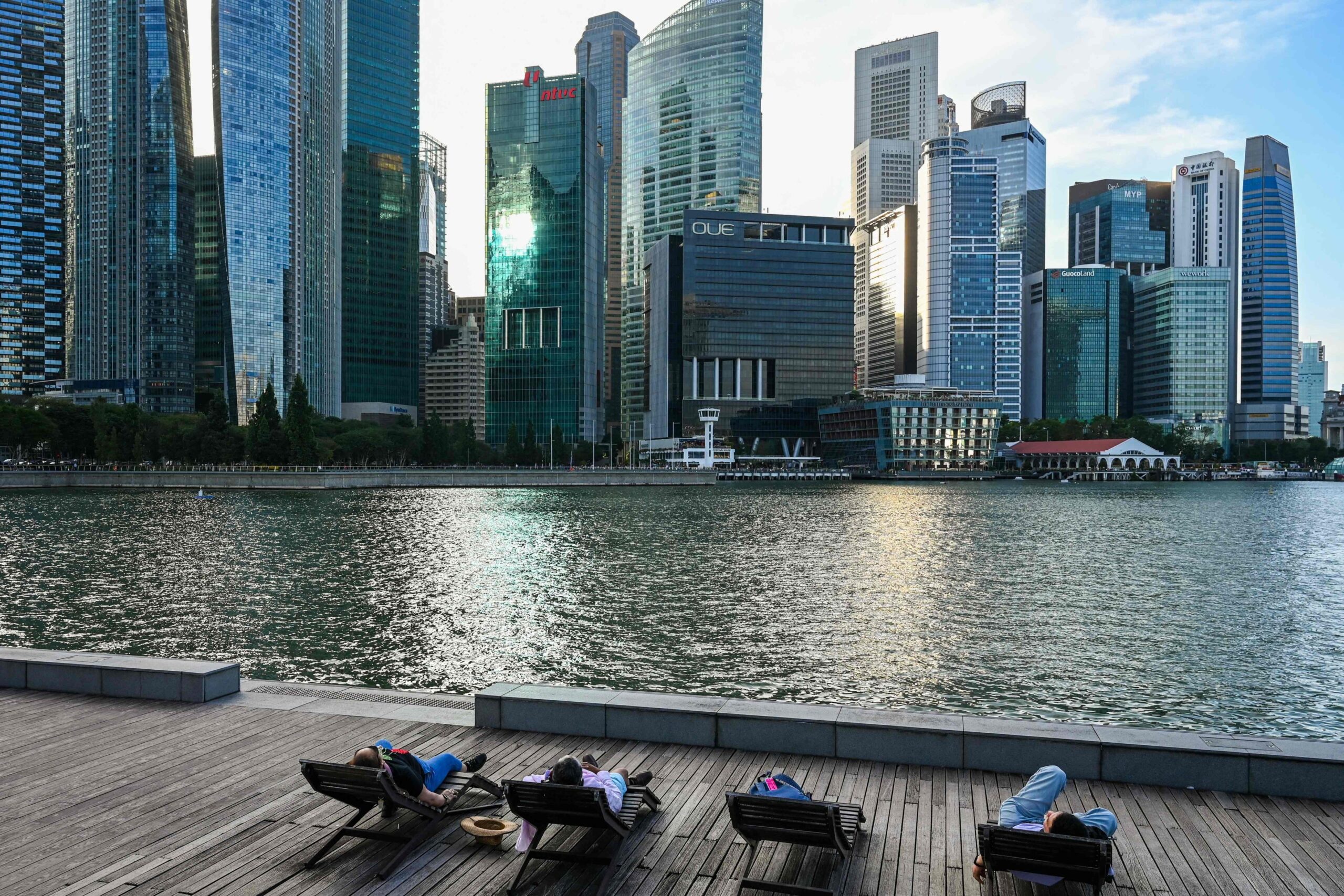
Singapore has spent the past two years becoming one of the primary beneficiaries of the global AI infrastructure buildout, alongside Taiwan’s semiconductor sector. The city-state’s role as a data-center hub allowed it to capture significant capital inflows even as the broader labour-market impact of that investment stayed limited, given how capital-intensive AI infrastructure spending tends to be (J.P. Morgan Private Bank).
Why the AI cycle didn’t stay contained to Singapore
What is changing in 2026 is the geography of that investment. J.P. Morgan’s Asia outlook notes Southeast Asian economies — traditionally anchored in commodities and export manufacturing — are now aligning more closely with the global AI investment cycle by deepening involvement in higher-value areas: infrastructure, hardware and complementary supply chains (J.P. Morgan Private Bank).
Land constraints in Singapore make expansion difficult, which is precisely where the Johor-Singapore Special Economic Zone becomes central to the region’s AI investment thesis rather than a side story.
The Johor SEZ as capacity release valve
Johor has launched a 7,300-acre innovation sandbox as part of the new special economic zone bordering Singapore, explicitly designed to combine Johor’s land and scale with Singapore’s capital and speed, according to the state investment committee’s chair (Fortune). One local official described the ambition bluntly: the zone is meant to be more than “an industrial park with a nicer brochure” (Fortune).
Malaysia’s structural beneficiary position
Malaysia’s electrical and electronics sector already accounts for roughly 40% of the country’s total exports, with semiconductors comprising about 65% of E&E exports — positioning Malaysia as a structural beneficiary of the AI-linked shift in regional trade, according to J.P. Morgan’s Asia analysis (J.P. Morgan Private Bank). Malaysia’s economy minister has framed 2026 explicitly as a year of “execution” for the Anwar administration as it tries to lock in these policy gains (Fortune).
Monetary policy backdrop supports the buildout
Asian central banks spent much of 2025 easing policy and are entering the final stages of that cycle in 2026, shifting more of the growth-support burden to fiscal policy — a backdrop J.P. Morgan expects to support stronger domestic credit growth and consumer demand across the region, reinforcing rather than competing with the AI capital cycle (J.P. Morgan Private Bank).
The regional risk to watch
Most of the region avoided the brunt of 2025’s tariff shock thanks to exemptions on semiconductors, electronics and pharmaceuticals, but that exemption structure remains a policy choice in Washington rather than a permanent feature — meaning the Singapore-Johor AI corridor’s growth case still carries meaningful US trade-policy risk that investors should not discount simply because 2025’s tariffs were absorbed relatively smoothly (J.P. Morgan Private Bank).
Discover more from The Economy
Subscribe to get the latest posts sent to your email.

Dubai’s transformation from oil-adjacent trading post to global capital hub is no longer a talking point — it is a measurable trend. The emirate’s newly launched Economic Survey 2026 shows GDP climbing to $265 billion alongside rising employment, while international family offices are gathering for the Family Office Summit Dubai 2026 as the city cements its position as a family-wealth hub (Gateway Group; Arabian Business).
The non-oil growth engine
The UAE enters 2026 with the World Bank projecting national growth of roughly 5%, well above the global average, driven substantially by 5.3% expansion in the non-oil sector (Barchart). Technology, green energy and healthcare are the top-performing sectors, and 64% of UAE executives expect trade volumes to exceed 2025 levels — confidence underpinned by the country’s expanding network of Comprehensive Economic Partnership Agreements (Barchart). Historically, oil production accounted for half of Dubai’s GDP; today it contributes less than 1% (Wikipedia/Economy of Dubai).
Why family offices specifically are relocating
The Family Office Summit Dubai 2026 is drawing international participants precisely because the emirate has built regulatory infrastructure — inside jurisdictions like the DIFC — designed to attract exactly this category of capital. As one DIFC executive noted, incentives alone are no longer enough to win global finance; institutional credibility and regulatory clarity now matter more, which explains why firms such as Sixth Street have opened Abu Dhabi offices as global investment houses deepen their Middle East presence (Gateway Group).
Infrastructure is compounding the pull
Beyond finance, the UAE’s infrastructure build-out is reinforcing the wealth-hub thesis. Etihad Rail’s Abu Dhabi–Fujairah passenger service and the Madinat Zayed and Liwa station openings, arriving ahead of schedule, signal a state execution model that investors increasingly cite as a differentiator versus regional peers (GCC Business Watch). Dubai has also rolled out a AED 1 billion economic support package aimed at business liquidity and resilience amid regional geopolitical headwinds (GCC Business Watch).
The regional competition for capital
Dubai’s rise is happening alongside — not in isolation from — a broader Gulf capital race. Saudi Arabia’s economy is set for stronger growth per IMF assessments, and Gulf sovereign and corporate capital is increasingly being deployed across sectors from AI infrastructure to green growth commitments, meaning Dubai’s wealth-hub status will need continual reinforcement rather than passive maintenance (GCC Business Watch).
The bottom line for investors
For family offices weighing jurisdiction, Dubai’s pitch in 2026 combines three elements rarely available together: near-zero effective taxation, a non-oil economy growing faster than most G20 peers, and physical and financial infrastructure being built ahead of demand rather than in reaction to it. That combination — not simply low tax rates — is what is now pulling global family wealth toward the emirate.
Discover more from The Economy
Subscribe to get the latest posts sent to your email.

Russia’s War Economy Got a Reprieve From Iran

China’s Economy Has a Structural Problem: Factories Are Winning, Households Are Losing

How Malaysia “Shrugged Off” Trump’s Tariffs — and What Comes Next

Singapore’s AI Boom Is Now a Two-Country Story

Why Global Family Offices Are Converging on Dubai in 2026

A Weak Jobs Report Just Rewired the Fed’s Autumn — And Wall Street Cheered

Britain’s Fragile Rebound Meets a Budget Deadline and a Trump Ultimatum

Pakistan’s Economy Grew 3.7% — So Why Doesn’t It Feel Like a Recovery?

Top 15 Financial Stocks for Investment in PSX

Pakistan Exports 2026: Record $35.6B Forecast Masks Trade Deficit Risk

UK’s Jobs Downturn Now Matches the 2008 Financial Crisis — And AI Is Accelerating It

Fed Rate Cut Bets Surge After Shock US Jobs Report Exposes Labor Market Cracks

Pakistan’s Trade Gap Widens to $3.95bn Despite Meeting FY26 Current Account Target

Why Ottawa Is Betting on Dubai: Inside Canada’s Gulf Trade Pivot

Gold Price Forecast 2026: Fed’s July 29 Decision and Record Central Bank Buying Explained

China Politburo July 2026: Stimulus Signals Explained

Pakistan Economy 2026: GDP Grows 3.7% as IMF Completes EFF Review Amid Middle East Risk

Strait of Hormuz Blockade 2026: Oil Prices Surge 9% as US-Iran Conflict Reignites

Down But Not Out: Inside the Slow Sinking of Russia’s War Economy

Gulf Capital Retreat From Pakistan 2026: UAE Loan Freeze & What It Means

Global Stock Market Selloff 2026: Stagflation Fears Return as Iran Conflict Reignites

Pakistan’s Economic Survey FY26: Inflation Spike Insights

Russia Fuel Shortages 2026: Inside a Cracking War Economy

Strait of Hormuz Crisis 2026: How Trump’s Toll U-Turn Exposes Global Economic Risk

Bank of England Rate Decision Amid Energy Crisis

Russia’s War Economy Model Is Starting to Crack, Think Tank Warns

Pakistan’s Economic Growth: Resilience Amid Challenges

Andy Burnham, UK Gilts and Mortgages: July 2026 Explainer
-

 Markets & Finance7 months ago
Top 15 Stocks for Investment in 2026 in PSX: Your Complete Guide to Pakistan’s Best Investment Opportunities
-

 Analysis6 months ago
Johor’s Investment Boom: The Hidden Costs Behind Malaysia’s Most Ambitious Economic Surge
-

 Analysis6 months ago
Top 10 Stocks for Investment in PSX for Quick Returns in 2026
-

 Analysis6 months ago
Brazil’s Rare Earth Race: US, EU, and China Compete for Critical Minerals as Tensions Rise
-

 Banks7 months ago
Best Investments in Pakistan 2026: Top 10 Low-Price Shares and Long-Term Picks for the PSX
-

 Investment7 months ago
Top 10 Mutual Fund Managers in Pakistan for Investment in 2026: A Comprehensive Guide for Optimal Returns
-

 Global Economy8 months ago
15 Most Lucrative Sectors for Investment in Pakistan: A 2025 Data-Driven Analysis
-

 Global Economy8 months ago
Pakistan’s Export Goldmine: 10 Game-Changing Markets Where Pakistani Businesses Are Winning Big in 2025