
Business
Trump’s Greenland Tariffs Trigger Sharp Stock Market Slide as Fear Gauge Spikes

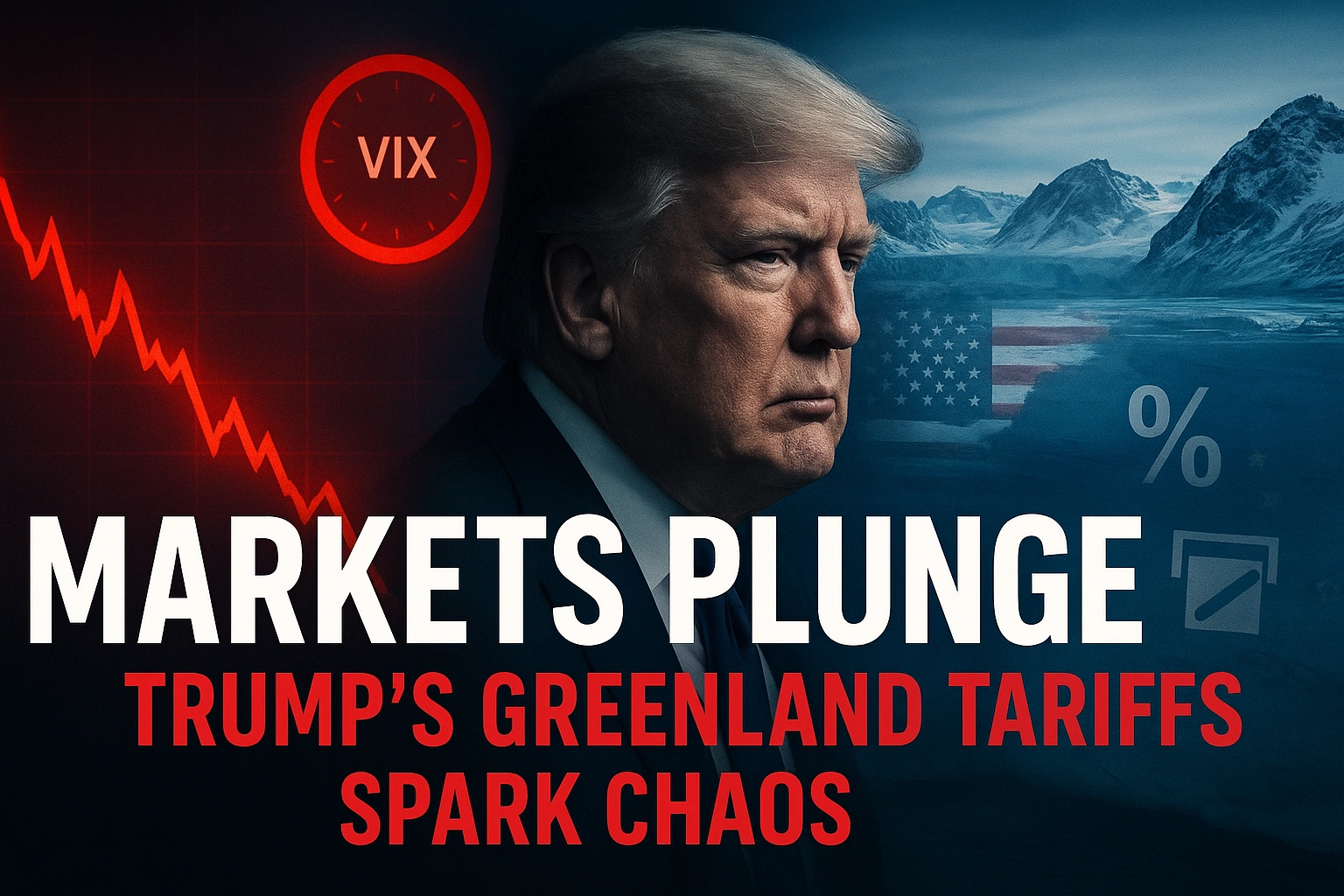
Trump’s Greenland tariff threats sparked a 2% market plunge, pushing the VIX above 20 as investors flee U.S. assets. Analysis of the transatlantic crisis reshaping global markets.
Market Carnage as Geopolitical Gambit Rattles Investors
The trading floor of the New York Stock Exchange descended into controlled chaos on Tuesday, January 20, 2026, as President Donald Trump’s ultimatum over Greenland sent tremors through global financial markets. By the closing bell, the S&P 500 had hemorrhaged 143.15 points—a brutal 2.1% decline to 6,796.86—marking the benchmark index’s steepest single-day drop since October and erasing all gains accumulated in the young year.
“The fear trade is absolutely on right now,” observed Krishna Guha, head of global policy and central banking strategy at Evercore ISI, capturing the sentiment that gripped Wall Street as investors confronted an unprecedented scenario: the world’s most powerful economy threatening trade war against its closest military allies over territorial ambitions in the Arctic.
The Nasdaq Composite fared worse, plummeting 561.07 points or 2.4% to 22,954.32, while the Dow Jones Industrial Average shed 870 points—a 1.7% decline that wiped more than $1.2 trillion in market capitalization from the S&P 500 alone. The CBOE Volatility Index, Wall Street’s closely watched “fear gauge,” surged past the psychologically significant 20 threshold, reaching an intraday high of 20.99—levels not witnessed since mid-November when markets grappled with Federal Reserve policy uncertainty.
European markets mirrored the distress. Germany’s DAX plunged 1.0% to close at 24,703, while Britain’s FTSE 100 declined 0.7% and the pan-European STOXX 600 tumbled 0.7%, with the selloff intensifying throughout Tuesday’s session as the magnitude of the transatlantic rupture became apparent.
This was no ordinary market correction driven by earnings disappointments or macroeconomic data. This was a fundamental reassessment of geopolitical risk premiums, a repricing of American exceptionalism, and the emergence of what strategists termed the “Sell America” trade—a phenomenon not seen with such intensity since April 2025’s “Liberation Day” tariff tumult.
The convergence of Trump’s Greenland gambit with the annual World Economic Forum gathering in Davos created a surreal juxtaposition: global business leaders convening to discuss cooperation and prosperity even as the U.S. president threatened economic coercion against NATO allies. For investors navigating an already precarious landscape of elevated valuations, persistent inflation concerns, and approaching Federal Reserve leadership transitions, Trump’s Saturday announcement proved the catalyst for a long-anticipated reckoning.
The Greenland Escalation: From Sideshow to Systemic Crisis
President Trump’s interest in Greenland—the vast, ice-covered autonomous territory of Denmark—first surfaced during his initial term in 2019, when he privately floated the idea of purchasing the strategically located island. Danish officials dismissed the proposal as “absurd,” and the episode quickly faded from headlines, relegated to the category of Trumpian provocations that generated brief controversy before evaporating.
But what began as a seemingly quixotic fascination has metastasized into a full-blown diplomatic crisis with profound market implications. On Saturday, January 17, Trump announced via Truth Social that he would impose 10% tariffs on “any and all goods” from eight European nations—Denmark, Norway, Sweden, France, Germany, the United Kingdom, the Netherlands, and Finland—effective February 1, 2026. These levies would escalate to 25% on June 1 unless an agreement was reached for “the Complete and Total purchase of Greenland.”
Trump’s rationale combined national security imperatives with sweeping claims about Arctic geopolitics. “China and Russia want Greenland, and there is not a thing that Denmark can do about it,” Trump wrote, characterizing the joint military exercises recently conducted by European forces in Greenland as “a very dangerous situation for the Safety, Security, and Survival of our Planet.”
The timing of these military deployments—specifically by Danish, German, Norwegian, and French forces—was not coincidental. NATO allies had dispatched small contingents to Greenland in a calculated show of support for Denmark and a signal that they took Arctic security seriously, precisely the concern Trump claimed motivated his acquisition push. Yet Trump interpreted this allied solidarity as a “dangerous game” warranting punitive tariffs.
The targeted European nations represent some of America’s oldest and most strategically vital allies. Combined, these eight countries accounted for approximately $750 billion in bilateral trade with the United States in 2024, with Germany alone responsible for $236 billion, the United Kingdom $147.7 billion, and the Netherlands $122.3 billion, according to U.S. Census Bureau data. Imposing across-the-board tariffs on this volume of trade would constitute the largest unilateral trade action against allies in modern American history.
European leaders responded with unusual unity and force. In a joint statement released Sunday, leaders from the eight targeted nations warned that the tariff threats “undermine transatlantic relations and risk a dangerous downward spiral,” pledging to “stand united and coordinated in our response.” European Commission President Ursula von der Leyen and European Council President António Costa declared that “Europe will remain united, coordinated, and committed to upholding its sovereignty.”
French President Emmanuel Macron, attending the Davos forum, spoke of preferring “respect to bullies,” while Swedish Prime Minister Ulf Kristersson stated bluntly: “We will not let ourselves be blackmailed. Only Denmark and Greenland decide on issues concerning Denmark and Greenland.”
By Monday evening, the situation had further deteriorated when Trump threatened 200% tariffs on French wine after reports emerged that Macron had declined to join Trump’s proposed “Board of Peace” for Gaza. The escalation suggested a pattern of impulsive retaliation that heightened market anxiety about policy unpredictability.
Perhaps most revealing of the administration’s approach came during Tuesday’s White House briefing, when Trump was asked how far he would be willing to go to secure control of Greenland. His two-word response—”You’ll find out”—sent chills through diplomatic channels and trading desks alike. The president had declined to rule out military action in previous statements, and his cryptic answer did nothing to dispel concerns that the Greenland pursuit represented more than mere negotiating posture.
Anatomy of Tuesday’s Market Meltdown
The selloff that engulfed global markets on January 20 bore the hallmarks of a classic risk-off rotation, but with troubling undertones that distinguished it from routine volatility spikes. Investors weren’t merely seeking shelter from a passing squall; they were fundamentally reassessing the United States’ role as a stable anchor for global capital.
Equity Markets Under Siege
The carnage was broadly distributed across sectors, with only defensive consumer staples holding ground. Colgate-Palmolive gained 1.1% and Campbell’s rose 1.5% as investors sought refuge in recession-resistant names. But for cyclical and growth-oriented equities, Tuesday delivered punishing losses.
Technology stocks, which had led the market’s ascent through 2025, bore the brunt. The Nasdaq’s 2.4% decline reflected heightened concern that tariff-induced economic disruption would crimp corporate earnings precisely when valuations remained stretched. European technology shares fared no better, with the region’s tech-heavy sectors declining sharply.
Industrial conglomerate 3M plummeted 7% after reporting mixed quarterly results and CEO William Brown warned that proposed European tariffs could slice $60-70 million from 2026 earnings—a concrete example of how Trump’s Greenland strategy was already flowing through to corporate guidance. Automotive manufacturers, facing the prospect of severely disrupted transatlantic supply chains, suffered disproportionate losses. BMW, Volkswagen, Daimler Truck, Porsche, and Mercedes-Benz each declined between 3% and 3.7%, reflecting Germany’s particular vulnerability as an export-oriented economy.
European luxury goods makers, sensitive to both consumer confidence and currency movements, also stumbled. Shares of LVMH—owner of Moët & Chandon, Dom Pérignon, and Veuve Clicquot—fell 2.1% on concerns about Trump’s 200% wine tariff threat, while Rémy Cointreau declined modestly.
The breadth of the decline was striking: on the New York Stock Exchange, decliners outnumbered advancers by a 1.19-to-1 ratio, while the Nasdaq saw a 1.34-to-1 ratio favoring declining issues. A total of 18.77 billion shares changed hands, well above the recent 20-session average of 16.85 billion—a sign of forced repositioning rather than measured profit-taking.
The VIX Surge: Fear Reclaims 20
The CBOE Volatility Index’s breach of 20 represented more than a statistical milestone. The VIX had spent much of late 2025 oscillating between 12 and 16, reflecting market complacency despite elevated absolute valuations. Its jump to an intraday high of 20.99 on Tuesday—closing at approximately 20.71—signaled that the “honeymoon period” with Trump’s second-term economic policies had decisively ended.
Historically, VIX readings above 20 indicate heightened investor anxiety and often presage periods of sustained turbulence. The index’s surge reflected surging demand for portfolio insurance through S&P 500 options, with traders paying premiums to protect against further downside. Notably, VIX futures curves inverted slightly, suggesting near-term volatility concerns outweighed long-term fears—a pattern consistent with event-driven spikes rather than structural bear markets.
“The VIX reclaiming the 20 level is more than just a statistical milestone; it is a clear signal that the market’s ‘honeymoon period’ with the current administration’s economic policies has ended,” noted analysts at FinancialContent, emphasizing that the convergence of the Greenland tariff threat with earnings uncertainty and lingering effects of the 43-day government shutdown had created a “visibility gap” making every headline a potential market-mover.
Safe-Haven Flows: Gold, Silver, and Treasury Dynamics
The flight to safety manifested most dramatically in precious metals markets. Gold surged to new all-time highs, trading near $4,600 per ounce—a gain of approximately 6% year-to-date. Silver outperformed even gold’s impressive advance, soaring above $95 per ounce, representing a remarkable 16% gain since January 1 and more than 200% appreciation from year-ago levels.
The precious metals rally reflected multiple anxieties: inflation hedging, currency debasement concerns, and pure geopolitical risk aversion. Analysts at Bank of America noted that gold was serving as “the primary hedge and performance driver in 2026,” with some forecasts suggesting silver could reach as high as $135-$309 per ounce if industrial demand for green energy applications continued accelerating alongside safe-haven buying.
Paradoxically, U.S. Treasury prices fell sharply Tuesday despite their traditional safe-haven status, sending yields spiking. The 10-year Treasury yield jumped approximately 6 basis points to 4.29%, while 20- and 30-year yields also climbed—making it more expensive for the U.S. government to service its $36 trillion debt burden. This atypical behavior signaled something more troubling than routine risk rotation: international investors were actively selling American sovereign debt, questioning the reliability of U.S. policy commitments.
Denmark’s announcement that pension fund Akademikerpension would sell $100 million in U.S. Treasuries—citing “poor U.S. government finances” but clearly motivated by the Greenland dispute—provided a concrete example of the “Sell America” dynamic. While Treasury Secretary Scott Bessent dismissed the move as “irrelevant” given its modest size, the symbolic importance was unmistakable: even small, wealthy U.S. allies were beginning to weaponize their dollar holdings.
Currency Markets Signal Confidence Crisis
The U.S. Dollar Index, which measures the greenback against a basket of six major currencies, tumbled nearly 1%—its sharpest single-day decline since April 2025. The euro gained 0.6% against the dollar, reflecting not European economic strength but rather a repricing of American political risk.
“This is ‘sell America’ again within a much broader global risk off,” wrote Krishna Guha of Evercore ISI, noting that the dollar’s weakness and euro’s strength suggested global investors were “looking to reduce or hedge their exposure to a volatile and unreliable” United States. The currency movements were particularly significant given that international capital had flooded into dollar-denominated assets throughout 2024 and 2025, drawn by American growth outperformance and the AI investment boom.
Guha warned that if Trump failed to walk back his Greenland plans—a trade known colloquially as “TACO” (Trump Always Chickens Out)—or find a diplomatic compromise, the impacts on the dollar and other U.S. assets “could be severe and long-term.”
The Geopolitical Stakes: Why Greenland Matters
To understand why markets reacted with such alarm to Trump’s Greenland gambit requires examining the island’s unique strategic significance and the broader Arctic competition reshaping 21st-century geopolitics.
Geographic Imperative: The GIUK Gap and Arctic Chokepoints
Greenland occupies a position of extraordinary strategic importance, sitting astride the GIUK Gap—the maritime corridor between Greenland, Iceland, and the United Kingdom. During the Cold War, this choke point was crucial for monitoring Soviet submarine movements between the Arctic and the Atlantic. Today, as Russia rebuilds its Northern Fleet and increases Arctic military activity, the GIUK Gap has regained salience as a surveillance and potential interdiction zone.
The United States maintains Pituffik Space Base (formerly Thule Air Base) in northwestern Greenland—a critical installation for missile early warning, space surveillance, and satellite tracking. Established in 1951 under a defense agreement with Denmark, Pituffik provides coverage of potential ballistic missile launches from Russia and gives the U.S. strategic depth for Arctic operations.
Climate change has dramatically elevated Greenland’s importance. Melting Arctic ice is opening new shipping routes—the Northwest Passage along North America’s northern coast and the Transpolar Sea Route through the central Arctic Ocean—that could slash transit times between Asia, Europe, and North America. These emerging corridors will require infrastructure, maritime governance, and security frameworks. Greenland’s geographical position makes it central to managing this transformation.
The Rare Earth Dimension: Critical Minerals and Supply Chain Vulnerability
Beyond military geography, Greenland harbors substantial deposits of rare earth elements and other critical minerals essential for modern technology, renewable energy systems, and defense applications. The island’s mineral wealth includes rare earths, uranium, iron ore, and potentially significant oil and gas reserves.
Rare earth elements—comprising 17 minerals crucial for high-performance magnets, electronics, and precision guidance systems—represent a particular vulnerability for Western economies. China currently dominates the global rare earth supply chain, controlling approximately 60% of mining and more than 90% of processing capacity. This monopoly position grants Beijing potential leverage over industries ranging from electric vehicles to wind turbines to advanced weaponry.
Greenland’s Tanbreez and Kvanefjeld deposits contain substantial heavy rare earth reserves that could diversify supply chains away from Chinese dominance. In June 2025, the U.S. Export-Import Bank expressed interest in providing a $120 million loan to fund Tanbreez mining development—signaling the Trump administration’s recognition of Greenland’s resource value.
However, exploiting these resources faces daunting obstacles: extreme climate conditions, mountainous terrain, virtually non-existent infrastructure, and stringent environmental regulations championed by Greenland’s largely Indigenous Inuit population. Mining development remains aspirational rather than imminent, and any projects would require sustained multi-billion-dollar investments over decades.
The China Factor: Arctic Ambitions and the Polar Silk Road
China declared itself a “near-Arctic state” in 2018—a geographically questionable designation given China’s distance from the Arctic Circle—and announced its “Polar Silk Road” strategy as an extension of the Belt and Road Initiative. Beijing has pursued scientific research stations, infrastructure investments, and resource acquisition throughout the Arctic, though with limited success in Greenland specifically.
Chinese attempts to invest in Greenlandic airports were blocked in 2018 after Danish and U.S. pressure, and other mining ventures involving Chinese partners have stalled or failed. Nevertheless, China’s Arctic ambitions remain a persistent concern for Washington, particularly as Beijing deepens its relationship with Russia and expands its ice-capable naval fleet.
Trump administration officials have framed Greenland acquisition as essential to countering Chinese influence. Former national security adviser Mike Waltz stated explicitly that the focus was “about critical minerals” and “natural resources,” while Trump himself has alternately emphasized national security and economic imperatives.
Russia’s Arctic Militarization: The Northern Fleet Resurgence
Russia has systematically rebuilt its Arctic military capabilities since 2014, reopening Cold War-era bases, constructing new facilities, and expanding its Northern Fleet—the world’s largest ice-capable naval force. Moscow views the Arctic as central to its strategic deterrent, with nuclear-armed submarines operating from Arctic ports and new hypersonic missile systems deployed in the region.
Russian President Vladimir Putin, speaking at the March 2025 International Arctic Forum in Murmansk, acknowledged Trump’s Greenland ambitions and warned that “Russia has never threatened anyone in the Arctic, but we will closely follow the developments and mount an appropriate response by increasing our military capability and modernising military infrastructure.”
European leaders’ Arctic concerns intensified following Russia’s 2022 invasion of Ukraine, which shattered assumptions about post-Cold War cooperation. The recent deployment of small European military contingents to Greenland—the very exercises Trump characterized as “dangerous”—reflected NATO’s growing focus on Arctic security in an era of renewed great-power competition.
Market Implications: Unpacking the “Fear Trade”
The question confronting investors as markets opened Wednesday was whether Tuesday’s selloff represented a one-day event-driven correction or the opening chapter of a more sustained revaluation of American asset attractiveness.
The “Sell America” Trade: Structural or Cyclical?
The “Sell America” phenomenon—simultaneous selling of U.S. stocks, bonds, and currency—first emerged during April 2025’s “Liberation Day” tariff announcement, when Trump unveiled sweeping global tariffs. That episode proved temporary as administration officials walked back some of the more extreme measures and markets recovered.
The Greenland situation differs in crucial respects. First, it involves military allies rather than economic competitors, raising fundamental questions about alliance cohesion and American reliability. Second, Trump’s willingness to risk NATO unity over territorial acquisition suggests a foreign policy approach less constrained by traditional diplomatic considerations. Third, the convergence with approaching Supreme Court rulings on presidential tariff authority creates legal uncertainty layered atop policy volatility.
Citi strategist Beata Manthey captured the shift in market dynamics: “The latest step-up in transatlantic tensions and tariff uncertainty dents the near-term investment case for European equities, casting doubt on broad-based EPS inflection in 2026.” Manthey downgraded Continental Europe to Neutral for the first time in over a year and specifically downgraded “internationally exposed” sectors including autos and chemicals.
JPMorgan strategist Greg Fuzesi warned that if the Greenland issue “triggers a larger sentiment effect by generating more profound uncertainty, its economic implications could be larger” than the direct trade impact. This observation highlights the distinction between calculable first-order effects (tariff costs) and incalculable second-order effects (confidence collapse, investment paralysis, alliance dissolution).
Sector Vulnerabilities: From Industrials to Luxury Goods
Specific sectors face disproportionate exposure to transatlantic trade disruption. Automotive supply chains, highly integrated across the Atlantic, would suffer severe dislocation from 25% tariffs. German manufacturers, already grappling with transition to electric vehicles and Chinese competition, could see European production become economically unviable for U.S. export.
Aerospace and defense contractors paradoxically face both risks and opportunities. Deteriorating transatlantic relations could jeopardize collaborative programs like the F-35 fighter jet, which involves components from multiple European suppliers. Conversely, increased European defense spending in response to perceived American unreliability could boost European defense stocks at the expense of American contractors.
Luxury goods makers face demand destruction from weakened consumer confidence alongside currency headwinds. The dollar’s decline makes European luxury items less affordable for American consumers, while tariff costs would force either price increases (dampening demand) or margin compression (reducing profitability).
Financial services firms confront operational complexity from fragmented regulatory landscapes and heightened compliance costs if transatlantic economic coordination breaks down. The prospect of the European Union deploying its “anti-coercion instrument”—the so-called “trade bazooka” permitting restrictions on U.S. firms’ access to European markets—represents an existential threat for American financial institutions with significant European operations.
Valuation Multiples in a Higher-Risk Environment
Perhaps most consequential for long-term investors: elevated equity valuations predicated on assumptions of policy stability, earnings growth, and dollar dominance suddenly appear vulnerable. The S&P 500’s cyclically adjusted price-to-earnings (CAPE) ratio hovers near 40—historically associated with subsequent decade-long underperformance. Such valuations presume sustained corporate profitability and investor confidence.
If geopolitical risk premiums permanently expand due to American foreign policy unpredictability, equity valuations must compress to compensate investors for increased uncertainty. A modest 10% valuation haircut would imply S&P 500 levels around 6,100—roughly 10% below Tuesday’s close—without any change to underlying earnings prospects.
“Markets may already be pricing in full the concept of American exceptionalism, at least barring an epic, crack-up economic boom,” observed strategist Mould. “It may therefore not take too much to persuade investors to hedge their bets and diversify.”
European Response: The Anti-Coercion Instrument and Retaliation Scenarios
European leaders convened emergency consultations immediately following Trump’s Saturday announcement, with EU ambassadors holding Sunday meetings and further discussions scheduled throughout the week at the Davos forum. The range of potential responses spans from diplomatic protest to economic warfare.
The “Trade Bazooka”: Europe’s Nuclear Option
The European Union’s anti-coercion instrument (ACI), adopted in 2023 and colloquially termed the “trade bazooka,” provides Brussels with sweeping retaliatory powers against economic coercion by non-EU countries. French President Emmanuel Macron reportedly requested ACI activation during emergency meetings, with German MEP Bernd Lange, who chairs the European Parliament’s trade committee, explicitly calling for immediate deployment.
The ACI permits the EU to:
- Restrict U.S. businesses’ access to Europe’s single market
- Exclude American suppliers from EU public procurement tenders
- Impose export and import restrictions on U.S. goods and services
- Limit foreign direct investment from American firms
- Suspend preferential trade agreements
These measures would represent the most significant transatlantic economic rupture since World War II, dwarfing trade disputes of the 1970s and 1980s. European officials have indicated that a package exceeding $100 billion in counter-tariffs is already prepared, targeting American products from bourbon to Harley-Davidson motorcycles to agricultural commodities—classic retaliatory items designed to inflict political pain in swing states.
Legal and Institutional Constraints
European leaders face delicate calibration challenges. Overreacting to Trump’s threats risks accelerating a downward spiral and potentially playing into narratives of European aggression that could fracture transatlantic unity. Underreacting invites further coercion and signals weakness that could embolden not only the Trump administration but also authoritarian powers watching to gauge Western resolve.
Moreover, Trump’s tariffs target individual member states rather than the EU collectively, creating a technical complexity: does Brussels possess authority to retaliate on behalf of sovereign nations for bilateral disputes? This loophole—whether intentional or accidental—could provide a face-saving mechanism for de-escalation but also creates enforcement ambiguity.
The Supreme Court’s pending ruling on whether Trump can use the International Emergency Economic Powers Act (IEEPA) to impose tariffs adds another layer of uncertainty. If the Court curtails presidential tariff authority, Trump’s Greenland leverage evaporates—but the damage to alliance trust may prove lasting. If the Court upholds broad executive discretion, European leaders must contemplate a permanent shift in the transatlantic economic architecture.
Congressional Pushback and Partisan Divisions
Notably, Trump faces significant opposition from within his own party regarding the Greenland strategy. Republican Senators Lisa Murkowski, Thom Tillis, and Representative Don Bacon have sharply criticized the tariff threats and territorial ambitions.
“This is appalling. Greenland is a NATO ally. Denmark is one of our best friends… so the way we’re treating them is really demeaning and it has no upside,” stated Rep. Bacon. Senator Murkowski, who represents Alaska and possesses deep Arctic expertise, warned that pressuring allies “plays directly into Putin’s hands” and urged Congress to “reassert our Constitutional authority over tariffs so that they are not weaponized in ways that harm our alliances.”
Senate Minority Leader Chuck Schumer announced plans to introduce legislation blocking tariffs against countries opposing Greenland acquisition, though passage faces long odds in the narrowly divided Congress. Nevertheless, the bipartisan congressional delegation that visited Copenhagen and Greenland during the tariff announcement sent a powerful message that Trump lacks unified domestic support for his approach.
Forward Scenarios: From Davos Diplomacy to Constitutional Crisis
As Trump arrived in Davos on Wednesday for meetings with European leaders and CEOs, market participants confronted multiple potential outcomes, each carrying distinct implications for asset prices.
Scenario 1: De-escalation and Strategic Ambiguity
In this optimistic case, face-to-face meetings in Davos yield tacit understandings that allow both sides to step back from the brink. Trump might secure enhanced U.S. military access to Greenland, expanded cooperation on Arctic security, and European commitments to facilitate American rare earth mining investments—while formally abandoning acquisition demands.
Denmark and Greenland could frame such concessions as pragmatic security cooperation consistent with existing defense agreements rather than capitulation to coercion. The tariff threats would be postponed or quietly shelved, allowing markets to rebound as immediate crisis dissipates.
This scenario presumes Trump values deal-making optics over ideological commitment to territorial expansion and that European leaders possess sufficient domestic political capital to make concessions without appearing weak. Market probability: 35-40%.
Scenario 2: Legal Resolution through Supreme Court Ruling
If the Supreme Court rules against the administration’s use of IEEPA for tariff imposition—a decision potentially imminent—Trump’s Greenland leverage collapses absent alternative legal authorities. The Court appeared skeptical during oral arguments about executive branch claims that emergency economic powers implicitly include tariff authority.
A favorable ruling for plaintiffs challenging presidential tariff powers would trigger market relief, with possible 3-5% equity rallies erasing Tuesday’s losses. However, Trump’s pursuit of Greenland through other means (diplomatic pressure, military posturing, congressional legislation) would remain possible, sustaining elevated uncertainty even as immediate tariff risks recede.
This scenario hinges entirely on Supreme Court jurisprudence regarding executive power scope and statutory interpretation. Market probability: 25-30%.
Scenario 3: Escalation and Transatlantic Economic Warfare
In this bleakest scenario, Trump implements the threatened tariffs on February 1, Europe retaliates with its prepared counter-tariff package and potentially activates the ACI, and the situation cascades into full-scale trade war. Corporate supply chains fracture, cross-border investment collapses, and NATO cohesion erodes as economic conflict spills into security cooperation.
Extended market volatility would likely see the VIX sustained above 25, equity indexes declining an additional 10-15% from Tuesday’s levels, and recession risks spiking as business confidence evaporates. Gold could surge toward $5,000 per ounce while the dollar enters a protracted decline as foreign central banks diversify reserves away from Treasury securities.
This scenario assumes both sides misjudge the other’s resolve, domestic political pressures prevent compromise, and institutional guardrails prove insufficient to arrest the deterioration. Market probability: 15-20%.
Scenario 4: Chronic Uncertainty and Range-Bound Markets
Perhaps most likely: an extended period of elevated uncertainty without definitive resolution. Trump neither abandons Greenland ambitions nor implements maximum tariffs, while Europeans maintain retaliatory threats without activation. The situation becomes a persistent background risk factor that elevates volatility premiums and depresses valuations without triggering acute crisis.
In this scenario, markets trade in choppy ranges with frequent volatility spikes on headline developments. The VIX remains structurally elevated in the 18-22 range rather than reverting to sub-15 complacency. Investors demand higher risk premiums for holding equities, particularly those with international exposure, while defensive sectors and dividend aristocrats outperform growth stocks.
This outcome reflects the broader challenge of valuing assets in an environment of perpetual policy uncertainty, where traditional forecasting models break down and political risk becomes a dominant variable. Market probability: 25-30%.
Investment Implications: Navigating the New Volatility Regime
For investors seeking to position portfolios amid this geopolitical maelstrom, several considerations merit attention.
Geographic Diversification Beyond U.S. Exposure
The Greenland crisis reinforces the case for geographic diversification away from excessive U.S. concentration. While American equities have delivered extraordinary returns over the past decade, the combination of peak valuations and heightened policy risk argues for rebalancing toward European, Asian, and emerging market exposures.
Paradoxically, European equities may offer relative value if the Greenland situation resolves without full-scale trade war. Depressed valuations following Tuesday’s selloff create entry points for patient investors willing to accept elevated near-term volatility. German industrials and French luxury goods, trading at depressed multiples, could deliver substantial returns if transatlantic tensions ease.
Sector Rotation Toward Defensives and Quality
Within U.S. equity portfolios, shifting toward defensive sectors with stable cash flows and limited international exposure offers some protection. Utilities, consumer staples, healthcare, and telecommunications historically outperform during periods of geopolitical stress and elevated volatility.
The concept of “quality” investing—emphasizing strong balance sheets, consistent profitability, and robust competitive advantages—gains relevance when macro uncertainty dominates. Companies with pricing power, low debt levels, and diversified revenue streams possess superior resilience during extended periods of turbulence.
Precious Metals as Portfolio Insurance
Gold and silver’s Tuesday surge underscores their continuing relevance as portfolio diversifiers and inflation hedges. While precious metals generate no income and can experience extended periods of underperformance, they provide non-correlated returns during equity market stress.
Analysts at Bank of America and other institutions suggest allocating 5-10% of portfolios to precious metals exposure through physical holdings, ETFs, or mining equities. Silver’s industrial applications in solar panels, electric vehicles, and electronics create dual support from both safe-haven demand and green energy transition tailwinds.
Fixed Income Complexity: Duration Risk and Credit Selection
The Treasury market’s Tuesday behavior—declining prices despite equity selloff—illustrates the challenges facing bond investors. Traditional stock-bond diversification benefits may prove less reliable if foreign creditors reduce U.S. sovereign debt holdings or inflation concerns resurface.
Shorter-duration bonds and floating-rate instruments provide some protection against rising yields, while investment-grade corporate bonds from companies with minimal international exposure offer alternatives to government securities. Municipal bonds, insulated from federal trade policy, represent another consideration for taxable accounts.
Volatility as an Asset Class
Sophisticated investors might consider volatility-linked products that benefit from elevated VIX levels. VIX futures, options, and structured notes allow tactical positioning around volatility spikes, though these instruments carry complexity and risks unsuitable for retail portfolios.
For those comfortable with options strategies, purchasing protective puts on equity positions or implementing collar strategies (selling upside calls while buying downside puts) can limit losses during extended volatility regimes, albeit at the cost of capping gains.
The Davos Reckoning: Policy Uncertainty as Permanent Condition
As global leaders gathered in the Swiss Alps for the World Economic Forum’s annual meeting, the cognitive dissonance was palpable. CEOs and heads of state convening to discuss cooperation, innovation, and sustainable development found themselves confronting an American president threatening territorial conquest and economic warfare against democratic allies.
Treasury Secretary Scott Bessent, attempting to calm nerves at Davos, drew distinctions between the Greenland situation and routine trade negotiations: “What President Trump is threatening on Greenland is very different than the other trade deals. So I would urge all countries to stick with their trade deals, we have agreed on them, and it does provide great certainty.” The message—that Greenland represents a unique national security imperative rather than a template for future coercive tactics—offered limited reassurance given the administration’s track record.
Bank CEOs, including Goldman Sachs International co-CEO Anthony Gutman, acknowledged the new reality: “This is the new normal,” he told CNBC, noting that volatility from policy uncertainty now represented a persistent feature of the investment landscape rather than an aberration. ING Group CEO Steven Van Rijswijk characterized Europe’s experience with Trump’s first-term “Liberation Day” tariffs as “a wake-up call” regarding the weaponization of trade policy.
The broader question confronting the Davos elite: whether Trump’s Greenland pursuit represents an isolated fixation or harbingers a fundamental reordering of American foreign policy priorities, where territorial ambition, unilateral coercion, and transactional alliance relationships supersede post-World War II norms of multilateral cooperation and institutional restraint.
Conclusion: When Geopolitics Trumps Economics
The market carnage of January 20, 2026, delivered an uncomfortable lesson about the limits of economic modeling in an age of resurgent great-power competition and nationalist foreign policy. Investors accustomed to parsing Federal Reserve communications, analyzing corporate earnings, and projecting growth trajectories suddenly confronted a different calculus: the political risk of an American president threatening force and economic coercion to acquire allied territory.
The fear that gripped markets Tuesday extended beyond tariff arithmetic or trade flow disruptions. It reflected deeper anxieties about American reliability, alliance cohesion, and the potential unraveling of the rules-based international order that has underpinned globalization and cross-border capital flows for eight decades.
For Europe, the Greenland crisis forces a reckoning postponed since Trump’s first term: whether the continent can continue relying on American security guarantees and economic partnership, or must chart a more autonomous path with all the costs and complexities that entails. For Asian and Middle Eastern allies observing from afar, the spectacle of the United States threatening NATO partners over territorial desires raises uncomfortable questions about Washington’s commitment to longstanding alliance frameworks.
For investors, the imperative becomes managing portfolios in an environment where geopolitical shocks can materialize with minimal warning and political risk dominates traditional financial analysis. The comfortable assumption that American assets represent a safe harbor in troubled times—a presumption dating to the Bretton Woods era—faces its most serious challenge since the 1970s stagflation.
As dawn broke over Asian markets Wednesday morning, with traders in Tokyo, Hong Kong, and Shanghai watching European close figures and awaiting Trump’s Davos appearances, the question dominating investor consciousness was elegantly simple yet profoundly difficult to answer: Is this the beginning of a new regime of persistent policy uncertainty and elevated volatility, or merely another tempest that will pass as quickly as it arrived?
The market will deliver its verdict in the days ahead. What remains certain is that Tuesday, January 20, 2026, marked a inflection point—the day when Wall Street’s fear gauge spiked, global equity markets hemorrhaged value, and investors began seriously contemplating a world where American exceptionalism could no longer be taken for granted.
The fear trade, as one analyst observed, is absolutely on. And it may be on for considerably longer than anyone anticipated.
Sources Referenced
- Market Data: Real-time financial data from major exchanges (NYSE, Nasdaq, European bourses)
- CBOE Global Markets: VIX index levels and volatility metrics
- Trump Statements: Truth Social posts and White House briefing transcripts
- European Response: Joint statements from EU leaders, European Commission, European Council
- Analyst Commentary: Evercore ISI (Krishna Guha), Citi (Beata Manthey), JPMorgan, Bank of America
- Corporate Guidance: 3M earnings report and tariff impact projections
- Congressional Response: Statements from Senators Murkowski, Tillis, Rep. Bacon, Sen. Schumer
- Davos Coverage: World Economic Forum proceedings, Treasury Secretary Bessent remarks
- Precious Metals Markets: Gold and silver spot prices, analyst forecasts
- Currency Markets: U.S. Dollar Index, euro-dollar exchange rates
- Geopolitical Analysis: Arctic security assessments, rare earth supply chain reports
- Historical Context: Previous Trump tariff episodes, transatlantic trade history
Discover more from The Economy
Subscribe to get the latest posts sent to your email.


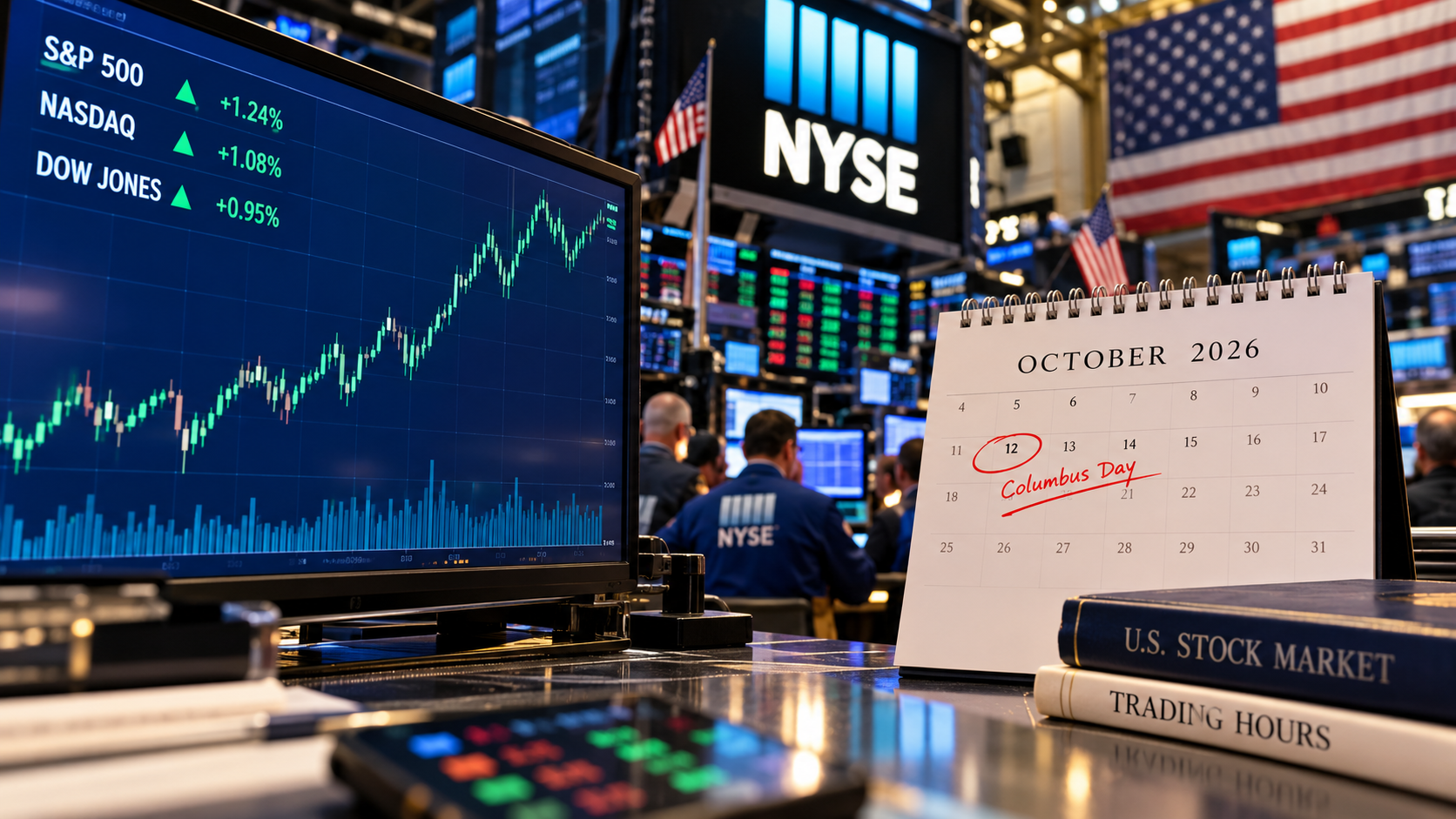
NYSE and Nasdaq are scheduled to trade their regular session on Monday, October 12, 2026, although the U.S. bond-market holiday schedule differs from that for stocks. Research cutoff: October 12, 2026; confirm developing facts before publication.
What is happening and why readers are searching
Yes. Monday, October 12, 2026 is Columbus Day, also observed by many as Indigenous Peoples’ Day, and the New York Stock Exchange and Nasdaq are scheduled to trade during their standard 9:30 a.m.–4 p.m. Eastern session. The bond market follows a different holiday schedule: SIFMA recommends a full closure in U.S. dollar fixed-income trading. Sources: NYSE and SIFMA holiday schedule.
The important context competitors can overlook
This distinction matters for more than trivia. A trader may see stocks move while some bond markets and banks are closed. Brokerage funding, transfer cutoffs and market data from less-liquid products can behave differently from a typical Monday. International exchanges observe their own holidays and may not follow the U.S. calendar. The federal holiday label alone does not tell a reader whether a particular financial instrument trades. For primary-source checks and current reporting, see NYSE and Kiplinger. The key distinction is separate equity, bond, bank and settlement schedules.
A practical way to use this information
Check your brokerage’s trading notice for options, mutual-fund cutoffs, fixed income and account funding. Avoid saying “the market is closed” without naming the asset class. Readers with urgent cash needs should confirm transfer and settlement arrangements directly with their institution. The next scheduled full U.S. stock-market holiday after October 12 is Thanksgiving Day, November 26, according to the exchange holiday calendars.
A holiday-hours comparison worth saving
| Market or service | October 12, 2026 | What to check |
|---|---|---|
| NYSE-listed shares | Regular session scheduled | Your broker and exchange notices |
| Nasdaq-listed shares | Regular session scheduled | Trading hours and order type |
| U.S. dollar bond market | SIFMA recommends closure | Fixed-income trading desk |
| Banks and transfers | Federal holiday may affect services | Your bank’s payment timetable |
NYSE exchange trading hours and the SIFMA holiday recommendation are different types of evidence. Neither establishes that every retail intermediary will offer normal transfer processing.
What to verify before making a decision
The right next step is to identify the source, timestamp and applicable market or jurisdiction. Check whether a number is a historical observation, official announcement, target, forecast or scenario. If you intend to act financially, legally or commercially, use the relevant provider’s current terms and obtain professional advice where appropriate. The sources cited here establish context; they are not a substitute for live prices, individual eligibility checks or binding agreements.
Reader questions
Can I buy U.S. stocks on Columbus Day?
Yes, the regular NYSE and Nasdaq session is scheduled.
Are Treasury bonds trading normally?
SIFMA recommends a U.S. bond-market holiday closure.
What “the market is open” actually means
The NYSE and Nasdaq trading session and the U.S. federal-holiday calendar are separate systems. On Monday, October 12, 2026, their standard core trading hours are scheduled to run from 9:30 a.m. to 4 p.m. Eastern Time. A share of a widely traded U.S. company can therefore change hands while many bank branches and government offices remain closed. But that statement does not tell you whether your brokerage’s customer-service desk is staffed normally, whether a fund values assets at its usual time, or whether a particular bond has a reliable two-sided quote. Those details depend on instrument, venue and broker.
For an investor outside the United States, convert Eastern Time carefully. Some countries move clocks on different dates, while others do not observe daylight saving time. A calendar showing “9:30” without a time zone is insufficient. Use the NYSE official market calendar as the first reference for exchange trading hours and your broker’s order preview for instrument-specific handling.
Stocks, Treasuries, funds and cryptocurrency are not interchangeable
A company’s listed common stock may trade normally even when the recommended U.S. bond-market session is closed. Treasury bonds, municipal bonds and corporate bonds do not operate in exactly the same way as exchange-listed shares. Fixed-income markets are fragmented, and a limited or irregular quoting environment can produce wider bid-ask spreads. Placing a market order in a thinly traded security can be more expensive than expected. Investors considering a bond trade should ask about dealer liquidity, execution timing and whether prices are executable rather than merely indicative.
Mutual funds, exchange-traded funds, stock-index futures and cryptocurrencies each have their own pricing mechanics. An ETF can trade on the stock exchange, but its underlying holdings could include instruments in markets observing a holiday. Mutual funds normally process orders according to their published prospectuses and cutoff policies. Futures venues publish product-specific schedules. Cryptocurrency markets trade around the clock, but uninterrupted availability does not guarantee tight spreads. Checking one “market open” headline is not enough to infer all these schedules.
Order types and settlement around a federal holiday
Imagine an investor who places an order for shares on Monday morning. The exchange may execute it during the ordinary equity session, but settlement and cash-transfer processing can be affected by banking holidays and applicable business-day conventions. A trade confirmation, settled-cash display and withdrawal availability are not the same event. The safest approach is to check the brokerage’s holiday operations notice rather than assuming that an executed trade instantly creates withdrawable cash. Different account types may impose additional restrictions.
For a volatile security, an investor can compare the displayed bid and ask before trading and consider a limit order rather than automatically accepting an uncertain market price. This does not guarantee execution. It does specify the least favorable purchase price or sale price the investor is willing to accept. Orders entered outside the core session may also have distinct participation, duration and execution rules, which a broker should disclose.
The practical Columbus Day checklist
A useful market-hours answer should cover more than the yes-or-no question. Check the exact date and year, the trading venue, the time zone, the security type, your brokerage’s processing calendar and any early-closing notice. For dollar-denominated fixed income, consult the SIFMA holiday schedule. For your specific bank, inspect its branch and electronic-transfer information. Do not assume a bank holiday means cards stop working or electronic trading becomes impossible; these are distinct operations.
Holiday headlines can also expire quickly. A search result from 2025 or 2027 might display the same Columbus Day keywords yet give the wrong weekday or market specifics. Editors should include “Monday, October 12, 2026” near the top and remove any blanket claim that all financial markets are open. If the story is reused next year, the date and all supporting calendars need new verification.
What to do if a trade or transfer is urgent
For an urgent payment, ask the receiving institution about cutoff times and whether it recognizes the holiday as a processing day. For an urgent investment order, verify the specific instrument’s status directly in the broker interface and review the quote rather than trusting a static article. Where timing is not essential, waiting for ordinary liquidity can be more sensible than accepting a large spread. These are general execution considerations, not recommendations to buy or sell any particular security.
The broader lesson is that exchange trading, dealer liquidity and banking settlement are three separate clocks. Columbus Day demonstrates why a short market-hours answer is useful as a starting point but inadequate for every investor’s operational decision.
Discover more from The Economy
Subscribe to get the latest posts sent to your email.

Conagra Brands has stopped producing Celeste frozen pizza, bringing an end to the familiar budget-friendly product line. The company disclosed its decision as part of a wider simplification of its food portfolio during its fiscal first-quarter 2027 earnings cycle. A Conagra representative subsequently confirmed that existing retail inventory can continue to sell, but the company is no longer manufacturing new Celeste pizzas. That means a shopper may still spot a box in a freezer, even though production has ceased. Conagra’s quarterly results and Fox Business’s confirmation from the company establish the basic facts.
Key takeaways:
- The decision is a confirmed discontinuation, not a social-media rumor or temporary nationwide recall.
- Existing products may remain on shelves until inventories run out; availability is local and cannot be guaranteed.
- Conagra’s management presented Celeste as part of a broader effort to simplify underperforming brands and individual product lines.
- A brand’s devoted following does not necessarily make it profitable to produce and distribute nationally.
Did Celeste frozen pizza really stop production?
Yes. During the September 30, 2026 earnings discussion, management identified the exit from Celeste as one example of simplifying Conagra’s assortment. In a statement reported by Fox Business, the company said it had stopped making Celeste and would sell remaining inventory. The same report said Conagra viewed the exit as positive for future margins, despite a small negative contribution to reported quarterly sales.
Two distinctions matter. Production means manufacturing fresh units for shipment. Distribution and retail availability depend on the inventory already in warehouses, on trucks, or in stores. Stopping production does not instantly remove all existing boxes from sale. Nor is there evidence in the reviewed statements of a restart date or replacement product under the same brand.
Shoppers seeking an answer to “Is Celeste discontinued?” should therefore treat the answer as yes, while recognizing that a few locations may continue selling stock for a limited period. Store-listing pages can lag real inventory. Checking a retailer’s stock status or contacting the store is more useful than relying on an old product listing.
Why Conagra made the decision
Conagra is pursuing a leaner mix of products. The company said its fiscal first-quarter reported net sales fell 1.4%, while reported diluted earnings per share rose 5.9% from the year-earlier period. Its earnings announcement also reaffirmed fiscal-year guidance for an organic sales decline of 1% to 3%. Conagra’s September 30 release provides the financial context.
The takeaway is not simply that one pizza sold poorly. Large packaged-food companies face costs across manufacturing capacity, ingredients, packaging, transportation, shelf space and promotional activity. Each different size or variety adds complexity. A low-volume item can consume factory time and distribution attention that might otherwise support a larger brand or faster-growing category.
Industry publication Food Dive described Celeste’s removal as an early sign of a larger portfolio review. Food Processing similarly framed the move as SKU rationalization—industry shorthand for trimming individual products or assortments.
What SKU rationalization means to shoppers
A stock-keeping unit, or SKU, is a specific retail product variation. Cutting SKUs can mean eliminating a flavor, size or entire line. It may improve the manufacturer’s operating efficiency, but it also reduces choice. In Celeste’s case, the reported decision is broader than dropping one variety: the brand’s frozen pizzas are no longer being produced.
This is a trade-off for retailers too. Shelf space is limited; grocers favor products that sell consistently, generate acceptable margins and are easy to replenish. A long-established label can therefore disappear even if a loyal group of customers still buys it.
Celeste’s history explains the reaction
The nostalgic response is not difficult to understand. According to People’s history of the brand, Celeste grew out of the Lizio family’s frozen-pizza business in Illinois in the early 1960s, then gained wider national distribution after its sale to Quaker Oats in 1969. Its single-serving format became part of ordinary freezer routines for generations of customers.
That history has value, but sentimental recognition differs from today’s unit economics. A brand’s cultural footprint captures decades of purchases and memories. A modern annual business review measures recent sales velocity, production costs, distribution economics and likely future performance. Both can be true: consumers can love a product while its owner concludes the business does not justify further investment.
It would be misleading, however, to assign a definitive financial loss to Celeste alone. The public earnings figures reviewed here describe Conagra as a whole and management’s portfolio strategy, not an audited standalone Celeste profit-and-loss statement.
Can customers still buy Celeste pizza?
Possibly, for a limited time. Conagra’s confirmation leaves open the sale of units already produced. Grocery availability can vary across chains, individual stores and locations; stock may disappear at different speeds.
| What a customer sees | What it means |
|---|---|
| Celeste box still in a freezer | Likely remaining inventory; it does not prove production restarted |
| Product displayed on a retailer website | A listing is not a stock guarantee; verify store availability |
| Product shown as out of stock | Could indicate local sell-through; not necessarily a separate recall |
| Social post promising a return | Do not rely on it without a new manufacturer announcement |
| Old coupon or promotion | Terms and actual retailer supply still control |
For any remaining frozen product, follow the labeled storage and preparation instructions. Avoid stockpiling food if storage quality cannot be maintained. Price surges by third-party sellers should not be mistaken for an official recommended retail price.
Does this signal trouble for the wider frozen-pizza market?
Not necessarily. One company’s decision about one brand cannot establish a decline across the entire frozen-pizza category. Portfolio simplification can happen even in categories with viable demand, particularly when individual products fail to justify operational complexity. Conversely, a popular category does not guarantee that every brand or price point performs well.
Conagra’s wider fiscal results show a company navigating sales pressure while trying to maintain profitability. The decision makes sense as part of management’s stated plan. To establish a wider market decline would require independently sourced industry unit sales, dollar sales, pricing and retailer data—none of which should be invented to make a broader headline.
What happens next for Conagra?
Management has signaled a continuing review of its assortment. Investors will watch subsequent quarterly disclosures for signs that lower complexity improves profit margins without causing excessive loss of sales. Customers will watch for further product exits and which remaining brands receive greater shelf presence.
A successful simplification program would ideally improve factory utilization, inventory efficiency and brand investment. But there are risks: removing too many niche products may push loyal customers toward competitors. The outcome is measurable only over future reporting periods.
Frequently asked questions
Is Celeste frozen pizza permanently discontinued?
Conagra has confirmed production stopped and provided no restart plan in the statements reviewed as of October 10, 2026. It is appropriate to describe the product as discontinued; any future return would require a new announcement.
Why did Conagra stop making Celeste?
Conagra presented the exit as part of a strategy to remove smaller, lower-return businesses and simplify its product portfolio. Its earnings materials provide context.
Can I still find Celeste at Walmart or Kroger?
A retailer could still have previously manufactured stock, but availability varies. Check a specific store rather than assuming the product remains nationally stocked.
Was Celeste pizza recalled?
The reporting reviewed here describes a business discontinuation, not a safety recall. If concerned about a specific package, consult the official recall notices and the package details.
Will another company buy or relaunch Celeste?
There is no verified agreement or relaunch timetable in the material reviewed. Speculation about a buyer should not be published as fact.
Who owned Celeste at the end?
Conagra Brands was the manufacturer and brand owner responsible for the discontinuation announcement.
Bottom line
Celeste’s removal illustrates how an iconic grocery brand can be commercially vulnerable in a modern food portfolio. The key consumer fact is straightforward: the manufacturing run has ended, but existing inventory may remain for sale. The larger business story is Conagra’s effort to put resources behind products with stronger expected returns. Readers should look for verified new company disclosures rather than assume the label will return.
Discover more from The Economy
Subscribe to get the latest posts sent to your email.

The central business question about artificial intelligence has changed. Access to a capable tool is no longer enough to demonstrate an advantage. The harder test is whether the organisation produces better results after accounting for review, integration, training and operating costs.
McKinsey’s 2026 State of AI survey captures this tension. Eighty percent of respondents reported improved individual productivity, while 37% attributed some enterprise-level earnings impact to AI. Those findings describe the survey sample; they do not prove that every company sees the same pattern.
Nevertheless, the distinction is commercially important. An employee can finish a draft faster while the organisation remains constrained by approvals, unreliable data or a lack of customer demand. Businesses need to measure the complete process rather than celebrate speed at one stage.
Task improvement and business improvement are different
Imagine a customer-service team using AI to draft replies. Drafting time falls, but every response still passes through the same review queue. If that queue is the main source of delay, customers may notice little improvement.
Alternatively, the tool may let the team handle more requests with the same staffing. That could improve service even if no job is removed and no immediate payroll saving appears. The value would show up in capacity, response times or customer retention rather than a simple reduction in wages.
These are illustrative cases, but they expose a common measurement problem. Time saved is an intermediate result. The business still has to convert that time into additional output, better quality, reduced costs or another outcome it actually values.
The strongest pilot starts with a baseline
Before introducing a tool, record how the process currently performs. Useful measures might include turnaround time, error frequency, rework, customer complaints and cost per completed case. A baseline prevents ordinary variation from being mistaken for an AI benefit.
The unit of measurement should match the business objective. Counting generated documents says little about whether the documents were useful. Counting chatbot interactions does not show whether customers resolved their problems. High usage can even indicate confusion if people repeatedly retry unsuccessful tasks.
A pilot should also identify what success would justify expansion. For example, a team might require faster completion without an increase in material errors. Deciding that threshold in advance makes it harder to redefine success after seeing disappointing results.
Calculate the full cost, including human review
Subscription fees are only one part of AI expenditure. Integration work, access controls, evaluation, staff training and ongoing supervision can be substantial. Consumption-based charges may also increase as a pilot moves into routine use.
McKinsey’s survey reports that roughly one-fifth of respondents encountered AI operating costs that constrained usage. That is a reminder to model expenditure under realistic volumes rather than assume that the price of a small experiment represents the cost of a production system.
Consider a hypothetical team saving 100 hours a month. If review and correction consume 40 additional hours elsewhere, the net time benefit is 60 hours before other costs. If the saved time cannot be redeployed, its financial value may be smaller than multiplying those hours by an employee’s salary would suggest.
Redesign the workflow around the actual bottleneck
Adding AI to an inefficient process can accelerate one step while preserving the underlying problem. A sales team might generate more proposals while approvals remain slow. A finance department might classify invoices faster while unresolved supplier records continue to block payment.
The practical response is to map the whole process. Identify where work waits, where mistakes originate and which decisions require human judgment. Then determine whether AI addresses that constraint or merely produces more material for someone else to review.
This approach can lead to smaller, more useful deployments. A reliable extraction tool tied to a clear review procedure may deliver more value than an ambitious agent with broad permissions. The right scope depends on the task’s consequences, available data and the organisation’s ability to detect errors.
Quality has to be measured alongside speed
AI output can sound persuasive while containing mistakes. Businesses therefore need evaluation methods that reflect the consequences of failure. A minor tone problem in an internal draft differs from an incorrect price, contractual statement or customer instruction.
The NIST AI Risk Management Framework provides an official reference for thinking about AI risks and governance. Applied operationally, the relevant question is simple: which failures matter, how will they be detected, and who is responsible for responding?
Testing should include difficult and unusual cases, not just representative easy ones. A system that performs well on routine requests can still fail where a policy has exceptions or the underlying information is incomplete. The cost of those failures belongs in the business case.
Data access can matter more than model choice
A model cannot reliably answer organisation-specific questions if the relevant information is missing, outdated or contradictory. Businesses may discover that the most valuable preparatory work is cleaning records, assigning ownership and resolving conflicting policies.
Permissions matter too. Connecting an assistant to more information can improve usefulness while increasing the consequences of an access mistake. The deployment needs a clear account of who may see which material and what actions the system is permitted to take.
This creates an important procurement distinction. A compelling demonstration with carefully selected data does not establish readiness for the company’s actual environment. Buyers should ask how updates are handled, how errors are investigated and whether the product can be evaluated on realistic internal cases before a broad commitment.
Infrastructure growth is a separate investment story
The AI economy includes chip suppliers, data centres, power systems, software companies and businesses adopting applications. They do not all earn returns in the same way or on the same schedule.
The International Energy Agency’s Energy and AI report examines the relationship between AI and energy systems. For business analysis, the distinction matters because demand for computing infrastructure can grow even while some end users struggle to demonstrate profitable applications.
An investor or executive should therefore separate spending growth from return on that spending. A supplier can benefit from a construction cycle before the customer achieves a satisfactory payoff. Over time, however, customer economics matter to the durability of demand. Strong capital expenditure is evidence of commitment, not conclusive proof of eventual value.
What smaller businesses can do differently
A smaller company may lack the budget for extensive custom infrastructure, but it can still choose a narrow problem with a measurable outcome. Repetitive internal documentation, information retrieval or draft preparation may offer a manageable starting point when data and review requirements are clear.
The business should assign an owner who understands the process rather than treating the project as a tool purchase alone. That person can gather feedback, identify recurring failures and decide whether the deployment is helping employees complete useful work.
Expansion should follow evidence. If a pilot creates little value, the next step might be redesign, a different tool or stopping the experiment. A willingness to stop is part of competent investment management. Continuing simply because AI is strategically fashionable can turn a limited test into an expensive routine.
A practical scorecard for the next quarter
Track five things together: outcome quality, total completion time, cost per completed task, user adoption and the frequency of significant failures. The combination provides a more balanced view than any single headline metric.
Review how much of the benefit is repeatable. A one-time backlog reduction may be valuable without supporting the same ongoing return. Similarly, enthusiastic early users may not represent employees who encounter the system later with less training or motivation.
AI’s commercial promise in 2026 is substantial, but the route to value runs through ordinary operational discipline. Businesses need clear objectives, dependable information, realistic cost accounting and responsibility for the final result. The most useful question is not how much AI the organisation uses. It is what customers, employees and owners receive in return.
Discover more from The Economy
Subscribe to get the latest posts sent to your email.

Oil and Diesel Prices in October 2026: How Supply Shocks Can Reach Inflation

AI Chip Demand in 2026: What TSMC, Nvidia and Data-Center Spending Reveal

Q3 2026 Earnings Season: The Bank, AI and Consumer Signals That Really Matter

Treasury Yields in 2026: Why Higher Bond Rates Matter for Stocks, Mortgages and Savings

KOSPI 2026: Why South Korean Stocks Turned Volatile and What AI Investors Should Watch

IREN Stock in 2026: AI Cloud Growth, Bitcoin Transition and the Risks Investors Miss

Stock Market Crash in 2026? Warning Signs, Scenarios and a Calm Investor Checklist

Peso Mexicano vs Dólar Estadounidense: A Practical USD/MXN Guide for October 2026

Is the Stock Market Open on Columbus Day 2026? NYSE, Nasdaq and Bonds Explained

Concert Ticket Prices in 2026: Dynamic Pricing, Fees and How to Buy Safely

High-Yield Savings Accounts in 2026: How to Compare APY Without Chasing a Headline

EU-China Trade Deal 2026: How Beijing and Brussels Avoided a Trade War—and Who Wins

Social Security 2027 COLA Announcement: Date, Formula and What Retirees Should Check

China’s AI Microdrama Boom: How Beijing Is Reshaping Global Media

China Stocks Today: Are Big Economies in Asia Nearing a Market Bottom?

World’s Largest Economies: Ranking the Top Global Powers

Global Pension Systems Ranked: The World’s Best and Worst Retirement Frameworks

Elon Musk’s Next Moves: Disrupting the 2026 Global Economy

Pakistan Economy 2026: Inside the SBP’s Balancing Act

Crude Oil & Petroleum Market Analysis: OPEC+ Decisions and Price Forecasts

GasBuddy Market Insights: How Crude Price Shifts Impact Local Fuel Cost Averages

Global Equity Market Divergence: US Tech vs. European Dividend Stocks vs. Asian Growth

IMF & World Bank Global Economic Outlook: Growth Forecasts Across Europe and Asia

Silver Price Today: Why the Xi-Trump AI Standoff Is Fueling a Safe-Haven Rally

Bitcoin Price Forecast 2026–2027: Will the 4-Year Cycle Hold?

Asian Stock Markets 2026: Japan, China, Pakistan & More

The Future of Silicon: Supply Chain Vulnerabilities in the 2026 Tech Sector

SpaceX IPO: How Aerospace Is Reshaping Tech Startup News
-

 Markets & Finance9 months ago
Top 15 Stocks for Investment in 2026 in PSX: Your Complete Guide to Pakistan’s Best Investment Opportunities
-

 Analysis8 months ago
Johor’s Investment Boom: The Hidden Costs Behind Malaysia’s Most Ambitious Economic Surge
-

 Analysis8 months ago
Top 10 Stocks for Investment in PSX for Quick Returns in 2026
-

 Banks9 months ago
Best Investments in Pakistan 2026: Top 10 Low-Price Shares and Long-Term Picks for the PSX
-

 Analysis8 months ago
Brazil’s Rare Earth Race: US, EU, and China Compete for Critical Minerals as Tensions Rise
-

 Investment9 months ago
Top 10 Mutual Fund Managers in Pakistan for Investment in 2026: A Comprehensive Guide for Optimal Returns
-

 Global Economy10 months ago
15 Most Lucrative Sectors for Investment in Pakistan: A 2025 Data-Driven Analysis
-

 Global Economy10 months ago
Pakistan’s Export Goldmine: 10 Game-Changing Markets Where Pakistani Businesses Are Winning Big in 2025