
Social Security
Social Security Extra $90 Deposit: Who Qualifies for the October 2026 Medicare Rebate?


Millions of Americans are seeing, or expecting, an extra $90 payment connected to the Social Security Administration this October. The reason is a one-time Medicare Part B premium rebate from the Medicare Improvement Fund, not an across-the-board monthly increase in Social Security retirement benefits. The Centers for Medicare & Medicaid Services (CMS) says an estimated 20.8 million eligible beneficiaries will receive one $90 payment in October 2026. Most direct deposits were expected on or around October 8, with paper checks arriving later in the month.
Key takeaways:
- The $90 payment is a one-time rebate, not a new monthly Social Security benefit.
- It is limited to specific Original Medicare Part B enrollees; not everyone who receives Social Security qualifies.
- CMS identifies Medicaid premium assistance, income-related premium adjustments and Medicare Advantage enrollment as exclusions.
- Eligibility questions go to 1-800-MEDICARE; CMS directs people to contact Social Security about payment status beginning October 15, 2026.
What is the $90 Social Security deposit?
The federal government announced the $90 rebate to help eligible people offset Medicare Part B premium costs. Part B generally covers physician and other outpatient medical services. For many retirees, Part B premiums are deducted from monthly Social Security payments, which explains why the rebate may be described informally as an “extra Social Security deposit.”
That language can mislead readers. The Social Security Administration is involved in distribution, but the policy is a Medicare premium rebate funded through the Medicare Improvement Fund. It should not be confused with Supplemental Security Income (SSI), the Social Security cost-of-living adjustment (COLA) or an extra monthly pension check.
According to CMS’s October 3 fact sheet, eligible beneficiaries normally do not need to apply separately to receive the payment. The White House announced the program on October 2. The source of the funding and the timing ahead of November’s midterm elections have also generated political debate, as covered by Associated Press. Political discussion should not obscure the practical payment rules.
Who qualifies for the $90 Medicare rebate?
The CMS FAQ states that the payment is for approximately 20.8 million people enrolled in Original Medicare Part B, residing in the United States and meeting the agency’s premium-assistance and income-related adjustment conditions. CMS says beneficiaries enrolled in Medicare Advantage are not eligible. People whose Part B premiums are paid with Medicaid assistance and people paying an Income-Related Monthly Adjustment Amount (IRMAA) are also excluded under the published guidance.
Use this screening table as an explanation, not a substitute for an official eligibility determination:
| Situation | What the published CMS guidance indicates |
|---|---|
| Original Medicare Part B; U.S. resident; no listed exclusion | Potentially eligible for one $90 rebate |
| Medicare Advantage enrollee | Not eligible under CMS’s October FAQ |
| Medicaid pays Part B premium | Excluded |
| Pays IRMAA income-related Part B surcharge | Excluded |
| Receives Social Security but is not enrolled in qualifying Part B | Social Security receipt alone does not qualify |
| Lives outside the United States | Does not meet the stated U.S. residency criterion |
This table necessarily simplifies individual circumstances. People with mixed coverage, recent enrollment changes or disputed premium status should check directly with Medicare at 1-800-633-4227.
Why so many Medicare beneficiaries do not qualify
Medicare has different coverage routes. Some beneficiaries use Original Medicare with Part A and Part B; others receive benefits through Medicare Advantage plans administered by private insurers. Some low-income beneficiaries receive Medicaid assistance with their Part B premiums. Higher-income enrollees may pay IRMAA surcharges. The new rebate targets only the narrower group specified by CMS, not the entire Medicare population.
This distinction helps explain CBS News reporting about why many older Americans received the deposit while tens of millions did not. Lack of a payment does not automatically indicate a government error or missed Social Security benefit.
When will the $90 be deposited?
CMS’s schedule says most eligible beneficiaries should receive a direct deposit on or around October 8, 2026. Others should receive paper checks issued by the U.S. Treasury later in October. That wording describes a general rollout rather than an individual promise that every bank account will show money on the same day.
The federal guidance says eligible mailed-check recipients may see a description along the lines of a Medicare Improvement Fund payment offsetting the October premium. A letter or email explaining the rebate may arrive around mid-October. Notification correspondence is not itself a condition for payment.
What if October 8 passed and there is no deposit?
Do not assume you are entitled to a missing deposit until eligibility is established. First, check that you have qualifying Original Medicare Part B coverage and are not in an excluded category. Then inspect your bank history for an independently verifiable federal payment. If a mailed check is expected, allow for the stated later-in-October schedule.
For eligibility, CMS directs beneficiaries to 1-800-MEDICARE (1-800-633-4227). For payment status, CMS directs beneficiaries to the Social Security Administration at 1-800-772-1213 beginning October 15, 2026. These divisions of responsibility are unusually important: calling the right agency with the right question may prevent repeated transfers or misleading social-media advice. CMS official FAQ.
Is the $90 payment monthly or recurring?
No. CMS describes one rebate in October 2026. It is not a new recurring $90 monthly add-on. A person who receives the payment should not automatically add $90 to every future month’s household budget.
This also is not the same as the 2026 Social Security cost-of-living adjustment. The Social Security Administration says 2026 benefits received a 2.8% COLA, beginning with applicable January benefit payments. That annual adjustment follows a separate calculation and timeline. The Medicare rebate and the COLA operate under different rules, even when both affect a retiree’s bank balance.
| Feature | October $90 rebate | Social Security COLA |
|---|---|---|
| Purpose | One-time Medicare Part B premium offset | Annual benefit adjustment linked to inflation |
| Amount | $90 for an eligible person | Varies by individual benefit amount |
| Frequency | Once, per CMS announcement | Adjustment to ongoing benefits |
| Eligibility | Specific Original Medicare Part B group | Social Security/SSI entitlement rules |
| Source to verify | CMS Medicare Improvement Fund FAQ | SSA COLA page |
Is the rebate a scam?
The rebate itself is real and documented on a federal government website. That does not mean every unsolicited call, text message, social post or website about claiming it is legitimate. Be wary of anyone asking for a processing fee, bank password or verification code to unlock a $90 payment.
Because CMS describes automatic distribution, a message directing you to pay a fee or submit sensitive information through an unknown link should raise immediate concern. Instead, navigate independently to CMS.gov or SSA.gov or call the published numbers. Do not trust a phone number copied from a suspicious text.
How much difference can $90 make?
For a beneficiary facing recurring medical and living expenses, $90 can offer modest immediate relief. But its financial impact needs perspective: a one-time offset does not permanently reduce the future monthly Part B bill, cover all out-of-pocket healthcare costs or guarantee lower premiums in subsequent years.
Associated Press coverage notes that the payment is being distributed in a politically charged period. Supporters frame it as direct affordability relief. Critics question whether a one-off payment meaningfully changes long-term healthcare costs. Both policy debates are separate from the factual question of whether an eligible beneficiary should receive $90.
Frequently asked questions
Why did Social Security send me $90?
If you qualify, it is likely the one-time Medicare Improvement Fund premium rebate. Confirm the entry with official records rather than relying solely on the bank description.
Do all retirees receive the $90?
No. CMS limits eligibility to a specific group of Original Medicare Part B enrollees and lists several exclusions.
Is the payment related to the 2026 COLA?
No. The 2026 COLA is a separate ongoing benefit adjustment; the $90 rebate is one-time.
Are Medicare Advantage members eligible?
No, according to CMS’s October 3 FAQ.
What if I receive both Medicare and Medicaid?
If Medicaid pays your Part B premium, the CMS guidance says you are excluded. Confirm individual circumstances through Medicare.
When should I call if payment is missing?
CMS directs beneficiaries to Social Security about payment status beginning October 15; call Medicare for eligibility questions.
Do married couples get $180?
If both individuals independently meet the federal eligibility rules, each could qualify for a separate $90 rebate. Marriage alone does not create an additional payment.
Bottom line
The extra $90 is real, but the phrase “Social Security bonus” is misleading. It is a single, targeted Medicare Part B rebate scheduled for October 2026. Check your coverage type, understand the exclusions and use official Medicare or SSA channels for unresolved questions. Avoid anyone charging a fee to unlock the payment.
Discover more from The Economy
Subscribe to get the latest posts sent to your email.


Social Security
Social Security $90 Payment Claims: What’s Real, What’s a Scam, and What Your 2027 COLA Could Be

No official $90 Social Security payment exists. Here’s how to spot the claim, check your real payment date, and estimate the 2027 COLA increase.
Key Takeaways
- We found no official Social Security program that pays a $90 benefit. Viral claims about special Social Security payments have repeatedly been debunked as scams.
- Regular benefits follow a birth-date schedule, with most payments on a Wednesday. The Social Security Administration publishes the full calendar at ssa.gov.
- The 2026 cost-of-living adjustment was 2.8%. Forecasts for the 2027 COLA cluster around 3.2% to 3.6%, but the official figure is not announced until October 14, 2026.
- The Social Security Administration will never ask you to pay a fee or share your bank details to receive a benefit or adjustment.
Search Intent Summary
Readers searching for a “$90 Social Security payment” usually want one of three things: to know whether they’re owed money, when their next check arrives, or how much their benefit will rise. This guide answers all three and flags the claims that are not real.
Why the “$90 Payment” Claim Doesn’t Hold Up
We could not find any government announcement, Social Security Administration notice, or credible news report describing a $90 payment to beneficiaries. The pattern is familiar. Social Security scam posts frequently promise a sudden payment or boost, then send readers to a link that asks for personal information.
The same playbook has appeared before. In 2022, a Facebook post claimed people born before 1957 were getting a $1,728 boost to their checks. USA Today’s fact-check found that no such benefit had been announced, and the promoted page was a non-government site. PolitiFact reached the same conclusion, and the Social Security Administration told reporters to check its website for accurate information.
In 2024, a rumored $600 increase spread online. The Social Security Administration’s Office of the Inspector General warned that people were seeking personal information in exchange for a cost-of-living adjustment that does not work that way.
If you saw a $90 claim, ask three questions. Does it appear on ssa.gov? Does it require you to pay a fee, enter your Social Security number, or click a link to “claim” money? Is it described by a news outlet that cites the agency directly? If the answer to the first and third is no, or the second is yes, treat it as a scam.
The Social Security Administration’s scam awareness page lists the warning signs. Legitimate contact from the agency is limited, and it never threatens you or demands payment by gift card or wire transfer.
How Your Regular Payment Date Works
Most people receive their benefit on a schedule tied to their birth date. Social Security pays on the second, third, or fourth Wednesday of the month:
- Birth dates from the 1st to the 10th: second Wednesday
- Birth dates from the 11th to the 20th: third Wednesday
- Birth dates from the 21st to the 31st: fourth Wednesday
Two groups follow different timing. People who began receiving benefits before May 1997 are paid on the 3rd of each month. People who receive both Social Security and Supplemental Security Income are also paid on the 3rd, while SSI alone is paid on the 1st.
When a payment date falls on a weekend or federal holiday, payment comes on the previous business day. Some months have no regular payment in the normal sense because the schedule shifts. Check your exact dates in your my Social Security account rather than relying on a third-party calendar.
If your payment is late, the agency suggests waiting three business days before you report it. Most beneficiaries now receive direct deposit, and the Social Security Administration no longer mails checks to most new recipients.
The 2027 COLA: What to Expect
The cost-of-living adjustment is the one increase that does reach every beneficiary’s check. The Social Security Administration calculates it from the CPI-W, an inflation measure for wage earners and clerical workers. The agency compares the average CPI-W for July, August, and September with the same three months a year earlier.
For 2026, the adjustment was 2.8%. Forecasts for 2027 have moved in a narrow range this year. The Committee for a Responsible Federal Budget projected 3.2%, and The Senior Citizens League projected 3.6% in its latest update, down from 3.8% earlier in the summer.
To see what those numbers mean in dollars, take the average retirement benefit of $2,086 reported for July 2026. A 3.6% increase would raise it by about $75 a month, to roughly $2,161. A 3.2% increase would add about $67 a month.
Those are estimates. Official figures become final only after the September inflation data is released, which means the 2027 COLA could still shift. The agency announces the official figure on October 14, 2026, and that announcement is the number to plan around.
What Could Change Your Check
The COLA is not the only factor. Three other items commonly affect what you receive.
Medicare Part B premiums are usually deducted from Social Security benefits, so a premium increase can offset part of a COLA. Check the Medicare announcement alongside the COLA.
Federal income tax may apply to part of your benefit if your combined income crosses certain thresholds. Those thresholds are set in law and are not indexed to inflation in the same way.
Overpayments and withholding changes also affect the net amount. If the agency tells you that you were overpaid, it typically recovers the money through reduced future payments. Contact the agency if you believe a notice is wrong.
A Practical Checklist
Start by logging into your my Social Security account to confirm your payment date, deposit method, and mailing address. Set up deposit alerts from your bank if you want an early warning when a payment posts.
Compare any unexpected payment offer against ssa.gov before you act. If a message asks for your Social Security number, bank login, or a payment to “release” funds, stop and contact the agency directly through its official number or website.
After the October 14 COLA announcement, use the new figure to update your household budget. Expect the increase to appear in your January 2027 payment.
Future Outlook
Social Security will keep producing these claims for as long as there is money and a large audience to exploit. The real benefit changes will be announced through official channels, with the COLA the most predictable of them. Program financing and any changes to benefit formulas are subject to ongoing policy debate, so watch the agency’s own announcements rather than secondhand summaries.
Frequently Asked Questions
Is there a $90 Social Security payment?
We could not find any official Social Security program paying a $90 benefit. Claims of special payments, boosts, or stimulus-style checks have repeatedly been debunked. Check ssa.gov or contact the agency directly before acting on any offer.
When will I get my Social Security payment?
Most beneficiaries are paid on the second, third, or fourth Wednesday, based on birth date. People who started before May 1997 and those receiving both Social Security and SSI are paid on the 3rd. Your exact date appears in your my Social Security account.
When is the 2027 COLA announced?
The Social Security Administration will announce the 2027 cost-of-living adjustment on October 14, 2026. Forecasts currently cluster between 3.2% and 3.6%, but the official figure may differ.
How do I avoid Social Security scams?
Never pay a fee to claim a benefit, and never share your Social Security number or bank details with someone who contacted you unexpectedly. Verify any claim on ssa.gov, and report suspicious contact through the agency’s scam reporting channels.
Discover more from The Economy
Subscribe to get the latest posts sent to your email.
Key Takeaways
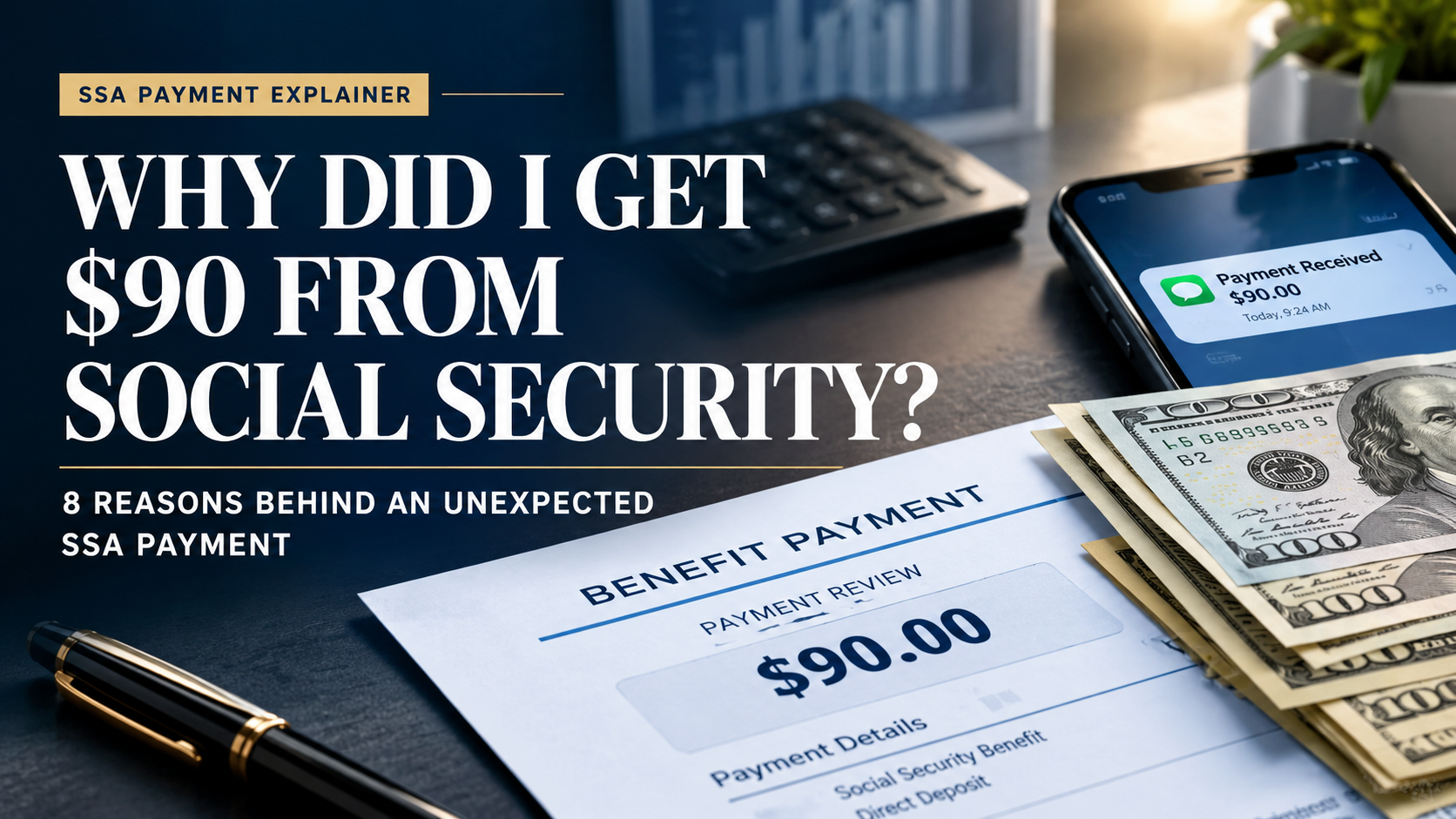
- A surprise $90 deposit is usually an adjustment, not a gift. The most common causes are back pay, a benefit-rate change, a Medicare premium correction or a recalculation after you worked.
- Check your records before you spend it. Your my Social Security account and any mailed notice should explain the payment. Letters often trail the deposit by days.
- Overpayments are real, and they are recoverable. If SSA decides it paid you too much, it can withhold 50% of your monthly benefit, or 10% of an SSI payment, after giving you notice.
- 2026 has more moving parts than usual. A 2.8% cost-of-living adjustment, a higher Medicare Part B premium and ongoing Social Security Fairness Act recalculations all touch payment amounts.
- Never send money back to a caller or texter. Real SSA problems arrive by letter or inside your online account, not through gift-card demands.
You open your banking app and there it is: a deposit labeled something like “SSA TREAS 310,” and it is $90 you didn’t expect. It isn’t your normal payment day. It isn’t your normal amount.
Your first feeling is probably a mix of hope and dread. Is the government sending you extra money? Or is this the opening move in a clawback?
The honest answer is that only the Social Security Administration can tell you what happened to your record. But the list of likely explanations is short, and you can narrow it down in about ten minutes. This guide walks through the payment calendar, eight common causes, what an overpayment looks like, and the exact steps to confirm what you received.
First, Was It Really Off Schedule?
Before you chase a mystery, confirm that the date is actually unusual. SSA pays on a fixed pattern, laid out in its 2026 benefit payment schedule.
| Your situation | When Social Security pays |
|---|---|
| Birthday on the 1st through 10th | Second Wednesday of the month |
| Birthday on the 11th through 20th | Third Wednesday of the month |
| Birthday on the 21st through 31st | Fourth Wednesday of the month |
| Started benefits before May 1997, or receive both Social Security and SSI | The 3rd of the month |
| SSI payments | The 1st of the month |
In October 2026, for example, the Wednesday groups are paid on the 14th, 21st and 28th. If a $90 deposit landed outside your slot, you can rule out a simple timing quirk. If it landed inside your slot, check whether your regular payment changed instead.
Eight Reasons You Might Have Received $90
1. Retroactive benefit adjustment (back pay)
This is the classic one. SSA recalculates a benefit and discovers you were underpaid for earlier months. Rather than waiting for your next regular deposit, it often pays the difference immediately.
Here is a purely hypothetical example. If your monthly benefit was corrected upward by $45, and the change applies to the previous two months, you would see a catch-up deposit of $90.
2. The 2026 cost-of-living adjustment
Benefits rose 2.8% in January 2026, which SSA put at about $56 more per month for the average retired worker. On the average benefit of roughly $1,920, a 2.8% increase is around $54 a month. A $90 gap could reflect a larger-than-average benefit, a delayed processing of the raise, or a COLA plus another adjustment stacked together.
3. A Medicare Part B premium change
Most beneficiaries over 65 have their Part B premium deducted before the deposit hits. The standard premium is $202.90 in 2026, up $17.90 from last year, with a $283 annual deductible. If your premium was corrected or your income-related surcharge was adjusted, the difference can surface as a small one-time payment or as a changed deduction. Both are worth checking.
4. Social Security Fairness Act recalculations
The Social Security Fairness Act repealed the Windfall Elimination Provision and Government Pension Offset, which had reduced benefits for many people with public pensions. SSA published a dedicated page on the law. If you or a spouse worked in government jobs outside Social Security, a late recalculation can still generate adjustments.
5. A recomputation after you kept working
If you continued working after you started benefits, SSA can review your earnings and raise your benefit. The increase may come with a small back payment covering the months it should have applied.
6. Family or survivor benefit changes
Benefits paid to spouses, children or survivors are linked to the worker’s record. When one person’s status changes, the others’ amounts can shift, and SSA may true up the difference.
7. An SSI or state supplement change
If you receive Supplemental Security Income, small amounts can move because of changes in income, living arrangements or a state supplement. SSI payments also follow their own calendar, so the timing can look odd.
8. A refund of previously withheld money
If SSA withheld too much earlier, for an overpayment recovery or a premium, it may refund the excess. A refund usually comes with a notice explaining the math.
What If It’s an Overpayment?
Sometimes the answer is less pleasant. An overpayment happens when SSA pays more than the law allows. It can follow unreported work, a change in marital status or living situation, or a simple processing error.
Here is how the process works, according to SSA’s overpayment page:
- You get a notice explaining the amount and the reason.
- SSA waits at least 30 days before it begins collecting.
- After that, it withholds 50% of your benefit or 10% of an SSI payment each month until the debt is repaid, unless you arrange something different.
You have options. According to SSA’s overpayment fact sheet, you should contact SSA within 60 days if you want to appeal. If you agree you were overpaid but it wasn’t your fault and repayment would be a hardship, you can request a waiver using Form SSA-632-BK. For smaller overpayments of $1,000 or less, a waiver request may be possible by phone. NerdWallet’s guide to Social Security overpayments walks through the appeal-versus-waiver choice in plain English.
| If your notice says… | Your likely move |
|---|---|
| You were not overpaid, or the amount is wrong | Appeal within 60 days |
| You were overpaid, but it wasn’t your fault and you can’t afford repayment | Request a waiver |
| You were overpaid and agree | Ask for a repayment plan you can afford |
How to Find Out What Happened in Ten Minutes
You don’t need to guess. Work through these steps in order.
- Log in to your my Social Security account. Type the address into your browser yourself rather than clicking a link in a message. Look at your benefit amount, payment history and any notices.
- Check your mail and messages. Explanations are typically mailed, and the letter can arrive days after the electronic deposit.
- Compare this month’s regular payment to last month’s. A changed monthly amount points to a rate adjustment, a Medicare deduction change or a recomputation.
- Call SSA at 1-800-772-1213 if nothing explains it. Have your Social Security number ready, and be prepared for a wait.
- Keep a record. Screenshot the deposit and save any letter. You’ll want it at tax time and if SSA later asks questions.
A Word on Scams
Unexpected money can also be bait. Scammers impersonate agency employees, create urgency and push you toward payment methods that can’t be reversed.
The pattern is consistent. SSA’s inspector general says the agency will never demand payment by gift card, wire transfer or cash, and the CFPB’s five ways to recognize a Social Security scam lists the same red flags. The inspector general’s fraud advisory adds that agency texts asking you to call a number about a problem should be treated as suspicious.
Rule of thumb: if someone contacts you about the $90 and asks you to send money anywhere, stop. Verify through your online account or the official phone number instead.
What to Do With the $90 in the Meantime
Treat it like a pending item. Leave it in your account until you know the cause, especially if there is any chance it’s an overpayment. If it turns out to be back pay, it is part of your benefits for tax reporting, so keep your annual SSA-1099 handy and ask a tax professional how it applies to your situation.
Asked & Answered
Can Social Security take back a $90 deposit?
Yes, if SSA determines it was an overpayment. The agency must send a notice first, waits at least 30 days before collecting, and gives you appeal and waiver rights.
How long until I get an explanation letter?
Often a few days to about two weeks after the deposit. If your online account shows no new notice and nothing arrives by mail, call SSA.
Does a one-time $90 mean my monthly benefit changed?
Not necessarily. A one-time amount can be back pay. But compare your next regular payment to the previous one, because a recalculation can do both: pay the past difference and change the future amount.
What if I got $90 but my regular payment went down?
That pattern deserves a prompt call. It could reflect a Medicare premium change, a withholding for an overpayment, or an error. Ask SSA to walk you through each line.
Will the next COLA change my deposits again?
Probably. Cost-of-living adjustments are announced in the fall and take effect with January benefits. Your Part B premium for 2027 will also be set, and it comes out of the same check.
Discover more from The Economy
Subscribe to get the latest posts sent to your email.
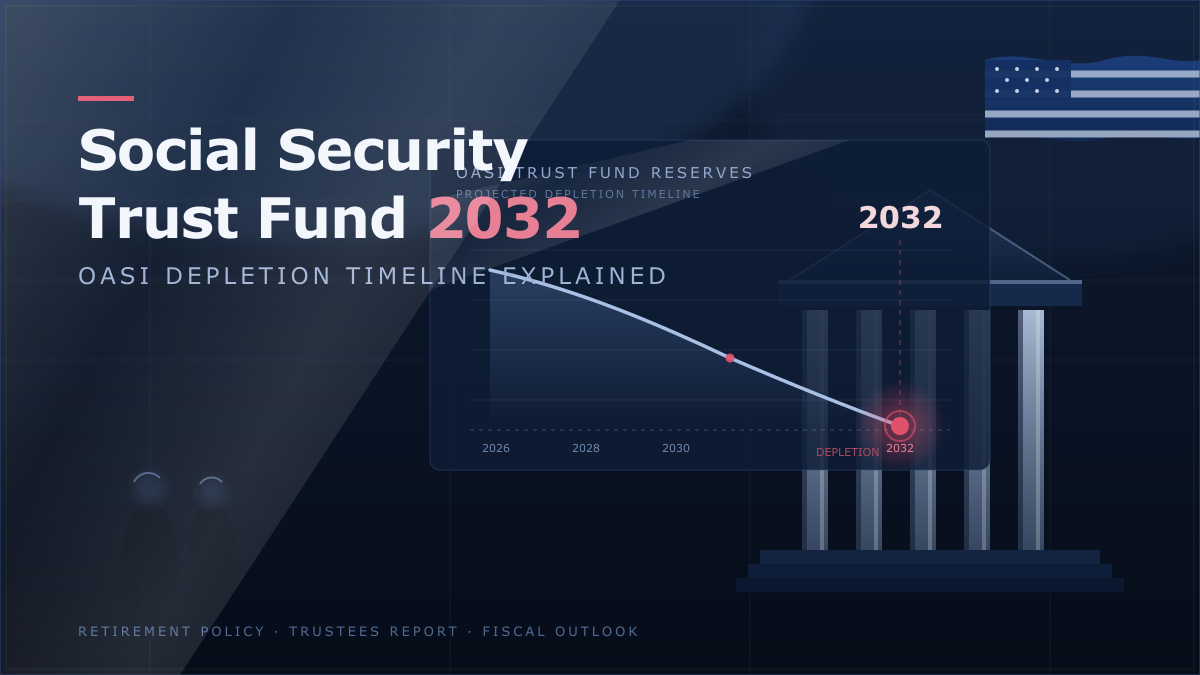
The 2026 Social Security Trustees Report moved the projected depletion date for the Old-Age and Survivors Insurance (OASI) trust fund to the fourth quarter of 2032 — one quarter earlier than the prior year’s estimate, and the fund’s worst reading in over a decade. With a 2027 Cost-of-Living Adjustment (COLA) now projected in the 3.2%–3.6% range, the same inflation dynamic that raises retirees’ monthly checks is simultaneously narrowing the runway policymakers have to act.
The 2026 Trustees Report, in Numbers
- OASI depletion: Q4 2032, at which point the fund could pay only 78% of scheduled benefits — an automatic 22% across-the-board cut with no congressional action required.
- Combined OASI/DI depletion: Q3 2034, if Congress permits fund-combining (which requires new legislation), covering 83% of benefits at that point.
- Disability Insurance (DI) fund remains solvent through the full 75-year projection window on its own.
- Combined trust fund reserves fell $160 billion in 2025 to $2.56 trillion.
- The 75-year actuarial deficit widened to 4.42% of taxable payroll, up from 3.82% in the prior year’s report — a meaningfully worse trajectory in a single annual cycle.
- The OASI trust fund ratio (reserves as a share of annual program cost) is projected to collapse from 153.0% today to 38.6% in 2032, and 0% in 2033.
Separately, the Congressional Budget Office’s March 2026 update pulled the OASI depletion date forward to 2032 as well — a year earlier than its own 2025 estimate — citing weaker payroll tax revenue inflows tied to slowing real GDP growth (1.4% in Q4 2025) and a softening labor market (unemployment near 4.4% as of February 2026).
Why a Bigger COLA Makes the Math Worse
The COLA mechanism and the trust fund’s solvency are mechanically linked, and not in the direction that helps retirees long-term:
- COLAs increase the “cost” side of the ledger immediately, raising the total dollar amount SSA must pay out to roughly 71 million beneficiaries the moment a new adjustment takes effect.
- Payroll tax revenue — the “income” side — only rises with wage growth, which does not move in lockstep with the CPI-W-driven COLA formula. When inflation outpaces wage growth, as has occurred intermittently through the 2023–2026 stretch of 8.7%, 3.2%, 2.5%, and 2.8% COLAs, the trust fund absorbs a larger annual drawdown.
- The trust fund has run a cash-flow deficit since 2010 and a total-cost-exceeds-total-income deficit since 2021 — meaning every COLA cycle since then has added incremental strain rather than working from a position of surplus.
- Penn Wharton Budget Model’s dynamic scoring reaches the same 2032 OASI depletion date and projects payable benefits falling from 83% at depletion to as low as 64% of scheduled benefits by 2100 absent reform — illustrating that 2032 is a waypoint, not an endpoint, in a longer structural decline.
What Depletion Actually Means (and Doesn’t)
A common misconception is that trust fund depletion means Social Security “runs out of money” entirely. It does not: payroll taxes continue flowing in every pay period regardless of trust fund balance, because Social Security is fundamentally a pay-as-you-go transfer program. What depletion means concretely:
- SSA would be legally permitted to pay benefits only up to the level covered by concurrent payroll tax revenue — no more.
- At the projected 2032 depletion point, that translates to a roughly 22–23% across-the-board benefit cut, applied automatically and without new legislation, to every OASI beneficiary simultaneously.
- Unlike prior near-misses (Social Security came within months of insolvency in the early 1980s before the Greenspan Commission reforms), there is currently no comparable bipartisan reform package moving through Congress, and prediction markets closed 2025 pricing the odds of Social Security-related tax relief passing in reconciliation at essentially zero.
Legislative Scenarios on the Table
Congress has a narrow, well-documented menu of policy levers, each with distinct distributional consequences:
| Lever | Mechanism | Political Difficulty |
|---|---|---|
| Raise the payroll tax rate | Currently 12.4% split between employer/employee | High — direct tax increase on all workers |
| Lift or eliminate the taxable maximum (“wage cap”) | Currently applies FICA only up to a capped wage level | Moderate — targets higher earners, popular in polling |
| Reduce future benefit growth | Adjust the benefit formula for new claimants | High — politically framed as a “cut” |
| Raise the full retirement age further | Already rising to 67 for 1960+ births under 1983 law | High — disproportionately affects lower-income/manual-labor workers |
| Combine OASI and DI reserves | Extends combined depletion to 2034 from OASI’s 2032 | Requires new legislation; buys limited time |
CRFB and other nonpartisan scorekeepers have been explicit that every point of extra COLA “imposes high costs for a retirement fund that is only six years away from insolvency,” framing the 2027 COLA debate not just as a budgeting question for retirees but as an input into how quickly the 2032 deadline arrives.
Forward-Looking Implications for Stakeholders
- Current retirees and near-retirees (within 6–10 years of the 2032 deadline) face the highest exposure to an unmitigated benefit cut, since they have the least time to adjust savings or claiming strategy before depletion.
- Workers under 45 have a longer runway to absorb likely reform outcomes — whether through payroll tax increases, wage-cap adjustments, or benefit formula changes — but also bear the compounding uncertainty of not knowing which lever(s) Congress will ultimately pull.
- Financial advisors and retirement planners increasingly model a “haircut scenario” — assuming benefits are reduced by roughly 20–23% from the mid-2030s onward — as a base case for clients within a decade of the depletion window, rather than treating full scheduled benefits as a safe planning assumption.
- Markets and fiscal analysts will watch whether any reconciliation-adjacent legislative vehicle in 2027–2028 attempts even a partial fix (e.g., a targeted wage-cap increase) given the narrowing window before the automatic-cut mechanism activates.
Bottom Line
The OASI trust fund’s Q4 2032 depletion date is now six years away, one quarter sooner than last year’s estimate, and moving in the wrong direction across nearly every metric the trustees track — reserve balance, trust fund ratio, and the 75-year actuarial deficit. A larger-than-average 2027 COLA, while providing real near-term relief to retirees, adds to the cost side of a program that has run structural deficits since 2021, tightening rather than loosening the window Congress has to act before an automatic ~22% benefit cut becomes law by default.
Discover more from The Economy
Subscribe to get the latest posts sent to your email.

Social Security Extra $90 Deposit: Who Qualifies for the October 2026 Medicare Rebate?

Anthropic Bans Sustained Abuse of Claude AI Under New Usage Policy Effective November 12, 2026

Jeff Bezos Three-Day Workweek View: What He Really Said

Celeste Frozen Pizza Discontinued: What Conagra Confirmed

US–China Critical Minerals Competition: Why a Trade Deal Cannot Fix Every Supply Risk

Oil Price Outlook 2026: How Supply Risks Reach Fuel Bills, Inflation and Business Costs

AI in Business 2026: Why Faster Employees Do Not Automatically Mean Higher Profits

Mortgage Rates in 2026: Why They Remain High and How to Compare the True Cost

Gold Price Outlook 2026: The Forces Behind the Forecasts—and What Could Reverse Them

Global Economic Outlook 2026: Growth, Inflation and Risks

Trump–Putin Diesel Deal: Why Zelensky Is Angry and What It Means for Fuel Prices

Anthropic Draws the Line: Why Claude’s New Usage Policy Explicitly Bans ‘Cruel Behavior’ Toward AI

Ynon Kreiz & Mattel’s Digital Transformation: Franchise Strategy and Financial Growth

Crude Oil & Petroleum Market Analysis: OPEC+ Decisions and Price Forecasts

Oil Prices Break $100 in 2026: Middle East Conflict & Energy Markets

Middle East War Economics 2026: Oil Prices & Energy Markets

China Stocks Today: Are Big Economies in Asia Nearing a Market Bottom?

PSX Forecast 2026: KSE-100, IMF Reviews & Geopolitics

Crypto Daily Outlook: Bitcoin, Altcoins, and the Future of Decentralized Finance

Global Pension Systems Ranked: The World’s Best and Worst Retirement Frameworks

Enterprise AI Platforms Disrupting B2B SaaS in 2026: Full Analysis

World’s Largest Economies: Ranking the Top Global Powers

Elon Musk’s Next Moves: Disrupting the 2026 Global Economy

Pakistan Economy 2026: Inside the SBP’s Balancing Act

GasBuddy Market Insights: How Crude Price Shifts Impact Local Fuel Cost Averages

World Bank & IMF Reports 2026: Why the “3% Growth” Consensus Is Actually a Debate

Global Equity Market Divergence: US Tech vs. European Dividend Stocks vs. Asian Growth

Stock Market Today: Dow Climbs 500 Points as Markets Shake Off Inflation Jitters
-

 Markets & Finance9 months ago
Top 15 Stocks for Investment in 2026 in PSX: Your Complete Guide to Pakistan’s Best Investment Opportunities
-

 Analysis8 months ago
Johor’s Investment Boom: The Hidden Costs Behind Malaysia’s Most Ambitious Economic Surge
-

 Analysis8 months ago
Top 10 Stocks for Investment in PSX for Quick Returns in 2026
-

 Banks9 months ago
Best Investments in Pakistan 2026: Top 10 Low-Price Shares and Long-Term Picks for the PSX
-

 Analysis8 months ago
Brazil’s Rare Earth Race: US, EU, and China Compete for Critical Minerals as Tensions Rise
-

 Investment9 months ago
Top 10 Mutual Fund Managers in Pakistan for Investment in 2026: A Comprehensive Guide for Optimal Returns
-

 Global Economy10 months ago
15 Most Lucrative Sectors for Investment in Pakistan: A 2025 Data-Driven Analysis
-

 Global Economy10 months ago
Pakistan’s Export Goldmine: 10 Game-Changing Markets Where Pakistani Businesses Are Winning Big in 2025