
Fintech & Global Finance
Marie Gluesenkamp Perez: How a Former Shop Owner’s Moderate Politics Are Shaping Tech and Economy Bills

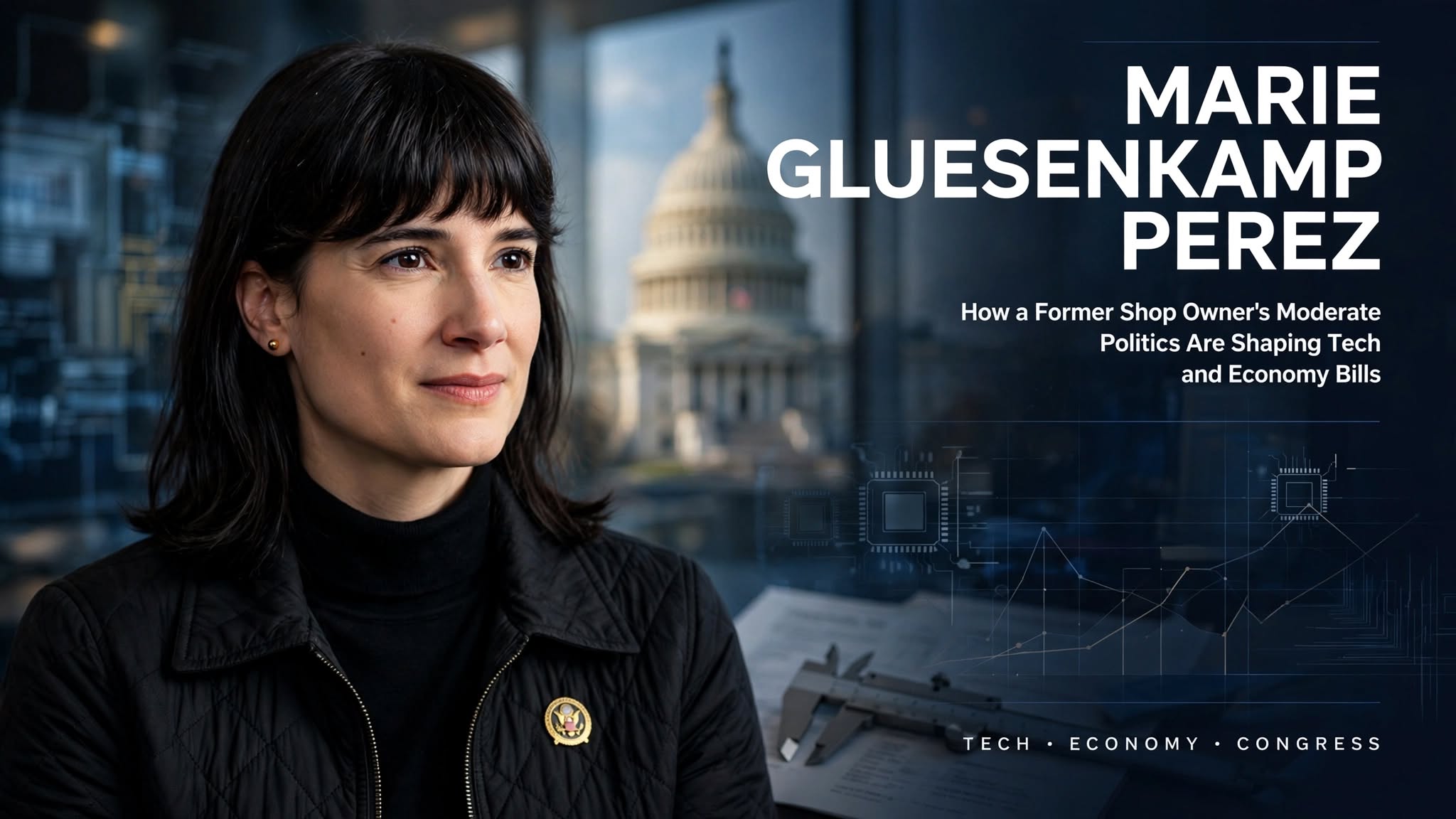
Key Takeaways
- Rep. Marie Gluesenkamp Perez (D-WA-3), a former auto repair shop co-owner, has built a legislative record centered on right-to-repair, trades workforce development, and semiconductor manufacturing funding.
- She helped secure a $105 million federal investment for Analog Devices, including $80 million for Pacific Northwest projects, to modernize domestic semiconductor fabrication — reinforcing Washington’s “Silicon Forest” manufacturing base.
- Described as one of the House’s most centrist Democrats, she sits in the Problem Solvers Caucus, the Blue Dog Coalition, and the Congressional Hispanic Caucus, and serves on the House Appropriations Committee.
- She is seeking a third term in the 2026 midterms against Republican John Braun, the Washington State Senate minority leader.
- Her legislative approach consistently favors practical, trade-oriented policy over ideological framing — a positioning that has made her a notable swing-district data point heading into November.
From Auto Shop to Appropriations Committee
Gluesenkamp Perez co-owned an auto repair and machine shop with her husband before her 2022 upset win over Republican Joe Kent, a race she repeated and won again in 2024. That hands-on business background has directly shaped her legislative priorities: she has pushed bipartisan right-to-repair legislation for agricultural equipment, introduced the Fairness for the Trades Act to expand 529 education savings plans to cover trade-career tools, and worked to ease regulatory burdens on small businesses like the one she used to run.
The Semiconductor Funding Win
In one of her more tangible economy-facing wins, Gluesenkamp Perez — alongside Washington Senators Patty Murray and Maria Cantwell — helped secure $105 million for Analog Devices to modernize domestic chip fabrication, with $80 million specifically benefiting Pacific Northwest facilities, including an expansion in Camas. The investment targets mature-node semiconductors used in automotive, healthcare, aerospace, defense, and consumer electronics — chips that are less headline-grabbing than AI accelerators but arguably more embedded in everyday supply chains (a theme covered in our companion piece on 2026 silicon supply chain risk).
Where She Sits Politically
Caucus memberships tell their own story: Problem Solvers Caucus, Blue Dog Coalition, and Congressional Hispanic Caucus place her firmly in the House’s center-right Democratic lane. She has been publicly described as one of the chamber’s most centrist Democrats, willing to break from party lines on specific votes. Her appropriations work has focused heavily on constituent-level wins — from mobile home energy-efficiency provisions to Secure Rural Schools reauthorization — over broader ideological legislation.
2026 Midterm Context
Gluesenkamp Perez is defending her seat in Washington’s 3rd Congressional District against John Braun, the Washington State Senate’s Republican minority leader — a race widely watched as a bellwether for how centrist Democrats in competitive districts perform in the 2026 midterms.
What is Marie Gluesenkamp Perez known for in Congress?
Rep. Gluesenkamp Perez (D-WA-3) is known for centrist, trades- and small-business-focused legislation, including right-to-repair bills and a $105 million semiconductor manufacturing investment for the Pacific Northwest. She sits on the House Appropriations Committee and is seeking a third term in 2026 against Republican John Braun.
Discover more from The Economy
Subscribe to get the latest posts sent to your email.



The global Banking growth is becoming more uneven, capital is increasingly sensitive to financing costs, and investors must distinguish a convincing story from an investable price. This guide focuses on research methods and risks rather than predictions of guaranteed returns. The IMF October 2026 outlook projects 3.1% global growth and 4.7% inflation for 2026, while the IMF financial-stability assessment warns that market resilience coexists with important vulnerabilities.
Key takeaways
- Match each investment decision to its time horizon, currency and ability to withstand losses.
- Separate observable earnings or contractual cash flows from optimistic forecasts.
- Compare diversification, fees, taxes, liquidity and regulatory restrictions before committing capital.
- Track primary institutional evidence and update assumptions when conditions change.
- Readers in Pakistan should consider rupee exposure and availability of regulated investment channels.
Why this matters now
The central question behind global banking trends 2026 is not merely what may happen next. It is which economic mechanisms could change cash flow, purchasing power or risk. The Bank for International Settlements’ 2026 review describes an economy supported by technological investment but constrained by geopolitical and fiscal pressures. A robust financial plan must therefore survive both a favourable and an adverse scenario.
Digital banks are extending beyond borders
Technology can reduce the need to duplicate large physical branch networks, but banking remains subject to local licensing, deposit protection, consumer law and capital rules. Cross-border scale is a business model, not a regulatory exemption. Readers should distinguish a licensed bank from an e-money provider, broker or unregulated payments application. See the primary institutional research.
For practical analysis, separate the baseline, the upside case and the downside case. Document the specific development that would change your assessment. Assess timing: a promising long-term theme may still be inappropriate for cash needed within twelve months.
Artificial intelligence in credit and fraud
Banks use machine learning for transaction screening, fraud detection, service operations and risk analysis. The operational promise is significant, but opaque credit models can create unfair outcomes, and false-positive fraud alerts can disrupt customers. Model governance requires testing, human accountability, explainability and correction routes. Customer consent does not remove every data-protection obligation. See the primary institutional research.
For practical analysis, separate the baseline, the upside case and the downside case. Document the specific development that would change your assessment. Assess timing: a promising long-term theme may still be inappropriate for cash needed within twelve months.
Cybersecurity is now systemic finance risk
An attack against a large processing vendor can affect many institutions simultaneously. The IMF’s October 2026 stability assessment identifies sophisticated cyber threats alongside sovereign-yield and AI valuation shocks. Banks should test recovery procedures, third-party concentration, authentication controls and incident communications, not merely purchase security software. See the primary institutional research.
For practical analysis, separate the baseline, the upside case and the downside case. Document the specific development that would change your assessment. Assess timing: a promising long-term theme may still be inappropriate for cash needed within twelve months.
Compliance: technology must support judgment
Anti-money-laundering monitoring, sanctions screening and know-your-customer processes are increasingly automated. False matches and poor data can cause excessive account restrictions, while under-detection carries serious legal exposure. Institutions need measurable controls, independent audits and escalation channels. The Financial Stability Board provides international coordination context but rules vary by jurisdiction. See the primary institutional research.
For practical analysis, separate the baseline, the upside case and the downside case. Document the specific development that would change your assessment. Assess timing: a promising long-term theme may still be inappropriate for cash needed within twelve months.
What Pakistani customers and banks should do
Customers should verify a provider’s licensing status, understand complaint mechanisms, enable strong authentication and never disclose one-time passcodes. Financial firms need resilient payment systems, staff training and clear consent practices. Track SBP circulars for locally applicable requirements rather than extrapolating foreign regulations to Pakistan. See the primary institutional research.
For practical analysis, separate the baseline, the upside case and the downside case. Document the specific development that would change your assessment. Assess timing: a promising long-term theme may still be inappropriate for cash needed within twelve months.
Comparison and decision framework
| Question | Stronger evidence | Warning sign |
|---|---|---|
| What drives returns? | Audited cash flows, clear contract or transparent index | Undefined or projected returns |
| What can go wrong? | Explicit scenario and downside analysis | Claims of guaranteed gains |
| Is it affordable to hold? | Low transparent fees and adequate liquidity | Leverage, costly spreads or lockups |
| Is access legitimate? | Appropriate licensing and clear legal rights | Unverified brokers or custody |
| Is the exposure diversified? | Multiple independent sources of return | One company, sector or currency |
What it means for Pakistani savers and investors
A Pakistani reader faces both international investment risk and local purchasing-power risk. For example, a foreign asset can rise in US-dollar terms while the rupee conversion and transaction costs alter the realized local outcome. The opposite can also occur. Record the starting exchange rate, applicable taxes, custody charges and capital-transfer restrictions, and confirm current requirements with the State Bank of Pakistan and the relevant securities regulator. Overseas access should not be assumed universally available.
An emergency reserve, expensive consumer debt and near-term family obligations deserve attention before any speculative allocation. A portfolio that cannot meet a sudden cash requirement may force sales at the worst moment. The objective is not to remove risk—impossible in markets—but to choose risks that fit the investor’s actual liabilities.
Risks, limitations and uncertainty
Institutional forecasts are conditional and can change after policy decisions, commodity shocks, conflict escalation or unexpectedly weak earnings. Historic correlations are not binding promises about future asset performance. The analysis does not provide live stock prices, current investment product quotes, real-time exchange rates or individualized tax advice. Prices, regulations and product eligibility should be checked on the transaction date.
Frequently asked questions
Is this a guaranteed investment opportunity?
No. Every financial asset or strategy involves uncertainty. The existence of a popular investment theme is not evidence that an individual security is fairly priced.
What should beginners examine first?
Understand the product, the financial loss you could tolerate, fees and liquidity. Verify the provider and decide whether the money may be needed soon.
How do interest rates affect the analysis?
They influence financing costs, discount rates, exchange rates and demand. The effect differs by sector, maturity and business balance sheet.
Can Pakistani residents invest in foreign markets?
Access depends on current foreign-exchange, banking, brokerage, securities and tax rules, and on the investor’s individual circumstances. Check current regulations and regulated providers rather than assuming access.
How often should this analysis be refreshed?
Review institutional economic releases monthly and re-evaluate immediately after material earnings, regulatory or policy changes. Avoid reacting mechanically to every daily market movement.
Is diversification enough to prevent losses?
No. Diversification may reduce company-specific risk but cannot eliminate broad market, currency, inflation or systemic risks.
Conclusion
Sound financial decisions begin with verifiable evidence, reasonable valuation, awareness of uncertainty and a plan that survives adverse outcomes. Readers should compare multiple independent sources and avoid letting a compelling headline substitute for due diligence.
Discover more from The Economy
Subscribe to get the latest posts sent to your email.

CoreWeave shares have become a direct test of how investors value artificial-intelligence infrastructure when the cost of capital rises. An October 14 Reuters report described a severe selloff across AI-related stocks after unexpectedly strong U.S. inflation data and singled out CoreWeave’s financing exposure. The central investing question is not whether AI demand exists. It is whether the company’s contracted demand, operating cash generation and available funding can support the speed and cost of construction implied by its expansion plans. For primary-source background, consult Reuters October 14 AI selloff; Financial Times CoreWeave funding; CoreWeave investor relations. In a fast-moving topic, publication time and information cutoff matter: subsequent events may require updating the figures or legal status, not merely changing the date in the footer.
What triggered the latest CoreWeave attention
The October inflation surprise raised investors’ expectations for interest rates and the price of financing long-duration projects. Reuters reported sharp declines in AI-infrastructure names, including CoreWeave, during the October 14 session. A one-day stock move is an observed price reaction, not evidence that its customers have canceled contracts. But the selloff makes funding structure newly important. Businesses that must invest cash today to earn revenue over years are highly sensitive to financing rates, payment schedules and equipment-value assumptions. Investors should confirm the trading session, percentage return and share class from an exchange or market-data service before republishing a price snapshot.
CoreWeave shares have become a direct test of how investors value artificial-intelligence infrastructure when the cost of capital rises.
Why AI infrastructure differs from an ordinary software company
CoreWeave supplies compute infrastructure, including GPU-intensive capacity used for AI workloads. Unlike a software business that can sell more subscriptions with limited marginal hardware investment, a compute provider may need expensive servers, electricity arrangements, networking, cooling systems and leases before customer revenue arrives. This can create a timing mismatch between contracted demand and free cash flow. Contract backlog can indicate future business, but it should never be substituted for cash already received. Terms for delivery, termination, prepayments and customer concentration can matter as much as the top-line headline number.
Debt, leases and the financing sensitivity
The Financial Times described CoreWeave seeking institutional financing for a large infrastructure build-out. Debt and lease obligations create fixed or contractual costs even when equipment utilization fluctuates. Investors should distinguish balance-sheet borrowings, lease liabilities, securitized equipment financing and contingent commitments; simplistic claims that all financing is identical distort risk. The cost of debt can rise sharply if lenders demand more compensation for uncertainty. At the same time, long-duration enterprise contracts can reduce revenue uncertainty. A sensible analysis weighs both sides and studies repayment schedules rather than judging the company by one leverage ratio.
Demand quality and customer concentration
AI companies and enterprise customers can require substantial compute, but customer contracts differ in reliability and profitability. A long agreement with a strong counterparty may support asset-backed financing more effectively than several short contracts with uncertain collection. Yet dependence on a few large buyers creates negotiating power and renewal risks. Look for disclosure about remaining performance obligations, revenue recognition, prepayments, utilization and customer concentration. An impressive backlog can coincide with negative free cash flow because building the capacity to fulfill those obligations is costly. The investment case strengthens only when large demand translates into economic returns after depreciation, interest and maintenance.
What valuation methods tell different stories
Price-to-sales ratios focus on revenue growth but ignore the cost required to deliver it. Enterprise value to EBITDA can obscure heavy capital replacement costs if depreciation is particularly meaningful. Free cash flow, measured consistently, makes investment intensity visible but may temporarily penalize a fast-growing construction phase. No single metric is decisive. Compare the company with infrastructure providers facing similar capital needs rather than only with asset-light software companies. Then stress-test outcomes under higher borrowing rates, slower installations, lower GPU pricing and changes in customer demand. These are scenarios, not assertions about what management will do.
Worked example: how to interpret a difficult headline
Imagine two AI-cloud projects with identical contracted revenue. Project A finances infrastructure at a lower fixed rate and launches on time; Project B faces a financing reset, a construction delay and higher electricity costs. The revenue headline may look the same, but cash generation and equity value could differ considerably. This is why debt maturity, deployment timing and customer collection are better questions than the size of an announced deal alone. This is a deliberately illustrative comparison unless explicit documented numbers are identified. It should not be mistaken for a real person’s financial circumstances, an unverified event, or a guaranteed forecast. Its purpose is to show how a reader can apply the underlying principle and identify which information still needs to be checked.
Three concepts that are often confused
| Concept | What it actually establishes |
|---|---|
| Revenue growth | Describes delivered services; does not equal net cash generation. |
| Backlog or contract value | Indicates potential future work subject to conditions and timing. |
| Cash flow after capital spending | Tests whether expansion economics can sustain funding obligations. |
These distinctions are more than technical niceties. They change the answer to the reader’s question. An estimate does not carry the same evidentiary weight as a final rule; an announcement does not have the same practical consequence as a completed transaction; and a provisional interpretation should not be presented as a confirmed event. Wherever a live source supplies a new fact, the editor should check whether the old text still describes the right stage of the process.
A reader’s verification workflow
Start by recording the precise claim and the date it was allegedly true. Open the primary announcement or filing rather than a social-media screenshot. Ask whether the source has an incentive to present only the most favorable interpretation, and corroborate material facts with reputable independent reporting where available. For numerical claims, note the denominator, timeframe and whether the number is a stock, a flow, a forecast or a realized result. For legal claims, note the court, agency, stage of proceedings and exact published document.
Next, separate information useful for immediate decisions from context that merely explains the headline. A person may need to act on a deadline even when the long-run political debate remains unresolved. Someone evaluating a security may need financing details, while a customer comparing technology products needs a tested specification and local warranty terms. The same headline can matter for different reasons; the article should therefore provide an actionable answer without implying that every reader faces the same circumstances.
Indicators and developments worth monitoring
- Company quarterly financial filings and debt footnotes.
- Interest rates and spreads on financing vehicles.
- Capacity construction and customer-service activation.
- New customer agreements and changes in utilization.
Avoid treating these signals as a checklist that mechanically predicts the future. Some are leading indications and others are lagging measurements. A change becomes significant only after its magnitude, source and comparison period are understood. If two reputable sources disagree, explain the source of the difference—definitions, timing, jurisdiction, measurement or uncertainty—instead of selecting whichever number makes the strongest headline. That practice strengthens both reader trust and the article’s usefulness in search features that surface isolated paragraphs.
The specific information advantage of this article
Growth forecasts grab attention but often hide the cost of building the revenue-generating assets. Treat contract backlog and installed capacity as distinct measures, then compare them with borrowing needs, lease liabilities and cash returns. This is the difference between an AI-demand story and a credible investment-risk story.
Frequently asked questions
Is CoreWeave stock the same as buying Nvidia?
No. CoreWeave operates compute infrastructure with financing and customer risks unlike a semiconductor designer. For individual decisions, consult the primary institution or product provider, and use the exact relevant date.
Why did rising rates matter?
More expensive capital can reduce the present value of future cash flows and make funding new servers costlier. For individual decisions, consult the primary institution or product provider, and use the exact relevant date.
Does backlog guarantee profit?
No. Contracts must be fulfilled, and expenses, financing and accounting recognition determine profitability. For individual decisions, consult the primary institution or product provider, and use the exact relevant date.
What is the biggest unresolved question?
Whether contracted capacity can generate durable cash returns after equipment, power and financing costs. For individual decisions, consult the primary institution or product provider, and use the exact relevant date.
Bottom line
CoreWeave shares have become a direct test of how investors value artificial-intelligence infrastructure when the cost of capital rises. An October 14 Reuters report described a severe selloff across AI-related stocks after unexpectedly strong U.S. inflation data and singled out CoreWeave’s financing exposure. The central investing question is not whether AI demand exists. It is whether the company’s contracted demand, operating cash generation and available funding can support the speed and cost of construction implied by its expansion plans. The best next step is to identify which of the monitored developments could change this answer and use a current, authenticated record before acting. Clear distinctions between confirmed facts, estimates, proposals and contested claims are more valuable than dramatic certainty.
Discover more from The Economy
Subscribe to get the latest posts sent to your email.

The debate over tariffs is often framed as a simple contest between protection and globalization. The WTO’s 2026 research takes a broader view: rules reduce uncertainty and help countries of different sizes participate in international trade. Its fragmentation simulations point to substantial losses in world production and exports under extreme bloc-based scenarios; simulations are not forecasts of what will certainly occur. Sources: World Trade Organization and WTO World Trade Report.
The important context competitors can overlook
Tariffs can shift the price paid by importers and consumers while also creating some domestic production incentives. Businesses may diversify suppliers, hold additional inventory or redesign products to satisfy rules-of-origin tests. Those adjustments involve transition costs that matter to small companies as much as multinationals. Services trade and AI-related goods add further complexity to a story that should not revolve solely around container volumes. For primary-source checks and current reporting, see World Trade Organization and Reuters critical-minerals report. The key distinction is use wto scenario data with clear caveats.
Tariffs can influence import costs, consumer prices and industrial decisions, but their burden depends on market and supply-chain conditions. Research cutoff: October 12, 2026; confirm developing facts before publication.
A practical way to use this information
When comparing government policy proposals, specify the tariff base, exemptions, enforcement timeline and likely retaliation. Add a simple product-level example rather than declaring a uniform percentage increase in retail prices. Quote the latest WTO outlook with its publication date and avoid presenting modeled economic losses as realized data.
What to verify before making a decision
The right next step is to identify the source, timestamp and applicable market or jurisdiction. Check whether a number is a historical observation, official announcement, target, forecast or scenario. If you intend to act financially, legally or commercially, use the relevant provider’s current terms and obtain professional advice where appropriate. The sources cited here establish context; they are not a substitute for live prices, individual eligibility checks or binding agreements.
Reader questions
Do tariffs always lower imports by the same percentage? No. Responses differ by product, substitutes, exchange rates and supplier decisions.
Are WTO fragmentation figures predictions? No. The cited large losses come from modeled scenarios.
A tariff is a tax at the border, not a complete industrial strategy
Tariffs change the costs of importing selected goods under applicable rules. The legal importer generally pays the customs charge, but the eventual economic burden can be distributed among importers, foreign suppliers, consumers and other businesses depending on pricing power and competition. Some companies raise final prices, some accept lower margins and some shift sourcing. This means a tariff announcement does not translate into an identical consumer-price rise for every product. The product classification, country of origin, exemptions and date of entry all matter.
The political goals of a tariff can include protection of domestic production, bargaining leverage, revenue or national-security concerns. Supporters argue that tariffs can encourage local capacity or address unfair competition. Critics argue that they raise costs, weaken competition or invite retaliation. The net effect depends on design, industry structure, adjustment time and policy responses. An informative analysis should present these competing mechanisms without assuming one tool produces the same outcome in all sectors.
Why moving a factory is much harder than changing a supplier
Supply chains combine raw materials, specialist components, equipment, logistics and skilled labor. A company buying parts from a supplier in one country may discover that proposed alternatives rely on the same upstream producer. Moving assembly to a new destination does not necessarily change where key components originate. Rules of origin determine whether goods qualify for particular trade treatment and can be technically complex. Companies must also consider qualification, standards, financing, infrastructure and contract penalties before making a shift.
Diversification can reduce exposure to one country but add administrative costs and smaller production runs. Localizing every input can be impossible or uneconomic for some industries. The realistic goal is often a balance of cost, resilience and geopolitical exposure, not absolute self-sufficiency. Good trade reporting identifies which stage of production is moving instead of proclaiming an entire supply chain has returned home because a final assembly plant opened.
The consumer and small-business impact
A retailer importing kitchen equipment may face direct landed-cost changes, while a local manufacturer using imported components may see an indirect impact. Each business must calculate customs, shipping, insurance, compliance and foreign-exchange costs to know the actual margin effect. Consumers can experience higher prices on some goods while seeing little change on others. Exchange-rate adjustments, discounting and existing inventories can obscure the immediate result. A price spike should not automatically be attributed to tariffs without a defensible comparison.
Small firms may be less able to absorb abrupt compliance costs than large multinationals with dedicated customs teams. They may need new documentation, alternate logistics or changes in pricing strategy. For policy analysis, compare the stated objective with observable outcomes such as investment, production, prices and trade flows. Announced investment intentions are useful but not equivalent to completed factories or jobs.
Why retaliation and trade rules matter
One country’s import restriction can trigger another government’s policy response, affecting exporters that were not part of the original dispute. Export controls, quotas, licensing requirements and tariffs are legally and economically distinct tools. Some measures are contested under international trade agreements or subject to national exceptions. A ruling, negotiation or exemption can alter practical exposure over time. Editors should identify whether a trade measure has been proposed, enacted, suspended, challenged or amended.
The World Trade Organization provides data and analysis on trade trends and rules, but national customs authorities remain important for product-specific requirements. A broad macroeconomic model can indicate risks from fragmentation; it does not determine the duty on a particular shipment. Businesses need current tariff schedules and professional customs advice for binding decisions.
A framework for reporting trade fragmentation
Track bilateral trade flows by product, capacity announcements, manufacturing output, consumer prices and new trade restrictions. Distinguish a change caused by cyclical demand from one caused by policy. When describing “friend-shoring,” name the goods and actual supplier changes. Cite the baseline year and currency in every export or import comparison. Avoid calculating a global economic cost by adding together incompatible estimates from different models.
International trade can provide gains through specialization while also creating vulnerabilities. The debate is not settled by claiming either that all globalization is beneficial or that every import is a strategic mistake. Useful reporting follows the evidence to explain who pays, who benefits and what tradeoffs emerge.
Three common tariff misconceptions
“The exporting country pays the tariff directly.” Customs charges are generally collected from the party legally responsible for import entry, while the economic burden can be shared through changed prices and margins. Exporters might lower prices to stay competitive; consumers might pay more; or importers might absorb the cost. It is not a universal one-party payment story.
“Imports automatically disappear when a tariff rises.” Some products have readily available alternatives; others require scarce components or long qualification processes. Demand may adjust slowly, and firms may carry existing inventory before changing suppliers. Trade statistics need sufficient time and product detail to reveal what actually changed.
“A new factory proves all jobs moved home.” Final assembly may be localized while essential inputs remain imported. Employment effects depend on automation, capacity, production volume and domestic supplier networks. A reliable report distinguishes announced construction investment from completed operating employment rather than equating every investment figure with realized jobs.
Discover more from The Economy
Subscribe to get the latest posts sent to your email.

4 Reasons Why China’s Trade Concessions to Europe Will Not Solve the Crisis

The AI Revolution Needs Atomic Power. Southeast Asia Is Ready to Build It.

Zhuhai Airshow 2026: How China’s Stealth Jets, Drones and Missiles Are Redrawing Global Air Power

The $8 Billion Runway: China’s Strategic Bet on Guangzhou and the Future of Aviation

The Sandbox Imperium: Why Beijing’s Digital Yuan Needs Hong Kong

Gold at the $4,000 Line: Possible December Fed Hike

Oil at $100+: Hormuz, a Qatari Peace Draft and the Iran Deadline

The Fed’s 10-2 Hold: Why Two Dissenters Wanted a Rate Hike

SBP Raises Policy Rate to 12%: What It Means for Your Loans, Savings and Business

IMF’s $1.2bn Staff-Level Deal: What Pakistan Promised on Surplus

Decoding the DBS–BCA Merger Rumour: Market Volatility, Strategic Realities

New Xbox Games October 26–30, 2026: Releases and Game Pass

Tokyo Disneyland Peter Pan’s Flight Closure: January–February 2027 Guide

Neocloud Economics in 2026: GPU Debt, Utilization and Power

Crude Oil & Petroleum Market Analysis: OPEC+ Decisions and Price Forecasts

Top US Convenience Store Chains: Store Counts, EV Charging, and Sales Trends

Social Security Extra $90 Deposit: Who Qualifies for the October 2026 Medicare Rebate?

Who Is Shivon Zilis? The Neuralink Executive at the Center of the Musk–OpenAI Trial

Gold Price Outlook 2026: The Forces Behind the Forecasts—and What Could Reverse Them

Algorithmic Dogfights: Why the U.S. and China Must Establish Rules of Engagement for Autonomous Air Power

Corporate America Faces a New Debt Test as US Borrowing Costs Surge

Global Economic Outlook 2026: 7 Forces Reshaping Markets, Trade and Business

Stock Market Crash in 2026? Warning Signs, Scenarios and a Calm Investor Checklist

Geopolitics and Your Portfolio: How International Affairs Move Global Markets

Stock Market Today: Dow, S&P 500, and Nasdaq Retreat as Treasury Yields

Anthropic Bans Sustained Abuse of Claude AI Under New Usage Policy Effective November 12, 2026

US–Iran Conflict in October 2026: Hormuz, Oil Prices and Diplomacy

Why Did I Get $90 From Social Security? 8 Reasons Behind an Unexpected SSA Payment
-

 Markets & Finance10 months ago
Top 15 Stocks for Investment in 2026 in PSX: Your Complete Guide to Pakistan’s Best Investment Opportunities
-

 Analysis8 months ago
Johor’s Investment Boom: The Hidden Costs Behind Malaysia’s Most Ambitious Economic Surge
-

 Analysis9 months ago
Top 10 Stocks for Investment in PSX for Quick Returns in 2026
-

 Banks10 months ago
Best Investments in Pakistan 2026: Top 10 Low-Price Shares and Long-Term Picks for the PSX
-

 Analysis9 months ago
Brazil’s Rare Earth Race: US, EU, and China Compete for Critical Minerals as Tensions Rise
-

 Investment10 months ago
Top 10 Mutual Fund Managers in Pakistan for Investment in 2026: A Comprehensive Guide for Optimal Returns
-

 Global Economy10 months ago
15 Most Lucrative Sectors for Investment in Pakistan: A 2025 Data-Driven Analysis
-

 Global Economy10 months ago
Pakistan’s Export Goldmine: 10 Game-Changing Markets Where Pakistani Businesses Are Winning Big in 2025