
economic Zones
Johor-Singapore SEZ: The $19B Data Centre Hub You’ve Missed

While global headlines chase the AI infrastructure story in the US and China, one of the most interesting AI capital-deployment stories on the planet is unfolding almost unnoticed across a 4-kilometre stretch of water between Singapore and Malaysia — and it’s worth understanding for anyone tracking where the next wave of Southeast Asian growth is actually landing.
What the JS-SEZ Actually Is
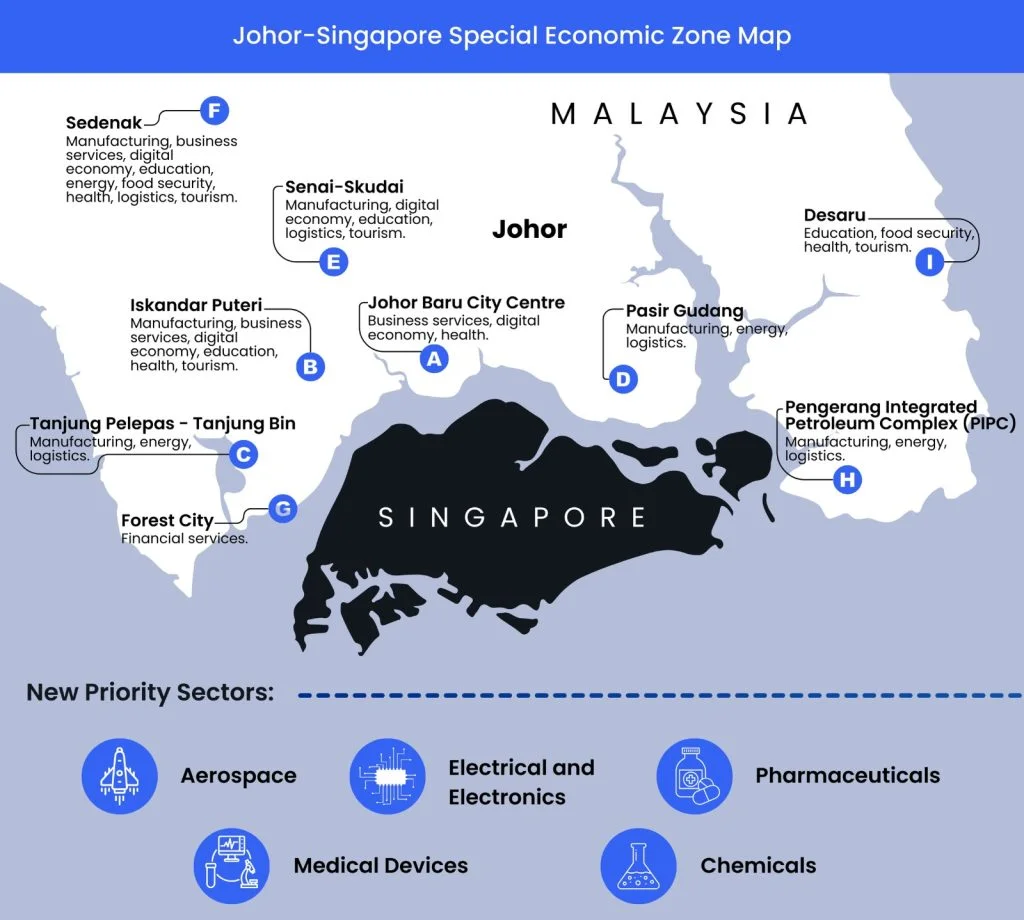
The Johor-Singapore Special Economic Zone, formally established on January 7, 2025, covers roughly 3,588 square kilometres across southern Johor state. It spans nine flagship areas and targets investment across eleven sectors, including manufacturing, logistics, financial services, the digital economy, tourism, education, healthcare, and the green economy (Forest City SFZ / Manila Times).
The core idea is simple, even if the execution is complex: Singapore contributes financial infrastructure, regulatory credibility, and capital markets access; Johor contributes roughly four times Singapore’s land area and a median monthly wage around one-seventh of Singapore’s, creating room for industrial-scale development that Singapore’s tiny footprint simply can’t accommodate (Trowers & Hamlins).
The Numbers That Show This Isn’t Just Another SEZ Announcement
Skeptics have plenty of reason to be cautious about grand cross-border economic zone announcements — Southeast Asia has seen plenty of ambitious blueprints fizzle. But the JS-SEZ’s investment figures suggest real capital is already moving, not just political goodwill.
The zone attracted $19 billion in approved investments in 2025, with more than 57% of cumulative approved projects already entering the implementation stage — not just paper commitments (VietnamPlus). That momentum continued into 2026, with $1.3 billion in new approved investments in the first quarter alone, and the Invest Malaysia Facilitation Centre Johor (IMFC-J) fielding 285 investment enquiries worth a combined $18.5 billion in just the first five months of the year.
Separately, Singapore’s Ministry of Trade and Industry confirmed Singapore-based companies have committed more than S$5.5 billion into Johor since the memorandum of understanding was signed (Forest City SFZ). On the Malaysian side, domestic and foreign investment into the region more than doubled from MYR 48.5 billion (roughly US$11.9 billion) in 2024 to MYR 110 billion (about US$27 billion) in 2025, with 70% of that total year’s investment specifically tied to JS-SEZ projects (Lundgreen’s Investor Insights).
The Real Story: Johor Is Becoming Singapore’s Data Centre Overflow Valve
Here’s the angle competitors are missing entirely: this isn’t primarily a manufacturing or logistics story. It’s a data centre story, and it’s happening precisely because Singapore has run out of room and water to support the AI infrastructure boom domestically.
Roughly 60% of Southeast Asia’s data centres are already concentrated in Johor (Lundgreen’s Investor Insights). That’s not a coincidence — Singapore enforces strict limits on new data centre expansion domestically, largely due to power and water constraints, pushing hyperscale demand across the border. Global players including Microsoft, ByteDance, and AirTrunk have already invested in Johor’s data centre buildout, and Johor also benefits from proximity to Singapore’s extensive submarine cable network — around 30 international cables carrying a combined 44.8 terabits per second of capacity (Trowers & Hamlins).
The economics are striking at a granular level: based on Johor State Data Centre Development planning guidelines, every MYR 1 billion (roughly US$250 million) invested in a data centre creates 400 to 600 jobs and adds MYR 500 million (about US$126 million) to Malaysia’s GDP (Lundgreen’s Investor Insights). With data centres, manufacturing, and energy topping the list of investor enquiries by sector, and China, Singapore, and South Korea ranking as the top three source countries for investment interest (Invest Johor), the zone is quietly positioning itself as a geopolitically neutral alternative for AI infrastructure at a moment when US-China tensions make data centre siting decisions increasingly political.
The Infrastructure Piece Everyone’s Watching: The RTS Link
The physical backbone tying this all together is the Johor Bahru-Singapore Rapid Transit System Link, a four-kilometre rail connection between Bukit Chagar and Woodlands North designed to carry up to 10,000 passengers per hour in each direction, cutting a commute that currently involves congested causeway traffic down to roughly five minutes (Forest City SFZ). It’s targeted to begin passenger service by the end of 2026 — a deadline that, if hit, would materially improve the shared-labour-market model underpinning the entire economic zone concept, where thousands of Malaysians already commute daily into Singapore.
What’s Genuinely Uncertain — and Why That Matters for Investors
This is where most boosterish coverage of the JS-SEZ falls short: it’s not risk-free, and the risks are structural rather than cosmetic.
No unified regulatory framework yet exists. The JS-SEZ falls under Malaysian jurisdiction, and substantive regimes — tax, labour law, compliance — remain entirely separate between the two countries. Current cross-border coordination focuses on facilitation rather than genuine legal integration, and the formal master plan and investment blueprint, originally targeted for the first quarter of 2026, has already been delayed (Trowers & Hamlins).
Implementation friction is real, not theoretical. Existing Singaporean businesses operating in Johor are reportedly receiving contrasting guidance from Malaysia’s federal and state governments on tax treatment — exactly the kind of bureaucratic inconsistency that can quietly erode investor confidence even as headline investment figures climb.
The minimum investment threshold favors large players over SMEs. Malaysia’s tax incentive package, administered through MIDA, requires a minimum capital investment of RM500 million (roughly US$126 million) to qualify — a bar high enough to exclude most small and mid-sized businesses from the zone’s most attractive incentives, concentrating benefits among multinationals and large regional players.
Water is the long-term constraint to watch. Data centres consume enormous volumes of water for cooling, and shifting that burden onto Johor — precisely because Singapore’s own water resources are limited — creates an environmental sustainability question that current green initiatives (stormwater reuse, greywater recycling, solar-powered facilities) are only beginning to address at scale.
What This Means for Businesses Weighing Entry
For companies evaluating the JS-SEZ as an expansion target, the practical playbook emerging from early movers suggests: treat Johor as a genuinely separate operating environment rather than “Singapore with cheaper rent,” budget for parallel legal review in both jurisdictions rather than assuming harmonized compliance, and prioritize sectors — data centres, advanced manufacturing, logistics — where the zone’s infrastructure investment is most mature, rather than betting on sectors still waiting on the delayed master plan for clarity.
The Bottom Line
The JS-SEZ has moved past the announcement-and-optimism phase that sinks most cross-border economic zones and into measurable capital deployment — $19 billion in approved 2025 investment with the majority already under implementation is a meaningful signal, not just a talking point. But the zone’s success now depends on execution details that don’t make for exciting headlines: harmonizing tax treatment, delivering the RTS Link on schedule, finalizing the long-delayed master plan, and managing the environmental trade-offs of becoming Southeast Asia’s default data centre overflow zone. Investors who track those unglamorous milestones will understand the JS-SEZ’s real trajectory long before the next round of splashy investment-forum press releases does.
Discover more from The Economy
Subscribe to get the latest posts sent to your email.


Economic Corridors
The Johor-Singapore Corridor: How Malaysia Became Southeast Asia’s AI Infrastructure Powerhouse
Introduction
While global attention has fixated on the Strait of Hormuz and Middle East energy risk, a quieter structural story has been reshaping Southeast Asia’s economic map: Malaysia’s transformation from a legacy chip-assembly hub into one of the region’s most important AI infrastructure and semiconductor innovation centers. Electrical and electronics exports rose 39.7% year-on-year in the first five months of 2026 alone, and the driving force behind that surge is a cross-border partnership most global business audiences have never heard of — the Johor-Singapore Special Economic Zone (VietnamPlus).
The Headline Numbers
Malaysia’s Economy Minister Akmal Nasrullah Mohd Nasir confirmed that E&E exports hit 382.9 billion ringgit (roughly $95.7 billion) in the January–May 2026 period, now representing 48.2% of the country’s total exports (VietnamPlus). That growth has fed directly into an upgraded national GDP forecast: HLIB Chief Economist Felicia Ling raised Malaysia’s 2026 growth projection to 4.7% from an earlier 4.5% estimate, citing the electrical and electronics sector’s stronger-than-expected performance alongside resilient domestic demand (BusinessToday Malaysia). That figure sits comfortably within Bank Negara Malaysia’s own official growth range of 4.0% to 5.0%, with inflation expected to average around 2.0% — well inside the central bank’s projected 1.5%–2.5% band (BusinessToday Malaysia).
The global backdrop is doing plenty of the heavy lifting: the worldwide semiconductor market is projected to expand by a remarkable 90% in 2026, driven overwhelmingly by AI infrastructure and high-performance computing demand — a tailwind HLIB expects Malaysia’s manufacturing base to keep capturing through its established position in the global semiconductor upcycle (BusinessToday Malaysia).
Why Johor, Specifically
Johor, the Malaysian state bordering Singapore, has emerged as the epicenter of this boom. In the first half of 2025 alone, Johor recorded RM56 billion (roughly $13.3 billion) in approved investments — the highest of any Malaysian state — with Singapore itself the single largest foreign investor at RM43.4 billion ($10.3 billion), a striking signal of cross-border confidence given the two economies’ historically distinct development paths (Malay Mail). The Johor-Singapore Special Economic Zone (JS-SEZ) is designed explicitly to combine Singapore’s upstream design and financial excellence with Malaysia’s outsourced semiconductor assembly and test (OSAT) strength, creating an integrated cross-border cluster rather than two competing national industries (Malay Mail).
The data center layer of this story is arguably even bigger. Johor is now described as a strategic extension of Singapore’s own digital infrastructure — absorbing the spillover of cloud, AI and hyperscale investment that land- and power-constrained Singapore cannot fully accommodate on its own soil (Bernama). AMRO’s research office notes that Malaysia is gaining data center capacity faster than any other state in the Asia-Pacific region, with proximity to Singapore cited as a decisive locational advantage alongside land and energy availability that more developed Asian markets increasingly lack (AMRO Asia).
The Economics Behind the Migration
Cost is a major part of the explanation. Average construction costs for a Malaysian data center run $8–10 million per megawatt as of 2025 — meaningfully cheaper than Singapore’s cost structure — though these costs are expected to climb 5–7% annually going forward due to inflation, rising interest rates and tightening regulation (ResearchAndMarkets/BusinessWire). Malaysia has also moved to manage the strain this investment wave places on its own grid: a new power tariff structure for data centers, finalized in mid-2025, is set to raise energy costs for operators by 10–14%, part of a broader Green Data Center Guidelines framework administered by the Malaysia Digital Economic Corporation to enforce energy-efficient, sustainable buildouts (ResearchAndMarkets/BusinessWire).
Penang’s Parallel Track: Moving Up the Value Chain
While Johor captures data centers and assembly investment, Penang — long dubbed Malaysia’s Silicon Valley — is pursuing a distinct strategy focused on higher-value semiconductor manufacturing and talent, continuing to attract chipmakers on the strength of its established supply chain and skilled workforce (Bernama). Malaysia’s government has been explicit that the ambition extends beyond hosting foreign assembly lines: officials point to the country’s strategic partnership with British chip design firm Arm as evidence of a deliberate push toward technology ownership and intellectual property, rather than remaining a pure-play assembly and test hub (VietnamPlus).
The Structural Caveat Analysts Are Flagging
Not every observer treats the data center boom as an unambiguous win. Asia Society’s Policy Institute cautions that most of Malaysia’s current data center commitments are geared toward inference and model deployment rather than the far more computationally intensive work of model training — meaning the buildout does not, on its own, move Malaysia into the small group of “compute-north” countries that shape how frontier AI models are actually built (Asia Society). Data centers also generate comparatively limited technological and labor spillover relative to semiconductor fabrication or advanced manufacturing — a distinction that matters for how much of this boom translates into durable, high-skill domestic employment versus real estate and power infrastructure investment (Asia Society).
Energy Security as a Quiet Advantage
Malaysia’s resilience narrative extends to energy as well. HLIB notes the country’s diversified crude oil import sources — spanning Saudi Arabia, Oman, Sudan, the UAE, Angola and the United States — provide meaningful insulation even in the event of shipping disruptions along routes such as the Strait of Hormuz, a risk that has weighed on other Asian import-dependent economies through 2026 (BusinessToday Malaysia).
Key Takeaways
- Malaysia’s E&E exports rose 39.7% year-on-year to $95.7 billion in the first five months of 2026, now 48.2% of total exports.
- The Johor-Singapore Special Economic Zone is the structural engine behind this growth, pairing Singapore’s capital and design strength with Malaysia’s assembly and land/power advantages.
- 2026 GDP growth has been upgraded to 4.7%, with Bank Negara Malaysia expected to hold its policy rate at 2.75% through the year.
- Data center construction costs remain cheaper than Singapore’s, though new power tariffs will raise operating costs 10–14%.
- Analysts caution the current boom is concentrated in inference-oriented, lower-spillover data centers rather than frontier model training capacity.
Sources: VietnamPlus, BusinessToday Malaysia, Malay Mail, Bernama, AMRO Asia, ResearchAndMarkets/BusinessWire, Asia Society Policy Institute
Discover more from The Economy
Subscribe to get the latest posts sent to your email.
While much of global business coverage has focused on the Strait of Hormuz and Fed policy, one of Southeast Asia’s most significant economic developments has unfolded with comparatively little international attention: the Johor-Singapore Special Economic Zone has become a genuine cross-border investment magnet, even before its formal master plan has been unveiled.
The Scale of the Numbers
The JS-SEZ attracted 19 billion dollars in approved investments in 2025, with more than 57 percent of cumulative approved projects already at the implementation stage — a conversion rate that signals genuine capital deployment rather than speculative announcements. Malaysia’s Minister of Economy, Akmal Nasrullah, confirmed the momentum has continued into 2026, with a further $1.3 billion in newly approved investments recorded in the first quarter alone.
Investor interest continues to build at pace: the Invest Malaysia Facilitation Centre Johor processed 285 investment enquiries worth a combined $18.5 billion during just the first five months of 2026 — a pipeline roughly equivalent to the entire prior year’s approved investment total, suggesting the zone’s growth trajectory is accelerating rather than plateauing.
Why Investors Are Betting Ahead of the Master Plan
What makes the JS-SEZ notable is that this capital is arriving before Malaysia has formally unveiled the zone’s master plan — investors are pricing in the structural logic of the corridor itself rather than waiting for finalised regulatory detail. That logic rests on combining Singapore’s capital markets, legal infrastructure and connectivity with Johor’s land availability, labour costs and manufacturing base — a complementary pairing that Southeast Asia has lacked at this scale until now.
How much investment has the Johor-Singapore Special Economic Zone attracted?
The JS-SEZ attracted $19 billion in approved investments in 2025, with more than 57% of projects already in implementation, plus a further $1.3 billion approved in Q1 2026 — momentum that has continued even ahead of the zone’s formal master plan.
The zone’s momentum is reinforced by the broader institutional interest converging on the region. Maybank’s Invest ASEAN conference, held in Singapore in July 2026, drew roughly 200 institutional investors managing a combined $23 trillion in assets under management, with energy transition, supply chain reconfiguration and AI-led digital transformation identified as the dominant themes shaping capital allocation decisions across the region.
The Malaysia Growth Connection
The JS-SEZ is not an isolated success story — it’s a direct contributor to Malaysia’s broader macroeconomic outperformance in 2026. Maybank IBG’s decision to upgrade Malaysia’s 2026 GDP growth forecast to 4.9 percent cited sustained investment approval momentum in technology, renewable energy, industrial real estate and infrastructure — categories that map closely onto the sectors driving JS-SEZ deal flow.
Regional Comparison
Positioned against other Southeast Asian investment corridors, the JS-SEZ’s growth compares favourably even to Indonesia’s well-established Batam-Bintan-Karimun zone with Singapore, which drew $5.7 billion in investment in 2025 — roughly a third of the JS-SEZ’s total despite BBK’s longer operating history. The comparison underscores how quickly the Johor corridor has scaled since gaining formal momentum.
What to Watch Next
The formal unveiling of the JS-SEZ master plan remains the key near-term catalyst that could either validate or complicate current investment momentum, by clarifying tax incentives, land-use zoning, and cross-border labour mobility provisions. Until then, the zone’s implementation rate — already above 57 percent of approved projects — suggests investors are not waiting for regulatory certainty to deploy capital, a vote of confidence that is increasingly rare in a global environment defined by geopolitical and monetary policy uncertainty.
Discover more from The Economy
Subscribe to get the latest posts sent to your email.

The July 1, 2026 mandatory review deadline for the Canada-United States-Mexico Agreement passed without a renewal deal, triggering a decade-long review process that could leave the pact’s terms unresolved through 2036 and deepening the uncertainty already weighing on Canada’s economy.
What Happened at the CUSMA Deadline
The Trump administration formally declined to extend CUSMA on Canada Day, starting a 10-year review process rather than locking in a fresh 16-year term that Canada and Mexico had both pushed for, according to The Hub. CUSMA’s sunset clause requires a joint review every six years, and absent unanimous agreement to extend, the deal remains technically in force until 2036, with annual reviews in between. Steve Verheul, Canada’s former chief trade negotiator, said he did not expect a resolution before this fall’s U.S. midterm elections.
Trump has imposed 25% tariffs on Canadian and Mexican vehicles and components, with 50% duties on steel, aluminum, and copper from both countries, and has signaled he intends to keep some tariffs in place even in a revised pact, according to Al Jazeera. Canada has notably been excluded from key negotiating discussions on the broader USMCA framework even as the review process moves forward.
The Economic Toll: Technical Recession
Statistics Canada confirmed the country slipped into a technical recession during the six-month period from October 2025 through March 2026, with Deloitte projecting full-year 2026 GDP growth of just 0.7%, down sharply from 1.7% in 2025, according to Global News. Business investment fell for five consecutive months as companies adopted a wait-and-see posture pending trade clarity.
More recent data offers a partial silver lining: Statistics Canada reported real GDP expanded 0.5% in April 2026, the strongest monthly growth since July 2025, driven by a rebound in construction, higher public sector spending, and improving housing market activity, according to BNN Bloomberg. Energy remains the single biggest contributor to that rebound, effectively “carrying” the broader economy even as tariffs continue to hit the manufacturing sector.
Signal49’s Forecast: Storm Before the Calm
Newer independent research from Signal49 Research forecasts Canada’s GDP will rise just 0.5% in 2026, citing both trade uncertainty and the reignited Middle East conflict as compounding headwinds, according to Newswire. Chief economist Pedro Antunes described Canada’s economy as being “in the storm before the calm,” with growth prospects for 2027 improving to 2.1% if trade tensions genuinely ease. The Bank of Canada is expected to hold its policy rate at 2.25% throughout the forecast period, as sluggish domestic growth and elevated unemployment keep broader inflationary pressure contained even as gasoline prices rise.
The Domestic Political Backdrop
Trump’s repeated commentary about Canada as a “51st state,” reported meetings between his officials and Alberta separatists ahead of a fall referendum, and the broader tariff regime have entrenched an “elbows up” defensive posture within the Canadian electorate, according to The Hub. Prime Minister Mark Carney has pursued a dual-track strategy — courting deeper integration with Washington while simultaneously telling audiences in Beijing and Davos that Canada must build resilience against great-power economic coercion.
What’s Next
With CUSMA’s future now stretched across a decade-long review window rather than resolved cleanly, Canadian businesses face a prolonged period of trade policy uncertainty. The near-term catalyst to watch is whether tariff rates on steel, aluminum, and autos are adjusted before the fall midterms, and whether the U.S.-Iran conflict’s renewed pressure on oil prices provides enough of an energy-sector tailwind to offset continued manufacturing weakness.
Discover more from The Economy
Subscribe to get the latest posts sent to your email.

The Medicaid Churn: Front-End Revenue Cycle Risks for Enterprise Hospitals

The 2026 Crypto Regulatory Shift: What It Means for Institutional Investors

AI-Powered Training: The Next Multi-Billion Dollar Ecosystem in Fitness

BRICS Summit 2026: Economic Implications of the India-China Diplomatic Thaw

Emerging Market Debt: The Ripple Effect of China’s Sovereign Refinancing Role

Dropping Oil & Surging Gold: Navigating Safe-Haven Investments in Q3

2026 AI Stock Frenzy: How to Position Your Portfolio

The AI Disruption in Financial Risk Management: Moving Beyond Record Banking Profits

The Rise of Green Aviation: Balancing High Fuel Prices with Sustainable Infrastructure

US-China Relations in Q3 2026: Trade Tariffs and Supply Chain Risks

Emerging Markets Rebound: Top Stock Strategies for the Gulf and South Asia

Tackling the 2026 Global Food Crisis: Policy Shifts and Market Speculation

Post-Quantum Encryption in Banking: The Next Frontier in Cybersecurity Investments

The Financial Cost of Sanctions: Afghanistan’s Economy 5 Years Under the Taliban

China Politburo July 2026: Stimulus Signals Explained

Russia Fuel Shortages 2026: Inside a Cracking War Economy

Top 15 Financial Stocks for Investment in PSX

State Farm’s $5B Dividend 2026: Who Qualifies & Payout Dates

Pakistan Passed Its Third IMF Review

SpaceX Stock Lockup Expiration Explained: Why $123B in Shares Could Hit the Market

Pakistan IMF Program 2026: Inside the Push Toward an Interest-Free Economy

Andy Burnham, UK Gilts and Mortgages: July 2026 Explainer

Russia Oil Revenue 2026: How Sanctions on Rosneft and Lukoil Are Draining the War Chest

Pakistan’s 2026 Monsoon Floods Threaten Fragile Economic Recovery as Inflation Nears 9%

Gold Price 2026: Why Bullion Has Fallen 25% From Its January Record High

Russia Oil Revenue 2026: The Iran War Windfall and What a Hormuz Deal Means for Moscow

Canada US Trade War 2026: Inside Carney’s Push to Cut Ties With Trump’s Tariffs

Russia’s Budget Deficit Blew Past Its Full-Year Target in Three Months
-

 Markets & Finance8 months ago
Top 15 Stocks for Investment in 2026 in PSX: Your Complete Guide to Pakistan’s Best Investment Opportunities
-

 Analysis6 months ago
Johor’s Investment Boom: The Hidden Costs Behind Malaysia’s Most Ambitious Economic Surge
-

 Analysis6 months ago
Top 10 Stocks for Investment in PSX for Quick Returns in 2026
-

 Analysis7 months ago
Brazil’s Rare Earth Race: US, EU, and China Compete for Critical Minerals as Tensions Rise
-

 Banks7 months ago
Best Investments in Pakistan 2026: Top 10 Low-Price Shares and Long-Term Picks for the PSX
-

 Investment8 months ago
Top 10 Mutual Fund Managers in Pakistan for Investment in 2026: A Comprehensive Guide for Optimal Returns
-

 Global Economy8 months ago
15 Most Lucrative Sectors for Investment in Pakistan: A 2025 Data-Driven Analysis
-

 Global Economy8 months ago
Pakistan’s Export Goldmine: 10 Game-Changing Markets Where Pakistani Businesses Are Winning Big in 2025