
Analysis
How a Chinese Engineer Built a Billion-Dollar Empire with Robotic ‘Eyes’


Inside Orbbec’s 3D Vision Revolution: How Howard Huang’s Technology Powers China’s Humanoid Robot Boom and Reshapes Global Markets
BEIJING — On a sweltering August afternoon in 2025, a sleek humanoid robot named Tiangong Ultra streaked across a specially modified track at Beijing’s National Speed Skating Oval, completing the 100-meter sprint in 21.50 seconds. While nowhere near Usain Bolt’s record, the achievement marked something far more significant: the first fully autonomous humanoid to win a track event at the inaugural World Humanoid Robot Games. Behind the robot’s uncanny ability to navigate, perceive depth, and avoid obstacles lay a critical component most spectators overlooked—a pair of 3D vision cameras manufactured by a Shenzhen-based company called Orbbec.
Those robotic “eyes” have made their creator, 45-year-old engineer Howard Huang (Huang Yuanhao), a billionaire. As China’s artificial intelligence and robotics sectors explode, Orbbec has emerged as the invisible backbone of the nation’s humanoid robot revolution—and Huang’s personal fortune has soared alongside it. With Orbbec’s stock surging over 315% in the past year and reaching a market capitalization of approximately $5.2 billion, Forbes estimates Huang’s net worth at $1.4 billion, making him one of China’s newest tech tycoons.
Yet Huang’s journey from MIT-trained optical physicist to billionaire entrepreneur illuminates more than just a personal success story. It reveals how China is methodically constructing dominance in the robotics sector, building an ecosystem that spans from chip design to system integration, from academic research to commercial deployment. And at the center of this strategic push sits Orbbec’s technology—the depth-sensing cameras that give machines the spatial awareness they need to function in the real world.
The Rise of Robotic ‘Eyes’: From Academic Labs to Robot Marathon Winners
Howard Huang’s path to robotics royalty began not in boardrooms but in laboratories. After earning his PhD from City University of Hong Kong, specializing in optical measurement and laser speckle interferometry, Huang spent years as a postdoctoral researcher at the Singapore-MIT Alliance for Research and Technology (SMART) Center. His academic work produced over 40 published papers on 3D scanning technology—research that would later become the foundation for Orbbec’s proprietary depth-sensing systems.
In 2013, Huang founded Orbbec in Shenzhen with a singular vision: to “create 3D vision for a 3D world.” The timing proved prescient. Intel’s RealSense cameras had validated the market for depth-sensing technology, but Huang saw an opportunity to build something more comprehensive. Where competitors purchased components and assembled them, Orbbec developed its own chips from scratch—a vertically integrated approach that would later give the company crucial advantages in cost and customization.
“My motto is: ‘Climb the highest peaks in the best of times, and tackle the toughest challenges in the most cutting-edge industries,'” Huang told City University of Hong Kong in an August 2025 interview. “Achieving global influence in the robotics industry—that is the highest peak we aim to conquer.”
The company’s 3D vision cameras work by projecting structured light or using stereo vision to create detailed depth maps—enabling robots to perceive three-dimensional space much like human eyes do, but with millimeter-level precision. Orbbec’s RGBD (Red, Green, Blue, Depth) cameras combine traditional color imaging with depth sensing, giving robots the ability to identify objects, measure distances, and navigate complex environments in real-time. This technology has applications far beyond robotics: facial recognition for contactless payments, 3D scanning for industrial measurement, and autonomous navigation for warehouse logistics.
China’s Robot Craze: The Perfect Storm for Orbbec’s Ascent
Orbbec’s explosive growth coincides with—and directly fuels—China’s unprecedented push into humanoid robotics. The numbers tell a compelling story. According to the 2025 World Humanoid Robot Games, held in Beijing from August 15-17, 280 teams from 16 countries competed with over 500 humanoid robots across 26 events. Chinese robots dominated: Unitree Robotics swept medals in the 1,500-meter, 400-meter, and relay races, while Beijing’s Tiangong Ultra—powered by Orbbec cameras—won the 100-meter sprint and had earlier become the first humanoid to complete a half-marathon.
These aren’t just publicity stunts. The games revealed the real-world capabilities that Chinese manufacturers are racing to commercialize. Robots sorted medicine, handled logistics, cleaned hotel rooms, and performed industrial tasks—all applications where Orbbec’s depth-sensing technology provides critical advantages. Ant Group’s wheeled robot R1, unveiled in September 2025, uses advanced Orbbec 3D cameras. So does state-backed X-Humanoid’s flagship Tiangong 3.0 platform, which recently achieved “the first full-size humanoid robot capable of touch-interactive, high-dynamic whole-body control.”
The broader Chinese robotics market reflects this momentum. According to the International Federation of Robotics (IFR), China installed over 276,000 industrial robots in 2023—more than 51% of the global total. The nation’s robot density in manufacturing reached 392 robots per 10,000 employees, up from virtually zero two decades ago. Statista projects the global robotics market will reach $205 billion by 2030, with China commanding the lion’s share of production capacity and an increasingly large portion of innovation.
Shenzhen’s manufacturing ecosystem has proved particularly fertile ground for Orbbec. The city’s unmatched supply chains allow rapid prototyping and scaling—advantages that Western competitors struggle to match. When Intel controversially announced in 2021 it was “winding down” RealSense camera production (the decision was later reversed, but the division was eventually spun out in July 2025), Orbbec moved swiftly to capture market share, hiring former Intel RealSense sales leader Mike McSweeney as Vice President of Sales in 2024.
Outpacing Global Competitors: The Technology War Heats Up
In the high-stakes 3D vision market, Orbbec faces formidable competitors—yet has systematically carved out advantages. Intel’s RealSense, now operating independently after its July 2025 spin-out with $50 million in funding, remains a major player. The company’s new D555 camera, featuring 5 TOPS of onboard AI compute, targets industrial robotics with advanced edge processing. RealSense claims to work with 60% of AMR and humanoid developers, including high-profile clients like Agility Robotics and Geek+.
Yet Orbbec has competitive edges that extend beyond technology. Independent testing by OpenCV researchers comparing Orbbec’s Gemini 2 L against RealSense D455 found Orbbec cameras delivered lower temporal noise (0.15mm vs. 1.41mm) and more stable depth images in challenging conditions. While RealSense’s D455 performed better in certain scenarios involving strong light reflections, Orbbec’s newer Gemini 2 XL addressed many of these limitations.
More critically, Orbbec offers superior pricing and customization. Where RealSense cameras must serve a global market with standardized products, Orbbec can rapidly develop specialized versions for Chinese robotics companies. The company’s Gemini 435Le, priced competitively around $499, claims 30-50% better depth precision than comparable alternatives while maintaining the same price point. For cost-sensitive Chinese manufacturers racing to scale production, this value proposition proves compelling.
Other competitors include Luxonis (focusing on embedded AI cameras), Zivid (industrial 3D cameras), and various Chinese players. But none combine Orbbec’s vertically integrated manufacturing, local market access, and proven track record in humanoid robotics. According to market research firm Interact Analysis, Orbbec held a commanding 72% market share in South Korea’s mobile robot 3D vision market in 2024—a testament to its competitive strength even in export markets.
The Business Model: From Facial Recognition to Humanoid Robots
Orbbec went public on Shanghai’s STAR Market (ticker: 688322) in July 2022, raising 1.2 billion yuan ($170 million) in its IPO. The company’s subsequent financial performance has been volatile but increasingly positive. In the first half of 2025, Orbbec posted net profit of 30 million yuan ($4.1 million), reversing an 81 million yuan loss from the same period in 2024. Revenue more than doubled to 436 million yuan, with 62% still coming from facial recognition modules for retail and healthcare—not robotics.
This reveals both Orbbec’s current business reality and its future trajectory. The company’s bread-and-butter revenue comes from 3D cameras used in China’s ubiquitous contactless payment systems and medical insurance verification kiosks. Jack Ma’s Ant Group, which deployed Orbbec cameras in millions of Alipay terminals, remains a critical customer. But robotics represents the growth engine. In September 2025, Orbbec announced plans to raise up to 1.9 billion yuan ($262 million) through private placement, specifically targeting “AI vision and spatial perception technology” for robotics. Management projects robotics revenue will grow at a compound annual rate of approximately 100% over the next three to five years.
Huang, who holds a 27% stake in Orbbec, has seen his paper wealth fluctuate with the stock’s dramatic swings. Trading around 103 yuan per share in mid-February 2026 (up from lows of 41.53 yuan in early 2025), the stock remains highly volatile—reflecting both investor enthusiasm for China’s robot boom and uncertainty about when humanoid robots will achieve mass-market adoption. Analysts note that with a price-to-earnings ratio exceeding 395, Orbbec is priced for perfection, betting that robotics revenue will eventually dwarf the company’s current facial recognition business.
Global Implications: The New Technology Arms Race
Orbbec’s success sits at the intersection of several global trends that extend far beyond one company’s fortunes. First, it exemplifies China’s systematic approach to achieving technological self-sufficiency. Unlike previous generations of Chinese tech companies that relied on foreign components, Orbbec designs its own photosensitive chips, depth computation algorithms, and system architectures. This vertical integration insulates the company from supply chain disruptions and potential sanctions—a strategic priority as U.S.-China tech rivalry intensifies.
Second, the company’s growth underscores how China’s manufacturing advantages extend beyond low-cost labor to encompass entire industrial ecosystems. Shenzhen’s electronics supply chains, talent pools, and rapid iteration cycles allow companies like Orbbec to move from prototype to production at speeds unmatched in the West. When Orbbec needs a custom chip or modified optical system, local suppliers can deliver in weeks, not months.
Third, robotics raises profound questions about labor markets and economic disruption. According to IFR research, more than half of manufacturing operators will work alongside robots by 2034. In China, where youth unemployment already exceeds 15% in some regions, the robot revolution presents both opportunity and risk. Orbbec’s cameras enable automation that could displace millions of factory workers—even as they create new roles in robot maintenance, programming, and oversight.
Western policymakers are taking notice. The U.S. Department of Commerce has added various Chinese robotics and AI companies to export control lists, citing national security concerns. While Orbbec isn’t currently targeted, the company’s deep integration into China’s military-civil fusion strategy—Huang serves as a guest professor at Peking University’s robotics program—makes future restrictions plausible. For now, Orbbec sells globally: its cameras power robots in South Korea, Japan, and increasingly Europe, though the company has been cautious about expanding too aggressively into the U.S. market.
The Road Ahead: Challenges and Opportunities
For all Orbbec’s success, significant challenges loom. The humanoid robotics market remains largely speculative—full of impressive demos but limited commercial deployment outside controlled environments. Tesla, Figure AI, and other Western competitors are racing to develop general-purpose humanoids that could render specialized Chinese robots obsolete. Boston Dynamics’ Atlas, recently upgraded with electric actuators, demonstrates capabilities that still exceed most Chinese humanoids.
Orbbec also faces potential technical disruption. The rapid advance of end-to-end AI vision systems—where neural networks process raw camera feeds directly—could reduce demand for specialized depth cameras. NVIDIA’s latest robotics platforms, including the Jetson Thor module announced in 2025, increasingly handle depth perception through AI rather than hardware sensors. Orbbec is hedging by developing AI-enhanced cameras, but the company’s core value proposition could erode if pure computer vision proves sufficient.
Financial sustainability remains uncertain. Despite revenue growth, Orbbec reported negative free cash flow of -247 million yuan in the past 12 months as of late 2025. Heavy R&D spending—necessary to stay ahead of competitors—consumes much of the company’s revenue. The planned 1.9 billion yuan capital raise will provide runway, but investor patience may wear thin if robotics revenue doesn’t accelerate quickly.
Yet Huang remains bullish. At CES 2026 in January, Orbbec unveiled the ultra-compact Gemini 305 camera specifically designed for robotic arms, alongside announcements of full compatibility with NVIDIA’s Jetson Thor platform. The company is also expanding manufacturing capacity, establishing a dual-hub strategy across China and Vietnam to mitigate geopolitical risks. Partnerships with major chipmakers like MediaTek (an investor) and platform providers like NVIDIA suggest Orbbec is being woven into the broader robotics technology stack.
The Bigger Picture: What Orbbec’s Rise Tells Us
Howard Huang’s journey from MIT researcher to billionaire robotics magnate encapsulates a broader shift in global innovation leadership. China is no longer playing catch-up in advanced technologies—it’s increasingly setting the pace, particularly in fields like robotics where manufacturing prowess and scale advantages matter most.
Orbbec’s 3D cameras won’t make headlines the way flashy humanoid robots do. But they represent the unsexy infrastructure—the picks and shovels—of the robot revolution. Just as NVIDIA grew rich selling GPUs during the AI boom, Orbbec is positioned to profit regardless of which specific robot manufacturer wins the humanoid race. As long as robots need to see, Orbbec has a product to sell.
The World Humanoid Robot Games in Beijing may have seemed like spectacle—clumsy robots stumbling through sprints and football matches. But they previewed a future that’s arriving faster than most anticipated. A future where Chinese companies like Orbbec don’t just participate in global technology markets—they define them. Where a trained engineer’s vision for “3D vision in a 3D world” becomes the foundation of billion-dollar fortunes. And where the eyes of tomorrow’s robots, seeing the world with inhuman precision, bear the mark “Made in Shenzhen.”
For Western competitors and policymakers, Orbbec’s ascent poses an uncomfortable question: In the race to build the robots of tomorrow, who is really seeing clearly?
Key Sources and Further Reading
• Forbes: “How A Chinese Engineer Became A Billionaire Making Robotic ‘Eyes'” – Primary source on Huang’s net worth and Orbbec’s market performance
• Orbbec Official Website – Company technology specifications, product lines, and corporate announcements
• Global Times: “First World Humanoid Robot Games conclude” – Coverage of the Beijing robot games and Chinese robotics achievements
• The Robot Report: “After Intel exit, RealSense maps its own future” – Analysis of competitive landscape in 3D vision market
• OpenCV: “A Quick Comparison of the Orbbec and RealSense 3D Cameras” – Independent technical comparison of depth camera performance
• Statista: Global Robotics Market Forecast – Market size projections and industry growth data
• International Federation of Robotics (IFR) World Robotics 2024 Report – Authoritative data on global robot deployment and manufacturing trends
Discover more from The Economy
Subscribe to get the latest posts sent to your email.



For decades, the global dominance of the U.S. dollar has rested on two primary pillars: deep, unencumbered liquid capital markets and an indispensable global financial messaging protocol known as SWIFT. When Beijing launched its e-CNY initiative, Western observers initially framed it as a central bank digital currency (CBDC) designed primarily for domestic surveillance, retail convenience, and financial inclusion.
However, recent strategic moves highlight a far more ambitious objective. As documented by the South China Morning Post, Beijing is actively leveraging Hong Kong as its central offshore laboratory to establish the infrastructure required for international cross-border digital yuan adoption.
The crucial strategic question is no longer whether China can engineer robust distributed ledger architecture, but whether an offshore financial hub operating under “One Country, Two Systems” can bridge the gap between rigid domestic capital controls and global institutional acceptance. To succeed, China must resolve the fundamental tension between absolute monetary sovereignty and the open networks required for international currency adoption.
1. The Paradox of the Offshore Laboratory
China’s monetary expansion faces a well-documented structural paradox. According to macroeconomic research from the Carnegie Endowment for International Peace, no currency can achieve true international reserve status without offering open capital accounts and deep, freely convertible liquidity. Yet, completely relaxing capital controls would expose China’s domestic banking system to volatile international capital flows and speculative pressures.
Hong Kong serves as the pressure valve and testing ground for this paradox:
- Legal & Regulatory Buffer: Hong Kong maintains a trusted common law judicial system and an independent monetary authority (Hong Kong Monetary Authority).
- Convertibility Bridge: It allows mainland authorities to test e-CNY settlement, cross-border retail links, and digital asset integration without opening mainland financial markets directly to global speculative shocks.
- Institutional Liquidity: As the world’s premier offshore renminbi hub, Hong Kong provides the institutional counterparties necessary to build real-world transaction volume.
“The digital yuan’s true test lies not in domestic retail adoption, but in whether foreign counterparties can settle cross-border trade without taking on unacceptable regulatory or capital risks.”
2. Wholesale Settlement and Project mBridge
While retail consumer wallets attract considerable media attention, the real geopolitical shift is occurring at the wholesale institutional level. Strategic initiatives like Project mBridge—developed in partnership with the Bank for International Settlements (BIS), the People’s Bank of China, and regional central banks—demonstrate how multi-CBDC platforms can streamline international trade.
As reported in market analyses by Bloomberg and trade finance studies covered by Reuters, multi-lateral CBDC platforms offer significant operational advantages:
- Elimination of Intermediaries: Direct ledger-to-ledger transactions bypass traditional correspondent banking networks.
- Speed and Efficiency: Cross-border settlement times are reduced from days to seconds.
- Cost Reduction: Transaction costs and foreign exchange spreads across regional trade corridors in Asia and the Middle East are dramatically lowered.
If commercial enterprises operating in Hong Kong can settle trade directly in e-CNY with instant finality, Beijing creates a compelling economic incentive for trade partners that operates independently of Western clearing networks.
3. Geopolitical Implications & The Road Ahead
Western policymakers and central bankers are monitoring these developments closely. Recent congressional testimony and Treasury reviews highlighted by Reuters reflect growing concern in Washington that alternative settlement rails could gradually erode the reach and enforcement of Western financial sanctions.
However, technological capability alone does not guarantee global currency dominance. Until foreign corporate treasuries and central banks have full confidence in converted currency liquidity, property rights, and transparent legal protections, the digital yuan will serve primarily as an efficient alternative mechanism for bilateral trade rather than an immediate replacement for the U.S. dollar.
Institutional Summary & Comparison
| Dimension | Conventional Retail Focus | Wholesale / Strategic Reality |
| Primary Mechanism | Retail e-CNY wallets for tourists & merchants | Multi-CBDC corridors (Project mBridge) & Project Ensemble |
| Core Objective | Domestic payments & payment app competition | Disintermediation of correspondent banking and SWIFT rails |
| Primary Barrier | Consumer habituation & merchant readiness | Capital controls, currency convertibility, and institutional trust |
Sources & Citations
- South China Morning Post: Beijing wants Hong Kong to sow the seeds for the digital yuan
- Bank for International Settlements (BIS): Central Bank Digital Currency (CBDC) & Cross-Border Payments Research
- Carnegie Endowment for International Peace: China’s Financial System and Capital Account Dynamics
- Bloomberg Financial Analysis: Global Macro & Digital Currency Integration
- Reuters News & Analysis: Cross-Border Settlement and Global Trade Finance
Discover more from The Economy
Subscribe to get the latest posts sent to your email.
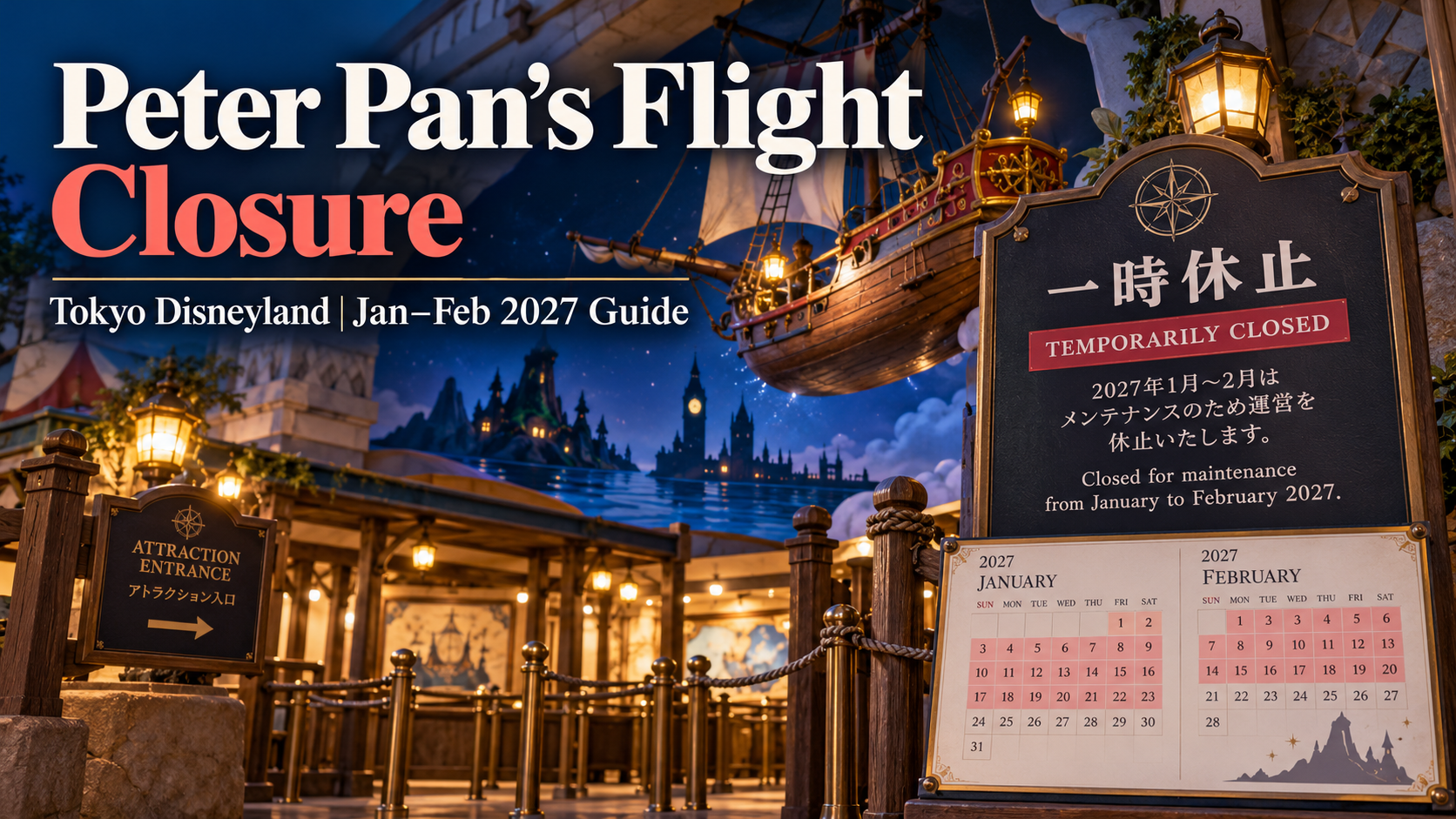
Guests planning a visit to Tokyo Disneyland in early 2027 should put one easily missed detail on their itinerary: Peter Pan’s Flight is scheduled to be temporarily closed from January 6 through February 2, 2027. The operator lists the dates both on its official attraction page and in the Tokyo Disneyland closure schedule. This is a scheduled interruption, not an announcement that the classic ride is being removed permanently. Travelers visiting on dates inside that window should assume the attraction will not be available unless Tokyo Disney Resort publishes a change.
The distinction matters because online references to “Peter Pan closing at Tokyo Disney” can confuse two different parks and two different experiences. Tokyo Disneyland’s Peter Pan’s Flight is a compact Fantasyland ride. Tokyo DisneySea has a separate, newer attraction called Peter Pan’s Never Land Adventure, with its own planned March 2027 maintenance period. The first planning step is making sure the information applies to the ticket you actually bought.
At a glance: what the operator currently says
| Planning question | Verified answer |
|---|---|
| Which attraction? | Peter Pan’s Flight |
| Which park? | Tokyo Disneyland, Fantasyland |
| Scheduled closure starts | January 6, 2027 |
| Scheduled closure ends | February 2, 2027 |
| Reopening expectation | After the listed closure window, subject to operator changes |
| Type of notice | Temporary closure; not announced as permanent |
| Where to recheck | Official attraction listing |
The dates are explicitly labeled as a temporary closure by Tokyo Disney Resort. Do not treat February 3 as an unconditional reopening guarantee: an operator may update maintenance information or temporarily suspend operations for other reasons. Check again shortly before travel and on the day you enter the park.
What is Peter Pan’s Flight?
Peter Pan’s Flight is a dark ride based on the familiar journey from London to Never Land. Guests sit in a flying pirate-ship vehicle that travels through a storybook environment. According to the operator’s ride information, it is in Fantasyland, lasts about two and a half minutes and carries two people per vehicle. It operates indoors and includes dark spaces. These details make it particularly appealing to families who want a gentle, classic Disney experience rather than a high-speed thrill ride.
There are restrictions worth noting even on operating days. The published guidance says a guest must be able to maintain a stable seated position independently and that children may not be held on an adult’s lap during the ride. If your group includes young children, anyone needing seating assistance or visitors uncomfortable with darkness, read the official description and accessibility guidance rather than assuming that the attraction suits everyone because it is short.
Short ride duration is not the same as short waiting time. Demand for well-known classics can vary with crowds, operating conditions and holiday schedules, so it is unwise to schedule a tight sequence of unrelated bookings around a predicted queue. The operator’s app and in-park staff can provide current operating information when the ride is available.
The dates around the closure are not interchangeable
A guest visiting January 5 has a fundamentally different planning position from someone arriving January 6. January 5 falls before the currently listed closure, while January 6 is its opening day. A February 2 visit falls on the final listed day of the maintenance window; February 3 is the earliest day after that window, not a contractual promise that the ride will run.
For a family staying at the resort for multiple days, the difference might be worth changing which day is assigned to Tokyo Disneyland. If one day is before January 6 and another is inside the closure, put Disneyland first if the classic Peter Pan ride is a must-do. But do not swap a park ticket or hotel reservation until you understand the applicable change and cancellation conditions. The economic cost of reshuffling an entire trip can exceed the benefit of experiencing one short ride.
A visitor traveling from overseas may be choosing between a single Disneyland day and a DisneySea day. In that case, consider the trip’s overall priorities. Someone who values vintage Fantasyland attractions may still prefer Disneyland even during the closure. Someone traveling expressly for an immersive Peter Pan adventure could be more interested in the DisneySea attraction—but must buy admission to that different park and verify its own operating schedule.
Other Tokyo Disneyland closures during the same period
The official park maintenance listing shows other attractions with early-2027 closure windows that may overlap your visit. At the time of this review, it lists Jungle Cruise: Wildlife Expeditions from January 6 through March 31, Splash Mountain from January 7 through February 4, and Haunted Mansion from January 8 through February 4. These are operator-published schedules, not independent predictions about refurbishment completion.
This makes the Peter Pan closure more significant for certain visitors than a single unavailable ride might suggest. A group that expected several classic experiences in one afternoon could find multiple priorities temporarily inaccessible. Conversely, the park contains many other attractions and entertainment offerings, and the attractions that remain open should be evaluated on their own current descriptions rather than guessed from historical schedules.
It is worth making a small “must ride / would enjoy / optional” list. Mark each attraction against the closure page. Then build flexibility around weather, performance calendars and queue variation. A plan with alternatives is more resilient than a rigid minute-by-minute schedule.
Better alternatives for different kinds of visitors
If the attraction’s appeal is gentle fantasy storytelling, explore other Fantasyland offerings listed in the official Tokyo Disneyland attraction directory. Filter for ride type and height or access restrictions, and read the current operating details. Do not assume that a neighboring attraction will be open merely because it is not listed in an older travel blog.
If the main attraction is Disney character immersion, devote time to character experiences, themed areas, shopping or scheduled entertainment that is actually available on your day. These can preserve the spirit of the trip without pretending they are substitutes for the ride itself. Some guests will prefer to spend the recovered time on a longer headliner; others may value an unhurried lunch and a park exploration that is less vulnerable to queues.
If the trip is built around Peter Pan specifically, Tokyo DisneySea’s Never Land Adventure may appear attractive. But it is not the same ride: it is a 3D boat-based experience in Fantasy Springs, with different restrictions and a different length. Tokyo Disney Resort’s DisneySea attraction page is the reliable way to compare them. Admission, access arrangements and the day’s capacity remain separate questions.
Parents should also avoid overstating the value of a replacement to children. “Another attraction has pirates” does not make it the planned Peter Pan experience. Setting expectations before entering the park is often more effective than negotiating disappointment in a crowded queue area.
Are refunds or ticket changes automatic?
The announcement of an attraction’s temporary closure does not itself demonstrate that every guest is entitled to a ticket refund or a date change. Theme-park tickets ordinarily grant admission subject to operating conditions, not a binding guarantee that every individual ride will operate. Actual ticket terms, package conditions and any operator-specific accommodation policy govern what can be changed.
Before buying or modifying a pass, review the official Tokyo Disney Resort ticket and reservations guidance and any reseller’s terms. A third-party package might combine transport, hotel rooms and tickets under separate cancellation rules. You should not rely on the statement “ride closed” as a universal reason for a penalty-free cancellation.
If your booking is complex, write down the name of the supplier, reservation reference, exact park date and type of admission. Seek a written answer before paying a change fee. This is particularly important if you plan to move only one day of a multi-day trip and keep the remainder unchanged.
Does Disney Premier Access help during the closure?
No paid queue-management product can make an attraction operate while it is closed. Disney Premier Access is a separate, paid tool for eligible operating experiences; eligibility and availability can change. The official Premier Access guide explains that places may sell out and that the price does not include park admission. It should not be marketed to families as a guaranteed workaround for a published maintenance closure.
The app can nevertheless be useful for other attractions and live operating information. If a ride is unavailable, remove it from the day’s queue-management plan and redirect attention to attractions genuinely offered that day. Check the current product terms before purchasing any additional access.
How to build a more reliable 2027 itinerary
Start with the official attraction closure list rather than the social-media version of it. Choose a date, read the list for the correct park, then check the pages for the two or three attractions most important to your group. If several favorites overlap with closures, compare another travel day, but preserve buffer time and cost limits.
Once you have a provisional itinerary, check whether your whole group can experience the alternatives. A family with a toddler and grandparents may have different needs from a group of teenagers. Ride seating rules, dark environments, height restrictions and walking distances deserve attention before buying optional upgrades.
A week before departure, look at the operator’s park calendar and attraction pages again. On the morning of your visit, follow current app information and staff instructions. Write down a backup plan that does not depend on a single ride reopening on the first conceivable day.
Quick visitor questions
Is Peter Pan’s Flight shutting permanently? The published notice says temporary closure January 6–February 2, 2027. It does not announce permanent removal.
Is it in Tokyo Disneyland or DisneySea? Peter Pan’s Flight is in Tokyo Disneyland’s Fantasyland. DisneySea has the separate Never Land Adventure.
Can I ride on February 2? The current listing includes February 2 in the closure window. Do not plan on riding that day.
Is February 3 the official reopening day? It is the first day after the presently announced closure period, assuming the dates are unchanged. Confirm the park’s live information rather than treating operation as guaranteed.
Should I change my trip? That depends on how important this specific ride is compared with hotel, flights, admission and other attractions. For most travelers, adjusting priorities within the same park is the lower-risk first option.
Final planning advice
This news is not a farewell to Peter Pan’s Flight. It is a defined, temporary gap in the operating calendar. The useful response is to check your exact visit date, compare the rides your family actually cares about and keep a realistic alternative ready. Tokyo Disneyland can still be an appealing destination during the listed closure; the difference between an enjoyable trip and a frustrating one may simply be accurate expectations.
Discover more from The Economy
Subscribe to get the latest posts sent to your email.

Key Takeaways
- Rolex’s secondary market rose approximately 7.9% year-over-year as of 2026 (per WatchCharts data) — trailing Patek Philippe (+16.2%) and Tudor (+11.4%) but still outperforming Audemars Piguet (+3.4%).
- Rolex raised U.S. retail prices 4–9% in January 2026 (steel models ~5.6%, gold models ~8.7%), narrowing the historical gap between retail and pre-owned pricing.
- Not every model appreciates: steel sports references (Submariner, GMT-Master II, Daytona) have held value far better than two-tone or widely available dress references like the standard Datejust.
- The Lady-Datejust posted the sharpest 2026 gain among tracked collections — up 22.73%, from roughly $9,269 to $11,376 — driven by demand for smaller, “everyday luxury” watches.
- Gold’s rise past $2,400/oz has directly lifted the investment case for Rolex’s precious-metal references (Day-Date, Sky-Dweller, Yacht-Master).
The Model-by-Model Picture
| Category | 2026 Trend |
|---|---|
| Lady-Datejust | +22.73% (strongest performer among tracked collections) |
| Steel sports models (Submariner, GMT-Master II) | Held value well; corrected from 2022 peak but stabilized above retail |
| Daytona | Corrected from highs above $50,000 to the mid-$30,000s; still among the most sought-after references |
| Two-tone/widely available Datejust | Flat to negative — “holds value” is an overstatement for this category |
| Gold references (Day-Date, Sky-Dweller) | Lifted by gold’s rise above $2,400/oz |
Why the “Rolex Always Appreciates” Myth Is Fading
The pandemic-era boom pushed some references — the Daytona above all — to speculative highs disconnected from historical norms. Since the March 2022 peak, steel sports models have compressed meaningfully, and dealers who bought inventory near the top have in some cases faced 20–40% markdowns on liquidation. The lesson for 2026 buyers: Rolex as a category is not a monolith. Value retention depends heavily on specific reference, condition, and whether the piece comes with box and papers (“full set”).
What’s Actually Driving 2026 Strength
- Retail price increases raise the floor. When a new Submariner retails at $10,050 (up from $9,500), a pre-owned example at $11,000–$12,000 suddenly represents a smaller premium — narrowing the gap without secondary prices actually moving.
- Supply discipline remains Rolex’s core lever. The brand has never confirmed production numbers, and secondary-market premiums remain entirely a function of Rolex’s own manufacturing decisions — a risk factor as much as a support.
- Certified Pre-Owned rollout. Rolex’s now fully rolled-out CPO program has changed how buyers transact in the used market, adding a layer of brand-verified legitimacy that supports pricing.
The Case for Rolex as a Portfolio Diversifier
Financial advisors increasingly frame luxury watches not as a replacement for equities or bonds, but as a tangible, historically low-correlation diversifier — one that carries its own risks (illiquidity, condition-dependent pricing, no yield) but has demonstrated multi-decade resilience for specific references.
Is Rolex a good investment in 2026?
It depends heavily on the specific reference. Steel sports models like the Submariner and Daytona have held or grown in value; two-tone and widely available dress models generally have not. Overall, Rolex’s secondary market rose about 7.9% year-over-year in 2026, trailing Patek Philippe but ahead of Audemars Piguet.
Discover more from The Economy
Subscribe to get the latest posts sent to your email.

Brian Kemp’s Georgia Legacy: Economic Growth, Elections and the Costs of His Policy Choices

Dow Futures vs Dow Jones: What E-mini Contracts Really Tell You Before Wall Street Opens

China Tape Maker Stock Debut: Crown New Materials Soared 787%

Apple’s Earnings Beat Had a Catch: Look Past the Tariff Refund

Social Security Payments in November 2026: The Full Calendar and Two Important Changes

Johor–Singapore SEZ’s $21.8 Billion Bet: The Hard Part Starts Now

China’s 175 Trillion AI Tokens Reveal a Bigger Shift: The AI Boom

The Philippines’ Stagflation Trap: Higher Interest Rates

Alphabet’s $500 Billion Reckoning: Wall Street Is Losing Patience With the AI Boom

4 Reasons Why China’s Trade Concessions to Europe Will Not Solve the Crisis

The AI Revolution Needs Atomic Power. Southeast Asia Is Ready to Build It.

Zhuhai Airshow 2026: How China’s Stealth Jets, Drones and Missiles Are Redrawing Global Air Power

The $8 Billion Runway: China’s Strategic Bet on Guangzhou and the Future of Aviation

The Sandbox Imperium: Why Beijing’s Digital Yuan Needs Hong Kong

Crude Oil & Petroleum Market Analysis: OPEC+ Decisions and Price Forecasts

Top US Convenience Store Chains: Store Counts, EV Charging, and Sales Trends

Social Security Extra $90 Deposit: Who Qualifies for the October 2026 Medicare Rebate?

Gold Price Outlook 2026: The Forces Behind the Forecasts—and What Could Reverse Them

Algorithmic Dogfights: Why the U.S. and China Must Establish Rules of Engagement for Autonomous Air Power

Global Economic Outlook 2026: 7 Forces Reshaping Markets, Trade and Business

Corporate America Faces a New Debt Test as US Borrowing Costs Surge

Stock Market Crash in 2026? Warning Signs, Scenarios and a Calm Investor Checklist

US–Iran Conflict in October 2026: Hormuz, Oil Prices and Diplomacy

Stock Market Today: Dow, S&P 500, and Nasdaq Retreat as Treasury Yields

Geopolitics and Your Portfolio: How International Affairs Move Global Markets

Anthropic Bans Sustained Abuse of Claude AI Under New Usage Policy Effective November 12, 2026

Why Did I Get $90 From Social Security? 8 Reasons Behind an Unexpected SSA Payment

US–China Critical Minerals Competition: Why a Trade Deal Cannot Fix Every Supply Risk
-

 Markets & Finance10 months ago
Top 15 Stocks for Investment in 2026 in PSX: Your Complete Guide to Pakistan’s Best Investment Opportunities
-

 Analysis9 months ago
Johor’s Investment Boom: The Hidden Costs Behind Malaysia’s Most Ambitious Economic Surge
-

 Analysis9 months ago
Top 10 Stocks for Investment in PSX for Quick Returns in 2026
-

 Banks10 months ago
Best Investments in Pakistan 2026: Top 10 Low-Price Shares and Long-Term Picks for the PSX
-

 Analysis9 months ago
Brazil’s Rare Earth Race: US, EU, and China Compete for Critical Minerals as Tensions Rise
-

 Investment10 months ago
Top 10 Mutual Fund Managers in Pakistan for Investment in 2026: A Comprehensive Guide for Optimal Returns
-

 Global Economy10 months ago
15 Most Lucrative Sectors for Investment in Pakistan: A 2025 Data-Driven Analysis
-

 Global Economy10 months ago
Pakistan’s Export Goldmine: 10 Game-Changing Markets Where Pakistani Businesses Are Winning Big in 2025